SEMI Issues Statement Supporting Microelectronics Industry Incentive Provisions in U.S. National Defense Authorization Act
MILPITAS, Calif. – December 4, 2020 – SEMI, the industry association serving the global electronics design and manufacturing supply chain, today released the following statement from president and CEO Ajit Manocha on the Fiscal Year 2021 National Defense Authorization Act.
“SEMI supports the provisions included in the conference report on the Fiscal Year 2021 National Defense Authorization Act for programs to provide incentives for microelectronics manufacturing and research in the U.S. They are helpful steps to support microelectronics innovation and manufacturing. SEMI thanks Sens. Cornyn, Warner, Cotton and Schumer, Reps. Matsui and McCaul, and other congressional and administration leaders for their support and hard work to enact these provisions. We look forward to working with Congress and the administration to provide the funding needed to implement these programs and to enact the CHIPS Act investment tax credit which will provide the certainty needed to attract many more new, large-scale microelectronics manufacturing investments in the U.S.”
About SEMI
SEMI® connects more than 2,400 member companies and 1.3 million professionals worldwide to advance the technology and business of electronics design and manufacturing. SEMI members are responsible for the innovations in materials, design, equipment, software, devices, and services that enable smarter, faster, more powerful, and more affordable electronic products. Electronic System Design Alliance (ESD Alliance), FlexTech, the Fab Owners Alliance (FOA) and the MEMS & Sensors Industry Group (MSIG) are SEMI Strategic Association Partners, defined communities within SEMI focused on specific technologies. Visit www.semi.org to learn more, contact one of our worldwide offices, and connect with SEMI on LinkedIn and Twitter.
Association Contact
Samer Bahou/SEMI
Phone: 1.408.943.7870
Email: [email protected]
SEMI and the Semiconductor Equipment Association of Japan (SEAJ) gather the data from more 80 global equipment companies that provide monthly reports. Following are quarterly billings data in billions of U.S. dollars quarter-over-quarter and year-over-year change by region:
The SEMI Equipment Market Data Subscription (EMDS) provides comprehensive market data for the global semiconductor equipment market. A subscription includes three reports:
Monthly SEMI Billings Report, a perspective on equipment market trends
Monthly Worldwide Semiconductor Equipment Market Statistics (WWSEMS), a detailed report of semiconductor equipment billings for seven regions and 24 market segments
SEMI Semiconductor Equipment Forecast, an outlook for the semiconductor equipment market.
For more information or to subscribe, please contact the SEMI Industry Research and Statistics Group at [email protected]. More information is also available online.
About SEMI
SEMI® connects more than 2,400 member companies and 1.3 million professionals worldwide to advance the technology and business of electronics design and manufacturing. SEMI members are responsible for the innovations in materials, design, equipment, software, devices, and services that enable smarter, faster, more powerful, and more affordable electronic products. Electronic System Design Alliance (ESD Alliance), FlexTech, the Fab Owners Alliance (FOA) and the MEMS & Sensors Industry Group (MSIG) are SEMI Strategic Technology Communities, defined communities within SEMI focused on specific technologies. Visit www.semi.org to learn more, contact one of our worldwide offices, and connect with SEMI on LinkedIn and Twitter.
Association Contact
Michael Hall/SEMI
Phone: 1.408.943.7988
Email: [email protected]
Align your company with the ASMC, one of the most highly respected semiconductor manufacturing conferences in the industry. The attendees are an excellent audience to expand your brand image to new and existing markets.
CONTACT
Shane Poblete Director, Sales & Business Development - Expo and Events, SEMI Tel: +1 202-847-5983 Email: [email protected]
Media Sponsors
SEMI is proud to partner with the following media to bring you news about this event. Click below to visit their website to learn more about each of them.
Save the dates for ASMC 2027—June 14–17!
Advancing Semiconductor Manufacturing Excellence
ASMC is the leading international technical conference for discussing solutions that improve the collective manufacturing expertise of the semiconductor industry. Solving the challenges presented by semiconductor manufacturing is a combined effort by device makers, equipment and materials suppliers, and academics. ASMC provides an unparalleled platform for semiconductor professionals to network and learn the latest in the practical application of advanced manufacturing strategies and methodologies. Technical presentations at ASMC highlight industry innovations with specific results and select ASMC manuscripts are published in the ASMC Special Section of IEEE Transactions on Semiconductor Manufacturing.
The ASMC Committee is composed of industry professionals representing the microelectronics supply chain. All papers presented at the conference are peer-reviewed by the ASMC Technical Committee.
ASMC brings together manufacturers, equipment and materials suppliers, and academia to solve manufacturing challenges with innovative strategies and methodologies.
SMC3 - Register 3: 15% off (must register all 3 on same order)
SMC5 - Register 5: 20% off (must register all 5 on same order)
SMC10 - Register 10: 25% off (must register all 10 on same order)
NOTE: For Group Discounts, Attendees must be registered within the same order.
For more information, please contact Karen Popp, Senior Program Manager, at [email protected].
Registration is final. Cancellations will not be accepted. No refunds provided. Substitutions are only accepted with written permission from the original registrant.
HAYES MANSION 200 Edenvale Avenue San Jose, CA, CA 95136
HEALTH & SAFETY
Your health and safety are our top priority. The personal preference of the attendees to wear masks is respected at all SEMI events. SEMI Americas (“SEMI") monitors developing federal, state, and local health and safety recommendations as well as requirements regarding COVID to determine the most appropriate safety protocols for our in-person events.
Sponsorship opportunities can be tailored to meet your specific branding and marketing objectives. Become a sponsor and brand your company to an influential audience at SMC.
CONTACT
Shane Poblete Director, Sales & Business Development - Expo and Events, SEMI Tel: +1 202-847-5983 Email: [email protected]
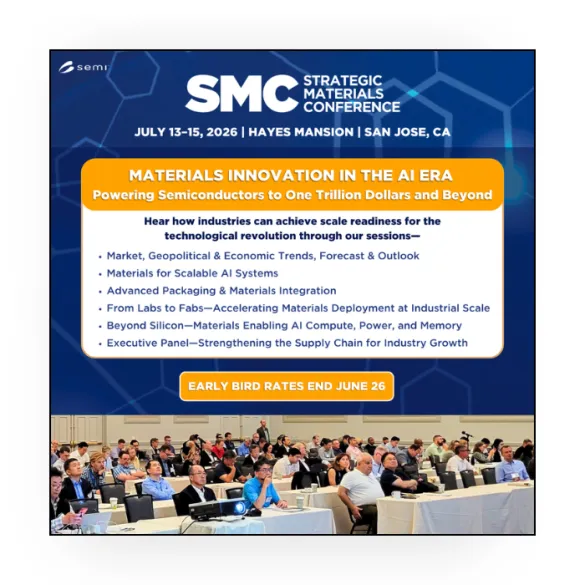
Materials Innovation in the AI Era: Powering Semiconductors to One Trillion Dollars and Beyond
Beyond the AI boom lies a challenge—and opportunity—that is far more foundational: ensuring the materials ecosystem underpinning a $2.5 trillion industry is resilient enough to support the next era of innovation. As artificial intelligence accelerates demand for advanced hardware, energy infrastructure, and high‑performance components, the pressure on global materials supply chains has never been greater.
This year, SMC explores how industries can achieve scale readiness through smarter design, diversified sourcing, sustainable processes, and breakthrough materials science. It invites leaders to look past the excitement of AI itself and toward the essential building blocks that will determine whether this technological revolution is secure and sustainable.
Sessions
Market, Geopolitics & Outlook
Materials for Scalable AI Systems
Advanced Packaging & Materials Integration
From Labs to Fabs—Accelerating Materials Deployment at Industrial Scale
Quantum & Emerging Devices
Executive Panel–Strengthening the Supply Chain
REGISTRATION INCLUDES
Approved speaker PDF presentations
Breakfast, lunch, coffee breaks
Two networking receptions
Tabletop exhibits
WHO SHOULD ATTEND
SMC offers valuable content and unprecedented networking opportunities for semiconductor industry professionals who share common strategic objectives on materials innovation, management, and business success.
CEO ● CTO ● Presidents & General Managers ● Executive VP & Senior Executives ● Engineering & Fab Managers ● Academia ● Startup Founders ● Financial Analysts ● Market Researchers ● Consulting Firms ● Consortiums
Off
Add to Calendar2026-07-13 00:00:002026-07-15 00:00:00SMC 2026—Strategic Materials Conference Hayes Mansion 200 Edenvale Avenue San Jose, CA, CA 95136 United StatesSEMI.org[email protected]America/Los_Angelespublic
America/Los_Angeles
1
Elastomer seals are critical components in semiconductor manufacturing equipment, where they are routinely exposed to demanding conditions including aggressive process chemistries, plasma environments, vacuum, elevated temperatures, and repeated mechanical cycling. Understanding how elastomer properties, seal design, application conditions, and installation practices interact is essential for achieving reliable sealing performance.
This webinar will explore common seal failure modes and the mechanisms that can contribute to premature failure, including chemical and plasma degradation, compression set, thermal effects, mechanical damage, and installation-related issues. Examples will be used to demonstrate how visual observations, application information, and engineering analysis can help identify potential root causes and guide corrective actions.
The course concludes by presenting information on current or emerging technologies and the attendant challenges, that include hybrid bonding, co-packaged optics, and advanced substrate materials. The course also touches upon challenges with thermal dissipation for high-power AI products, and the bottlenecks now shaping next-generation semiconductor package roadmaps.
Learning Objectives
An understanding of the fundamental properties of elastomers and how those properties influence seal performance.
Types of elastomers used in semiconductor manufacturing and factors that affect the material selection process.
How operating conditions such as temperature, plasma, process chemistry, vacuum, and mechanical loading can affect seal life.
Common seal failure modes and how to identify them.
The importance of proper seal design, gland design, and installation practices.
Understand how failure analysis can be used to troubleshoot sealing problems and identify opportunities for improvement.
How ASNA can support customers through application evaluation, material and design recommendation, failure analysis, customer engineering, and on-site installation support.
Who Should Attend
This course is ideal for engineers and technical professionals, including equipment, process, mechanical, applications, reliability, maintenance, and field service engineers.
Instructors
ANSA
Important Information
Note that only the person who registered will receive a certificate of completion. This virtual training will not be recorded. Attendees must be present to access course knowledge.
Can't find the training link day of? After you register, you will receive the link to the live training via the email address you provided. In addition, you will receive email reminders about 24 hours in advance and an hour before with the same link. Please keep these emails on hand to access the training on time. If you do not see any confirmation emails, please check your junk/spam folders before contacting SEMI U for support.
This two-hour webinar provides a practical introduction to elastomer sealing technology, beginning with the fundamentals of seal elastomers and the properties that influence their performance.
Pricing
Members: Free
Non-Members: Free
Why Elastomer Seals Fail in Semiconductor Equipment
Virtual Training - Americas & EU
8:00 am - 10:00 pm
Off
Add to Calendar2027-03-01 08:00:002027-03-01 22:00:00Why Elastomer Seals Fail in Semiconductor Equipment (America/EU) 3/1/27This two-hour webinar provides a practical introduction to elastomer sealing technology, beginning with the fundamentals of seal elastomers and the properties that influence their performance. PricingMembers: FreeNon-Members: Free United StatesSEMI.org[email protected]America/Los_Angelespublic
America/Los_Angeles
Given the immense cost of AI products & platforms, an important and differentiating factor for a successful packaging technology supplier is offering stellar quality and reliability to preserve the value of the expensive silicon chiplets. This course introduces various aspects of demonstrating Quality and Reliability in semiconductor packaging. One way to guarantee stellar quality and reliability of products with new technologies is to overdesign them, but that can be very expensive. Alternatively, under-designing packages from a reliability perspective may be cheaper; however, it will likely trigger premature failures in the field, leading to higher ownership costs and frustration for customers. Optimizing this balance to deliver new technology and meet customer expectations requires drawing from experience (history), judicious use of simulations, augmenting with empirical data and, more importantly, engineering rigor to make the right technology decisions.
This course will prepare the audience to tackle technical problems (related to failure mechanisms and product qualification) by providing a blueprint that aids in proving that the technology capabilities can meet the market demands. The participants will experience the concepts through hands-on exercises throughout the course.
Learning Objectives
A brief overview of semiconductor packaging.
Understand the fundamentals of quality and reliability principles.
Understand the concept of the bathtub curve and its use for Q&R optimization.
Introduce the philosophy, and practical elements, of product qualification.
Understand use conditions based on different markets like Automotive, Data Centers, Mobile, Space, etc.
Understand different quality tests and reliability stress tests done for product qualification.
Get insight into typical failure mechanisms and failure analysis techniques.
Demonstrate how to perform life distribution analysis to characterize statistical behavior of failures.
Introduction to acceleration models for predicting useful life of the package.
Hands-on exercises
Who Should Attend
This course is ideal for anyone seeking a better understanding of how quality and reliability evaluation s performed for semiconductor packaging.
Note that only the person who registered will receive a certificate of completion. This virtual training will not be recorded. Attendees must be present to access course knowledge.
Can't find the training link on the day of? After you register, you will receive the link to the live training via the email address you provided. In addition, you will receive email reminders about 24 hours in an advance and an hour before with the same link. Please keep these emails on hand to access the training on time. If you do not see any confirmation emails, please check your junk/spam folders before contacting SEMI U for support.
This four-hour course presents a methodology to deliver an optimum approach, and quantify, figures of merit that define quality and reliability for complex, heterogeneous integrated products.
Pricing
Members: $149
Non-Members: $199
* For group orders with 10+ attendees, and for Students/Veterans discounted pricing, please contact [email protected]
Packaging Quality and Reliability in the Era of Chiplets
Virtual Training - Americas & EU
8:00 am - 12:00 pm
Off
Add to Calendar2027-03-11 08:00:002027-03-11 12:00:00Packaging Quality and Reliability in the Era of Chiplets 3/9/27(Americas/EU) This four-hour course presents a methodology to deliver an optimum approach, and quantify, figures of merit that define quality and reliability for complex, heterogeneous integrated products. PricingMembers: $149Non-Members: $199* For group orders with 10+ attendees, and for Students/Veterans discounted pricing, please contact [email protected]United StatesSEMI.org[email protected]America/Los_Angelespublic
America/Los_Angeles
Rapid advances in electronics, sensors, computation, wireless systems, artificial intelligence, and neurotechnology are creating a new generation of medical solutions that interact directly with the body’s electrical and physiological control systems. Collectively described as bioelectronic medicine, these technologies offer the potential to complement—and in some applications overcome important limitations of—traditional pharmaceutical approaches by providing interventions that can be spatially targeted, dynamically adjusted, continuously monitored, and personalized to an individual patient’s physiology.
This Master Class will provide a broad introduction to the rapidly evolving field of bioelectronic medicine from the perspective of electrical and computer engineering. It will examine how technologies familiar to engineers—including low-noise sensing, embedded computing, signal processing, machine learning, wireless communications, miniaturized stimulation electronics, wearable devices, and closed-loop control—are being translated into new diagnostic and therapeutic platforms. Examples will range from cardiac pacemakers and cochlear implants to deep-brain stimulation, vagus nerve stimulation, spinal cord stimulation, transcranial stimulation, peripheral nerve interfaces, and digital biomarkers. Particular attention will be given to the transition from open-loop stimulation toward sensor-guided, closed-loop bioelectronic medicine, in which physiological measurements provide real-time feedback for optimizing stimulation parameters and tracking therapeutic responses. The Master Class will also explore why engineers are increasingly central to the future of medicine. Biological systems present unusual engineering challenges: signals are weak and noisy, anatomy and physiology vary substantially between individuals, neural systems are nonlinear and adaptive, and successful devices must operate safely at the interface between electronics and living tissue. These challenges are generating opportunities for innovation across semiconductor technology, MEMS and wearable sensors, electrode design, power management, computational modeling, AI, cybersecurity, human-machine interfaces, and systems engineering.
The Master Class will conclude with a look toward the next generation of bioelectronic medicine: intelligent therapeutic systems and digital twins capable not simply of measuring disease or delivering predetermined stimulation, but of continuously sensing physiological state, interpreting changes in biological function, and adapting interventions to promote recovery and maintain health. For electrical and computer engineers, this emerging field represents an opportunity to apply core engineering disciplines to some of the most consequential challenges in human health.
ABOUT THE SPEAKER
John Ralston, PhD, CEO and Co-founder, Neursantys Inc. John Ralston is a pioneer in the development of non-invasive bioelectronic devices and adaptive neuroplastic treatments for neurosensory, neuromotor, and neurocognitive impairments that have limited pharmacological treatment options.
At Neursantys, John is collaborating with healthcare researchers, providers, and payers to restore motor and cognitive functions that have been impaired by both normal aging and accelerated aging caused by head trauma, disease, and spaceflight.
With a career spanning public and private R&D organizations and entrepreneurial ventures in Canada, Europe, and the U.S., John has authored/co-authored over 250 professional publications, presented over 150 talks and seminars, and has 16 issued patents. John earned B.Sc. degrees in Physics and Electrical Engineering from M.I.T., a PhD in Electrical Engineering from Cornell University, and the MSc in Management of Technology from the MIT Sloan School of Management.
Join Dr. John Ralston, Founder and CEO of Neursantys, a pioneering bioelectronics company developing non-invasive neurostimulation and wearable technologies for diagnosing and treating neuromotor conditions, for an engaging Master Class on the rapidly advancing field of bioelectronic medicine.
Learn how innovations in sensors, AI, embedded systems, neural interfaces, and closed-loop therapies are enabling personalized, real-time treatments that interact directly with the body’s physiological systems and are shaping the future of healthcare.
Recent Advances in Bioelectronics Medicine
Flexible Electronics Master Class #32
10:00 am - 12:00 pm
Off
Add to Calendar2026-11-18 10:00:002026-11-18 12:00:00FEMC#32 Recent Advances in Bioelectronics MedicineJoin Dr. John Ralston, Founder and CEO of Neursantys, a pioneering bioelectronics company developing non-invasive neurostimulation and wearable technologies for diagnosing and treating neuromotor conditions, for an engaging Master Class on the rapidly advancing field of bioelectronic medicine. Learn how innovations in sensors, AI, embedded systems, neural interfaces, and closed-loop therapies are enabling personalized, real-time treatments that interact directly with the body’s physiological systems and are shaping the future of healthcare.United StatesSEMI.org[email protected]America/Los_Angelespublic
America/Los_Angeles
Register Here
This three-day virtual workshop (4 hours a day) provides a complete overview of the semiconductor manufacturing process. The class focuses on key process steps needed to form a functioning device. Some important science and engineering ideas needed to understand device manufacturing will be discussed. The workshop is designed for non-technical personnel needing an understanding of the fab process steps. Some technical background from attendees will improve the workshop learning.
The first day will overview the fab process steps with a brief summary of how a transistor functions. We will discuss how multiple transistors are connected to form a logic or memory device. We will also cover how a transistor works with respect to the physical layout of Bipolar and MOSFET transistors.
The second day will cover key fab process steps. Ion implantation, photolithography including DUV and EUV processes, plasma processes including deposition and etch, rapid thermal processing, and wet etch processing. Specific emphasis will be given to the different wet etch processes.
The third day of the workshop will focus on the new transistor designs, including FinFET and CFET designs. We will also cover reasons for changing the transistor design and newer materials, including tantalum, hafnium, silicon germanium, and low-k dielectrics. We will also review roadmaps of leading companies, including TSMC, Intel, and Samsung.
After completing the workshop, the student will be able to describe all the fabrication and assembly process steps and have an understanding of how the process steps work together to form the completed integrated circuit, in addition to an understanding of future structures.
Who Should Attend
This course is intended for both manufacturing and R&D know-how in IC packaging professionals, including but not limited to:
Process Technicians
Material Engineers
Process Engineers
Equipment Manufactures
Technical Marketing Engineers
Topics Included
Silicon wafer manufacturing
Basic operating principles of transistors and semiconductor devices
Planar, FinFET, and GAA transistor formation and design differences
Fab processes needed to form a semiconductor, including the following:
Note that only the person who registered will receive a certificate of completion. This virtual training will not be recorded. Attendees must be present to access the course knowledge.
Can't find the training link on the day of? After you register, you will receive the link to the live training via the email address you provided. In addition, you will receive email reminders about 24 hours in advance and an hour before with the same link. Please keep these emails on hand to access the training on time. If you do not see any confirmation emails, please check your junk/spam folders before contacting SEMI U for support.
Unlock the essentials of the semiconductor manufacturing process. We will cover science and engineering concepts needed to understand device manufacturing.
Pricing
Members: $549
Non-Members: $599
* For group orders with 10+ attendees, and for Students/Veterans discounted pricing, please contact [email protected].
Silicon to Systems: A Practical Introduction to Semiconductor Device Mfg.
Virtual Training - Americas/EU
8:00 am - 12:00 pm
Off
Add to Calendar Disabled
America/Los_Angeles
By the end of this course, participants will understand the scope of SubFAB and its critical role within the semiconductor manufacturing ecosystem, tracing its evolution and recognizing new trends. They will be able to identify and describe the core SubFAB systems and interpret typical facility layouts and equipment installation specifics. Learners will assess the environmental, and sustainability impacts of modern SubFABs. They will map a standard SubFAB organizational chart, typical roles, and responsibilities, and simulate incident-response workflows to reinforce operational readiness. Participants will be exposed to preventive maintenance and safety best practices to ensure reliability and compliance with regulations.
Who Should Attend
This course is designed for engineers and technicians in semiconductor manufacturing, equipment suppliers/OEM on-site service personnel, IE and MEP designers.
Course Outline
Introduction & Course Logistics
Welcome, introductions, and platform quick start
Learning objectives and course flow
Module 1: SubFAB Fundamentals
Definition & scope of SubFAB
Historical evolution (from early fabs to today)
Core equipment & support systems overview
Typical facility layouts and installation configurations
Note that only the person who registered will receive a certificate of completion. This virtual training will not be recorded. Attendees must be present to access the course knowledge.
Can't find the training link day of? After you register, you will receive the link to the live training via the email address you provided. In addition, you will receive email reminders about 24 hours in advance and an hour before with the same link. Please keep these emails on hand to access the training on time. If you do not see any confirmation emails, please check your junk/spam folders before contacting SEMI U for support.
SubFAB 101: Foundations of Semiconductor Support Facilities is a 4-hour course that covers SubFAB basics and its critical role within the semiconductor manufacturing ecosystem, including its evolution and new trends.
San Francisco: 8:00 AM - 12:00 PM
Jerusalem: 6:00 PM - 10:00 PM
England: 4:00 PM - 8:00 PM
Munich: 5:00 PM - 9:00 PM
Pricing
Members: $349
Non-Members: $399
* For group orders with 10+ attendees, and for Students/Veterans, discounted pricing, please contact [email protected].
SubFAB 101: Foundations of Semiconductor Support Facilities
Virtual Training - Americas & Europe
8:00 am - 12:00 pm
Off
Add to Calendar2027-03-17 08:00:002027-03-17 12:00:00 SubFAB 101: Foundations of Semiconductor Support Facilities (Americas/EU) 3/17SubFAB 101: Foundations of Semiconductor Support Facilities is a 4-hour course that covers SubFAB basics and its critical role within the semiconductor manufacturing ecosystem, including its evolution and new trends. San Francisco: 8:00 AM - 12:00 PMJerusalem: 6:00 PM - 10:00 PM England: 4:00 PM - 8:00 PM Munich: 5:00 PM - 9:00 PMPricingMembers: $349Non-Members: $399* For group orders with 10+ attendees, and for Students/Veterans, discounted pricing, please contact [email protected]. United StatesSEMI.org[email protected]America/Los_Angelespublic
America/Los_Angeles
In this course, we dive into the fundamental roles of packaging in enabling a complex product; namely, signal distribution, power delivery, thermal management, mechanical protection of the fragile silicon die(s), and the risks associated with the manufacturing flow. We trace the evolution of packaging technology from wire-bonded leadframe packages through flip-chip and ball grid arrays to today's advanced heterogeneous integration platforms, including 2.5D interposers, 3D die stacking, fan-out wafer level packaging, and chiplet-based architectures.
Given the complicated, and expensive, nature of these semiconductor packages, quality and reliability are a central theme for such complex products. We will discuss quality metrology used to maintain outgoing product quality and accelerated testing methods used to predict field performance using physics of failure methodology.
The course concludes by presenting information on current or emerging technologies and the attendant challenges, that include hybrid bonding, co-packaged optics, and advanced substrate materials. The course also touches upon challenges with thermal dissipation for high-power AI products, and the bottlenecks now shaping next-generation semiconductor package roadmaps.
Learning Objectives
Define core packaging functions (signal, power, thermal, and mechanical).
Trace the evolution from leadframes to 2.5D/3D and chiplet architectures.
Explain the "More than Moore" shift from transistor to package innovation.
Identify key failure mechanisms like electromigration and thermal fatigue.
Apply quality metrology and screening methods to ensure outgoing product standards.
Use accelerated testing and physics-of-failure models to predict long-term package reliability.
Evaluate emerging trends in hybrid bonding and co-package optics.
Hands-on exercises
Who Should Attend
This course is ideal for anyone seeking a better understanding of semiconductor packaging fundamentals, challenges, and latest technologies.
Note that only the person who registered will receive a certificate of completion. This virtual training will not be recorded. Attendees must be present to access course knowledge.
Can't find the training link day of? After you register, you will receive the link to the live training via the email address you provided. In addition, you will receive email reminders about 24 hours in an advance and an hour before with the same link. Please keep these emails on hand to access the trainings on time. If you do not see any confirmation emails, please check your junk/spam folders before contacting SEMI U for support.
This four-hour workshop provides a comprehensive technical foundation in semiconductor packaging, bridging the gaps between front-end wafer fabrication and final system integration.
Pricing
Members: $149
Non-Members: $199
* For group orders with 10+ attendees, and for Students/Veterans discounted pricing, please contact [email protected]
Semiconductor Packaging Fundamentals and Advances
Virtual Training - Americas & EU
8:00 am - 12:00 pm
Off
Add to Calendar2027-03-09 08:00:002027-03-09 12:00:00Semiconductor Packaging Fundamentals and Advances (Americas/EU) 3/9This four-hour workshop provides a comprehensive technical foundation in semiconductor packaging, bridging the gaps between front-end wafer fabrication and final system integration. PricingMembers: $149Non-Members: $199* For group orders with 10+ attendees, and for Students/Veterans discounted pricing, please contact [email protected]United StatesSEMI.org[email protected]America/Los_Angelespublic
America/Los_Angeles