Join us online May 18 from 2–3pm PDT for the 2021 ESD Alliance CEO Outlook! Free registration for members.
ESD Alliance CEO Outlook
May 18, 2021
2–3pm PDT
2:00 pm - 3:00 pm
Off
Add to Calendar2021-05-18 14:00:002021-05-18 15:00:00ESD Alliance CEO OutlookJoin us online May 18 from 2–3pm PDT for the 2021 ESD Alliance CEO Outlook! Free registration for members.United StatesSEMI.org[email protected]America/Los_Angelespublic
America/Los_Angeles
Fabrication in the cleanroom, and in the newer printed electronics tools, are often a function of time-varying parameters of the equipment, environment, and materials. The parameters often have co-dependencies across different process steps and tool sets. Physics based models and linear regression have been used traditionally, which are often not sufficient to learn the underlying variabilities.
This course will teach the material needed to connect cleanroom and printed electronics science and technology to that of advanced data processing capabilities enabled by Artificial Intelligence and Machine Learning. Cleanroom tools inherently can have millions of internal variables and can learn from the datasets, providing a powerful and complementary approach to traditional feedback control and process stabilization approaches.
Learning models are developed on images (CD-SEMS, optical images), time history data (Optical Emission Spectroscopy), and textual process information. A subset of the class will include: (1) Approaches to preprocess image data and create learning-based models, (2) model verification, (3) application to nanomechanical switch fabrication, and (4) cloud based implementation, data security, and data standardization.
Course Outline:
1.Introduction – The need for AI in microfabrication and printed electronics
a.Microfabrication: Tool variability, process variations
d.Deep Neural Nets (e.g. Image to Image translation using Pix2Pix)
5.Results and outlook
a.Improvement in linewidths
b.Cloud based implementations
About the Instructors
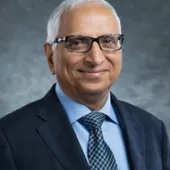
Amit Lal Amit Lal is the Robert M. Scharf 1977 Professor in the School of Electrical and Computer Engineering at Cornell University, Ithaca, NY. His work has resulted in new fabrication approaches and architectures in Micro/Nano-Electromechanical Systems, Physical Acoustics and Ultrasonics, Inertial Sensors, Biomedical MEMS, Analog Circuit Design, Solid-State Electronics, Radioactive Thin Films for Autonomous Microsystems, and Nanofabrication. The current focus of his research is on: (1) Gigahertz Ultrasonic for chip-scale communications, sensing, and computation, (2) Near zero power sensors for long-lifetime IoT, (3) Ultrasonic inertial sensors based on surface acoustic waves.
Peter C. Doerschuk Peter C. Doerschuk is a professor in the School of Electrical and Computer Engineering and the Meinig School of Biomedical Engineering at Cornell University in Ithaca NY. His interests in signal and image understanding have resulted in new algorithms for a variety of problems from microfabrication to single-particle cryo electron microscopy of biological particles.
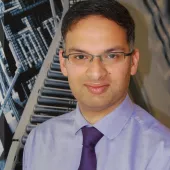
Benyamin Davaji Benyamin Davaji is a postdoctoral research associate in the School of Electrical and Computer Engineering at Cornell University. Ben works with Prof. Amit Lal at SonicMEMS Laboratory on developing solid-state acoustic wave inertial sensors, ultrasound neuromodulation microdevices, event-powered sensors, and methods to use machine learning and artificial intelligence to enhance micro and nanosystem design and manufacturing. He is the recipient of the 2019 Cornell achievement award for excellence in mentoring and the 2016 MEMS shark pub tank prize at the Hilton Head Conference. Before joining Cornell, Ben worked with Prof. Chung Hoon Lee on microthermal analysis and thermal microfluidic systems at Nanodevices Laboratory at Marquette University and received a Ph.D. in electrical engineering. During his Ph.D., he received the 2014 IEEE Larry Hause award and the 2014 College of Engineering outstanding TA award.
Flexible Hybrid Master Classes are offered on many topics! Visit this page for entire list and links to more detailed information on each one.
J. Devin MacKenzie is the Washington Research Foundation Professor of Clean Energy and an Associate Professor of Materials Science and Engineering and Mechanical Engineering at UW. Dr. MacKenzie is also the director of the Washington Clean Energy Testbeds, an open access laboratory with world-class printed electronics, flexible electronics and energy device fabrication and testing capabilities. Dr. MacKenzie has 20 years of experience co-founding or leading startups in novel fabrication including as a co-founder and CEO of Imprint Energy commercializing printed flexible batteries, as CTO of Add-Vision, a printed flexible OLED display company that was acquired in 2011, and as a VP at Kovio, an MIT spin out, leading printed Si RF device integration. Devin also co-founded the world’s first printed electronics company, Plastic Logic Ltd. in the United Kingdom. Previously Dr. MacKenzie was a researcher at AT&T Bell Laboratories. Prior to entering the start-up world, Devin was a postdoc in Physics at the University of Cambridge and earned PhD, MS, and BS degrees from the University of Florida and MIT. Dr. MacKenzie has over 220 patents and publications and has been cited over 10,000 times.
The Master Class covers the basics of battery terminology, chemistry and structures relevant to flexible electronics. The unique challenges related to the practical use and manufacturing of flexible batteries is discussed, as well as a summary of the current state of the art and emerging flexible battery technologies. The presentation is 90 minutes with 30 minutes of Q&A and discussion from the participants who attended the live recording on April 20, 2021.
Flexible Hybrid Master Classes are offered on many topics! Visit this page for entire list and links to more detailed information on each one.
Flexible Batteries
A Flexible Electronics Master Class On Demand
10:00 am - 12:00 pm
Off
Add to Calendar Disabled
America/Los_Angeles
The MEMS & Sensors Industry Group is offering a series of webinars where technical experts will share strategies and new approaches related to MEMS product development from prototype to production. The series will enable designers, product managers, test engineers, integrators, entrepreneurs, and investors to shorten development timelines and increase manufacturing yield while introducing robust MEMS products into the market.
This webinar series will be offered in three parts. Each webinar will be offered to a live audience and will be available to watch on-demand at your convenience.
United States
MODERATOR
Bob Smith (Webinar I)
Executive Director
ESDA Alliance
Mary Ann Maher (Webinar I)
Chief Executive Officer
SoftMEMS
Greg Lebsack (Webinar I)
General Manager
ICDS, Siemens
MODERATOR
Michelle Bourke (Webinar II)
Senior Director of Strategic Marketing
LAM Research
Dr. Alissa Fitzgerald (Webinar II)
Founder & Managing Member
A.M. Fitzgerald & Associates, LLC
Dr. Carolyn White (Webinar II)
Associate
A.M. Fitzgerald & Associates, LLC
MODERATOR
Mary Ann Maher (Webinar III)
Chief Executive Officer
SoftMEMS
Sixto Arjonilla (Webinar III)
Quality Director of Motion Sensors
NXP
Anupam Choubey (Webinar III)
Principal Technical Lead
Draper Lab
Srikanth Ganesan (Webinar III)
Senior Manager, MEMS/CMOS Reliability
TDK InvenSense
March 10th, 2021
8:00 am
-
9:00 am
Webinar I: Using Digital Twins to Address The Design Gap for Sensor-Based Products
Designing next-generation sensor-based systems like those found in wearables, IoT and medical devices poses many challenges. MEMS and sensor design is challenging due to the use of unique materials, fabrication processes and packaging. The age of COVID has necessitated designers working remotely and collaborating over time zones. These factors have led to a gap in design, modeling and simulation capability for creating the billions of interconnected sensors required by future applications.
This webinar discusses MEMS and sensor design challenges and how Digital Twins can be used for facilitating the design of sensor-based products. The talk will describe how Digital Twins may be applied in many phases of the design process from materials design optimization all the way to artificial intelligence algorithm training and virtual product testing. Examples will be given illustrating the use of Digital Twins to create a Digital Factory to increase sensor manufacturing yield and how Digital Twins are being used in sensor-based medical product design.
April 7th, 2021
8:00 am
-
9:00 am
Webinar II: How to Plan for Successful MEMS Product Development
Drawing on our experience in successfully executing more than 400 MEMS development projects at AMFitzgerald, we will present a practical overview on navigating the technical and business challenges of MEMS product development. We will describe helpful strategies and tactics discussed in our new book, MEMS Product Development: From Concept to Commercialization, that when practiced diligently, can shorten development timelines, help avoid common pitfalls, and improve the odds of success, especially when resources are limited. We illuminate what it really takes to develop a novel MEMS product so that innovators, designers, entrepreneurs, product managers, investors, and executives may properly prepare their companies to succeed.
May 5th, 2021
8:00 am
-
9:00 am
Webinar III: The Growing Importance of MEMS Reliability
MEMS-based devices are experiencing significant market expansion in consumer, industrial, medical and automotive applications. With the expansion in the marketplace, there is a growing focus on the importance and unique challenges of MEMS reliability. This talk will explore MEMS reliability from concept and application-based customer requirements, through design and development processes with a demonstration of meeting industry reliability standards, similar to other semiconductor products. We also will consider MEMS reliability throughout semiconductor and customer manufacturing processes. In some cases, it has been found that standard manufacturing handling can result in environments for MEMS devices that are more strenuous than the final application. Through a better understanding of the factors impacting MEMS reliability, proper alignment of development and industrialization processes can help all of us introduce robust MEMS products into the market.
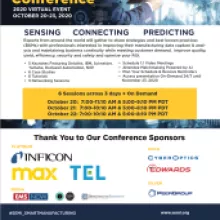
Virtual Global Smart Manufacturing Conference Event Guide
Globalized supply chains, combined with limited travel and access to experts, has led to rapid acceleration in implementations of smart manufacturing strategies. These systems are focused on improving things such as:
Quality and yield
Efficiency
Security and safety
Optimizing manufacturing cost
This inaugural Global SEMI Smart Manufacturing event brought together experts around the world to share strategies and best practices for professionals improving their manufacturing data capture& analysis and maintaining business continuity, while meeting increasing demands of customers.
The [LIVE] event is over, but the presentations and content remains fresh and applicable via the ON DEMAND platform. To access the information, just register for the event and click on the Agenda for access to the presentations.
Content available until November 23, 2020
Global Smart Manufacturing Conference
Sensing, Connecting & Predicting for Capturing the ROI of Smarter Manufacturing
12:00 am - 12:00 am
Off
Add to Calendar Disabled
America/Los_Angeles
The course explores how reliability testing plays a critical role for Flexible Hybrid Electronics throughout the development process. The presentation highlights how it is essential to create a reliability test plan that covers the requirements for EV, DV and finally though PV, in order to insure product reliability and performance.
The instructors discuss how the Molex design process is used to identify risks and challenges for custom FHE applications and how the various reliability test are used evaluate and eliminate the potential risk and challenges.
AGENDA
Overview of Molex Printed Circuits Solutions
FHE challenges & requirements
Overview of reliability testing development process
Reliability test standards
Reliability lab set up
Q&A
The various industry standards related to HMI, FHE, PE, Printed Sensors and other applications are also reviewed in conjunction with usage in reliability testing related to FHE.
Instructors Tom Seputis, Lab Manager, and Dave Rasmussen. Director, PCS Engineering, as they provide an overview of Molex Printed Circuit Solutions and the reliability testing and challenges related to Flexible Hybrid Electronics.
This Master Class is 4th in a series of 4 classes. Classes 1-3, and the series are also available On Demand at the following links:
Flexible Electronics Master Class #4 explores best practices for ensuring reliability of FHE devices throughout the production process. The course is taught by experts from Molex's Printed Circuit Solutions Division which has been successfully building complex and reliable flexible circuits for many advanced applications.
Flexible Electronics Reliability Testing and Challenges
A Flexible Electronics Master Class
12:00 am - 12:00 am
Off
Add to Calendar Disabled
America/Vancouver
#4 Reliability Measurement and Test for Flexible Electronics
United States
Robert Street
Fellow, Palo Alto Research Center
The presentation will describe techniques practiced at PARC for the fabrication of flexible hybrid electronics. Topics will include printing interconnects, logic circuits and resistors, bonding integrated circuits and integrating sensors of different types. The techniques will be illustrated with various examples of wireless sensor prototypes on flexible substrates, and also development of electronics on textiles.
HYBRID INTEGRATION TECHNIQUES FOR FLEXIBLE ELECTRONICS
A Flexible Electronics Master Class
10:00 am - 12:00 pm
Off
Add to Calendar2020-09-24 10:00:002020-09-24 12:00:00Flexible Electronics Master Class#3: IntegrationThe presentation will describe techniques practiced at PARC for the fabrication of flexible hybrid electronics. Topics will include printing interconnects, logic circuits and resistors, bonding integrated circuits and integrating sensors of different types. The techniques will be illustrated with various examples of wireless sensor prototypes on flexible substrates, and also development of electronics on textiles.
United StatesSEMI.org[email protected]America/Vancouverpublic
America/Vancouver
#4 Reliability Measurement and Test for Flexible Electronics
United States
Robert Street
Fellow, Palo Alto Research Center
The presentation will describe techniques practiced at PARC for the fabrication of flexible hybrid electronics. Topics will include printing interconnects, logic circuits and resistors, bonding integrated circuits and integrating sensors of different types. The techniques will be illustrated with various examples of wireless sensor prototypes on flexible substrates, and also development of electronics on textiles.
HYBRID INTEGRATION TECHNIQUES FOR FLEXIBLE ELECTRONICS
A Flexible Electronics Master Class
10:00 am - 12:00 pm
Off
Add to Calendar2020-09-24 10:00:002020-09-24 12:00:00Flexible Electronics Master Class#3: IntegrationThe presentation will describe techniques practiced at PARC for the fabrication of flexible hybrid electronics. Topics will include printing interconnects, logic circuits and resistors, bonding integrated circuits and integrating sensors of different types. The techniques will be illustrated with various examples of wireless sensor prototypes on flexible substrates, and also development of electronics on textiles.
United StatesSEMI.org[email protected]America/Vancouverpublic
America/Vancouver
printing fine lines, pads and pad pitches with < 100um
logic circuits and resistors
bonding integrated circuits
integrating sensors of different types on flexible substrates without significant performance degradation
pick and place with micron-level accuracy
MASTER CLASS SERIES
This Master Class is 3rd in a series of 4 classes. Classes 1 and 2 are available On Demand. Class 4 will cover Building in Reliability Testing and is now available for registration.
The 1-hour class describes techniques practiced at PARC for the fabrication of flexible hybrid electronics. Topics include printing interconnects, logic circuits and resistors, bonding integrated circuits and integrating sensors of different types. The techniques are illustrated with various examples of wireless sensor prototypes on flexible substrates, and also development of electronics on textiles.
HYBRID INTEGRATION TECHNIQUES FOR FLEXIBLE ELECTRONICS
A Flexible Electronics Master Class
12:00 am - 12:00 am
Off
Add to Calendar Disabled
America/Vancouver
This course, originally recorded on August 18, 2020, describes how machine learning and AI-based approaches to research, development, and production brings advantages to cleanroom processes. AI-based identification of time-varying equipment performance, and the effects of the previous recipe used on the outcome of the current desired methods, are just some of the ways AI can be used to reduce the process variability.
Cornell University has applied AI approaches to optimize lithography and etching processes involved in the development of an RF wake-up NEMS (Nano ElectroMechnical system) switch that needs a well-controlled gap between a moving shuttle and a contact. This presentation highlights that, as well as a decision tree based AI model for predicting lithography outcomes.
The AI work used as the basis for the course has been applied to plasma etching and the combined prediction of lithography and thin-film etching, using CD-SEM imagery for feature extraction and modeling process variables. Additional approaches to train process-modeling CAD tools to result in better process development experience have been developed.
The course provides a useful basis upon which to formulate AI strategies for all thin film manufacturing sites.
This on-demand course, originally recorded on August 18, 2020, describes how machine learning and AI-based approaches to research, development, and production brings advantages to cleanroom processes. AI-based identification of time-varying equipment performance, and the effects of the previous recipe used on the outcome of the current desired methods, are just some of the ways AI can be used to reduce the process variability.
Artificial Intelligence in Thin Film Manufacturing
A Flexible Electronics Master Class
10:00 am - 12:00 pm
Off
Add to Calendar2020-08-18 10:00:002020-08-18 12:00:00Flexible Electronics Master Class#2: AI in MfgThis on-demand course, originally recorded on August 18, 2020, describes how machine learning and AI-based approaches to research, development, and production brings advantages to cleanroom processes. AI-based identification of time-varying equipment performance, and the effects of the previous recipe used on the outcome of the current desired methods, are just some of the ways AI can be used to reduce the process variability.United StatesSEMI.org[email protected]America/Vancouverpublic
America/Vancouver