This comprehensive course will cover the underlying fundamentals, the interrelationship between materials and processes, and the hardware used in printed electronics. The masterclass will also explore how printed electronics can be applied currently in example applications including practical aspects of the technology, its highlights and challenges and scalability. We will also explore emerging new technologies at the cutting edge of FHE, semiconductor packaging, photonics and quantum materials. Throughout the course there will be opportunities for Q/A and discussions and case studies based on participant's interest.
ABOUT THE SPEAKER
J. Devin MacKenzie, PhD Dr. Devin MacKenzie is the Washington Research Foundation Professor and an Assoc. Prof. of Materials Science and Engineering and Mechanical Engineering at UW. He is also the Technical Director of the Washington Clean Energy Testbeds, a lab that provides open-access to world-class advanced manufacturing and characterization tools for printed optoelectronics, sensors and energy device research and scale-up. Devin also has 25 years of entrepreneurial experience in sustainable materials and manufacturing of semiconductors, optoelectronics and energy devices. Prior to UW he was CEO and co-founder of printed battery company, Imprint Energy (acquired CCL/Avery), Previously, as the CTO of Add-Vision, Inc. (acquired Sumitomo Chemical), Dr. MacKenzie led R&D for roll-to-roll printed flexible OLEDs at Add-Vision with licensing in Europe and Asia. Prior to Add-Vision, he led printed silicon RF device and product engineering at Kovio, Inc. a Si Valley MIT spin-out (acquired Thin Film Electronics). Dr. MacKenzie also co-founded, Plastic Logic, from Cambridge University as a postdoc and subsequently a visiting scientist in Physics at the Cavendish Laboratory. Prior to that he worked at Bell Labs and NASA. Dr. MacKenzie has authored over 240 publications and patents that have been licensed globally and has been cited over 12,900 times in fields ranging from rare earth-doped nitrides to quantum materials. He holds Ph.D, MS, and undergraduate degrees in Materials Science and Engineering from the University of Florida and the Massachusetts Institute of Technology.
United States
J. Devin MacKenzie, PhD
Washington Research Foundation Professor of Clean Energy, Associate Professor
Join us for a comprehensive Master Class with Dr. Devin MacKenzie, as he dives into the fundamentals and real-world applications of printed and flexible hybrid electronics (FHE). This session will explore the critical interrelationship between materials, processes, and hardware used in printed electronics, providing a strong foundation for understanding how these systems are designed and manufactured.
Participants will gain insight into current applications of printed electronics, along with practical considerations such as performance, scalability, and manufacturing challenges. The course will also highlight emerging technologies at the forefront of innovation, including advances in FHE, semiconductor packaging, photonics, and quantum materials
Advancing Printed Electronics Technology: From Macroelectronics to Quantum Devices
Flexible Electronics Master Class #31
10:00 am - 12:00 pm
Off
Add to Calendar2026-09-30 10:00:002026-09-30 12:00:00FEMC#31 Advancing Printed Electronics Technology: From Macroelectronics to Quantum DevicesJoin us for a comprehensive Master Class with Dr. Devin MacKenzie, as he dives into the fundamentals and real-world applications of printed and flexible hybrid electronics (FHE). This session will explore the critical interrelationship between materials, processes, and hardware used in printed electronics, providing a strong foundation for understanding how these systems are designed and manufactured.Participants will gain insight into current applications of printed electronics, along with practical considerations such as performance, scalability, and manufacturing challenges. The course will also highlight emerging technologies at the forefront of innovation, including advances in FHE, semiconductor packaging, photonics, and quantum materialsUnited StatesSEMI.org[email protected]America/Los_Angelespublic
America/Los_Angeles
REGISTER NOW
Join the SEMI Water Management team and document authors for a webinar discussing their research and findings for the Water Management Strategy Reports. The reports are guides for water managers for understanding their water balance, baseline, potential savings and a general maturity scale for several solutions to be considered to move up the maturity scale to Zero Liquid Discharge (ZLD). The webinar will provide an overview on how the documents should be used to work with water solutions providers and provide strategies for both new and legacy facilities with end-of-pipe solutions as well as treatments for individual process stage water discharge.
The webinar will include a discussion of next steps for the continued development of the reports, including how they interact with SEMI Standards and the industry roadmaps.
9:00 am - 10:00 am
Off
Add to Calendar2026-05-21 09:00:002026-05-21 10:00:00Water Management Strategies WebinarJoin the SEMI Water Management team and document authors for a webinar discussing their research and findings for the Water Management Strategy Reports. The reports are guides for water managers for understanding their water balance, baseline, potential savings and a general maturity scale for several solutions to be considered to move up the maturity scale to Zero Liquid Discharge (ZLD). The webinar will provide an overview on how the documents should be used to work with water solutions providers and provide strategies for both new and legacy facilities with end-of-pipe solutions as well as treatments for individual process stage water discharge. The webinar will include a discussion of next steps for the continued development of the reports, including how they interact with SEMI Standards and the industry roadmaps.Reports can be downloaded HERE.United StatesSEMI.org[email protected]America/Los_Angelespublic
America/Los_Angeles
Watch the recorded webinar
Venue: Convention Hall 2, 3F, Suwon Convention Center
Language: Korean/English (Simultaneous interpretation will be provided)
NOTICE
The agenda is subject to change at the discretion of the speakers.
Presentation materials will be available for download after the conference via the SEMI Korea program registration website(https://semikrprogram.com), only for materials approved by the speakers for distribution.
VP, Advanced Technology Integration, Office of the CTO
Lam Research
How Wafer Processing Is Reshaping the 3D Era for AI
AI is fueling unprecedented growth and accelerating demand for advanced devices. Its requirements for performance, power, and area scaling are driving memory and logic devices toward 3D architectures.
At the heart of this 3D transformation, processing steps must enable taller, perpendicular structures as well as smaller features. Meeting these requirements calls for new deposition and etch capabilities that did not exist before, leading to breakthroughs needed in areas such as atomic-level deposition and etch (ALD and ALE), high-aspect-ratio processing, dry resist EUV patterning, and the adoption of new materials like molybdenum (Mo). As a result, the transition to 3D devices will drive increased intensity of deposition and etch processing.
This presentation will explore how deposition and etch are critical to unlocking the future of 3D devices, with increasing velocity required to meet the demands of AI-driven innovation.
Head of Technology & Innovation and President of Intermolecular®
Merck
Integrated Materials Innovation in the AI Era
As the semiconductor industry navigates the challenges of dimensional and functional scaling in the artificial intelligence (AI) era, advanced materials science has emerged as a critical enabler for performance enhancement. Modern AI-centric architectures demand the integration of increasingly complex system-on-chip (SoC) designs with non-traditional material systems.
This work details a high-throughput methodology for the rapid down-selection and optimization of multi-element thin films, ensuring alignment with both physical and electrical key performance indicators (KPIs). Utilizing combinatorial physical vapor deposition (PVD) in conjunction with unit-cell electrical test vehicles, we systematically screen an expansive elemental compositional space to identify optimal candidates. Advanced machine learning (ML) algorithms are integrated into each phase of the development lifecycle—spanning precursor synthesis, process optimization, and heterogeneous integration—to satisfy the rigorous specifications of emerging device applications. The synergy between integrated materials engineering and AI-driven informatics significantly reduces the temporal gap between material discovery and device-level implementation.
Chemical and materials research faces increasing demands for data-driven automation and autonomous research systems due to vast exploration spaces and complex decision-making processes. In this talk, we introduce EXAONE Discovery as a Chemical Agentic AI system and present an integrated research framework designed to accelerate scientific discovery.
EXAONE Discovery is an agent-based system that tightly integrates property prediction, molecular generation, synthesis prediction, and literature/data extraction. Based on given research objectives, the system accumulates relevant data, generates candidate molecules using model-driven approaches, evaluates their properties, and derives feasible synthetic routes—automating the end-to-end discovery pipeline. Furthermore, it is designed to enable a closed-loop research paradigm by interfacing with autonomous laboratories, connecting design–prediction–synthesis–validation cycles. This allows hypotheses proposed by AI to be experimentally validated, with results continuously fed back into the system for iterative model improvement and optimization.
In this talk, we will demonstrate how this integrated approach enhances research productivity across various industrial use cases in materials discovery and optimization, and discuss future directions of Chemical Agentic AI.
Emerging Etching Chemistry for Advanced Semiconductor Manufacturing
The rising technical demands for advanced semiconductor device manufacturing, and the industry’s ambitious net-zero commitments necessitate the development of novel etch chemistries that deliver both technical excellence and environmental sustainability. This talk will present an overview of the emerging etching chemistries developed by Air Liquide for variety-targeted applications. These innovative chemistries focus on delivering improved performance with unique technical merits to address current industry challenges. Exemplified by a novel low Global Warming Potential (GWP) designed for general dielectric etch, its synergistic integration with advanced abatement solutions, and a simplified Life Cycle Analysis (LCA) - from raw material extraction through processing, manufacturing, distribution, and use, this presentation aims to provide insights into a pathway towards more sustainable semiconductor manufacturing processes.
Enabling Advanced Metallization with Selective Deposition
As device architectures scale toward the angstrom era, metallization has emerged as one of the most critical bottlenecks to continued improvements in power and performance. Shrinking feature dimensions increase resistance, heighten reliability risks, and add complexity in interconnects and contacts. At these scales, traditional approaches which uniformly affect all wafer surfaces are increasingly ineffective. They rely heavily on lithography to define placement, and struggle to address tighter geometries and growing sensitivity to interfaces. Selective deposition is a solution which enables atomicscale control of where metals grow, placing material only where it is needed, without relying on patterning. It also enables monocrystalline metal growth, eliminating grain boundaries to minimize contact resistance.
This presentation will highlight how Applied Materials’ integrated materials solutions are enabling multiple inflections through area selective metallization. Selective Cobalt Capping technology encapsulates copper interconnects, improving adhesion, suppressing electromigration, and extending copper reliability to advanced nodes. Applied’s Selective Barrier eliminates a highly resistive interface at the interface of interconnect wiring. For contact fill, Applied developed Selective Tungsten (W) as a liner-less gap-fill solution that eliminates traditional liner/barrier layers and enables bottomup, seamfree metal fill. Finally, we introduce Selective Molybdenum (Mo) deposition that carries lowresistivity contact scaling forward as dimensions approach the fundamental scaling limits of W. Applied’s state-of-the-art atomic layer deposition tool for molybdenum delivers bottom-up, single-crystal Mo growth, enabling the next generation of contact scaling.
Cleaning processes originally relied on wet etch based patterning. However, dry etching now performs the majority of the patterning work, so wet etching is no longer needed for most pattern creation steps. Consequently, the focus of cleaning has shifted from patterning to the removal of contaminants. To obtain a clean surface, we must eliminate unwanted contaminants without any side effects such as pattern damage, collapse, material loss, or corrosion.
However, in the current era of 3 D structured devices such as V NAND, GAA, and 3 D DRAM, lateral wet etching is essential for patterning 3 D devices, and the proportion of wet etching in cleaning processes is increasing. Additionally, different kinds of selectivity such as concentration selectivity and area selectivity, have become important, in addition to conventional material selectivity. Sometimes we have to remove a film uniformly even though there are seams and voids. In addition, pattern loading has become a critical factor in lateral removal processes. We must solve these loading issues to achieve better performance and yield.
From time to time we must use more flexible, multi step processes; therefore, premixed chemistry is not enough to meet our purpose. Due to the flexibility of dry (gas phase) cleaning, the portion of dry cleaning has been increasing sharply. Area selectivity has also become another challenge. We must etch without corner rounding or climbing, and we want to perform anisotropic etching.
Conversely, based on the generic clean roadmap, high aspect ratio cleaning and low consumption cleaning will remain continuous challenges. Super critical CO2 drying is a solution for pattern collapse in HAR patterns, yet a dryer that is milder than CO2 but better than conventional IPA dryer technology is still required. In terms of chemical reduction, the puddle process may be a solution, but some side effects related to temperature consistency and cleanliness differences due to fluid dynamics must be resolved before implementation.
AI Enabled Materials Breakthroughs: From Molecules to Manufacturing
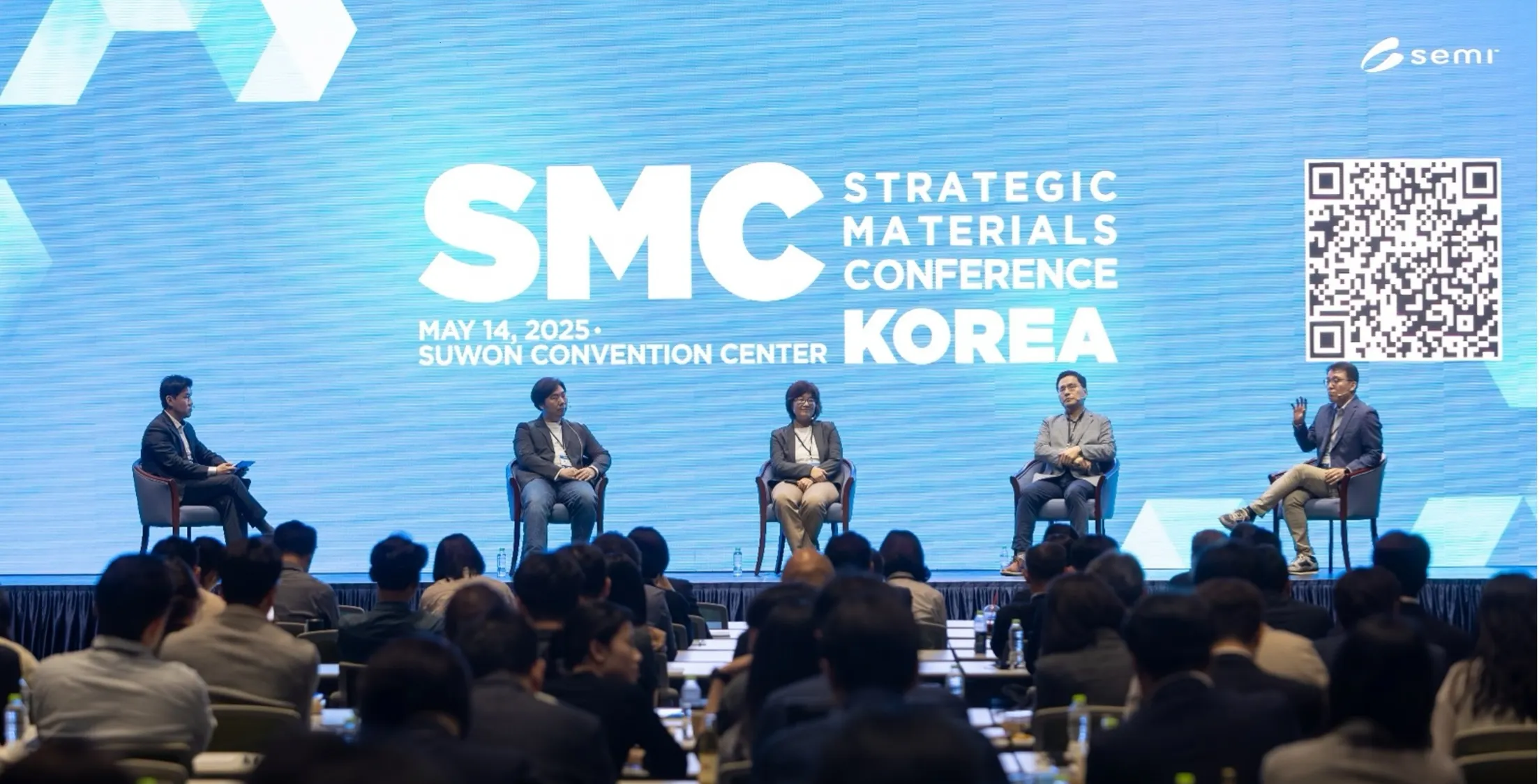
The transition toward an AI-driven technological landscape is redefining the paradigm of materials innovation across the semiconductor industry. In response, SMC (Strategic Materials Conference) Korea will spotlight next-generation semiconductor materials and process innovation strategies that enable and accelerate AI-driven advancements.
This conference brings together leading companies representing the global semiconductor ecosystem to share strategic directions and practical insights into materials innovation, from material design to real-world manufacturing processes.
The first session will focus on materials strategies for the AI era, exploring market and technology trends as well as AI-driven development approaches to provide a comprehensive view of next-generation semiconductor innovation. The second session will offer an in-depth exploration of process-ready materials essential for advanced semiconductor manufacturing, highlighting practical applications in areas such as photoresists, etching chemistry, and cleaning processes.
By convening key players across the semiconductor ecosystem, this conference provides a unique platform to gain a holistic perspective on the present and future of materials innovation in the AI era. Participants will have the opportunity to gain valuable technical insights while fostering collaboration and connections across the industry.
SMC (Strategic Materials Conference) Korea 2026
May 12(Tue), 2026 | Convention Hall 2, 3F, Suwon Convention Center
8:30 am - 4:30 pm
Off
Add to Calendar2026-05-12 08:30:002026-05-12 16:30:00SMC (Strategic Materials Conference) Korea 2026AI Enabled Materials Breakthroughs: From Molecules to ManufacturingThe transition toward an AI-driven technological landscape is redefining the paradigm of materials innovation across the semiconductor industry. In response, SMC (Strategic Materials Conference) Korea will spotlight next-generation semiconductor materials and process innovation strategies that enable and accelerate AI-driven advancements. This conference brings together leading companies representing the global semiconductor ecosystem to share strategic directions and practical insights into materials innovation, from material design to real-world manufacturing processes. The first session will focus on materials strategies for the AI era, exploring market and technology trends as well as AI-driven development approaches to provide a comprehensive view of next-generation semiconductor innovation. The second session will offer an in-depth exploration of process-ready materials essential for advanced semiconductor manufacturing, highlighting practical applications in areas such as photoresists, etching chemistry, and cleaning processes. By convening key players across the semiconductor ecosystem, this conference provides a unique platform to gain a holistic perspective on the present and future of materials innovation in the AI era. Participants will have the opportunity to gain valuable technical insights while fostering collaboration and connections across the industry.Suwon Convention Center South KoreaSEMI.org[email protected]Asia/Seoulpublic
Asia/Seoul
Please be sure to check / understand the followings before applying
Due to the nature of this product, we do not accept cancellations or refunds after the application has been made. Please understand this in advance.
When applying for this event, please register using a corporate email address.
SEMI Member Price is avilable for those who work for a SEMI member company or a wholly owned subsidiary that is registered as a subsidiary. If you are unsure, please click HERE to inquire. Please note that if your membership status cannot be confirmed, you will be charged the general price.
Payment is only possible by credit card. You can download your receipt from Receipt / Application History in your My Page.
Please note that places will be allocated on a first-come, first-served basis, so please apply as soon as possible.
First deadline: June 5 (Fri.) Final deadline: June 25 (Thu.)
Symposium Fee SEMI Members : 280,000 JPY (Excluding tax) Please note that you will be responsible for the cost of local accommodation, transportation and participation in the golf competition. A shuttle bus service is scheduled to run between New Chitose Airport and the venue.
Accommodation Charge 51,460JPY - 78,660JPY per night (including Breakfast and tax)
1 person usage: 51,460 JPY / night (per person) 2 people usage: 28,800 JPY / night (per person)
Superior Room Lake Side (40㎡) (Non-smoking)
1 person usage: 54,760 JPY / night (per person) 2 people usage: 30,450 JPY / night (per person)
Junior Suite Room Sea Side (58㎡) (Non-Smoking)
1 person usage: 72,060 JPY / night (per person) 2 people usage: 38,700 JPY / night (per person)
Junior Suite Room Lake Side (58㎡) (Non-Smoking)
1 person usage: 78,660 JPY / night (per person) 2 people usage: 42,000 JPY / night (per person)
*Breakfast, consumption tax, bathing tax, and service charge are included.
[Outbound] July 8 (Wed) New Chitose Airport → Windsor Hotel Toya Resort & Spa
Duration: 120 minutes
Fare: Free (application is required)
Meeting / Departure: Please arrive on a flight landing at New Chitose Airport between 8:30 and 10:00. Multiple shuttle services will be arranged to coincide with your flight arrival time.
[Return] July 10 (Fri) The Windsor Hotel Toya Resort & Spa → New Chitose Airport
Travel Time: Approx. 120 minutes
Fare: Free (Advance reservation required)
Departure:
Departures will begin from around 14:50, operating sequentially. (Please note that departure times may vary depending on the program’s end time.) *If you are taking the return bus, please book a flight departing at 6:30 PM or later.
JTB Global Marketing & Travel ISS Japan 2026 Desk
*Inquiries can be received only by e-mail. E-mail: [email protected] Office Hours: 10:00-16:30 (Mon-Fri except Saturdays, Sundays and Holidays)
We will be holding “ISS Japan 2026”, a conference to discuss strategies and issues with an eye on the future of the industry. As digital technology supports global prosperity, we will provide opportunities for exchanging opinions and networking on important issues such as sustainability, energy issues, and the latest technology, in order for Japan to demonstrate leadership as an important base for semiconductor manufacturing.
Rewriting the Curve: Memory, AI, and the Next Semiconductor Era
This talk discusses the strategic importance of next-generation memory technologies, such as DRAM and HBM, in the semiconductor industry being reshaped by rapid AI advancements. It highlights their role in boosting performance and energy efficiency, while exploring broader transformations across supply chains, industry collaboration, and talent development.
Advancing Tools & Materials to Empower 3DIC Manufacturing for AI Innovations
The roadmap for advanced packaging in AI applications presents significant challenges, particularly with scaling up and incorporating more chiplets.
This expansion poses obstacles in terms of yield and productivity.
To address these challenges, CoP (Chip-on-Panel) technology will be introduced to complement current CoW (Chip-on-Wafer) to accelerate 3DIC scale up. However, this shift requires substantial infrastructure development, especially for tool development and material innovations. Meanwhile, material usage will be significantly increased, raising concerns about supply chain resilience.
All of which will play a pivotal role in enabling this critical technology expansion and requires seamless collaborations across backend eco-system.
Representative Director, Japan Association of Corporate Executives
Technological Evolution and Economic Growth
As global change accelerates and the international environment becomes increasingly uncertain, the effective use of technologies such as AI is essential for Japan to achieve sustainable economic growth. At the same time, building a “Collaborative Growth Model” rooted in empathy enables us to realize true prosperity. This lecture explores the latest technological trends and discusses Japan’s vision for sustainable growth.
National Technology Office・Chief Technology Officer
Microsoft Japan
An Autonomous Digital World Powered by AI Agents: The New Frontier of Value Creation Enabled by Generative AI
Generative AI is beginning to create an “autonomous digital world,” in which operations and decision-making are orchestrated autonomously through AI agents.
In this session, we will provide an overarching view of how these technological advancements are transforming corporate business processes, organizational structures, and executive decision-making, and examine the fundamental impact these changes have on competitiveness and business strategy.
In addition, the session will offer insights for Japanese companies and the Japanese market from a global perspective, while sharing Microsoft’s vision for the future and strategic perspectives on driving new value creation.
Deputy Director General for Semiconductor and Information Policy Deputy Director General for Economic Security
Ministry of Economy, Trade and Industry
Economic Security and Semiconductor
This presentation will discuss the growing importance of the semiconductor industry amid concurrent geopolitical tensions,
supply chain disruptions, and technological advancements; outline strategies for fostering innovation and strengthening supply chain resilience;
and introduce the Japanese government’s AI and semiconductor strategy in light of these developments.
Inside Taiwan’s Semiconductor Strategy: Technology, Supply Chains, and Geopolitics
This presentation explores Taiwan’s semiconductor development strategy as a "pivotal fulcrum" of the global AI industry. First, it examines how Taiwan maintains its technological leadership by leveraging advanced process nodes and the unique cluster advantage of "zero distance between R&D and production". Second, from a supply chain perspective, it analyzes innovative models for the global deployment of the industrial ecosystem. Furthermore, the session addresses the strategic management of key technical know-how amidst geopolitical challenges and defines a collaborative positioning of "deep coupling" with global partners. Finally, it highlights the evolution and vision
of government policy as it transforms from a "regulator" into an "enabler".
Geopolitics, Economic Security, and Asia (China/India)
This session explains approaches to addressing economic security risks, incorporating the latest developments in export and investment regulations in the semiconductor sector. In particular, it focuses on risks associated with business operations in China and India.
In March this year, the Chinese Communist Party and government adopted the 15th Five-Year Plan (2026–2030), reaffirming their commitment to accelerating “self-reliance and self-strengthening” in high-tech industries centered on semiconductors. This presentation examines how far China’s semiconductor supply chain has advanced toward greater autonomy amid prolonged U.S.–China technology tensions. By analyzing developments in key firms, it also considers how Japanese companies should respond to these changes.
Session 5 The Insights from Round Table Discussion
9:40 am
Break
10:50 am
Session 6 Leadership and Strategy to Forge Japan's Future
11:00 am
Shingo Yamagami
Special Advisor
TMI Associates
How Should Japan Respond to the Turbulent World?
The world has witnessed the Russian invasion of Ukraine, China’s wolf warrior diplomacy and a series of economic coercion, and the US military operations in Venezuela as well as Iran.
How should Japan react to the measures by major powers that shake the foundations of the rules-based international order established after WWII?
Fawning China, worshipping the US, and the deterioration of Japan’s presence in the world.
How could Prime Minister Takaichi extricate Japan’s diplomacy from such a stalemate that has continued since PM Suga through PM Kishida and Ishiba?
These will be discussed candidly in light of the speaker’s 40-year-long experience as a diplomat.
Chairman, Chief Sustainability Development Officer
CinnamonAI
Future of Global Community, Japan and AI
As AI reshapes the world, global competition and collaboration are accelerating. How can Japan create new value and demonstrate leadership in an era with no easy answers? Drawing on perspectives from startups, global companies, local governments, and business schools, this session offers fresh insights and invites participants to rethink Japan's future in the age of AI.
AI is dominating the semiconductor market. As AI-related semiconductor prices rise and demand continues to grow, the outlook for the Semiconductor Production Equipment (SPE) market is improving. In addition to demand fueled by technological innovations unique to AI semiconductors, the industry faces an urgent need to construct new fabrication facilities and add production lines to keep up with increased volumes. In this seminar, we will explore the outlook for both the semiconductor and SPE markets.
We would like to examine the current status and future prospects of Japan's Semiconductor Materials Industries that not only provides solutions for BEOL where semiconductor elements are formed on wafer surface but also for BEOL where thermal and insulation managements are vital. We would like to briefly touch the implications of geopolitical risks.
AI progress continues to accelerate. Frontier development is shifting from scaling pretraining to optimizing inference and strengthening agent/orchestration layers. This drives demand beyond GPUs to DPUs and data center infrastructure. As physical AI and multimodal models rise, this talk examines the implications for the semiconductor industry.
Session 8 Energy Security and Industrial Growth Strategies
11:00 am
Naoko Doi
Senior Research Director
The Institute of Energy Economics, Japan
Toward a Secure Electricity Supply: Meeting the AI and Semiconductor Demand
Global electricity demand is rising due to the growing needs of AI and semiconductors, alongside advancing electrification in the industry, transport, and buildings. In developing Asian countries, structural shifts toward electrification are also being pursued to counter soaring oil prices, making the securing of a stable power supply a shared global challenge.This presentation highlights future demand outlooks and proposes solutions—including AI-driven energy efficiency, grid enhancement, and "watt-bit" integration—and draws implications for Japan.
In light of the anticipated increase in electricity demand driven by the expansion of GX (Green Transformation) industrial development, as well as the expected growth in the adoption of renewable energy leveraging Hokkaido’s inherent potential, this presentation introduces Hokkaido Electric Power Company’s initiatives to secure power supply capacity and promote energy decarbonization toward the future industrial growth of Hokkaido.
General Manager, Business Development Department, Industry Business Division, Industrial Co-Creation Business Unit
Tokyu Land
Powering Industrial Growth with Renewable Energy
As the need for carbon neutrality becomes more urgent and AI-driven data center demand continues to grow, integrating renewable energy with industrial infrastructure is increasingly important. This session highlights our 100% renewable-powered Ishikari data center as a practical model for integrating digital and green transformation at scale.
Session9 Grand Finale Japan's International Competitiveness
12:30 pm
Olivier Faynot
Silicon Component Division Manager
CEA-Leti
Shaping the Future of High-Value-Added Electronic Products
Artificial Intelligence (AI) has push the semiconductor industry toward a great challenge of energy efficiency. AI rely on massive infrastructure that are converting electricity into token. The demand is very high at either device level (high transistor density, huge amount of memory, etc.), technology level (3D integration, 3D partitioning, etc.) and infrastructure (power management, optical interconnection, etc.). These challenges are a unique opportunity to promote innovation at system level to reach a sustainable way to support AI requirements in terms of energy. Biography
12:30 pm
Satoshi Nohara
Director-General, Commerce and Information Policy Bureau
Ministry of Economy, Trade and Industry
The Future of Japan's AI and Semiconductor Strategy
This presentation examines the structural shift whereby AI and semiconductors are emerging as critical foundations that shape national competitiveness, social resilience, and economic security. It further explores the technological trajectory toward the advancement of Vertical AI and Physical AI. Against this backdrop, it highlights the importance of transforming Japan’s unique strength in real-world operational data into a new source of competitive advantage and presents a strategy for realizing a System-to-Silicon paradigm.
Toward a Science and Technology-oriented Nation: The Future of Japan
As the world grapples with challenges such as population decline and intensifying global competition, how can Japan achieve sustainable growth? This session will highlight technologies such as space, AI, and robotics from a broad perspective that spans industry, society, and philosophy. We will explore Japan’s future and strategic direction through “science and technology-oriented nation,” a concept advocated by Keidanren. Biography
Atsuyoshi Koike
CEO
Rapidus
The Semiconductor Strategy in the Age of AI
The rise of AI is radically transforming the semiconductor industry. In this new era, the keys to success are speed and data. To thrive, we must build deep partnerships with cutting-edge global leaders while fostering strong co-creation with local communities. We will share our steps to create new innovations.
On the afternoon of the second day, we invite you to relax and enjoy a moment of calm surrounded by the wide open skies and lush greenery of Hokkaido’s magnificent natural landscape. As part of ISS Japan’s off-site networking activities designed to foster connections among participants, we offer not only a golf competition but also a variety of alternative activities for those who do not wish to participate in golf.
Schedule 12:00-13:00 Lunch 13:00-18:30 Golf Tournament 19:00-20:30 Dinner Party
Activities
For those not participating in the golf tournament, we invite you to enjoy a variety of activities that allow you to experience the magnificent natural landscapes of Hokkaido. A wide range of activity programs offered by the hotel is available. https://www.windsor-hotels.co.jp/en/activity/
Reservations can be made via the link below. Reservation Contact Information Tel: +81-142-73-1177 (Hours: 8:00 AM – 5:00 PM) Email: [email protected] * When making your reservation, please mention that you will be attending “ISS JAPAN."
Asia/Tokyo
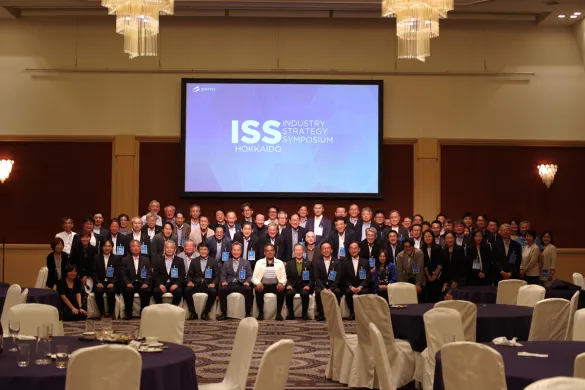
ISS Hokkaido 2025 Event Report
We have compiled an overview of the 2025 event, along with photos of participants and their comments.
Europe’s Semiconductor Strategy: Navigating Geopolitics, Building Resilience
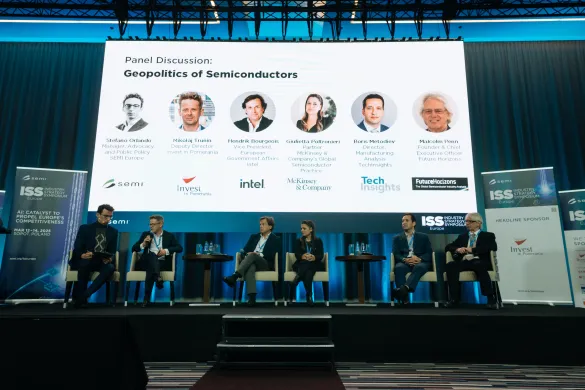
As geopolitical dynamics continue to influence global industries, the semiconductor sector finds itself at a pivotal crossroad. During the SEMI Industry Strategy Symposium (ISS Europe) held in Sopot, Poland, a high-level panel on the Geopolitics of Semiconductors brought together leaders from across the ecosystem to explore Europe’s role in an increasingly fragmented world shaped by strategic dependencies and evolving alliances.
The semiconductor industry is entering an era of deep interdependence, rapid innovation, and growing complexity. Breakthroughs in AI accelerators, advanced lithography, heterogeneous integration, and next-generation computing rely on globally distributed ecosystems of suppliers, governments, research institutions, and manufacturers. Yet intelligence systems remain fragmented, limiting visibility and slowing coordinated responses to disruptions and market shifts.
This webinar introduces Co-Intelligence™, a new model that connects intelligence across organizations—not just within them—to enable shared context, collective situational awareness, and coordinated decision-making.
We will also explore Conductor™, a platform designed to operationalize ecosystem-level intelligence by integrating signals across stakeholders and enabling faster, more aligned responses to industry challenges.
Attendees will gain:
A comprehensive view of Co-Intelligence™, the intelligence model for complex semiconductor ecosystems
Access to key insights from an industry leader
An exclusive inside look at the Conductor™ platform
Front-row access to the launch of a new era for the semiconductor industry and invitations to join the emerging network
Agenda:
Welcome & Introductions - Setting the Stage for Co-Intelligence™ – 5 minutes
Keynote – 10 minutes
Roundtable discussion - 10 minutes
Conductor™ Demo – 20 minutes
Q&A – 10 minutes
Session Closes – 5 minutes
Keynote Speaker
I-Ting Fang Department Manager AI for business intelligence TSMC
Bio: I-Ting Fang is a Department Manager at TSMC's Corporate Planning Organization — the “brain” for balancing demand, supply, and capacity planning. She leads teams building intelligence platforms that monitor supply chain health, assess market demand, and track potential events impacting the semiconductor industry and TSMC.
Panelists
Bettina Weiss Chief of Staff & Corporate Strategy SEMI
Sharon Su Director of Strategic Supplier Partnership Dell Technologies
Semiconductor supply chain innovation and orchestration at scale now requires collective intelligence and ecosystem coordination. Join this webinar to explore Co-Intelligence™ and get an exclusive preview of the Conductor™ platform to improve visibility and resilience.
Choose your session:
9-10am CST, April 9 // 6-7pm PDT, April 8 [Register Now]
9-10am PDT, April 10(pre-recorded keynote with live Q&A) [Register Now]
Co-Intelligence™: The New Architecture of Semiconductor Ecosystems
Webinar | Global Sessions
Off
Add to Calendar2026-04-08 00:00:002026-04-10 00:00:00Co-Intelligence™: The New Architecture of Semiconductor EcosystemsSemiconductor supply chain innovation and orchestration at scale now requires collective intelligence and ecosystem coordination. Join this webinar to explore Co-Intelligence™ and get an exclusive preview of the Conductor™ platform to improve visibility and resilience.Choose your session:9-10am CST, April 9 // 6-7pm PDT, April 8 [Register Now] 6-7pm CST // 12-1pm CEST, April 9 [Register Now]9-10am PDT, April 10 (pre-recorded keynote with live Q&A) [Register Now]United StatesSEMI.org[email protected]America/Los_Angelespublic
America/Los_Angeles
Digital Twin is a virtual representation of the structure, context, and behavior of physical systems or a process, with a live link to a physical system serving as a key enabler for predictive and data-driven optimization. In Printed and Flexible Hybrid Electronics (FHE), manufacturing involves multiple interdependent variables—different printing technologies, inks, substrates, and process conditions—each introducing its own complexity. In practice, additional challenges such as equipment drift, batch-to-batch variations, and environmental fluctuations further impact process consistency and yield. Changing a process or transferring it between tools is often difficult, as each setup is highly customized and sensitive to local conditions. To address these challenges, Digital Twin frameworks connect data from design, fabrication, and metrology into continuously learning digital models. They enable early detection of process drifts, virtual experimentation for process development, and data-driven optimization that reduces time, cost, and waste.
This course introduces Digital Twin frameworks for FHE, focusing on Deep Neural Network (DNN)-based predictive models. Participants will learn how to integrate design, fabrication, and metrology data into continuously learning virtual twins that detect process drifts, enable virtual experimentation, and optimize manufacturing. The program covers the full workflow—from image processing and virtual metrology to AI model training, validation, and hyperparameter tuning—using real datasets. A hands-on “Build Your Own Digital Twin” module in Google Colab will provide practical experience in training and refining models for printed electronics applications, equipping attendees with both theoretical insight and applied skills for process optimization and performance prediction.
ABOUT THE SPEAKER
Benyamin Davaji, PhD Benyamin Davaji is an Assistant Professor in the Department of Electrical and Computer Engineering at Northeastern University, Boston, Massachusetts, where his research centers on integrated microsystems for sensing and computation using mechanical waves. His work spans acoustic and ultrasound transducers, biointerfaces, and microcalorimetry, with a strong emphasis on data-guided nanofabrication, advanced semiconductor device manufacturing, and interdisciplinary approaches to microsystem design and manufacturing. He earned his Ph.D. in Electrical and Computer Engineering from Marquette University in 2016 and completed a postdoctoral appointment at Cornell University.
Join us for a Master Class with Benyamin Davaji, PhD, as he introduces Digital Twin frameworks for Printed and Flexible Hybrid Electronics, demonstrating how AI- and DNN-based models integrate design, fabrication, and metrology data along with printing technologies to detect process drift, enable virtual experimentation, and optimize manufacturing performance. Participants gain hands-on experience building continuously learning digital twins to reduce variability, cost, and time to optimization.
Digital Twins for Printed Electronics: How Can AI Learn FHE Printing?
Flexible Electronics Master Class #29
10:00 am - 12:00 pm
Off
Add to Calendar2026-06-10 10:00:002026-06-10 12:00:00FEMC#29 Digital Twins for Printed Electronics: How Can AI Learn FHE Printing?Join us for a Master Class with Benyamin Davaji, PhD, as he introduces Digital Twin frameworks for Printed and Flexible Hybrid Electronics, demonstrating how AI- and DNN-based models integrate design, fabrication, and metrology data along with printing technologies to detect process drift, enable virtual experimentation, and optimize manufacturing performance. Participants gain hands-on experience building continuously learning digital twins to reduce variability, cost, and time to optimization. United StatesSEMI.org[email protected]America/Los_Angelespublic
America/Los_Angeles
Watch on-demand
Plan now to join fellow semiconductor industry professionals at SEMI Headquarters in Milpitas, California at the 2026 SEMI EHS Summit.
Industry experts will present on the regulatory matters that will impact the industry in 2026 and beyond, followed by discussions on taking collective action to strengthen semiconductor manufacturing.
Topics:
US Regulatory Landscape under second Trump Administration
US State-level legislation
Europe: PFAS restriction, REACH restriction, Packaging and Packaging Waste Regulation, GENESIS Consortium, etc.
US Department of War Perspective on Semiconductor Supply Chain Risks
Stockholm Convention
Emerging regulations in Asia
Supply Chain Transparency
US EPA Technology Transition Rule (HFC Phasedown)
US EPA TSCA New Substances of Concern
Attend, network and strategically prepare your company. This is an in-person event only.
EHS Summit 2026
Regulations, Rules & Proposals
8:30 am - 3:30 pm
Off
Add to Calendar2026-05-28 08:30:002026-05-28 15:30:002026 EHS SummitPlan now to join fellow semiconductor industry professionals at SEMI Headquarters in Milpitas, California at the 2026 SEMI EHS Summit.Industry experts will present on the regulatory matters that will impact the industry in 2026 and beyond, followed by discussions on taking collective action to strengthen semiconductor manufacturing. Topics:US Regulatory Landscape under second Trump AdministrationUS State-level legislationEurope: PFAS restriction, REACH restriction, Packaging and Packaging Waste Regulation, GENESIS Consortium, etc.US Department of War Perspective on Semiconductor Supply Chain RisksStockholm ConventionEmerging regulations in AsiaSupply Chain TransparencyUS EPA Technology Transition Rule (HFC Phasedown)US EPA TSCA New Substances of ConcernAttend, network and strategically prepare your company. This is an in-person event only.SEMI 673 South Milpitas Blvd. Milpitas, CA 95035 United StatesSEMI.org[email protected]America/Los_Angelespublic
America/Los_Angeles
Register Now
Standards meeting registration is free, but is required for both in-person and virtual. Coffee and tea will be provided. ASMC event and lunch are not included.
For those planning to participate remotely, please select the virtual option during registration.
ASMC Registration Discount As a SEMI Standards Program Member, you have the option to register for ASMC at a discounted rate. ASMC registration is separate from Standards meetings.
ASMC POSTER SESSION NETWORKING EVENT
Mingle with ASMC attendees after Tuesday's meetings! Tuesday, May 12 | 5:30-7:30 PM ET
How do I participate in the meetings?
To participate in the meetings, you must be a SEMI Standards Program Member.
SEMI Sustainability, in collaboration with STX Group, hosted a webinar on Internal Carbon Pricing (ICP) for the semiconductor value chain. The session was anchored in a new industry report developed with input from members of SEMI’s Carbon Pricing Workgroup and will feature speakers from ASML, Delta Electronics, and Lam Research. The webinar highlighted the 5 key steps in creating and implementing your own ICP plan, and understand the process, its benefits and the opportunities offered.
The presentations explored key insights from the report alongside SEMI member perspectives, with speakers sharing practical examples and lessons learned—from early exploration to applied approaches—across the semiconductor value chain.
Internal Carbon Pricing Webinar for the Semicondcutor Value Chain