downloadGroupGroupnoun_press release_995423_000000 copyGroupnoun_Feed_96767_000000Group 19noun_pictures_1817522_000000Member company iconResource item iconStore item iconGroup 19Group 19noun_Photo_2085192_000000 Copynoun_presentation_2096081_000000Group 19Group Copy 7noun_webinar_692730_000000Path
Skip to main content
Default Banner Image

South Korea

India Japan Malaysia Singapore South Korea Taiwan United States Vietnam Inside the Fab Training

Course Description 

This course provides a comprehensive introduction to semiconductor manufacturing, guiding participants through the complete journey from silicon fundamentals to chip fabrication and packaging. Designed for professionals new to the semiconductor industry, the course explains key concepts, terminology, devices, and manufacturing processes used in modern fabs. 

Who Should Attend

Anyone interested in understanding semiconductor manufacturing, including new employees, professionals in related industries, and those seeking to broaden their knowledge of the field.  

Learning Objectives

Upon completion of the course, participants should be able to:

  • Explain fundamental semiconductor concepts, including silicon materials, doping, PN junctions, and basic device behavior. 
  • Identify and correctly use common semiconductor manufacturing terminology.
  • Outline the key steps involved in front-end wafer fabrication, from bare silicon to patterned wafers.
  • Summarize back-end manufacturing processes, including assembly, packaging, and testing.

Topics Included

  • Basic Electronics and Microelectronics
  • Process Nodes
  • Device Physics and Transistor Operation
  • Crystal Growth and Wafer Preparation
  • Advanced Transistor Technologies
  • Circuit Design and Layout
  • Wafer Processing

Important Information

Note that only the person who registered will receive a certificate of completion. This virtual training will not be recorded. Attendees must be present to access the course knowledge. 

Can't find the training link on the day of the training? After you register, you will receive the link to the live training via the email address you provided. In addition, you will receive email reminders 24 hours in advance and 1 hour before, with the same link. Please keep these emails on hand to access the training on time. If you do not see any confirmation emails, please check your junk/spam folders before contacting SEMI U for support.

 

Kalya Shubhakar
Kalya Shubhakar
Senior Lecturer


Singapore

- SEMI U

Strengthen your knowledge and skills by learning about the journey from silicon fundamentals to chip fabrication and packaging. 

Pricing                     
  • Members:  $399
  • Non-Members:  $449

* * Group pricing for 10+ attendees: $3,800 and 20+ attendees: $7,600
Any questions, please contact [email protected]

10:00 am - 2:00 pm Off Add to Calendar 2026-08-10 10:00:00 2026-08-13 14:00:00 Inside the Fab: An Introduction to Semiconductor Manufacturing (Asia) Strengthen your knowledge and skills by learning about the journey from silicon fundamentals to chip fabrication and packaging. Pricing                     Members:  $399Non-Members:  $449* * Group pricing for 10+ attendees: $3,800 and 20+ attendees: $7,600Any questions, please contact [email protected] Singapore SEMI.org [email protected] Asia/Singapore public Asia/Singapore Register Now


Event format
Promote in calendar
Off
Belgium China France Germany India Ireland Italy Japan Malaysia Singapore South Korea Taiwan United States Vietnam Water Mgmt banner 350x317 Business Executive Technical

Thank you to our sponsors:  


         Sundt Construction Company & General Contractor | Sundt                                   SCREEN logo


Highlighted content

United States

9:00 am - 9:10 am

Welcome and Overview of the Water Management Working Group

9:10 am - 9:25 am
Pascal Osten
Leader, Water Solution Providers Cohort
Pascal Osten
DAS Environmental Expert GmbH

Procedures Guide

9:25 am - 9:35 am
Catherine Marsan-Loyer
Co-Lead, Fab, OSATs Cohort
Catherine Marsan-Loyer
C2MI

Water Savings Guide and Baseline-setting

9:35 am - 9:45 am
Jared Burdik
Co-Lead, Fab, OSAT Cohort
Jared Burdick
Sundt Corp.

Solutions Maturity Scale

9:45 am - 9:55 am

Q&A & WrapUp

EHS SMG Sustainability EMG FOA Standards

Join the SEMI Water Management team and document authors for a webinar discussing their research and findings for the Water Management Strategy Reports.  The reports are guides for water managers for understanding their water balance, baseline, potential savings and a general maturity scale for several solutions to be considered to move up the maturity scale to Zero Liquid Discharge (ZLD). The webinar will provide an overview on how the documents should be used to work with water solutions providers and provide strategies for both new and legacy facilities with end-of-pipe solutions as well as treatments for individual process stage water discharge. 

The webinar will include a discussion of next steps for the continued development of the reports, including how they interact with SEMI Standards and the industry roadmaps.

Reports can be downloaded HERE.

9:00 am - 10:00 am Off Add to Calendar 2026-05-21 09:00:00 2026-05-21 10:00:00 Water Management Strategies Webinar Join the SEMI Water Management team and document authors for a webinar discussing their research and findings for the Water Management Strategy Reports.  The reports are guides for water managers for understanding their water balance, baseline, potential savings and a general maturity scale for several solutions to be considered to move up the maturity scale to Zero Liquid Discharge (ZLD). The webinar will provide an overview on how the documents should be used to work with water solutions providers and provide strategies for both new and legacy facilities with end-of-pipe solutions as well as treatments for individual process stage water discharge. The webinar will include a discussion of next steps for the continued development of the reports, including how they interact with SEMI Standards and the industry roadmaps.Reports can be downloaded HERE. United States SEMI.org [email protected] America/Los_Angeles public America/Los_Angeles Register Here

Event format
Promote in calendar
On

Registration

Registration

※ Early-bird Registration Deadline: May 7(Thu), 2026, 10: 00 AM (KST)


Registration Fee  

  • Early Bird
    • SEMI Member: KRW 308,000
    • Non-Member: KRW 363,000
  • On site
    • SEMI Member : KRW 385,000
    • Non-Member: KRW 385,000
  • Group
    • SEMI Member : KRW 275,000
    • Non-Member: KRW 330,000
      ※ Group registration fee applies to groups of five or more from the same company.

※ For group registration inquiries, please contact SEMI Korea Program Team at [email protected].

Registration
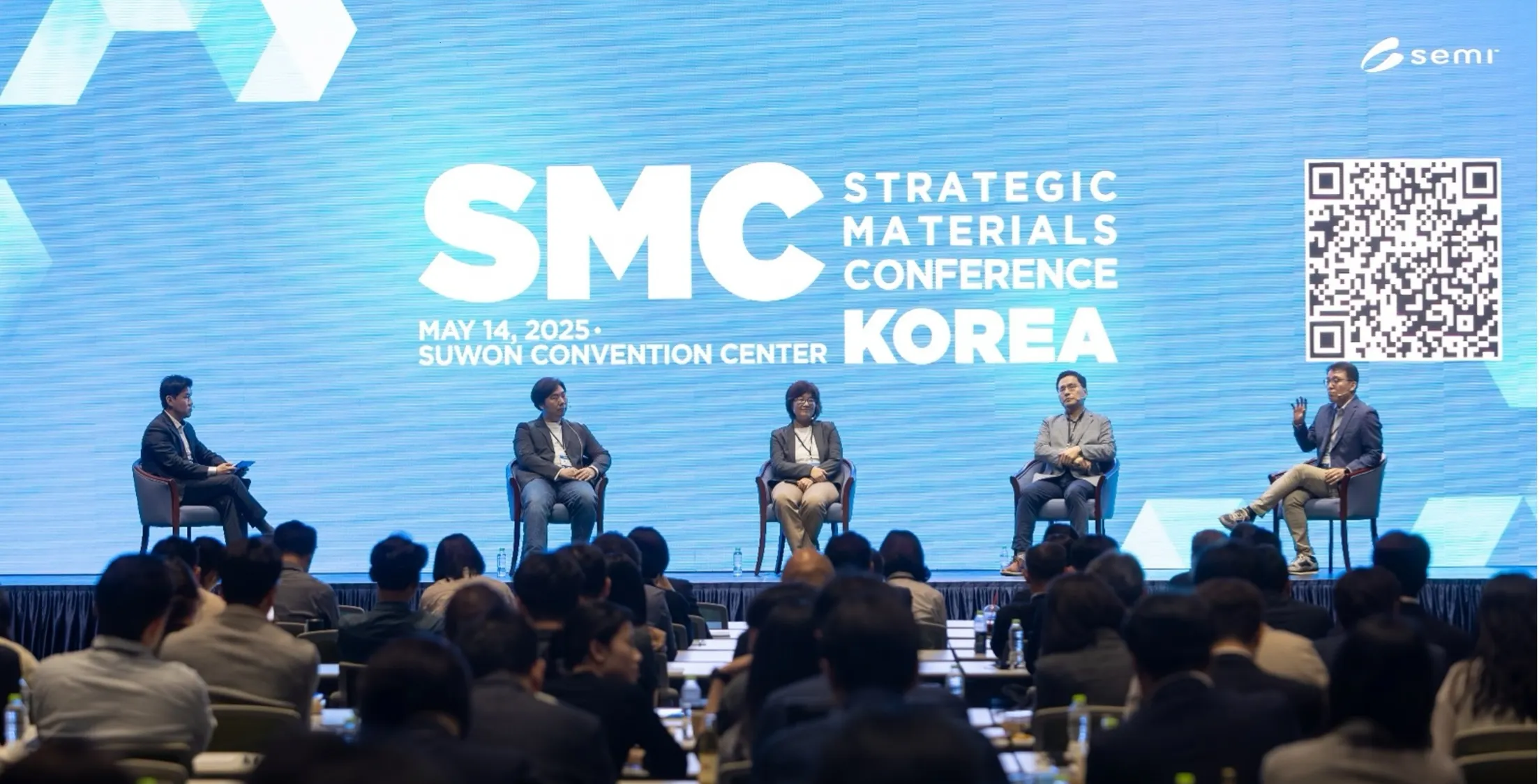
South Korea SMC Korea 2026 Business Technical

OVERVIEW

  • Date: May 12(Tue), 2026 8:30-16:30 KST
  • Venue: Convention Hall 2, 3F, Suwon Convention Center
  • Language: Korean/English (Simultaneous interpretation will be provided)  


NOTICE

  • The agenda is subject to change at the discretion of the speakers.
  • Presentation materials will be available for download after the conference via the SEMI Korea program registration website(https://semikrprogram.com), only for materials approved by the speakers for distribution.
  • Parking fees are not provided.  


SPONSORS

SMC-Korea-2023-Sponsor_DW.jpg
SMC-Korea-2023-Sponsor_DS_0.jpg SMC-Korea-2023-Sponsor_JSR.jpg
Huntsman

line_2.jpg

CONTACT


Suwon Convention Center
South Korea

8:30 am - 9:00 am

Welcome Reception

9:00 am - 9:25 am
Anand Murthy
Anand Murthy
VP, Advanced Technology Integration, Office of the CTO
Lam Research

How Wafer Processing Is Reshaping the 3D Era for AI

AI is fueling unprecedented growth and accelerating demand for advanced devices. Its requirements for performance, power, and area scaling are driving memory and logic devices toward 3D architectures.
At the heart of this 3D transformation, processing steps must enable taller, perpendicular structures as well as smaller features. Meeting these requirements calls for new deposition and etch capabilities that did not exist before, leading to breakthroughs needed in areas such as atomic-level deposition and etch (ALD and ALE), high-aspect-ratio processing, dry resist EUV patterning, and the adoption of new materials like molybdenum (Mo). As a result, the transition to 3D devices will drive increased intensity of deposition and etch processing.
This presentation will explore how deposition and etch are critical to unlocking the future of 3D devices, with increasing velocity required to meet the demands of AI-driven innovation.

※ Biography

9:25 am - 9:50 am
Ganesh Panaman
Ganesh Panaman
Head of Technology & Innovation and President of Intermolecular®
Merck

Integrated Materials Innovation in the AI Era

As the semiconductor industry navigates the challenges of dimensional and functional scaling in the artificial intelligence (AI) era, advanced materials science has emerged as a critical enabler for performance enhancement. Modern AI-centric architectures demand the integration of increasingly complex system-on-chip (SoC) designs with non-traditional material systems.
This work details a high-throughput methodology for the rapid down-selection and optimization of multi-element thin films, ensuring alignment with both physical and electrical key performance indicators (KPIs). Utilizing combinatorial physical vapor deposition (PVD) in conjunction with unit-cell electrical test vehicles, we systematically screen an expansive elemental compositional space to identify optimal candidates. Advanced machine learning (ML) algorithms are integrated into each phase of the development lifecycle—spanning precursor synthesis, process optimization, and heterogeneous integration—to satisfy the rigorous specifications of emerging device applications. The synergy between integrated materials engineering and AI-driven informatics significantly reduces the temporal gap between material discovery and device-level implementation.

※ Biography

9:50 am - 10:15 am
한세희 랩장
Sehui Han
Lab Leader
LG AI Research

AI for Scientific Discovery: EXAONE Discovery

Chemical and materials research faces increasing demands for data-driven automation and autonomous research systems due to vast exploration spaces and complex decision-making processes. In this talk, we introduce EXAONE Discovery as a Chemical Agentic AI system and present an integrated research framework designed to accelerate scientific discovery.
EXAONE Discovery is an agent-based system that tightly integrates property prediction, molecular generation, synthesis prediction, and literature/data extraction. Based on given research objectives, the system accumulates relevant data, generates candidate molecules using model-driven approaches, evaluates their properties, and derives feasible synthetic routes—automating the end-to-end discovery pipeline. Furthermore, it is designed to enable a closed-loop research paradigm by interfacing with autonomous laboratories, connecting design–prediction–synthesis–validation cycles. This allows hypotheses proposed by AI to be experimentally validated, with results continuously fed back into the system for iterative model improvement and optimization.
In this talk, we will demonstrate how this integrated approach enhances research productivity across various industrial use cases in materials discovery and optimization, and discuss future directions of Chemical Agentic AI.

※ Biography

10:15 am - 10:40 am
이세철
Peter Lee
Managing Director at Citigroup, Semiconductor Analyst
Citigroup

Global Memory Technology & Market Outlook

10:40 am - 11:05 am
황중일
Jung-il Hwang
Vice President
SK hynix

Materials Challenges and Path Forward for Future Memory Scaling

11:05 am - 11:25 am

Networking Break

11:25 am - 12:30 pm

Panel Discussion

12:30 pm - 1:30 pm

Networking Lunch

1:30 pm - 1:55 pm
Xiangyu Guo
Xiangyu Guo
Air Liquide

Emerging Etching Chemistry for Advanced Semiconductor Manufacturing

The rising technical demands for advanced semiconductor device manufacturing, and the industry’s ambitious net-zero commitments necessitate the development of novel etch chemistries that deliver both technical excellence and environmental sustainability. This talk will present an overview of the emerging etching chemistries developed by Air Liquide for variety-targeted applications. These innovative chemistries focus on delivering improved performance with unique technical merits to address current industry challenges. Exemplified by a novel low Global Warming Potential (GWP) designed for general dielectric etch, its synergistic integration with advanced abatement solutions, and a simplified Life Cycle Analysis (LCA) - from raw material extraction through processing, manufacturing, distribution, and use, this presentation aims to provide insights into a pathway towards more sustainable semiconductor manufacturing processes.

※ Biography

1:55 pm - 2:20 pm
Kirthi Rachakonda
Kirthi Rachakonda
Global Product Manager
Applied Materials

Enabling Advanced Metallization with Selective Deposition

As device architectures scale toward the angstrom era, metallization has emerged as one of the most critical bottlenecks to continued improvements in power and performance. Shrinking feature dimensions increase resistance, heighten reliability risks, and add complexity in interconnects and contacts. At these scales, traditional approaches which uniformly affect all wafer surfaces are increasingly ineffective. They rely heavily on lithography to define placement, and struggle to address tighter geometries and growing sensitivity to interfaces. Selective deposition is a solution which enables atomicscale control of where metals grow, placing material only where it is needed, without relying on patterning. It also enables monocrystalline metal growth, eliminating grain boundaries to minimize contact resistance.

This presentation will highlight how Applied Materials’ integrated materials solutions are enabling multiple inflections through area selective metallization. Selective Cobalt Capping technology encapsulates copper interconnects, improving adhesion, suppressing electromigration, and extending copper reliability to advanced nodes. Applied’s Selective Barrier eliminates a highly resistive interface at the interface of interconnect wiring. For contact fill, Applied developed Selective Tungsten (W) as a liner-less gap-fill solution that eliminates traditional liner/barrier layers and enables bottomup, seamfree metal fill. Finally, we introduce Selective Molybdenum (Mo) deposition that carries lowresistivity contact scaling forward as dimensions approach the fundamental scaling limits of W. Applied’s state-of-the-art atomic layer deposition tool for molybdenum delivers bottom-up, single-crystal Mo growth, enabling the next generation of contact scaling.

※ Biography

2:20 pm - 2:45 pm
JungHwan Hah
JungHwan Hah
CEO
SK Trichem

Periodic Table & Device Evolution

2:45 pm - 3:10 pm
Kuntack Lee
Kuntack Lee
Master
Samsung Electronics

Next Generation Cleaning Processes and Materials

Cleaning processes originally relied on wet etch based patterning. However, dry etching now performs the majority of the patterning work, so wet etching is no longer needed for most pattern creation steps. Consequently, the focus of cleaning has shifted from patterning to the removal of contaminants. To obtain a clean surface, we must eliminate unwanted contaminants without any side effects such as pattern damage, collapse, material loss, or corrosion.
However, in the current era of 3 D structured devices such as V NAND, GAA, and 3 D DRAM, lateral wet etching is essential for patterning 3 D devices, and the proportion of wet etching in cleaning processes is increasing. Additionally, different kinds of selectivity such as concentration selectivity and area selectivity, have become important, in addition to conventional material selectivity. Sometimes we have to remove a film uniformly even though there are seams and voids. In addition, pattern loading has become a critical factor in lateral removal processes. We must solve these loading issues to achieve better performance and yield.
From time to time we must use more flexible, multi step processes; therefore, premixed chemistry is not enough to meet our purpose. Due to the flexibility of dry (gas phase) cleaning, the portion of dry cleaning has been increasing sharply. Area selectivity has also become another challenge. We must etch without corner rounding or climbing, and we want to perform anisotropic etching.
Conversely, based on the generic clean roadmap, high aspect ratio cleaning and low consumption cleaning will remain continuous challenges. Super critical CO2 drying is a solution for pattern collapse in HAR patterns, yet a dryer that is milder than CO2 but better than conventional IPA dryer technology is still required. In terms of chemical reduction, the puddle process may be a solution, but some side effects related to temperature consistency and cleanliness differences due to fluid dynamics must be resolved before implementation.

※ Biography

3:10 pm - 3:30 pm

Networking Break

3:30 pm - 4:30 pm

Panel Discussion

4:30 pm

Adjourn

EMG

AI Enabled Materials Breakthroughs: From Molecules to Manufacturing

The transition toward an AI-driven technological landscape is redefining the paradigm of materials innovation across the semiconductor industry. In response, SMC (Strategic Materials Conference) Korea will spotlight next-generation semiconductor materials and process innovation strategies that enable and accelerate AI-driven advancements.  

This conference brings together leading companies representing the global semiconductor ecosystem to share strategic directions and practical insights into materials innovation, from material design to real-world manufacturing processes.  

The first session will focus on materials strategies for the AI era, exploring market and technology trends as well as AI-driven development approaches to provide a comprehensive view of next-generation semiconductor innovation. The second session will offer an in-depth exploration of process-ready materials essential for advanced semiconductor manufacturing, highlighting practical applications in areas such as photoresists, etching chemistry, and cleaning processes.   

By convening key players across the semiconductor ecosystem, this conference provides a unique platform to gain a holistic perspective on the present and future of materials innovation in the AI era. Participants will have the opportunity to gain valuable technical insights while fostering collaboration and connections across the industry.

8:30 am - 4:30 pm Off Add to Calendar 2026-05-12 08:30:00 2026-05-12 16:30:00 SMC (Strategic Materials Conference) Korea 2026 AI Enabled Materials Breakthroughs: From Molecules to ManufacturingThe transition toward an AI-driven technological landscape is redefining the paradigm of materials innovation across the semiconductor industry. In response, SMC (Strategic Materials Conference) Korea will spotlight next-generation semiconductor materials and process innovation strategies that enable and accelerate AI-driven advancements.  This conference brings together leading companies representing the global semiconductor ecosystem to share strategic directions and practical insights into materials innovation, from material design to real-world manufacturing processes.  The first session will focus on materials strategies for the AI era, exploring market and technology trends as well as AI-driven development approaches to provide a comprehensive view of next-generation semiconductor innovation. The second session will offer an in-depth exploration of process-ready materials essential for advanced semiconductor manufacturing, highlighting practical applications in areas such as photoresists, etching chemistry, and cleaning processes.   By convening key players across the semiconductor ecosystem, this conference provides a unique platform to gain a holistic perspective on the present and future of materials innovation in the AI era. Participants will have the opportunity to gain valuable technical insights while fostering collaboration and connections across the industry. Suwon Convention Center South Korea SEMI.org [email protected] Asia/Seoul public Asia/Seoul
Event format
Promote in calendar
Off

High-performance connectivity software delivers structured, high-volume equipment data required by tier-one fabs and advanced packaging facilities ahead of the expected mid-2026 SEMI standards update

POITIERS, March 25, 2026 – Agileo Automation, a leading provider of control and connectivity solutions for global semiconductor manufacturing, today unveils Agil'EDA, a new software solution implementing Equipment Data Acquisition (EDA), a set of SEMI standards also known as Interface A, to enable semiconductor equipment manufacturers to meet the evolving high-performance connectivity requirements of tier-one fabs and advanced packaging facilities.

As semiconductor manufacturing moves towards higher levels of automation and data-driven optimization, fab owners increasingly require EDA alongside traditional SECS/GEM connectivity from semiconductor OEMs for their production tools. Agil'EDA addresses this by separating the control flow from the data flow, ensuring that structured, high-frequency data collection does not interfere with critical equipment operations.
Designed for long-term deployment, Agil'EDA fully supports the widely used EDA Freeze 2 (SOAP/XML) and is architected for the transition to Freeze 3 (gRPC/protocol buffers). This next-generation standard offers significantly higher data throughput and reduced latency. Agileo has already successfully tested and validated its EDA Freeze 3 implementation at SEMI’s North America Standards Fall Meetings in November 2024 in Milpitas, California. SEMI’s EDA Freeze 3 standards suite is expected to be released mid-2026.

Complementing the SECS/GEM standards used to control equipment behavior, Agil’EDA incorporates robust cybersecurity features such as authentication and encrypted communications. The product is available as a stand-alone solution for any existing equipment software using a platform-independent gRPC application programming interface (API) to communicate with it or as a pre-integrated component within Agileo’s A²ECF-SEMI framework. When used with Agil'GEM and Agil'GEM300, it provides a comprehensive connectivity solution that significantly reduces time to market for OEMs.

"With the growing demand for data to improve yield in tier-one fabs, as well as in Advanced Packaging and 3D integration, EDA is no longer optional. It is becoming a mandatory requirement for equipment entering the world's most advanced fabs," explains Marc Engel, chief executive officer of Agileo Automation. "The key value we deliver for OEMs is a fast and easy adoption path for a seamless EDA architecture that delivers compliant production machines to global fab customers. By providing a future-proof architecture ready for Freeze 3, which will significantly increase performance, we address OEMs’ current needs while preparing them for the evolving requirements of semiconductor manufacturing, including AI-driven process control."

- ends -

About Agileo Automation
Agileo Automation is a trusted partner for equipment manufacturers, helping them build smarter, automated, and more connected machines that integrate seamlessly into advanced semiconductor fabs. Founded in 2010 in Poitiers, France, Agileo helps OEMs with control, communication, data acquisition, and testing across their tools through proven software and expert support. Its flagship A²ECF-SEMI framework provides a solid foundation for developing equipment controllers fully aligned with SEMI SECS/GEM, GEM300, and EDA standards. As an active member of SEMI and the OPC Foundation, Agileo Automation contributes directly to shaping the standards that drive manufacturing. For more information, please visit our website or follow us on LinkedIn.

Dresden, Germany, March 24, 2026 – As semiconductor manufacturing continues to expand in China, reliable and efficient environmental technologies are becoming increasingly important for stable and sustainable fab operation. DAS Environmental Experts presents its SALIX wet scrubber product family, a series of high-efficiency point-of-use systems designed for the treatment of waste gases from wet chemical processes in semiconductor manufacturing.

SALIX systems are engineered to ensure high removal efficiency and stable operation in demanding semiconductor production environments. SALIX reliably removes substances such as IPA, ammonia and hydrofluoric acid (HF) from waste gas streams of modern single wafer clean systems – a key contribution to safe and sustainable semiconductor manufacturing. In addition, the technology removes particles, salts and droplets from the processed gas stream. The robust system design supports high uptime and long maintenance intervals, contributing to reliable fab operation.

A key advantage of the SALIX product family is its flexible portfolio. SALIX products are among the smallest and most compact systems on the market and are suitable for both new fabs and retrofit applications in existing fabs. DAS Environmental Experts offers the technology in four different products, providing semiconductor manufacturers with a wide range of configuration options:

• NEW: SALIX – the latest release with improved performance and optimized system operation
• SALIX MINI – a compact two-stage system for space-constrained installations
• NEW: SALIX MICRO [SR1.1]– a highly compact configuration with pre-scrubber section for flexible integration

This structured product portfolio enables customers to select the most suitable system according to process requirements, fab layout and integration needs. The availability of multiple system variants within one technology platform provides semiconductor manufacturers with excellent flexibility in system selection and plant design.

SALIX systems are designed for compatibility with all common process tools and can be adapted to a wide range of wet chemical applications. Their compact design and flexible configuration support efficient integration into modern fabs, helping manufacturers optimize both environmental performance and operational efficiency.

The SALIX product family will be presented during SEMICON China 2026 (March 25–27, Shanghai New International Expo Centre). Interested visitors can learn more about the technology and its applications at the DAS Environmental Experts booth (Booth N2 | 2619).

With more than three decades of experience in environmental technology for the semiconductor industry, DAS Environmental Experts continues to support chip manufacturers worldwide with solutions that combine high process reliability, efficient emission treatment and long-term operational stability.

About the Company
DAS Environmental Experts Group (DAS Group), headquartered in Dresden, Germany, was founded in 1991 and is now a global organization with subsidiaries on three continents and more than 950 employees worldwide. Over the past three decades, DAS Group has become one of the leading technology and equipment providers for waste gas abatement solutions with a focus on semiconductor industry.
In addition, DAS Group develops advanced process and system solutions for industrial water treatment, with extensive expertise in the recycling and reuse of wastewater from the semiconductor industry.
DAS solutions are engineered to meet the stringent purity requirements of semiconductor manufacturing, helping clients comply with global environmental standards.

Brings Advocacy for the adoption of RISC-V processors and processor verification tool standards

Leverages broad experience in EDA business strategy, marketing and sales

SAN JOSE, Calif., March 05, 2026 (GLOBE NEWSWIRE) -- Breker Verification Systems today named Larry Lapides, former Synopsys Executive Director of RISC-V Tools Business Development, to its Advisory Board.

In making today’s announcement, David Kelf, Breker’s CEO, noted that Lapides has been a tireless advocate for the adoption of RISC-V processors and the urgent need for RISC-V processor verification tool standards. “Larry’s RISC-V knowledge and his ties to the RISC-V community are welcome additions to Breker and our advisory board.”

“Breker sits at the forefront in the development of commercial processor verification solutions and is a valued member of the RISC-V community,” remarks Lapides. “It will be a pleasure to work with Breker to move this important effort forward.”

Larry Lapides Biography
Lapides joined Synopsys through the acquisition of Imperas Software, where he was Vice President of Worldwide Sales and Marketing. He previously ran worldwide sales at EDA companies including Verisity Design and has more than 30 years in software tools and EDA, plus time spent in infrared systems engineering.

Lapides holds a Bachelor of Arts degree in Physics from UC Berkeley, a Master of Science degree in Applied Physics from Cornell University and an MBA from Clark University in Worcester, Mass.

About Breker Verification Systems
Breker Verification Systems solves complex semiconductor challenges across the functional verification process from streamlining UVM-based testbench composition to execution for IP block verification, significantly enhancing SoC integration and firmware verification with automated solutions that provide test content portability and reuse. Breker’s solutions include a SystemVIP library of scenarios for RISC-V and Arm, core and SoC testing, coherency, security and other critical areas. Breker solutions easily layer into existing environments and operate across simulation, emulation, prototyping, and post-silicon execution platforms. Its Trek family is production-proven at leading semiconductor companies worldwide and enables design managers and verification engineers to realize measurable productivity gains, speed coverage closure and easy verification knowledge reuse. As a leader in the development of the Accellera Portable Stimulus Standard (PSS), privately held Breker has a reputation for dramatically reducing verification schedules in advanced development environments. Case studies that feature Analog Devices, Broadcom, IBM and other companies leveraging Breker’s solutions are available on the Breker website.

Engage with Breker at:
Website: www.brekersystems.com
Twitter: @BrekerSystems
LinkedIn: https://www.linkedin.com/company/breker-verification-systems/

TrekSoC, TrekSoC-Si, TrekBox and SoC Scenario Modeling are registered trademark of Breker Verification Systems. Breker Verification Systems acknowledges trademarks or registered trademarks of other organizations for their respective products.

Location: Richardson, Texas

Modus Test, a leader in advanced test socket testing solutions and performance validation, and yieldWerx, a semiconductor data and yield analytics platform, today announced a strategic partnership to help close the gap between test hardware and yield intelligence. The collaboration combines Modus Test’s high-performance socket test technology with yieldWerx’s enterprise-scale yield management platform to provide manufacturers with direct visibility into the relationship between socket health and device performance.

The partnership addresses a long-standing disconnect between test execution and data analytics in high- volume manufacturing. Degraded, misaligned, or worn sockets can introduce false failures or escapes without clear root-cause identification. By integrating hardware performance data with yield analytics, manufacturers can better distinguish contact-related artifacts from true silicon failures.
Through this partnership, customers can now:
• Monitor and trend socket performance across testers, sites, and handlers
• Correlate device failures to specific sockets, test cells, or contact events
• Identify unnecessary device rejects caused by socket degradation
• Detect potential escapes where devices pass due to intermittent contact issues
• Optimize preventive maintenance cycles using data-driven insights

By integrating Modus Test equipment data with yieldWerx’s wafer-, lot-, and device-level analytics, manufacturers gain the ability to separate true device behavior from test interface variability, improving confidence in test outcomes and accelerating root-cause resolution.

About yieldWerx
yieldWerx provides a semiconductor yield management platform that enables manufacturers to collect, analyze, and act on production data across the manufacturing lifecycle. The platform consolidates data from wafer fabrication through final test, delivering visibility into product quality, process performance, and yield improvement opportunities.

About ModusTest
Modus Test, LLC was founded on the idea that there are creative ways to improve results by combining innovation with the best-known methods in test design and manufacturing. Providing innovative test solutions includes the MPT series of parametric tests, systems, and accessories. Modus Test has a global presence and the capability to support customers in all the IC development centers and high-volume manufacturing sites around the world. See for yourself how combining innovation with best-known methods can improve your results.

Statements from Leadership
“yieldWerx was built to unify disparate manufacturing data into actionable yield intelligence,” said Aftkhar Aslam, CEO of yieldWerx. “Valuable data exists across testers, handlers, sockets, MES systems, and inspection tools, but it often remains siloed. Our platform connects these domains into a unified analytical framework that enables faster, data-driven decisions that reduce costs.”

“This partnership represents an important step forward in bringing greater transparency and intelligence to semiconductor test,” said Jesse Ko, COO of Modus Test. “Modus Test’s high-performance socket validation solutions, combined with yieldWerx’s powerful analytics platform, create a closed-loop ecosystem where hardware performance and yield outcomes are fully correlated. Together, we are enabling a smarter, more adaptive test environment.”

For further information, please visit https://www.yieldWerx.com or https://www.ModusTest.org.

Breker Verification Systems and Moores Lab AI Partner to Create First AI-Driven SoC Verification Solution
• Test Suite Synthesis, agentic AI integration will enable automated specification test generation across range of SoC designs on varied verification platforms
• AI-driven synthesis verification flow prototype to be demonstrated during DVCon U.S. in March
• Joint Breker, Moores Lab AI reception at DVCon U.S. Monday evening followed by AI in verification panel
SAN JOSE, CALIF.––February 26, 2026––Breker Verification Systems and Moores Lab AI today formalized a partnership to create the first AI-driven SoC verification flow integrating Breker’s Trek Test Suite Synthesis with Moores Lab agentic AI technology.

The solution leverages Breker’s vast experience in test generation for complex system design scenarios with the agentic AI VerifAgent™ product from Moores Lab AI. It seamlessly enables automated multicore, multitool, C or transaction level modeling (TLM) test generation for complex SoC scenarios from manually composed specifications.

The flow uses agentic AI to read a specification and generate appropriate scenario models for test synthesis that will produce combined C and SystemVerilog tests that can be run on simulation and emulation platforms targeting high-coverage SoC scenarios.

A prototype of the AI-driven verification flow will be demonstrated in Breker’s Booth (#203) and the Moores Lab AI Booth (#101) during DVCon U.S. March 2 through March 4 at the Hyatt Regency in Santa Clara.

“SoC verification requires highly complex scenario tests that find unpredictable corner cases across advanced, multi-core architectures,” says David Kelf, CEO of Breker Verification Systems. “The Moores Lab AI VerifAgent technology is an excellent complement to our proven Trek synthesis products that leverages our deep verification experience to drive the first AI SoC verification solution.”

“Breker has long been a pioneer in portable stimulus and system-level verification innovation,” notes Shelly Henry, CEO of Moores Lab AI. “Integrating VerifAgent with the Breker solutions creates a powerful synergy that enables engineering teams to verify increasingly complex silicon much faster and with greater confidence. We’re excited to partner with Breker to bring AI-driven transformation to SoC-level verification workflows.”

Combining Test Suite Synthesis with Agentic AI
Test Suite Synthesis generates high coverage tests efficiently for complex SoC-specific scenarios using various verification approaches, while agentic AI can accelerate the understanding of specifications to automatically derive verification plans and scenario models.

Combining the two can drive an automated verification solution that enables test generation for complex SoC scenarios from a manually composed specification that may be applied across a broad range of designs on varied verification platforms.

Availability
The AI-driven verification flow will be developed throughout 2026.

For more information, visit: http://www.breker.com or [email protected], or www.mooreslab.ai or [email protected].

Breker and Moores Lab AI at DVCon U.S.
In addition to the AI-driven verification flow prototype, Breker will exhibit and demonstrate its RISC-V CoreAssurance and SoCReady SystemVIP and Trek Test Suite Synthesis solutions at DVCon U.S. To arrange a demonstration or private meeting, send email to [email protected].

Moores Lab AI will showcase the VerifAgent product and discuss its product roadmap for agentic AI-driven silicon engineering at DVCon U.S. Email [email protected] to schedule an on-site meeting.

On Monday, March 2, Breker and Moores Lab AI will host an evening reception at DVCon in the Hyatt Regency Hotel Cypress room beginning at 6:30 p.m. and followed by a panel discussion on AI-driven SoC verification.

About Breker Verification Systems
Breker Verification Systems solves complex semiconductor challenges across the functional verification process from streamlining UVM-based testbench composition to execution for IP block verification, significantly enhancing SoC integration and firmware verification with automated solutions that provide test content portability and reuse. Breker’s solutions include a SystemVIP library of scenarios for RISC-V and Arm, core and SoC testing, coherency, security and other critical areas. Breker solutions easily layer into existing environments and operate across simulation, emulation, prototyping, and post-silicon execution platforms. Its Trek family is production-proven at leading semiconductor companies worldwide and enables design managers and verification engineers to realize measurable productivity gains, speed coverage closure and easy verification knowledge reuse. As a leader in the development of the Accellera Portable Stimulus Standard (PSS), privately held Breker has a reputation for dramatically reducing verification schedules in advanced development environments. Case studies that feature Analog Devices, Broadcom, IBM and other companies leveraging Breker’s solutions are available on the Breker website.

Engage with Breker at:
Website: https://www.brekersystems.com/
LinkedIn: https://www.linkedin.com/company/breker-verification-systems/
X: @BrekerSystems

About Moores Lab AI
Moores Lab AI is building the next generation of AI tools for semiconductor design and verification. Its agentic AI platform transforms the chip development lifecycle by drastically reducing engineering time and cost, without changing existing flows, tools, or documentation. Moores Lab AI is headquartered in Austin, Texas, and proudly develops its products entirely in the United States.

For more information, visit www.mooreslab.ai or on social media:
LinkedIn: https://www.linkedin.com/company/mooreslabai/
X: @MooresLabAI

Registration Details

Registration is required for this event as it is likely to reach maximum room capacity, at which point interested attendees will be waitlisted.

SEMI Members:  $150

Non-Members of SEMI:  $200

Refunds possible before May 1, 2026.  Substitutions allowed up to May 20.

Questions? Contact James Amano at [email protected].

Belgium China France Germany India Ireland Italy Japan Singapore South Korea Taiwan United States 2026 EHS Summit Banner Business Executive Technical

The Summit includes strategic business and technical information for many levels and sectors of the ecosystem, including:

  • Government relations/advocacy staff
  • EHS regulatory professionals
  • Senior executives
  • Business development
  • Device manufacturers
  • Equipment suppliers
  • Materials suppliers
  • Component suppliers
  • Fab and facility systems construction companies

SEMI
673 South Milpitas Blvd.
Milpitas, CA 95035
United States

8:30 am

Badge Pickup and Networking

9:00 am
Joe Stockunas
Joe Stockunas
President, SEMI Americas
SEMI

Welcome and Introduction

9:05 am
James Amano
James Amano
Senior Director, EHS
SEMI

SEMI EHS Overview

9:20 am
Russ Lamotte
K. Russell LaMotte
Principal
Beveridge & Diamond, PC

US Regulatory Landscape: PFAS, PIP, TTR, and more

9:50 am
Iranda Chaki
Iranda Chaki
Senior Policy Coordinator
SEMI Europe

Europe: PFAS Restriction, POPs, F-Gas, GENESIS, REACH

10:15 am

Break

10:45 am
Michael Golden
Michael Golden
Director, Navy Programs & Microelectronics Initiatives
Office of the Deputy Assistant Secretary of War for Product Support

US Department of War Perspective on Semiconductor Supply Chain Risks

11:15 am
Patrick Gottsacker
Patrick Gottsacker
Supply Chain Regulatory Compliance Program Manager
Intel

US EPA: TSCA New Substances of Concern

11:45 am

Morning Session Q&A

12:15 pm

Lunch & Networking

1:15 pm
James Amano
James Amano
Senior Director, EHS
SEMI

Review of afternoon agenda

1:20 pm
Andrew Petraszak
Andrew Petraszak
Tokyo Electron
Patrick Gottsacker
Patrick Gottsacker
Intel

PFAS Transparency

1:50 pm
Masahide Yodogawa
Masahide Yodogawa
Director, Technology Co-Creation Promotion Group
AGC, Inc.

PFAS Recycling

2:15 pm
Ben Kallen
Ben Kallen
Sr. Manager, Public Policy & Advocacy
SEMI
Andrew Petraszak
Andrew Petraszak
Tokyo Electron

SEMI Washington DC Update: Federal and State-level Advocacy

2:40 pm

Afternoon Q&A

3:00 pm - 3:30 pm

Networking

EHS Sustainability Standards

Plan now to join fellow semiconductor industry professionals at SEMI Headquarters in Milpitas, California at the 2026 SEMI EHS Summit.

Industry experts will present on the regulatory matters that will impact the industry in 2026 and beyond, followed by discussions on taking collective action to strengthen semiconductor manufacturing. 

Topics:

  • US Regulatory Landscape under second Trump Administration
  • US State-level legislation
  • Europe: PFAS restriction, REACH restriction, Packaging and Packaging Waste Regulation, GENESIS Consortium, etc.
  • US Department of War Perspective on Semiconductor Supply Chain Risks
  • Stockholm Convention
  • Emerging regulations in Asia
  • Supply Chain Transparency
  • US EPA Technology Transition Rule (HFC Phasedown)
  • US EPA TSCA New Substances of Concern

Attend, network and strategically prepare your company.  This is an in-person event only.

8:30 am - 3:30 pm Off Add to Calendar 2026-05-28 08:30:00 2026-05-28 15:30:00 2026 EHS Summit Plan now to join fellow semiconductor industry professionals at SEMI Headquarters in Milpitas, California at the 2026 SEMI EHS Summit.Industry experts will present on the regulatory matters that will impact the industry in 2026 and beyond, followed by discussions on taking collective action to strengthen semiconductor manufacturing. Topics:US Regulatory Landscape under second Trump AdministrationUS State-level legislationEurope: PFAS restriction, REACH restriction, Packaging and Packaging Waste Regulation, GENESIS Consortium, etc.US Department of War Perspective on Semiconductor Supply Chain RisksStockholm ConventionEmerging regulations in AsiaSupply Chain TransparencyUS EPA Technology Transition Rule (HFC Phasedown)US EPA TSCA New Substances of ConcernAttend, network and strategically prepare your company.  This is an in-person event only. SEMI 673 South Milpitas Blvd. Milpitas, CA 95035 United States SEMI.org [email protected] America/Los_Angeles public America/Los_Angeles Register Now

Event format
Promote in calendar
On
Belgium China France Germany India Ireland Italy Japan Malaysia Singapore South Korea Taiwan United States Watch the recording ICP 2026 2 Business Executive Technical
Highlighted content

United States

Sustainability

SEMI Sustainability, in collaboration with STX Group, hosted a webinar on Internal Carbon Pricing (ICP) for the semiconductor value chain. The session was anchored in a new industry report developed with input from members of SEMI’s Carbon Pricing Workgroup and will feature speakers from ASML, Delta Electronics, and Lam Research.  The webinar  highlighted the 5 key steps in creating and implementing your own ICP plan, and understand the process, its benefits and the opportunities offered.

The presentations explored key insights from the report alongside SEMI member perspectives, with speakers sharing practical examples and lessons learned—from early exploration to applied approaches—across the semiconductor value chain. 

Off Add to Calendar Disabled America/Los_Angeles
Event format
Promote in calendar
Off