During this sharing, SEMI invites Globalfoundries to share not only their wisdom and experience, how they use smart manufacturing as tool to ease the pain points; actions and suggestions that Taiwan can benefit from will also be included.
Online Taiwan
Dan Steele
Senior Director and the APAC Head of Environmental, Health, Safety, and Security (EHS&S)
GLOBALFOUNDRIES (GF) Singapore
1:15 pm
Online Registration
1:30 pm
Welcome Remark
Ms. Ana Li, senior director, SEMI
1:35 am
Navigating Our Way Through the Pandemic: People, Company & Government
Keynote: TBD
Speaker: Mr. Dan Steele, Senior Director and the APAC Head of Environmental, Health, Safety, and Security (EHS&S)
2:15 pm
QA & Networking Time
SEMI Taiwan host member seminar regularly to update member current market information, industry observation, current trends. During the COVID infection is outbreaking and starting affecting the workforce in semiconductor industry from foreign workers confirmed cases in Taiwan recently, how to stay healthy and at the same time sustain manufacturing operation is truly a difficult question, Singapore met similar challenges when the COVID outbreak in 2020, what they did to keep manufacturing fabs production sustained can also be a good reference.
Learn From Singapore: COVID Challenges And Practice Sharing to Taiwan High-Tech Manufacturers
1:30 pm - 2:30 pm
Off
Add to Calendar2021-07-06 13:30:002021-07-06 14:30:00Learn From Singapore: COVID Challenges And Practice Sharing to Taiwan High-Tech Manufacturers SEMI Taiwan host member seminar regularly to update member current market information, industry observation, current trends. During the COVID infection is outbreaking and starting affecting the workforce in semiconductor industry from foreign workers confirmed cases in Taiwan recently, how to stay healthy and at the same time sustain manufacturing operation is truly a difficult question, Singapore met similar challenges when the COVID outbreak in 2020, what they did to keep manufacturing fabs production sustained can also be a good reference.
Online TaiwanSEMI.org[email protected]America/Los_Angelespublic
Globalism, Global Growth & Global Tensions: Navigating the Shifting Sands of the Semiconductor Supply Chain
REGISTRATION
Complimentary for SEMI Members.
Use your corporate email address during login to be recognized as a SEMI Member.
The past 12 months have been among the most challenging in many of our careers. The next 12 maybe even more so. The COVID-19 pandemic created worldwide supply and demand imbalances; this, combined with the decoupling of global supply chains, presents daunting challenges as we work to get the right products to the right places at the right time, and of course at the right price. In a time of economic growth and strong demand, the semiconductor industry is experiencing multiple disruptions: supply shortages, unpredictable delivery times, and increased raw material and shipping costs. For an industry that has perfected just-in-time practices to deliver constant cost reductions, this is uncharted territory. In this webinar, seasoned supply chain experts from semiconductor manufacturing and the materials supply chain will provide us with insights on the current landscape, what to expect in the next 12 months, and how they are positioning their organizations to survive and thrive in this dynamic environment.
United States
10:00 am
-
10:03 am
Phil Marzolf
Chief Commercialization Officer
Arieca
Session Introduction
Biography: Phil Marzolf serves as Chief Commercialization Officer for Arieca, where he is responsible for transitioning Arieca’s technology from the laboratory to end market applications. He has over 30 years of experience commercializing new products in the semiconductor and computer technology markets. He was a founding member of nSerial, a SERDES startup that was acquired by Intel in 2001. Phil is an adjunct professor and entrepreneur in residence at Carnegie Mellon University and is an investor and Board member for several early-stage companies. He earned a BSEE from the University of Notre Dame, an MSEE from Santa Clara University, and an MBA from the Wharton School at the University of Pennsylvania.
10:03 am
-
10:25 am
Christine Kurek
Sr. Director for the Customer Fulfillment Organization
EMD Electronics
Biography: Christine Kurek is currently the Sr. Director for the Customer Fulfillment Organization in the Electronics business of Merck KGaA, Darmstadt, Germany. In this Integrated Supply Chain role, Christine is responsible for Customer Service, and Logistics, as well as Process Enablement, functions, Master Data, and Analytics for the Electronics Division. Christine has over 25 years of experience in managing Materials Supply Chains that support the semiconductor industry. She earned a BS degree in Chemistry from Pennsylvania State University, a graduate certificate in Supply Chain Management from the Penn State Smeal College of Business; and, she has achieved certification as an APICS Certified Supply Chain Professional.
10:25 am
-
10:45 am
Julie Ply
Director of Quality Materials
Brewer Science
Biography: Julie Ply is the Director of Quality Materials at Brewer Science. Julie started her career in the semiconductor industry in 2014 as a Senior Quality Engineer with Brewer Science. Julie’s current responsibilities include oversight of BSI Strategic Supplier Development, Quality Engineering and Quality Control teams. Prior to that she spent 26 years of her career in automotive related manufacturing with an emphasis on process engineering and improvement. She has co-authored several papers for SAE (Society of Automotive Engineers) and TMS (The Minerals, Metals and Materials Society). She is a graduate of University of Missouri – Rolla (now Missouri University of Science and Technology) with a degree in Metallurgical Engineering.
Navigating the Shifting Sands of the Semiconductor Supply Chain
10:00 am - 11:00 am
Off
Add to Calendar2021-08-10 10:00:002021-08-10 11:00:00Globalism, Global Growth & Global Tensions: Navigating the Shifting Sands of the Semiconductor Supply ChainUnited StatesSEMI.org[email protected]America/Los_Angelespublic
Held over three days, this FOA members-only meeting will focus on key speakers, open forums, market updates, and content that you have come to expect. Please plan on joining fellow industry peers at the meeting to network and share insights and best practices on the latest business, and technology trends affecting the electronics manufacturing industry. The FOA community stays connected and continues the good dialogue on keeping our fabs productive with the innovative solutions that members continue to drive even in the virtual environment.
About Fab Owners Alliance (FOA)
The Fab Owners Alliance, a SEMI technology community, is an international, group of semiconductors & MEMS fab owners and industry suppliers who meet regularly to discuss and act on common manufacturing issues, combining strengths and resources to maintain and increase their global competitiveness. Established in 2004, the FOA consists of 25+ device companies with over 120 semiconductor manufacturing facilities and 65+ suppliers to the industry. With a network of global offices, the FOA connects fab managers and accelerates manufacturing excellence at semiconductor fabs around the world.
-
FOA
8:00 am - 11:30 am
Off
Add to Calendar2021-06-22 08:00:002021-06-24 11:30:00Fab Owners Alliance 2021 Q2 Meeting United StatesSEMI.org[email protected]America/Los_Angelespublic
America/Los_Angeles
Non-Member Price for Government, Military, and Academia: $199
Contact Michelle Fabiano at [email protected] for discount code. Must have a valid .gov, .mil or .edu or email address
Non-Member Price for Students: $199
Contact Michelle Fabiano at [email protected] for discount code. Must have a valid student identification card.
Bridging the Gap Between Engineering and the Life Sciences
OVERVIEW
The Symposium brought together experts to share their work and identify gaps to accelerating the development of technologies and optimize health outcomes. Topics covered included using AI in diagnostics and decision-making using AI; data fusion for real time diagnosis; and the impact of these technologies on rural and decentralized healthcare.
Layered on top was the topic of performance augmentation by reading biochemical markers, digital genomics, using new and proposed bio-sensors and wearables. We heard about tools and technologies available to assess physiological markers that are correlated to health and wellness such as stress, fatigue, chronic disease and cognition.
The forum focused on bringing together the players across the growing range of industries that are advancing human monitoring applications to:
share pre-competitive ideas that may be applied to product development
assess roadblocks in bringing human monitoring products to market
form partnerships that have become key in overcoming obstacles to successful manufacturing and product development
Symposium Planning Committee
Michael Brothers, PhD, UES
Dr. Andreas Caduff, Digital Medicine Society
Dr. Paul Chao, National Chiao Tung University
Caroline Desvergne, PhD, CEA-Leti
Doyle Edwards, Brewer Science
Dr. Johnsee Lee, Personal Genomics
Dr. Yi-Shao Liu, Helios Bioelectronics Inc.
Regina Shia, US Air Force Research Laboratory
Suren Uswatta, 1st Lt , US Air Force Research Laboratory
Natalie Wisniewski, PhD, Profusa, Inc.
Dr. Tsung-Lung Yang, Quality Improvement Center, Kaohsiung Veterans General Hospital
Background on SEMI NBMC
The Nano-Bio Materials Consortium (NBMC) was founded to bring together scientists, engineers and business development professionals from industry, government and universities to collaboratively initiate research and development of electronic technologies to improve human performance health monitoring, diagnostics and performance augmentation. The goal is to proactively build an ecosystem that can drive healthcare and medical electronics innovation towards products that serve society faster. These innovations are laying the groundwork for new products in in digital health and personalized medicine enabling overall health protection.
MODERATOR:
- Dr. Yi-Shao Liu, Helios Bioelectronics Inc.
PANELISTS:
- Dr. Paul Chao, National Chiao Tung University
Central Europe Time (CET)
MODERATOR:
- Dr. Yi-Shao Liu, Helios Bioelectronics Inc.
PANELISTS:
- Ben Carter, B-Secur
- Paru Deshpande, PhD, IMEC
- Dr. Golo von Basum, von basum consulting
- Dr. Paul Chao, National Chiao Tung University
Pacific Daylight Time (PDT)
MODERATOR:
- Dr. Yi-Shao Liu, Helios Bioelectronics Inc.
PANELISTS:
- Justin Reggi, HumanFirst
- Sheng Xu, UCSD
- Adrian Condon, B-Secur
- Matthew Dalton, Air Force Research Laboratory, Materials and Manufacturing Directorate
- Azar Alizadeh, GE Research
12:35 pm
-
12:40 pm
Break for Moving to Breakout Rooms
12:40 pm
-
1:00 pm
Breakout Rooms for Smaller Discussion
THURSDAY, JULY 29, 2021 (CST, CET, PDT) - SESSION 2: DECENTRALIZED DNA SEQUENCING & MOLECULAR DIAGNOSTICS
10:00 am
-
10:05 am
MODERATOR
Dr. Yi-Shao Liu
Chief Operating Officer
Helios Bioelectronics, Inc.
Welcome
MODERATOR
Dr. Yi-Shao Liu
Chief Operating Officer, Helios Bioelectronics, Inc.
MODERATOR:
- Yu-Chuan Li, Taipei Medical Universtiy
PANELISTS:
- Paul Chua, Becton Dickinson
Central Europe Time (CET)
MODERATOR:
- Michael Brothers, UES, Inc.
PANELISTS:
- Angelos Echiadis, GlaxoSmithKline Pharmaceuticals Ltd
- Andrew Carmody, The Health Data Exchange
- Philipp Tholen, Zühlke Group
Pacific Daylight Time (PDT)
MODERATOR:
- Dr. Andreas Caduff, Digital Medicine Society
PANELISTS:
- Steve Steinhubl, PhysIQ
- Bobby Reddy, Jr., Prenosis
- Matteo Lai, Empatica
- Joseph Jarvis, Airman Biosciences Division (RHB), 711th Human Performance, Air Force Research Laboratory
12:35 pm
-
12:40 pm
Breakout Room Instructions
12:40 pm
-
1:00 pm
Breakout Rooms & Networking
THURSDAY, AUGUST 5, 2021 (CST, CET, PDT) - SESSION 4: APPLICATIONS IN RURAL & DECENTRALIZED HEALTHCARE IN THE DIGITAL AGE
10:00 am
-
10:05 am
Welcome
MODERATOR (Chungyuan Standard Time (CST))
Stephen Lee
Director for Early Innovation Partnering for North Asia, Johnson & Johnson Innovation
MODERATOR (Central Europe Time (CET))
Jerome Mouly
Team Lead Analyst, Sensing & Actuating, Yole Développement
MODERATOR (Pacific Daylight Time (PDT))
Regina Shia
Research Psychologist, Air Force Research Laboratory
Associate Dean for Rural Health, MU School of Medicine & Senior Program Director for Health and Safety, MU Extension and Engagement
University of Missorui
Using Health Care Workforce, Community, and Health Indicators to Inform Policy, Education Methods, and Programming for Rural Providers Through Technology to Improve Health Outcomes in Missouri
- Tracy Greever-Rice, Director, MC Center for Health Policy
- E. Rachel Mutrux, Sr. Program Director, Missouri Telehealth Network & Show-Me ECHO
- Dena Higbee, Director, Russell D. and Mary B. Shelden Clinical Simulation Centers at the University of Missouri School of Medicine, and the Essig Simulation Center, Sinclair School of nursing
11:35 am
-
12:05 pm
Jean-Charles DRON
e-Meuse santé COO
Département de la Meuse
E-Meuse santé, a Large-scale Transformation Project, Rooted in Territories, to Address Major Health Issues of the Population, Thanks to Digital, Organizational and Economic Innovations
The Global Smart MedTech Symposium was produced July 28-29, Aug 4-5, 2021, for a global audience with a wide range in international experts and panelists. Overall focused on bridging the gap between engineering and life sciences.
Each day had a different technical focus, enabling shared roadmaps and direction:
July 28 - Realtime Continuous Diagnostics & Monitoring
July 29 - Decentralized DNA Sequencing & Molecular Diagnostics
August 4 - Data Science & Infrastructure - AI/Data Fusion
August 5 - Applications in Rural & Decentralized Healthcare in the Digital Age
Presentations from subject matter experts and the subsequent panel discussions are available for each of three regions: Asia, Europe and North America.
2021 Global Smart MedTech Symposium
Bridging the Gap Between Engineering and the Life Sciences
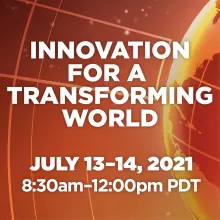
Innovation for a Transforming World—Now On-Demand Through August 14, 2021
The transformation of our industry never ceases. As the data storm builds, the drivers for digital disruption are coming together at the first global conference for Innovation for a Transforming World.
Accelerated by the response to the global pandemic, the innovations enabled by the semiconductor ecosystem continue to evolve at breakneck speed. The crises of the past year emerged as a powerful force that hastened the merging of the physical and digital worlds. This brought dramatic changes to our ways of life.
At the tip of this rapidly building iceberg of challenges and opportunities, every business is weighing the most favorable blend of preservation and innovation. The Innovation for a Transforming World virtual event will explore the optimal balance of resources for both preserving current expertise and customers, while seeing where to innovate to engage the next technology demands and fortunes.
It is a fusion of strategy and successful tactics. It begins with design, materials, workforce, advanced manufacturing, and now, it adds utilization of unprecedented volumes of data, via the Cloud and AI. Not only will we forecast equipment, fab, packaging and semiconductor market demand, but also trends for emerging markets and design.
Offering insights for the digital next steps, the collaborative value of SEMI’s members provides the foundation that has helped to deliver the most productive half century in history. This platform and its tremendous collective assets will serve to power the global economy for the next 50 years.
Going forward, the space between the physical and digital will shrink even further, enabling us to do things we’ve never done before. Unheard-of innovations will materialize with greater frequency and immeasurable impact. Sharing best practices that can be applied today is critical to transformations.
PRESENTATION TOPICS
Day 1—Digital Transformation
How will your business thrive through disruption, providing resiliency, vision, and culture?
Does your organization have a 360* view of customer needs and digital touch points?
What are the next business models?
How has the process for innovation changed in a more decentralized world?
Day 2—Market Symposium: Market Outlook, Technology Trends, Market Indicators and Drivers
Explore how to garner a competitive edge in times of crisis.
Gain new strategies for customer engagement.
Build business resilience during disruption.
Access mid-year market outlook, technology trends, market indicators, and drivers to help guide business decisions.
Hear expert insights from Altimeter | Bank of America, Merrill Lynch | Cornami | Dell Technologies | Deloitte | SEMI | TechSearch International and more.
United States
8:00 am
-
8:10 am
Ajit Manocha
CEO and President
SEMI
Welcome & SEMI Survey Results
8:10 am
-
8:20 am
Heidi M. Hoffman
Senior Director, Corporate Marketing
SEMI
SEMI Member Survey on COVID Response & Impact
8:20 am
-
8:40 am
Sven Smit
Chairman & Director
McKinsey Global Institute
Leading Toward and Beyond the COVID Exit
8:40 am
-
9:05 am
Jennie Raubacher
Global Head of Semiconductor, Clean Tech & Auto Tech Investment Banking
The demand for microelectronics surged this past year as the COVID-19 pandemic accelerated a digital transformation of the way many of us work and live.
Join your C-suite colleagues in a webinar, hosted by Ajit Manocha, President & CEO of SEMI, for an analysis of the emerging business landscape and what post-pandemic operations and opportunities will look like. Featured speakers from McKinsey & Co. and Wells Fargo Securities will share their insights on the impact of the surge and the economic policies being enacted to strengthen the worldwide economy.
This webinar is a timely forum to better gauge future demand and ongoing challenges – and how to adapt your business accordingly.
CEO Webinar Series: Surging Chip Demand, Digital Transformation, and the Pandemic – What’s Next?
8:00 am - 9:30 am
Off
Add to Calendar Disabled
America/Los_Angeles
Strengths & weaknesses of printed conductor and filler types
Understanding the performance criteria of conductive inks
Resistance measurement, sheet resistance vs volume resistivity, unit conversion, measuring film thickness and surface roughness
Understanding the microstructure of low temperature printable conductors
Percolation conductors: silver filled Polymer Thick Film (PTF) inks and isotropic ECAs
Sinterable conductors: nanoparticle, metalorganic/particle hybrids, and copper inks
Semi-sinterable conductors
Test methods for mechanical and environmental reliability
Overview of how printing methods work
Methods with a master: Screen, flexo, gravure, gravure offset
'Digital' or direct write methods for 2D & 3D: jet based, microdispense,
Conventional, non-equilibrium photonic, chemical, and mechanical methods for curing
Understand the resolution and sheet resistance limits to AM of circuits
Calculating the tradeoffs to selecting the appropriate conductor for achieving a specific sheet resistance
Transparent printable conductors and films
About the Instructor
Mike Mastropietro has spent his entire 20+ year career working with printable electronically functional materials and additive manufacturing methods for FHE devices including: formulation, conventional printing, direct write printing, equilibrium and non-equilibrium curing methods, and application development. Prior to joining ACI, he spent two years at NextFlex managing their printing/direct write programs, and overseeing material selection and integration into devices.
At 27, he cofounded a nanoparticle ink company, PChem Associates, whose unique low temperature sintering ink technology was acquired a decade later by NovaCentrix. He started his career at Parelec Inc., pioneers of hybrid particle-metalorganic decomposition (MOD) based inks. He has received an IPC Distinguished Committee Service award for his contributions PE/FHE standards and is a Nextflex fellow. Mike holds a M.S degree in chemical engineering from The Pennsylvania State University where his research on synthesis of surfactant stabilized nanoparticles was awarded a 2000 Materials Research Institute Xerox Research Award.
This FHE Master Class covers all the basics of using printable conductors for additive manufacture of circuits on polymer substrates. Attendees will learn about the different types classes of conductive inks available, and how to characterize their performance and cost. Students will also procure an overview of traditional and digital printing methods, drying/curing/sintering methods, and design and assembly differences compared to traditional ‘printed’ circuit boards.
This class is offered OnDemand.
Printing, Curing and Characterization Methods for Printable Conductors
Flexible Electronics Master Class
Originally recorded - September 8, 2021
10:00 am - 12:00 pm
Off
Add to Calendar2021-09-08 10:00:002021-09-08 12:00:00FlexTech Master Class #8 MaterialsThis FHE Master Class covers all the basics of using printable conductors for additive manufacture of circuits on polymer substrates. Attendees will learn about the different types classes of conductive inks available, and how to characterize their performance and cost. Students will also procure an overview of traditional and digital printing methods, drying/curing/sintering methods, and design and assembly differences compared to traditional ‘printed’ circuit boards.
This class is offered OnDemand. United StatesSEMI.org[email protected]America/Los_Angelespublic
America/Los_Angeles
In a flash last March, employees worked from home, and teleconferencing became a way of life. Executives adopted new guidelines and ensured employees had the proper technology and secure networks to be productive. The workforce adapted, engineers are designing around the world around the clock, and employers are more open to where people work.
Learn about—
Increased productivity
New physical office space setup
Using the cloud to overcome technology issues
Corporate travel
Plus more
Learn why some companies offer more flexibility for employees to work from home at least part of the time. Also, why others may not require new employees to re-locate; perhaps something technology has made easier.
The co-hosts, ESD Alliance and Accellera are looking beyond the pandemic as companies start bringing employees back to the office. A panel of experts explores an executive view and strategies of how the transition from remote work back to the office will unfold.
The Executive View—Returning to the Office
Hosted by ESD Alliance and Accellera
August 11, 2021
9–10am PDT































 and
and