INAUGURAL EVENT FOCUSED ON SMART MANUFACTURING & SMART MOBILITY
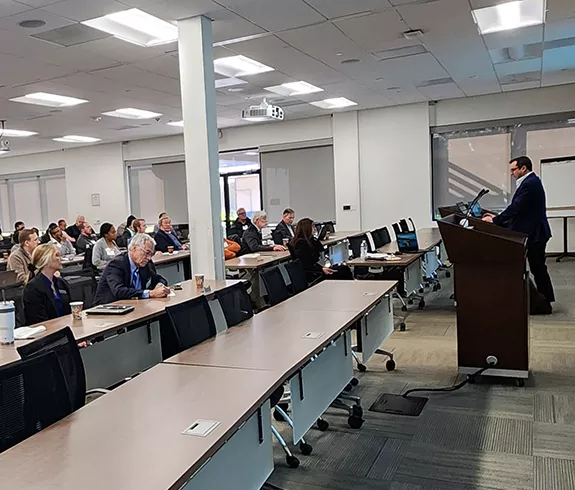
Join us for a groundbreaking Midwest conference and tradeshow on April 1-2, 2025, focused on Smart Manufacturing and Smart Mobility with an emphasis on the semiconductor industry! Automotive electronics and smart manufacturing are two of the key end markets on the path to $1T in semiconductor revenue.
A significant amount of both markets is concentrated in the Midwestern United States. SEMIEXPO in the Heartland will bring these two key markets together and provide an opportunity for collaboration and growth.
Smart Manufacturing
The program will focus on the deployment of Industry 4.0 or Smart Manufacturing tools, technologies, and methods for the semiconductors required for this growing market.
Smart Mobility
The program will unite stakeholders in the semiconductors/sensors and mobility ecosystems to identify and address technical issues and supply chain dynamics that are best addressed collectively.
Ways to Participate
Exhibit
Sponsor
Speak
Attend
MAKE YOUR MARK AT THE INAUGURAL SEMIEXPO HEARTLAND
Plan Now to Exhibit or Sponsor. Contact— Shane Poblete | +1 202-847-5983 | [email protected]
NEW EVENT!
April 1–2, 2025
Indiana Convention Center, Indianapolis, IN
Off
Add to Calendar2026-04-29 00:00:002026-04-30 00:00:00SEMIEXPO Heartland 2026Indiana Convention Center 100 S Capitol Ave Detroit, MI United StatesSEMI.org[email protected]America/Detroitpublic
America/Detroit
Your company has built a strong patent portfolio — now what? This webinar will discuss strategies for managing existing patents, including how to use IP to strengthen your business and maximize return on investment. Topics will include best practices for patent marking, controlling rising maintenance fees, and licensing, as well as insights into emerging trends in patent enforcement and litigation in the semiconductor sector.
ABOUT THE SPEAKER
Michael Jones, Partner, Rothwell Figg Michael H. Jones’s practice includes patent litigation, patent prosecution, and IP counseling. Michael advises clients who have developed a broad range of technologies, including semiconductor devices and manufacturing, integrated circuits and systems, green energy, terahertz electronics, hardware and protocols for wireless communications, and various online technologies. Although much of his work is with large multinational clients with complex patent portfolios, Michael also has a significant, and growing, practice with smaller high-technology clients, ranging from startups to growth companies dealing with patent issues for the first time in their evolution. Michael has a B.S. in Electrical and Computer Engineering from University of Virginia, a M.S. in Electrical and Computer Engineering from University of California, Santa Barbara, and a J.D. from The George Washington University Law School.
Best Practices for Semiconductor Patent Portfolio Management
Flexible Electronics Master Class #23
10:00 am - 12:00 pm
Off
Add to Calendar2024-11-06 10:00:002024-11-06 12:00:00FEMC #23 Best Practices for Semiconductor Patent Portfolio ManagementUnited StatesSEMI.org[email protected]America/Los_Angelespublic
America/Los_Angeles
A high quality patent can turn an innovation into a valuable business asset. Strategic drafting of patent applications and the management of the prosecution of the application around the world is essential to obtaining maximum value. Learn how to ensure your valuable innovation remains protected while avoiding common pitfalls, including losing rights through errors like public disclosure or incomplete protection.
ABOUT THE SPEAKER
Brian Rosenbloom, Partner, Rothwell Figg With over two decades of experience in the intellectual property (IP) field and a strong technical background in the electrical and software arts, Rothwell Figg partner Brian Rosenbloom is an expert in patent prosecution, IP counseling, and patent litigation proceedings before the U.S. Patent and Trademark Office and in district courts across the country. Brian represents clients ranging from Fortune 100 companies to independent inventors, entrepreneurs, and emerging enterprises, and works with a broad range of technologies. Brian received a Bachelor’s degree in Electrical Engineering from Columbia University (Tau Beta Pi Engineering Honor Society, Eta Kappa Nu Electrical Engineering Honor Society), and worked as a software engineer at General Electric Information Services for several years. After working at GE, he pursued a law degree and received a J.D. from Georgetown University Law Center (cum laude).
How to Protect Your Valuable IP in the Microelectronics Industry
Flexible Electronics Master Class #22
10:00 am - 12:00 pm
Off
Add to Calendar2024-10-30 10:00:002024-10-30 12:00:00FEMC #22 How to Protect Your Valuable IP in the Microelectronics IndustryUnited StatesSEMI.org[email protected]America/Los_Angelespublic
In this webinar, Jenny Colgate and Mark Rawls, experienced “high technology” litigators, explore the emerging legal challenges posed by artificial intelligence in both the semiconductor and medtech industries, delving into issues such as intellectual property, breach of contract, unfair competition, data privacy and security, and liability for AI-driven decisions. Attendee will gain insights into effective risk mitigation strategies, understand the evolving legal landscape, and learn how to navigate the complexities of AI litigation in these critical sectors
ABOUT THE SPEAKERS:
Jenny Colgate is an experienced litigator whose expertise extends into all facets of intellectual property and technology-related matters, including patents, data protection, trade secret, unfair competition, trademark, copyright, breach of contract, and fraud claims. Jenny works across many subject areas, including artificial intelligence, healthcare, semiconductors, software, and consumer products. In addition to Jenny’s litigation practice, she also regularly counsels clients on AI governance programs, IP protection and enforcement, privacy law compliance and best practices, and contract/licensing issues. A recognized thought leader, Jenny routinely authors expert analyses and speaks on panels and webinars. Jenny has a B.A. from University of Pennsylvania (summa cum laude, with honors), an L.L.M. in intellectual property from University of New Hampshire Franklin Pierce Law center (magna cum laude), and a J.D. from University of New Hampshire Franklin Pierce Law Center (magna cum laude). Jenny is a certified CIPP/US privacy professional and has completed the IAPP AI Governance Professional training program.
Mark Rawls’ practice consists of a mixture of patent prosecution and litigation, as well as technology-related work such as the preparation of opinions, licensing, and post-grant work. His clients are in a wide range of industries, including such diverse fields as electronics, software, telecommunications, energy, medical devices, artificial intelligence and machine learning, and farm equipment manufacturing, and come from all over the world. These companies run the gamut from very small, startups to sophisticated global concerns with large patent portfolios. Prior to his legal career Mark was a computer scientist at Raytheon BBN Technologies, focusing on applying artificial intelligence/machine learning to speech recognition and machine translation technologies. This work also included working carefully with large language models to improve the accuracy of the speech recognition and machine translation models. This industry experience has given him a particular facility with software and software-adjacent technologies, including with artificial intelligence/machine learning. Mark holds a B.S. in Computer Science and Mathematics (magna cum laude) and an M.S. in Mathematics from University of Virginia in addition to a J.D. from William and Mary Law School (magna cum laude).
Navigating the Legal Landscape: AI Litigation Risks in Semiconductor and Medtech
Flexible Electronics Master Class #21
10:00 am - 12:00 pm
Off
Add to Calendar2024-09-25 10:00:002024-09-25 12:00:00FEMC#21 Navigating the Legal Landscape: AI Litigation Risks in Semiconductor and MedtechUnited StatesSEMI.org[email protected]America/Los_AngelespublicRegister Now
As artificial intelligence (AI) continues to transform the MedTech and semiconductor landscapes, it brings forth a myriad of opportunities and challenges that demand careful attention to governance and compliance. In this webinar, Jenny Colgate, an experienced intellectual property, privacy, and data governance lawyer, will share her expertise and insights on implementing effective AI governance frameworks including: (1) an introduction to AI governance; (2) the evolving AI and privacy regulatory landscape; (3) ethical considerations and best practices; (4) establishing an AI governance program for your organization; and (5) follow-through and enforcement.
ABOUT THE SPEAKER:
Jenny Colgate is an experienced litigator whose expertise extends into all facets of intellectual property and technology-related matters, including patents, data protection, trade secret, unfair competition, trademark, copyright, breach of contract, and fraud claims. Jenny works across many subject areas, including artificial intelligence, healthcare, semiconductors, software, and consumer products. In addition to Jenny’s litigation practice, she also regularly counsels clients on AI governance programs, IP protection and enforcement, privacy law compliance and best practices, and contract/licensing issues. A recognized thought leader, Jenny routinely authors expert analyses and speaks on panels and webinars. Jenny has a B.A. from University of Pennsylvania (summa cum laude, with honors), an L.L.M. in intellectual property from University of New Hampshire Franklin Pierce Law center (magna cum laude), and a J.D. from University of New Hampshire Franklin Pierce Law Center (magna cum laude). Jenny is a certified CIPP/US privacy professional and has completed the IAPP AI Governance Professional training program.
The Department of Defense needs non-linear advances in gas-phase sensing to identify chemical threats, toxic industrial compounds, and physiological changes present in human breath. Currently, fieldable instruments for gas analysis are large (>0.5 cubic feet), expensive (>$50,000), and slow. Hand-held devices are limited to identification of specific targets such as nitrogen oxide, oxygen, and carbon dioxide or generalized estimated concentration of total volatile organic compounds (VOCs). Biohybrid sensing involves combining biological sensory elements with electronic components in a SWaP-C solution for fast and accurate detection of VOCs. Unprecedented VOC sensing potential lies within the biological sense of olfaction, which boasts rapid, selective, and sensitive capability to identify hundreds of thousands of compounds in complex environments. However, there are currently no commercially available devices harnessing the capability of olfaction due to the challenges in the bioelectronic interfacing necessary for maintaining long-term stability and environmental conditions necessary to sustain olfactory signaling elements (whether it be at the organ-, cell-, or protein-level). This course will provide an overview of the current state of biohybrid VOC sensing comparing and contrasting examples utilizing olfactory organ/tissue-based, cell-based, and protein-based modalities.
ABOUT THE SPEAKER
Dr. Elisabeth Steele is a biomedical engineer at Blue Halo serving as a Lead Scientist and Team Lead supporting sensor development at the Air Force Research Laboratory (AFRL). Her expertise is in neural tissue engineering and electrophysiology with recent focus in the design and testing of biohybrid gas sensors inspired by insect olfaction. Dr. Steel conducted neuromodulation research as a post-doctoral fellow with Dr. Tim Bruns at the University of Michigan. Additionally, she served as a Technical Sales Engineer with NeuroNexus Technologies, the industry leader in microelectrode array technology for neuroscience electrophysiology applications. She received her PhD (2018) and M.S. (2013) in Biomedical Engineering from Wayne State University in Detroit, Michigan. She completed her B.S. in Bioengineering in 2007 from University of Toledo.
This webinar features Dr. Elisabeth Steele of UES covering the status of non-linear advances in gas-phase sensing to identify chemical threats, toxic industrial compounds, and physiological changes present in human breath.
Biohybrid Sensing Systems for Volatile Organic Compounds
Flexible Electronics Master Class #18
10:00 am - 12:00 pm
Off
Add to Calendar Disabled
America/Los_Angeles
Watch Now!
The healthcare industry has transformed over the last twenty-five years due to the co-development of diagnostics along with state-of-the-art therapeutics and treatments; notably, this has led to the field of companion diagnostics. The best example of this is the prescribed use of insulin based on glucose levels monitored via test strips or the continuous glucose monitor. The future goal of medicine is to have truly personalized treatment protocols based on an individual’s biometrics, physiology, and exposure.
However, this goal requires further identification and quantitation of biomarkers and health exposures, both biological and chemical, both at the point-of-care as well as in real-time. Therefore, technologies are needed that can miniaturize current diagnostics to make them inexpensive, simple-to-use, and ideally wearable.
However, where and what to sense remains a critical question to solve, as each biofluid, including blood, sweat, saliva, tears, breath, and exhaled breath condensate contains a different profile of biomarkers. Additionally, biomarkers have vastly different physiochemical properties and abundances, which present different challenges as well as require a range of sensing modalities. Therefore, this course will be an overview of the “What, Where, and How of Sensing to Meet Current and Future MedTech Needs”. At the end of the course, a perspective of where these technologies can impact the future of health outcomes will be presented as well as key considerations for future technologies to gain commercial acceptance
ABOUT THE SPEAKER
Dr. Michael Brothers, PMP currently is a Principal Scientist and Technical Program Manager at UES, a Blue Halo Company. In these roles, Dr. Brothers supervises contractors executing research to identify biomarkers indicative of human performance, develop novel sensors, as well as field research. Dr. Brothers also serves as a subject matter expert on biochemical sensors, both in the liquid phase and gas phase, for the 711th Human Performance Wing at Wright Patterson Air Force Base.
Notably, Dr. Brothers has co-authored multiple publications and patents on using novel sensing modalities to sense in complex fluids and environments, including jet fuel, sweat, saliva, and breath. Dr. Brothers has also served as the Principal Investigator on sensor development efforts for both optical based gas sensors and flexible, ink-printed gas sensors for wearable applications.
Dr. Brothers has his Ph.D. from the University of Illinois Urbana-Champaign in Chemical Biology and his B.S. in Chemistry and Biology from the University of Cincinnati.
This webinar featured Dr. Michael Brothers of UES, a Blue Halo Company, outlining the status of personalized medical treatment protocols based on an individual’s biometrics, physiology, and exposure. This course will be an overview of the “What, Where, and How of Sensing to Meet Current and Future MedTech Needs"
Perspectives on Biosensor Applications
Flexible Electronics Master Class #17
10:00 am - 12:00 pm
Off
Add to Calendar Disabled
America/Los_Angeles
Watch Now
2024 Technology Workshops Enabling the Future of Electronics
Registration
Registration Fee (April 16 & 17 only)
$250 members $399 non-members
SEMI members who wish to join the NextFlex Workshop on April 19th should contact [email protected] for a special discount code.
Cancellation Policy
Cancellations received on or before March 16, 2024, are fully refunded with a $50 processing fee. Refunds will not be issued for cancellations (including no-shows) made after March 16, 2024, and only substitutions are accepted with a written note from the registered attendee. Please email your cancellations or substitutions on company letterhead to Michelle Fabiano at [email protected].
4610 Vestal Pkwy E, Vestal, NY 13850 TEL: (607) 770-8500
SEMI NBMC Technical Gap Analysis Workshop - Tues. 4/16 - 8 am-6 pm During this workshop, attendees will address the technical topics / gaps in the Nano-Bio Materials space to explore topics and technology development required to meet development objectives. Breakfast, and lunch will be included and reception at the end of the day will be included.
SEMI FlexTech FHE Technical Gap Analysis Workshop - Wed. 4/17 - 8 am-4 pm, followed by tours of Binghamton University labs Attendees will then turn their sights to completing a Technical Gap Analysis in preparation for FlexTech’s next Request for Proposals (RFP), including exploring topics and technology development required to meet development objectives. Breakfast, lunch and tours of Binghamton University lab tours will conclude the day.
Binghamton University Tours - Wed. 4/17 - 4:00pm - 5:30pm The tour will include facilities that are part of the S3IP (Small Scale Systems Integration & Packaging) a New York State Center of Excellence, CAMM (Center for Advanced Microelectronics Manufacturing) a New York State Center of Advanced Technology and home to the New York Node of NextFlex, the Analytical & Diagnostics Laboratory, the IEEC (Integrated Electronics Engineering Center) a New York State Center of Advanced Technology and NECCES (the Northeast Center for Chemical Energy Storage).
Binghamton University 2024 Art of Science Exhibit - Wed. 4/17 - 4:00pm - 5:30pm Binghamton University holds an annual contest that celebrates the beauty of science through photographs and images that describe some aspect of research and captured visually. The advances in imaging technology and tools mean that scientists have an increased ability to generate exciting data as well as to create compelling works of art and workshop attendees are invited to the opening reception for the 2024 Art of Science Exhibit in the atrium of the Center of Excellence Building. Contest winners will be announced, and refreshments will be served.
In addition: NextFlex Workshop– Thurs, 4/18 NextFlex will convene the hybrid electronics community for a one-day workshop at Binghamton University in New York on April 18 to explore and define collaborative responses to soon to be announced opportunities under the CHIPS and Science Act, including the National Advanced Packaging Manufacturing Program (NAPMP), with a specific focus on advancing hybrid electronics for industrial and medical applications.
Attendees will break into groups for smaller discussions to identify challenges, prioritize those challenges and identify opportunities on critical issues discussed throughout the morning session.
Additively Manufactured Flexible " Smart" Packaging and Reconfigurable On-Package Antenna Arrays for Next Generation 5G/mm Wave System on Package Designs
Attendees will break into groups for smaller discussions to identify challenges, prioritize those challenges and identify opportunities on critical issues discussed throughout the morning session.
2:35 pm
-
2:50 pm
Break
2:50 pm
-
4:00 pm
Breakout Sessions Readout
4:00 pm
-
5:30 pm
Binghamton University Laboratory Tours & 2024 Art of Science Exhibit and Reception
The tour will include facilities that are part of the S3IP (Small Scale Systems Integration & Packaging) a New York State Center of Excellence, CAMM (Center for Advanced Microelectronics Manufacturing) a New York State Center of Advanced Technology and home to the New York Node of NextFlex, the Analytical & Diagnostics Laboratory, the IEEC (Integrated Electronics Engineering Center) a New York State Center of Advanced Technology and NECCES (the Northeast Center for Chemical Energy Storage).
Join leaders from FlexTech, NBMC, NextFlex and the microelectronics industry in this dynamic workshop, where we'll explore advancements, challenges, and solutions in critical technologies like flexible hybrid electronics, hybrid electronics, wearables, bio-signal sensing for real-time cognitive and physical state monitoring, and more. Participate in hands-on sessions, cross-disciplinary discussions, and gain insights from industry and academia through impactful talks. Contribute your suggestions in dynamic breakout sessions to shape and enable the future of these technologies.
2024 Technology Workshops Enabling the Future of Electronics
- NBMC Gap Analysis
- FHE Gap Analysis
- NextFlex Workshop (April 18 - separate registration)
7:30 am - 6:00 pm
Off
Add to Calendar2024-04-16 07:30:002024-04-17 18:00:002024 Technology Workshops Enabling the Future of ElectronicsPresented by Hosted by Join leaders from FlexTech, NBMC, NextFlex and the microelectronics industry in this dynamic workshop, where we'll explore advancements, challenges, and solutions in critical technologies like flexible hybrid electronics, hybrid electronics, wearables, bio-signal sensing for real-time cognitive and physical state monitoring, and more. Participate in hands-on sessions, cross-disciplinary discussions, and gain insights from industry and academia through impactful talks. Contribute your suggestions in dynamic breakout sessions to shape and enable the future of these technologies.Binghamton University, Innovative Technologies Complex (ITC) 85 Murray Hill Rd Vestal, NY 13850 United StatesSEMI.org[email protected]America/Los_Angelespublic
Event Contact
For questions, please contact Michelle Fabiano at [email protected].
For many generations of technology nodes, Moore’s Law has reliably delivered the doubling of transistor density every 1.5-2 years while bringing down the cost per transistor. However, in recent advanced nodes, Moore’s Law has slowed down and the cost of advanced node chips has increased.
To keep up with performance demands, manufacturers have continued to increase chip size to have large System on Chip (SoCs), and we have seen chip sizes reach the lithographic reticle limits. Moreover, increasing chip size beyond reticle limits also decreases chip yields and contributes to increasing the cost of manufacturing. Thus, increasing chip sizes beyond reticle limits is not a solution.
The semiconductor industry needs to be on the path of delivering more performance and functionality at reasonable prices despite the slowing of Moore’s Law.
One popular approach the industry is adopting to deliver improved performance is focusing on advanced packaging, including the use of chiplets, hybrid bonding and state of the art 3D stacked systems. This course will discuss the meaning and the need for advanced packaging and dive deeper into each one of these advanced packaging approaches.
Outline
Need to Advanced Packaging
Types of Advanced Packaging
3D bonding and Intro to Hybrid Bonding for Advanced Packaging
Types of Hybrid Bonding, Current Status and Challenges
Future opportunities in Hybrid Bonding
Summary
Featured Speaker Biography:
Arsalan Alam is a Sr. Packaging Engineer at AMD’s Advanced Packaging Group in Austin, Texas. He completed his PhD in Electrical and Computer Engineering with the Center for Heterogeneous Integration and Performance Scaling (CHIPS) group at the University of California, Los Angeles, in 2021. He received his Master’s degree in Microelectronics and VLSI from IIT Roorkee, India and his Bachelor’s degree in Electronics and Communication Engineering from the Zakir Hussain College of Engineering and Technology, India. His research interest is in advanced packaging, including FOWLP, 2.5D, and 3D. He holds about 20 publications and two patents with multiple patents pending. He was the winner of the IEEE EPS Packaging Vision Award, 2020 and recipient of the Broadcom Foundation Fellowship, 2017-2018.
This course will discuss the meaning and the need for advanced packaging such as chiplets, and 3D stacked systems, with a deep dive into hybrid bonding.
Our speaker will be a young, but distinguished engineer from AMD's Advanced packaging Group in Austin, Texas, Dr. Arsalan Alam. Come up to speed quickly and efficiently on the latest thinking on how the semiconductor industry will be delivering more performance and functionality despite the physical limitations of the atom.
Introduction to Hybrid Bonding for Advanced Packaging
A Flexible Electronics Course
10:00 am - 12:00 pm
Off
Add to Calendar Disabled
America/Los_Angeles