-
FlexTech
Off
Add to Calendar2020-10-28 00:00:002020-10-30 00:00:00FLEX China 2020Suzhou Shi Jiangsu Sheng ChinaSEMI.org[email protected]America/Los_Angelespublic
For late submissions please contact:
Michelle Fabiano [email protected]
20 Years of Driving Innovation to Make the World Safer
You'll hear experts highlight the latest technical breakthroughs, unique electronics applications, and business strategies giving insight into the future of next-generation Integration beyond Moore's law era. Key technologies and markets in the areas of Smart Medical, Smart Mobility, Smart Manufacturing, Data, AI, and Displays will be explored throughout each technical track presented each day of FLEX week.
Flexible hybrid electronics (FHE) present unique heterogeneous integration capabilities with unprecedented continuity with us and our world. This softer side of electronics represents high performance integrated devices that are curved and variable in form factor. Electronics that augment our daily activities and interact with our surroundings like no personal computing device ever has are emerging in new and varied application spaces.
KEY TOPICS
February 22 » Session 1—FHE Systems
February 23 » Session 2—Materials Processing
February 24 » Session 3—Sensors & MEMS
February 25 » Session 4—Sustainability & Power
February 26 » Industry Virtual Tours
ON-DEMAND AVAILABILITY
February 15–21
Prepare and preview the On-Demand presentations in order to join each day ready for the interactive panel discussions and luminary keynote discussions.
February 26–March 26
All content will be available for 30 days On-Demand in case you missed anything during FLEX week.
WHO ATTENDS?
Celebrating its 20th year, the online event will gather executives, product managers, business development professionals, and engineering directors as well as leading industry analysts and media for the latest developments, trends, and innovations in flexible hybrid electronics (FHE). More than 400 companies, universities, R&D labs, and government agencies from around the world have participated in FLEX conferences each year.
Please fill out the FLEX Interest Formto stay updated on FLEX 2021 Conference & Expo.
FLEX IS GOING VIRTUAL!
This is the 20th Anniversary of the FLEX Conference & Expo.
Thank you to the entire FLEX community, committee members, sponsors, attendees, and exhibitors, for your support. We are proud to have you with us on the journey into the next 20 years and beyond.
This course, originally recorded on August 18, 2020, describes how machine learning and AI-based approaches to research, development, and production brings advantages to cleanroom processes. AI-based identification of time-varying equipment performance, and the effects of the previous recipe used on the outcome of the current desired methods, are just some of the ways AI can be used to reduce the process variability.
Cornell University has applied AI approaches to optimize lithography and etching processes involved in the development of an RF wake-up NEMS (Nano ElectroMechnical system) switch that needs a well-controlled gap between a moving shuttle and a contact. This presentation highlights that, as well as a decision tree based AI model for predicting lithography outcomes.
The AI work used as the basis for the course has been applied to plasma etching and the combined prediction of lithography and thin-film etching, using CD-SEM imagery for feature extraction and modeling process variables. Additional approaches to train process-modeling CAD tools to result in better process development experience have been developed.
The course provides a useful basis upon which to formulate AI strategies for all thin film manufacturing sites.
This on-demand course, originally recorded on August 18, 2020, describes how machine learning and AI-based approaches to research, development, and production brings advantages to cleanroom processes. AI-based identification of time-varying equipment performance, and the effects of the previous recipe used on the outcome of the current desired methods, are just some of the ways AI can be used to reduce the process variability.
Artificial Intelligence in Thin Film Manufacturing
A Flexible Electronics Master Class
10:00 am - 12:00 pm
Off
Add to Calendar2020-08-18 10:00:002020-08-18 12:00:00Flexible Electronics Master Class#2: AI in MfgThis on-demand course, originally recorded on August 18, 2020, describes how machine learning and AI-based approaches to research, development, and production brings advantages to cleanroom processes. AI-based identification of time-varying equipment performance, and the effects of the previous recipe used on the outcome of the current desired methods, are just some of the ways AI can be used to reduce the process variability.United StatesSEMI.org[email protected]America/Vancouverpublic
America/Vancouver
This course describes how machine learning and AI-based approaches to research, development, and production brings advantages to cleanroom processes. AI-based identification of time-varying equipment performance, and the effects of the previous recipe used on the outcome of the current desired methods, are just some of the ways AI can be used to reduce the process variability.
The team from Cornell has applied AI approaches to optimize lithography and etching processes involved in the development of an RF wake-up NEMS (Nano ElectroMechnical system) switch that needs a well-controlled gap between a moving shuttle and a contact. We report on a decision tree based AI model for predicting lithography outcomes.
This work is being applied to plasma etching and the combined prediction of lithography and thin-film etching, using CD-SEM imagery for feature extraction and modeling process variables. Additional approaches to train process-modeling CAD tools to result in better process development experience are developed.
This course describes how machine learning and AI-based approaches to research, development, and production brings advantages to cleanroom processes. AI-based identification of time-varying equipment performance, and the effects of the previous recipe used on the outcome of the current desired methods, are just some of the ways AI can be used to reduce the process variability.
Originally recorded August, 2020, this course is now offered On-Demand.
Artificial Intelligence in Thin Film Manufacturing
As new materials and process emerge to enable the integration of high performance micro-electronics into paper-thin, flexible hybrid electronics (FHE), there is an increasing demand for new power sources that also support the goals of ultra-thin and flexible.
Among the key challenges is the ability to achieve high energy densities as the battery thickness decreases to a point where the packaging becomes an increasing fraction of the total volume. The challenge is further complicated by the demanding duty cycles for many FHE systems that require both high power (periodic, large current bursts) and high energy (operation across many years in some cases).
At the same time, the new power sources must meet the typical high standards for safety, durability, compatibility with a wide range of storage and operation temperatures, and the needs to support effective integration into the FHE platforms.
The session reviews the challenges and progress for new power supplies that are emerging to meet the needs of the FHE community.
Course provided by Brian Berland, Chief Technology Officer, ITN Energy Systems
#2 AI in Thin-Film Manufacturing (2 hours)
This session describes how machine learning and AI-based approaches to research, development, and production brings advantages to clean room processes. AI-based identification of time-varying equipment performance, and the effects of the previous recipe used on the outcome of the current desired methods, are just some of the ways AI can be used to reduce the process variability.
The team from Cornell University has applied AI approaches to optimize lithography and etching processes involved in the development of an RF wake-up NEMS (Nano Electro Mechnical system) switch that needs a well-controlled gap between a moving shuttle and a contact. The work is applied to plasma etching and the combined prediction of lithography and thin-film etching, using CD-SEM imagery for feature extraction and modeling process variables. Additional approaches to train process-modeling CAD tools to result in better process development experience are developed and explained in this session.
Course instructors includes Amit Lal, Chris Ober, Peter Doerschuk, Banyamin Davaji from Cornell University, and Garry Bordonaro and Jeremy Clark with the Cornell NanoScale Facility.
#3 Hybrid Integration Techniques for Flexible Electronics (1.5 hours)
The 1-hour class describes techniques practiced at PARC for the fabrication of flexible hybrid electronics. Topics include printing interconnects, logic circuits and resistors, bonding integrated circuits and integrating sensors of different types. The techniques are illustrated with various examples of wireless sensor prototypes on flexible substrates, and also development of electronics on textiles.
Specific topics covered in this session include:
printing interconnects
printing fine lines, pads and pad pitches with < 100um
logic circuits and resistors
bonding integrated circuits
integrating sensors of different types on flexible substrates without significant performance degradation
pick and place with micron-level accuracy
Course instruction given by Robert Street, Palo Alto Research Center
#4 Flexible Electronics Reliability Testing and Challenges (1.5 hours)
This online Reliability Engineering Master class is for people with an engineering or science background, who want to learn and use methods and techniques to conduct reliability analysis and improvement. This course is intentionally structured to show you a wide variety of reliability engineering knowledge and important applications.
This session outlines the foundation reliability engineering concepts and methods, and how to apply fundamental failure investigation techniques. You will also learn a range of effective workplace improvement solutions and risk analyses used to implement reliability engineering strategies.
Course Instruction given by Dave Rasmussen and Tom Seputis, Molex.
Flexible Hybrid Master Classes for 2021 are offered on many additional topics! Visit this page for entire list and links to more detailed information on each one.
SEMI FlexTech organizes this series of Flexible Electronics Master Classes on topics proving most challenging to the design, manufacture and use of flexible and printed electronics. The series enables product designers, integrators, and others new to the fields to evaluate technologies and components and make the best choices for their product.
The courses were offered to a live audience July-October, 2020, and are now available on-demand.
Flexible Electronics Master Class Series
Power Sources, Integration & AI and Reliability in Thin-Film Manufacturing
Master Class Abstract:As new materials and process emerge to enable the integration of high performance micro-electronics into paper-thin, flexible hybrid electronics (FHE), there is an increasing demand for new power sources that also support the goals of ultra-thin and flexible.
Among the key challenges is the ability to achieve high energy densities as the battery thickness decreases to a point where the packaging becomes an increasing fraction of the total volume. The challenge is further complicated by the demanding duty cycles for many FHE systems that require both high power (periodic, large current bursts) and high energy (operation across many years in some cases).
At the same time, the new power sources must meet the typical high standards for safety, durability, compatibility with a wide range of storage and operation temperatures, and the needs to support effective integration into the FHE platforms.
The webinar will review challenges and progress for new power supplies that are emerging to meet the needs of the FHE community.
SEMI FlexTech offers a series of Flexible Electronics Master Classes on topics proving most challenging to the use of flexible and printed electronics. The series enables product designers, integrators, and others new to the fields to evaluate technologies and components and make the best choices for their product.
The first course in the series is on Flexible Power Sources: Challenges, Progress and Integration. This course was offered to a live audience on July 29, 2020, and is now available on-demand.
Flexible Power Sources: Challenges, Progress, and Integration
The first in the FlexTech Master Class Series
11:00 am - 12:00 pm
Off
Add to Calendar Disabled
America/Vancouver
Master Class Abstract:As new materials and process emerge to enable the integration of high performance micro-electronics into paper-thin, flexible hybrid electronics (FHE), there is an increasing demand for new power sources that also support the goals of ultra-thin and flexible.
Among the key challenges is the ability to achieve high energy densities as the battery thickness decreases to a point where the packaging becomes an increasing fraction of the total volume. The challenge is further complicated by the demanding duty cycles for many FHE systems that require both high power (periodic, large current bursts) and high energy (operation across many years in some cases).
At the same time, the new power sources must meet the typical high standards for safety, durability, compatibility with a wide range of storage and operation temperatures, and the needs to support effective integration into the FHE platforms.
The webinar reviews challenges and progress for new power supplies that are emerging to meet the needs of the FHE community.
SEMI FlexTech offers a series of Flexible Electronics Master Classes on topics proving most challenging to the use of flexible and printed electronics. The series enables product designers, integrators, and others new to the fields to evaluate technologies and components and make the best choices for their product.
The first course in the series is on Flexible Power Sources: Challenges, Progress and Integration. This course was offered to a live audience on July 29, 2020, and is now available on-demand.
Flexible Power Sources: Challenges, Progress, and Integration
The first in the FlexTech Master Class Series
12:00 am - 12:00 am
Off
Add to Calendar Disabled
America/Vancouver
[SMART MedTech Virtual Workshop 4] Automation, Augmentation, and AI
Registration
Registration Includes:
Live access to four (4) webinars
Post-webinar access to recordings and presentations
Member Price: $199
Non-Member Price: $399
Non-Member Price for Government, Military, and Academia: $249
(Contact Michelle Fabiano at [email protected] for discount code. Must have a valid .gov, .mil or .edu email address)
Recent developments in both biological data acquisition and analysis provide new opportunities for data driven modeling of the health state of an organism. In this talk we explore geometric ideas and manifold learning methods for analyzing such data sets. In one example we examine the evolution of temperature patterns generated by telemetry data collected from healthy and infected Collaborative Cross mice challenged with Salmonella typhimurium. We visualize the interruption in circadian patterns and characterize the severity of infection within three days after exposure. This work was conducted in collaboration with David Threadgill and Helena Andrews-Polymenis of Texas A&M University.
10:30 am
-
10:55 am
Kevin Zhao
Co-Founder & CTO, Harmonize Health
Predictive & Prescriptive Analytics for Digital Health
A key to making digital care delivery easier is to augment biometric monitoring with predictive & prescriptive analytics. Optimized algorithms can efficiently tie together fragmented data sources, such as wearables & medical records. More importantly, they lay the foundation for intuitive workflows that guide clinical staff through effective triage & medical interventions.
10:55 am
-
11:20 am
Mary Clare McCorry, PhD
Director of Technology and Process Development, ARMI | BioFabUSA
Bringing Sensors and Automation to Manufacturing of Replacement Tissue and Organs
The tissue engineered medical product (TEMP) industry has been held back historically by a lack of scalability, challenges with product consistency, and high final product costs. Over the last three decades, cutting edge science in the space has continued to advance while manufacturing tools and equipment specific to the needs of the field has lagged behind in development. To propel TEMP technologies into the commercial market, automation and sensor technologies need to be developed and implemented to make practical the scalable, consistent, cost-effective manufacturing of TEMPs. BioFabUSA is program of the Advanced Regenerative Manufacturing Institute (ARMI), an industry-led, member-driven, non-profit organization funded by the department of defense dedicated manufacturing of engineered tissues and tissue-related technologies. ARMI | BioFabUSA coordinates technology development projects that crosscut manufacturing areas in raw materials, automation, equipment, software, sensors and measurement tools, data management, preservation, processes, quality systems, and other pertinent elements of tissue engineered medical product manufacturing. With the combined effort of the ARMI membership, ARMI drives impactful advanced research and development activities that enable the development of a scalable, modular, automated and closed platform for the fabrication of TEMPs. This platform relies heavily on the integration of sensors and automation necessary to advance manufacturing technology development and demonstration, paving the way for compressed timelines for process design and development, as well as commercial, GMP-compliant manufacturing.
11:20 am
-
11:45 am
Andreas Caduff
Industry Advisory Board Member, ETH Zürich
Using Digital Biomarkers and Diagnostics Towards More Holistic Health Mapping
With an ongoing shift from managing disease towards the inclusion of maintaining health the world has seen the rise of increasingly sophisticated body monitoring and analytics. These tools are aiming to empower the individual to better navigate own health. They are also seeking to generate powerful insights towards the detection of subclinical symptoms or processes via existing and novel digital biomarkers. In that context a topic that is receiving increasing interest is the modulation of human physiology around an individual ‘baseline’ in everyday life and the dynamic around that. Today, there is more and more fully contextualised and truly long-term physiological data becoming available that allows deeper insights into the response of the human body to our behaviour, exposed environment or health events per se. This provides real life data in an unprecedented way. Insights emerging from that are fascinating, sometimes surprising and increasingly instructional.
This talk will provide an overview of where we have come from, what we are currently at and what’s unfolding in the convergence of different domains towards such more integrated and holistic health mapping and new opportunities in real word evidence driven clinical trials.
[SMART MedTech Virtual Workshop 3] Human Wearables Enabling Rapid Decision Making in the Integrated Care Continuum
Registration
Registration Includes:
Live access to four (4) webinars
Post-webinar access to recordings and presentations
Member Price: $199
Non-Member Price: $399
Non-Member Price for Government, Military, and Academia: $249
(Contact Michelle Fabiano at [email protected] for discount code. Must have a valid .gov, .mil or .edu email address)
Wearable sensors can enable continuous collection of physiologic signals to measure physiologic parameters or identify signatures of disease. The combination of wearable sensors and artificial intelligence to continuously analyze data provides new approaches to patient monitoring at all levels of care. This talk will outline some of the factors that can affect the safety and performance of wearable patient monitoring systems from sensors to data-driven applications and discuss regulatory science approaches we are taking to address the challenges in their evaluation.
10:30 am
-
10:55 am
Ashleigh Coker
Program Lead for Cyber-physical Exploitation for Disaster and Emergency Response (CEDER), Air Force Research Laboratory, Sensors Directorate
Cyber Physical Sensing and Medical Internet of Things
In recent years, human wearable technologies have grown to include smart watches, fitness trackers, smart shirts, smart shoes, and more. While there seems to be overwhelming agreement that the data available from these devices [are useful], may radically improve healthcare decision making, and could pave the way toward a true, integrated care continuum, there is little acknowledgement of the complexity and cost of collecting, compiling, and presenting those data to allow healthcare providers and researchers to draw meaningful conclusions.
Despite a focus on personalized learning and readiness within the Air Force, the Performance-Enabled Operational Training Environments (PEOTE) work may emerge as an adaptable [system architecture] model for healthcare information technology and informatics systems to overcome these data proliferation challenges.
PEOTE, in development at Air Force Research Laboratory, is an approach to architecting information networks, by leveraging existing operational communications and data infrastructure and applying these pathways to training. The technologies and the methods in development enable the most flexible data collection and analysis capabilities by creating and leveraging standards-based data architectures, infrastructure capabilities, and data structures. When applied to a training scenario, this framework enables the use of biodata, not as human performance indicators, but as mission performance indicators.
This talk covers the networked training environment, how our team is developing performance measures, and some of the use cases we are exploring, including using the Survival Health Awareness Responder Kit (SHARK) data within Air Force Combat Search and Rescue mission training and large-force exercises.
11:20 am
-
11:45 am
Oxana Pantchenko, PhD
Program Manager for Medical Devices, NextFlex
State-of-the-Art in Wearable EEG, EOG and EMG Medical Devices
In this presentation, a review of wearable EEG, EOG, and EMG state-of the-art medical devices with clearance for US marketing will be discussed. A team comprising of researchers from NextFlex evaluated 510(k) cleared, de Novo granted, and PMA approved wearable medical devices by searching through various US FDA databases. Additionally, the team also examined adverse events reported through the Manufacturer and User Facility Device Experience database that houses medical device reports submitted to the FDA. Wearable EEG, EOG, and EMG medical device profiles will be presented discussed on usability for detecting decrement in human performance due to cognitive stress and/or cognitive fatigue.
[SMART MedTech Virtual Workshop 2] En Route Care (ERC) and Point of Care (POC) Diagnostics
Registration
Registration Includes:
Live access to four (4) webinars
Post-webinar access to recordings and presentations
Member Price: $199
Non-Member Price: $399
Non-Member Price for Government, Military, and Academia: $249
(Contact Michelle Fabiano at [email protected] for discount code. Must have a valid .gov, .mil or .edu email address)
The United States has executed Aeromedical Evacuation (AE) for over 100 years. Originating with the first crude attempts at evacuating patients on biplanes in 1918. AE has evolved directly in line with the medical capabilities and advancements in aircraft. AE now provides the United States Air Force (USAF) with a global reach on various cargo and refueling aircraft. In the late 1980s, specialized Critical Care Air Transport Teams (CCATTs) developed to augment AE crews. CCATTs drastically changed medical care provided in our nation’s battlespaces. They allowed for more agile far forward casualty care and forged the En Route Care (ERC) systems. ERC is the backbone ensuring the survival of our wounded warriors and bringing them home to their families. The challenges abound when functioning in the ERC system to include the environment, the available resources, and personnel limitations. Exploring and targeting these challenge areas will continue to allow ERC to keep in step with our ever‐changing mission requirements and progress the impressive legacy of bringing heroes home.
10:30 am
-
10:55 am
Zheng Yan, PhD
Assistant Professor, Mechanical and Aerospace Engineering; Biomedical, Biological and Chemical Engineering, University of Missouri, Columbia
Exploring the Easy and Cost-Effective Fabrication of Multifunctional On-Skin Wearable Biomedical Devices
As compared to conventional, rigid, bulky physiological monitoring tools, emerging onskin wearable biomedical devices are ultrathin, lightweight, and small footprint and can find wide applications in point of care diagnostics because of their easy deployment outside the hospital settings. At present, on-skin wearables are usually fabricated by patterning conventional inorganic materials, novel organic materials, or emerging nanomaterials on continuous (i.e., non-porous) flexible supporting substrates. Consequently, the state-of-the-art on-skin wearables often suffer from expensive precursor materials, costly fabrication facilities, complex fabrication processes, and limited functionalities and disposability. By using widely accessible pencils and papers as the fabrication tools, we have developed a rich variety of cost-effective and disposable on-skin bioelectronic devices, ranging from biophysical sensors and sweat biochemical sensors to thermal stimulators, humidity energy harvesters, and transdermal drug delivery systems. The enabled devices can find wide applications in point of care diagnostics, particularly in low-resource environments owing to their low-cost resources, handy operation, time-saving fabrication, and abundant potential designs. Besides, by using judiciously engineered porous elastomer as supporting substrates, on-skin wearable devices with high breathability and self-cooling capability can be achieved.
10:55 am
-
11:20 am
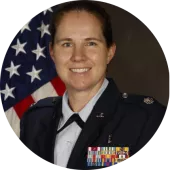
Lt Col Melinda Eaton
Virtual Health Program Manager & Deputy Program Manager for Pharmaceuticals, Devices, and Medical Support Systems, United States DoD Virtual Health Program Management Office
An overview of the DHA virtual health program including driving factors, high level requirements, and pathway forward. The presentation will also provide an update on the DoD virtual health COVID-19 response and the value provided to patient care through virtual health.
11:20 am
-
11:45 am
Azar Alizadeh, PhD
Principal Scientist, GE Research
Manufacturing of Disposable Wearable Patient Monitoring Devices
Wireless wearable devices can continuously assess and communicate the condition of patients and are crucial components of the are crucial components of the move towards digital, mobile health monitoring. We envision that widespread adoption of disposable wireless devices has the potential to radically transform care-giving in clinical settings. Implementation of continuous patient monitoring could make practices such as spot-checking patient vital signs during hospitalization obsolete. Furthermore, earlier patient discharge may become possible through earlier and safer patient mobilization enabled by wireless monitoring. In this talk, we will discuss flexible hybrid electronic manufacturing opportunities and challenges to create low cost, high performance wireless sensor systems for patient monitoring. These single use devices will support 3-Lead ECG, reflective SpO2, respiration rate and core body temperature sensing on a continuous basis for 72 hours.