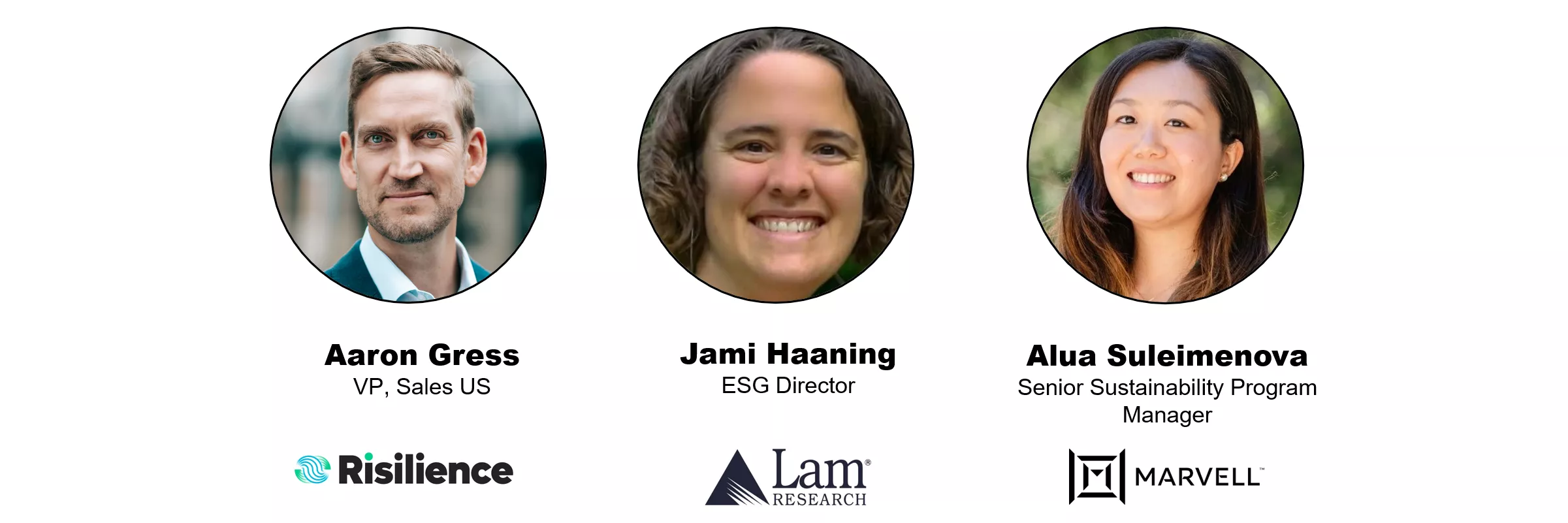
This exclusive event for SEMI members will help companies understand how to identify and measure climate risks in the semiconductor value chain, and develop strategies for integrating climate risk into internal business decisions. Join us for this 45-minute virtual session and strengthen your grasp of the leading edge of data-driven strategy and quantification for climate risk across our industry.
Times
2 Sessions available for global business hours:
EMEA: April 1, 2025 - 5:00-5:45 pm CET
America: April 1, 2025, 8:00-8:45 am or 5:00-5:45 pm Pacific Time
Asia Pacific: April 2, 2025 8-8:45 am Singapore
Navigating Climate Risk in the Semiconductor Value Chain
Metrics, Tactics & Strategies
Off
Add to Calendar2025-04-01 00:00:002025-04-02 00:00:00Navigating Climate RiskThis exclusive event for SEMI members will help companies understand how to identify and measure climate risks in the semiconductor value chain, and develop strategies for integrating climate risk into internal business decisions. Join us for this 45-minute virtual session and strengthen your grasp of the leading edge of data-driven strategy and quantification for climate risk across our industry.Times2 Sessions available for global business hours:EMEA: April 1, 2025 - 5:00-5:45 pm CETAmerica: April 1, 2025, 8:00-8:45 am or 5:00-5:45 pm Pacific TimeAsia Pacific: April 2, 2025 8-8:45 am Singapore United StatesSEMI.org[email protected]America/Los_Angelespublic
America/Los_Angeles
SEMI University celebrates its second-year anniversary! Our pledge remains unwavering: providing comprehensive, technical education to equip you with the skills needed for a prosperous journey in the semiconductor sector.
Are you ready to take your semiconductor industry knowledge to the next level? We're thrilled to invite you to our upcoming webinar titled "SEMI University - Overview and 2025 Roadmap." This webinar promises to be an informative session where you'll gain insights into the latest updates, exciting live trainings, new certifications, and courses offered by SEMI U in 2025.
During this webinar, you can expect to:
Discover the latest updates and enhancements to SEMI U's course catalog.
Learn about the exciting live, in-person training courses scheduled for this year.
Get insights into new courses designed to keep you ahead in the industry.
Gain access to a special 10% discount on ALL on-demand courses.
Join us to discover our current course offerings, upcoming in-person and virtual trainings, and more! Engage in a Q&A session. Plus, by attending this free webinar, you'll receive a 10% discount code for all on-demand courses. Please scroll down below to "Choose Your Session" and register for the webinar time that works best for you!
SEMI University - Overview & 2025 Roadmap
FREE Webinar
May 15, 2025
Off
Add to Calendar2025-05-15 00:00:002025-05-15 00:00:00SEMI University - Overview & 2025 Roadmap Join us to discover our current course offerings, upcoming in-person and virtual trainings, and more! Engage in a Q&A session. Plus, by attending this free webinar, you'll receive a 10% discount code for all on-demand courses. Please scroll down below to "Choose Your Session" and register for the webinar time that works best for you! United StatesSEMI.org[email protected]America/Los_AngelespublicRegister Now
This webinar will feature the authors and analysts of the recently released report "Toward a Shared View on the Climate Impact of Digital Technology" exploring the positive climate impact of digital technology and how to calculate when understanding any organizations footprint. They will explain the role of the semiconductor industry, in particular, in shaping a more sustainable future and how to account for that in emissions calculations. Download the report here.
Calculating the Climate Impact of Digital Technology
A Webinar
8:00 am - 9:00 am
Off
Add to Calendar2025-03-25 08:00:002025-03-25 09:00:00Quantifying the Positive Impacts of the ICT SectorThis webinar will feature the authors and analysts of the recently released report "Toward a Shared View on the Climate Impact of Digital Technology" exploring the positive climate impact of digital technology and how to calculate when understanding any organizations footprint. They will explain the role of the semiconductor industry, in particular, in shaping a more sustainable future and how to account for that in emissions calculations. Download the report here.United StatesSEMI.org[email protected]America/Los_Angelespublic
America/Los_Angeles
The first part of the course provides a brief overview of semiconductor design and fabrication steps, encompassing IC design techniques, all wafer processing steps, assembly, and packaging. It delves into semiconductor jargon in laypeople terms, and various substrate types such as Si, SiGe, FDSOI, GaAs, SiC, GaN. Additionally, it discusses different types of transistors like pMOS, nMOS, Bipolar, BiCMOS, CMOS, FinFets, and GAA and their evolution and what applications they are used in.
The second part of the course focuses on semiconductor business aspects such as silicon economics, wafer processing costs, semiconductor revenue forecasts, driving forces in the industry, top semiconductor IDMs, market competitors based on market share, OEMs, foundries, top tool vendors, and Fabless companies. Addresses the fastest-growing semiconductor markets based on geographic locations and applications, identifies semiconductor competitors/customers, and discusses major semiconductor markets like Automotive, PC, Mobile, Memory, Wireless, Cell phones, Consumer, Gaming, AI, IoT, Digital TV, Radio, Automotive, MEMS, and Emerging Technology & Impact on Industry.
Learning Objectives
Understand the fundamental principles and theories semiconductor technology.
Communicate with other associates and understand wafer processing steps.
Understand semiconductor business aspects such as silicon economics, wafer processing costs, semiconductor revenue forecasts, driving forces in the industry, top semiconductor IDMs, market competitors based on market share, OEMs, foundries, top tool vendors, and Fabless companies.
Review the semiconductor eco-system as it relates to design and fabrication of a semiconductor device.
Gain knowledge of major semiconductor markets like Automotive, PC, Mobile, Memory, Wireless, Cell phones, Consumer, Gaming, AI, IoT, Automotive, MEMS, and Emerging Technology & Impact on Industry.
Demonstrate effective communication skills through written reports, presentations, and discussions related to semiconductor subjects.
Collaborate effectively with peers in group projects or discussions regarding semiconductor subjects.
Analyze and evaluate research literature in semiconductor technology.
Develop critical thinking and problem-solving skills applicable to semiconductor technology.
Who Should Attend
This course is suitable for anyone seeking a better understanding of the semiconductor industry, market leaders, terminology, business, and the semiconductor ecosystem.
See what course participants had to say about this course!
"Denny Frye knows so much about the history of the semiconductor industry that he was able to tie together many different industries and technologies that I have heard about but never knew how they were connected."
"Great overview of the semiconductor industry & market."
"This was a very detailed course on many facets of the industry, would recommend!"
"It was a great mix of technical and overview of the key players in the market!"
"Good blend on technical and commercial topics."
"Excellent introduction to the semiconductor world."
"Great session on the understanding of the semiconductor industry in a nutshell."
Important Information
Note that only the person who registered will receive a certificate of completion. This virtual training will not be recorded. Attendees must be present to access course knowledge.
Can't find the training link day of? After you register, you will receive the link to the live training via the email address you provided. In addition, you will receive email reminders about 24 hours in an advance and an hour before with the same link. Please keep these emails on hand to access the trainings on time. If you do not see any confirmation emails, please check your junk/spam folders before contacting SEMI U for support.
Embark on a journey through semiconductor design, manufacturing, and business in this illuminating course. Explore IC design techniques, transistor evolution, and market dynamics. Delve into substrate types and industry economics, discovering the fastest-growing markets and key players shaping the semiconductor landscape.
Pricing
Members: $845
Non-Members: $945
* For group orders with 10+ attendees, and for Students/Veterans discounted pricing, please contact [email protected].
Understanding Semiconductor Technology and Business
Virtual Training - Americas
7:30 am - 3:00 pm
Off
Add to Calendar2025-08-25 07:30:002025-08-25 15:00:00Understanding Semiconductor Technology and Business (Virtual Training, Americas) Embark on a journey through semiconductor design, manufacturing, and business in this illuminating course. Explore IC design techniques, transistor evolution, and market dynamics. Delve into substrate types and industry economics, discovering the fastest-growing markets and key players shaping the semiconductor landscape.PricingMembers: $845Non-Members: $945* For group orders with 10+ attendees, and for Students/Veterans discounted pricing, please contact [email protected].United StatesSEMI.org[email protected]America/Los_Angelespublic
America/Los_Angeles
Sold Out
Marcel Demmler graduated in Physical Engineering in 2007. After graduation, he had a position in the R&D team at a company specializing in ion beam and plasma process technologies. In 2011, he started working as a Sales Director for the US and Japanese markets in that company. Marcel Demmler has been responsible for the worldwide sales and service organization at scia Systems since 2013.
High-precision sensors have been rapidly adopted across various industries and applications, including automotive electronics, industrial equipment, and cloud storage.
Among the advanced techniques used to produce high-quality sensors made of complex multi-layer compositions, ion beam and plasma processing stands out due to their precision and efficacy. In this webinar, scia Systems explains the principles and advantages of ion beam and plasma technologies and how they can be applied to produce sophisticated, high-quality sensors.
Key Takeaways:
· Learn how ion beam processing enables sensor production.
· Understand how ion beam etching streamlines the manufacturing of different sensor types, such as TMR, IR, and pyroelectric sensors.
· Discover the benefits of thin film deposition with scia Systems’ coating solutions for bio-sensors.
MSIG Webinar
Ion Beam Technology – Enabling an ever-evolving sensor landscape
April 23, 2025
8-9am PT
8:00 am - 9:00 am
Off
Add to Calendar2025-04-23 08:00:002025-04-23 09:00:00scia systems webinarHigh-precision sensors have been rapidly adopted across various industries and applications, including automotive electronics, industrial equipment, and cloud storage.Among the advanced techniques used to produce high-quality sensors made of complex multi-layer compositions, ion beam and plasma processing stands out due to their precision and efficacy. In this webinar, scia Systems explains the principles and advantages of ion beam and plasma technologies and how they can be applied to produce sophisticated, high-quality sensors.Key Takeaways:· Learn how ion beam processing enables sensor production.· Understand how ion beam etching streamlines the manufacturing of different sensor types, such as TMR, IR, and pyroelectric sensors.· Discover the benefits of thin film deposition with scia Systems’ coating solutions for bio-sensors.United StatesSEMI.org[email protected]America/Los_AngelespublicRegister here
The semiconductor industry is undergoing unprecedented growth, driven by advancements in AI, high-performance computing, and the electrification of the automotive sector. This rapid expansion requires significant capital expenditures (CAPEX) to support the development of new technologies and the scaling of semiconductor manufacturing. Understanding how CAPEX is allocated—both geographically and by technology—is essential for ensuring supply chain resilience and long-term industry growth. Additionally, major investments in semiconductor fabs, influenced by market demand and government incentives, are shaping the future landscape of chip production.
In this webinar, panelists will provide an analysis of CAPEX trends in the semiconductor industry, focusing on WFE investments from 2025 to 2035, offering both near-term clarity and long-term strategic insights. They will also highlight fab investment trends, equipment spending, and capacity expansion through 2028, with a focus on leading-edge logic technologies and mainstream nodes. Together, these presentations will offer a comprehensive view of how CAPEX strategies and fab investments will shape the industry's future.
United States
7:00 am
-
7:05 am
Ajit Manocha
CEO
SEMI
Welcome Remarks
7:05 am
-
7:40 am
Dr. Handel Jones
CEO
IBS
CAPEX Activities in the Semiconductor Industry for Support of Growth
7:00 am - 8:15 am
Off
Add to Calendar2025-05-28 07:00:002025-05-28 08:15:00Semiconductor CAPEX and Capacity OutlookUnited StatesSEMI.org[email protected]America/Los_Angelespublic
America/Los_Angeles
The instructor discusses the applied aspects of plasma-assisted etching from a general point of view. The emphasis is on mechanistic understanding. The etching of Si and its compounds is covered in detail. The chemistries used in the etching of other technology-related materials such as Al, organics, and III-V compounds are summarized. Other topics presented include selectivity, loading, ARDE and feature scale problems, damage, and issues associated with high-density plasma RIE. A section on plasma diagnostics and ion-beam based etching methods is briefly discussed.
Learning Objectives
Understand the fundamentals of dry etching and the basic concepts of plasma etching
Understand the physics of rf glow discharges (both high and low density)
Understand the surface science aspects of RIE including the role of energetic ions
Recognize the factors which influence etching anisotropy
Define the steps of plasma-surface chemistry leading to etching
Topics Covered
Fluorocarbon plasma etching of Si and its compounds
Selectivity, loading effects, and aspect ratio dependent etching
Uniformity of etching, damage, feature charging issues, and particles
Etching of other materials (Al, organics, III-V compounds, etc)
Plasma diagnostics such as optical emission spectroscopy with actinometry, mass spectrometry and laser-induced fluorescence
Issues in high density plasma etching, wall effects, and ion beam-based methods
Deep Reactive Ion Etching (DRIE)
Applications and processing etching using ALE
End point detection
Who Should Attend
This course is intended for scientists, technicians and others working with or interested in the dry etching of materials in reactive gas glow discharges, particularly those who do not have extensive experience in the field.
See what previous course participants had to say about this training!
"Instructors' Process and Hardware knowledge were impressive."
"I finally gained a clear understanding of the RIE process."
"The instructor had a very good knowledge of the content."
"I had a great time to learn fundamental concepts of plasma etching course from SEMI."
Important Information
Note that only the person who registered will receive a certificate of completion. This virtual training will not be recorded. Attendees must be present to access course knowledge.
Can't find the training link day of? After you register, you will receive the link to the live training via the email address you provided. In addition, you will receive email reminders about 24 hours in an advance and an hour before with the same link. Please keep these emails on hand to access the trainings on time. If you do not see any confirmation emails, please check your junk/spam folders before contacting SEMI U for support.
This course discusses the fundamentals of plasma assisted phenomena and reactive ion etching (RIE) processes. The emphasis is on the physical and chemical processes that determine the consequences of a reactive gas plasma/surface interaction. The role of energetic ions as encountered in RIE systems is discussed in detail and the factors which influence anisotropy of etching are highlighted. Plasma-assisted etching equipment is described including capacitively coupled, inductively coupled and wave-generated plasmas sources.
Pricing
Members: $845
Non-Members: $945
* For group orders with 10+ attendees, and for Students/Veterans discounted pricing, please contact [email protected].
Plasma Etching, ALE, & RIE
Virtual Training - US & EU
8:00 am - 12:00 pm
Off
Add to Calendar2025-07-23 08:00:002025-07-24 12:00:00Plasma Etching, ALE, & RIE (Virtual Training, US & EU) This course discusses the fundamentals of plasma assisted phenomena and reactive ion etching (RIE) processes. The emphasis is on the physical and chemical processes that determine the consequences of a reactive gas plasma/surface interaction. The role of energetic ions as encountered in RIE systems is discussed in detail and the factors which influence anisotropy of etching are highlighted. Plasma-assisted etching equipment is described including capacitively coupled, inductively coupled and wave-generated plasmas sources. PricingMembers: $845Non-Members: $945* For group orders with 10+ attendees, and for Students/Veterans discounted pricing, please contact [email protected].United StatesSEMI.org[email protected]America/Los_Angelespublic
America/Los_Angeles
Sold Out
This course offers a solid foundation in semiconductor manufacturing, from basic concepts to advanced techniques, providing practical insights into the tools, processes, and technologies driving the industry.
Learning Objectives
Gain a comprehensive understanding of the semiconductor industry and manufacturing process, design, and eco-system of the semiconductor industry
Understand the jargon, tools, and materials used in the design and fabrication of an integrated chip
Effectively be able to communicate semiconductor manufacturing concepts with other associates and industry professionals
Course Topics
Basic Electronics and Microelectronics: Definitions of essential electronic terms/concepts and introduction to microelectronics and integrated circuits
Process Nodes: Process nodes and their impact on device performance and cost
Device Physics and Transistor Operation: Principles of device operation and transistor functionality
Crystal Growth and Wafer Preparation: Crystal growth techniques and wafer preparation processes
Advanced Transistor Technologies: FDSOI, FinFETs, and Gate-All-Around (GAA) transistors and their impact on device performance
Circuit Design and Layout: Introduction to circuit design, layout techniques, and tools
Wafer Processing:
Mask Making and Lithography: Techniques and materials used in mask making and various lithographic methods (DUV, Immersion, EUV)
Clean Room Environments: Importance of clean rooms in semiconductor manufacturing and contamination issues
Etching and Cleaning Processes: Plasma and wet etching processes
Ion Implantation and Diffusion Techniques: Methods for doping and controlling diffusion in semiconductor fabrication
Deposition Techniques: RTP, CVD, ALD, and ALE techniques and their effect on device performance
Electroplating and Sputtering: Metal deposition techniques used in manufacturing
Packaging and Testing: Techniques such as wire bonding, die stacking, flip chip, and chiplets packaging, semiconductor testing processes
Metrology and Measurement Tools: Tools and methods used for precision measurement in semiconductor manufacturing
Semiconductor Industry Ecosystem: The major players in the industry
Who Should Attend
Anyone interested in understanding semiconductor manufacturing, including new employees, professionals in related industries, and those seeking to broaden their knowledge of the field.
See what course participants had to say about this course!
"The expansive width of coverage with sufficient depth; well curated, relevant information with live references, and the open style of delivery which made the course more of a sharing than a lecture, was enjoyable."
"Denny's knowledge and ability to explain things in simplified ways was awesome!"
"I really enjoyed going over the topics and watching the in-depth videos. I also liked how we received the slide information prior to the class."
"The range of topics was perfect for an intro course."
"Denny did a great job explaining complex topics. The opportunity to ask questions directly was beneficial for the entire class. If a question couldn't be answered immediately, it was addressed by the next break at the latest."
"Thank you very much for the informative course. I appreciate the in-depth and in-detail insight in all aspects of Semiconductor Manufacturing!"
Important Information
Note that only the person who registered will receive a certificate of completion. This virtual training will not be recorded. Attendees must be present to access course knowledge.
Can't find the training link day of? After you register, you will receive the link to the live training via the email address you provided. In addition, you will receive email reminders about 24 hours in an advance and an hour before with the same link. Please keep these emails on hand to access the trainings on time. If you do not see any confirmation emails, please check your junk/spam folders before contacting SEMI U for support.
Gain a comprehensive understanding of the semiconductor industry and the integrated circuit (IC) manufacturing process. This course is designed for new personnel in the field or anyone seeking a well-rounded knowledge of the tools, materials, and terminology used in semiconductor manufacturing.
Pricing
Members: $995
Non-Members: $1,095
* For group orders with 10+ attendees, and for Students/Veterans discounted pricing, please contact [email protected].
Overview of Semiconductor Manufacturing
Virtual Training - Americas
7:30 am - 3:00 pm
Off
Add to Calendar2025-08-26 07:30:002025-08-27 15:00:00Overview of Semiconductor Manufacturing (Virtual Training, Americas) Gain a comprehensive understanding of the semiconductor industry and the integrated circuit (IC) manufacturing process. This course is designed for new personnel in the field or anyone seeking a well-rounded knowledge of the tools, materials, and terminology used in semiconductor manufacturing.PricingMembers: $995Non-Members: $1,095* For group orders with 10+ attendees, and for Students/Veterans discounted pricing, please contact [email protected].United StatesSEMI.org[email protected]America/Los_Angelespublic
America/Los_Angeles
Sold Out
The first part of the course provides a brief overview of semiconductor design and fabrication steps, encompassing IC design techniques, all wafer processing steps, assembly, and packaging. It delves into semiconductor jargon in laypeople terms, and various substrate types such as Si, SiGe, FDSOI, GaAs, SiC, GaN. Additionally, it discusses different types of transistors like pMOS, nMOS, Bipolar, BiCMOS, CMOS, FinFets, and GAA and their evolution and what applications they are used in.
The second part of the course focuses on semiconductor business aspects such as silicon economics, wafer processing costs, semiconductor revenue forecasts, driving forces in the industry, top semiconductor IDMs, market competitors based on market share, OEMs, foundries, top tool vendors, and Fabless companies. Addresses the fastest-growing semiconductor markets based on geographic locations and applications, identifies semiconductor competitors/customers, and discusses major semiconductor markets like Automotive, PC, Mobile, Memory, Wireless, Cell phones, Consumer, Gaming, AI, IoT, Digital TV, Radio, Automotive, MEMS, and Emerging Technology & Impact on Industry.
Learning Objectives
Understand the fundamental principles and theories semiconductor technology.
Communicate with other associates and understand wafer processing steps.
Understand semiconductor business aspects such as silicon economics, wafer processing costs, semiconductor revenue forecasts, driving forces in the industry, top semiconductor IDMs, market competitors based on market share, OEMs, foundries, top tool vendors, and Fabless companies.
Review the semiconductor eco-system as it relates to design and fabrication of a semiconductor device.
Gain knowledge of major semiconductor markets like Automotive, PC, Mobile, Memory, Wireless, Cell phones, Consumer, Gaming, AI, IoT, Automotive, MEMS, and Emerging Technology & Impact on Industry.
Demonstrate effective communication skills through written reports, presentations, and discussions related to semiconductor subjects.
Collaborate effectively with peers in group projects or discussions regarding semiconductor subjects.
Analyze and evaluate research literature in semiconductor technology.
Develop critical thinking and problem-solving skills applicable to semiconductor technology.
Who Should Attend
This course is suitable for anyone seeking a better understanding of the semiconductor industry, market leaders, terminology, business, and the semiconductor ecosystem.
Note that only the person who registered will receive a certificate of completion. This virtual training will not be recorded. Attendees must be present to access course knowledge.
Can't find the training link day of? After you register, you will receive the link to the live training via the email address you provided. In addition, you will receive email reminders about 24 hours in an advance and an hour before with the same link. Please keep these emails on hand to access the trainings on time. If you do not see any confirmation emails, please check your junk/spam folders before contacting SEMI U for support.
Embark on a journey through semiconductor design, manufacturing, and business in this illuminating course. Explore IC design techniques, transistor evolution, and market dynamics. Delve into substrate types and industry economics, discovering the fastest-growing markets and key players shaping the semiconductor landscape.
Pricing
Members: $845
Non-Members: $945
* For group orders with 10+ attendees, and for Students/Veterans discounted pricing, please contact [email protected].
Understanding Semiconductor Technology and Business
Virtual Training - Europe
9:30 am - 5:00 pm
Off
Add to Calendar2025-07-28 09:30:002025-07-28 17:00:00Understanding Semiconductor Technology and Business (Virtual Training, Europe) Embark on a journey through semiconductor design, manufacturing, and business in this illuminating course. Explore IC design techniques, transistor evolution, and market dynamics. Delve into substrate types and industry economics, discovering the fastest-growing markets and key players shaping the semiconductor landscape.PricingMembers: $845Non-Members: $945* For group orders with 10+ attendees, and for Students/Veterans discounted pricing, please contact [email protected].GermanySEMI.org[email protected]Europe/Brusselspublic
Europe/Brussels
Sold Out
This course offers a solid foundation in semiconductor manufacturing, from basic concepts to advanced techniques, providing practical insights into the tools, processes, and technologies driving the industry.
Learning Objectives
Gain a comprehensive understanding of the semiconductor industry and manufacturing process, design, and eco-system of the semiconductor industry
Understand the jargon, tools, and materials used in the design and fabrication of an integrated chip
Effectively be able to communicate semiconductor manufacturing concepts with other associates and industry professionals
Course Topics
Basic Electronics and Microelectronics: Definitions of essential electronic terms/concepts and introduction to microelectronics and integrated circuits
Process Nodes: Process nodes and their impact on device performance and cost
Device Physics and Transistor Operation: Principles of device operation and transistor functionality
Crystal Growth and Wafer Preparation: Crystal growth techniques and wafer preparation processes
Advanced Transistor Technologies: FDSOI, FinFETs, and Gate-All-Around (GAA) transistors and their impact on device performance
Circuit Design and Layout: Introduction to circuit design, layout techniques, and tools
Wafer Processing:
Mask Making and Lithography: Techniques and materials used in mask making and various lithographic methods (DUV, Immersion, EUV)
Clean Room Environments: Importance of clean rooms in semiconductor manufacturing and contamination issues
Etching and Cleaning Processes: Plasma and wet etching processes
Ion Implantation and Diffusion Techniques: Methods for doping and controlling diffusion in semiconductor fabrication
Deposition Techniques: RTP, CVD, ALD, and ALE techniques and their effect on device performance
Electroplating and Sputtering: Metal deposition techniques used in manufacturing
Packaging and Testing: Techniques such as wire bonding, die stacking, flip chip, and chiplets packaging, semiconductor testing processes
Metrology and Measurement Tools: Tools and methods used for precision measurement in semiconductor manufacturing
Semiconductor Industry Ecosystem: The major players in the industry
Who Should Attend
Anyone interested in understanding semiconductor manufacturing, including new employees, professionals in related industries, and those seeking to broaden their knowledge of the field.
Note that only the person who registered will receive a certificate of completion. This virtual training will not be recorded. Attendees must be present to access course knowledge.
Can't find the training link day of? After you register, you will receive the link to the live training via the email address you provided. In addition, you will receive email reminders about 24 hours in an advance and an hour before with the same link. Please keep these emails on hand to access the trainings on time. If you do not see any confirmation emails, please check your junk/spam folders before contacting SEMI U for support.
Gain a comprehensive understanding of the semiconductor industry and the integrated circuit (IC) manufacturing process. This course is designed for new personnel in the field or anyone seeking a well-rounded knowledge of the tools, materials, and terminology used in semiconductor manufacturing.
Pricing
Members: $895
Non-Members: $995
* For group orders with 10+ attendees, and for Students/Veterans discounted pricing, please contact [email protected].
Overview of Semiconductor Manufacturing
Virtual Training - Asia
9:00 am - 4:30 pm
Off
Add to Calendar2025-07-17 09:00:002025-07-18 16:30:00Overview of Semiconductor Manufacturing (Virtual Training, Asia) Gain a comprehensive understanding of the semiconductor industry and the integrated circuit (IC) manufacturing process. This course is designed for new personnel in the field or anyone seeking a well-rounded knowledge of the tools, materials, and terminology used in semiconductor manufacturing.PricingMembers: $895Non-Members: $995* For group orders with 10+ attendees, and for Students/Veterans discounted pricing, please contact [email protected].SingaporeSEMI.org[email protected]Asia/Singaporepublic
Asia/Singapore
Sold Out