





MILPITAS, Calif. —December 19, 2019—North America-based manufacturers of semiconductor equipment posted $2.12 billion in billings worldwide in November 2019 (three-month average basis), according to the November Equipment Market Data Subscription (EMDS) Billings Report published today by SEMI. The billings figure is 1.9 percent higher than the final October 2019 level of $2.08 billion, and is 9.1 percent higher than the November 2018 billings level of $1.94 billion.
“Monthly billings of North American equipment manufacturers increased for a second consecutive month,” said Ajit Manocha, president and CEO of SEMI. “This improvement in equipment billings reflects industry expectations for a stronger close to 2019.”
The SEMIBillings report uses three-month moving averages of worldwide billings for North American-based semiconductor equipment manufacturers. Billings figures are in millions of U.S. dollars.
|
|
Billings |
Year-Over-Year |
|
June 2019 |
$2.026.1 |
-18.4% |
|
July 2019 |
$2,031.9 |
-14.6% |
|
August 2019 |
$2,001.8 |
-10.5% |
|
September 2019 |
$1,959.1 |
-5.7% |
|
October 2019 (final) |
$2,080.8 |
2.5% |
|
November 2019 (prelim) |
$2,121.1 |
9.1% |
Source: SEMI (www.semi.org), December2019
SEMI publishes a monthly North American Billings report and issues the Worldwide Semiconductor Equipment Market Statistics (WWSEMS) report in collaboration with the Semiconductor Equipment Association of Japan (SEAJ). The WWSEMS report currently reports billings by 24 equipment segments and by seven end market regions. SEMI also has a long history of tracking semiconductor industry fab investments in detail on a company-by-company and fab-by-fab basis in its World Fab Forecast and SEMI FabView databases. These powerful tools provide access to spending forecasts, capacity ramp, technology transitions, and other information for over 1,000 fabs worldwide. For an overview of available SEMI market data, please visit www.semi.org/en/MarketInfo.
The data contained in this release were compiled by David Powell, Inc., an independent financial services firm, without audit, from data submitted directly by the participants. SEMI and David Powell, Inc. assume no responsibility for the accuracy of the underlying data.
About SEMI
SEMI® connects more than 2,100 member companies and 1.3 million professionals worldwide to advance the technology and business of electronics design and manufacturing. SEMI members are responsible for the innovations in materials, design, equipment, software, devices, and services that enable smarter, faster, more powerful, and more affordable electronic products. Electronic System Design Alliance (ESD Alliance), FlexTech, the Fab Owners Alliance (FOA) and the MEMS & Sensors Industry Group (MSIG) are SEMI Strategic Association Partners, defined communities within SEMI focused on specific technologies. Visit www.semi.org to learn more, contact one of our worldwide offices, and connect with SEMI on LinkedIn and Twitter.
Association Contact
Michael Hall/SEMI
Phone: 1.408.943.7988
Email: [email protected]
Notes
Next SEMI Billings report is December 19, 2019 at 3:00pmPacific.
For information on SEAJ Billings Express Report, visit www.seaj.or.jp
MILPITAS, Calif. – December 16, 2019 – Projected 2019 global fab equipment spending has been revised upward to US$56.6 billion on the strength of surging memory investments in the latter part of the year after a weak first half, SEMI reported today in its World Fab Forecast. SEMI data now point to just a 7 percent decline in fab equipment investments from 2018 to 2019, a marked improvement on the previously forecast drop of 18 percent. Rising investments in memory – particularly 3D NAND – leading-edge logic and foundries have powered the turnaround.

SEMI has also revised its 2020 fab equipment investment projections to a more upbeat US$58 billion.
The rebound snaps a global slowdown in fab equipment spending that saw total investments drop 10 percent in the second half of 2018 and 12 percent in the first half of 2019 as indicated by the yellow trend line in Figure 1. During the first six months of 2019, fab equipment spending for memory fell 38 percent, to below US$10 billion, as 3D NAND sector investments took an especially hard hit, plunging 57 percent from the second half of 2018. DRAM investments fell 12 percent in the second half of 2018 and another 12 percent in the first half of this year.
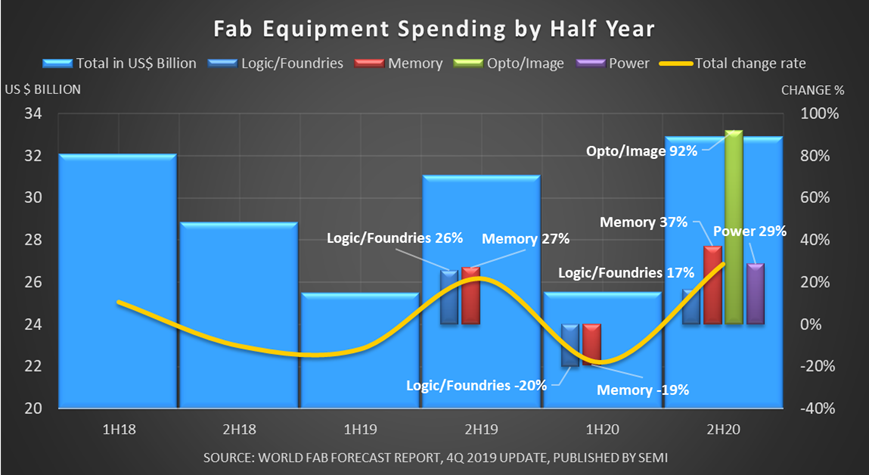
Figure 1: Fab equipment spending by half year and change rates of main investment contributors
The downtrend shifted abruptly toward the end of 2019. Investments in leading-edge logic and foundry are now expected to climb 26 percent in the second half of 2019, lead by TSMC and Intel, and 3D NAND spending will skyrocket more than 70 percent over the same period. While the decline in DRAM investments continued in the first half of this year, the descent since July has been more muted.
Lead by Sony, image sensors spending is expected to jump 20 percent in the first half of 2020 and soar by over 90 percent in the second half, peaking at US$1.6 billion. Investments for power-related devices, driven by Infineon, ST Microelectronics and Bosch, are projected to grow by over 40 percent in the first half of 2020 and another 29 percent in the second half, reaching nearly US$1.7 billion.
The latest World Fab Forecast report, published in late November 2019, covers quarterly spending for construction and equipment from 2018 to 2020. The report lists more than 1,340 fabs and lines and 135 facilities expected to start volume production in 2019 or later. The World Fab Forecast also provides quarterly totals for capacities, technology nodes, 3D layers, product types and wafer sizes.
Learn more about SEMI fab databases.
About SEMI
SEMI® connects more than 2,100 member companies and 1.3 million professionals worldwide to advance the technology and business of electronics design and manufacturing. SEMI members are responsible for the innovations in materials, design, equipment, software, devices, and services that enable smarter, faster, more powerful, and more affordable electronic products. Electronic System Design Alliance (ESD Alliance), FlexTech, the Fab Owners Alliance (FOA) and the MEMS & Sensors Industry Group (MSIG) are SEMI Strategic Association Partners, defined communities within SEMI focused on specific technologies. Visit www.semi.org to learn more, contact one of our worldwide offices, and connect with SEMI on LinkedIn and Twitter.
Association Contact
Michael Hall/SEMI
Phone: 1.408.943.7988
Email: [email protected]
MILPITAS, Calif. ─ December 16, 2019 – Flexible hybrid electronics breakthroughs are driving the next wave of smart MEMS and sensing solutions for more personalized, portable electronics, setting the stage for the co-located Flexible Hybrid Electronics Conference and Exhibition (FLEX) and MEMS & Sensors Technical Congress (MSTC) Feb. 24-27, 2020. Co-sponsored by SEMI FlexTech and SEMI MEMS & Sensors Industry Group, FLEX and MSTC will gather more than 100 global experts for market and technical presentations, tech courses, and more than 50 exhibit opportunities for connecting with industry visionaries at the DoubleTree by Hilton Hotel in San Jose, Calif. Registration is now open.
“Today’s pervasiveness of MEMS and sensors have given us an industrial nervous system where AI meets everything – on the person, on the farm, at sea, in the car, and in the factory,” said Dave Anderson, president of SEMI Americas and host of the conferences. “FLEX and MSTC will offer insights into how the enormous amounts of unstructured data collected by these field monitors will lead to groundbreaking applications that transform the way we work and live.”

Themed See the Future with 20/20 Vision, the FLEX 2020 will highlight cutting-edge flexible and printed electronics applications that deepen interactions between users and their surroundings to improve their daily lives. FLEX 2020 will showcase flexible hybrid and printed electronic products, equipment, processes and materials, and the applications they enable.
Themed Technologies Driving the Next Wave of Smart MEMS & Sensing Solutions, MSTC 2020 will spotlight MEMS and sensors advances and market opportunities stemming from artificial intelligence (AI), augmented reality (AR), machine learning, 5G mobile networks and blockchain.
Keynotes during the two events will highlight novel integration and market opportunities for flexible hybrid electronics (FHE), MEMS and sensors as the industry innovates to meet consumer demand for more user-centric solutions.
FLEX and MSTC 2020 Keynote Speakers

|
Zachary Bolton, Head of R&D, North America, Continental Corporation |

|

|
Antti Vasara, President and CEO, VTT Technical Research Centre of Finland, Ltd |

|

|
Michael Wiemer, CTO and Co-Founder, Mojo Vision |

|

|
Zhenan Bao, K.K. Lee Professor of Chemical Engineering, Stanford University |

|
FLEX 2020 will also feature the annual FLEXI Awards honoring organizations and individuals for innovation and commercialization, research and development, and education leadership, as well as the popular university student poster session highlighting projects related to flexible electronics or MEMS and sensors.
The co-located FLEX and MSTC events will be the second of eight conferences comprising SEMI’s second annual Technology Leadership Series of the Americas. Aligned from coast to coast throughout 2020, the series is designed to foster critical discussions on the short- and long-term influences and opportunities in the $2 trillion global electronics industry.
For information on registration and pricing, including early-bird rates and discounts for government, military and academia participants, click here.
FLEX Platinum sponsors include Eink and Novacentrix.
Follow FLEX 2020 on Twitter at: #SEMI_FLEX and @flextechnews. Follow MSTC 2020 on Twitter at: ##SEMI_MSTC and @MEMSGroup.
About SEMI
SEMI® connects more than 2,100 member companies and 1.3 million professionals worldwide to advance the technology and business of electronics design and manufacturing. SEMI members are responsible for the innovations in materials, design, equipment, software, devices, and services that enable smarter, faster, more powerful, and more affordable electronic products. Electronic System Design Alliance (ESD Alliance), FlexTech, the Fab Owners Alliance (FOA) and the MEMS & Sensors Industry Group (MSIG) are SEMI Strategic Association Partners, defined communities within SEMI focused on specific technologies. Visit www.semi.org to learn more, contact one of our worldwide offices, and connect with SEMI on LinkedIn and Twitter.
Association Contact
Scott Stevens, Cardinal Communications for SEMI Americas
Phone: 1.512.288.4050
Email: [email protected]


MILPITAS, Calif. — December 11, 2019 — SEMI, the global industry association representing the electronics manufacturing and design supply chain, and VLSI Research, the leading semiconductor manufacturing market research firm, today unveiled the Semiconductor Manufacturing Monitor, a report covering the semiconductor manufacturing industry from materials to electronic systems. The inaugural report includes comprehensive 2018 and 2019 quarterly data for the semiconductor manufacturing supply chain, a one-quarter outlook, and semiconductor equipment forecast scenarios to 2020.

“The Semiconductor Manufacturing Monitor sets a new standard for semiconductor manufacturing by offering critical insights for making strategic business decisions and investments in our highly dynamic industry,” said Ajit Manocha, SEMI president and CEO. “The combination of SEMI’s leading benchmark data and VLSI Research’s semiconductor manufacturing expertise delivers an unparalleled breadth of market research spanning the entire semiconductor manufacturing supply chain.”

“The semiconductor industry has never been so rife with change,” said Risto Puhakka, president of VLSI Research. “More than ever, stakeholders across the industry need timely market scenarios and updates vital to decision-making. VLSI Research is excited to partner with SEMI and offer key semiconductor manufacturing data in the Semiconductor Manufacturing Monitor to meet this pressing need.”
Published four times each year, the annual subscription provides information on the following segments:
- Electronic systems sales
- IC sales by logic and memory
- Semiconductor manufacturing CapEx by memory and non-memory
- Leading foundry, fabless, OSAT and semiconductor equipment company revenues
- Silicon shipments
- Global wafer fab capacity
- IC inventory
This Semiconductor Manufacturing Monitor is ideal for companies requiring cost-effective, comprehensive industry data from trusted sources. For more information and to purchase the report, click here.
About VLSI Research
VLSI Research's unique combination of deep semiconductor industry contacts and data analytics with databases and information libraries reaching back seven decades, combined with its locations in the world's technology hotspots, make it perfectly suited for the development of the world's most distinguished semiconductor market research. VLSI Research information is selectively crafted by renowned semiconductor manufacturing market research analysts with over a century of combined experience. VLSI Research is the only market research firm to have won the SEMI Sales and Marketing Excellence Award. Visit www.vlsiresearch.com to learn more.
About SEMI
SEMI® connects more than 2,100 member companies and 1.3 million professionals worldwide to advance the technology and business of electronics design and manufacturing. SEMI members are responsible for the innovations in materials, design, equipment, software, devices, and services that enable smarter, faster, more powerful, and more affordable electronic products. Electronic System Design Alliance (ESD Alliance), FlexTech, the Fab Owners Alliance (FOA) and the MEMS & Sensors Industry Group (MSIG) are SEMI Strategic Association Partners, defined communities within SEMI focused on specific technologies. Visit www.semi.org to learn more, contact one of our worldwide offices, and connect with SEMI on LinkedIn and Twitter.
Contacts
Michael Hall/SEMI
Phone: 1.408.943.7988
Email: [email protected]
VLSI Research
Phone: 1.408.453.8844
Email: [email protected]
Global Semiconductor Equipment Sales Forecast – 2020 Rebound, 2021 Record High
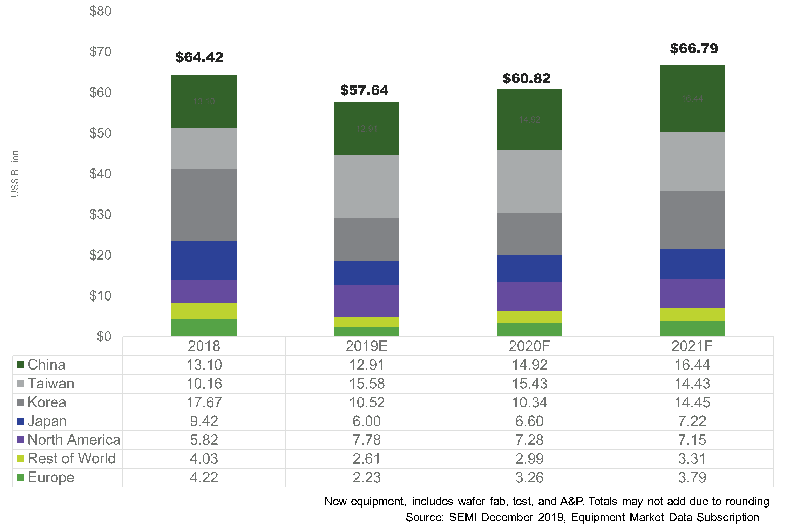
TOKYO – December 11, 2019 – Global semiconductor manufacturing equipment sales will drop 10.5 percent to $57.6 billion in 2019 from last year’s historic peak of $64.4 billion but stage a 2020 recovery and set a new high in 2021, SEMI, the global industry association representing the electronics manufacturing and design supply chain, reported today in its Year-End Total Equipment Forecast.
Released at SEMICON Japan 2019, the forecast shows equipment sales registering a 5.5 percent increase to $60.8 billion in 2020 and continued expansion into 2021, with record revenues of $66.8 billion as leading device manufactures invest in sub-10nm equipment, especially for foundry and logic.
The SEMI year-end forecast shows sales of wafer fab equipment – consisting of wafer processing, fab facility and mask/reticle equipment – falling 9 percent in 2019 to $49.9 billion. The assembly and packaging equipment segment is on track to decline 26.1 percent to $2.9 billion in 2019, while semiconductor test equipment is forecast to drop 14.0 percent to $4.8 billion this year.
Taiwan will dethrone Korea as the largest equipment market and lead the world with 53.3 percent growth this year, followed by North America with a 33.6 percent uptick. China will maintain the second spot for the second consecutive year, and Korea will fall to third after throttling back capital expenditures. All regions tracked except Taiwan and North America will contract this year.
SEMI expects the 2020 equipment market recovery to be fueled by advanced logic and foundry, new projects in China, and, to a lesser extent, memory. In Europe, equipment sales will surge 45.9 percent to $3.3 billion. Taiwan is forecast to remain the top equipment market next year on the strength of $15.4 billion in sales, with China second at $14.9 billion and Korea third at $10.3 billion. More upside is likely if the macroeconomy improves and trade tensions subside in 2020.
In 2021, all sectors tracked are expected to grow and the memory spending recovery will hit full stride. China is expected to ascend to the top position with equipment sales of more than $16 billion, followed by Korea, and Taiwan.
The Year-End Total Equipment Forecast is based on SEMI's industry-recognized World Fab Forecast database and input from equipment manufacturers. Total equipment includes wafer processing, fab facilities, mask/reticle, total test, and assembly and packaging equipment.
The following results reflect market size in billions of U.S. dollars.
The Equipment Market Data Subscription (EMDS) from SEMI provides comprehensive market data for the global semiconductor equipment market. A subscription includes three reports:
- Monthly SEMI Billings Report, a perspective of equipment market trends
- Monthly Worldwide Semiconductor Equipment Market Statistics (SEMS), a detailed report of semiconductor equipment bookings and billings for seven regions and over 22 market segments
- SEMI Mid-Year Forecast, a semiconductor equipment market outlook
For more information or to subscribe, please contact SEMI customer service at 1.877.746.7788 (toll free in the U.S.). For more information online, please click here.
About SEMI
SEMI® connects more than 2,100 member companies and 1.3 million professionals worldwide to advance the technology and business of electronics design and manufacturing. SEMI members are responsible for the innovations in materials, design, equipment, software, devices, and services that enable smarter, faster, more powerful, and more affordable electronic products. Electronic System Design Alliance (ESD Alliance), FlexTech, the Fab Owners Alliance (FOA) and the MEMS & Sensors Industry Group (MSIG) are SEMI Strategic Association Partners, defined communities within SEMI focused on specific technologies. Visit www.semi.org to learn more, contact one of our worldwide offices, and connect with SEMI on LinkedIn and Twitter.
Association Contact
Michael Hall/SEMI
Phone: 1.408.943.7988
Email: [email protected]
TOKYO – December 10, 2019 – SEMICON Japan 2019, the largest and most influential gathering of the electronics manufacturing supply chain in Japan with nearly 55,000 attendees expected, opens tomorrow at Tokyo Big Sight to focus on growth opportunities in smart transportation and smart manufacturing and the critical importance of business continuity planning (BCP). Industry leaders and visionaries from across the electronics supply chain will gather December 11-13 at SEMICON Japan 2019 – themed Enabling a Smarter World – for insights into the latest technologies, innovations and trends in the electronics industry.

SMART Applications Zone
With their promise of greater manufacturing efficiency and social good, smart technologies are driving strong demand for semiconductors and related electronics, setting the stage for the SMART Applications Zone at SEMICON Japan 2019. The zone showcases advanced technologies and products in SMART Transportation and SMART Manufacturing while providing collaboration opportunities across the entire electronics supply chain. Key exhibitors include:
- SMART Transportation
- Toyota, DENSO, Zuken, Tier IV, Renesas Electronics, Livox Tech, Deloitte Touche Tohmatsu and Solidray
- SMART Manufacturing
- Advanced Industrial Science and Technology (AIST), Deloitte Touche Tohmatsu, Siemens, Sony Semiconductor Solutions, Chuo Denshi Kogyo (CDK) and United Semiconductor Japan (USJC)
Business Continuity Planning
Business Continuity Planning (BCP) has seen strong demand as companies in the semiconductor manufacturing supply chain work to deepen their cooperation with one another to sustain operations in the event of natural disasters and other emergencies. SEMICON Japan 2019 features an exhibition and seminar highlighting the importance of BCP to the electronics supply chain. Visitors will learn about earthquake countermeasures by stepping into the Seismic Isolation Experience Car.
Exhibitors in the BCP area include THK, DISCO, HORIBA STEC and Murata Machinery.
Representatives from Sony Semiconductor Manufacturing, THK, DISCO and Team Engineering Consulting will share lessons learned from disasters and discuss the vital importance of daily preparation.
The SEMICON Japan 2019 SuperTHEATER features seven sessions over three days:
- Opening keynotes – Creating the Next Era featuring Makiko Eda, Chief Representative Officer at World Economic Forum, and Yuzuru Utsumi, President at Arm
- Semiconductor Executive Forum – Executive Viewpoints from Top Two in the Era of Digitalization with thought leaders from IHS Markit and Sony Semiconductor Solutions
- SMART Connectivity Forum – Infinite World Brought by 5G Innovation with experts from Softbank and Nokia Solutions & Networks
- SMART Transportation Forum I – Front-line of Automated Driving (Part1) featuring speakers from Intel and DENSO
- SMART Transportation Forum II – Revolution of Sky Transportation, supported by the U.S. Commercial Service in Japan, with presenters from Ministry of Economy, Trade and Industry (METI), Subaru and Bell Helicopter
- Manufacturing Innovation Summit – Issues and Innovation: What will Drive Growth to 2030 featuring thought leaders from VLSI Research, Applied Materials, KLA, Nikon and Tokyo Electron
- Mirai Vision Forum – Future Relation of Technology and Body 2.0 with speakers from Leave a Nest, Ory Lab and Autonomous Control Systems Laboratory
Register now for SEMICON Japan. For a detailed agenda, please see the SEMICON Japan Schedule-at-a-Glance.
About SEMI
SEMI® connects more than 2,100 member companies and 1.3 million professionals worldwide to advance the technology and business of electronics design and manufacturing. SEMI members are responsible for the innovations in materials, design, equipment, software, devices, and services that enable smarter, faster, more powerful, and more affordable electronic products. Electronic System Design Alliance (ESD Alliance), FlexTech, the Fab Owners Alliance (FOA) and the MEMS & Sensors Industry Group (MSIG) are SEMI Strategic Association Partners, defined communities within SEMI focused on specific technologies. Visit www.semi.org to learn more, contact one of our worldwide offices, and connect with SEMI on LinkedIn and Twitter.
Association Contact
Mayumi Amagai/SEMI
Phone: 81-3-3222-5854