downloadGroupGroupnoun_press release_995423_000000 copyGroupnoun_Feed_96767_000000Group 19noun_pictures_1817522_000000Member company iconResource item iconStore item iconGroup 19Group 19noun_Photo_2085192_000000 Copynoun_presentation_2096081_000000Group 19Group Copy 7noun_webinar_692730_000000Path
Skip to main content
Default Banner Image

SEMI News

MILPITAS, Calif. — September 19, 2019 — North America-based manufacturers of semiconductor equipment posted $2.00 billion in billings worldwide in August 2019 (three-month average basis), according to the August Equipment Market Data Subscription (EMDS) Billings Report published today by SEMI. The billings figure is 1.4 percent lower than the final July 2019 level of $2.03 billion, and is 10.5 percent lower than the August 2018 billings level of $2.23 billion.

“August billings of North American equipment manufacturers declined one percent relative to July levels,” said Ajit Manocha, president and CEO of SEMI. “However, even though the industry is facing headwinds, monthly billings levels have remained above $2 billion for the past four months.”

The SEMI Billings report uses three-month moving averages of worldwide billings for North American-based semiconductor equipment manufacturers. Billings figures are in millions of U.S. dollars.


Billings
(3-mo. avg.)

Year-Over-Year

March 2019

$1,825.3

-24.9%

April 2019

$1,922.0

-28.5%

May 2019

$2,065.2

-23.6%

June 2019

$2.026.1

-18.4%

July 2019 (final)

$2,031.9

-14.6%

August 2019 (prelim)

$2,002.5

-10.5%

Source: SEMI (www.semi.org), September 2019

SEMI publishes a monthly North American Billings report and issues the Worldwide Semiconductor Equipment Market Statistics (WWSEMS) report in collaboration with the Semiconductor Equipment Association of Japan (SEAJ). The WWSEMS report currently reports billings by 24 equipment segments and by seven end market regions. SEMI also has a long history of tracking semiconductor industry fab investments in detail on a company-by-company and fab-by-fab basis in its World Fab Forecast and SEMI FabView databases. These powerful tools provide access to spending forecasts, capacity ramp, technology transitions, and other information for over 1,000 fabs worldwide. For an overview of available SEMI market data, please visit www.semi.org/en/MarketInfo.

The data contained in this release were compiled by David Powell, Inc., an independent financial services firm, without audit, from data submitted directly by the participants. SEMI and David Powell, Inc. assume no responsibility for the accuracy of the underlying data.

About SEMI
SEMI® connects more than 2,100 member companies and 1.3 million professionals worldwide to advance the technology and business of electronics design and manufacturing. SEMI members are responsible for the innovations in materials, design, equipment, software, devices, and services that enable smarter, faster, more powerful, and more affordable electronic products. Electronic System Design Alliance (ESD Alliance), FlexTech, the Fab Owners Alliance (FOA) and the MEMS & Sensors Industry Group (MSIG) are SEMI Strategic Association Partners, defined communities within SEMI focused on specific technologies. Visit www.semi.org to learn more, contact one of our worldwide offices, and connect with SEMI on LinkedIn and Twitter.

Association Contact
Michael Hall/SEMI
Phone: 1.408.943.7988
Email: [email protected]

Notes
Next SEMI Billings report is October 22, 2019 at 3:00pm Pacific
For information on SEAJ Book-to-Bill Report, visit www.seaj.or.jp

SEMICON Taiwan Logo

TAIPEI, Taiwan ─ September 18, 2019 ─ With Taiwan expected to lead the world in semiconductor equipment investments in 2019, SEMICON Taiwan 2019 opens today, gathering the world’s top technologists, visionaries and innovators for insights into the latest trends and opportunities across smart vertical markets including manufacturing, automotive, healthcare and data. September 18-20 at Nangang Exhibition Center, Hall I, in Taipei, SEMICON Taiwan 2019 spans the entire semiconductor and microelectronics supply chain – from design through systems. Registration for the event remains open.

Taiwan is on track to boost semiconductor equipment investments 21.1 percent this year and vault past South Korea to top the world in equipment spending, an increase driven by advanced manufacturing processes and capacity, according to SEMI's latest market report. In addition, for the ninth consecutive year Taiwan is the world's biggest consumer of semiconductor materials with spending of US$11.4 billion.

At the SEMICON Taiwan 2019 opening ceremony, Premier SU Tseng-chang, Director of the American Institute in Taiwan (AIT), credited Taiwan’s rise in prominence in the global semiconductor industry to joint efforts by local government and industry. Tseng-chang also lauded Taiwan’s manufacturing sector for its enormous contributions to the global information and communication technology (ICT) industry while serving as a key growth engine in the region.

SEMICON Taiwan Debuts Electro-innovation Forum and Technology Think Tank Summit

  •  Electro-innovation Forum – Experts from five of the world’s top research institutes and R&D centers examine innovation drivers and trends and prospects for the microelectronics industry. Participants include imec, CEA-Leti, Fraunhofer, the National Research Foundation (NRF), the Industrial Technology Research Institute (ITRI) and TSMC.
  •  Technology Think Tank Summit – Co-organized with the Ministry of Economic Affairs (MOEA), the summit brings together industry leaders in SiP, IC design, memory, wafer fabrication, packaging and testing to explore the future of the industry. Participants include CEOs from Quanta Computer, Hon Hai Technology Group, TSMC, ASE, Etron Technology, Powerchip Semiconductor and Macronix International.

International Forums Spotlight Latest Industry Trends

Expected to draw an event record 50,000 visitors, SEMICON Taiwan 2019 features 19 other international forums spotlighting industry trends and the latest technologies. Themed Leading the SMART Future, SEMICON Taiwan showcases Artificial intelligence (AI), Internet of Things (IoT), 5G, machine learning, quantum computing and other cutting-edge technologies that are transforming the microelectronics industry and giving rise to a growing universe of smart applications.

The following SEMICON Taiwan forums, summits and pavilions offer the latest industry perspectives on key vertical markets and the talent critical to industry growth.

  •  Smart Transportation Forum – The Compound Semiconductor Innovation Zone and Smart Car Zone for the first time showcase new electric cars from BMW (i3s, i8 Coupe) and Audi (e-tron). The forum features a wide variety of semiconductor applications for future smart vehicles.  
  •  Smart Data Global Summit and Quantum Computing: A Window into Future Computing – Experts from Facebook, Mentor, ARM and Qualcomm focus on smart data applications and fulfilling the promise of a digital future through computing innovations and AI chip designs.
  •  Smart MedTech Forum – Focuses on business opportunities inspired by AI-assisted medical technology and cross-sector collaboration. Experts from medical institutions, software suppliers, research institutes, and medical device start-ups will meet to discuss the future of smart medical technology and business opportunities.
  •  Smart Manufacturing EXPO – Showcases complete smart manufacturing solutions for a wide range of high-technology industries such as semiconductor, touch panel, flat-panel display and PCB.
  •  Smart Workforce Pavilion – Semiconductor industry insights, lectures, career coaching and job matching for prospective talent

Asia’s First Testing Ground for Self-Driving Vehicles, Taiwan’s Circular Economy

SEMICON Taiwan 2019 will launch two landmark events in collaboration with the Taiwanese government and various industry associations.

  •  Hsinchu City will become the first testing ground for self-driving vehicles in Asia under a memorandum of understanding – Autonomous Driving System Platform in Open Fields – between SEMI, ITRI and the city government.
  •  SEMICON Taiwan teams up with Taiwan Trusted Alliance for Sustainable Supply and Circular Economy in inviting 15 industry associations to launch the 15T Circular Economy Alliance. The alliance seeks to promote the results of Taiwan's circular economy efforts in the global market and explore more sustainable opportunities.

SEMICON Taiwan 2019 features:

  •  21 theme areas and national pavilions
  •  More than 300 speakers across 21 international forums
  •  700 exhibitors from around the world
  •  More than 2,300 booths

SEMICON Taiwan 2019 showcases the full suite of SEMI offerings spanning the full electronics supply chain to support industry growth including:

  •  Vertical Application Platforms: Smart Manufacturing, Smart Transportation, Smart Medical and Smart Data
  •  Workforce Development, Industry Standards, Think Tanks and Thought Leadership Platforms
  •  Strategic Association Partners, such as R&D and innovation leaders imec, CEA-Leti and Fraunhofer, as well as MEMS & Sensors Industry Group and Electronic System Design Alliance

With the semiconductor industry working to extend silicon scaling beyond Moore’s Law, SEMICON Taiwan will also gather industry experts to explore heterogeneous integration opportunities and challenges across three events:

For more information, please visit the SEMICON Taiwan 2019 website or follow us on Facebook.

About SEMI
SEMI® connects more than 2,100 member companies and 1.3 million professionals worldwide to advance the technology and business of electronics design and manufacturing. SEMI members are responsible for the innovations in materials, design, equipment, software, devices, and services that enable smarter, faster, more powerful, and more affordable electronic products. Electronic System Design Alliance (ESD Alliance), FlexTech, the Fab Owners Alliance (FOA) and the MEMS & Sensors Industry Group (MSIG) are SEMI Strategic Association Partners, defined communities within SEMI focused on specific technologies. Visit www.semi.org to learn more, contact one of our worldwide offices, and connect with SEMI on LinkedIn and Twitter.


Association Contacts
Emmy Yi
E-mail: [email protected]
Tel: +886.3.560.1777 ext.205

Eileen Lin
E-mail: [email protected]
Tel: +886.3.560.1777 ext. 288

semi-logo

MILPITAS, Calif. — September 16, 2019 — SEMI, the global industry association representing the electronics manufacturing and design supply chain, today announced that semiconductor industry veteran Bee Bee Ng has joined SEMI as president of SEMI Southeast Asia, reporting to SEMI CFO Richard Salsman.

Bee Bee Ng Photo

As president, Ng will develop strategies, objectives and global policies for achieving SEMI’s business goals in Southeast Asia. Based in Singapore, Ng will direct SEMI Southeast Asia sales and services; expositions and programs including standards, EHS, workforce development and advocacy; and administrative operations.

“We are delighted to welcome Bee Bee Ng to SEMI,” said Ajit Manocha, SEMI president and CEO. “Her extensive experience in the semiconductor industry, strong business relationships throughout Southeast Asia, and passion for driving business results are tremendous assets to SEMI. We look forward to Bee Bee’s leadership in working with SEMI members to grow the Southeast Asia market and uncover new opportunities that will help the $2 trillion global electronics industry reach its full potential.”

Ng brings to SEMI more than 25 years of experience in sales, marketing, distribution and logistics management in the Southeast Asia semiconductor, electronics and related industries. Previously, Ng held positions at Nissei Sangyo (Singapore) Pte. Ltd. (now Hitachi Hi-Tech) and more recently KLA-Tencor (Singapore) Pte. Ltd., where she won the President’s Award for Top Account Sales Manager.   

Bee Bee holds a bachelor's degree in Chemistry and Material Science from National University of Singapore.

About SEMI
SEMI® connects more than 2,100 member companies and 1.3 million professionals worldwide to advance the technology and business of electronics design and manufacturing. SEMI members are responsible for the innovations in materials, design, equipment, software, devices, and services that enable smarter, faster, more powerful, and more affordable electronic products. Electronic System Design Alliance (ESD Alliance), FlexTech, the Fab Owners Alliance (FOA) and the MEMS & Sensors Industry Group (MSIG) are SEMI Strategic Association Partners, defined communities within SEMI focused on specific technologies. Visit www.semi.org to learn more, contact one of our worldwide offices, and connect with SEMI on LinkedIn and Twitter.

Association Contact
Michael Hall/SEMI
Phone: 1.408.943.7988
Email: [email protected]

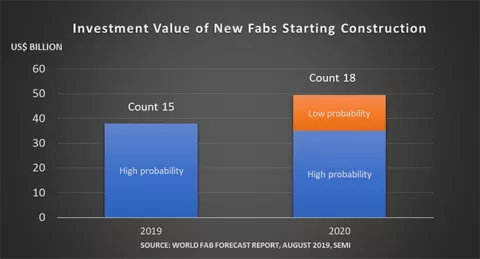
MILPITAS, Calif. – September 12, 2019 – Investments in new fab projects starting construction in 2020 is expected to reach nearly US$50 billion, up about US$12 billion from 2019, according to the latest update of the World Fab Forecast from SEMI. See figure 1.

semi-logo

Fifteen new fab projects with a total investment of US$38 billion will have started construction by the end of 2019 with 18 more fab projects forecast to start construction in 2020. Of the 18, 10 fab projects with a total investment value of more than US$35 billion carry a high probability and the other eight, with a total investment value of more than US$14 billion, are weighted with a low probability of materializing.

Fabs Chart 650px

Figure 1: Total investments (construction and equipment) for new fabs and lines (greenfield, shell, new line) starting construction through 2020

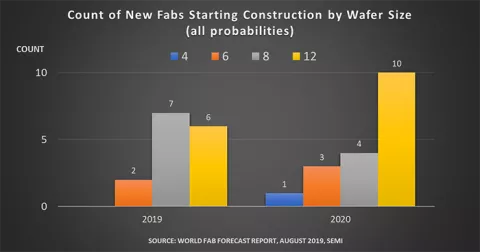
Facilities that commence construction in 2019 will begin equipping as early as the first half of 2020, with some starting to ramp production as early as mid-2020. These new fab projects will add more than 740,000 wafers per month (in 200mm equivalents). Most of the additional capacity will be dedicated to foundries (37%) followed by memory (24%) and MPU (17%). Of the 15 new fab projects in 2019, about half are for 200mm wafer sizes. See figure 2.

 Fab Count chart 700px

Figure 2: Fab Count by wafer size for new fabs and lines (greenfield, shell, new line) starting construction in 2019 and 2020

The fab projects to begin construction in 2020 are expected to produce more than 1.1 million wafers per month (in 200mm equivalents). Most of these fabs and lines will begin equipping in 2021. The high-probability fabs will increase capacity by 650,000 wafers per month (in 200mm equivalents) while the low-probability facilities may add another 500,000 wafers per month (in 200mm equivalents). The bulk of the capacity will be for foundry (35%) and memory (34%) across various wafer sizes.

Published by the Industry Research and Statistics Group at SEMI, the World Fab Forecast covers new, planned and existing fabs as well as fab spending for construction and equipping, capacity expansion, and technology nodes by quarter and by product type with more than 1,300 front-end fab listings. All told, 192 updates have been made to the report, including the addition of 64 new facilities and lines since its previous publication in June 2019. The World Fab Forecast also includes projections for fabs and lines starting construction beyond 2020.

Learn more about SEMI fab databases. 

About SEMI
SEMI® connects more than 2,100 member companies and 1.3 million professionals worldwide to advance the technology and business of electronics design and manufacturing. SEMI members are responsible for the innovations in materials, design, equipment, software, devices, and services that enable smarter, faster, more powerful, and more affordable electronic products. Electronic System Design Alliance (ESD Alliance), FlexTech, the Fab Owners Alliance (FOA) and the MEMS & Sensors Industry Group (MSIG) are SEMI Strategic Association Partners, defined communities within SEMI focused on specific technologies. Visit www.semi.org to learn more, contact one of our worldwide offices, and connect with SEMI on LinkedIn and Twitter.

Association Contact
Michael Hall/SEMI
Phone: 1.408.943.7988
Email: [email protected]

As a top semiconductor manufacturing hub, Korea is poised to lead the world in fab construction spending in 2019 and 2020, accounting for 27 percent of the total market. Little wonder that Korea’s prowess in the semiconductor industry has meant steady membership growth for SEMI Korea, with HD Cho, president of SEMI Korea, putting the average annual jump at about 7 percent.But HD Cho’s focus as he returned to COEX in Seoul, home to SEMICON Korea, in late August was not on membership growth over the years but the future. Cho hosted about 400 SEMI members gathered at SEMI Korea Members Day for insights into the state of the world economy, semiconductor industry outlooks, and perspectives on how South Korean and European microelectronics companies can form stronger ties. Setting the stage with look at macroeconomics, Byung-yeon Kim, team manager of NH Investment and Securities, predicted that, as the global economy continues to falter, 25 of the 58 major countries this year will cut interest rates in a bid to boost prospects for growth. Historically, the global composite leading indicator (CLI), a bellwether for turning points in the economy, has rebounded after 20 months of decline, he said. While the CLI downtrend is now past the 20-month mark, Kim struck a bullish note, predicting that the global economy will bounce back before long.Soo-kyoum Kim, vice president at IDC, referring to the semiconductor industry’s own soft patch, said that total revenue is expected to drop from $475 billion in 2018 to $440 billion this year but should rebound to a new high of $500 billion in 2023. The memory market will be especially hard-hit, dropping more than 29 percent in 2019 and another 14 percent next year before bottoming and then staging a recovery in the second half of 2020. The strength of the rebound will hinge on server market demand, he added.Next year will also see rebounds in semiconductor equipment and materials revenue, with growth of 12 percent and 3 percent, respectively, said Clark Tseng, director of Industry Research and Statistics at SEMI. The increases will follow a 2019 equipment market drop of 18 percent to $53 billion from the previous year while materials this year is expected to remain flat at $52 billion. The semiconductor industry will expand at a modest 2.4 percent this year, jumping to 7.6 percent in 2020, Tseng reported, citing the average growth rate based on data from Gartner, WSTC, IC Insights, VLSI Research and other industry analyst firms. Despite current weak market demand and the ongoing trade war, the long-term outlook for the semiconductor industry remains upbeat, he added.In Europe, semiconductor industry growth continues on the strength of the region’s high strategic importance in the global electronics supply chain, said Laith Altimime, president of SEMI Europe. Fab construction spending in Europe continued to grow in 2018, reaching $300 million, and is expected to hit $1.2 billion in 2019 and $1.6 billion in 2020, with equipment, parts and components driving the surges.To help build stronger ties between European and Korean chip industries, Altimime introduced the SEMI Korea members to SEMI Europe business platforms including SEMICON Europe, the 3D System Summit, ISS Europe, and the MEMS Imaging Sensor Summit. He also encouraged the formation of more business partnerships between companies in the two regions by familiarizing SEMI Korea members with European players in areas such as foundry, MEMS, sensors and wafer manufacturing.And it will be MEMS and sensors that help drive the 4th Industrial Revolution, said Sung-hyuk Kim, a team leader at LG Electronics' Sensor Solution Research Institute. In his presentation Architecting Sensor Solutions for the Next Revolution, he noted that sensors are finding their way into devices where they have never been used before. In household refrigerators, gas sensors help deodorize the inside while distance sensors detect the approach of people. Air conditioners equipped with a camera sensor can pinpoint the location of humans and steer the airflow in their direction. Of course, all these smarts will come in form of data-devouring artificial intelligence (AI), and that data will be generated in massive amounts by MEMS and sensors – placing them at the epicenter of the 4th Industrial Revolution.Jaegwan Shim is a marketing specialist at SEMI Korea.
Read More

MUNICH, Germany ─ September 10, 2019 ─ Cutting-edge medical technology will highlight SEMICON Europa, 12-15 November, 2019 at Messe München, in Munich, Germany, as the SMART MedTech Forum gathers industry experts for insights into the latest developments and trends in medtech innovations driven by semiconductors. The SMART MedTech Forum is Europe's first event to foster collaboration across the semiconductor and medtech value chains. SEMICON Europa registration is open for visitors and exhibitors.

SEMICON Europa Logo

The SMART MedTech Forum takes the stage at the Inspiration Hub (Hall B2), where attendees will connect with companies behind medtech innovations, experience leading medtech products, and discover startups shaking up the healthcare scene. The forum features the following sessions focused on the critical role of semiconductors and medtech in enabling technology innovation and solutions to the world’s most pressing healthcare challenges.

Global Healthcare Solutions
Janssen Pharmaceutical Companies of Johnson & Johnson will kick off the forum with a discussion on global healthcare challenges and opportunities, followed by a MedTech Europe presentation on trends in healthcare, medtech and digital technology. imec and GE Research will explore how to bridge the gap between semiconductors and medical technologies to solve global healthcare challenges.

Digitization of Preventive Healthcare
More smart medtech device companies are focused on preventive medicine, setting the stage for a presentation by OnePlanet Connected Health Solutions on opportunities in digital health for tracking mental stress using wearable data and machine learning. Maxim Integrated will discuss the potential of sleep monitoring to prevent health problems and reduce healthcare costs, and how wearables can help prevent high blood pressure. And ams AG will examine how sensors can enable consumer health applications for preventative healthcare.

Revolutionizing Healthcare with Personalized Medicine            
Personalized medicine is on the rise as it aims to increase the efficiency and quality of care through customized patient management. Yole Developpement and Fraunhofer EMFT will introduce innovative solutions in precision medicine and drug delivery for personalized healthcare, while X-FAB will discuss how MEMS manufacturing is enabling breakthroughs in personalized medicine.  

The Digital Patient: The Future of Artificial Organs and Human Avatars          
Digital patients promise to prevent and cure disease and transform healthcare through personalized treatment. Experts from the EPFL Lausanne, Philips, Robert Bosch GmbH, and Bart's Heart Centre will discuss quantum leaps in personalized treatment, including the use of artificial organs, Organ-on-Chip, and human avatars as the next paradigm in healthcare.

Pioneering Research in Medical Technologies
With fundamental research key to healthcare innovation, leading research and innovation centers imec and the KU Leuven will examine how CMOS-compatible technologies and systems can be applied to life sciences to enable platforms for personalized medicine.

Other SMART MedTech Forum Highlights
The MedTech Startup Session will host some of the most innovative medtech startups, including Sensome and its breakthrough remote monitoring technology that can turn invasive vascular medical devices into connected healthcare devices. Onera Health and ChronoLife will introduce innovative diagnostic solutions, while PKvitality will present its health-monitoring smartwatches. IC’Alps will showcase its products and services for the design and supply of ASIC/SOC integrated circuits for medtech applications.  
In addition, leaders from ChronoLife, the European Commission and Siemens Healthineers will gather for the panel Key Drivers Transforming Healthcare: AI, Big Data and Cybersecurity, three areas central to medtech advances.

SMART MedTech Forum Sponsors

SEMICON Europa Sponsors

  • Atotech, DAS Environmental Expert, Ebara, Edwards, EV Group, Inficon, JSR Micro, Lam Research, Pfeiffer Vacuum, Rena Technologies, Screen, Siconnex Customized Solutions, Tokyo Electron

For more details, please visit the SEMICON Europa website and connect with SEMI Europe on Twitter or LinkedIn @SEMIEurope (use #SEMICONEuropa).

About SEMI
SEMI® connects more than 2,100 member companies and 1.3 million professionals worldwide to advance the technology and business of electronics design and manufacturing. SEMI members are responsible for the innovations in materials, design, equipment, software, devices, and services that enable smarter, faster, more powerful, and more affordable electronic products. Electronic System Design Alliance (ESD Alliance), FlexTech, the Fab Owners Alliance (FOA) and the MEMS & Sensors Industry Group (MSIG) are SEMI Strategic Association Partners, defined communities within SEMI focused on specific technologies. Visit www.semi.org to learn more, contact one of our worldwide offices, and connect with SEMI on LinkedIn and Twitter.

Press Contact
Serena Brischetto, SEMI Europe
Email: [email protected]

MSIG MEMS & Sensors Executive Congress to feature business leaders examining market opportunities, innovations and technology trends

MILPITAS, Calif. – September 4, 2019 – Senior executives from across the MEMS and sensors supply chain will gather at MEMS & Sensors Executive Congress (MSEC), October 22-24, 2019, in Coronado, Calif. for the latest innovations driving widespread adoption of these tiny smart devices. Recent MEMS and sensor leaps support more personalized user experiences in biomedical/healthcare, the food supply chain, and Internet of Things (IoT). MSEC is hosted by the MEMS & Sensors Industry Group (MSIG), a SEMI Strategic Association Partner. Registration is now open with early-bird pricing available until September 20, 2019.

MSEC comes as manufacturers plan to embed more than 50 billion MEMS and sensors in thousands of applications by 2024 to meet consumer demand for more intelligence and interactivity in electronic products, according to Yole Développement.1 Featured speakers at MSEC will examine the enabling role of MEMS and sensors in diverse intelligent applications.

MSEC Keynotes and Other Speakers

Albert Pisano press photo

Albert Pisano, professor and dean, UC San Diego, will explore how MEMS will enable development of large-scale sensor-driven systems in smart cities, spanning healthcare, transportation, retail and education.  

 UC San Diego Logo
Stefan Finkbeiner Press Photo

Stefan Finkbeiner, CEO and general manager, Bosch, will explain how software synthesis and artificial intelligence (AI) will enable MEMS-enabled consumer-electronic devices to automatically adapt to users.

Bosch Logo
Pete Warden Press Photo

Pete Warden, staff research engineer, Google, will describe how low-power, low-cost machine learning (ML) will enable hundreds of billions of embedded devices to turn raw sensor data into actionable insights.

Google Logo
Rachel Gabato Press Photo

Rachel Gabato, COO, ripe.io, will describe how sensors, AI, ML and blockchain technology underpin a radically transparent digital-food supply chain that maps foods’ journey from production and transportation to the dinner plate.

ripe.io Logo
John Smee Press Photo

John Smee, VP of engineering, Qualcomm, will explain enhancements to 5G Near Radio (NR) that will enable higher performance and more reliable connectivity in industrial IoT, vehicle-to-everything (C-V2X), and massive IoT devices (MIoT).

Qualcomm Logo

Additional MSEC Speakers

  • Alissa M. Fitzgerald, founder and managing member, A.M. Fitzgerald & Associates, LLC
  • Dave Monk, vice president and general manager, Motion Sensors, NXP
  • Michael O’Connell, chief analytics officer, TIBCO Software
  • Philip Perconti, director, U.S. Army Research Laboratory
  • Radislav Potyrailo, principal scientist, Micro and Optoelectronics, GE Global Research
  • Rajendra Rao, general manager, IBM Food Trust

Other MSEC Highlights

  • Technology Showcase where innovators will demonstrate leading-edge MEMS/sensors-enabled products and platforms
  • Networking Events including receptions and evening dinner

Premier Sponsors

Event sponsors include: GE, mCube, Microtech Ventures, Okmetic, OnScale, Rogue Valley Microdevices, Silex Microsystems, SUSS MicroTec and Teledyne DALSA

MSEC will take place at Coronado Island Marriott Resort & Spa in Coronado, Calif. For more information, including the full event agenda, please visit the MSEC website.

Stay in touch on Twitter: @MEMSgroup @SEMI #SEMI_MSEC

About MEMS & Sensors Executive Congress
Hosted by MEMS & Sensors Industry Group (MSIG), a SEMI technology community, MEMS & Sensors Executive Congress (MSEC) is the only US event at which industry executives can exchange ideas and information about MEMS and sensors in commercial applications, all while networking with partners, customers and competitors.

About SEMI
SEMI® connects more than 2,100 member companies and 1.3 million professionals worldwide to advance the technology and business of electronics design and manufacturing. SEMI members are responsible for the innovations in materials, design, equipment, software, devices, and services that enable smarter, faster, more powerful, and more affordable electronic products. Electronic System Design Alliance (ESD Alliance), FlexTech, the Fab Owners Alliance (FOA) and MEMS & Sensors Industry Group (MSIG) are SEMI Strategic Association Partners, defined communities within SEMI focused on specific technologies. Visit www.semi.org to learn more, contact one of our worldwide offices, and connect with SEMI on LinkedIn and Twitter.

Press Contacts
Michael Hall, SEMI
Email: [email protected]

Maria Vetrano, Vetrano Communications
Email: [email protected]

MILPITAS, Calif. — September 10, 2019 — Worldwide semiconductor manufacturing equipment billings reached US$13.3 billion in the second quarter of 2019, down 20 percent from the same quarter of 2018 and 3 percent from than the previous quarter, SEMI, the global industry association representing the electronics manufacturing and design supply chain, reported today.

semi-logo

The data are gathered jointly with the Semiconductor Equipment Association of Japan (SEAJ) from more than 80 global equipment companies that provide data on a monthly basis.

The quarterly billings data by region in billions of U.S. dollars, quarter-over-quarter growth and year-over-year rates by region are as follows:


2Q2019

1Q2019

2Q2018

2Q19/1Q19
(Qtr-over-Qtr)

2Q19/2Q18
(Year-over-Year)

China

3.36

2.36

3.79

43%

-11%

Taiwan

3.21

3.81

2.19

-16%

47%

Korea

2.58

2.89

4.86

-11%

-47%

North America

1.70

1.67

1.47

2%

15%

Japan

1.38

1.55

2.28

-11%

-39%

Europe

0.57

0.84

1.18

-32%

-52%

Rest of World

0.51

0.67

0.96

-24%

-47%

Total

13.31

13.79

16.74

-3%

-20%

            Source: SEMI (www.semi.org) and SEAJ, September 2019

The Equipment Market Data Subscription (EMDS) from SEMI provides comprehensive market data for the global semiconductor equipment market. A subscription includes three reports:

  • Monthly SEMI Billings Report, which offers a perspective of the trends in the equipment market
  • Monthly Worldwide Semiconductor Equipment Market Statistics (WWSEMS), a detailed report of semiconductor equipment billings for seven regions and 24 market segments
  • SEMI Total OEM Semiconductor Equipment Forecast, which provides an outlook for the semiconductor equipment market

For more information or to subscribe, please contact SEMI customer service at 1.877.746.7788 (toll free in the U.S.) or 1.408.943.6901 (International Callers). More information is also available online.

About SEMI
SEMI® connects more than 2,100 member companies and 1.3 million professionals worldwide to advance the technology and business of electronics design and manufacturing. SEMI members are responsible for the innovations in materials, design, equipment, software, devices, and services that enable smarter, faster, more powerful, and more affordable electronic products. Electronic System Design Alliance (ESD Alliance), FlexTech, the Fab Owners Alliance (FOA) and the MEMS & Sensors Industry Group (MSIG) are SEMI Strategic Association Partners, defined communities within SEMI focused on specific technologies. Visit www.semi.org to learn more, contact one of our worldwide offices, and connect with SEMI on LinkedIn and Twitter.

Association Contact
Michael Hall/SEMI
Phone: 1.408.943.7988
Email: [email protected]

The future of the semiconductor industry began to blossom recently in Seoul, South Korea as young, innovative minds teased out secrets to electronics manufacturing and their path to enter the industry one day. Twenty-seven middle schoolers gathered in early August at Yonsei University for SEMI High Tech U (HTU), the worldwide SEMI program that introduces students to science, engineering, technology and math (STEM) careers over three days of hands-on activities and experiential learning. Since 2001, HTU has reached some 8,000 students in nine countries.Semiconductor giants including Applied Materials, KLA, Lam Research and Dongjin Semichem were key teachers as representatives from the companies gave theoretical and practical lectures to pique the students’ interest in STEM educations and careers. The speakers, all experts in microelectronics, surveyed microchips and solar cells, mathematical and scientific experimentation, engineering design and the inner workings of semiconductor manufacturing before the students broke off into teams for lessons largely of their own making. Fine-tuning a wooden contraption – a Statapult – to hurl a ball as far as possible might not sound like the stuff of microelectronics, but it drew on the type of problem-solving skills and creativity the students will need to thrive in the semiconductor industry. Student teams made adjustments to the levers of miniature catapults, then tested the throwing power of the devices. After the ball tosses, they reconvened as a class to share lessons in how they calibrated their catapults for a longer tossing distance and ways they could improve the devices’ performance. Students also took tours of two very different semiconductor manufacturing settings – one virtual and the other real. The young learners donned virtual reality headsets for a simulated walk-through of Applied Materials (the tour was sponsored by the company), then slipped on bunny suits for a tour of Yonsei University's BIT micro fab and a close-up look of how semiconductors are made.But it was the ever-popular Human Calculator game that inspired the greatest thrill as students dove deep into technology. During the exercise, they converted numbers into binary and then traced the digits through a series of gates in an electronic circuit, an exercise requiring careful team communication and concentration to generate the right outputs. The students surprised SEMI Korea employees and instructors, and themselves, by completing the exercise with record speed. Their time: less than two seconds.Human resources managers from sponsor companies were on hand to give the middle school students a head start in their careers with lessons in resume writing and career management. In mock interviews, the students honed their interviewing skills. And in meetings with SEMI High Tech U alumni they learned how their predecessors worked their way into semiconductor industry and their focus of study in college.To be sure, the day was rich in details about working in the microelectronics industry. But did it meet the students’ expectations? In a survey before the event, the more than two dozen students, on average, rated their knowledge of microelectronics at 4.5 on a scale of 1 to 10, a score that jumped to 7.7 after completing HTU. Their favorite module? No surprise: Engineering Design. In this exercise, the students designed a carrier for six 12-ounce beverage cans using only decidedly low-tech materials such as strings, rubber bands and wooden boards. Their innovations were studies in high creativity and ingenuity – just the type of imaginations the semiconductor industry needs. SEMI Korea has offered SEMI HTU since 2011. This year, various other career development programs such as semiconductor manufacturing tutorials and mentoring are planned as SEMI Korea continues to sow the seeds of the next generation of industry workers. Jaegwan Shim is a marketing specialist at SEMI Korea.
Read More