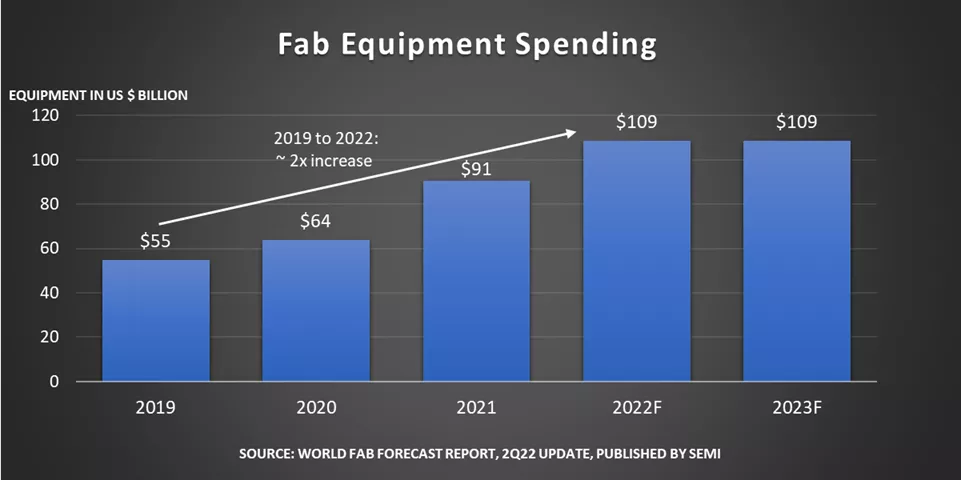
Global fab equipment spending for front-end facilities is expected to increase 20% year-over-year (YOY) to an all-time high of US$109 billion in 2022, marking a third consecutive year of growth following a 42% surge in 2021, SEMI announced today in its latest quarterly World Fab Forecast report. Fab equipment investment in 2023 is expected to remain strong.
 "The global semiconductor equipment industry remains on track to cross the $100 billion threshold for the first time as shown in our latest update of the World Fab Forecast,”said Ajit Manocha, president and CEO of SEMI. “This historic milestone puts an exclamation point on the current run of unprecedented industry growth.”
Fab Equipment Spending by Region
Taiwan is expected to lead fab equipment spending in 2022, increasing investments 52% YoY to US$34 billion, followed by Korea at US$25.5 billion, a 7% rise, and China at US$17 billion, a 14% drop from its peak last year. Europe/Mideast is forecast to log record high spending of US$9.3 billion this year and, while comparatively smaller than outlays in other regions, its investments would represent a staggering growth of 176% YoY. Taiwan, Korea and Southeast Asia are also expected to register record-high investments in 2023.
In the Americas, the report shows fab equipment spending reaching US$9.3 billion in 2023, a 13% YoY rise following a 19% YoY increase in 2022, with the region retaining its fourth-place ranking both years in worldwide fab equipment spending.
Semiconductor Industry Continues to Boost Capacity
The SEMI World Fab Forecast report shows the global industry increasing capacity 8% this year after a 7% rise in 2021. Capacity growth is expected to continue in 2023, rising 6%. The fab equipment industry last saw a YoY growth rate of 8% in 2010, when it topped 16 million wafers per month (200mm equivalents) – nearly half of the 29 million wafers per month (200mm equivalents) projected for 2023.
Over 85% of equipment spending in 2022 will stem from capacity increases at 158 fabs and production lines, a proportion expected to edge down to 83% next year as 129 known fabs and lines add capacity.
As expected, the foundry sector, with a share of about 53%, will account for the bulk of equipment spending in 2022 and 2023, followed by memory at 33% in 2022 and 34% in 2023. The two sectors also account for the largest capacity increases.
The latest update of the SEMI World Fab Forecast report, published in June, lists more than 1,400 facilities and lines globally, including 133 future facilities and lines with various probabilities that are expected to start volume production.
About SEMI
SEMI® connects more than 2,500 member companies and 1.3 million professionals worldwide to advance the technology and business of electronics design and manufacturing. SEMI members are responsible for the innovations in materials, design, equipment, software, devices, and services that enable smarter, faster, more powerful, and more affordable electronic products. Electronic System Design Alliance (ESD Alliance), FlexTech, the Fab Owners Alliance (FOA), the MEMS & Sensors Industry Group (MSIG) and SOI Consortium are SEMI Strategic Technology Communities. Visit www.semi.orgto learn more, contact one of our worldwide offices, and connect with SEMI onLinkedIn andTwitter
Association Contact
Michael Hall/SEMI
Phone: 1.408.943.7988
Email: [email protected]

 Themed Resilient Europe: Semiconductors Enabling a Sustainable Digital Life, ISS Europe 2022 will present economic, technology, market, business, and geopolitical developments influencing the global electronics manufacturing industry as well as their implications for strategic business decisions.




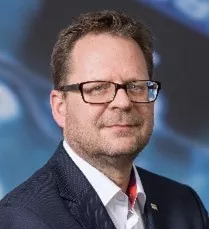



 “We applaud Luc Van den hove and Paul Boudre for their excellent work and outstanding research and development leadership and contributions to the European semiconductor community,” said Laith Altimime, president of SEMI Europe.
 Van den hove received his Ph.D. in electrical engineering from the KU Leuven in Belgium. He joined imec in 1984, starting his research career in the field of silicide and interconnect technologies and became manager of the imec micro-patterning group (lithography and dry etching) in 1988. In 1996, Van den hove was appointed department director of unit process step R&D, and in 1998 vice president of the silicon process and device technology division. In January 2007, he was appointed imec EVP and COO and has served as president and CEO of imec since 2009.
 Boudre holds a graduate degree in chemistry from France’s Ecole Nationale Supérieure de Chimie de Toulouse. He joined Soitec in 2007 as Director of Sales, Marketing and Business Development. He has been the CEO since 2015 and a member of the Board of Directors. During his 10 years at KLA-Tencor, he led the group’s European operations, then served as VP for Europe and the U.S. He held management duties in the industrial units of IBM Semiconductor (now part of GlobalFoundries), STMicroelectronics, Motorola Semiconductor (now part of NXP Semiconductors), and Atmel. Boudre has been active in the semiconductor industry for 30 years.
 “Year-over-year first quarter equipment revenue growth is in sync with positive forecasts for 2022 as the semiconductor industry continues its robust increase of fab capacity,” said Ajit Manocha, SEMI president and CEO. “North America and Europe logged healthy quarter-over-quarter rises in equipment spending as they intensify efforts to bolster domestic chipmaking.”
 “Speedy adoption of the European Chips Act will significantly accelerate Europe’s work to attract investments to build up chip manufacturing capacity and R&D,” said Laith Altimime, president of SEMI Europe. “The Act is also a key step forward for Europe to substantially decarbonize semiconductor manufacturing and drive digital transformation.”
 “As global demand for semiconductors continues to grow, Michigan is poised to be a solution provider for semiconductor shortages and puts companies in the heart of semiconductor and battery R&D efforts nationwide,” said Governor Gretchen Whitmer. “Michigan is one of only three states that will be launching planning work to define curricula to support employers in the semiconductor industry. With this new apprenticeship program, along with our global manufacturing and automotive R&D leadership, we are leading the charge in addressing the universal industry demand for semiconductors while creating good jobs for Michigan workers.”
 SEMICON Europa 2022 will convene experts and technologists for insights into the latest technology, materials and process innovations powering digital transformation and the next wave of semiconductor industry growth. The event will spotlight cutting-edge solutions that enable chipmakers to implement a broad range of new application-specific technologies.
 Stockunas will lead the SEMI Americas staff in increasing the value SEMI delivers to members, directing North America sales and services, and driving events and programs. He will also advocate for the microelectronics industry as part of the SEMI Global Leadership Team.
 “We look forward to bringing together industry leaders for their perspectives on near-term 3D roadmaps and how the semiconductor industry can enable innovation for emerging applications,” said Laith Altimime, president of SEMI Europe. “Their insights promise to help the semiconductor industry address new technology challenges and requirements across the entire supply chain.”