downloadGroupGroupnoun_press release_995423_000000 copyGroupnoun_Feed_96767_000000Group 19noun_pictures_1817522_000000Member company iconResource item iconStore item iconGroup 19Group 19noun_Photo_2085192_000000 Copynoun_presentation_2096081_000000Group 19Group Copy 7noun_webinar_692730_000000Path
Skip to main content
Default Banner Image

United States

BRUSSELS, BelgiumSeptember 30, 2021 – SEMI, the global industry association representing more than 2,400 semiconductor and electronics manufacturing companies worldwide, today applauded the proposed European Chips Act legislation aimed at strengthening semiconductor research, development, and manufacturing in Europe.

SEMI logoProposed by European Commission President Ursula von der Leyen in her State of the Union speech on September 15, the European Chips Act is part of the Commission’s policies to achieve the digital transformation of the region’s economy by 2030 under its Digital Decade plan.

“SEMI supports incentives for semiconductor manufacturing and supply chain investments such as those proposed to be included in the European Chips Act,” said Ajit Manocha, SEMI president and CEO. “Transparent implementation of such initiatives allows industry participants the opportunity to efficiently strengthen the resilience of the global semiconductor industry and create a more robust supply chain. The current chip shortage has exacerbated backlogs and lead times for semiconductor manufacturing equipment and materials. Given the vital importance of these elements to expanding semiconductor production capacity, incentives should extend to investments in both new and existing semiconductor manufacturing equipment and materials facilities.”

Citing the current shortages and Europe’s dependency on the global chip ecosystem in a recent blog post, Thierry Breton, the European Commissioner for Internal Market, emphasized the Chips Act must ensure the resilience of the semiconductor supply chain across design, production, packaging and equipment. Breton calls for the legislation to strengthen Europe’s ability to develop mega fabs capable of high-volume production of advanced and energy-efficient semiconductors. Additionally, he recommends the Chips Act include strategies for extending the research ambitions of Europe, tightening coordination of chip production among EU member states, and providing a framework for international cooperation and partnerships.

Visit SEMI Global Advocacy and SEMI Europe Advocacy to learn more about public policy efforts and developments.

About SEMI

SEMI® connects more than 2,400 member companies and 1.3 million professionals worldwide to advance the technology and business of electronics design and manufacturing. SEMI members are responsible for the innovations in materials, design, equipment, software, devices, and services that enable smarter, faster, more powerful, and more affordable electronic products. Electronic System Design Alliance (ESD Alliance), FlexTech, the Fab Owners Alliance (FOA) and the MEMS & Sensors Industry Group (MSIG) are SEMI Strategic Technology Communities, defined communities within SEMI focused on specific technologies. Visit www.semi.org to learn more, contact one of our worldwide offices, and connect with SEMI on LinkedIn and Twitter.


Association Contacts

Samer Bahou / SEMI Headquarters
Phone: +1.408.943.7870
Email: [email protected]

Serena Brischetto / SEMI Europe
Phone: +49 30 3030 8077-11
Email: [email protected]

HSINCHU, Taiwan – September 27, 2021 – Semiconductor leaders and visionaries will convene December 28-30 at SEMICON Taiwan 2021 for insights into the latest innovations that will drive the next wave of industry growth as the event, the region’s premier gathering of the entire electronics manufacturing and design supply chain, returns to the Taipei Nangang Exhibition Center, Hall 1 (TaiNEX 1).

SEMICON Taiwan logoFeaturing more than 550 exhibitors in over 2,000 booths and chip industry leaders such as TSMC, ASE and Nanya Technology, SEMICON Taiwan 2021 – themed Forward as One – will showcase cutting-edge advances and solutions in critical semiconductor industry areas including heterogeneous integration, green manufacturing, smart and advanced manufacturing, advanced testing, strategic materials, and MEMS and sensors.  

SEMICON Taiwan 2021 was rescheduled after Taiwan’s Central Epidemic Command Center (CECC) recently relaxed restrictions on social distancing and exhibition size following a successful push to reduce the number of COVID-19 cases. With the safety and well-being of all event participants a top priority, SEMI will meet the highest standards in implementing pandemic prevention measures during the exhibition.

“Taiwan is a semiconductor manufacturing powerhouse that produces some of the world’s most sophisticated chips and has led semiconductor equipment spending in seven of the past 10 years,” said Terry Tsao, Chief Marketing Officer at SEMI and President of SEMI Taiwan. “With Taiwan’s central position in the semiconductor industry, SEMICON Taiwan 2021 offers visitors unmatched opportunities to connect with some of the industry’s top companies and uncover new business opportunities across leading-edge technologies including artificial intelligence (AI), Internet of Things (IoT), 5G and machine learning that are transforming the microelectronics industry and giving rise to a growing universe of smart applications.”

Five Online Forums Pave the Way to SEMICON Taiwan 2021

The journey to SEMICON Taiwan 2021 began in September with five live online forums featuring expert insights into critical semiconductor industry areas – Power and Opto Chips, Smart Manufacturing, Sustainable Manufacturing, Smart MedTech and Cybersecurity. Available on-demand through November, the online events offer insights into future semiconductor industry trends.  


About SEMI

SEMI® connects more than 2,400 member companies and 1.3 million professionals worldwide to advance the technology and business of electronics design and manufacturing. SEMI members are responsible for the innovations in materials, design, equipment, software, devices, and services that enable smarter, faster, more powerful, and more affordable electronic products. Electronic System Design Alliance (ESD Alliance), FlexTech, the Fab Owners Alliance (FOA) and the MEMS & Sensors Industry Group (MSIG) are SEMI Strategic Technology Communities, defined communities within SEMI focused on specific technologies. Visit www.semi.org to learn more, contact one of our worldwide offices, and connect with SEMI on LinkedIn and Twitter.


Association Contacts

Elma Fang

Email: [email protected]

Phone: +886.3.560.1777 ext. 207


Connie Lin

Email: [email protected]

Phone: +886.3.560.1777 ext. 211

MILPITAS, Calif. — September 20, 2021 — North America-based semiconductor equipment manufacturers posted $3.65 billion in billings worldwide in August 2021 (three-month average basis), according to the August Equipment Market Data Subscription (EMDS) Billings Report published today by SEMI. The billings figure is 5.4% lower than final July 2021 billings of $3.86 billion and 37.6% higher than August 2020 billings of $2.65 billion.

SEMI logo“After an extraordinary eight-month run of record-breaking results, billings of North America-based semiconductor equipment manufacturers expectedly softened in August compared to July,” said Ajit Manocha, SEMI president and CEO. “Nonetheless, billings continue to reflect strong demand for semiconductor equipment and solid year-over-year growth.”

The SEMI Billings report uses three-month moving averages of worldwide billings for North American-based semiconductor equipment manufacturers. Billings figures are in millions of U.S. dollars.


Billings
(3-mo. Avg.)

Year-Over-Year

March 2021

$3,273.9

47.9%

April 2021

$3,428.9

50.3%

May 2021

$3,588.5

53.1%

June 2021

$3,690.2

59.2%

July 2021 (final)

$3,857.4

49.8%

August 2021 (prelim)

$3,650.0

37.6%

Source: SEMI (www.semi.org), September 2021


SEMI publishes a monthly North American Billings report and issues the Worldwide Semiconductor Equipment Market Statistics (WWSEMS) report in collaboration with the Semiconductor Equipment Association of Japan (SEAJ). The WWSEMS report currently reports billings by 24 equipment segments and by seven end market regions. SEMI also has a long history of tracking semiconductor industry fab investments in detail on a company-by-company and fab-by-fab basis in its World Fab Forecast and SEMI FabView databases. These powerful tools provide access to spending forecasts, capacity ramp, technology transitions, and other information for over 1,000 fabs worldwide. For an overview of available SEMI market data, please visit www.semi.org/en/MarketInfo.

The data contained in this release were compiled by David Powell, Inc., an independent financial services firm, without audit, from data submitted directly by the participants. SEMI and David Powell, Inc. assume no responsibility for the accuracy of the underlying data.


About SEMI

SEMI® connects more than 2,400 member companies and 1.3 million professionals worldwide to advance the technology and business of electronics design and manufacturing. SEMI members are responsible for the innovations in materials, design, equipment, software, devices, and services that enable smarter, faster, more powerful, and more affordable electronic products. Electronic System Design Alliance (ESD Alliance), FlexTech, the Fab Owners Alliance (FOA) and the MEMS & Sensors Industry Group (MSIG) are SEMI Strategic Technology Communities, defined communities within SEMI focused on specific technologies. Visit www.semi.org to learn more, contact one of our worldwide offices, and connect with SEMI on LinkedIn and Twitter.


Association Contact

Michael Hall/SEMI
Phone: 1.408.943.7988
Email: [email protected]


Notes

Next SEMI Billings report is October 21, 2021 at 3:00pm Pacific.

For information on SEAJ Billings Express Report, visit www.seaj.or.jp. 

Event to Explore Opportunities in Medical, Space Exploration, Telecommuting, Community Infrastructure, and Other Growth Markets 

MILPITAS, Calif. – September 14, 2021 – Returning to a live format, MEMS and Sensors Executive Conference (MSEC 2021) will gather industry visionaries and experts October 11-13 at the Coronado Island Marriott Resort in San Diego for insights into the latest trends and innovations in sensorization for growth markets including medical, fitness, connected communities, environmental and air quality, and wearables. Registration is open for MSEC 2021, hosted by the MEMS & Sensors Industry Group (MSIG), a SEMI technology community.

MSEC 2021 logoInternet of Things (IoT) spending is surging as digital transformation continues apace, creating new opportunities for MEMS and sensors innovations. The compound annual growth rate (CAGR) for IoT spending will reach 26.7% between 2022 and 2025 as the number of global IoT connections reaches a forecasted 31 billion, a tenfold increase from a decade ago, according to IoT Analytics. The market research firm reports that in 2020, IoT connections for smart devices such as cars, home electronics and connected industrial equipment outnumbered non-IoT-connected electronics for the first time.

“Sensors are driving the widespread adoption of smart and connected IoT systems, which require unprecedented amounts of data,” said Dr. Tim Brosnihan, executive director of the SEMI MEMS & Sensors Industry Group. “By better monitoring the air we breathe, the water we drink, the food we eat, the health of our bodies and the safety of our surroundings, sensors continue to improve the quality of our lives.”

Themed Sensorization: Enabling Better, Smarter Living, MSEC 2021 will focus on technology solutions to pressing challenges in healthcare, the environment, resource management, transportation, and safety. The event will showcase components, software, and systems critical to MEMS and sensors innovations.

The health and well-being of all event exhibitors and attendees remains the top priority for SEMI. MSEC 2021 health and safety guidelines to protect against spread of COVID-19 will help provide a safe experience for all attendees on-site. 

MSEC Keynotes

Claude Jean

Claude Jean, executive vice president, general manager, Semiconductor, Teledyne DALSA

Mars to Earth – Lessons from the Perseverance Rover in How Sensors Enable the Effort to Sense and Analyze Mars

Teledyne 170x65
Anton Hofmeister

Anton Hofmeister, Analog MEMS & Sensors vice president, MEMS Microactuators general manager, STMicroelectronics

How MEMS Actuators Will Power Emerging Applications

STMicroelectronics_170x65
Joshua C. Dorr

Joshua C. Dorr, Ph.D., director, Advanced Sensors and Microsystems, Honeywell

Sweating the Small Stuff: A Safer World Through Soft Target LiDAR

Honeywell Logo


MSEC 2021 will also feature sessions on topics including the following:

  • Sensors for Better Living with Renesas Electronics Corporation, iSonoHealth, AdHawk Microsystems
  • Sensors Expanding Our World with Teledyne Dalsa, STMicroelectronics
  • MEMS Speakers Product Showdown with USound GmbH, xMEMS Labs
  • Industry Market Outlook and Emerging Trends with McKinsey & Company, XFAB
  • Applications Trends for Connected Communities with M. Fitzgerald & Associates
  • Innovation and the Voice of the Customer

Networking Fun at MSEC 2021 – Ferry Ride, Sailing Ship Tour, Maritime Museum

 MSEC 2021 attendees will be able to network on-site at the event and during a group tour aboard a scenic ferry ride through San Diego Harbor. The ride will be followed by a walk on the decks of the largest and oldest active sailing ship, Star of India, and a tour of the Maritime Museum of San Diego’s renowned collection ranging from sailing and steam vessels to submarines. 

MSEC 2021 Premier Sponsors

Event sponsors also include Okmetic, Rogue Valley Microdevices, SPTS Technologies, a KLA Company, SUSS MicroTec, and TEL.

SEMI MSIG lockup logo

Learn more at MSEC 2021. 

About SEMI

SEMI® connects more than 2,400 member companies and 1.3 million professionals worldwide to advance the technology and business of electronics design and manufacturing. SEMI members are responsible for the innovations in materials, design, equipment, software, devices, and services that enable smarter, faster, more powerful, and more affordable electronic products. Electronic System Design Alliance (ESD Alliance), FlexTech, the Fab Owners Alliance (FOA) and the MEMS & Sensors Industry Group (MSIG) are SEMI Strategic Technology Communities, defined communities within SEMI focused on specific technologies. Visit www.semi.org to learn more, contact one of our worldwide offices, and connect with SEMI on LinkedIn and Twitter.

Association Contact

Scott Stevens, Cardinal Communications for SEMI Americas
Phone: 1.512.288.4050
Email: [email protected]

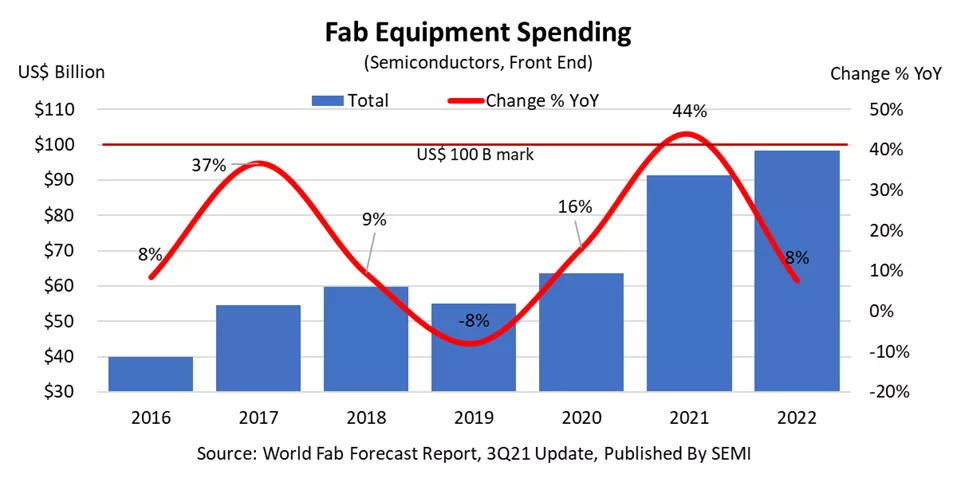
MILPITAS, Calif. — September 14, 2021 — Powered by digital transformation and other secular technology trends, global semiconductor equipment investments for front end fabs in 2022 are expected to reach nearly US$100 billion to meet soaring demand for electronics after topping a projected $90 billion this year, both new records, SEMI highlighted today in its World Fab Forecast report.

SEMI logoThe new fab equipment spending records will mark a rare three consecutive years of growth that began in 2020, bucking the historical cyclical trend of a one- or two-year expansion followed by a year or two of tepid growth or declines. The semiconductor industry last saw more than two consecutive years of growth in the mid-1990s.


World Fab Forecast chart


The foundry sector will account for the bulk of fab equipment investments in 2022, with more than US$44 billion in spending, followed by the memory sector at over US$38 billion. Both DRAM and NAND also show large increases in 2022 with jumps in spending to US$17 billion and US$21 billion, respectively. Micro/MPU investments will reach approximately US$9 billion, discrete/power US$3 billion, analog US$2 billion, and other devices about US$2 billion next year.

Regionally in 2022, Korea will lead in fab equipment spending at US$30 billion, followed by Taiwan at US$26 billion, and China at nearly US$17 billion. Japan will take the fourth spot with almost US$9 billion in fab equipment spending. While Europe/Mideast will be in fifth place at US$8 billion, the region is expected to post standout year-over-year percentage growth of 74% in 2022. In the Americas and Southeast Asia, spending is projected to reach more than US$6 billion and US$2 billion, respectively.  

The World Fab Forecast report lists 1,417 facilities and lines globally, including 129 facilities and lines starting volume production in 2021 and beyond.  


About SEMI

SEMI® connects more than 2,400 member companies and 1.3 million professionals worldwide to advance the technology and business of electronics design and manufacturing. SEMI members are responsible for the innovations in materials, design, equipment, software, devices, and services that enable smarter, faster, more powerful, and more affordable electronic products. Electronic System Design Alliance (ESD Alliance), FlexTech, the Fab Owners Alliance (FOA) and the MEMS & Sensors Industry Group (MSIG) are SEMI Strategic Technology Communities, defined communities within SEMI focused on specific technologies. Visit www.semi.org to learn more, contact one of our worldwide offices, and connect with SEMI on LinkedIn and Twitter.


Association Contacts

Michael Hall/SEMI

Phone: 1.408.943.7988

Email: [email protected]


Christian G. Dieseldorff/SEMI

Phone: 1.408.943.7940

Email: [email protected]

MILPITAS, Calif. – September 7, 2021 – Global semiconductor equipment billings surged 48% year-over-year to a record high of US$24.9 billion in the second quarter of 2021, a 5% increase from the prior quarter, SEMI announced today in its Worldwide Semiconductor Equipment Market Statistics (WWSEMS) Report.

SEMI logoCompiled from data submitted by members of SEMI and the Semiconductor Equipment Association of Japan (SEAJ), the Worldwide SEMS Report is a summary of the monthly billings figures for the global semiconductor equipment industry. 

Following are quarterly billings data in billions of U.S. dollars with quarter-over-quarter and year-over-year changes by region:
 

Region

2Q2021

1Q2021

2Q2020

2Q2021/1Q2021

2Q2021/2Q2020

China

8.22

5.96

 4.59

38%

79%

Korea

6.62

7.31

 4.48

-9%

48%

Taiwan

5.04

5.71

 3.51

-12%

44%

Japan

1.77

1.66

 1.72

7%

2%

North America

1.68

1.34

 1.64

25%

2%

Rest of World

0.84

1.02

 0.37

-18%

129%

Europe

0.71

0.58

 0.46

22%

54%

Total

 24.87

 23.57

 16.77

5%

48%

Sources: SEMI (www.semi.org) and SEAJ (www.seaj.or.jp), September 2021


The SEMI Equipment Market Data Subscription (EMDS) provides comprehensive market data for the global semiconductor equipment market. The subscription includes three reports:

  • Monthly SEMI Billings Report, a perspective on equipment market trends
  • Monthly Worldwide Semiconductor Equipment Market Statistics (WWSEMS), a detailed report of semiconductor equipment billings for seven regions and 24 market segments
  • SEMI Semiconductor Equipment Forecast, an outlook for the semiconductor equipment market

For more information or to subscribe, please contact the SEMI Industry Research and Statistics Group at [email protected]. More information is also available online.


About SEMI
SEMI® connects more than 2,400 member companies and 1.3 million professionals worldwide to advance  the technology and business of electronics design and manufacturing. SEMI members are responsible for the innovations in materials, design, equipment, software, devices, and services that enable smarter, faster, more powerful, and more affordable electronic products. Electronic System Design Alliance (ESD Alliance), FlexTech, the Fab Owners Alliance (FOA) and the MEMS & Sensors Industry Group (MSIG) are SEMI Strategic Technology Communities, defined communities within SEMI focused on specific technologies. Visit www.semi.org to learn more, contact one of our worldwide offices, and connect with SEMI on LinkedIn and Twitter.

Association Contact
Michael Hall/SEMI
Phone: 1.408.943.7988
Email: [email protected]

By: Erick Irigoyen, Mark Duffield & Nishant Saini, AWS

The high-volume manufacturing of semiconductor devices relies on complex wafer production and packaging processes, supported by a long list of specialized equipment manufacturers and materials suppliers. This heterogenous and globally distributed manufacturing supply chain must work closely with semiconductor design and verification teams. These teams create application-specific integrated circuits (ASICS) and systems-on-chip (SoC) to meet performance, quality, and security requirements of industries including automotive, communications, and others. Increasing yield and optimizing costs require secure communication and collaboration on data gathered across all stages such as design, verification, and manufacturing.

Globally distributed semiconductor companies and their manufacturing partners increasingly rely on Smart Manufacturing technologies to improve operational efficiency and reduce time to market (TTM). These technologies include advanced production and yield analytics, Artificial Intelligence and Machine Learning (AI/ML), automated forecasting and supply chain risk analysis, industrial IoT, predictive maintenance, digital, analog, mixed-signal and EM/RF simulations, digital twins, customized manufacturing execution systems (MES), computational lithography, among others. At its core, Smart Fab is a data driven approach, allowing semiconductor manufacturers and their fabless customers to remain competitive in a dynamic and challenging market. This ensures efficient supply chain integration, improved transparency, security, traceability, and reliability.

Smart Fab spans the entire semiconductor supply chain (Figure 1). From a semiconductor foundry’s perspective, it provides a holistic view of all the fab systems. Some of these systems include engineering and design data (EDA, PLM, CAD, CAE), operations data from manufacturing applications, and machine/sensor data. The combination of data from these systems provides the ability to analyze the interaction between process equipment manufacturing automation, supply chain, commercial management, facilities monitoring, and control.
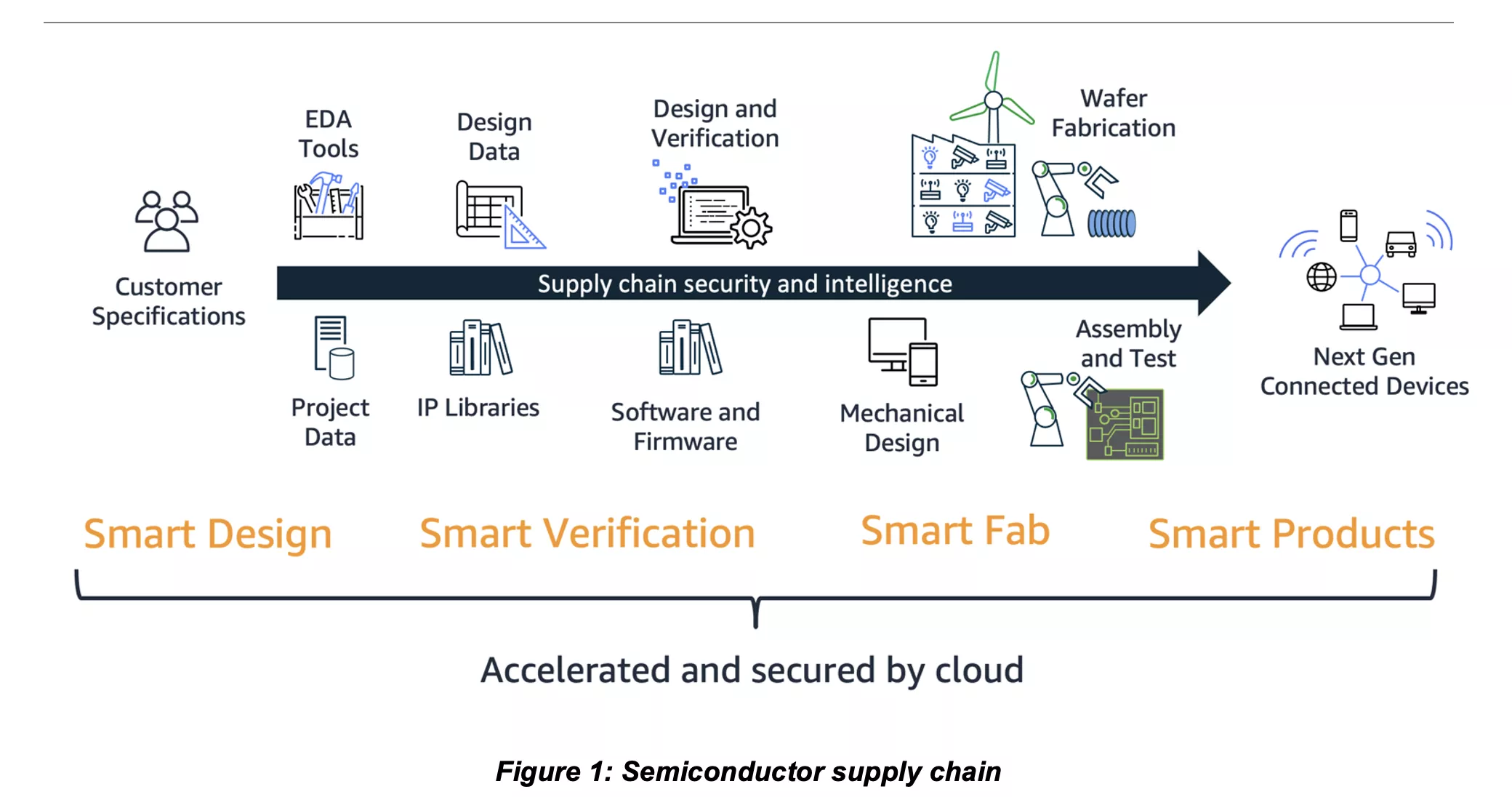
Figure 1

Smart Fab also extends beyond today’s typical approach to optimize capital expenditure (CAPEX), time to market, design quality, and advanced technology device fabrication. It focuses on continuous operational expenditure (OPEX) improvements across all fab operations, in addition to CAPEX optimizations, TTM, and quality. Secure access to data throughout the supply chain makes this possible with cloud-based collaboration, Internet of Things (IoT) technologies, AI/ML, and advanced analytics.

Secure collaboration is a key feature for Smart Fab. For a foundry, the platform can increase collaboration by enabling controlled access to data with its key suppliers for ease of communication and accelerated service response times. This results in improved responsiveness, reliability, traceability, and quality. For a fabless or integrated semiconductor company and its ASIC and SoC development teams, Smart Fab allows a high level of visibility, using actionable data generated during the manufacturing and test processes. For example, enabling curated data generated during wafer fab, die sort, packaging, assembly, and test can be used to evaluate and improve wafer yields, and reduce device failure rates.

With applications for chain participants, the reduced cost of sensor technologies for IoT and the rapid development of AI/ML methods expand the possibilities to collect and act on large amounts of operational and real-time data. IoT enabled sensors can provide an inexpensive way to get additional inspection points throughout the manufacturing process compared to the conventional wired sensor approach. IoT technologies also provide a way to integrate and analyze collected data with existing systems, resulting in potential process improvements. For a foundry, this implies the integration of all its systems as part of the IoT platform with the fabless designer of the chip to further improve visibility, yield, and TTM.

AI/ML and Data Analytics are becoming an increasingly important productivity tool, reducing time to market across the semiconductor manufacturing value chain. Manufacturing, being the largest cost driver, will likely benefit the most from AI/ML and Data analytics in terms of cost reduction and productivity improvements. For example, AI/ML can be used to improve business processes such as forecasting, scheduling and inventory management, overall equipment effectiveness (OEE), process parameters, defect detection, and automated testing. Chip design and verification is another area that stands to gain from AI/ML and Data Analytics. Manufacturing-related analytics can be used at design stages to improve design-for-manufacturing and design-for-quality (“zero defect”) initiatives. It can reduce costly iterations for new products introductions and accelerate ramp-up time.

AWS enables Smart Fab through cloud-based services for AI/ML, Data Analytics, and IoT. These services accelerate and enhance semiconductor manufacturing capabilities by utilizing cloud infrastructure and can be tailored to meet specific requirements. Additionally, AWS for Industrials offers a set of solutions and services tailored for Industrial customers.

AWS has service offerings in the following key areas to drive a measurable impact:

  • Collect data and manage end devices: Create a single data lake for analysis: Amazon S3, AWS IoT Core, AWS IoT Device Management, AWS IoT Greengrass, and AWS IoT SiteWise.
  • Analyze data across the design and fabrication process: AWS Lake Formation, Amazon Athena, Amazon EMR, Amazon Redshift, Amazon Kinesis, Amazon Timestream and AWS Glue are used to collect, store, and analyze data at scale
  • Increase yield through Data Analytics and AI/ML: Amazon SageMaker, Amazon Monitron, Amazon Lookout for Equipment, Amazon Lookout for Vision, and AWS Panorama.
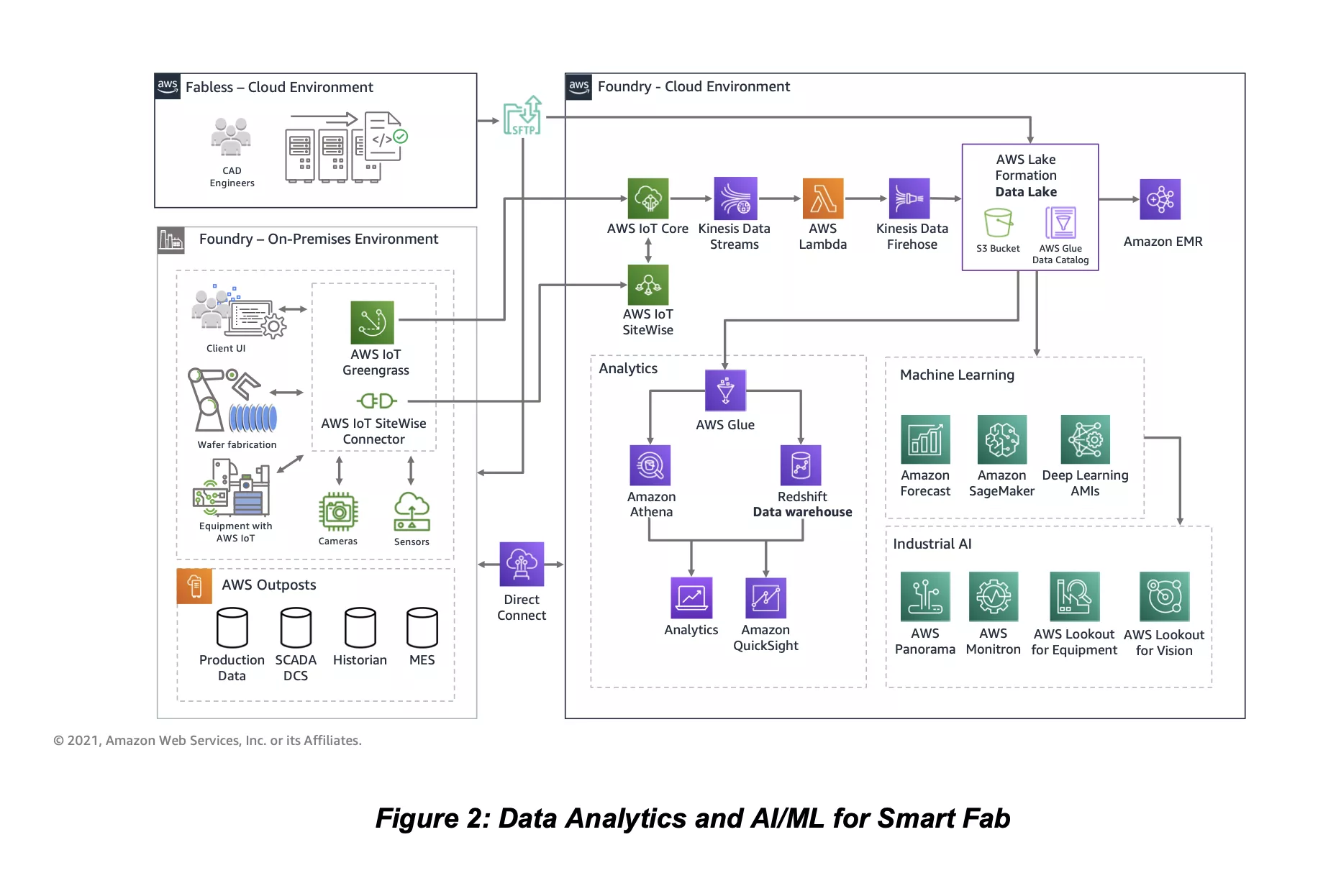
AWS Figure 2

Figure 2 shows the Data Analytics and AI/ML reference architecture for Smart Fab, and it illustrates a hybrid cloud framework from the foundry’s perspective. The Fab’s physical equipment, controllers, cameras, sensors, human-machine interfaces are latency sensitive and remain on-premises. Latency sensitive manufacturing applications can also be run on premises with AWS Outposts, which is a fully managed service that offers the same AWS infrastructure, AWS services, APIs, and tools within a data center.

Central to a Data Analytics and AI/ML strategy is the data lake in the cloud. Multiple data lakes may be managed by different organizations. For example, at a fabless semiconductor customer, fab and test partners can improve operations and increase device yields by analyzing data captured from field deployments in combination with manufacturing and design-related data. To ingest data from sensors, machines, and manufacturing applications running on-premises or in the cloud, AWS offers a variety of services (AWS IoT Greengrass, AWS IoT SiteWise, Amazon Kinesis, AWS Transfer for SFTP). The data from these sources are ingested, contextualized and then stored in the data lake. The architecture can also be optimized for collaboration with a semiconductor design environment running on AWS. Relevant design data is sent to the foundry, on-premises test facility, and data lake. Data lake serves as a central source of all fab data for analytics applications, advanced ML modeling and advanced AI services to generate actionable insights.

AWS for Smart Fab provides a customizable blueprint to address different use cases and the different needs of semiconductor companies. By using AWS services, a Smart Fab can apply advanced tools to data across the entire supply chain in near-real-time, proactively correcting potential issues and improving yield. Augmenting human intelligence with advanced analytics and AI/ML uncovers the underlying trends and creates new opportunities to improve semiconductor manufacturing cycles.

Improvements in both CAPEX and OPEX are necessary for all semiconductor manufacturers to increase profitability and growth within the highly competitive and dynamic semiconductor market environment built on the challenges of diverging products, technologies, and client base. Efficient supply chain integration is critical given that it faces restrictions in terms of experienced expert resources (for both operation and maintenance) and the availability of spare parts and consumables. Smart Fab provides opportunities for supply chain integration, improves transparency, reliability, sustainability of the facility systems, reducing OPEX. Ultimately, the operational data from existing fab, packaging, and assembly lines can be used in comparative analysis to optimize CAPEX for new projects, improve development turnaround times, and increase new product introduction (NPI) cycles.

This article re-published with permission from AWS.  To view the original article and more about the authors, visit AWS.

Cadence, Siemens EDA and Synopsys Approve Server Certification Protocol Through Development Effort Led by the ESD Alliance; Protocol Moves to Standardization Process

MILPITAS, Calif. – August 31, 2021 The SEMI Electronics System Design (ESD) Alliance today announced completion of the anti-piracy SEMI Server Certification Protocol (SSCP) for software license management, a year-long joint development effort led by the ESD Alliance, a SEMI Technology Community.

SEMI ESDA logoThe SSCP, approved by development committee members Cadence, Siemens EDA and Synopsys, uniquely identifies each customer license server to assure that licenses are issued only by authorized servers to help protect against software piracy. The SCCP is now undergoing standardization and will be managed by the SEMI Standards group after its finalization as an industry standard. The committee members intend to implement the protocol in their respective license management software.

“A big thank you to Cadence, Siemens EDA, and Synopsys, our joint development association partners, for their work to push the protocol forward,” said Bob Smith, executive director of the SEMI ESD Alliance. “It took a concerted effort to reach this key milestone and that push will continue as we move forward to finalizing SSCP as an industry standard. Software piracy costs industry billions of dollars per year and hurts both vendors and their customers, a problem the protocol will help mitigate.”

An industry-standard protocol to combat software piracy is a growing necessity for design automation software suppliers to ensure only authorized servers are issuing licenses. Design automation software is complex and requires ongoing and significant R&D investments. Bad actors can apply server cloning techniques to access unlicensed copies of the software, putting legitimate users and software vendors at a competitive disadvantage by forcing software vendors to increase prices to support continuing investments in R&D.

“The SSCP is a significant step forward for the semiconductor industry in its efforts to stem software piracy,” said Nimish Modi, senior vice president of market and business development at Cadence. “The collaboration among design automation suppliers ensures a wide-ranging and inclusive anti-piracy strategy.”

“Completing the server certification protocol is a huge achievement,” said Joe Sawicki, executive vice president of IC EDA for Siemens. “Congratulations to everyone who worked to establish this anti-piracy standard that protects against theft and provides a level playing field for all our users.”

“Synopsys is pleased to collaborate across the design automation industry to define a method to combat piracy,” said Arun Venkatachar, vice president of Synopsys central engineering. “It is critical for the industry to level the playing field for legitimate users. We are committed to working with SEMI and the industry to implement the protocol and make it an industry standard.”

“Ansys applauds the anti-piracy initiative led by the SEMI ESD Alliance to develop the SSPC," said Shane Emswiler, senior vice president at Ansys. "Ansys is committed to ensuring fair access for all users and combating piracy. We are proud to stand with our peers in this effort."

To learn more about SSCP, contact the SEMI ESD Alliance at [email protected].


About SEMI

SEMI® connects more than 2,400 member companies and 1.3 million professionals worldwide to advance the technology and business of electronics design and manufacturing. SEMI members are responsible for the innovations in materials, design, equipment, software, devices, and services that enable smarter, faster, more powerful, and more affordable electronic products. Electronic System Design Alliance (ESD Alliance), FlexTech, the Fab Owners Alliance (FOA) and the MEMS & Sensors Industry Group (MSIG) are SEMI Technology Communities, defined communities within SEMI focused on specific technologies. Visit www.semi.org to learn more, contact one of our worldwide offices, and connect with SEMI on LinkedIn and Twitter.

About the Electronic System Design Alliance

The Electronic System Design (ESD) Alliance, a SEMI Technology Community representing members in the electronic system and semiconductor design ecosystem, is a community that addresses technical, marketing, economic and legislative issues affecting the entire industry. It acts as the central voice to communicate and promote the value of the semiconductor design ecosystem as a vital component of the global Electronics industry.

Follow the ESD Alliance

ESD Alliance Bridging the Frontier blog

Twitter: @ESDAlliance

LinkedIn

Facebook


All trademarks and registered trademarks are the property of their respective owners.

Note: A list of relevant Siemens trademarks can be found here.


Association Contact

Michael Hall/SEMI

Phone: 1.408.943.7988

Email: [email protected]


Nanette Collins/ESD Alliance                        
Phone: 1.617.437.1822

Email: [email protected]

MILPITAS, Calif. — August 23, 2021 — North America-based semiconductor equipment manufacturers posted $3.86 billion in billings worldwide in July 2021 (three-month average basis), according to the July Equipment Market Data Subscription (EMDS) Billings Report published today by SEMI. The billings figure is 4.5% higher than final June 2021 billings of $3.69 billion and 49.8% higher than July 2020 billings of $2.57 billion.

SEMI logo“The start of the second half of 2021 further extends a robust sales uptrend for North America-based semiconductor equipment manufacturers,” said Ajit Manocha, SEMI president and CEO. “Capacity demand across the semiconductor manufacturing supply chain continues its strong growth, reflecting the role of semiconductor equipment as a key engine of digital transformation globally.”

The SEMI Billings report uses three-month moving averages of worldwide billings for North American-based semiconductor equipment manufacturers. Billings figures are in millions of U.S. dollars.


Billings
(3-mo. Avg.)

Year-Over-Year

February 2021

$3,143.1

32.4%

March 2021

$3,273.9

47.9%

April 2021

$3,428.9

50.3%

May 2021

$3,588.5

53.1%

June 2021 (final)

$3,690.2

59.2%

July 2021 (prelim)

$3,857.2

49.8%

Source: SEMI (www.semi.org), August 2021


SEMI publishes a monthly North American Billings report and issues the Worldwide Semiconductor Equipment Market Statistics (WWSEMS) report in collaboration with the Semiconductor Equipment Association of Japan (SEAJ). The WWSEMS report currently reports billings by 24 equipment segments and by seven end market regions. SEMI also has a long history of tracking semiconductor industry fab investments in detail on a company-by-company and fab-by-fab basis in its World Fab Forecast and SEMI FabView databases. These powerful tools provide access to spending forecasts, capacity ramp, technology transitions, and other information for over 1,000 fabs worldwide. For an overview of available SEMI market data, please visit www.semi.org/en/MarketInfo.

The data contained in this release were compiled by David Powell, Inc., an independent financial services firm, without audit, from data submitted directly by the participants. SEMI and David Powell, Inc. assume no responsibility for the accuracy of the underlying data.


About SEMI

SEMI® connects more than 2,400 member companies and 1.3 million professionals worldwide to advance the technology and business of electronics design and manufacturing. SEMI members are responsible for the innovations in materials, design, equipment, software, devices, and services that enable smarter, faster, more powerful, and more affordable electronic products. Electronic System Design Alliance (ESD Alliance), FlexTech, the Fab Owners Alliance (FOA) and the MEMS & Sensors Industry Group (MSIG) are SEMI Strategic Technology Communities, defined communities within SEMI focused on specific technologies. Visit www.semi.org to learn more, contact one of our worldwide offices, and connect with SEMI on LinkedIn and Twitter.


Association Contact

Michael Hall/SEMI
Phone: 1.408.943.7988
Email: [email protected]


Notes

Next SEMI Billings report is September 20, 2021 at 3:00pm Pacific.

For information on SEAJ Billings Express Report, visit www.seaj.or.jp. 

SINGAPORE – August 17, 2021 – Opening next week as a virtual conference and exhibition, SEMICON Southeast Asia (SEMICON SEA) 2021, the region’s premier event for the global electronics manufacturing and design supply chain, will gather industry experts from around the world for insights into the latest semiconductor ecosystem developments and trends with a focus on 5G, a key industry growth driver. Registration for the event – 23 to 27 August 2021 – is open.

SEMICON SEA Virtual logoThemed Powering Innovation – 5G and Beyond, SEMICON SEA 2021 will highlight opportunities for the semiconductor ecosystem to deliver on the promise of 5G. Offering unprecedented network speed and capacity, higher reliability and lower power consumption, 5G is poised to reshape sectors such as healthcare, agriculture, mobility, robotics, imaging and sensor monitoring over the coming years. Advanced, high-performance and reliable semiconductor chips are key to 5G infrastructure development that will help power future Internet of Things (IoT) economies worldwide.

“5G has enormous potential to transform economies, businesses and societies,” said Ms. Ng Bee Bee, President of SEMI Southeast Asia. “However, gearing up for 5G hardware and software growth poses many challenges for materials, chip fabs, design, testing and other sectors within the semiconductor supply chain. To help overcome these hurdles, 5G ecosystem leaders and changemakers will share their visions and ways the industry can come together to drive 5G innovation worldwide.”

“We are delighted to host SEMICON Southeast Asia 2021 this year,” said Mr. Terence Gan, Senior Vice President, Semiconductors at the Singapore Economic Development Board. “Singapore plays an important role in the global semiconductor supply chain. Some of the world’s largest semiconductor companies have established their manufacturing and R&D centres here. These companies have been able to tap the strong support of government agencies and the semiconductor ecosystem, and are well-positioned to capture growth opportunities in the sector. SEMICON Southeast Asia provides a platform for global leaders from business and government to come together and collaborate to seize these opportunities.”

Semiconductor Industry Changemakers and Leaders at SEMICON SEA 2021

Guest of honour Mr. Gan Kim Yong, Singapore’s Minister for Trade and Industry, will kick off the SEMICON SEA 2021 conference, 23 to 25 August 2021.

Speakers from semiconductor powerhouses such as GlobalFoundries, Lam Research, Micron, AEM, Applied Material, Infineon, KLA Corporation, and Kulicke & Soffa will offer industry insights during keynotes, panel discussions, presentations and the following technical tracks.

  • Track 1: EDA/Chip Manufacturer
  • Track 2: Equipment/Material/Foundry
  • Track 3: End User/Infrastructure/Telecommunications
  • Track 4: Cloud Services/Artificial Intelligence (AI)
  • Track 5: 5G-Enabled Mobility

SEMICON SEA 2021 will also feature public and private sector leaders in roundtable discussions on how the Southeast Asia semiconductor ecosystem can foster business and investment alliances. Speakers will share updates on the progress of various sectors in Southeast Asia in their digital transformation as well as their work to further the collective interest of players in all segments of electronics in the region.  

Connect for Business

SEMICON SEA 2021 virtual exhibitions, Meet the Experts sessions and Online Business Matching program will run through 27 August 2021.

Showcasing the latest innovations and solutions, the SEMICON SEA 2021 virtual exhibition will connect exhibitors with prospective customers for new business opportunities and partnerships. Back by popular demand after virtual SEMICON SEA 2020, the Online Business Matching program will help connect exhibitors with potential technical buyers for dedicated one-on-one meetings.  

The Search for Green Manufacturing and Innovation Solutions

With sustainability a critical business success factor, SEMI Southeast Asia will work closely with companies such as GlobalFoundries, Micron and Soitec to identify solutions partners in order to build a green manufacturing ecosystem as part of the Online Business Matching program.

SEMI Southeast Asia will also organise the GlobalFoundries, Micron and Soitec Green Manufacturing Solution Search for U.S., Europe and Asia suppliers across three major solution fields at SEMICON SEA 2021: energy conservation, water conservation, and waste diversion.

Career Opportunities

To grow the semiconductor industry’s talent pool, SEMICON SEA 2021 will also connect job seekers with semiconductor companies for career opportunities.  

For more details and the full agenda, please visit the SEMICON Southeast Asia website and connect with SEMI Southeast Asia on Facebook or LinkedIn.
 

About SEMI

SEMI® connects more than 2,400 member companies and 1.3 million professionals worldwide to advance the technology and business of electronics design and manufacturing. SEMI members are responsible for the innovations in materials, design, equipment, software, devices, and services that enable smarter, faster, more powerful, and more affordable electronic products. Electronic System Design Alliance (ESD Alliance), FlexTech, the Fab Owners Alliance (FOA) and the MEMS & Sensors Industry Group (MSIG) are SEMI Strategic Technology Communities, defined communities within SEMI focused on specific technologies. Visit www.semi.org to learn more, contact one of our worldwide offices, and connect with SEMI on LinkedIn and Twitter.
 

Association Contacts

Travers LIM

SEMI Southeast Asia Pte Ltd

[email protected]

+65 9660 1882


Yuan Chenyue

FINN Partners Singapore

[email protected]

+65 8353 8979