MILPITAS, Calif. — March 16, 2022 — The global semiconductor materials market grew 15.9% to $64.3 billion in revenue in 2021, surpassing the previous market high of $55.5 billion set in 2020, SEMI, the global industry association representing the electronics manufacturing and design supply chain, reported today in its Materials Market Data Subscription (MMDS).
 Wafer fabrication materials and packaging materials revenues in 2021 totaled $40.4 billion and $23.9 billion, respectively, for year-over-year increases of 15.5% and 16.5%. The silicon, wet chemicals, chemical-mechanical planarization (CMP), and photomask segments showed the strongest growth in the wafer fabrication materials market, while packaging materials market growth was largely driven by the organic substrates, leadframes, and bonding wire segments.
“The global semiconductor materials market saw exceptional growth in 2021 on the strength of robust secular demand for chips and the industry’s expansion of production capacity,” said Ajit Manocha, president and CEO of SEMI. “All regions registered double-digit or high single-digit growth last year to meet historic demand for electronics as digital transformation continues apace.”
For the 12th consecutive year, Taiwan, at $14.7 billion, was the world's largest consumer of semiconductor materials on the strength of its foundry capacity and advanced packaging base. China registered the strongest absolute year-over-year growth in 2021 to rank second, while Korea remained the third largest consumer of semiconductor materials.
|
|
2020** |
2021 |
Year-Over-Year |
|
Taiwan |
$12,720 |
$14,711 |
15.7% |
|
China |
$9,783 |
$11,929 |
21.9% |
|
South Korea |
$9,119 |
$10,572 |
15.9% |
|
Japan |
$7,902 |
$8,811 |
11.5% |
|
Rest of World* |
$6,770 |
$7,801 |
15.2% |
|
North America |
$5,564 |
$6,036 |
8.5% |
|
Europe |
$3,622 |
$4,414 |
21.9% |
|
Total |
$55,479 |
$64,273 |
15.9% |
Source: SEMI (www.semi.org), March 2022
Note: Numbers may not add up due to rounding.
* Rest of World (ROW) includes Singapore, Malaysia, Philippines, other areas of Southeast Asia and smaller global markets.
** 2020 data reflect current updates.
The Materials Market Data Subscription (MMDS) from SEMI provides annual revenue with 10 years of historical data and a two-year forecast. The annual subscription includes quarterly updates for the materials segment and reports revenue for seven market regions (North America, Europe, Japan, Taiwan, South Korea, China and ROW). The report also features detailed historical data for silicon shipments and revenues for photoresist, photoresist ancillaries, process gases and lead frames.
For more information or to subscribe, please contact the SEMI Market Intelligence Team at [email protected].
About SEMI
SEMI® connects more than 2,500 member companies and 1.3 million professionals worldwide to advance the technology and business of electronics design and manufacturing. SEMI members are responsible for the innovations in materials, design, equipment, software, devices, and services that enable smarter, faster, more powerful, and more affordable electronic products. Electronic System Design Alliance (ESD Alliance), FlexTech, the Fab Owners Alliance (FOA), the MEMS & Sensors Industry Group (MSIG) and SOI Consortium are SEMI Strategic Technology Communities. Visit www.semi.org to learn more, contact one of our worldwide offices, and connect with SEMI on LinkedIn and Twitter.
Association Contact
Michael Hall/SEMI
Phone: 1.408.943.7988
Email: [email protected]
 “With hardware security critically important to the semiconductor industry, this project is a great step toward strengthening manufacturing cybersecurity to enable a safe and secure digital life,” said Laith Altimime, president of SEMI Europe. “SEMI welcomes the findings and will address these cybersecurity issues with our members. We thank the SSG research team for its invaluable support and are pleased to have partnered with it on this strategic initiative.”
 Expected to draw hundreds of attendees from across the industry, the 33rd annual ASMC will feature discussions on the global COVID-19 pandemic’s impact on manufacturing leadership, semiconductor market trends, heterogenous integration and quantum computing.






 WiS 2022 builds on the strength of past events with themes including mentorship, career networking and the critical role of companies in promoting gender diversity in the workplace. Industry stakeholders ranging from company leaders, team members and developers of internal programs supporting women will benefit from expert insights, open discussion and networking opportunities at WiS 2022. University STEM students and faculty attending WiS 2022 will learn more about these key workforce development issues and network with industry professionals as the chip industry continues to build its talent pipeline.

 Formerly known as the Worldwide OSAT Manufacturing Sites Database, the comprehensive database now includes more than 100 updates spanning packaging technology, product specialization and ownership/shareholder. With more than 100 new test facility additions to bring the total number of facilities tracked to 475, the database helps semiconductor manufacturers identify service offerings around the globe, an increasingly important task in supply chain management.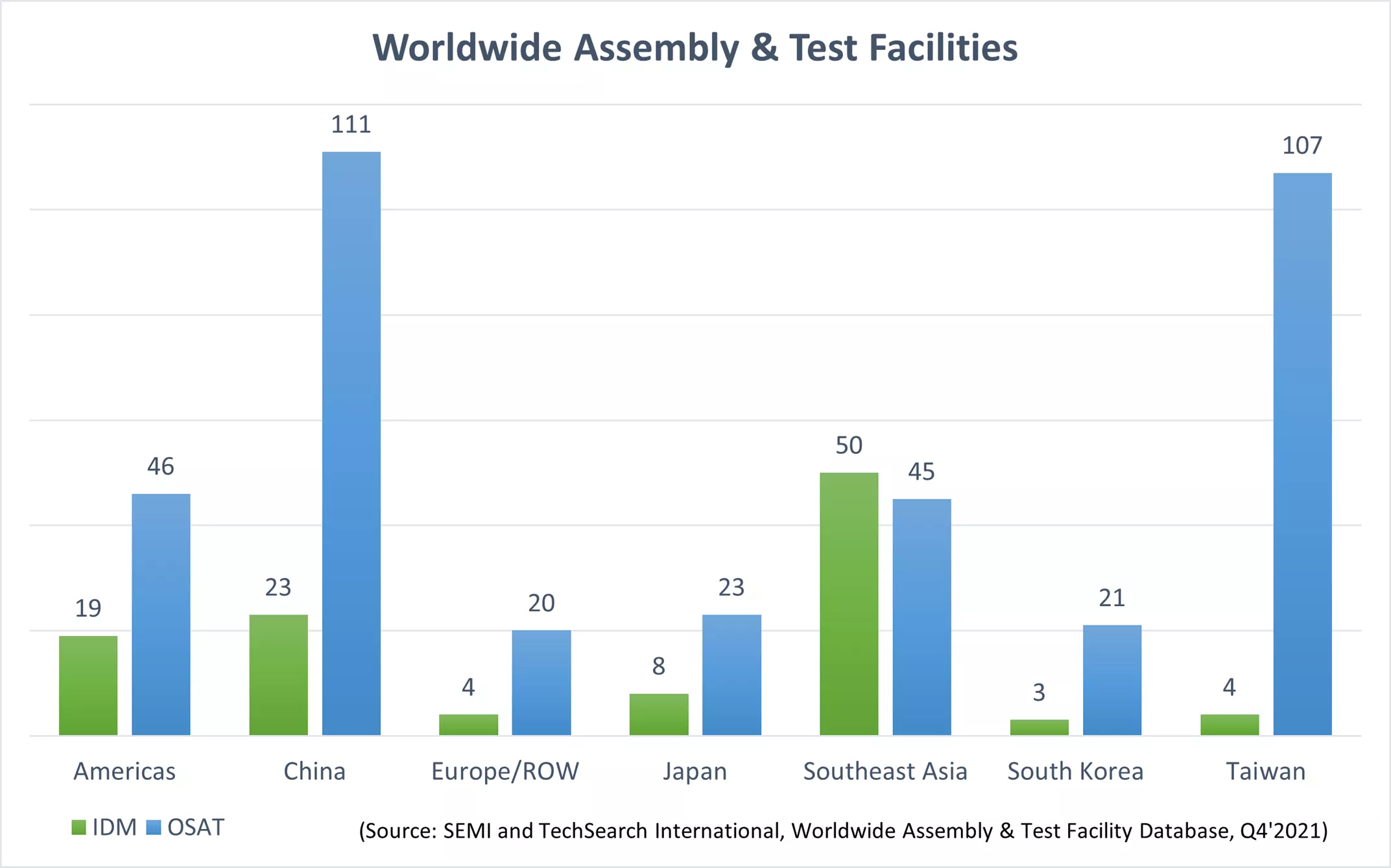
 Sponsored by the SEMI

 Under the act, the European Commission is called to step up investments in Europe’s capabilities to innovate in the design, production and packaging of advanced chips. Additionally, the act aims to strengthen the European Union’s R&D leadership and to address the skills shortages in the region.
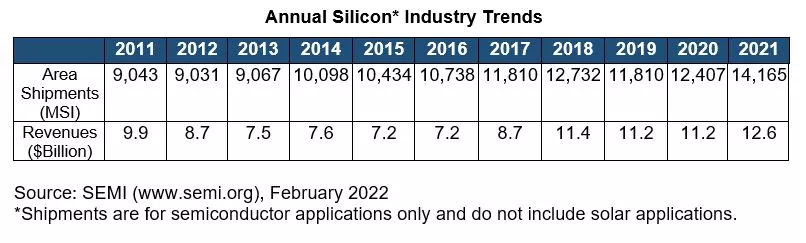
 Silicon shipments totaled 14,165 million square inches (MSI) compared to 12,407 MSI shipped in 2020 to meet surging broad-based demand for semiconductor devices and a wide variety of applications. 300mm, 200mm and 150mm wafer sizes all saw strong demand. Wafer revenue reached $12,617 million, surpassing the previous record of $12,129 million set in 2007.