downloadGroupGroupnoun_press release_995423_000000 copyGroupnoun_Feed_96767_000000Group 19noun_pictures_1817522_000000Member company iconResource item iconStore item iconGroup 19Group 19noun_Photo_2085192_000000 Copynoun_presentation_2096081_000000Group 19Group Copy 7noun_webinar_692730_000000Path
Skip to main content
Default Banner Image

SEMI News

The U.S. Toxic Substances Control Act (TSCA) requires the Environmental Protection Agency (EPA) to cost-share risk assessment fees for 20 chemicals designated as high priority across all U.S. manufacturers (including importers) that produce or import at least one of the chemicals including Formaldehyde, Di-ethylhexyl phthalate (DEHP) and Dibutyl phthalate (DBP). Providers of the substances must self-declare as manufacturers or importers under a 5-year look-back requirement.The SEMI EPA TSCA working group formed to assess the potential impact of the self-declaration requirement has uncovered two points of primary concern: 1. Of the 20 substances, about 10 are commonly found in electro-technical components such as capacitors, resistors, transformers and power supplies.2. Companies that import articles (e.g., components and parts) containing any level of these substances, even unintended residue from a production process upstream in their supply chain of imported articles, must self-identify. Manufacturers and importers that self-identify will be required to share the $1.4 million risk-assessment cost per substance. Small business concerns qualify for an 80 percent discount, with larger businesses covering the balance.The EPA has identified a preliminary list of companies that provide each chemical. The number of companies on the lists ranges from two to 525.On January 27, 2020, the EPA opened a 60-day period for organizations to submit comments to the EPA and self-identify as a manufacturer (or importer). SEMI plans to submit comments prior to the March 27 deadline, in part to request an extension.More information is available by visiting the Federal Register or contacting Olivier Corvez. This EPA webpage contains a February webinar transcript that is also a helpful resource.Olivier Corvez is senior manager of Environment, Health, Safety and Sustainability at SEMI.
Read More
The recent World Economic Forum event in Davos ranked the unfolding climate crisis among the top three risks companies and governments must address in order to prevent irreversible environmental damage. With the stakes that high, it is becoming critical for organizations of all sizes to take into account climate change risks and opportunities as they develop their strategic and business continuity plans.Two fundamentally different schools of thought have emerged on how to address climate change. On one side, NGOs and climate activists such as Greta Thunberg are pressuring governments to abruptly divert away from fossil fuels, a shift that experts say would exact a deep economic impact. On the other side is the camp that believes capitalism will run its course and ultimately guide public and private entities to find climate change solutions.For their part, organizations are responding to rising pressure from shareholders and stakeholders to disclose their emissions mitigation strategies. The accuracy and completeness of environmental disclosures ranges widely. Some businesses adopt a conservative approach and limit the volume of information made public, while others announce aggressive targets for reducing emissions from their operations and supply chains.Formed 18 years ago, the Carbon Disclosure Project (CDP) has motivated companies (and now cities) to disclose their greenhouse gas (GHG) emissions. In 2019, more than 525 institutional investors representing $96 trillion in assets backed the CDP, whose annual CDP questionnaire is often recognized as the most “comprehensive collection of self-reported environmental data in the world.”As the list of signatory investors supporting the CDP has grown over the years, so has the number of companies responding to the annual CDP questionnaire – from 228 companies in 2003 to over 8,400 in 2019. Company scores are based on 14 disclosure areas such as C-suite level sign-off on the questionnaire content, producing GHG emission data verified by a third party, or publicizing their completed questionnaire on the CDP website. Among all respondents, 179 companies (2%) scored the highest in leadership by demonstrating the strongest commitments to reducing greenhouse gases emissions from their operations and supply chain.Among these 179 companies – referred to as the A-list companies – 10 are SEMI members headquartered in Japan, Taiwan, Korea and France. SEMI applauds these members for ranking among the most progressive companies in disclosing greenhouse gas emissions, an achievement that requires considerable work but puts them in a position of strength in conveying to customers, investors and other stakeholders their commitment to climate resiliency.Olivier Corvez is senior manager of Environment, Health, Safety and Sustainability at SEMI.
Read More
The march of innovation in semiconductor microfabrication technology over the past 60 years has produced electronic devices and information systems that have transformed industries and lives around the world. And while advances in chip technology continue to make it possible to collect, transmit, store and process more data for a rapidly growing universe of applications, the pace of innovation is now facing strong headwinds. Powered by chip innovation, data centers have become massive centers of information processing but, on the downside, enormous consumers of electricity. Today, the power-hungry hubs account for five percent of the world's electricity usage, a proportion that is growing every year, raising important questions about sustainability. Compounding the challenge, the pace of Moore's Law, for decades the engine of electronic device and information system innovation, has slowed. While the research and development of state-of-the-art semiconductor fine processing technology remains robust, developing the advanced manufacturing technology for mass-producing more sophisticated electronics devices is becoming harder, as is ensuring business profitability."It has become difficult for semiconductor technology to continue to evolve as it has in the past," said Akira Minamikawa, Research Director of Technology Research at IHS Markit, who moderated the Semiconductor Executive Forum – View by Top Two in the Era of Digitalization on opening day of SEMICON Japan 2019 at Tokyo Big Sight. Held at the SuperTHEATER, the forum featured Terushi Shimizu, representative director and president at Sony Semiconductor Solutions, and Atsuyoshi Koike, president at Western Digital Japan, two industry powerhouses that could figure heavily in the future of digital technology. SuperTHEATER, the main stage at SEMICON Japan 2019 Image sensors evolve to become eyes of AIImage sensors are becoming eyes of artificial intelligence (AI) and intelligent systems that monitor people and events worldwide, collecting data that one day could help puzzle out growing social challenges such as energy conservation and traffic congestion. With 51 percent market share on the strength of its industry-leading technology, Sony Semiconductor Solutions dominates the image sensor market. Despite last year’s global semiconductor industry slump, the company’s “business continues to enjoy strong growth and we are very busy,” said Shimizu, who attributed the company’s robust performance to the rising importance of the social role of image sensors and the expanding number of applications they support.The success of the company’s image sensors can also be traced to its division of the image sensor market into two application categories: "Imaging" focuses on capturing beautiful image data, while "sensing" aims to collect data that accurately describes the state of a subject and its surroundings."In 2019, sales of imaging products for smartphones grew rapidly,” Shimizu said in his market overview. “This is due to the average annual 15 percent growth rate of multi-camera smartphones, with some phones today featuring seven cameras, and an average annual growth rate of 20 percent in sensor size to produce higher image quality."But Shimizu cautioned that Sony Semiconductor Solutions doesn’t expect the smartphone sensor market to maintain that fast growth rate."The imaging market is expected to grow until 2022, but after that, the sensing market will drive market growth,” he said, adding that the company’s “capital investment plan is based on this scenario."AI will be key in catalyzing growth of the sensor market as integrations of AI processing engines and sensing images grow in sophistication to capture images undetectable by the human eye, Shimizu said. AI will extract insight from captured image data. For its part, Sony will apply its layer stacking technology to sensing products."By stacking an AI processing engine, we want a significant portion of the recognition processing done within the sensor chip," Shimizu said.One sensor the company already offers collects in-depth information for indirect time-of-flight (ITOF) 3D ranging for new user interfaces relying on autonomous or gesture control for robotics. The sensor “was first used in smartphones in 2018 and saw widespread adoption in 2019," Shimizu said.Sony Semiconductor Solutions plans to focus on developing new sensors for integration with their ultrasonic cousins. Aided by optical deflection technology, the sensors will be used for product quality inspections during manufacturing.With the company’s growing strengths in sensor technology, it hopes “to increase sales of sensors from a few percent of the company’s total sales in 2018 to 30 percent in 2025,” Shimizu said, pointing to its goal "to capture 60 percent share of the image sensor market by 2025."Data as one way to spread happinessAt the heart of consumer devices such as smartphones and computers and also cloud servers, NAND flash has made it possible to process vast troves of data anytime, anywhere. In recent years, the technology has enjoyed stronger adoption for use as the storage medium of choice for edge computing, stationed between end devices and the cloud to help streamline data utilization. But the technology isn’t merely about making smarter use of bits and bytes."We would like to promote the technology development that can support the use of data to bring happiness to people around the world," Koike of Western Digital Japan said. The company calls data that contributes to individual happiness and helps solve social issues "data for good" and, like the Sony Semiconductor Solutions bifurcated classification of the image sensor market, categorizes information into “big data” and “fast data.”For example, big data can leverage AI to drive dramatic improvements in the interpretation of test data and, ultimately, the diagnostic accuracy of mammography for breast cancer screening, aiding in early detection to help save lives, Koike said. Fast data can be harnessed to analyze data collected from a manufacturing equipment line in real time to improve production efficiency. The company’s plant in Yokkaichi, Mie Prefecture, which the company operates in cooperation with Japanese memory manufacturer Kioxia, already uses fast data to bolster production.More NAND flash innovation and greater supply capacity are critical to developing "data for good," Koike said. "It is difficult to expand clean rooms at the same pace as data usage grows. In order to continue to advance technology and enhance supply capacity, we need to adopt new ideas for building production lines. We need a smaller equipment footprint, shorter cycle time and higher throughput."Semiconductor market shows signs of recoveryIn their discussion of the short-term outlook for the semiconductor market, Shimizu and Koike pointed to the importance of strengthening the talent pool of Japan’s semiconductor industry as global competition heats up with China’s pursuit of semiconductor independence and the industry pulls out of the 2019 slowdown fueled by weak memory prices. While Sony’s business has been buoyed by strong image sensor demand for smartphones, the devices “did very well, but other applications didn't," Shimizu said. Even the image sensor market stagnated.Despite the 2019 slump, market conditions and capital investments by semiconductor manufacturers have been on the upswing."In the second half of 2019, the Chinese market showed signs of recovery triggered by 5G,” Shimizu said. “In 2020, this movement is going to be in full swing around the world and we will be busier than last year."Koike agreed: "The semiconductor market for data centers will recover with 5G. The hard disk shortage is already an indication of a recovery, a turnaround that will undoubtedly extend to solid state drives (SSDs). In addition, advances in autonomous driving technology will ensure continued growth of the automotive semiconductor industry.”Japan should embrace international competition, not fear China's pursuit of chip independenceIt's no secret that China is investing heavily in its semiconductor development capabilities to move up the microprocessor value chain. Minamikawa posed the question: How should Japanese chip companies navigate the shifting regional balance of power? "It is natural for China to strive to establish domestic procurement of semiconductors that are fundamental technologies for various industries,” Koike said, “I think the efforts of Chinese companies are outstanding in that they are not pursuing short-term results, such as improving yields in the near future, but are making efforts with an eye to achieving results in 10 years. Japan has a variety of options including working with China to create joint ventures and competing head-on. Regardless of which choice we make, however, it is imperative for the survival of domestic companies that Japan maintains its technological competitiveness to remain ahead of China."Shimizu said that Sony’s “Chinese customers are quick to take action and study extremely hard. We often have opportunities to share our roadmap with them and explore innovation opportunities together. Before, they were passive and relied on us for insights into new technologies, but now they are more assertive and I sense that they will start to drive innovation.”Koike added that "although Japanese companies often talk about business globalization, neither Chinese nor American companies say much about it. While global expansion is a major requirement for business, I think Japanese companies need to focus more on the Japanese market overall, not just when they think about the growing competitiveness of Chinese companies." L-R: Akira Minamikawa, Research Director of Technology Research at IHS Markit; Atsuyoshi Koike, president at Western Digital Japan; Terushi Shimizu, representative director and president at Sony Semiconductor Solutions Talent key to bolstering competitiveness of Japan’s semiconductor industryMinamikawa of IHS Markit didn’t mince words in describing the talent shortage in the Japanese semiconductor industry as “grave,” saying that “the workforce challenge is not endemic to the electronics industry as evidence grows that the number of people obtaining doctorates in Japan is falling and the educational level of the Japanese population as a whole is in decline.”Three years ago, Shimizu interviewed professors on Kyushu island for insights into Japan’s talent shortfall. He came away feeling that “Japanese semiconductor companies were not sufficiently communicating the industry's talent and innovation needs to professors. To help professors and students better grasp the appeal and potential of the industry, we have started to send frontline engineers to universities to educate students and instructors about their work and careers. Expecting corporate HR departments to alone solve the talent shortage won’t work.”"In Japan, if you advance to a doctoral course, you will have a hard time getting a job, which is a strange situation,” Koike said. “Companies and universities need to work together more closely to better understand how to attract and hire doctoral graduates."Minamikawa said companies must have strong leaders with clear missions to attract the right talent, but Koike pointed to the drawbacks: "The image of a company with a strong leader seems to be cool, but it also has a downside because engineers stop thinking for themselves and wait for instructions from the top. I believe it is important for company leaders to have ongoing discussions at all organizational levels and lead the way in times of confusion."Shimizu agreed, citing his own company as an example."Thankfully, our company is very busy right now,” he said. “However, some employees are starting to request more time to think about how to improve the quality of their work. To maintain and strengthen our competitiveness and continue business growth, I believe it is important to cultivate an environment that encourages each employee to take more time to think for themselves."Motoaki Ito is the CEO of Enlight, Inc. and a reporter for SEMI. Mayumi Amagai is a marketing manager at SEMI Japan.
Read More
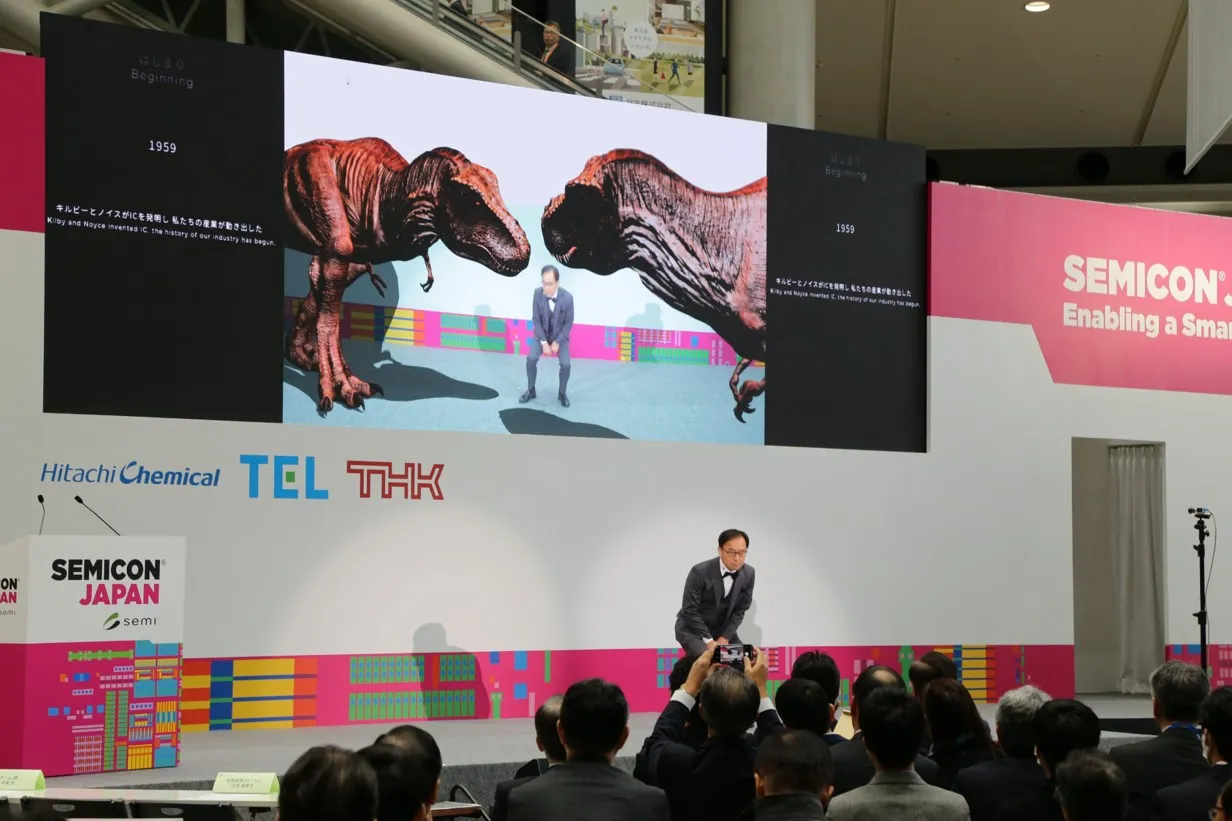
Augmented reality (AR) tyrannosauruses towered on-screen as I interacted with the creatures in a mix of prehistoric and cutting edge. Or, rather, my AR double was doing the playacting. Minutes later, virtual doppelgangers of a small lineup of chip industry executives cut the ceremonial ribbon. Seemingly sweeping away the winter chill, the opening of SEMICON Japan 2019 dazzled with smart technology and the promise of lives, cities and workplaces transformed, with uber-intelligent applications in full display at Tokyo Big Sight. But what resources does the industry need to harness to drive the next era of innovation? The semiconductor industry’s unwavering passion and young talent are key, said Hiroshi Imano, Chairperson of the SEMICON Japan Initiatives Committee, in his opening keynote. And hardly any region of the world is in a better position to help realize that future than Japan, Imano said. The region supplies one third of the equipment and more than half of all materials to the global semiconductor manufacturing industry.Talent was also top of mind for SEMICON Japan 2019 keynote speaker Makiko Eda, Japan's Chief Representative Officer at the World Economic Forum (WEF). Serving as a platform for public-private partnerships, the organization's mandate is to tackle global issues such as climate change and geopolitical strife in making world more resilient to risk and, by extension, more sustainable.Spanning ecology, economy, technology, society, geopolitics and industry, that mission includes reskilling and upskilling a billion people over the next decade, a high priority for WEF, which hosts a conference every January in Davos, Switzerland. The theme of this month's conference – Stakeholders for a Cohesive and Sustainable World – reflects the vital importance of building the international partnerships and global consensus necessary to achieving WEF's goals.One key to that sustainability will be technology and Arm, a global chip design company, will play a key role, with the company’s chips touching over 70 percent of the world’s population, Arm president Yuzuru Utsumi said in his keynote. Today, Arm is driving toward an ambitious goal: Ship 100 billion chips from 2017 to 2021 – the same number produced over the previous quarter century – by powering advances in mobile computing, server and networking infrastructures, and automotive applications.Arm’s innovation ecosystem of more than 1,000 partners will deliver these chips as they continue to work together to develop differentiated technology. Arm plans to increase investments not only in its primary processor business to accelerate market share gains but in the company’s new IoT business to create new revenue streams. The goal: Deliver long-term sustainable growth, Utsumi said. SEMICON Japan 2019 showcases SMART manufacturing and transportation Billed as a showcase of smart technologies, SEMICON Japan 2019 delivered with an array of eye-grabbing exhibitions in the popular SMART Applications Zone. In the SMART Transportation area, the automatic operation pavilion featured a car equipped with open-source software for autonomous driving. The exhibitor, Tier IV, aims to help lead the early commercialization of self-driving vehicles through the adoption of its software, Autoware, which makes it easier to develop self-driving vehicle prototypes using low-power platforms.Sony Semiconductor Solutions demonstrated a vision sensing processor designed to guide autonomous drones. Using two cameras, the processor measured the changing distance between visitors moving about the exhibit and stationary objects in real time, indicating proximity in hues of red (nearby) and blue (at a distance). Many visitors were wowed, describing the multichromatic display as futuristic.Others rode a simple wooden swing hanging by two ropes, but from dizzying heights thanks to Solidray’s Duo-Sight, a virtual reality (VR) system that projects 3D images stretching from wall to floor for immersive experiences. One visitor thrilled at how riding the swing, suspended only a few feet from the floor, felt like soaring on a flying trapeze. Target applications for the technology include virtual rides at amusement parks and presenting interior design options to homeowners.In the SMART Manufacturing area, one highlight was the demonstration by the National Institute of Advanced Industrial Science and Technology (AIST) of a remote-controlled Minimal Fab System designed for low-volume, high-mix chip production with little staffing. Designed to increase production efficiency, the system allows a circuit designer to manufacture a semiconductor by singlehandedly operating equipment up and down the production line. Controlling nearly 50 pieces of equipment, the Minimal Fab System on display manufactured chips that were verified for functional operation and exhibited afterwards.On the SMART Applications stage, exhibitors DENSO and Toyota Motor Corporation announced a new joint venture to conduct research and advanced development of the next-generation in-vehicle semiconductors critical to electric and autonomous vehicle innovation. The venture, operating as MIRISE Technologies, will combine Toyota’s mobility expertise with DENSO’s in-vehicle component prowess. The goal is to build a rapid, competitive development system by 2030, said Yoshifumi Kato, executive director of the DENSO Research and Development Center, and president and representative director of the venture. On track to begin work this year, MIRISE will span three fields of technology development: power electronics, sensing and SoC (System-on-a-Chip). The name MIRISE combines word the Japanese word "mirai" (future) with "rise."Business Continuity PlanningNatural disasters and other emergencies are an ongoing threat to uninterrupted business operations across the semiconductor manufacturing supply chain and particularly in earthquake-prone Japan. To better prepare for business disruptions and restore normal operations as soon as possible after disaster strikes, more companies are teaming on Business Continuity Planning (BCP).THK's Seismic Isolation Experience Car demonstrated one technology designed to help – a seismic isolation device. The car shakes like an earthquake to give people inside a taste of how a building heaves and sways during a quake with and without the device deployed. Visitors were struck by how much the isolator dampens tremors to prevent or minimize damage. In the BCP seminar, representatives from Sony Semiconductor Manufacturing, THK, DISCO and Team Engineering Consulting shared lessons learned from actual disasters and discussed the critical importance of daily disaster drills. Yukihide Keigo, Executive Engineer in charge of Products and Development at Sony Semiconductor Manufacturing, recounted how the company’s Kumamoto Prefecture plant struggled for 96 days to restore full operations after the facility sustained heavy damage in the 2016 earthquake. Keigo said the plant lacked the structural reinforcements necessary to withstand the impact and fell prey to poor planning and accountability. The Kumamoto plant has since implemented measures – structural and procedural improvements – that more accurately account for seismic risks to ensure full recovery within 56 days. The plant’s new procedures include emergency drills for staff including night-shift workers.Innovation abounds at six SuperTHEATER forumsSEMICON Japan 2019 was held in the West and South Halls of Tokyo Big Sight as organizers of the Tokyo Olympics occupied the East Hall, the exhibition's usual home at the venue, to prepare for the 2020 games. For the first time, the main stage, SuperTHEATER, was set up in the cavernous arena near the main entrance. The SuperTHEATER featured six forums over three days. Semiconductor Executive Forum – View by Top Two in the Era of Digitalization with thought leaders from IHS Markit and Sony Semiconductor Solutions SMART Connectivity Forum – Infinite World Brought by 5G Innovation with experts from Softbank and Nokia Solutions Networks SMART Transportation Forum I – Front-line of Automated Driving featuring speakers from Intel and DENSO SMART Transportation Forum II – Revolution of Sky Transportation, supported by the U.S. Commercial Service in Japan, with presenters from Ministry of Economy, Trade and Industry (METI), Subaru and Bell Helicopter Manufacturing Innovation Summit – Issues and Innovation: What will Drive Growth to 2030 featuring thought leaders from VLSI Research, Applied Materials, KLA, Nikon and Tokyo Electron Mirai Vision Forum – Future Relation of Technology and Body 2.0 with speakers from Leave a Nest, Ory Lab and Autonomous Control Systems Laboratory The Mirai Vision Forum highlighted advanced technologies that could lead to societal improvements. One presenter, Kentaro Yoshifuji, CEO at Ory Lab, recalled how, as a child, he once stayed home from school while recovering from an illness. His imagination in full flight, the youngster imagined having a clone that could attend school and be with his classmates. The experience eventually inspired him to develop OriHime, a robot that gives socially isolated people a way to communicate with friends or colleagues remotely. Originally developed for physically impaired people, OriHime today is used to help the able-bodied. The robot is situated with the companion and the user operates OriHime remotely. A camera and monitor in OriHime’s face provide the visual and audio connection and the user controls the device with a smartphone or tablet or, for those who are paralyzed, through eye movement. One potential application: With OriHime stationed at a business office, working mothers could use OriHime to telecommute to better balance their careers with their parenting responsibilities at home. The robot would be a mother’s go-between, enabling her to communicate directly with colleagues.The next generation of innovators also took the stage as five teams presented innovative business ideas in friendly competition. The top prize in The TECH CAMP Hackathon went to the group that hatched an ingenious plan to develop a jacket that trains users to move their bodies in preprogrammed ways. For example, legendary Japanese professional baseball player Shigeo Nagashima could wear the gear while batting to program the device, then give the jacket to someone who’s never swung a baseball bat. The jacket would help the user replicate Nagashima’s swing. Now comes the real work of any innovator – executing on the vision.And then came two soccer-playing artificial intelligence (AI) robots that squared off and ... Scored! The demonstration by the Toyota National College of Technology started as a research project by Toyota National College students in 2002. The young innovators designed and developed all the robotic hardware and software from scratch. Looking ahead to SEMICON Japan 2020!SEMICON Japan 2019 not only gathered leading Japanese semiconductor materials and manufacturing equipment providers to demonstrate their latest innovations. The premiere regional event also provided insights on key trends critical to the entire electronics manufacturing supply chain. This year’s event drew more than 51,000 visitors and 695 exhibitors from 15 regions filling more than 1,700 booths.SEMICON Japan 2020 returns to East Hall at Tokyo Big Sight in December 2020. I look forward to seeing you there!Jim Hamajima is president of SEMI Japan.
Read More
When we entered 2019, our priorities in SEMI Global Advocacy were crystal clear: Continue to advance our public policy priorities under the 4 T’s – Trade, Tax, Talent and Technology – and move toward a global reach. We raised SEMI’s profile on the world stage in representing arguably the most strategic industry sector today as we trained our sights on a number of issues across all four pillars, not the least of which was trade. Along the way, we educated key policymakers about the impact of their decisions on the global semiconductor supply chain, member companies and regional economies.While no one organization can resolve current global trade issues, SEMI did exert its influence effectively on behalf of its members. For example, when Japan’s Ministry of Economy, Trade and Industry (METI) announced its decision to tighten export controls with South Korea in July, SEMI immediately engaged METI and Korea’s Ministry of Trade, Industry and Economy (MOTIE) to make clear to METI the potential repercussions of its decision. In parallel, we worked to prevent a retaliatory escalation by MOTIE. Indeed, significant trade challenges remain as tariffs and export controls continue to take their toll on our industry’s globally integrated supply chain. We have much work ahead to ensure our members’ voices continue to be heard. Our well over 100 meetings with government officials this year is only the start of sustained outreach and engagement to better serve our members’ public policy interests. To that end, and based on member input, in 2019 SEMI Global Advocacy made it a priority to restructure to improve communications among our regions around the globe and strengthen member engagement. Each regional office responsible for government affairs is now staffed with a global advocacy liaison. In addition, we have increased staffing in the SEMI Europe office to better address the ever-changing regulatory environment and develop the European Union’s talent pipeline.In SEMI’s advocacy headquarters in Washington, DC, we have filled a new position – Vice President of Industry Advancement and Government Programs – to place greater focus on identifying opportunities to advance programs aligned with member, industry and government interests. We have also filled two additional positions in DC – a Vice President of Global Public Policy and Advocacy and a new Manager of Public Policy and Advocacy – dedicated to public policy work. Both are steeped in experience in trade, export controls and tax policy. In addition, our new Executive Director of the SEMI Foundation boasts expertise in developing and scaling workforce development programs.The end of 2019 culminates the first phase of strategic personnel and program adjustments we envisioned over a year ago and the beginning of more muscular, adaptive advocacy engagement communications. Today, we are in a much stronger position to support you, our members, and meet the public policy priorities established by the SEMI Board of Directors and Board of Industry Leaders. We’re immensely thankful for your continued engagement and look forward to working to advance your interests in 2020 – SEMI’s 50th anniversary!Mike Russo is Vice President of Industry Advancement and Government Programs at SEMI.
Read More
High-tech industry clusters in the bustling northern Taiwan port city of Hsinchu look set for an upgrade. Long a world-class hub of the semiconductor and optoelectronic technology industries, Hsinchu City is laying out plans to work with SEMI to attract more international companies, generate more jobs, promote Hsinchu’s development and help grow Taiwan’s microelectronics industry. High-tech heavyweights such as TSMC, UMC, MediaTek, Realtek, and AUO are all headquartered in The Windy City. The Industrial Technology Research Institute (ITRI), a leading Taiwan research center and incubator, also calls Hsinchu home, and the city boasts one of the highest concentrations of educational institutions in the region, a roster that includes National Chiao Tung and National Tsing Hua universities. Hsinchu’s thriving relations with these industry, academic and research partners have made it a hotbed of innovation, with numerous large Taiwanese and foreign companies having opened local offices. No less than these partners, the city – like SEMI – is committed to innovation.In a recent visit to the SEMI Taiwan office in Taipei, a Hsinchu City government team led by mayor Lin Chih-Chien, met with Terry Tsao, global SEMI chief marketing officer and president of SEMI Taiwan, to explore collaboration opportunities in areas such as technology subsidies, policy, education, and infrastructure. The meeting built on a relationship between the city and SEMI Taiwan that sprouted after SEMI executives and Hsinchu officials joined ITRI to host the Autonomous Driving System Platform in Open Fields kick-off ceremony – an initiative to accelerate Taiwan’s adoption of smart transportation technologies – at SEMICON Taiwan 2019.At the meeting, Mayor Lin highlighted that Hsinchu has long attracted high-tech companies by cultivating a business-friendly climate through incentives such as subsidies for infrastructure buildouts. He hopes to work with SEMI to promote to members the benefits of setting up local offices in Hsinchu City.With both Hsinchu’s high-tech clusters and SEMI’s global members deeply reliant on skilled workers for sustaining innovation and growth, Tsao and Mayor Lin agreed that inspiring students to pursue an education and careers in science, technology, engineering and mathematics (STEM) is vital to building a high-tech talent pool. One collaboration opportunity SEMI Taiwan is eyeing is to launch Taiwan’s first SEMI High Tech U (HTU) program in Hsinchu to spark the interest of school-age children through STEM educational activities at school camps or art and cultural centers. SEMI’s STEM discovery program offers hands-on activities and experiential learning led by industry volunteers. Since 2002, HTU has reached some 8,000 high-school students in 12 U.S. states and nine countries.Emmy Yi is a marketing specialist at SEMI Taiwan.
Read More
We live in the New Industrial Age. Manufacturing is undergoing a profound transformation, driven not only by technological (e.g. Artificial Intelligence, robotics, IoT) but also societal, market and regulatory developments that have fundamental implications for the workforce competency requirements. How can education and training systems keep pace with this unprecedented change? How does a future-proof curriculum look like?This topic has been extensively addressed by the Curriculum Guidelines for Key Enabling Technologies (KETs) and Advanced Manufacturing Technologies (AMT) initiative (2017-2019) of the Executive Agency for SMEs (EASME) and DG GROW of the European Commission. Carried out by PwC, the initiative focuses on the promising ways of organising learning experiences of individuals and groups in the New Industrial Age. The initiative produced the Curriculum Guidelines 4.0 that aim to equip all key stakeholder groups with the knowledge base needed to transform the existing curricula.The guidelines were developed based on the extensive state-of-play analysis and active stakeholder contribution by means of expert workshops, pan-European online surveys, in-depth interviews and individual expert consultations. All key stakeholder groups were involved in the preparation of the guidelines, including the representatives of education and training providers, industry, policymakers and supporting structures (e.g. industry associations, cluster organisations and trade unions), as well as learners themselves. SEMI was among the key contributors. The guidelines were presented to the public at the EU Conference on Skills for Industry: Curriculum Guidelines 4.0 in Brussels on 26 November, 2019.The guidelines aim to be applicable for both designing fundamentally new educational offers and/or advancing the existing curricula, depending on the level of required change. They address non-tertiary vocational education and training, higher education and on-the-job training for the manufacturing-related domains.The guidelines follow a holistic approach covering a broad spectrum of dimensions relevant to curriculum design and implementation, namely: Strategy: defining core values, commitments, opportunities, resources and capabilities of an educational/training institution Collaboration: promoting practices that move beyond the typical institutional collaboration patterns and engaging individuals and communities Content: defining the nature of educational content, including specific principles related to the actual content of the curricula Learning environment: creating specific environment during the program, e.g. stimulating multidisciplinary orientation, design thinking, team spirit, collective problem-solving, risk-taking behaviour, experimental approaches Delivery mechanisms: establishing means by which learners experience and access education/training; paying special attention to technology-enabled learning Assessment: identifying most appropriate forms of assessment, including advantages and disadvantages Recognition: exploring appropriate formal and informal ways of recognition Quality: identifying the determinants of education training quality: what makes learners’ and employers’ perception different? Based on the results of the pan-European survey, the four key elements that require the most substantial change are Strategy, Collaboration, Learning Environment and Content.The guidelines will be tested in practice in the context of METIS (Microelectronics Training, Industry and Skills), a project recently launched by SEMI and 19 partners from 14 countries. Aligned with the Curriculum Guidelines 4.0, METIS will establish a Microelectronics Observatory and Skills Council consisting of representatives from industry, academia, NGOs, think tanks and government. The consortium will develop a New Skills Strategy for the microelectronics industry in Europe with a focus on raising occupational profiles and skills critical to the future of the sector.METIS will enable a new industry-driven curriculum with 43 modules integrating online education and work-based learning in microelectronics design and manufacturing. Training will focus on chip design, system design, basic of manufacturing and key competencies. METIS is a Sector Skills Alliance co-funded by the Erasmus+ Program, receiving 4 million EUR funding from the EU.Preparing students for lifelong learning, offering Big Picture education, creating effective learning ecosystems, applying problem-based and student-centric approaches, shifting from human-robot interactions towards human-machine collaboration – these are just some examples of the curriculum guidelines principles highlighted in the guidelines.The guidelines aim to offer key highlights, indicate a variety of possibilities and identify sources for more detailed information and inspiration. The guidelines by no means aim to serve as a standardised detailed recipe for organising education and training processes, as there is no one best way to approach it. The diversity of learners’ needs and contexts per definition implies a need for multitude of approaches, which could also be combined in their own unique/customised education and training solutions.The Curriculum Guidelines 4.0 will be publicly released in January 2020, and will be available on the EU Publications. More information about this and related initiatives can be found at https://skills4industry.eu/. Dr. Kristina Dervojeda leads the PwC Innovation Research Centre in the Netherlands.
Read More
The White House and House Speaker Nancy Pelosi announced that the United States has reached final terms on the U.S.-Mexico-Canada free trade agreement (USMCA). The USMCA provides important modifications and updates to the 25-year old North American Free Trade Agreement (NAFTA), and SEMI supports its timely ratification in the U.S. Congress. The USMCA includes significant provisions to protect continued innovation and North American market access across product design and manufacturing supply chains for the electronics industry. The agreement strengthens requirements for the protection and enforcement of intellectual property rights, including trade secrets. The U.S. microelectronics industry will benefit greatly from USMCA’s strong enforcement mechanism for the misappropriation of trade secrets including civil procedures and remedies, criminal penalties, and judicial procedures to prevent disclosure of trade secrets in litigation.The agreement also establishes new rules to enhance and protect digital trade to benefit companies of all sizes and consumers. The USMCA prohibits tariffs, taxes and other barriers to cross-border data flows and minimizes restrictions on where data can be stored and processed. These provisions establish important precedents for data and digital technology in future trade agreements. The USMCA aligns with SEMI’s core principles including open global markets, fair competition and the protection of intellectual property rights. Mexico and Canada are two of the United States’ most important trading partners, and strengthening the three countries’ mutual obligations under USMCA will greatly benefit SEMI members. SEMI welcomes final passage of the USMCA and the critical certainty it will bring to trade rules within North America going forward.Joe Pasetti is Vice President, Global Public Policy Advocacy, at SEMI.
Read More
Once an unpopular career destination for university graduates in Korea, the semiconductor industry has been a plum target since the rise of Samsung Electronics and SK Hynix as global leaders and key growth engines for the Korean economy. The industry’s outsize role in innovation of cutting-edge technologies and applications such as artificial intelligence (AI), Internet of Things (IoT), 5G and autonomous driving has added to the appeal.The draw of a career in chip manufacturing is even stronger when new graduates from Korean universities consider the semiconductor industry’s rapid growth of 22.2% in 2017 and 15.5% in 2018, according to VLSI Research. Yet, even before earning their degrees, many students are unclear about steps they need to take to prepare for a career in the industry and the type of work available to them.These questions and concerns were on the top of the minds of 250 students who gathered at COEX in Seoul in mid-November for SEMI Campus Outreach, a half day of career insights from global chip companies including Lam Research, Applied Materials, Tokyo Electron, and KLA along with leading semiconductor companies in Korea such as SEMES, EO technics, JUSUNG ENGINEERING, DONGJIN SEMICHEM, PSK and Wonik IPS. Keynote - Inhak Harry Suh, CEO, Lam Research Korea 250 students gathered at Campus Outreach Campus Outreach keynote speaker Inhak Harry Suh, CEO of Lam Research Korea, stressed that talented new graduates hold the key to leading the semiconductor industry into the Industry 4.0 era and the next phase of growth. He urged the students to look for a company that treats its employees with respect and fairness and to enjoy their work. Joining the executives in inspiring the students, field and service engineers highlighted the semiconductor industry’s strong growth potential, described their job responsibilities and the skills students need to develop to thrive, and offered guidance on subjects to study in school to best prepare students for jobs in the industry. On the recruiting side, human resources representatives at the event provided overviews of their companies and skills they’re looking for as they court talent. Campus Outreach sponsors At SEMICON Korea 2020 – Feb. 5-7 at COEX in Seoul – SEMI will continue to cultivate industry talent at the Workforce Development Pavilion. To help the industry solve its critical talent shortage, the pavilion will offer university students interviews with industry experts and tutorials on semiconductor production as the students explore career paths and are mentored by engineers during the Meet the Experts program. And with a diverse workforce recognized as a competitive advantage, the Women-in-Technology session will gather leaders to discuss how the industry can improve diversity.Jaegwan Shim is a marketing specialist at SEMI Korea.
Read More
Smart technologies have gripped the world’s imagination with their promise to revolutionize the way we live and work. With the semiconductor supply chain central to these advances, SEMI Japan in October hosted 200 members for SEMI Japan Members Day as speakers from three of the world’s top device manufacturers – Denso, Sony and Kioxia – offered their perspectives on the strides the semiconductor industry needs to make in three key areas: automotive, smart manufacturing and 3D flash memory manufacturing technology. Automotive Evolution and Electronics – DensoThe automotive industry is re-inventing itself to innovate across connectivity, autonomy, sharing and electric (CASE) and ensure safe, comfortable and environmentally friendly autonomous driving, said Nobuaki Kawahara, executive fellow and director of the Advanced Research and Innovation Center at Denso. Key focus areas of Denso in CASE innovation are Extraordinary Safety and Everyday Confidence. The company’s goal is to minimize damage to vehicles involved in collisions or one-car accidents by making it easier for drivers to detect and steer clear of objects in their path.To improve automobile safety and security, the company is developing advanced driver-assistance systems (ADAS) and autonomous driving technologies as it promotes the confluence of four areas of technology – HMI (Human Machine Interface), environmental recognition, vehicle control assistance, and information and communications. One use case Denso sees as a significant opportunity is deploying sensors such as millimeter-wave radar, cameras and LiDAR to monitor a vehicle’s surroundings, using GPS and precision mapping to pinpoint its location and determine the best route for safety and distance, and then transmitting that information to a motion-control system.Denso is also out to solve the hard challenges associated with autonomous driving in dynamic road conditions. Kawahara pointed out that road conditions vary and that rules for "driving at certain intervals in a certain lane" vary depending on the time of day. Also, on public roads in Abashiri, Hokkaido, where the company is currently conducting field tests, snowfall makes it difficult to recognize road images and gather sensor information. In Asia, it is also common for motorcycles and automobiles to speed along with very little space between them.Image Sensors to Accelerate Development of Smart Manufacturing – SonyTo fulfill the promise of smart manufacturing, the semiconductor supply chain must continue to invest in sensor and imaging technology innovation, said Shigeo Ohba, deputy senior general manager of the Imaging System Business Division at Sony Semiconductor Solutions. For its part, Sony is developing imaging sensors that help network and automate factories to achieve new production and cost efficiencies. For example, the company plans to design devices to increase equipment uptime through predictive maintenance, reduce defect rates and drive other manufacturing efficiencies. The challenge with today’s factory lines that produce a number of different devices is that they are highly complex to manage and therefore prone to human error, undercutting manufacturing efficiency. In the future, AI-powered machines will leverage data analysis to help streamline operations. Adapting an image sensor with AI to machine vision applications can simplify key processes such as measurement and inspection processes while reducing safety and security costs.Of the vast amount of information on all machines connected to the cloud, only essential details will be processed at the edge since edge data processing offers stronger security and reduces data transfer time. Ohba said image sensors will evolve based on edge AI, adding that "AI will be a paradigm shift for image sensors if it’s economically feasible."3D Flash Memory Manufacturing Technology Challenges – KioxiaIncreasing connectivity in factories for smarter, more efficient operations places huge demands on memory since networked devices typically store duplicate data, said Hideshi Miyajima, head of the Advanced Memory Development Center (AMDC) at Kioxia. To meet demand for higher networking speed and capacity, 2d NAND flash memory is moving to 3D and, in particular, three 3D techniques: multivalued memory, cell partitioning and layer stacking.To increase storage capacity, the third-generation 64-layer BiCS FLASH™ stacks layers to form nearly two trillion holes with a diameter of 100nm and a depth of 5μm on a wafer and places a uniform 2-3nm thin film on the inner wall of each 5-μm hole. For its BiCS FLASH™, Kioxia uses a dry etching technique that forms a straight, elongated through-hole and atomic layer deposition (ALD) technology, which creates a uniform laminate atomic layer on the wafer surface to grow materials uniformly and with high precision on large, complex substrates.In order to meet the cost expectations of high-volume 3D flash memory manufacturers, outlays across fabs must be reduced by better monitoring plasma control, enhancing yield through particle control, speeding film formation, and reducing gas, power and water usage, Miyajima said.SMART Transportation and SMART Manufacturing in the Spotlight at SEMICON JapanPlease join us at SEMICON Japan 2019, December 11-13 at Tokyo Big Sight, for the latest developments and trends in SMART Transportation and Smart Manufacturing. There are also a few other great reasons to attend. We look forward to seeing you in Tokyo!Jim Hamajima is president of SEMI Japan.
Read More