ALBANY, New York — May 13, 2024 — The 35th annual SEMI Advanced Semiconductor Manufacturing Conference (ASMC 2024) opens today to focus on critical topics ranging from yield management and metrology to new developments in artificial intelligence, smart manufacturing and sustainability. More than 120 experts will offer insights into the latest semiconductor manufacturing strategies and methodologies as hundreds of industry stakeholders gather at the May 13-16 conference in Albany, New York.
 Featuring keynotes by thought leaders from IBM, Wolfspeed, and Semiconductor Advisors, ASMC 2024 is the premier event where industry professionals network and share insights into best practices for semiconductor manufacturing. The conference is co-chaired by Bradley Wood, Applications Engineering Manager, CMP Filtration at Entegris, and Vijayalakshmi Seshachalam, CVD Process Manager at GlobalFoundries.
ASMC will feature the following:
- Digital Transformation for Sustainability: Empowering the Semiconductor Industry Through AI and Green Practices – The one-hour tutorial by EMD Electronics on Tuesday, May 14 will cover:
- Multifaceted environmental challenges associated with chip manufacturing
- How leveraging AI and embracing green practices can enable the industry to develop more sustainable materials, eco-friendly processes, and energy-efficient chips
- Case studies of collaborations among material suppliers, equipment manufacturers, and foundries and device makers that found great success
- Poster presentations from around the world will be on display at the Poster Session reception on the evening of May 14, covering a range of topics including:
- Yield Enhancement
- Advanced Metrology
- Advanced Equipment Processes and Materials
- Contamination-Free Manufacturing
- First Robotics Demonstration on Wednesday, May 15 – Sponsored by TEL
- The First Robotics Team from Shenendehowa High School in Clifton, N.Y. will demonstrate its competition robot and Crescendo game, a unique competition among robots to toss rings through musical hoops.
Also highlighting ASMC 2024 on Wednesday, May 15, will be the workforce development panel discussion titled Talent Pipeline: Building a Sustainable and Diverse Semiconductor Workforce. Panelists will include:
- Kylie Patterson, Senior Advisor, CHIPS for America
- Kevin Younis, COO and Executive Deputy Commissioner, Empire State Development
- Héctor M. Rodríguez, Dean of Science, Technology, Engineering and Math, Hudson Valley Community College
- Fran Dillard, Vice President and Chief Diversity Inclusion Officer, Micron
ASMC 2024 will also feature more than 20 technical sessions covering topics including:
- 3D, TSV, and Novel Advanced Silicon Processing
- Advanced Equipment Processes and Materials
- Advanced Metrology
- Advanced Process Control
- Advanced Semiconductor Technologies
- Artificial Intelligence / Machine Learning
- Big Data Management and Mining
- Contamination Free Manufacturing
- Defect Inspection
- Equipment Optimization
- Factory Automation
- Manufacturing for Sustainability
- Smart Manufacturing / Industrial Engineering
- Yield Enhancement / Yield Methodologies
The Women in Semiconductors (WiS 2024) program takes place on Thursday, May 16 in conjunction with ASMC 2024. The program will address challenges and strategies for promoting diversity and inclusion in the workplace. Complimentary registration is available for ASMC attendees.
For more conference details, please visit the ASMC website or contact Krish Raghunath of SEMI at [email protected].
About SEMI
SEMI® is the global industry association connecting over 3,000 member companies and 1.5 million professionals worldwide across the semiconductor and electronics design and manufacturing supply chain. We accelerate member collaboration on solutions to top industry challenges through Advocacy, Workforce Development, Sustainability, Supply Chain Management and other programs. Our SEMICON® expositions and events, technology communities, standards and market intelligence help advance our members’ business growth and innovations in design, devices, equipment, materials, services and software, enabling smarter, faster, more secure electronics. Visit www.semi.org, contact a regional office, and connect with SEMI on LinkedIn and X to learn more.
Association Contact
Michael Hall/SEMI
Phone: 1.408.943.7988
Email: [email protected]
 The SEMI North America Advisory Board selects SEMI Americas Government Leadership Award honorees based on their impact on policies and incentives to bolster semiconductor design and manufacturing in the Americas region and advance the growth of the global industry.
 The report leveraged
  Wafer fabrication materials revenue declined 7.0% to $41.5 billion in 2023, while packaging materials revenue fell 10.1% to $25.2 billion last year. The silicon, photoresist ancillaries, wet chemicals, and chemical mechanical planarization (CMP) segments logged the biggest contractions in the wafer fabrication materials market. The organic substrates segment accounted for much of the packaging materials market contraction.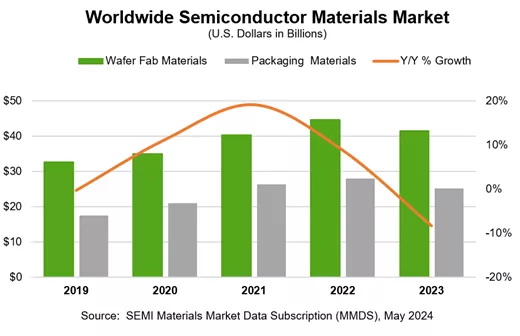
 “The continuing decline in IC fab utilization and inventory adjustment led to negative growth across all wafer sizes in Q1 2024, with polished wafer shipments falling slightly more year-over-year than EPI wafer shipments,” said Lee Chungwei (李崇偉), Chairman of SEMI SMG and Vice President and Chief Auditor at GlobalWafers. “Notably, utilization by some fabs bottomed out in Q4 2023 as growing AI adoption fueled rising demand for advanced node logic products and memory for data centers.”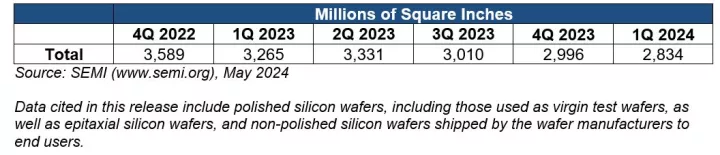
 Themed Materials Resilience: Navigating Challenges, Embracing Opportunities, SMC Korea 2024 will feature 14 global visionaries presenting on advanced materials, technology trends, sustainability and market forecasts to approximately 400 semiconductor industry professionals.

 “SEMI applauds the U.S. Department of Commerce for this latest step to enhance the resilience of the domestic semiconductor supply chain and supply of advanced chips,” said Joe Stockunas, President of SEMI Americas. “The CHIPS and Science Act investment will enable Samsung Electronics to grow its manufacturing footprint in Texas while supporting the buildout of an ecosystem with advanced packaging and R&D capabilities.”
 Sponsored by organizations including
  “We applaud the U.S. Department of Commerce for taking this significant step to enhance the resilience of the domestic semiconductor supply chain,” said Joe Stockunas, President of SEMI Americas. “This CHIPS and Science Act award is a key stride towards a 2-nanometer process, positioning the United States to produce the most advanced semiconductor chips at scale in order to advance global supply chain stability and help meet worldwide chip demand across various markets.”
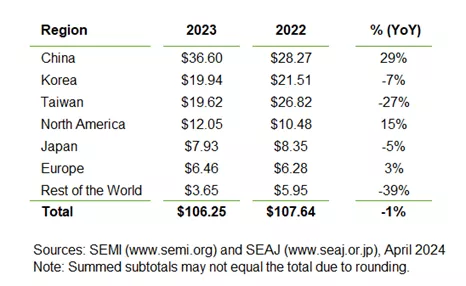
 China, Korea and Taiwan – the top three regions in chip equipment spending in 2023 – accounted for 72% of the global equipment market, with China remaining the largest semiconductor equipment market. The pace of investments in China accelerated 29% year-over-year, reaching $36.6 billion in billings last year. Equipment spending in Korea, the second-largest equipment market, fell 7% to $19.9 billion on softer demand and the memory market inventory correction. After posting four straight years of growth, equipment sales to Taiwan also contracted 27% to $19.6 billion.