downloadGroupGroupnoun_press release_995423_000000 copyGroupnoun_Feed_96767_000000Group 19noun_pictures_1817522_000000Member company iconResource item iconStore item iconGroup 19Group 19noun_Photo_2085192_000000 Copynoun_presentation_2096081_000000Group 19Group Copy 7noun_webinar_692730_000000Path
Skip to main content
Default Banner Image

United States

MILPITAS, Calif. January 16, 2023 SEMI today announced that its International Board of Directors has elected Mary Puma, president and CEO of Axcelis Technologies, as its new chairperson, effective immediately, in accordance with the association's by-laws.  

LogoPuma will lead the SEMI International Board of Directors in evolving the association’s operations, programs and services worldwide to support the growth of member companies throughout the electronics manufacturing and design supply chain.

“We congratulate Mary on her election and look forward to working with her on behalf of SEMI member companies to accelerate semiconductor industry growth and innovation and encourage greater collaboration on the industry’s most critical challenges,” said SEMI president and CEO Ajit Manocha. “Mary has been an outstanding contributor to the SEMI International Board of Directors and will now chair its work to heighten SEMI’s development and delivery of member value across all of our regions.”

Puma has served as Axcelis’ CEO since January 2002 and was instrumental in the company’s spin off from Eaton Corporation in 2000, when she was named president and Chief Operating Officer. Puma joined Eaton’s Semiconductor Operation in 1998, first serving as the vice president of the operation’s implant business and then as vice president for the overall operation. Puma joined Eaton in May 1996 as the general manager of the company’s commercial controls division. Prior to joining Eaton, she spent 15 years in various marketing and general management positions in five General Electric business units. Puma holds a Bachelor of Arts degree in economics from Tufts University and a Master of Science degree in Management from the MIT Sloan School of Management.

Puma replaces Bertrand Loy, president and CEO of Entegris, as chairperson of the SEMI Executive Committee.

“We thank Bertrand for his exemplary service on the SEMI Executive Committee,” Manocha said. “As the chair of the SEMI International Board, he helped guide SEMI through the immense challenges of the pandemic while serving as a key force in expanding our programs and services to support the growth of the global semiconductor design and manufacturing ecosystem. We are fortunate that he’ll continue to serve an advisory role as a past chair.”

SEMI’s 17 voting directors and 11 emeritus directors represent companies from Europe, China, Japan, Korea, North America, and Taiwan, reflecting the global scope of the association’s activities. SEMI directors are elected by the general membership as voting members of the board and can serve a total of five two-year terms.
 

About SEMI
SEMI® connects more than 2,500 member companies and 1.3 million professionals worldwide to advance the technology and business of electronics design and manufacturing. SEMI members are responsible for the innovations in materials, design, equipment, software, devices, and services that enable smarter, faster, more powerful, and more affordable electronic products. Electronic System Design Alliance (ESD Alliance), FlexTech, the Fab Owners Alliance (FOA), the MEMS & Sensors Industry Group (MSIG) and SOI Consortium are SEMI Strategic Technology Communities. Visit www.semi.org, contact one of our worldwide offices, and connect with SEMI on LinkedIn and Twitter to learn more.

Association Contact

Michael Hall/SEMI US
Phone: 1.408.943.7988
Email: [email protected]

SINGAPORE – 16 January 2023 – Cutting-edge innovations across an explosion of MEMS and sensors applications will take center stage at Advanced Semiconductor Technology Conference (ASTC) starting tomorrow as industry leaders and visionaries gather for insights into the latest technology developments and market trends. Registration is open for the 17-18 January conference and exhibition at Theatre@illuminITE College Central in Singapore.

LogoThemed Connecting Electronics and the Real World, ASTC 2023 will focus on growth applications across MEMS and sensors segments including automotive, consumer electronics, healthcare, mobile, industrial and Internet of Things (IoT). The event will highlight opportunities and challenges in design, manufacturing and integration.

“New sensor technologies are changing the dynamics in electronics manufacturing,” said Linda Tan, president of SEMI Southeast Asia. “Technology advancements are dramatically reducing the size and weight of many components while maintaining power and cost profiles to give rise to new, compelling applications that are changing the way we work and live. ASTC 2023 will delve into the latest technologies as we continue to support the semiconductor ecosystem around the region.”

ASTC 2023 is hosted by SEMI Southeast Asia and SEMI MEMS & Sensors Industry Group (MSIG), a SEMI Technology Community that promotes MEMS and sensors innovations critical to smart devices and brings together technologists and business leaders to collaborate, innovate, and help grow the global MEMS and sensors industry.

ASTC 2023 Highlights

  • Conference will feature industry thought leaders who will offer perspectives on industry trends as well as networking and other information-sharing opportunities.
  • Exhibition will showcase the latest MEMS and sensors technologies and innovations.
  • Young Emerging Leaders Award will recognize the next generation of innovative and creative industry leaders.

To register for Advanced Semiconductor Technology Conference 2023 or for more information, visit the conference website.


About SEMI
SEMI® connects more than 2,500 member companies and 1.3 million professionals worldwide to advance the technology and business of electronics design and manufacturing. SEMI members are responsible for the innovations in materials, design, equipment, software, devices, and services that enable smarter, faster, more powerful, and more affordable electronic products. Electronic System Design Alliance (ESD Alliance), FlexTech, the Fab Owners Alliance (FOA), the MEMS & Sensors Industry Group (MSIG) and SOI Consortium are SEMI Strategic Technology Communities. Visit www.semi.org to learn more, contact one of our worldwide offices, and connect with SEMI on LinkedIn and Twitter.

Association Contacts

Ryan Teo/SEMI Southeast Asia
Phone: +65 9859 0883

Email: [email protected]

Michael Hall/SEMI US
Phone: 1.408.943.7988
Email: [email protected]

MILPITAS, Calif. January 23, 2023 — Electronic System Design (ESD) industry revenue increased 8.9% from $3,458.2 million in Q3 2021 to $3,767.4 million in Q3 2022, the ESD Alliance, a SEMI Technology Community, announced today in its latest Electronic Design Market Data (EDMD) report. The four-quarter moving average, which compares the most recent four quarters to the prior four, rose 13.4%.   

Logo“The electronic design automation (EDA) industry posted overall gains in Q3 2022, with double-digit increases in all product categories except Semiconductor IP,” said Walden C. Rhines, Executive Sponsor of the SEMI Electronic Design Market Data report. “All geographic regions except Japan recorded growth in the quarter, with Asia Pacific reporting a double-digit increase.”

The companies tracked in the EDMD report employed 55,369 people globally in Q3 2022, an 8.2% increase over the Q3 2021 headcount of 51,182 and up 1.8% compared to Q2 2022.

The quarterly EDMD report contains detailed revenue information with the following category and geographic breakdowns.

Revenue by Product and Application Category – Year-Over-Year Change

  • Computer-Aided Engineering (CAE) revenue increased 16.7% to $1,231.2 million. The four-quarter CAE moving average increased 14.8%.
  • IC Physical Design and Verification revenue increased 12.2% to $687.4 million. The four-quarter moving average for the category increased 3.4%.
  • Printed Circuit Board and Multi-Chip Module (PCB and MCM) revenue increased 15.6% to $344.7 million. The four-quarter moving average for PCB and MCM rose 13.2%.
  • Semiconductor Intellectual Property (SIP) revenue decreased 1.0% to $1,360.2 million. The four-quarter SIP moving average grew 16.5%.
  • Services revenue increased 20.8% to $144 million. The four-quarter Services moving average increased 26.8%.

Revenue by Region – Year-Over-Year Change

  • The Americas, the largest reporting region by revenue, procured $1,622.1 million of electronic system design products and services in Q3 2022, an 8.5% increase. The four-quarter moving average for the Americas rose 16.8%.
  • Europe, Middle East, and Africa (EMEA) procured $451 million of electronic system design products and services in Q3 2022, a 0.2% increase. The four-quarter moving average for EMEA grew 3.8%.
  • Japan’s procurement of electronic system design products and services decreased 8.5% to $237.8 million. The four-quarter moving average for Japan declined 0.8%.
  • Asia Pacific (APAC) procured $1,456.4 million of electronic system design products and services in Q3 2022, a 16.3% increase. The four-quarter moving average for APAC increased 16.2%.


About the EDMD Report

The ESD Alliance Electronic Design Market Data (formerly the Market Statistics Service) report presents Electronic Design Automation (EDA), SIP and services industry revenue data quarterly. Both public and private companies contribute data to the report available from SEMI. Each quarterly report is published approximately three months after quarter close. EDMD report data is segmented as follows:

  • Revenue by product category (CAE, IC Physical Design and Verification, Semiconductor IP, PCB/MCM Layout, and Services) including numerous detailed sub-categories
  • Revenue by geographic region (Americas, EMEA, Japan and APAC)
  • Total employment at participating companies

For information about SEMI market research reports, visit the SEMI Market Research Reports and Databases Catalog.


About the Electronic System Design Alliance

The Electronic System Design (ESD) Alliance, a SEMI Technology Community, is the central voice to communicate and promote the value of the semiconductor design ecosystem as a vital component of the global electronics industry. As an international association of companies providing goods and services throughout the semiconductor design ecosystem, it is a forum to address technical, marketing, economic and legislative issues affecting the entire industry. For more information about the ESD Alliance, visit http://esd-alliance.org.

About SEMI

SEMI® connects more than 2,500 member companies and 1.3 million professionals worldwide to advance the technology and business of electronics design and manufacturing. SEMI members are responsible for the innovations in materials, design, equipment, software, devices, and services that enable smarter, faster, more powerful, and more affordable electronic products. Electronic System Design Alliance (ESD Alliance), FlexTech, the Fab Owners Alliance (FOA), the MEMS & Sensors Industry Group (MSIG) and SOI Consortium are SEMI Strategic Technology Communities. Visit www.semi.org to learn more, contact one of our worldwide offices, and connect with SEMI on LinkedIn and Twitter.

The information supplied by the ESD Alliance is believed to be accurate and reliable, but the ESD Alliance assumes no responsibility for any errors that may appear in this document. All trademarks and registered trademarks are the property of their respective owners.

Press Contacts                                                                                 

Paul Cohen
ESD Alliance
A SEMI Technology Community
978-769-2106             

Jack Taylor
Siemens EDA PR
Siemens Digital Industries Software
512-560-7143 

MILPITAS, Calif. January 10, 2023 SEMI today announced the election of three new members to the SEMI North America Advisory Board (NAAB): Colin Ritchie, Vice President of Industry & Government Relations at Advantest; Nate Baxter, President of Tokyo Electronic Ltd. (TEL) US; and Nigel Wenden, Chief Executive Officer at Westerwood Global.  

LogoThe Board appointments took effect Jan. 1, 2023. Members serve a three-year term. The SEMI NAAB is the principal advocate for member companies located in North America. The Board provides guidance on SEMI Americas programs designed to advance the business interests of member companies and address significant challenges in the electronics manufacturing and design supply chain.

“The SEMI North America Advisory Board warmly welcomes Colin, Nate and Nigel,” said Joe Stockunas, president of SEMI Americas. “Each brings extensive industry experience to the Board and are intimately familiar with SEMI through their participation in SEMI events including Industry Strategy Symposium (ISS) and International Trade Partners Conference (ITPC) as well as SEMI workforce development and advocacy programs. Their expertise and stewardship will be vital as member companies face ever-increasing chip industry complexity and look to seize new business and technology opportunities amid strong secular industry growth.” 

As Vice President Industry & Government Relations at Advantest, Colin Ritchie leads external industry engagements and government advocacy. Ritchie has more than 30 years of industry experience leading teams in engineering, operations, marketing, product management, investor and corporate relations as well as M&A ventures. He joined Advantest-Verigy (formerly HP and Agilent) in 2008 through the acquisition of Inovys, a venture capital-backed startup that developed innovative Design for Test solutions. Prior to Inovys, Ritchie spent more than 15 years at Schlumberger, where he held key engineering, operations, product line management, and marketing positions in Asia, Europe, and North America. He holds bachelor’s and master’s degrees in Electrical and Electronic Engineering from Heriot-Watt University, Edinburgh, Scotland.

As President of TEL US, Nate Baxter leads production of semiconductor and flat panel manufacturing equipment. Prior to his current role, Baxter was General Manager of the Development and Production division of TEL US and President of the TEL Manufacturing and Engineering of America, Inc. (TMEA) subsidiary. Baxter’s previous roles at TEL included Technology General Manager for one of the company’s large customer accounts and President of TEL US subsidiary TEL Epion. Prior to joining TEL in 2007, Baxter worked for more than a decade at Intel in various technology, supplier development and management roles. He holds a master’s degree in Materials Science from Georgia Institute of Technology and undergraduate degrees in Physics from Rollins College and Physical Metallurgy from Georgia Institute of Technology.

As Chief Executive Officer of Westerwood Global and President of Westerwood Global Board of Directors, Nigel Wenden oversees private equity, strategy, marketing, and international operations. Westerwood is a leading provider of managed service solutions to the semiconductor, solar, flat panel, LED and storage industries. Prior to Westerwood Global, Wenden served as President of Banner Industries, CEO of MDC Precision and held leadership positions with Mattson Technology, Edwards Vacuum, NWC Consulting and Millipore Corporation. He holds a bachelor of science degree in Electrical & Electronic Engineering from Coventry University and a diploma in Manufacturing and Production Engineering from Anglia Ruskin University.


About SEMI
SEMI® connects more than 2,500 member companies and 1.3 million professionals worldwide to advance the technology and business of electronics design and manufacturing. SEMI members are responsible for the innovations in materials, design, equipment, software, devices, and services that enable smarter, faster, more powerful, and more affordable electronic products. Electronic System Design Alliance (ESD Alliance), FlexTech, the Fab Owners Alliance (FOA), the MEMS & Sensors Industry Group (MSIG) and SOI Consortium are SEMI Strategic Technology Communities. Visit www.semi.org, contact one of our worldwide offices, and connect with SEMI on LinkedIn and Twitter to learn more.

Association Contact

Michael Hall/SEMI US
Phone: 1.408.943.7988
Email: [email protected]

BRUSSELS, Belgium — December 19, 2022 — SEMI, the industry association serving the global electronics design and manufacturing supply chain, today announced key actions proposed by SEMI Europe and European Commission (EC) representatives in consultation with semiconductor industry stakeholders to overcome the skills shortage in Europe’s microelectronics industry. The actions resulted from a December 2 workshop held in Brussels to support the European Chips Act and address challenges and future opportunities for developing skills critical to Europe’s semiconductor ecosystem.

LogoThe workshop marked the first meeting among SEMI Europe representatives, Lucilla Sioli, Director of Artificial Intelligence and Digital Industry in Directorate-General CONNECT at the European Commission, and more than 80 semiconductor industry stakeholders including representatives from SEMI Europe member companies to discuss key projects under the Pact for Skills for Microelectronics.

Workshop participants including SEMI members Bosch, imec, Intel and onsemi underscored the urgent need for training facilities, STEM graduates and a more diverse workforce, while market research firm Decision Etude and Conseil presented its recent METIS4Skills Strategy 2022 annual update. The report points to a worsening of the talent shortage in Europe since 2020.

The European Chips Act heightens the focus on the need for process engineers, maintenance technicians, process technicians and other semiconductor manufacturing workers.

“We thank the European Commission for its continuous support and collaboration with the semiconductor industry in strengthening Europe’s microelectronics skills ecosystem,” said Laith Altimime, president of SEMI Europe, who participated in the workshop with Christopher Frieling, director of Advocacy and Public Policy at SEMI Europe. “The European semiconductor industry must diversify its talent pool, an effort that requires funding so Europe can develop a sustainable workforce.”

Chip industry stakeholders participating in the workshop in person and virtually discussed common roadblocks to hiring, shared best workforce development practices and highlighted successes of EC, national and semiconductor industry skills initiatives. The participants generated a comprehensive list of actions geared toward improving the image of the semiconductor sector to attract students and young talent, re-skilling and upskilling workers, and sustaining the push for a diverse and inclusive workforce in Europe.

As part of the Erasmus+ project METIS, SEMI Europe will publish a summary of the workshop outcomes and recommendations for concrete follow-up actions in the first quarter of 2023. Examples of actions include:

  • Create an industry image campaign to raise public awareness on how technology is shaping the future, and how workers can establish careers in the semiconductor industry.
  • Remove barriers to entry in the industry for top university graduates in part by retooling immigration policies that affect the microelectronics sector.
  • Harmonize workforce development initiatives within Europe and create a European University Network for Microelectronics with a focus on internship and work opportunities for students.  
  • Inspire children and teenagers to pursue a STEM education, recruit more STEM teachers, attract female teenagers to STEM, and replicate existing talent development initiatives for the microelectronics industry such as competitions for European teenagers to design chips.

The workshop materials are available on the European Commission website. Once the EU Chips Act is enacted, the European Commission will host a second session to refine the actions that emerged from the initial workshop in order to help identify funding opportunities to support skills development in Europe, work that will support 2023 European Year of Skills initiatives.

Visit SEMI Global Advocacy to learn more about public policy efforts and developments, and SEMI Workforce Development for more information on efforts to address the microelectronics industry’s talent needs.

For more details, contact the SEMI Europe Advocacy team:


About SEMI
SEMI® connects more than 2,500 member companies and 1.3 million professionals worldwide to advance the technology and business of electronics design and manufacturing. SEMI members are responsible for the innovations in materials, design, equipment, software, devices, and services that enable smarter, faster, more powerful, and more affordable electronic products. Electronic System Design Alliance (ESD Alliance), FlexTech, the Fab Owners Alliance (FOA), the MEMS & Sensors Industry Group (MSIG) and SOI Consortium are SEMI Strategic Technology Communities. Visit www.semi.org, contact one of our worldwide offices, and connect with SEMI on LinkedIn and Twitter to learn more.

Association Contacts

Serena Brischetto/SEMI Europe
Phone: +49 30 3030 8077-11
Email: [email protected]

Michael Hall/SEMI
Phone: 1.408.943.7988
Email: 
[email protected]

VIENNA, Austria  December 13, 2022 Leading analysts, economists, policymakers and technologists will gather at the SEMI Industry Strategy Symposium Europe (ISS Europe) 2023, February 15-16 in Vienna, Austria, to provide the latest insights into major forces impacting the global semiconductor industry. Returning to a live venue, the annual symposium offers business leaders semiconductor industry intelligence and perspectives on growth trends to help ensure their company business plans and forecasts are based on current market conditions. Registration is open, with early bird pricing offered until December 31.

LogoThemed EU Chips Act: Realizing Europe’s Ambition by 2030, ISS Europe 2023 will examine economic, technology, market, business, and social developments and trends influencing the global electronics manufacturing industry. 

“These are exciting times for industry leaders to plan how they can capitalize on growth opportunities in Europe with focus on building more sustainable, resilient operations in the years ahead,” said Laith Altimime, president of SEMI Europe. “The European Chips Act will be instrumental in fulfilling these ambitions and is a particularly compelling opportunity for the European semiconductor industry to accelerate activities critical to Europe’s economic growth while helping people reshape the way they work and live.”

ISS Europe 2023 Highlights

Session 1: Industry Strategy and Market Forecast
Leading market analysts will focus on semiconductor demand drivers both in the near and long terms to help companies position themselves to seize growth opportunities in the years ahead.

Session 2: Closing the Talent Gap and Cultivating the Workforce of Tomorrow
Experts will explore how inclusive leadership is essential to building a diverse and sustainable workforce, as well for overcoming critical industry challenges such as the global talent shortage.

Session 3: Sustainable and Smart Manufacturing Solutions
Thought leaders will provide insights into novel technologies and solutions for improving semiconductor manufacturing efficiencies and reducing the industry’s carbon footprint.  

Session 4: Disruptive Technology Roadmap: Opportunities Fueled by Digitalization
Semiconductors are critical drivers of innovation for a vast array of electronic applications in industries including medical, automotive, agriculture and cloud computing. Industry leaders will discuss the role of innovations and disruptive technologies.

Business Networking

ISS Europe 2023 will feature several networking activities including a February 15 welcome reception at the Hilton Vienna Park and an exclusive gala dinner at Hofburg Vienna, where  attendees will meet with peers to explore new business partnerships and opportunities.

Premium sponsors: ASM, Comet, Ebara, EV Group, imec, Ovivo.

For more details, please visit the Industry Strategy Symposium Europe (ISS Europe) 2023 website and connect with SEMI Europe on Twitter or LinkedIn @SEMIEurope (#ISSEurope).


About SEMI
SEMI® connects more than 2,500 member companies and 1.3 million professionals worldwide to advance the technology and business of electronics design and manufacturing. SEMI members are responsible for the innovations in materials, design, equipment, software, devices, and services that enable smarter, faster, more powerful, and more affordable electronic products. Electronic System Design Alliance (ESD Alliance), FlexTech, the Fab Owners Alliance (FOA), the MEMS & Sensors Industry Group (MSIG) and SOI Consortium are SEMI Strategic Technology Communities. Visit www.semi.org, contact one of our worldwide offices, and connect with SEMI on LinkedIn and Twitter to learn more.

Association Contacts

Serena Brischetto / SEMI Europe
Phone: +49 30 3030 8077-11
Email: 
[email protected]

Michael Hall/SEMI
Phone: 1.408.943.7988
Email: 
[email protected]

Opening keynote panel to feature Rapidus representatives discussing strategies for strengthening Japan’s semiconductor industry.

TOKYO ─ December 13, 2022 ─ SEMICON Japan, the largest and most influential gathering of the microelectronics manufacturing supply chain in Japan, opens tomorrow at Tokyo Big Sight with more than 670 exhibitors from 11 regions showcasing their latest products and technologies. Themed Forward as One, SEMICON Japan 2022 will highlight cutting-edge technology innovations in areas including artificial intelligence (AI), robotics, autonomous vehicles, green energy, Internet of Things (IoT), medtech, and quantum computing. Registration is open for the Dec. 14-16 exhibition and conferences.

Logo“With strong governmental support and leadership, Japan is revitalizing partnerships with leading global companies to grow its semiconductor industry,” said Jim Hamajima, president of SEMI Japan. “In addition, SEMICON Japan 2022 comes as Rapidus plans to reach volume production of state-of-the-art 2nm logic chips within the next five years and Japan intensifies its focus on developing advanced packaging technologies.”



Underscoring its renewed commitment to becoming a leading manufacturer of advanced chips, Japan last month announced an initial investment of 70 billion yen (US$500 million) in Rapidus, a new Japanese chip production company created by Denso, Kioxia, MUFG Bank, NEC, NTT, Softbank, Sony Group and Toyota Motor.

SEMICON Japan 2022 Opening Keynote Panel

At the Opening Keynote Panel, representatives from the Japan House of Representatives, IBM Research, Rapidus and Riken will discuss the industry’s achievements in Japan over the past two years and potential solutions to new challenges.


HS

Akira Amari
Member of House of Representatives, Japan

HS

Dario Gil
Senior Vice President and Director, IBM Research

HS

Terry Higashi
Chairman of the Board of Directors, Rapidus

HS

Atsushi Koike
President and Representative Director, Rapidus

HS

Makoto Gonokami
President, RIKEN


Advanced Packaging and Chiplets Summit

The new Advanced Packaging and Chiplets Summit (APCS), hosted by SEMI in conjunction with SEMICON Japan 2022, will highlight the latest packaging technologies and innovations from top players and explore opportunities for driving semiconductor performance increases beyond traditional process scaling. The Summit will feature more than 70 exhibitors and presentations by nearly 20 thought leaders from chip industry powerhouses including ASE, Intel and TSMC.

SEMICON Japan 2022 Technology Pavilions

SEMICON Japan 2022 pavilions will spotlight leading-edge technologies driving semiconductor and electronics demand.

  • Aircraft Parts Suppliers Pavilion – ENA KIKI, HANSHIN METALICS, Hibiki Seiki, ITO, KOUWA-TEC, Kumabou Metal, Maeda Precision Manufacturing Limited Kobe, Mimasu Industries, Tamayakin, Techlab, WADA AIRCRAFT TECHNOLOGY, Yamanouchi Seisakusho, and Yoshimasu Seisakusho
  • FLEX Japan – Daicel, Elephantech, Japan Aviation Electronics Industry, Micro Technology, Toyobo, Xenomax-Japan, Yamashita Materials, and Zuken
  • Power and Compound Semiconductor Pavilion – Atecom Technology, Nippo Precision, and the Welsh Government
  • Quantum Computing Pavilion – blueqat, FormFactor, JSR, Keysight Technologies Japan, National Institute of Advanced Industrial Science and Technology (AIST), SEMI Quantum Computer Council, Sumitomo Heavy Industries, and Zurich Instruments
  • Smart Manufacturing Pavilion – Siemens, TIBCO Software, TNTTCom Online, Toshiba Digital Solutions, and TXOne Networks Japan

For a detailed schedule, please see the SEMICON Japan 2022 Agenda-at-a-Glance.


About SEMI
SEMI® connects more than 2,500 member companies and 1.3 million professionals worldwide to advance the technology and business of electronics design and manufacturing. SEMI members are responsible for the innovations in materials, design, equipment, software, devices, and services that enable smarter, faster, more powerful, and more affordable electronic products. Electronic System Design Alliance (ESD Alliance), FlexTech, the Fab Owners Alliance (FOA), the MEMS & Sensors Industry Group (MSIG) and SOI Consortium are SEMI Strategic Technology Communities. Visit www.semi.org, contact one of our worldwide offices, and connect with SEMI on LinkedIn and Twitter to learn more.

Association Contacts

Hiroki Yomogita/SEMI Japan
Phone: 81.3.3222.5854
Email: [email protected]

Michael Hall/SEMI US
Phone: 1.408.943.7988
Email: 
[email protected]

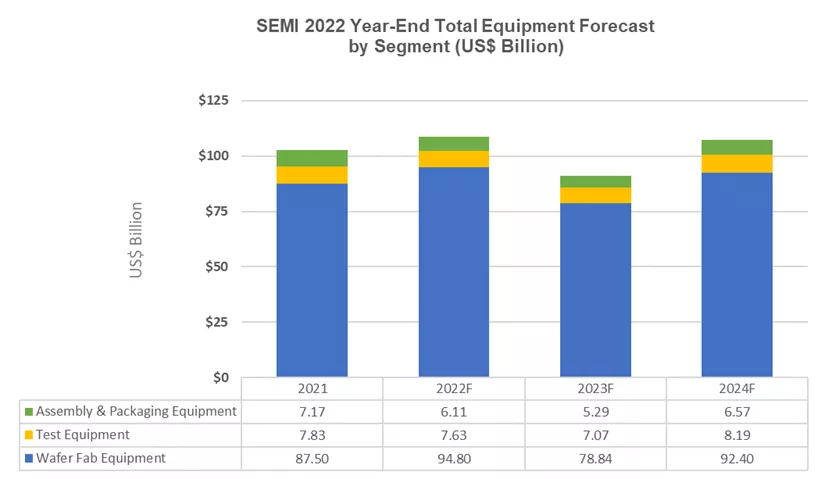
TOKYO — December 13, 2022 — Global sales of total semiconductor manufacturing equipment by original equipment manufacturers are forecast to reach a new high of $108.5 billion in 2022, rising 5.9% from the previous industry record of $102.5 billion in 2021, SEMI announced today in its Year-End Total Semiconductor Equipment Forecast – OEM Perspective at SEMICON Japan 2022. The record high caps three consecutive years of record revenue. The global total semiconductor manufacturing equipment market is expected to contract to $91.2 billion next year before rebounding in 2024 driven by both the front-end and back-end segments.

Logo“Record fab constructions have driven total semiconductor manufacturing equipment sales to cross the $100 billon mark for a second straight year,” said Ajit Manocha, SEMI president and CEO. “Emerging applications in multiple markets have set expectations for significant semiconductor industry growth this decade, which will necessitate further investments to expand production capacity.”

Semiconductor Equipment Sales by Segment    

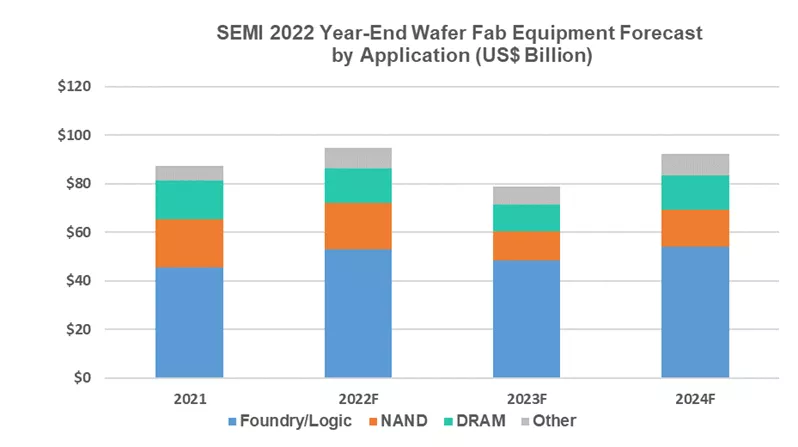
The wafer fab equipment segment, which includes wafer processing, fab facilities, and mask/reticle equipment, is projected to expand 8.3% to a new industry record of $94.8 billion in 2022, followed by a 16.8% contraction to $78.8 in 2023 billion before rebounding 17.2% to $92.4 billion in 2024.

Equipment sales in the foundry and logic segment, accounting for more than half of total wafer fab equipment receipts, are expected to rise 16% year-over-year to $53.0 billion in 2022 as demand for both leading-edge and mature nodes remain strong. Foundry and logic investments are projected to decrease in 2023, leading to an expected 9% drop in sales across the segment.

As enterprise and consumer demand for memory and storage weakens, DRAM equipment sales are expected to fall 10% to $14.3 billion in 2022 and 25% to $10.8 billion in 2023, while NAND equipment sales are projected to drop 4% to $19.0 billion in 2022 and 36% to $12.2 billion in 2023.

Challenging macroeconomic and semiconductor industry conditions are expected to spark a decline in back-end equipment segment sales. After registering robust 30% growth in 2021, semiconductor test equipment market sales are forecast to slip 2.6% to $7.6 billion in 2022 and 7.3% to $7.1 billion in 2023. Following an 87% surge in 2021, assembly and packaging equipment sales are projected to drop by 14.9% to $6.1 billion in 2022 and 13.3% to $5.3 billion in 2023. Back-end equipment expenditures are expected to improve in 2024 with growth of 15.8% and 24.1%, respectively, in the test equipment and assembly and packaging equipment segments.

Semiconductor Equipment Sales by Region

China, Taiwan and Korea are projected to remain the top three destinations for equipment spending in 2022. China is projected to maintain the top position next year after claiming it for the first time in 2020, while Taiwan is expected to regain the lead in 2024. Equipment spending for all regions tracked, except Korea, are expected to grow in 2022, though most will see a decrease in 2023 before returning to growth in 2024.

The following results reflect market size by segment and application in billions of U.S. dollars:

SEMI December 2022, Equipment Market Data Subscription Chart 1SEMI December 2022, Equipment Market Data Subscription Chart 2


Source: SEMI December 2022, Equipment Market Data Subscription

* Total equipment includes new wafer fab, test, and assembly and packaging. Total equipment excludes wafer manufacturing equipment. Totals may not add due to rounding.

The SEMI forecast is based on collective input from top equipment suppliers, the SEMI Worldwide Semiconductor Equipment Market Statistics (WWSEMS) data collection program and the industry-recognized SEMI World Fab Forecast database.

The Equipment Market Data Subscription (EMDS) from SEMI provides comprehensive market data for the global semiconductor equipment market. A subscription includes three reports:

  • Monthly SEMI North American Billings Report, an early perspective of equipment market trends
  • Monthly Worldwide Semiconductor Equipment Market Statistics (WWSEMS), a detailed report of semiconductor equipment billings for seven regions and more than 22 market segments
  • Bi-annual Total Semiconductor Equipment Forecast – OEM Perspective, an outlook for the semiconductor equipment market

For more information online, please visit SEMI Market Data.


About SEMI

SEMI® connects more than 2,500 member companies and 1.3 million professionals worldwide to advance the technology and business of electronics design and manufacturing. SEMI members are responsible for the innovations in materials, design, equipment, software, devices, and services that enable smarter, faster, more powerful, and more affordable electronic products. Electronic System Design Alliance (ESD Alliance), FlexTech, the Fab Owners Alliance (FOA), the MEMS & Sensors Industry Group (MSIG) and SOI Consortium are SEMI Strategic Technology Communities. Visit www.semi.org, contact one of our worldwide offices, and connect with SEMI on LinkedIn and Twitter to learn more.


Association Contact

Michael Hall/SEMI
Phone: 1.408.943.7988
Email: [email protected]

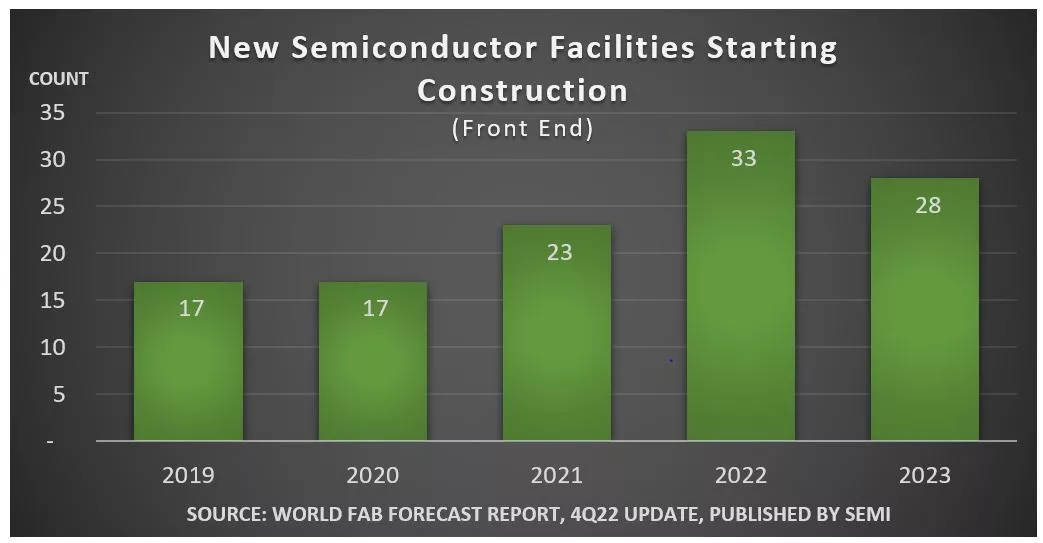
MILPITAS, Calif. — December 12, 2022 — The worldwide semiconductor industry is projected to invest more than $500 billion in 84 volume chipmaking facilities starting construction from 2021 to 2023, with segments including automotive and high-performance computing fueling the spending increases, SEMI announced today in its latest quarterly World Fab Forecast report. The projected growth in global factory count includes a record high 33 new semiconductor manufacturing facilities starting construction this year and 28 more in 2023.

Logo“The latest SEMI World Fab Forecast update reflects the increasing strategic importance of semiconductors to countries and a wide array of industries worldwide,” said Ajit Manocha, SEMI president and CEO. “The report underscores the significant impact of government incentives in expanding production capacity and strengthening supply chains. With the bullish long-term outlook for the industry, rising investments in semiconductor manufacturing are critical to laying the groundwork for secular growth driven by a diverse range of emerging applications.”  
 

Image


New Semiconductor Facilities Starting Construction by Region

The SEMI World Fab Forecast reports data from SEMI’s seven regions:

  • In the Americas, the U.S. Chips and Science Act has vaulted the region into the lead worldwide in new capital spending as the government investment spawns new chipmaking facilities and supporting supplier ecosystems. From 2021 through next year, the Americas is forecast to start construction on 18 new facilities.
  • China is expected to outnumber all other regions in new chip manufacturing facilities, with 20 supporting mature technologies planned.
  • Propelled by the European Chips Act, Europe/Mideast investment in new semiconductor facilities is expected to reach a historic high for the region, with 17 new fabs starting construction between 2021 and 2023. 
  • Taiwan is expected to start construction on 14 new facilities, while Japan and Southeast Asia are each projected to begin building six new facilities over the forecast period. Korea is forecast to start construction on three large facilities.  

The latest update of the SEMI World Fab Forecast report, published this month, lists more than 1,470 facilities and lines globally, including 162 volume facilities and lines with various probabilities that are expected to start production in 2022 or later. Download a report sample.  

For more information or to subscribe to the World Fab Forecast and other SEMI market research report, please contact the SEMI Market Intelligence Team (MIT) at [email protected]. More information on the SEMI market data portfolio is also available online.


About SEMI
SEMI® connects more than 2,500 member companies and 1.3 million professionals worldwide to advance the technology and business of electronics design and manufacturing. SEMI members are responsible for the innovations in materials, design, equipment, software, devices, and services that enable smarter, faster, more powerful, and more affordable electronic products. Electronic System Design Alliance (ESD Alliance), FlexTech, the Fab Owners Alliance (FOA), the MEMS & Sensors Industry Group (MSIG) and SOI Consortium are SEMI Strategic Technology Communities. Visit www.semi.org, contact one of our worldwide offices, and connect with SEMI on LinkedIn and Twitter to learn more.

Association Contact

Michael Hall/SEMI
Phone: 1.408.943.7988
Email: 
[email protected]

HSINCHU, Taiwan – December 13, 2022 – Taking aim at hardening the Taiwan semiconductor ecosystem’s defenses against cyberattacks, SEMI has launched a Semiconductor Cybersecurity Risk Rating Service. Using third-party risk scoring and risk posture assessment, the service is designed to help SEMI Taiwan members assess cybersecurity risks in real time and provide risk remediation guidance. Launched by the SEMI Taiwan Cybersecurity Committee, the service was developed by SEMI Taiwan, Taiwan Semiconductor Manufacturing Company (TSMC) and other semiconductor industry partners.

Logo“The new SEMI Semiconductor Cybersecurity Risk Rating Service will help Taiwan semiconductor companies bolster their cyber defenses as they deploy smart manufacturing practices that rely on greater connectivity both inside and outside of chip fabs,” said Terry Tsao, Global Chief Marketing Officer and President of SEMI Taiwan. “Crucially, the service will also facilitate cybersecurity decision-making as semiconductor companies work with their supply chain partners.”

“Ever since we helped our suppliers adopt the assessment and security rating mechanism that is the foundation of the SEMI Semiconductor Cybersecurity Risk Rating Service, many security vulnerabilities have been exposed and repaired in a timely manner,” Dr. James Tu, Chairman of the SEMI Taiwan Cybersecurity Committee and Head of Corporate Information Security at TSMC. “This important service not only helps semiconductor companies monitor their suppliers' cybersecurity status, but also makes possible the comparison of supply chain cybersecurity standards and benchmarking.”

SEMI Semiconductor Cybersecurity Risk Rating Service – 5 Features

  • Quantitative Risk Scores and Peer Comparison: Helps enterprises assess various cybersecurity risks, score risk exposure levels, and compare their cybersecurity defenses with those of peers to better understand their strengths and vulnerabilities both internally and externally.
  • Self-Evaluation with General Questionnaire: Aids enterprises in conducting internal risk and vulnerability assessment. The general semiconductor industry questionnaire is tailor-made based on security-related experiences from across the Taiwan semiconductor industry.
  • Risk Enhancement Recommendations: The service offers mitigation measures for each identified risk and re-evaluations once the measures are implemented, giving enterprises an immediate view of their cybersecurity optimization results and investment benefits.
  • Continuous Risk Ratings: Continuous risk ratings help keep enterprises updated with changes in risk indices while helping them understand both cybersecurity management trends and how they can strengthen their cybersecurity.
  • Objective Risk Ratings: Objective risk rating scores for enterprises to share with business partners to help deepen mutual trust.

The introduction of the SEMI Semiconductor Cybersecurity Risk Rating Service follows SEMI Taiwan’s January 2022 release of SEMI E187, the world's first cybersecurity standard for fab equipment.  


About SEMI
SEMI® connects more than 2,500 member companies and 1.3 million professionals worldwide to advance the technology and business of electronics design and manufacturing. SEMI members are responsible for the innovations in materials, design, equipment, software, devices, and services that enable smarter, faster, more powerful, and more affordable electronic products. Electronic System Design Alliance (ESD Alliance), FlexTech, the Fab Owners Alliance (FOA), the MEMS & Sensors Industry Group (MSIG) and SOI Consortium are SEMI Strategic Technology Communities. Visit www.semi.orgcontact one of our worldwide offices, and connect with SEMI on LinkedIn and Twitter to learn more.

Association Contacts

Monica Hung/SEMI Taiwan
Email: [email protected]
Phone: +886.3.560.1777 ext. 207

Michael Hall/SEMI US
Phone: 1.408.943.7988
Email: [email protected]