

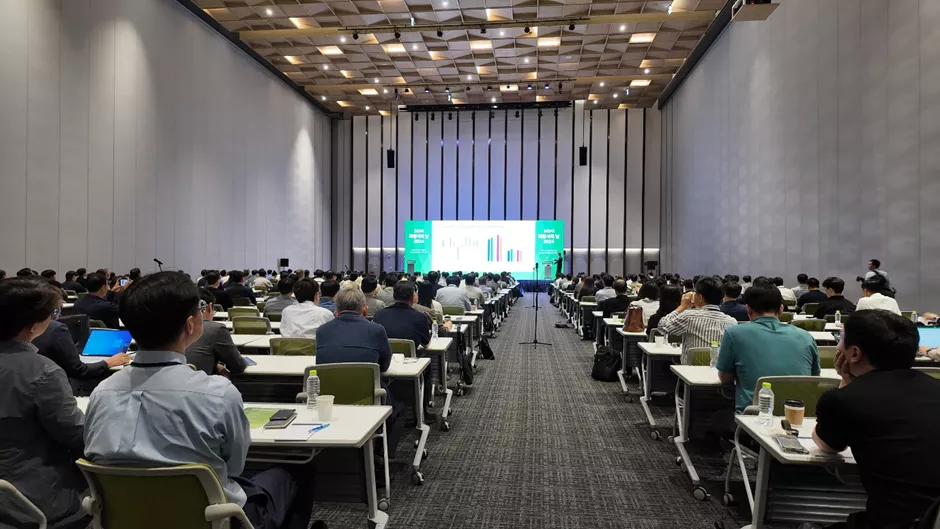
SEMI Korea Members Day 2025 in September featured a wealth of insights on semiconductor industry market and technology trends. As the two-year semiconductor inventory correction eases, Soo-Kyoum Kim, vice president at International Data Corporation (IDC), provided a market update during his address to the event’s 400 attendees at the Suwon Convention Center. He highlighted that the semiconductor market is showing signs of gradual recovery, with growth predicted for the second half of 2024 and into 2025.
This growth, he said, is being fueled by rising demand for artificial intelligence (AI) and high bandwidth memory (HBM). He projected that the total semiconductor market would grow to $779.8 billion in 2025, marking a 15.8% increase from this year's estimate of $673 billion.
By next year, the memory market is expected to rise by 24%, largely driven by demand for AI. Although consumer demand will likely weaken due to a slowdown in the Chinese market, Kim shared that easing inventory adjustments will lead to a rebound during the second half of 2024, particularly in the growth of DRAM and NAND. Kim also predicted that the non-memory market, which reached $503.4 billion this year, will grow to $569.4 billion by 2025.
Additionally, the compound annual growth rate (CAGR) for semiconductor network and data center sales is projected to be 26.4% and 16.2% by 2028, respectively. Kim explained that the strong demand for AI semiconductors in data centers and networks will help the semiconductor market maintain an 8% CAGR over the next five years, following the 2023 market adjustment.
SEMI Korea Members Day Highlights
 |
H.D. Cho |
The AI-driven industrial transformation is demanding more advanced processes. To accommodate AI, the industry has shifted its focus away from miniaturization toward back-end processes. However, the challenges facing Korea's semiconductor industry have also intensified.
Leading semiconductor research firms shared in-depth market forecasts and presented their latest semiconductor technology roadmaps, offering insights on business strategies for Korea’s semiconductor ecosystem.
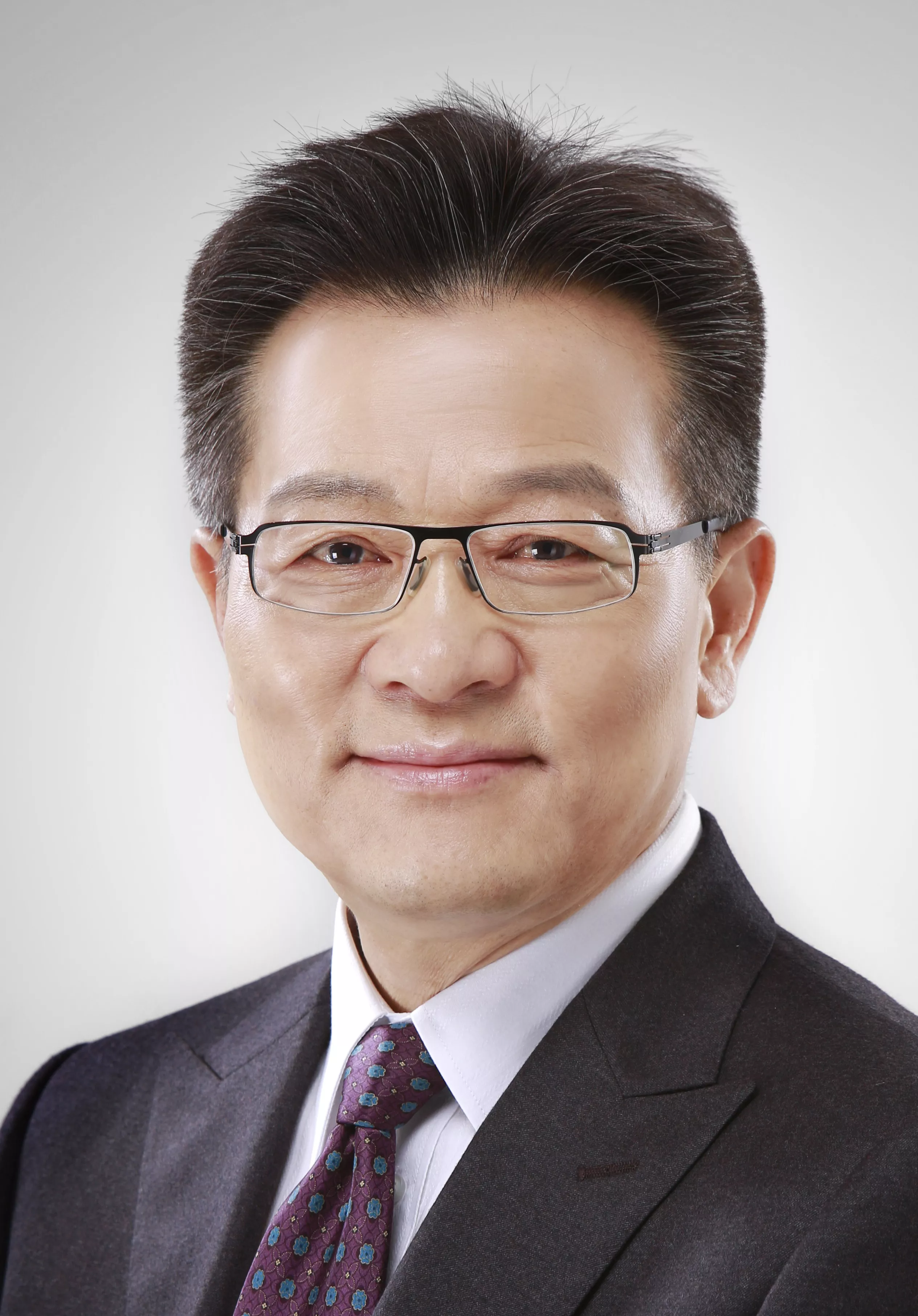
In his opening remarks, H.D. Cho, president of SEMI Korea, expressed deep gratitude for the exceptional resilience of SEMI Korea’s members, who continue to overcome roadblocks despite global uncertainties. He also highlighted the growth of SEMI Korea’s member companies, emphasizing their positive role in the global semiconductor supply chain, as well as SEMI's ongoing commitment in supporting their innovations.
Call for Renewable Energy Policy Reform to Achieve Net Zero
Bora Lee, leader of Solutions For Our Climate (SFOC), emphasized the strong correlation between the semiconductor industry and Korea's economic growth. Lee also outlined key factors contributing to the high costs that hinder renewable energy adoption in the semiconductor sector.
"Korea's levelized cost of electricity (LCOE) for renewable energy is about 2-3 times higher than the global average," she said. "The establishment of a policy council involving semiconductor companies is a crucial step in developing cooperative strategies to promote the use of renewable energy."
In addition, Lee stressed that collaboration among suppliers, consumers, and policymakers is necessary to address these barriers and accelerate the transition to renewable energy within the industry.
AI is Reshaping the Global Memory Market
Peter Lee of CITI Group shared that the convergence of cloud and edge computing is helping support new demands from AI, the metaverse, and automotive applications. As a result, this will increase long-term demand for memory.
"The growing demand for AI is diversifying the memory market," Lee said. "This includes products such as HBM, LLW, LPDDR5T, and CXL, all of which are expected to see increased adoption according to AI computing requirements."
As the need for parallel processing in AI training and inference tasks grows, Lee predicted the demand for HBM3 and DDR5 will significantly rise. HBM's share of total DRAM revenue is expected to increase dramatically – from 11% in 2023, to 30% by 2027.

Expected Growth of the GaN Power Semiconductor Market
Ho-Young Cha, a professor at Hongik University and co-founder and CTO of ChipsK, highlighted that the GaN power semiconductor market is expected to see continuous growth due to its advantages over silicon-based devices. The expansion of GaN technology applications in various industries, including consumer electronics, automotive, and telecommunications, he said, will drive additional growth.
"The GaN power semiconductor market will grow from $180 million in 2022 to $2.04 billion by 2028," said Cha.
Growth Outlook for the Semiconductor Equipment and Materials Market in 2025
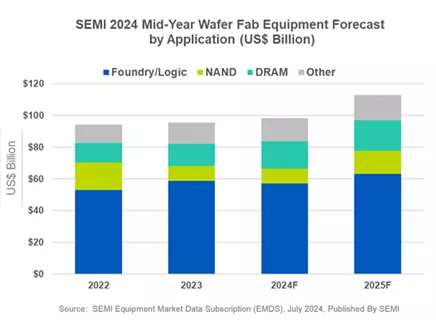
Clark Tseng, director of the SEMI Market Intelligence Team, projected that the short-term outlook for the global semiconductor market will gradually recover due to improvements in end-demand for major electronic product sectors and surging demand for AI chips.
"The equipment and materials markets are expected to show a slight improvement in 2024, with a strong recovery anticipated in 2025," Tseng stated.
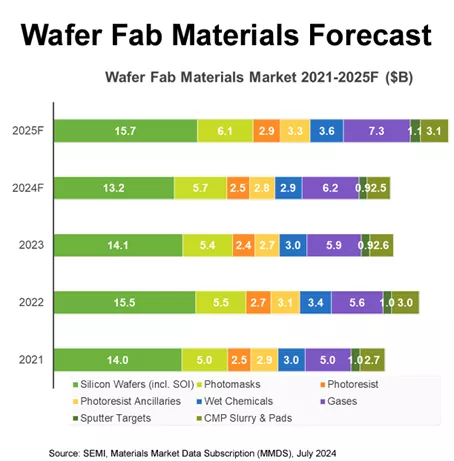
He noted that the equipment market would grow by approximately 3% in 2024 from $95 billion in 2023 and is expected to grow by 15% in 2025. Regarding wafer fab materials, the silicon wafer market is expected to decline from $14.1 billion in 2023 to $13.2 billion in 2024. However, recovery is anticipated to begin in the second half of 2024, with the market projected to reach a new record of $48 billion in 2025.
For more insights on Korea and the industry, attend SEMICON Korea from February 19-21, 2025 at COEX Convention & Exhibit Center. Visionaries and leaders will gather to discuss the latest developments, innovations, and business opportunities within the industry. As the region’s premier microelectronics event, SEMICON Korea 2025 is expected to host 70,000 attendees, 500 exhibitors, and 200 speakers. More event information, including registration details, will be available soon.
Jaegwan Shim is Senior Specialist, Marketing at SEMI.


