downloadGroupGroupnoun_press release_995423_000000 copyGroupnoun_Feed_96767_000000Group 19noun_pictures_1817522_000000Member company iconResource item iconStore item iconGroup 19Group 19noun_Photo_2085192_000000 Copynoun_presentation_2096081_000000Group 19Group Copy 7noun_webinar_692730_000000Path
Skip to main content
Default Banner Image

FD-SOI

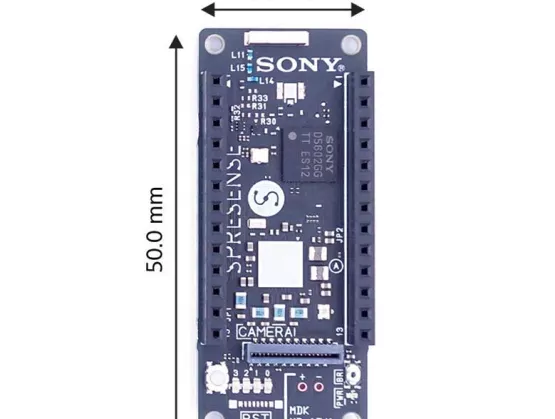
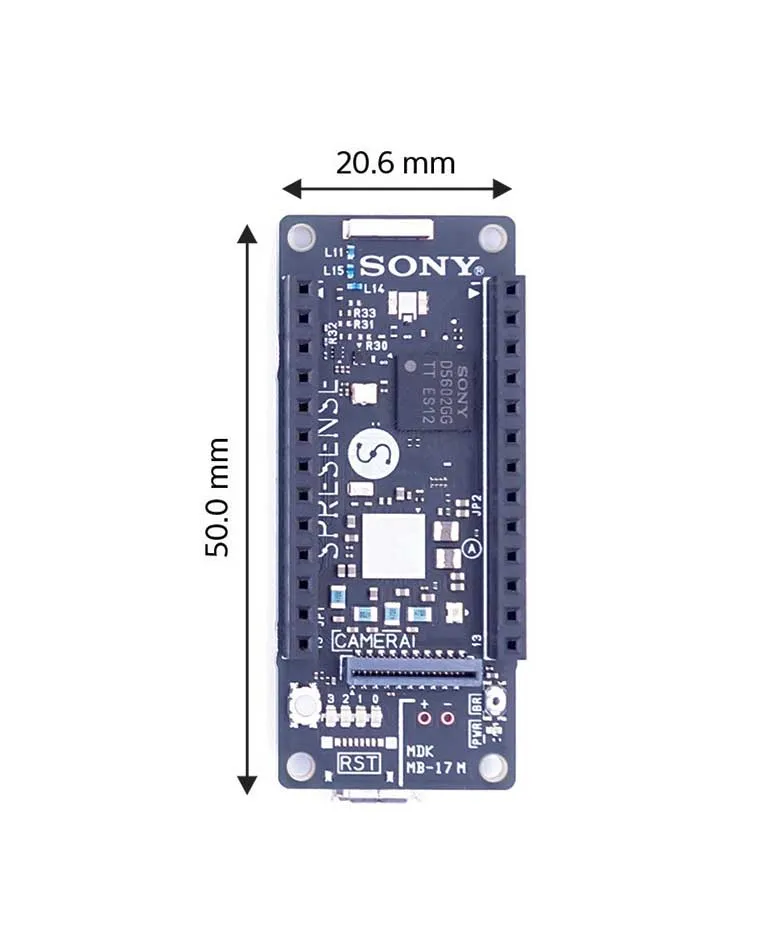
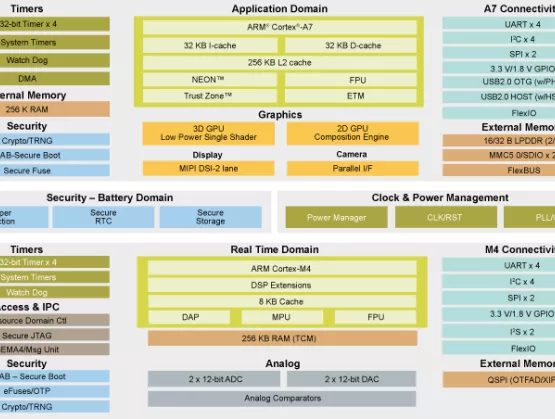
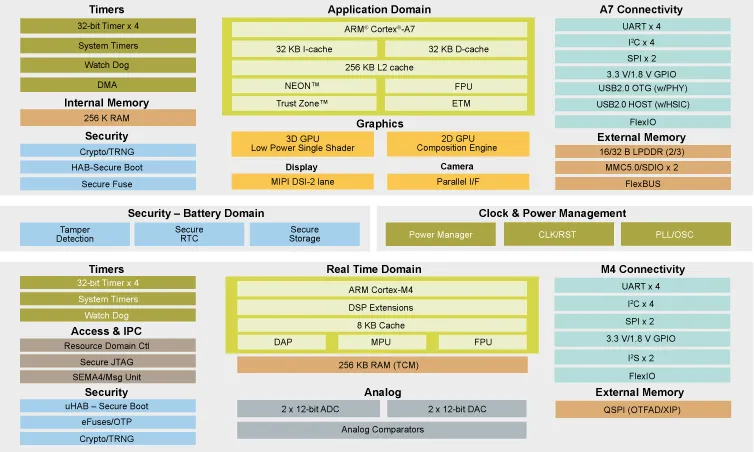
The MCU at the heart of Sony's new smart-sensing SPRESENSE™ for IoT is built on FD-SOI. Why? Low operating voltage and low power consumption, of course! Sony's got two cool new products going on sale in July 2018: the SPRESENCE main and extension boards for IoT applications, equipped with a smart-sensing processor (read the full press release here). A CXD5602PWBCAM1 camera board for sensing cameras will go on sale in August. All were on display at the SF Maker Fair '18, where they were an instant hit. [caption id="attachment_11931" align="alignright" width="300"] Here are the main features of Sony's CXD5602 MCU for IoT, which is built on FD-SOI. (Courtesy: Sony Semiconductor Solutions)[/caption] The main board (it's open source, btw) will run about US$50. You'll find the specs and main features here. Spresense is powered by Sony's FDSOI-based CXD5602 MCU (ARM Cortex-M4F × 6 cores), with a clock speed up to 156 MHz. The main board utilizes a multi-CPU structure equipped with Sony's state-of-the-art GNSS (Global Navigation Satellite System – which they talked about at the most recent SOI Symposiums in SF and Tokyo) receiver. A variety of systems for diverse applications, including drones, smart speakers, sensing cameras and other IoT devices, can be built by combining these boards and developing the relevant applications. The new board can be used to control a drone, for example, using GPS positioning technology and a high-performance processor, voice-controlled smart speakers, low-power consumption sensing cameras and other IoT devices, etc. It can also be combined with various sensors for use in systems that detect errors in production lines on the factory floor.
Read More
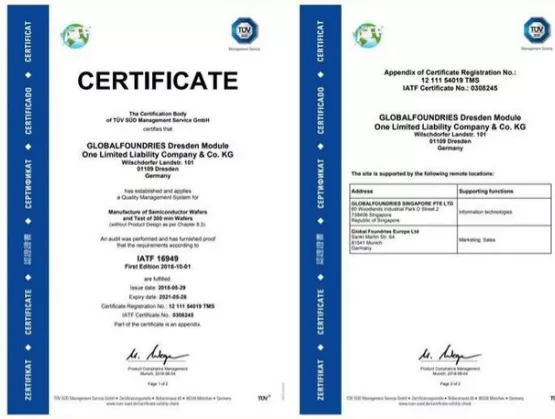
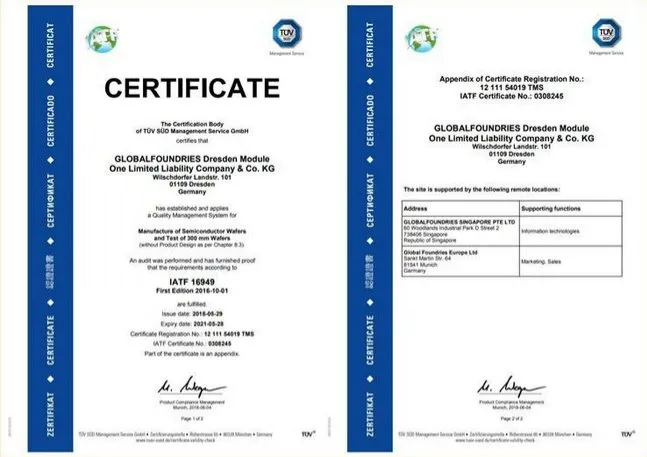
[caption id="attachment_11914" align="alignright" width="150"] Mark Granger, GlobalFoundries' VP Automotive Product Line Management[/caption] GF's 22FDX® (22nm FD-SOI) offering is on an automotive roll. The technology platform has been certified for several key automotive standards, and GF has announced an exciting new ADAS customer in Arbe Robotics. In addition to sharing info from various press releases and blogs, ASN also had a chance to catch up with Mark Granger, GF's VP for automotive, who provided some great insights. Read on! Taking the Heat When it comes to compliance, automotive industry standards are excruciatingly rigorous. Every part that goes into a car must adhere to the relevant standards: chips are no exception. One such standard is the AEC – Q100, a “Failure Mechanism Based Stress Test Qualification For Integrated Circuits”. The AEC – aka the Automotive Electronics Council – handles those testing standards and certification. Grade 2 means a technology is certified for the -40°C to +105°C ambient operating temperature range. To achieve Grade 2 certification, devices have to successfully withstand reliability stress tests for an extended period of time over the specified temperature range. GF recently announced that 22FDX has been AEC Q100 Grade 2 certified (press release here). However Granger adds that for their customers, they've added additional headroom that takes them to 125°C. They're now working on Grade 1 certification, he says, which means the devices are certified to handle junction temperatures up to 125°C (and there again, GF has added additional headroom that takes them to 150°C). That should be done by the end of 2018. The ability you get with FD-SOI to tune the transistors using body biasing is really beneficial here, he says. For GF, the 22FDX qualifications exemplifies their commitment to providing high-performance, high-quality technology solutions for the automotive industry. The automotive industry is driven by a “zero excursions – zero defects” mindset, says Granger, and that drives the foundry, too. SOI has been used for decades across industries where heat and electromagnetic radiation are challenges, bringing soft error rates (SER) down by orders of magnitude, notes Granger. (SOI, btw, essentially eliminates what are known as Single Event Upsets (SEU) caused by latch-up, which in turn brings down SER.) That in turn, ties into the FIT (failure in time) rate – and that's part of the ISO 26262 “Road vehicles – Functional safety” standard – where 22FDX is also certified. As a part of GF's AutoPro™ platform, 22FDX allows customers to easily migrate their automotive microcontrollers and ASSPs to a more advanced technology, while leveraging the significant area, performance and energy efficiency benefits over competing technologies. Moreover, the optimized platform offers high performance RF and mmWave capabilities for automotive radar applications and supports implementation of logic, Flash, non-volatile memory (NVM) in MCUs and high voltage devices to meet the unique requirements of in-vehicle ICs. GF's Fab 1 in Dresden, Germany (which is where they do 22FDX) also has achieved ISO-9001/IATF-16949 certification, which demonstrates that it is capable of meeting the stringent and evolving needs of the automotive industry. (IATF is the International Automotive Task Force. 16949 is a Quality Management System (QMS) certification specifically for the automotive sector.) Granger wrote a really informative blog on the GF website – you can read it here. It includes this graphic, indicating where in the car 22FDX-based parts are expected to go. [caption id="attachment_11913" align="alignleft" width="1000"] Here's how GF sees the applications for 22FDX and other chip technologies in automotive applications. (Courtesy: GlobalFoundries)[/caption] On Radar GF recently announced that Arbe Robotics selected 22FDX® as the process technology for its groundbreaking patented imaging radar. Arbe aims to achieve fully automated system capabilities and enable safer driving experiences for autonomous vehicles (read the press release here). As the first company to demonstrate ultra-high-resolution at a wide field of view, Arbe Robotics’ radar technology can detect pedestrians and obstacles at a range of 300 meters, in any weather and lighting conditions. The processor creates a full 3D shape of the objects and their velocity, and classifies targets using their radar signature. As Granger noted in his blog, “Radar is one of several sensor types used to detect objects near a vehicle, to enable features like adaptive cruise control. Lidar is another. It uses pulsed lasers to determine distance from an object by measuring the time it takes for the light to reflect back. However, lidar is currently expensive and is affected by weather conditions. Radar is less expensive, and higher-resolution radars promise to compete well with lidar in automotive applications, thereby enabling lower-priced vehicles to enjoy greater ADAS capabilities. 22FDX-based radar sensors can provide higher resolutions and less latency than current radar sensors at a very low total system cost.” While they may be complementary at first, there is a battle brewing between high-resolution radar and lidar, Granger told ASN. Putting their solution on 22FDX enables Arbe to achieve a 77 GHz mmWave radar and compete cost-effectively with lidar. “They wanted the best,” says Granger. 22FDX can achieve the requisite Ft and Fmax figures of merit. And with transistor stacking, they can also integrate the power amplifier (PA) on a single device. With the low inherent capacitance of the PA in 22FDX, you can get the high power output you need for mmWave but with low power consumption. GF blogger Dave Lammers has also written a great piece about the Arbe solution (you should read it: here's the link). “The company said its advanced technology allows the detection of small targets, such as a human or a bike even if they are somewhat masked by a large object such as a truck,” he writes. “The imaging radar can determine whether objects are moving, and in what direction, and alert the car in real-time about a risk. “While other car sensors can fail when it is raining, if there’s fog, and due to blinding lights such as a sudden reflection, Arbe’s radar is completely oblivious to all those factors. The custom designed radar processor creates a full real-time 4D image of the environment, and classifies targets using their radar signature.” Avi Bauer, Arbe's VP of R D, is now clearly an SOI fan. Lammers quotes him as saying, “With SOI the design is more straightforward, and (voltage) biasing allows you to do things that cannot be done in standard CMOS. For the transmit and receive modules, SOI’s higher resistivity substrate benefits the passive components – inductors and capacitors – and allows good isolation. High Q passives are important. At 22nm, SOI allows better performance overall.” Clearly good things are coming down the road for FD-SOI!
Read More
Some really innovative start-ups presented chips they're doing on FD-SOI at the SOI Consortium’s 2018 SOI Symposium in Silicon Valley. We'll cover those here in Part 3 of ASN's coverage, as well as a presentation on China by wafer-maker Simgui and the final panel discussion. BTW, if somehow you missed my coverage of the morning sessions about very cool new products and projects from NXP, Sony, Audi, Airbus and Andes Technology, be sure to click here to read it. And in the afternoon the foundry partners provided excellent insight into who's designing chips on FD-SOI, and VLSIresearch explained why. You can read that here. Some of the presentations are posted on the SOI Consortium Events page – but some won’t be. Either way, I’ll cover them here. Start-upsIneda Systems began as an ADAS start-up, and are now working on developing low-power SoCs for use in consumer and enterprise applications. They're using FD-SOI for their current family of chips. SVP Ramkumar Subramanian emphasized that NRE costs are really important for smaller designs. 22FDX, he said, enabled them to move from 40nm, and ramp to larger volumes. In February, GreenWaves Technologies, a fabless semiconductor startup designing disruptive ultra-low power embedded solutions for image, sound and vibration AI processing in sensing devices, announced its GAP8 IoT application processor. GAP8 evaluation boards can now be ordered. The GAP8 agile power management architecture combined with IOT low duty cycling is a perfect fit for FDSOI processes. CEO Loic Lietar talked about how it would be used in AI applications at the very edge, wherein only the necessary data should be uploaded to the cloud. Also in February, Dream Chips’ announced that its ADAS SoC fabbed in GlobalFoundries’ 22FDX (FD-SOI) technology was posting record power efficiency (you can read more about it in ASN's coverage at the time here.) Dream Chips is Germany’s largest independent Engineering Service Provider. At the symposium, CEO Jens Benndor's talked about their roadmap. [caption id="attachment_11865" align="alignleft" width="300"] (Courtesy: eVaderis, SOI Consortium)[/caption] eVaderis CEO Jean Pascal Bost talked about how data-intensive IoT applications are enabled with FD-SOI and embedded magnetoresistive non-volatile memory (eMRAM) technology. You can get the slides from his talk here. eVaderis has eflash-like and eSRAM-like eMRAM IP that covers most MCU applications. They also have an eMRAM compiler tool and high-value-added IP for 22FDX. They foresee impressive power savings at the system level with body biasing: 25x this year and up to 45x in 2020, so that intelligence can be brought to IoT. In February they announced that they are co-developing an ultra-low power MCU reference design using GF’s eMRAM technology on the 22FDX® platform. And in March eVaderis and Mentor/Siemens announced that eVaderis proprietary Magnetic Tunnel Junction (MTJ) model would be co-optimized with AFS to speed-up simulations and generations of embedded MRAM IPs and compiler products with good accuracy.An 22FDX MCU reference design project is underway, with tape-out in July '18. Reduced Energy Microsystems (REM) CEO William Coven talked about realizing near-threshold computing with 22FDX and low-power memories. REM has two products on 22FDX: their Neuron Vision SoC and 64-bit RISC-V IP cores. 22FDX, he says, has been fantastic. Simgui Jeffrey Wang, the CEO of wafer-maker Simgui looked at why China is promoting its IC industry. (In the SOI ecosystem, Simgui is particularly known for its RF-SOI wafers, which it produces using Soitec's Smart CutTM process.) This was more of an overview talk, not necessarily specific to the SOI ecosystem, but certainly interesting. In terms of worldwide semiconductor sales, he said, about half end up in China. The CICF – aka the Big Fund – is currently running at about $74 billion. Having realized that mergers acquisitions would not solve the problem, they've opened a second round, targeting another $160 billion. China's two biggest innovation success stories are Huawei (with its Kirin processor), and China Rail, which is now a global Fortune 500 company. The CAGR for the China semiconductor industry is 19%, though they need 20% to reach their goals. IC design is a particularly successful area, posting a CAGR of 29%, with two players in China in the top 10 worldwide. Packaging and assembly/test are also very strong. Zing is working on increasing the supply of 300mm silicon wafers, while Simgui is expanding in both 200 and 300mm capex, due to “big demand”, he said. Panel Discussion [caption id="attachment_11866" align="alignleft" width="300"] SOI Symposium Panel Discussion: (left to right): Giorgio Cesana (Co-Director SOI Consortium), Dave Eggleston (VP GF), Tim Saxe (CTO, Quicklogic), Wayne Dai (CEO, Verisilicon), Samir Patel, (CEO Sankalp Semi), Kelvin Low (VP, ARM), Mahesh Tirupattur (EVP, Analog Bits)[/caption] The day wrapped up with an excellent panel discussion moderated by SOI Consortium Executive Co-Director Giorgio Cesana. Here are a few of the observations made by the panelists. QuickLogic CTO Tim Saxe said that FD-SOI made their designs more compact. With FD-SOI for FPGAs, you've got one set of IP, and you can decide at runtime where you're going for low power or high performance. With a lot of power domains, you see the benefits at the system level. GF VP Dave Eggleston said they're seeing early adopters of eMRAM, especially for wearables with RF and low power. ARM VP Kelvin Low said people should do more than just migrate to FD-SOI. If they use back biasing, it can replace the need for big/little cores. Body biasing makes things easier, maintained Verisilicon CEO Wayne Dai. His teams find that with body biasing, you can tape out for “typical” instead of “worst case”. It's not too late for FD-SOI: it's perfect timing for the MCU market, which is still at 40nm, said Sankalp Semi CEO Samir Patel. As designers, they're happy to focus on companies still on the older nodes. The IP ecosystem should be more enthusiastic about FD-SOI, said Analog Bits EVP Mahesh Tirupattur. You've got more potential customers, and your volume runs can be bigger. In his closing remarks, SOI Consortium Executive Co-Director Carlos Mazure reminded the audience of the day's three take-aways: power consumption is driving even systems companies FD-SOI is penetrating fields like MCUs and SoCs where more intelligence is needed China is still a really big opportunity.
Read More
Here’s why the embedded community should care whether the chips they use are built on FD-SOI. FD-SOI has “…dramatically improved the landscape for power efficiency,” NXP VP Joe Yu explains in a recent Embedded Systems Engineering piece (you can read it here). He gets into the hows and whys of the i.MX7ULP chip design, taking a deep dive into the things that the embedded folks really care about. He details how FD-SOI decreases leakage and dynamic power, including the roles played by forward and reverse body biasing. He then goes on to explain why it’s better for analog, and how it prevents latch-up. FD-SOI enables new features, too, he points out, like ultra-low power consumption and deep sleep suspend. And perhaps most importantly, he explains how bursty high-performance and ultra energy efficiency are dynamically traded off on an as-needed basis. “Engineers no longer face a forced selection: low-power processor or high-performance processor,” he say. “Rather, the selection for performance or power efficiency can be made instantaneously, as needed, without having to reconfigure.” All of this plus the rich graphics and user interface FD-SOI enables makes the i.MX 7ULP perfect for “…IoT edge devices, as well as smart home controls, building automation, portable patient monitoring, wearables, and portable scanners.” This is an excellent read: highly recommended. Of course, ASN covered the i.mX7ULP when it was first announced (on Samsung's 28nm FD-SOI) last year – you can still read our coverage here. But it’s good to see the company explaining to their customers how FD-SOI will change the way they build products. BTW, you can get all the i.MX7ULP product details on the NXP website here. NXP has also put together a nifty video on the i.MX7ULP – see it here.
Read More
Good news: there are far fewer bigoted extremists out there when it comes to FD-SOI vs. FinFETs. People want the best technology for their application. It's that simple. That's a key piece of news from the updated survey by Dan Hutcheson, CEO of VLSI Research, which he presented in the afternoon session of the SOI Consortium's 2018 SOI Symposium in Silicon Valley The afternoon then featured presentations by foundry partners, which I'll cover here. Also in the afternoon were presentations by wafer-maker Simgui, some innovative start-ups leveraging FD-SOI for custom SoCs and the final panel discussion. I'll cover those in Part 3 of this series. BTW, if somehow you missed my coverage of the morning sessions about very cool new products and projects from NXP, Sony, Audi, Airbus and Andes Technology, be sure to click here to read it. The presentations are starting to be posted on the SOI Consortium Events page – but some won't be. Either way, I'll cover them here. VLSI Research A couple years ago at the annual SOI Symposium in Silicon Valley, Dan Hutcheson presented results of a survey he did (ASN covered it – you can still read about it here). At the 2018 event, he presented an update, which is now posted. You can get it here. The FD-SOI roadmap and IP availability are no longer issues for decision makers, he found. The 14nm branch – do you go FinFET or FD-SOI? – is gone. “Fins and FD are complementary,” he observed. Most people said they'd consider using both and running two roadmaps, choosing whichever technology is appropriate to a given design. [caption id="attachment_11841" align="alignnone" width="1000"] (Courtesy: VLSI Research, SOI Consortium)[/caption] From a transistor viewpoint, the top reasons to choose FD-SOI is that it's better for analog and has lower leakage/parastics. It's perceived as better for complex, high mixed-signal SoCs, and especially for RF and sensor integration. In fact, people see RF as the new mixed-signal, wherein FD-SOI is uniquely positioned for 5G and mmWave. From a business viewpoint, FD-SOI is perceived to have real advantages. In particular, FD-SOI wins when it comes to keeping down design costs, manufacturing costs and time-to-market. IoT is still the hottest target market for FD-SOI, to which he adds high growth expected in automotive and medical. Samsung With 20 tape-outs in 2018, Samsung is seeing an acceleration in its FD-SOI business. “The trend is healthy,” said Hong Hoa, SVP of the company's foundry business. FD-SOI, he continued, is on a “differentiation path.” Samsung's 28nm FD-SOI process, called 28FDS is at full maturity with very strong yields. They're seeing more customers and a wider range of applications. The design infrastructure, silicon-verified IP and methodologies are also all mature. They have optimal implementation and verification guidelines for body bias design, a body bias memory usage guide, and a body bias generator integration guide. The process supports Grade 1 automotive, and will be qualified for Grade 2 in a few weeks. FD-SOI, Hoa reminded the audience, offers superior RF performance compared to both planar bulk and 14nm FinFET. The Samsung strategy is to first provide a base for for the FD-SOI process, then add RF and eMRAM. The base for 28nm was done in 2016; they added RF in 2017 and eMRAM this year. The Samsung platform for IoT applications integrates both RF and eMRAM to support multi-function needs in a single platform. Lead customers are already working with eMRAM in their designs, he added. (BTW, Samsung has a really nice video explaining their eMRAM offering – you can see it on YouTube here.) The basic PDK for the Samsung 18nm FD-SOI process (18FDS) will be available in September 2018, with full production slated for fall of 2019. It will deliver a 24% increase in performance, a 38% decrease in power, and a 35% decrease in area for logic. RF for the 18FDSplatform will be ready by the end of this year, and eMRAM beginning in 2019. GlobalFoundries With design wins from 36 customers underway, 12 of which are taping out in 22FDX (GF's 22nm FD-SOI process) this year, the market has validated FDX for differentiation, said GF SVP Dr. Bami Bastani. And indeed, designers are using it for a wide array of applications across North America, Europe, Asia/Pacific and Japan. Customers in the North America are designing in 22FDX for NB-IoT, industrial, RF/analog, mobile, network switches and cryptocurrency applications. In Europe, it's more or less the same plus automotive/mmWave, optical transmission, wireless BTS and AI/ML. In Asia Pacific/Japan the mix is similar to Europe. Bastani sees the three big enablers as the the strengths of the roadmap, the ecosystem and multi-sourcing from Dresden and Chengdu (where they're already equipping the cleanrooms). He also tipped his hat in acknowledgment to the partnership with FD-SOI wafer supplier Soitec, noting that they have gone the extra mile to match GF's requirements. So that was the first part of a great afternoon. As mentioned above, my next post (part 3) will cover a very informative presentation by wafer-maker Simgui on the markets in China, plus talks by some innovative start-ups leveraging FD-SOI for custom SoCs and the final panel discussion.
Read More
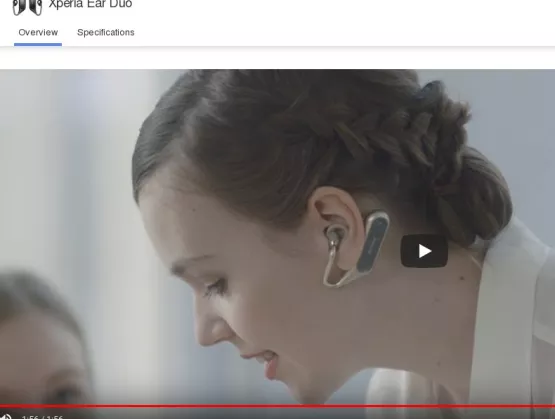
“The ecosystem is ready. The focus is now on applications and products.” And with those words, SOI Consortium Executive Director Carlos Mazure opened the annual Silicon Valley SOI Symposium. As promised, the day was packed with presentations about products on FD-SOI – some from big players like NXP and Sony, some from names new to the FD-SOI ecosystem like Audi and Airbus, and some from start-ups just getting into the game. The event got excellent coverage in EETimes/EDN – including in their editions across the globe in China, Japan, Taiwan, India and more. Samsung, GF Ramp FD-SOI, heralded the headlines. It was a full day of excellent presentations. In this post, I'll chronicle the morning presentations. The next post(s) will cover the afternoon session. Note that as of this writing, the ppts are not yet posted on the SOI Consortium website, but many will be. Keep checking back under the Events tab, and look under “past Events”. Andes Technology As semiwiki noted a few years back, Andes Technology is “...the biggest microprocessor IP company you've never heard of.” Based in Taiwan, Mediatek is one of their big customers; they've got a strong client base across Asia/Pacific, and are now making inroads into North America. Last year they announced with GF their 32-bit CPU IP cores had been implemented on GF's 22FDX® FD-SOI technology. In his symposium keynote, CEO Frankwell Lin said that in the test chip they're doing with GF and Invecus, they're seeing a 70% power savings compared with what they'd gotten in 28ULP. Their newest products are the N25 32bit and NX25 64bit RISC-V based cores, and in July they'll announce a core that runs on Linux. NXP “With FD-SOI we're enabling the future of embedded processing,” the always-quotable (and keynote speaker) NXP VP/GM Ron Martino told us. NXP's i.MX7ULP, i.MX8, i.MX8X and i.MXRT are all FD-SOI based. They all share fundamental building blocks, so NXP can build platforms, scale and re-use IP. “It's better than any technology I've worked on in my 30 years in the industry,” he said. They're seeing much higher performance with on-chip flash. And the RT “crossover” processor boasts 3x higher computing performance than today's competing MCUs. This is going to be critical for edge computing going forward, to which end NXP is working very closely with foundry partner Samsung. FD-SOI is not just helpful for the logic part of these chips – memory technologies also share in the benefits. They get much higher performance with on-chip flash. Leakage is cut by a factor of ten with biasing techniques, and the enhancements mean that memory can operate at very low voltages. NXP is increasingly sophisticated with how they use body biasing, applying high-granularity techniques to independent domains in different parts of the chips. Getting sub-0.6 Vmin delivers value at multiple levels: on battery life, on total system cost, and on system enablement. Invest in body biasing if you want to get leadership results, advised Martino. Edge computing – including machine learning and neural networks for things like image classification – is a big target, he continued. At the last CES they did a proof-of-concept “foodnet” where two appliances talked to each other without having to go to the cloud. In that case it was an i.MX8 in a fridge and an i.MXRT in a microwave, but he explained that the same concept can be applied to a car for driver awareness, where you don't want to take the extra time for or don't have a connection to the cloud. iMX and FD-SOI enable scalable solutions, he concluded. Audi What's a metal-bending company doing talking about electrons? asked Audi Project Manager Dr. Andre Blum. And why SOI? Well, for Audi, he said, SOI stands for Solutions, Opportunities and Innovation. [caption id="attachment_11790" align="alignleft" width="300"] Audi Project Manager Andre Blum says SOI stands for Solutions, Opportunities and Innovation -- at the 2018 SOI Symposium in Silicon Valley.[/caption] Audi is working on the various levels of autonomous driving, and they want it to be without design limitations. That means being able to hide sensors wherever they're needed. They'll create a cocoon around the car for the best driver experience. He showed a fun video Audi's made to illustrate their concept – it's the Invisible Man video, which you can check out on YouTube. But those new architectures can't up the power budget (think heat): rather they need to cut power drastically while increasing performance. And with FD-SOI, they see an opportunity to do just that, he said, while integrating the sensors. Audi is one of 25 partners in a heavily funded ( 100 million Euros) brand new EU Horizon 2020 program called Ocean12 (lead by Soitec). The launch was only May 1st 2018 (so as of today it doesn't even have a website yet), and it will run for about 4 years. It is described by ECSEL (a public-private entity that puts together the big EU research projects) as an “opportunity to carry European autonomous driving further with FDSOI technology up to 12nm node”. One to watch! Airbus For Airbus, it's all about increased connectivity and communications that are trusted and secure, said company expert Olivier Notebaert. Since their chip runs are low, NRE – non-recurring engineering costs – are very important; and they need flexible systems. SOI has a long history in aerospace – in fact that's originally where it got its start, since it can handle radiation and is immune to latch-up. Notebaert says that even for Airbus, IoT is their future. The developments they pioneer will be part of it. Airbus is a partner in the EU Horizon 2020 DAHLIA project – which stands for Deep sub-micron microprocessor for spAce rad-Hard appLIcation Asic. The project is, “...developing a Very High Performance microprocessor System on Chip (SoC) based on STMicroelectonics European 28nm FDSOI technology with multi-core ARM processors for real-time applications, eFPGA for flexibility and key European IPs, enabling faster and cost-efficient development of products for multiple space application domains. The performance is expected to be 20 to 40 times the performance of the existing SoC for space.” According to another recent presentation, DAHLIA is prototyping an FPGA this year that will be in production in 2019. Sony For Sony GM Kenichi Nakano, FD-SOI has big potential for low-power products. And he should know. Sony has been an FD-SOI pioneer, using it as the basis for GPS chips that are now in a growing number of cool products, especially watches. They're getting good feedback from the market and see good opportunities across a diversified global customer base, he said. Their CXD5603, for example, is the lowest power GNSS (GPS) chip worldwide. In mass production since 2015, it is now dominating world wearable markets like trackers -- such the popular Amazfit line. Running through their various FD-SOI based GPS offerings, he noted that the GPS is a pretty simple chip. But now customers are asking for more, like for it to work in the water (where a GPS typically doesn't). So Sony has partnered with triathalon teams and are seeing good results. With success, of course, comes greater demands: for greater accuracy, for more precise positioning in motion, for increased height accuracy, for even lower power – and Sony is meeting these demands with FD-SOI, in solutions like the new CXD5602. The CXD5602 product configuration covers audio/video/communications: key factors in IoT. A camera version is releasing this summer, as are main and extension boards. An LTE module will be released at the end of 2018. And now they're using those FD-SOI chips in audio applications. You'll find it in the Xperia™ Ear Duo, he said. The MWC press release noted that Xperia Ear Duo “... is driven by Sony’s ultra-low power consuming “CXD5602” chip and a sophisticated multi-sensor platform, the “Daily Assist” feature will recognize time, location and activities to offer relevant information throughout the day – reminding you what time your next meeting is when you reach the office or narrating the latest news headlines.” Also in that PR, Hiroshi Ito,Deputy Head of Smart Product Business Group at Sony Mobile Communications, said, “Ear Duo is the first wireless headset to deliver a breakthrough Dual Listening experience – the ability to hear music and notifications simultaneously with sounds from the world around you.” The highly anticipated wireless “open-ear” stereo headset started rolling out to select markets in Spring 2018. There's a great info page with video here. https://youtu.be/1lKo9acJDPs So that's what we heard in the morning. My next post (or posts?) will cover the afternoon. That includes Dan Hutcheson's excellent talk updating his FD-SOI survey, presentations from Samsung, Globalfoundries and Simgui, plus some from very cool start-ups, and the final panel presentation.
Read More
GlobalFoundries' new ecosystem partner program, called RFwave™, aims to simplify RF design and help customers reduce time-to-market for a new era of wireless devices and networks (read the full press release here). The program aims to give designers a low-risk, cost-effective path to highly optimized solutions that leverage GF's platforms including RF on FD-SOI and RF-SOI. The target is wireless applications such as IoT across various wireless connectivity and cellular standards, standalone or transceiver integrated 5G front end modules, mmWave backhaul, automotive radar, small cell and fixed wireless and satellite broadband. As such, the RFwave™ partner program provides GF customers with IP design elements, EDA tools, design consultation and services and OSAT product packaging and test solutions. These products and services are validated, and comprise a plug-and-play catalog of design solutions. With this level of integration, GF customers can create high-performance designs while minimizing development costs. Bami Bastani, senior vice president of GF’S RF Business Unit, says, “As a leader in RF, GF’s RFwave program takes industry collaboration to a new level, enabling our customers to build differentiated, highly integrated RF-tailored solutions that are designed to accelerate the next wave of technology.” Initial members of the RFwave Partner Program are: asicNorth, Cadence, CoreHW, CWS, Keysight Technologies, Spectral Design, and WEASIC.
Read More
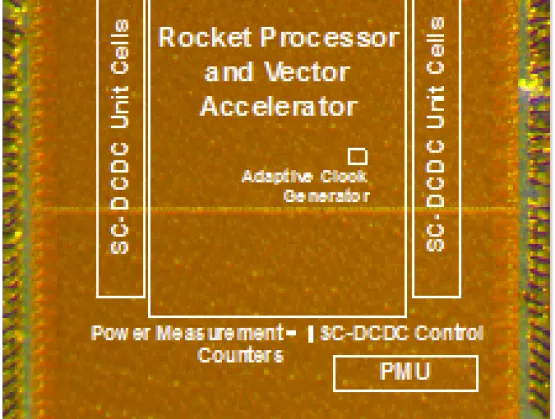
ST Fellow Dr. Andreia Cathelin gave a terrific presentation at the recent CMP Annual Meeting. Now posted and freely available, Performance of Recent Outstanding 28nm FD-SOI Circuits Taped Out Through CMP highlighted eight examples – though she told ASN that she had easily over 50 from which to choose.CMP is a Multi-Project Wafer (MPW) service organization in ICs, Photonic ICs and MEMS. They’ve been organizing prototyping and low volume production in cooperation with foundries for over 37 years. In partnership with ST since 1994, in the fall of 2012 they opened access to MPW runs in the 28nm FD-SOI process. More than 180 tape-outs have been fabricated since then using the process.As Dr. Cathelin said, this lets ST show their industrial clients just how good the technology is. The chips she chose to cover in her presentation get “spectacular performance”, she said, especially for low-power or power-sensitive SoCs.Here’s a quick recap of what she presented (some of which she co-authored), followed by some other SOI-related updates from the CMP meeting.8 (of Many) Great ChipsFD-SOI, said Dr. Cathelin, “...is unmatched for cost-sensitive markets requiring digital and Mixed Signal SoC integration and performance.” In the first dozen slides of her presentation, she gave the technical details on the advantages of FD-SOI in analog, RF/millimeter wave, Analog/Mixed-Signal and digital design. If you're a designer, you'll want to check those out.Then she ran through eight great chips – all manufactured by ST on 28nm FD-SOI through CMP's MPW services. Here they are. (You can click on the illustrations to see them in full screen.)1. A digital delay line with coarse/fine tuning through gate/body biasing in 28nm FDSOI [caption id="attachment_11559" align="alignnone" width="768"] (Courtesy: CMP, ST, ISEN)[/caption] This chip was presented at ESSCIRC '16 by a team from ISEN Lille, Professors Andreas Kaiser and Antoine Frappé (you can get the complete paper by I.Sourikopoulos et al on IEEE Xplore – click here.) As noted in the abstract, “Delay controllability has always been the major concern for the reliable implementation of circuits whose purpose is timing.” By leveraging body biasing in FD-SOI, this novel low-power design architecture for 60GHz receivers enables very high bandwidth together with fine-grain wide range delay flexibility, for implementing Delay Feedback Equalizer techniques in the Intermediate Frequency (IF) reception path. The results are state-of-the-art: ultra wide range, linear control, fs/mV sensitivity and energy efficient controllable delay cells. 2. 28FD-SOI Distributed Oscillator at 134 GHz and 202GHz [caption id="attachment_11560" align="alignnone" width="768"] (Courtesy: CMP, ST, ims)[/caption] Presented at RFIC '17 by a team from the IMS Bordeaux lab, Professor Yann Deval and STMicroelectronics, this chip demonstrates the highest oscillation frequency attainable so far at the 28nm node, be it planar bulk or FD-SOI. (Click here to get the full paper by R. Guillaume et al from IEEE Xplore.) As noted in the abstract, solutions on silicon for mmW and sub-mmW applications have been demonstrated for high-speed wireless communications, compact medical and security imaging. The main challenges are for the signal generation at high frequencies, and this implementation demonstrates spectacular oscillation frequencies close to the transistor’s transition frequency (fT). In this chip, they used body bias tuning to optimize the phase noise, demonstrated very low on-wafer variability, and simulation methods that permit measurement prediction precision within 0.1%.3. A 128 kb Single-Bitline 8.4 fJ/bit 90MHz at 0.3V 7T Sense-Amplifier-less SRAM in 28nm FD-SOI [caption id="attachment_11561" align="alignnone" width="768"] (Courtesy: CMP, ST, Lund U.)[/caption] Extremely energy efficient SoCs are key for the IoT era – but SRAM gets very tricky at ultra-low voltages (ULV). Presented at ESSCIRC '16 by B. Mohammadi et al (on IEEE Xplore here) from Professor Joachim Rodrigues' team at the Lund University, this is a 128 kb ULV SRAM, based on a 7T bitcell. The minimum operating voltage VMIN is measured as just 240mV and the retention voltage is as low as 200mV. FD-SOI enabled them to overcome ULV performance and reliability challenges by letting the Lund U.-lead team selectively overdrive the bitline and wordline with a new single-cycle charge-pump. Plus they came up with a new scheme so it doesn't need a sense amplifier, yet delivered 90MHz read speed at 300mV, dissipating 8.4 fJ/bit-access.4. Matched Ultrasound Receiver in 28FDSOI [caption id="attachment_11562" align="alignnone" width="768"] (Courtesy: CMP, ST, Stanford U.)[/caption] Presented at ISSCC '17 (with an extended relative paper at JSSC '17) by M-C Chen et al with Professor Boris Murmann's team at Stanford, the full title of the paper about this chip is A Pixel Pitch-Matched Ultrasound Receiver for 3-D Photoacoustic Imaging With Integrated Delta-Sigma Beamformer in 28-nm UTBB FD-SOI. (Click here to get it on IEEE Xplore.) It's a a proof-of-concept for a big ultrasound receiver: a “pixel pitch-matched readout chip for 3-D photoacoustic (PA) imaging.” PA is “...an emerging medical imaging modality based on optical excitation and acoustic detection.” It's used in studying cancer progression in clinical research, for example. As noted in the paper abstract, “The overall subarray beamforming approach improves the area per channel by 7.4 times and the single-channel SNR by 8 dB compared to prior art with similar delay resolution and power dissipation.” One of the (many) advantages of FD-SOI in this context is for front-end signal conditioning in each pixel. This unique type of pixel pitch-matched architecture implementation is possible only in a 28nm (or less) node of an FD-SOI technology, as it is matched with the pitch sizing needed for the ultrasound transducers in order to generate signals for a 3-D reading.5. SleepTalker - 28nm FDSOI ULV WSN Transmitter: RF-mixed signal-digital SoC [caption id="attachment_11563" align="alignnone" width="768"] (Courtesy: CMP, ST, UCL)[/caption] Presented at VLSI '16 and JSSC '17 by G. de Streel et al from Professor David Bol’s team at Université Catholique de Louvain la Neuve, the full title of the paper about this chip is SleepTalker: A ULV 802.15.4a IR-UWB Transmitter SoC in 28-nm FDSOI Achieving 14 pJ/b at 27 Mb/s With Channel Selection Based on Adaptive FBB and Digitally Programmable Pulse Shaping (get it on IEEE Xplore here). This chip tackles the IoT requirement for sensing functions that can operate in the ULV context. That means creating wireless sensor nodes (WSN) that can be powered on an energy harvesting power budget – and that's a real challenge if you want to incorporate an RF component that can handle medium data rates (5-30 Mb/s) for vision or large distributed WSN networks. The energy efficiency has to be better than 100 pJ/b. To get there, the UCL-lead team used wide-range on-chip adaptive forward back biasing for “...threshold voltage reduction, PVT compensation, and tuning of both the carrier frequency and the output power. [...] Operated at 0.55 V, it achieves a record energy efficiency of 14 pJ/b for the transmitter (TX) alone and 24 pJ/b for the complete SoC with embedded power management. The TX SoC occupies a core area of 0.93 mm2.”6. A 128x8 Massive MIMO Precoder-Detector in 28FDSOI [caption id="attachment_11564" align="alignnone" width="768"] (Courtesy: CMP, ST, Lund U.)[/caption] This massive MIMO chip was presented at ISSCC '17 by a team from Professors Liang Liu and Ove Edforss at the Lund University in a paper entitled 3.6 A 60pJ/b 300Mb/s 128×8 Massive MIMO precoder-detector in 28nm FD-SOI (H. Prabhu, et al; get it from IEEEE Xplore here). While Massive MIMO (MaMi) will be needed for next-gen communications, it can't be achieved by just scaling MIMO – that would be too costly in terms of flexibility, area and power. As noted in the Lund U. team's intro, “Algorithm optimizations and a highly flexible framework were evaluated on real measured channels. Extensive hardware time multiplexing lowered area cost, and leveraging on flexible FD-SOI body bias and clock gating resulted in an energy efficiency of 6.56nJ/QRD and 60pJ/b at 300Mb/s detection rate.”7. ENVISION: A 0.26-to-10TOPS/W Subword-Parallel Dynamic-Voltage-Accuracy-Frequency-Scalable Convolutional Neural Network Processor in 28nm FDSOI [caption id="attachment_11565" align="alignnone" width="768"] (Courtesy: CMP, ST, KU Leuven)[/caption] Today's solutions for always-on visual recognition apps are an order of magnitude too power hungry for wearables. Running at 10's to several 1OO's of GOPS/W, they use classification algorithms called ConvNets, or Convolutional Neural Networks (CNN). The paper about this chip was presented at ISSCC '17 by a team from professor Marian Verhelst at Katoliek Universiteit Leuven (B. Moons, et al, get it from IEEE Xplore here), and it changes everything. Leveraging FD-SOI and body-biasing, the KU Leuven team solved the power challenge with, “...the concept of hierarchical recognition processing, combined with the Envision platform: an energy-scalable ConvNet processor achieving efficiencies up to 10TOPS/W, while maintaining recognition rate and throughput. Envision hereby enables always-on visual recognition in wearable devices.”8. Fine-Grained AVS in 28nm FDSOI Processor SoC [caption id="attachment_11566" align="alignnone" width="768"] (Courtesy: CMP, ST, UC Berkeley)[/caption] As we learned at SOI Consortium FD-SOI Tutorial Day in SiValley last year, Professor Borivoje “Bora” Nikolic of UC Berkeley is known as one of the world's top experts in body-biasing for digital logic (he and his team have designed more than ten chips in ST’s 28nm FD-SOI!) They presented the RISC-V chip here at ESSCIRC '16 and JSSC '17, in a paper entitled Sub-microsecond adaptive voltage scaling in a 28nm FD-SOI processor SoC (B.Keller, et al, on IEEE Xplore here). As they noted in the intro, a major challenge for mobile and IoT devices is that their workloads are highly variable, but they operate under very tight power budgets. If you apply adaptive voltage scaling (AVS), you can improve energy efficiency by scaling the voltage to match the workload. But in the current gen of SoCs, the AVS timescales of hundreds of microseconds is too slow. The chip the Berkeley team presented brought that down to sub-microseconds by aggressively applying body-biasing throughout the chip, including to workload measurement circuits and integrated power management units. The result is “... extremely fine-grained ( 1μs) adaptive voltage scaling for mobile devices.” (BTW, they expand on some of the details in another paper published in 2017.) These design techniques are now taught at UC Berkeley, as this kind of implementation is the subject of a course in SoC design (including the RF part of transceivers); a first educational chip has already been taped-out and successfully measured. (BTW, Professor Nikolic will once again join Dr. Cathelin and other luminaries in teaching at the SOI Consortium's FD-SOI Training Day in Silicon Valley, 27 April 2018 - click here for sign-up information.)More SOI Through CMPAt the meeting, CMP also made a presentation on all their MPW offerings – you can get it here. On ST's SOI (in addition to 28nm FD-SOI, of course), that includes the new 160nm SOIBCD8s: Bipolar-CMOS-DMOS Smart Power (for automotive sensor interface ICs, 3D ultrasound, MEMS micro-mirror drivers); and 130nm H9-SOI-FEM: Front-End Module (for radio receiver/transceiver, cellular, WiFi, and automotive keyless systems).CMP also provides tutorials that are used by institutions across the globe. A new update to the tutorial, RTL to GDS Digital Design Flow in 28nm FD-SOI Process is now available – you can see the presentation they did about that here. (It now includes LVS and DRC steps with Mentor/Calibre or Cadence/PVS.) Other services, like the 2-day, hands-on THINGS2DO FD-SOI training days at the end of March are always fully booked almost immediately, but don't hesitate to inquire, as they'll be adding more. For some more examples of 28nm FD-SOI chips run through CMP over the years, see their website pages on Examples of Manufactured ICs. There are also some nice examples on pages 21 and 23 of their most recent annual report. For those in the photonics world, CMP has teamed up with Leti to offer Si-310 PHMP2M, a 200mm CMOS SOI platform. CMP is cooperating with Tyndall for the photonics packaging – see that presentation here. Training kits and tutorials will be available in Q3 of this year. And in partnership with MEMSCAP, CMP offers Multi-User MEMS Processes (aka MUMPs) for SOI-MEMS.So lots of terrific SOI resources for CMP – check it out!~ ~ ~Note: special thanks to Andreia Cathelin of ST and Kholdoun Torki of CMP for their help on this piece.
Read More
They've got initial silicon of Dream Chips' ADAS SoC fabbed in GlobalFoundries' 22FDX (FD-SOI) technology, and it's got record power efficiency (read the full press release here). The chip offers high performance image acquisition and processing capabilities and supports AI / Neural Network (NN) vision operation with a total of 1 TOPS at 500 MHz on 4 parallel engines. With all functions including quad-core Arm® Cortex®-A53, Tensilica DSPs, and INVECAS’ LPDDR4-Interfaces activated, the SoC shows single digit power dissipation without the need for forced cooling, which is of significant importance for embedding in automotive environments. [caption id="attachment_11538" align="alignleft" width="277"] Courtesy: Dream Chips Technologies[/caption] Targeting automotive computer vision applications, the SoC was created in close cooperation with Arm, ArterisIP, Cadence, GF, and INVECAS as part of the European Commission’s ENIAC THINGS2DO reference development platform, where about 40 partners in Europe cooperated to propel the FDSOI-Design Ecosystem. Of particular importance is the new and reduced power footprint of this SoC in 22FDX-technology from GF. AI/NN-operation for image recognition is available today, but most of the solutions need active cooling. Implementation of Dream Chip Technologies’ SoC on GF’s 22FDX platform demonstrated single digit Watt and cooling targets for designers managing power dissipation. If needed, the SoC bears the potential to increase the performance even further up to 2 TOPS at 1.0 GHz by applying GLOBALFOUNDRIES’s forward body-bias capabilities and other optimization techniques. The jointly developed ADAS SoC platform from Dream Chip Technologies is available now. Part of GF’s FDXcelerator™ Partner Program, Dream Chip is the largest independent German Design Service company specialized in the development of large ASICs, FPGAs, embedded software and systems with a strong application focus on automotive vision systems (ADAS).
Read More
ASN asked Carlos Mazure and Giorgio Cesana, the Executive Directors of the SOI Consortium, to take a moment to share their outlook for 2018. Here’s what they had to say. First of all, we’d like to wish everybody in the SOI ecosystem a safe, happy and prosperous 2018. We just finished up a great year, and now look forward to exciting prospects in the months to come. Taking a quick look back, 2017 was marked by significant growth for RF-SOI markets, and with key product announcements for FD-SOI (accompanied by a very positive change in how it is viewed). In both domains, the foundries announced their roadmaps, so now the current sweet spots and future directions are clearly established. Let’s take a moment to consider RF-SOI. As those following wireless markets know, RF-SOI has been the basis for antenna front-end modules in all the world’s smart phones for a few years now. With 2018, we see the industry turn its attention to 5G, with sub-6GHz in priority but also addressing the mmW space. Thanks to various flavors of RF-SOI, and RF integration in FD-SOI, we’ll move into a new phase where wireless will get faster and lower power than ever before. This will be a hot topic in both the SOI Consortium symposiums around the world this year, and in articles coming your way here in ASN. Another hot topic will be exciting new products coming out on FD-SOI. Chip design and manufacturing is of course always a fairly long process, and we’ve talked about the importance of building the ecosystem over the last few years. Now, a good ecosystem is in place. The design tools are ready and validated at the fabs, and key IP is ready. Of course with time there will be more and more IP, but lack of IP is no longer a barrier to design starts. Embedded memory – eMRAM – is another subject that designers want to learn more about, so that will be part of what we’ll be covering. [caption id="attachment_11476" align="alignleft" width="247"] Photo courtesy: SOI Consortium / Adele Hars[/caption] Last year we saw a growing list of successful FD-SOI tape-outs. In 2018, these chips will be ramping in volume. So this year, we look at products. We’ll be inviting those companies that are ramping in silicon to present their chips at the various symposia we organize around the world: Silicon Valley in the spring, Tokyo in the summer, China in the fall. Our symposia will again be accompanied by tutorial days, which have been very popular and successful. In this year’s tutorials there will be a particular focus on RF, analog and mixed-signal design, and they’ll dive deeper into how to use back biasing techniques for further boosting performance and lowering power. So we’re at the beginning of what should be a very exciting year. We’d like to take a moment to thank all the member companies in the SOI Consortium for their enthusiastic support. And we look forward to welcoming new members over the course of this year. With warm regards, Giorgio Cesana and Carlos Mazure Executive Directors of the SOI Consortium
Read More