downloadGroupGroupnoun_press release_995423_000000 copyGroupnoun_Feed_96767_000000Group 19noun_pictures_1817522_000000Member company iconResource item iconStore item iconGroup 19Group 19noun_Photo_2085192_000000 Copynoun_presentation_2096081_000000Group 19Group Copy 7noun_webinar_692730_000000Path
Skip to main content
Default Banner Image

FD-SOI

By Sowmyan Rajagopalan, Founder and CTO, Thalia Design Automation FD-SOI is receiving significant traction with analog designers, but analog IP reuse often equates to tough choices. Porting chips from bulk to FD-SOI or creating new chips on FD-SOI means making decisions on porting existing bulk IP or starting from scratch. To invest the time and resources in reusing an analog IP requires a judgement call on the potential returns from the market and the time it takes to get the IP to that market to generate revenue is key – if a competitor's project hits the market first, then the potential returns are greatly diminished. There is also a need to understand the differences in process technologies and the impact those differences have on the efficient reuse of analog IPs. All this means that the demands on resources and time are high. Decisions, decisions A typical decision fork faced by many companies is whether to design new IPs, or if they should instead build a portfolio of analog IPs. Given the opportunity cost, availability of resources, time and resources needed for each option means that doing both is a difficult option. Both have their advantages; designing new IPs allows companies to branch out and address new sectors or markets. New IPs often demand higher revenues and engages in-house designers as the work, by its nature, is more innovative and challenging. On the other hand, building a portfolio of analog IPs allows companies to expand in an existing market, bringing stabilisation and strengthening revenues from existing product sectors. But why should you have to choose when there’s a third option? Have your cake and eat it It is difficult for a company to drive both options internally – not least because there’s a paucity of good analog designers in the market, and the opportunity cost is simply too high. However, the good news is that firms like Thalia have the specialist expertise and toolsets required build a portfolio of analog IP, saving time and investment while in-house designers focus on new IP design. Looking back Over the last 18 months, there has been a rapid uptake of FD-SOI process technologies. With production at foundries such as GlobalFoundries and Samsung now in full swing, more and more analog designers are reaping the benefits of FD-SOI. At Thalia we’ve been at the forefront of some of these changes, having worked with multiple customers on projects that use FD-SOI technology. [bctt tweet="More more analog designers are reaping the benefits of #FDSOI. At Thalia we’ve been at the forefront of some of these changes, having worked with multiple customers on projects that use FD-SOI technology. - @Thalia_IP_Reuse CTO " username="soiconsortium"] Driving the shift to FD-SOI [caption id="attachment_34410" align="alignright" width="347"] (Courtesy: STMicroelectronics)[/caption] This figure contrasts the structures of traditional bulk planar and SOI type transistors. The main difference is the inclusion of a buried oxide layer that isolates the channel of the transistor from the bulk silicon of the substrate. This results in a very thin, controllable channel structure, with much lower leakage currents being ‘lost’ into the device substrate than traditional alternatives. This in turn improves two key figures of merit for the device. First, standby power consumption is dramatically reduced. Second, the threshold voltage is much more predictable and controllable – yields are improved, and power/performance tradeoffs via voltage scaling are more easily enabled. The penalty is that FD-SOI transistors are generally not so fast. But one other feature of the technology – particularly important for mixed signal and analog designs – allows smart designers to mitigate this effect. Biasing the body structure at a different voltage to the source enables the designer to trade speed for power: a reverse bias increases the threshold voltage of the device, making it slower, but reducing leakage current; conversely, forward biasing reduces the threshold voltage, increasing the speed of the device, at the cost of power. Design migration Thalia has worked on a number of projects that utilize SOI technologies. A recent RF front end for Bluetooth Low Energy (BLE), for example, used exactly the techniques I have outlined above. We migrated an entire subsystem design, composed of around 30 blocks (including ADCs, PLLs, mixers, amplifiers and power controllers), to a 28nm Samsung FD-SOI process. [caption id="attachment_34412" align="alignright" width="451"] Click on this slide to see a YouTube video of the full Thalia presentation given at the Design Reuse FDSOI Virtual Event in March 2020.[/caption] The circuit was verified for compliance with design specifications. Design changes were implemented to ‘nudge’ the design to meet the requirements. And we made full use of the body biasing techniques I have already outlined. We used reverse body biasing to keep leakage as low as possible in parts of the circuit in which speed was not a factor; and, where speed was a key requirement, implemented forward gate biasing to increase performance. We’re expecting increasing numbers of customers to start moving their analog and mixed signal designs to SOI technologies in the coming months and years. The process is not without its challenges: but with an intimate knowledge of circuit design and optimization, and of the subtleties of the processes themselves, there are substantial advantages to be reaped. Technology analyzer – identifying the root cause when circuits fail A large part of the effort involved with migrating an IP from one technology to another is involved with qualifying the IP in the target technology; if a block doesn’t meet the requirements of the target technology, it won’t function. Identifying the cause of this – the technology characteristics that cause it – and then addressing them is key to a successful outcome. Whenever a key specification is not being met in the target technology, we have to determine which process technology or circuit characteristic is causing this. By using our automated technology analyser, we can take a design-centric approach to analyse and compare base and target technologies to see where the process technologies are similar and where they differ the most. The technology analyser considers both first and second order effects including FT, gm/id, Vdsats among others. Using this technology, we can identify which characteristics differ between the origin and target technologies. With traditional methods, identifying differences in characteristics would be time consuming, but our technology analyzer gives a clear and rapid identification of the issues, allowing us to fix any mis-matched topologies and achieve a functioning result in the target technology. The reality? IP reuse is not a dream or a myth Our platform comprises three elements – Technology, Methodology and Design Expertise. Using this trifecta, we have been able to deliver IPs in different technologies, nodes and with improved characteristics. The AMALIA technology consists of four elements: a technology analyzer, schematic porting, design enabler and layout migration. Tech analyzer: Using a design-centric approach, the platform addresses key first and second order effects of process technologies and extracts and compares characteristics between base and target technologies to provide the user with clear inputs on how similar the technologies are. Automated schematic porting: Taking the inputs from the analyzer and generates a circuit in the target technology. This circuit can then be verified for response and characteristics. Design enabler: Once the circuit design for the target technology is correct, the design enabler and our team of experienced designers can nudge the circuit back into specification. Layout migration: The final stage is focussed on putting together the base layout framework which is then expanding on by our experienced layout designers. Who we are?We are Thalia Design Automation. I founded Thalia in 2011, with the aim of improving the efficiency and process cost of analog circuit design and to rollout an analog IP reuse platform. We’ve worked with vendors, numerous foundries and different nodes and have design centres in Germany and India with our headquarters in the UK. We have successfully rolled out an analog IP reuse platform that combines smart technology, a smart methodology and our smart and experienced resources to streamline the IP reuse process. In doing all this, Thalia regularly provides customers with a time saving of around 50% compared to a traditional circuit redesign. And as I stated at the beginning of this article, achieving a faster time to market is key to maximizing revenues from any IP.
Read More
VeriSilicon provides platform-based, all-round, one-stop custom silicon services and semiconductor IP. For two years running, they’ve been the #1 Chinese IP provider and well into the Top 10 worldwide (per IPnest 2020). They’re also an FD-SOI design powerhouse. Founded in 2001, VeriSilicon first began work on FD-SOI in 2013. Now they’re headed for listing on the Shanghai STAR exchange. SOI News talked to President CEO Dr. Wayne Wei-Ming Dai about his company’s innovative business model, and opportunities for FD-SOI.SOI News (SN): You call the VeriSilicon business model “SiPaaS”, for Silicon Platform as a Service. Can you tell us what that means? Is it particularly well-suited to designs based on FD-SOI? Dr. Wayne Wei-Ming Dai (WD): We see SiPaaS as the third transformation in the semiconductor industry. If you take a minute to look at the evolution, first was the IDM model of the 1960’s and 70’s, largely based in the US and Japan and driven first by the US military, then home appliances and consumer electronics. The second transformation was the foundry model, driven heavily by the PC and cellular communication, with a geographic center heavily based in Taiwan and Korea. That solved the CAPEX challenge. Now with the IoT, we solve the OPEX – operational expenses – challenge. Although 60% of our business comes from outside China, we do see particularly good opportunities for China. With AI and AIoT, there’s a lot of custom designs. You have a new model with the chip as a system, with lots of IP – but it also is much more expensive. The VeriSilicon SiPaaS model covers everything from IP to final tape-out, delivers packaged and tested parts, and that accelerates time to market and saves money. If you consider the share of R D expenses as a percentage of chip revenue, for leading fabless companies, they can be 20-30%, and you need to have a gross margin of 50% and higher. But if your gross margin is 40% or below, you might out of business. The VeriSilicon model seeks to transform the design-heavy model, where designers use their own IP, to the next wave, which is design-lite. When you’ve got a design-lite model for A/IoT, you don’t need such a big team. This is the third transformation. You first saw this starting in a major way in Israel, where going to design-lite enabled fabless companies to move very quickly. But you still need IPs, and for those working under a traditional model, we have those. In SiPaaS, we offer IP platforms. Chip design is kind of like building a house. If you want, we can just give you the kitchen – so that’s some specific IP. But we can also give you the entire house. The IPs form the solutions. For each type of application, there are similar IPs that need to be integrated. Sets of IPs form subsystems for IoT, automotive, medical, wearables, audio, video, etc. There are no boundaries on the platforms, but each have typical elements. In this industrial transformation, and now especially for AIoT, you’ll need many more chips in many different places. We have a lot of IP that we created organically, but we also made some major acquisitions over the years. For example, 13 years ago we bought a Dallas based DSP division from LSI Logic. Our design-lite platform approach plays particularly well in FD-SOI, where designers want to maximize the advantages of the technology. Remember that much of the original IP for FD-SOI comes from ST or Samsung. When Samsung first licensed 28nm FD-SOI from ST, we got a whole set of 28nm FD-SOI IP from ST with modification rights. So we started to play with them. Then that IP went to Synopsys. We have modified, optimized and customized it for customers. And with GlobalFoundries’ 22nm FD-SOI, when the IP comes out, we're the first ones invited to test it. So we focus on those IPs. We do benchmarks on ARM and others. And we’ve designed our own IPs for RF and more. We’ve done the body biasing circuits and software control, so we support design methodologies. People often ask us to show them how good FD-SOI is. So we do a lot of benchmarking. At 28 bulk, we can do apple-to-apple comparisons. And 28 bulk or 22 FD-SOI, it’s the same team, so we can do those comparisons, so they can compare the two nodes. And we’re partnering with more 3rd party IP companies – including smaller players – providing FD-SOI IP, which is great. [bctt tweet="Our design-lite platform approach plays particularly well in #FDSOI, where designers want to maximize the advantages of the technology - @VeriSilicon CEO Wayne Dai #IoT #edgeAI #wearables" username="SOIConsortium"] SN: You have been a very vocal champion of FD-SOI. Why? WD: We’re not against FinFET – that a really big part of our business and we’re very advanced in it. We were the first to do a tape-out on Samsung’s 7nm UV FinFET test chip and are working on 5nm. While overall we tape out over 30-50 chips a year, we are foundry neutral. But we recognize that FinFETs are not for everything: there are some things that FD-SOI does much better. Integrating RF, for example – it’s not impossible but it’s not natural in FinFET. Yes, if you’ve got a big digital chip running at high speed most of time, FinFET is better. But if you’re running high speed some of time, say around 20%, especially integrating RF, FD-SOI is better. And back biasing is impossible in FinFET. In the end, we “walk on two legs”. SN: What do designers need to know about FD-SOI? WD: Body biasing can sound complicated, but the thing is, you don't play with each transistor. In theory, you can control each transistor with body bias, but in reality, you do it region by region. With body biasing, you can dynamically make different parts of the chip behave differently. This is key. Some parts are reverse biased. Some parts are forward biased. You play with this block by block, and kick it in as-needed by software after the chip comes back. So in IoT, for example, where it's very serious low power, you may want to shut down certain parts when you're not using them, while other parts always need to be on. If you choose one of our platforms, we’ve taken care of that. There may be parts you only need to bring up and run at high-speed for certain tasks. So body biasing gives you all sorts of controls. With FinFETs you can't do that, you can just play with voltage scaling. You can drive up the speed – the dynamic power – when needed with forward biasing. During that time, you're not really worrying about leakage power because when the task is done you can completely shut down those parts again. It also changes tape out. Typically designers do worst case. But you might not need to design for the worst case: you leave too much on the table. With body biasing, if you solve for typical, when the chip comes back, you can tune and make adjustments post-silicon. So you can do an aggressive tape-out, which is much more effective than starting off with a worst case. True, if you sign off worst case, your chip can always run very fast, but sometimes you don't need that. And in order to solve for worst-case, you put in a lot of buffers or whatever for timing closure, which is unnecessary effort. What's more, for different applications, the worst case can be different: some applications may need some higher speeds and sometimes less. If you solve for typical, then depending on the application you can software-tune the device. In the past, you never had that kind of thing. With body biasing in FD-SOI, you can solve for typical, so you can save a lot of area and a lot of design cycle in terms of timing closure, in terms of use of buffers. If silicon comes back, and it's missing something – say you need it to go a little faster – I’ve done body biasing, so I adjust the timing. Most times it's probably ok, it's good enough. Of course, some applications you need some combination of fast and slow, and you can leverage the body-biasing post silicon to change what's fast and what's slow on the fly. Like in wearables, power is very critical – some parts are always on, and some parts are sometimes on. For the parts that are always on, you need to reduce the leakage, and you do that with reverse body biasing. For other parts, you bring them up and you run as fast as you can for a short period of time – in this case leakage isn't as important because most of the time it's shut down. But dynamic power is important. High performance is important. For that part you need forward biasing. With different parts of the chip, you can play with different things. Before, you had to do this before tape-out, and sometimes had to do worst-case, which should never happen: you leave too much margin on the table, because after silicon you couldn’t do anything. But now with body biasing in FD-SOI, you have the capability – you don't need to do worst case – if needed you can always adjust. And for different applications in the chip, you might need a different kind of operating frequency, right? So you can create different chips from the same chip. With body biasing, you can always tune to whatever you want. If I’m short of something, I can do some body biasing bring up the speed. Now that's different from voltage scaling. You cannot dynamically achieve voltage scaling. You might have two voltages – one's high, one's low. But you cannot continuously change. In FD-SOI the same die maybe has different applications with different performance requirements, so we don't need to do worst case design. They can come up with different performance chips in the same silicon. SN: What do you see as the drivers? WD: IoT, AIoT and automotive. Also RF, mmWave and connectivity. And at the edge, where you need very low power. FinFET and FD-SOI both solve the leakage problem. But if you need sleep mode most of the time and high performance 20% of the time, it is more energy efficient to use FD-SOI. There are a lot of applications in this category. In 12nm FD-SOI, you’ll reach almost the same performance as 7nm FinFET at 14nm cost. [bctt tweet="#FinFET #FDSOI both solve the leakage problem. But if you need sleep mode most of the time and high performance 20% of the time, it is more energy efficient to use FD-SOI /@VeriSilicon CEO #edgecomputing" username="soiconsortium"] You’ve seen some stagnation of IoT at the 40/55nm process nodes because at those nodes the performance was not as good as expected. You needed two AA batteries. The value of the IoT data was not generated, collected or analyzed. What you need is AI at the edge to pre-process the raw data so you lower network capacity requirements. AI at the edge is a great opportunity for FD-SOI. SN: How do you see the role of the SOI Consortium? WD: We work with the consortium for these big forums; in particular VeriSilicon co-founded and has now co-sponsored the Shanghai FD-SOI Forum for seven years. They’re the most visible and high quality. The consortium knows the people that need to know each other. There are a lot of meetings during these events, and a lot of deals are sealed; one signature event is the river dinner cruise where “everyone is on the same boat”. ~ ~ ~ Related VeriSilicon press releases: VeriSilicon Releases Most Advanced FD-SOI Design IP Platform on GlobalFoundries 22FDX for Edge AI and IoT Applications (2019-10-24). The VeriSilicon 22FDX IP Platform includes over 30 low-power, low-leakage and high-density memory compiler IPs and various key mixed signal IPs. VeriSilicon provides a one-stop silicon design service to customers designing for AIoT with mature IPs to shorten custom design cycles and reduce their R D costs. FD-SOI Body-Bias technology allows the user to adjust device threshold even after silicon is manufactured: it can enable dynamic tuning between High-Performance and Low-Power, and enhance the design flexibility without extra cost. Advanced ATSC 3.0 Chip Launched for Mobile and Broadcast Applications (2019-01-08). The demodulator SoC was designed and developed by Saankhya Labs with ASIC turnkey design and manufacturing services from VeriSilicon, using Samsung Foundry’s state of the art 28FDS (its Fully Depleted SOI process technology), chosen for its unique low power capabilities offered by the back bias option. (See more in-depth coverage on this announcement from SOI News here.) VeriSilicon Announces Ultra Low Power BLE 5.0 RF IP based on GLOBALFOUNDRIES 22FDX FD-SOI Process for IoT Applications (2018-11-01). The IP includes a transceiver that is compliant with the BLE 5.0 specification and supports GFSK modulation and demodulation. The silicon measurement shows that the sensitivity can be tested up to -98dBm with less than 7mW power dissipation in typical conditions. It largely improves battery life for low power IoT applications. In addition, the RF transceiver saves 40% area compared to a similar implementation on 55nm bulk CMOS. Besides the RF transceiver, this IP integrates on-chip balun, TX/RX switch and 32K RC OSC driver to save the BOM. Moreover, high efficiency DC/DC and LDOs are also available for power management. “Wearable and IoT markets especially the wireless earplug market are growing rapidly, and it will surge through consumer use, hearing aids, personal care and other industrial applications.” said Dr. Wayne Dai, Founder, Chairman, President and CEO of VeriSilicon. “By taking advantage of integrated RF capabilities of FD-SOI, in particular GF’s 22FDX, our BLE 5.0 RF IP will significantly reduce the system cost and greatly boost the growth momentum of wearable products such as wireless earplugs.” GlobalFoundries and VeriSilicon to Enable Single-Chip Solution for Next-Gen IoT Networks (2017-07-13). The integrated solution leverages GF's 22FDX technology to decrease power, area, and cost for NB-IoT and LTE-M applications. VeriSilicon's Artificial Intelligence Engine Delivers Multi-Sensory Experiences in NXP's i.MX 8 Flagship Applications Processor. (2017-06-08).
Read More
SOI News spoke with Philippe Berger, CEO of chip silicon IP design / power management specialist Dolphin Design. Here’s what he told us about the work they’re doing on FD-SOI.SOI News (SN): Dolphin Design has been offering IP solutions for bulk technologies since 1995. What is your specialty, and why are you expanding your offering to FD-SOI? Philippe Berger (PB): Low power is part of Dolphin’s DNA since its inception and we work hand-in-hand with our customers to offer IPs that enable design of Energy Efficient SoCs while allowing our customers to focus their design activity on their core competencies. Technology scaling is no longer the only answer for the next generation of Energy Efficient SoCs. FD-SOI is one of the attractive technologies to address the upcoming energy efficiency challenges of next SoC generations, be it for IoT or automotive among several other applications. FD-SOI offers the opportunity to deal with a complex SoC architecture, made of multiple power domains, including RF, including digital processing with AI, and sensor interfaces, all together with a complete power management on a single chip. [caption id="attachment_33090" align="alignright" width="175"] Philippe Berger, CEO, Dolphin Design.[/caption] This is a great opportunity for Dolphin Design. Adding the deep expertise of our engineers in this technology and our turnkey design platforms, we can really help companies targeting FD-SOI implement easily, quickly and safely an energy-efficient SoC. We have two complementary offerings for companies that want to leverage FD-SOI: A sensor-centric MCU subsystem as a configurable RTL design platform. This design platform, named Chameleon, allows achieving the best energy efficiency by turning the CPU off whenever possible and by eliminating latency and congestions on the memory bus. A power management design platform as a total solution to implement fast and safely a power management network that leverages low power techniques to meet the energy efficiency targets. This design platform, named Spider, combines a library of configurable power management IPs, including adaptive body biasing, with a scalable power controller enabling to control power and clock activity autonomously, even with the CPU off. We can intervene at a very early stage of our customers’ design cycles thanks to our system-level utilities rather than just IP bits and pieces. The figure below describes the components of our Spider power management design platform which is a key turnkey solution to leverage some unique capabilities of FD-SOI, such as the capability to operate at a very low voltage with a decent speed or the capability to support as high as 5V input voltage. ASN: What’s driving that business? PB: The emergence of new IoT and automotive markets is driving the business forcing IC design teams to pursue tough objectives: zero power consumption in off modes while maximizing the performance in active modes at minimal power consumptions. Unfortunately, scaling down to the next technology node makes it even harder to reduce power in off modes and is an expensive choice - too expensive - for many applications to achieve the energy efficiency targets in active modes. As a result, design teams must now pursue their gains by deploying increasingly complex power management techniques to meet the stringent requirements of the new IoT markets. This is particularly tricky in advanced IoT where near-sensor processing must be efficiently combined with RF connectivity, together with advanced power management. In addition, designers must confront the complexity of supporting high input voltage for interfacing with 4.2V/4.4V Li-Ion batteries or 5V USB charging mode that rely on 1.8V IO transistors. The need for solutions that enable to select fast and to implement safely the power management network which allows a seamless system-level integration while meeting power consumption targets in each SoC power mode -- that drives our business. SN: What do you see as the biggest benefits – and challenges – for designers moving to FD-SOI? PB: Its biggest benefit is its high integration capability. One of its key challenge is the ”so-far” relatively more complex design methodology that is required to take advantage of all FD-SOI characteristics, namely for example the biasing of the bulk to either reduce leakage or improve energy efficiency depending on working mode and technology centering. And ultimately, assuming the FD-SOI design flow is no longer a point of discussion, we need to get all designers “Thinking FD-SOI”. By that I mean to be aware of the breadth of FD-SOI advantages, so they are using it at every possible opportunity: in RF, in switches, in A/D converters (ADC) – in everything! FD-SOI’s double gate lets you think about more than decreasing noise and energy consumption. There are many opportunities for many blocks – especially analog. [bctt tweet="We need to get all designers “Thinking FD-SOI” so they’re using it at every possible opportunity: in RF, switches, ADC – in everything! Body biasing is usually thought of in the digital context, but it is also very useful in analog. – DolphinDesign CEO" username="soiconsortium"] SN: What does Dolphin Design offer designers moving to FD-SOI? PB: In order to ease these tasks, we developed the turnkey Spider platform based on power management IPs and system-level utilities. It speeds-up the design of energy efficient power management systems to weeks instead of months. Spider obviously exists in FD-SOI technology. It enables chip-architects to explore many power architectures and to select the best one to match the targeted PPA. It bridges the complexity gaps of designing fast and safely a power controller that can deal with numerous power domains and several operation modes for each domain and that can operate even when the CPU is off. Then, it bridges the gap between standard RTL and GDS flow, as it is able to generate the UPF backbone of the SoC. It offers a standardized and predictable power management flow, securing first silicon success. As an example, one of our key customers doing a ULP MCU shared that they have been able to design a complete power controller in less than one week instead of a couple of months. SN: You announced design kits with Adaptive Body Bias (ABB) solutions for GlobalFoundries’ 22FDX technology at the end of 2019. What challenges is that solving? PB: In the race for higher energy efficiency, digital designers face the impact of process variations. Chip designers have added margins all along their design to ensure the future chip will work fine whatever the technology centering after fabrication. Performance or size tradeoffs are necessary to cope with extreme variation cases (the so-called “corners”). At low voltage, SoC designers often use compensation techniques to limit the impact on the SoC energy efficiency. Through the control of transistor threshold voltage in FD-SOI technology, body biasing acts as a fantastic and automated control method to offset all variations. Designers can design their SoCs with reduced design corners for process, temperature and aging, boosting the PPA trade-off up to 10x at low voltage. We have been cooperating with GlobalFoundries over the last two years to provide the market with an Adaptive Body Bias (ABB) IP solution. The ABB feature allows designers to leverage forward and reverse body bias techniques to dynamically compensate for process, supply voltage, temperature (PVT) variations and aging effects. Our ABB IP embeds the body bias voltage regulation, PVT monitors and aging sensors, and a control loop. From standard-cell library to sign-off verification, our customers will continue to use their usual standard flow. For IoT on GF 22FDX, the design kits are available for production. For automotive, it will be in the next months. SN: Looking to the future, will there be a need for more application-specific FD-SOI IP? Where are the growth opportunities? Which ones will you be working on? PB: We anticipate new needs along the time as new applications will emerge in FD-SOI. We have a roadmap to enrich the catalog of power management IPs for addressing each market vertical with the most complete offering. But where we see the biggest growth for us is the growing adoption of power management IPs even by companies that were used to make voltage regulators on their own. Power management is no longer an issue of designing some good voltage regulators, like LDOs. Fabless companies face the challenge of dealing with the growing complexity of SoC power management network. It absorbs a significant portion of their design “energy”, in logic and in analog domains. They need to customize voltage regulators for each SoC and to maintain their design to keep them competitive. They also face the challenge of complex and sensitive power controller design. Finding the right design expertise to make such complex SoCs is a challenge in itself and in many cases power management complexity is the cause of a design respin. With the emergence of solutions such as Spider, that streamline and secure the selection and the implementation of the power management network, fabless companies start to question whether their core competency is power management IP design or if they can focus their design resources where they are the best at. The addition of body biasing into this picture makes it even more obvious for fabless companies that relying on a solid IP partner is a strong option. For Dolphin Design another opportunity for growth will mainly come from our capability to expand our offering for complementary design platforms for various FD flavors. We will communicate a lot in the coming months on our design platforms. We are also looking for diversification to other SoC functionalities. Processing is definitely an area in which we are significantly investing (MCU sub-systems and their associated DSPs), but energy harvesting and RF could also be good candidates in the future. SN: Dolphin Design is a member of the SOI Consortium. What do you see as the advantages of membership? PB: The 2019 Silicon Valley SOI Symposium was my first participation in an SOI Consortium event. [Note: you can get his full presentation here.] My first impression was good! I was positively surprised by the wide diversity of material shown. But really the key advantage was the opportunity to meet with so many different companies, all involved, from near or from far, with an FD-SOI tape out. It really helped me understand what I needed to put my teams to work on next!
Read More
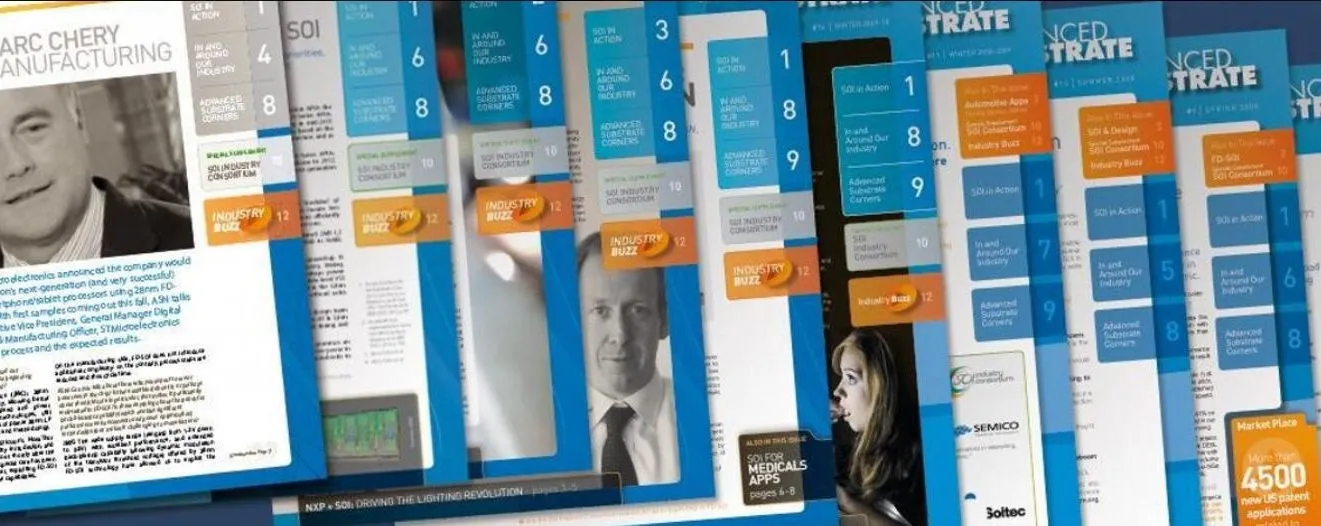
Let’s celebrate! As of April/May 2020, Advanced Substrate News – or ASN for short, and now aka the SOI Consortium newsletter – has been bringing you news for 15 years. I hope you’ll forgive me if this post has a personal angle, as I have been the Editor-in-Chief since Day 1 back in 2005. One of the things I’ve learned over my career covering technology in general and SOI in particular is that “new” technologies are never really new. They don’t pop out fully formed like Venus Boticelli-style. They take years – decades, even. SOI is no exception. What is exceptional about SOI imho is that the ecosystem – from the substrate providers to the end-product designers – keeps finding new things to do with it. There have always been naysayers – and for a while it took on an quasi-fanatic ferocity. There were those who quipped that SOI was the technology of the future...and always would be. But as it turns out, SOI’s is, has been and will be the right technology at many right moments, and I don’t see any sign of that changing in the years to come. We Need a Newsletter! [caption id="attachment_32012" align="alignright" width="189"] My Design News piece on SOI from June 2000 - it changed my life![/caption] As so much in the SOI story, ASN began with Soitec. I first encountered Soitec when I was working as Contributing Editor in Europe for Semiconductor International in the mid 1990’s. It was a start-up of just a few people that made silicon-on-insulator aka SOI wafers. Most of us at the time had barely a notion of what that was all about, but they had an intriguing story to tell about higher performance and lower power. It so happened a few years later (circa 2000) I was also writing for another publication called Design News – not about chip design, but product design, for folks designing cars and consumer electronics and washing machines and such. I kept hearing a new requirement added to the product-design mantra of faster-smaller-cheaper: lower power. It seemed to me that these SOI wafers could go a long way in solving some of product designers’ challenges. I pitched a story to my editor and it wound up on the cover (those were the days some might remember when trade magazines were on paper…). The big players were IBM for digital (in a current-events aside, DKY that those big iron machines at the US national labs cranking on the solutions for the current pandemic use IBM FinFET-on-SOI chips? Just saying…), Philips (now NXP) for power/analog, and Soitec for wafers – and of course Honeywell for aerospace and the big electronics players in Japan for all sorts of things automotive and ultra-low power. Top management at Soitec read the piece and saw that I “got it”. They brought me on board as a consultant, writing early websites, PR, brochures and such. But also most importantly, they invited me “in” – I sat in on sales reviews and attended the big shin-digs they sponsored on the Riviera and in the Alps. The people I met there – and stayed in touch with – were many of the ones that drive the industry today. (Of course, that was then, this is now: I don’t have that insider status any more, but I’ve kept in touch with and often still rely on the expert advice of people I met during that heady time.) Anyway, one day at the end of 2004, the Soitec folks said to me, “We need a newsletter.” They asked me to come up with a concept they could pitch to the Board. Since Soitec was also doing GaN SiC at the time, I thought it should be called Advanced Substrate News – ASN for short. And we agreed it should involve the entire ecosystem: end users, equipment manufacturers, academics, suppliers of all sorts, and especially: chip designers. But it was not an easy pitch. Who’d want to read about SOI wafers, they asked? Wouldn't we run out of things to say after two or at most three editions? But the idea was a solid one: ASN could be a bully pulpit for the nascent SOI ecosystem. Happily it won the day. I was named Editor-in-Chief, and have held that title ever since. Our very first edition (we were a print quarterly then) had about a dozen articles on SOI, including automotive with Philips, ultra-low power FD-SOI with Oki for Casio’s G-Shock watches (oh yes – it goes back a long ways!), low-power (by a company that Arm then bought), high-performance, high-resistivity SOI wafers for RF…it was all there. And if you look at what we cover now, it’s still all there – albeit better than ever and growing fast. (I just listened to the most recent Soitec Q4'20 quarterly financial report audiocast – announcing that they’d just had their best quarter ever – largely driven by RF-SOI.) We Need a Consortium! In 2007, the SOI Consortium was created with 19 members (a dozen of whom are still members today). As ASN Editor-in-Chief, I was honored to be part of that effort, participating in the meetings where we hashed out what it was all about and what a consortium would do. It was a great opportunity to meet the movers and shakers across the industry, many of whom I’m still in touch with. We published steadily, as the years, technologies and applications came and some went, but ASN readership continued to grow worldwide. Then in 2015, I got an email from the head of the Shanghai Academy of Sciences, which had recently spun off an SOI wafer maker called Simgui. He was (and is!) an ASN reader (though now he’s China’s Vice-Minister of Science Technology). Would I come to Shanghai and present some of the SOI-based applications ASN had been covering to his team there? They’d been working on SOI in parallel for many years, and were interested in where it was going in Europe and America. That was exciting! My first trip (of many, now) to China, it coincided with Semicon China 2015 and the announcement of the “Big Fund”. It was hall upon massive hall of stands immense and tiny, and the level of excitement was nothing short of amazing. (I was one of the only Western journalists there, and essentially broke the story in a piece I wrote for Consortium member Applied Materials’ customer magazine). That trip opened a lot of doors for me and ASN. As the SOI Consortium teamed up to with partners in China to host symposia there, we devoted more and more extensive coverage in ASN to those exciting events. [caption id="attachment_32041" align="alignright" width="328"] Here's some of our core players at the SOI Consortium: Executive Co-Directors Carlos Mazure (also of Soitec) and Jon Cheek (also of NXP) on the far left and right, respectively, Event Manager Iris Rith in the middle, me (Adele Hars) next on the right. We're joined here by Lucy Dai (2nd from left) of Simgui.[/caption] Eventually in 2016, ASN moved under the aegis of the SOI Consortium. We’re quite a jolly band that I have the privilege of working with. Granted at the time of this writing, the world is a difficult place, with so much uncertainty. But there are exciting times ahead with new products and technologies enabled by SOI, and you can be sure we’ll be covering them. RF-SOI will continue its juggernaut path in 5G mmWave. FD-SOI is steadily defining the new mainstream at the edge. The huge amounts of data the world is generating is driving photonics (which is all about SOI) to new heights. SOI for power (meaning high-voltage – think smart power) and imagers continues to grow. [caption id="attachment_32045" align="alignleft" width="99"] That's me - Adele Hars, ASN Editor-in-Chief - at the SOI Consortium's 2019 FD-SOI Symposium. (Photo courtesy VeriSilicon)[/caption] I’m honored to have brought you ASN for the last 15 years. Our archives are truly a treasure trove, and our mailing list of over 2500 really is an industry who's who. We’ve published well over a thousand (!) pieces in that time, most of which I’ve written with guidance from many an expert. However, we of course encourage our readers to pitch stories and/or submit SOI articles for publication consideration - so please, don't hesitate! I want to thank you all for your interest and your continued support. And thank you especially to all the SOI experts out there who so generously – and so patiently – share their time and enthusiasm with me and our readers. Stay safe! With warm regards, - Adele P.S. If you're not already on our emailing list and would like to join, just fill in the form at the bottom of this page. Thanks!
Read More
As a leading TCAD provider, Silvaco has very deep SOI roots, reaching back over 20 years. When Oki* pioneered the first FD-SOI chips in 2000 (really? yes!), whose tools did they use? Silvaco's. And those early FD-SOI chips went into Casio's most advanced G-Shock watches in 2005. (Yes, ASN has been covering FD-SOI for a long time!) But note that while those earliest chips used fully depleted architectures, they were on regular – not ultra-thin – SOI wafers, as they are today. [bctt tweet="Deep Roots: When Oki pioneered the 1st FD-SOI chips in 2000 (really? yes! for #CasioGShock) look whose tools they used: @SilvacoSoftware #FDSOI #lowpower #chipdesign #semiconductor #semiEDA" username="@soiconsortium"] When we look at the IEEE Spectrum Digital Library, it’s clear that Silvaco is continuing to be very active in the SOI space. There are 72 conference and journal publications citing Silvaco for their SOI research simulations since the year 2000 and 27 in the last five years. They’ve supported all the SOI evolutions – including partially-depleted SOI up through and including today's FD-SOI on ultra-thin SOI wafers. There are two Silvaco presentations that were given in Japan last fall – they're now on the SOI Consortium website. A Bit More About Silvaco Headquartered in Santa Clara, CA and founded in 1984, privately-held Silvaco is a leading provider of TCAD tools. TCAD (short for Technology-Computer Aided Design) is the use of computer modeling and simulation in developing semiconductor devices and processes. As such, TCAD tools reduce the development cost and shorten the development time. Silvaco also provides a full suite of analog and custom design tools spanning schematic, layout, signoff and variation analysis. The portfolio also includes tools for power integrity sign off, reduction of extracted netlist, and production-proven IP cores for automotive, consumer, and industrial applications. Silvaco provides a full TCAD to custom circuit design flow for vertical markets including: displays, power electronics, optical devices, radiation soft error reliability, analog circuits, library and memory design, advanced CMOS process, and IP development. They have 500+ customers in worldwide, and market leadership in TCAD design solutions for flat panel displays and power devices. Recent SOI Presentations Here's a quick recap of the two Silvaco presentations from the Japan SOI Symposium, October 2019, which you'll find on the SOI Consortium website. (To view the full presentations, however, your company needs to be a member of the Consortium.) Silvaco RF-SOI TCAD Solution was given by Sun Tao, Applications Engineering Manager, Silvaco. Silvaco positions itself as a “cost-effective partner to the FD-SOI community.” And as the presentation title indicates, it's a review of the tools Silvaco offers that support SOI – especially for RF applications. The presentation began with a review of recent updates to their TCAD simulation framework, including the TCAD design flow, Victory Process for speeding up 2D/3D process simulations, and Victory Device for device simulation. Under Silvaco’s DTCO – Design Technology Co-Optimization – flow, semiconductor physics are connected to circuit design, recognizing that each technology has specific requirements that need to be taken into account at every stage of the flow. [caption id="attachment_31635" align="aligncenter" width="589"] An example of how Silvaco Victory Tools Support Detailed Simulations of RF Devices on SOI (Courtesy: Silvaco and the SOI Consortium)[/caption] Tao then continued by showing useful TCAD simulations and analysis of SOI for RF applications. In trap-rich substrate simulations, for example, the Silvaco tools can predict the distortion from the active device, device biasing, and substrate, all of which can be co-optimized using Victory Process and Victory Device. In conclusion, he notes that Silvaco is offering TCAD to custom EDA solutions for predictive and comprehensive FD-SOI design work that can save money before committing to silicon. Platform Infrastructure for SOI-IP Ecosystem was given by Thomas Blaesi, VP of Global Marketing, Silvaco. "The massive use of IP is both an advantage and a challenge," began Blaesi. There are solutions out there, but they are disconnected. Typically SoC/IP designers, IP librarians, and support folks use various systems, while procurement, finance, and legal use others. This is a problem for both the providers and the consumers of IP. Silvaco has a system called Xena that centrally organizes all IP data: it’s an IP repository for tracking accounts, products, contracts, devices, support, compliance, and reporting. One of the first beneficiaries of Xena will be the SOI ecosystem, as providers of SOI IP are already signing on. [bctt tweet="One of the first beneficiaries of the Xena IP repository from @SilvacoSoftware will be the SOI ecosystem, as providers of SOI IP are already signing on. #FDSOI #RFSOI #semiconductorIP" #lowpower #chipdesign username="@soiconsortium"] Beyond the organizational advantages, Xena has patented “finger printing” and “DNA analysis”, so there is a digital representation of each IP on an SoC that cannot be reverse engineered. Each fingerprint contains list of unique signatures of each file in an IP or SoC. A file’s unique signature is created from the entire file content, and that signature is guaranteed to be unique to that content. [caption id="attachment_31634" align="aligncenter" width="591"] Silvaco's Xena Supports Audits of IP Usage in SoC Projects (Courtesy: Silvaco and the SOI Consortium)[/caption] It enhances support for all versions of common design files: hard IP, soft IP, and embedded software. Because it’s enterprise based, it will be particularly useful for large organizations. Fingerprinting and DNA analysis are vendor agnostic, universal, and easy-to-use tools and methodologies for IP lifecycle management, he concluded. -- *Oki's now part of Lapis Semi, btw, which is still active in FD-SOI
Read More
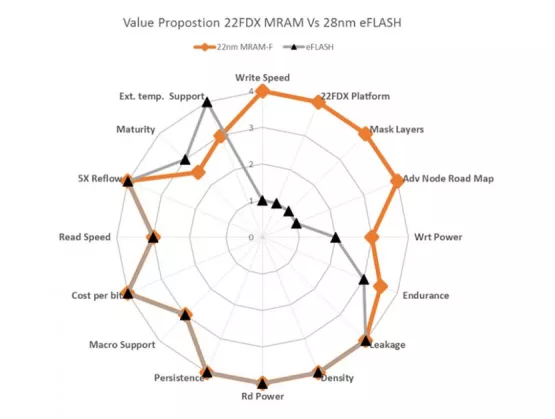
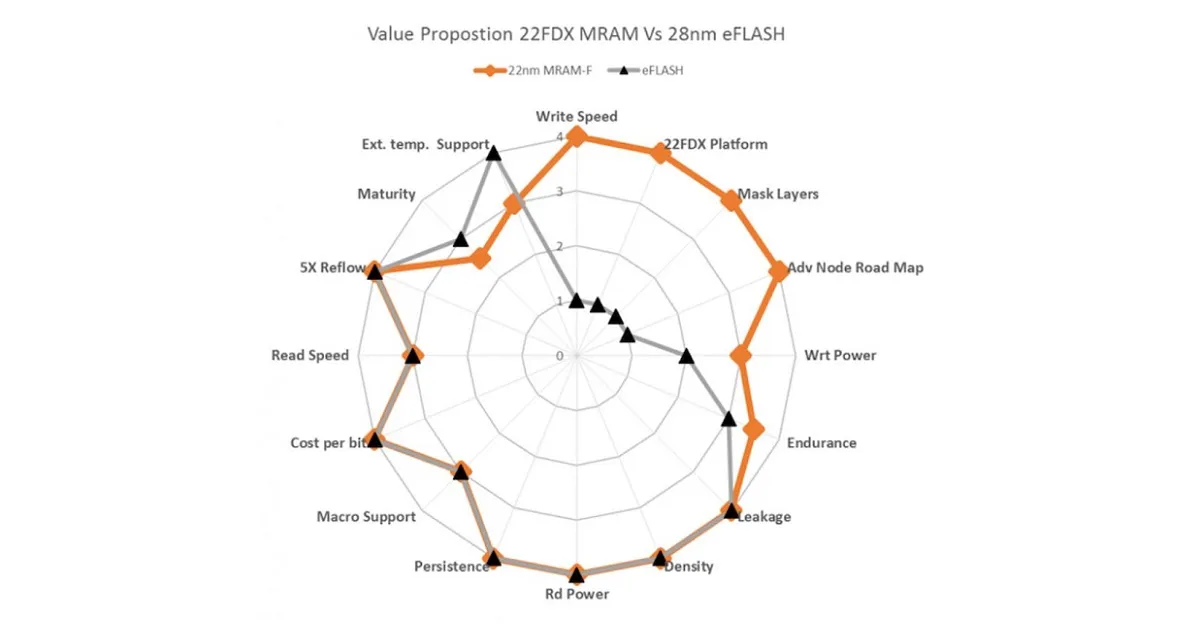
GlobalFoundries recently announced that its embedded magnetoresistive non-volatile memory (eMRAM) has entered production on the company’s 22nm FD-SOI (22FDX®) platform. (See the full press release here.) The company says this advanced embedded non-volatile memory on its FDX™ platform provides a cost-effective solution for low-power, non-volatile code and data storage applications. It is now working with several clients with multiple production tape-outs scheduled in 2020. GF heralds the announcement as a significant industry milestone, demonstrating the scalability of eMRAM as a cost-effective option at advanced process nodes for IoT, general-purpose microcontrollers, automotive, edge-AI, and other low-power applications. [caption id="attachment_31334" align="alignright" width="485"] (Courtesy: GlobalFoundries. Click to enlarge.)[/caption] “We continue our commitment to differentiate our FDX platform with robust, feature rich solutions that allow our clients to build innovative products for high performance and low power applications,” said Mike Hogan, senior vice president and general manager of Automotive and Industrial Multi-market at GlobalFoundries. “Our differentiated eMRAM, deployed on the industry’s most advanced FDX platform, delivers a unique combination of high performance RF, low power logic and integrated power management in an easy-to-integrate eMRAM solution that enables our clients to deliver a new generation of ultra-low power MCUs and connected IoT applications.”[bctt tweet="In production! @GlobalFoundries’ eMRAM on #22FDX FD-SOI replaces #eFlash for #IoT genpurpose #microcontrollers #automotive #edgeAI more. #lowpower #chipdesign #FDSOI" username="@soiconsortium"] [caption id="attachment_31330" align="alignleft" width="467"] (Courtesy: GlobalFoundries. Click to enlarge.)[/caption] Designed as a replacement for high-volume embedded NOR flash (eFlash), GF’s eMRAM allows designers to extend their existing IoT and microcontroller unit architectures to access the power and density benefits of technology nodes below 28nm. It is a highly versatile and robust embedded non-volatile memory (eNVM) that has passed five rigorous real-world solder reflow tests, and has demonstrated 100,000-cycle endurance and 10-year data retention across the -40°C to 125°C temperature range. The FDX eMRAM solution supports AEC-Q100 quality grade 2 designs, with development in process to support an AEC-Q100 quality grade 1 solution next year. [caption id="attachment_31331" align="alignright" width="280"] GF’s state-of-the-art 300mm production line at Fab 1 in Dresden, Germany, will support volume production of 22FDX with MRAM. (Courtesy: GlobalFoundries)[/caption] Custom design kits featuring drop-in, silicon validated MRAM macros ranging from 4 to 48 mega-bits, along with the option of MRAM built-in-self-test support is available today from GF and their design partners. eMRAM is a scalable feature that is expected to be available on both FinFET and future FDX platforms as a part of the company’s advanced eNVM roadmap. GF’s state-of-the-art 300mm production line at Fab 1 in Dresden, Germany, will support volume production of 22FDX with MRAM. Prior to this announcement, an excellent GF blog by David Lammers recapped GF's 2019 IEDM presentation of their eMRAM reliability data. You can read that here. It also provides a lot of interesting background information.
Read More
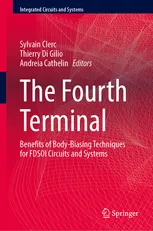
The chip design ecosystem finally has the book it’s been clamoring for: The Fourth Terminal - Benefits of Body-Biasing Techniques for FDSOI Circuits and Systems. [bctt tweet="The FD-SOI Chip Design Book: Yes, It’s Finally Here!" username="@soiconsortium"] The editors (who have also contributed chapters) are Andreia Cathelin, Sylvain Clerc and Thierry DiGilio, all world experts from STMicroelectronics. As Cathelin and Clerc note in the introduction: “The aim of this book is to introduce to the design community the straightforward design solutions in any modern FD-SOI planar CMOS technologies, by taking full advantage of body biasing techniques to efficiently modulate on the fly SoC solutions from high performance operation to energy efficiency mode. All design techniques are based on the classical pillar of regular planar CMOS devices. As the first fully industrial solution has been the 28nm FD-SOI CMOS technology from STMicroelectronics, all the design examples in this book have been demonstrated within this process integration frame.” [bctt tweet="The Fourth Terminal...taking full advantage of (FDSOI) body biasing techniques to efficiently modulate on the fly SoC solutions from high performance operation to energy efficiency mode" username="@soiconsortium"] The folks at ST were really the first to get into FD-SOI in a big way – in fact they’ve been at it for over two decades (!) so you’d be hard pressed to find experts at a company with deeper expertise. [caption id="attachment_29610" align="alignnone" width="535"] The Fourth Terminal team friends sporting Tour de Fourth Terminal t-shirts at ISSCC 2020. From left to right: MIT Prof. (and Series Editor for Springer's Integrated Circuits and Systems) Anantha Chandrakasan; Charles Glaser, Springer Editorial Director; Laurent Le Pailleur, ST; Andreia Cathelin, ST Fellow; Sylvain Clerc, ST; Stanford Prof. Boris Murmann (Photo courtesy Springer STMicroelectronics)[/caption] The Fourth Terminal is structured to cover three major areas: a technology overview (including body biasing for digital, analog and SRAM); a selection of circuits that illustrate body biasing in various fields; body bias deployment in mixed-signal and digital SoCs. The initial response has been tremendous. Editor Andreia Cathelin reports that posts she's made about it on LinkedIn were quickly viewed 10k times and more. Then came the book review by the eminent Stanford Professor Boris Murmann, who heralded its tour de force status in a clever turn of phrase: “With the help of a renowned international team of experts from industry and academia, the editors have distilled everything you need to know about FD-SOI circuit design into a 16-chapter "tour de fourth terminal". (Read his complete review here).[bctt tweet="Stanford Professor Boris Murmann calls this book a #Tour_de_Fourth_Terminal. #FDSOI #lowpower #chipdesign" username="@soiconsortium"] EETimes journalist Junko Yoshida blogged about it as Body Bias Gets Its Own Book (read that here), which generated lively discussions on LinkedIn (and underscored just how necessary this book is!). The Fourth Terminal - Benefits of Body-Biasing Techniques for FDSOI Circuits and Systems is part of the Springer Integrated Circuits Systems Series -- considered by many to be the most prestigious in the industry. Weighing in at 431 pages, The Fourth Terminal is available in both e-book and hardcover versions. See the Springer website to order this must-have addition to your library.
Read More
The GAP9, GreenWaves Technologies latest IoT application processor -- which is being fabbed on GlobalFoundries 22FDX (FD-SOI) technology -- will be sampling in the first half of 2020, according to EETimes (read the whole article here). Mass production is slated for 2021. Greenwaves (which has been an SOI Consortium member for several years now) is a fabless semiconductor startup designing disruptive ultra-low power embedded solutions for AI processing in sensing devices at the very edge. GreenWaves marketing director Martin Croome told EETimes, “We are using the body biasing ability in FD-SOI to allow us to achieve even lower power consumption.” Compared to GreenWaves’ currently shipping product, GAP8 (which is on a 55nm bulk process), GAP9 reduces energy consumption by 5 times while enabling inference on neural networks 10 times larger. This is thanks to architectural enhancements and the move to GF's 22FDX semiconductor process. The new chip delivers a peak cluster memory bandwidth of 41.6 GB/sec and up to 50 GOPS combined compute power at an overall power consumption of 50mW. It enables customers to embed machine learning and signal processing capabilities into battery operated or energy harvesting devices such as IoT sensors in smart building, consumer and industrial markets and consumer and medical wearable devices. GAP9 was showcased at the last RISC-V Summit in San Jose (read the full press release here). [caption id="attachment_29061" align="alignnone" width="400"] GAP9 Block diagram (Courtesy: GreenWaves)[/caption] Some of the (many!) features include: 10 identical high performance, extended ISA, RISC-V ISA cores (cluster of 9 cores for compute-intensive tasks and a fabric controller core for control and communication) Dynamic voltage frequency scaling and automatic body biasing Multiple power states: deep sleep, deep sleep with retentive RAM, low activity, SOC on, SOC on cluster on Click here for a full GAP9 product brief.
Read More
Digitimes Research is predicting a doubling of the global SOI market between 2019 and 2024, "...thanks to significant expansion in applications to mobile devices, communication infrastructure, IoT devices and automotive electronics in the 5G era...". (Read the full article in Digitimes here.) Beyond the continued enormous success of SOI in front-end modules (FEMs) for RF (aka RF-SOI, which as we know is found in every smartphone on the planet), the report cites high growth specialty areas such as imaging chips for smartphones and photonics in data centers. They also predict that FD-SOI will be "massively applied" in 5G, with applications in base stations and data centers. And of course, low voltage and low power consumption will be the big drivers in IoT and wearables. All this is driving Soitec, the major SOI wafer manufacturer, to expand capacity at its facilities in France and Singapore in 2020, says the report. This is happening in strategic cooperation with Shanghai-based Simgui. As noted in ASN about a year ago, Soitec and China’s SOI wafer leader Simgui announced an enhanced partnership and increased production capacity of 200mm SOI wafers in China, securing future growth. At that time the two companies redefined their manufacturing and licensing relationship to better serve the growing global market for RF-SOI in mobile and Power-SOI in automotive and consumer electronics. Separately, Okmetic of Finland, which specializes in SOI wafers for MEMS, sensors and RF, is also doubling its capacity (we covered their 2019 Shanghai presentation here.) (Image courtesy: Soitec)
Read More