downloadGroupGroupnoun_press release_995423_000000 copyGroupnoun_Feed_96767_000000Group 19noun_pictures_1817522_000000Member company iconResource item iconStore item iconGroup 19Group 19noun_Photo_2085192_000000 Copynoun_presentation_2096081_000000Group 19Group Copy 7noun_webinar_692730_000000Path
Skip to main content
Default Banner Image

FD-SOI

Editor's note: Arm and Samsung Foundry are extending their collaboration on FD-SOI, which they'll be highlighting at the SOI Consortium's Silicon Valley Symposium April 9th. In the meantime, Arm Senior Product Marketing Manager Umang Doshi described the range of projects in a recent Arm Community / Developer physical IP blog. We thank Arm for sharing this blog with ASN readers.~ ~~ Samsung Foundry and Arm FDSOI collaboration announced By Umang Doshi The challenge with designing at newer and more advanced process nodes is that things generally don’t get less complex and expensive, much as we might want this. Still, the upside to each new process node, generally, is that you can build more highly efficient and targeted devices to address more markets and applications in a timely fashion. For the complexity and cost challenges, however, there’s good news: Arm and Samsung Foundry just announced a comprehensive, foundry-sponsored physical IP platform, including an eMRAM compiler at 18FDS (18nm FDSOI). In addition, the Arm offerings for 18FDS include three POP IP packages for Arm Cortex-A55, Cortex-R52 and Cortex-M33 processor IP. The platform will help drive new leading-edge designs in power-sensitive applications in 5G, artificial intelligence (AI), automotive, Internet of Things (IoT), and other market segments. It’s the industry’s first, fully comprehensive physical IP platform that includes an eMRAM compiler at 18FDS. 28nm: Before the breakthrough One of the most widely embraced nodes, 28nm the so-called “forever node,” has done wonders for industry innovation over the years. However, leakage power is still challenging for planar transistors. Engineers deployed high-K metal gate (HKMG) at 28nm, to combat leakage, but it’s still an issue. That’s because the channel underneath the gate is too deep and too far from the gate to be well-controlled, which results in higher leakage power. Solutions for the leakage issue have prompted designers to embrace FinFETs and FDSOI (fully-depleted silicon-on-insulator) with thinner channels that enable greater control by the gate. Indeed, FDSOI is gaining traction in the market place. By construction, 28nm FDSOI enables much better transistor electrostatic characteristics versus conventional bulk technology. 28nm FDSOI offers: Wide Forward/Reverse Body-bias range and flexible Poly bias (PB) range to tradeoff power/performance. Better performance and power than bulk process technology. Better resistance to radiation and SER. Less sensitive to variability because there’s no channel doping. Ultra-low power voltage (operating at low voltages in the hundreds of millivolts range). Easy migration from bulk versus the previous SOI version, PDSOI (partially-depleted silicon-on-insulator), required unique timing and power models. What’s more, there are cost benefits today and more forecast for the future. Arm and Samsung Foundry extend FDSOI leadership from 28FDS to 18FDS In 2018, Arm announced the industry’s first Embedded MRAM (eMRAM) compiler IP built on Samsung Foundry’s 28FDS process technology. Since the announcement, Arm has engaged with several Samsung Advanced Foundry Ecosystem (SAFETM) partners on a landscape-changing collaboration to deliver the industry’s first 28FDS eMRAM-enabled IoT silicon system demonstrator telling the Arm IoT story on Samsung Foundry silicon. Coupled with Arm’s IoT ecosystem, Pelion IoT Platform and Platform Security Architecture (PSA) solutions, this 28FDS eMRAM-enabled IoT demonstrator will showcase a new-generation of secure and energy-efficient IoT edge devices which integrates software stacks offering secure boot, firmware updates, on-chip storage, chip to cloud communication and device/software provisioning. The combination of 28FDS and eMRAM non-volatile memory brings new opportunities for a new class of highly integrated and energy-efficient designs. We’re thrilled that Samsung Foundry has extended its successful collaboration on FDSOI technology from 28FDS process to 18FDS. With the new platform, 18FDS is a cost reduction solution with lower power and same back end of line (BEOL) as 14nm FinFET. It has RF and eMRAM support to enable the widest range of different applications. “18FDS is the next-generation node on Samsung's FD-SOI roadmap with enhanced power, performance, and area (PPA)," said Jaehong Park, executive vice president of Design Platform Development at Samsung Electronics. “The relationship between Samsung Foundry and Arm stretches back more than a decade and has helped put the right design technology in the hands of the world’s leading designers. The enhanced PPA from our 18FDS process combined with Arm cores and Artisan Physical IP will again bring the cost and time-to-market advantages to enable the competitive and differentiated SoC designs.” Highlights on Arm-Samsung 18FDS platform Includes seven memory compilers, three logic libraries, two (1.8 and 3.3V) GPIO libraries, three POP IPs and the eMRAM memory compiler. Supports automotive AEC-Q100 Grade 1 design requirements, and comes with ASIL-D support and a complete automotive safety package. Utilizes back biasing supported by the FDSOI technology to help achieve low leakage by using reverse body-bias technique or a performance boost using forward body-biasing. This is a key differentiation of 18FDS platform. Supports Logic Corner Generator (LCG) and Memory Compiler Corner Generator (MCCG). LCG and MCCG products allow designers to generate custom corners with body-bias voltages to take the maximum advantage of body biasing power-performance flexibility. 18FDS will help enable the development of new devices connecting consumers in entirely new ways, whether it’s in AI, 5G mobile, automotive or other areas. The platform will be available in late 2019. Arm's Physical Design Group has a track record of successful implementations with Samsung Foundry across multiple generations of process nodes and products. Besides 28/18FDS, Samsung Foundry and Arm also have 14LPP/LPC, 11LPP, 7LPP and 5LPE platform collaborations. Interested in knowing more about Artisan Physical IP at 28/18FDS? Come join us at SOI Silicon Valley Symposium on April 9 at Double Tree by Hilton, San Jose, California. During the event, you will have the opportunity to hear how Arm and other industry leaders work together to accelerate the adoption of FDSOI technologies including products and applications. Alternatively, you can also reach out to us with your inquiry.
Read More
FD-SOI for RF and mmWave communications is a hot topic. In high-data rate communications like RF and millimeter-wave devices in particular, FD-SOI delivers high-performance with numerous unique advantages, making it most likely the fastest RF-CMOS technology on the market. If you’d like to take a deep dive and learn more about it, Soitec and Incize are sponsoring a free, full-day workshop in Grenoble on April 4th, 2019. Click here for registration information. The workshop follows the day after the IEEE/EDS EuroSOI-ULIS conference there (you can read about the full conference in a previous ASN post). This technical workshop will cover the FD-SOI technology platform with a focus on its compatibility with RF mmWave communications. Attendees will hear from notable FD-SOI leaders and experts from leading industry and research institutions presenting updates on key developments and building blocks across the semiconductor value chain. Topics will include circuit design, device fundamentals, simulation and characterization of RF devices, test, CMOS technology and substrate technologies enabling FD-SOI. In addition, the workshop will include an overview about how FD-SOI technology is benefiting current and future end user applications. Here’s the agenda: [caption id="attachment_15990" align="alignleft" width="945"] FD-SOI technology platform: new standards for emerging consumer electronics [Click to enlarge.][/caption]
Read More
[caption id="attachment_15930" align="alignright" width="150"] Daniel Nenni, CEO Founder, SemiWiki.com[/caption] Note to our readers: Semiwiki Founder Dan Nenni recently wrote an excellent piece on the importance of the Synopsys investment in automotive IP for GlobalFoundries' 22FDX (FD-SOI) technology. He graciously has given us permission to reprint it here in ASN. By Dan Nenni, CEO Founder, SemiWiki.com IP vendors have always had the inside track on the status of new process nodes and what customers are planning for their next designs. This is even more apparent now that systems companies are successfully doing their own chips by leveraging the massive amounts of commercial IP available today. Proving once again that IP really is the foundation of modern semiconductor design. Automotive is one of those market segments where systems companies are doing their own chips. We see this first hand on SemiWiki as we track automotive related blogs and the domains that read them. To date we have published 354 automotive blogs that have been viewed close to 1.5M times by more than 1k different domains. [caption id="attachment_15933" align="alignleft" width="1000"] (Courtesy: semiwiki.com and GlobalFoundries)[/caption] The recent press release by Synopsys and GLOBALFOUNDRIES didn’t get the coverage it deserved in my opinion and the coverage it got clearly missed the point. Synopsys, being the #1 EDA and #1 IP provider, has the semiconductor inside track like no other. For Synopsys to make such a big investment in FD-SOI (GF FDX) for automotive grade 1 IP is a huge testament to both the technology and the market segment, absolutely. I talked to John Koeter, Vice President of Marketing for IP, Services and System Level Solutions. John is a friend and one of the IP experts I trust. 3 years ago Synopsys got into automotive grade IP and racked up 25 different customer engagements just last year. The aftermarket electronics for adding intelligence (autonomous-like capabilities, cameras, lane and collision detection, etc...) to older vehicles is also heating up, especially in China. I also talked to Mark Granger, Vice President of Automotive Product Line Management at GLOBALFOUNDRIES. Mark has been at GF for two years, prior to that he was with NVIDIA working on autonomous chips with deep learning and artificial intelligence. According to Mark, GF's automotive experience started with the Singapore fabs acquired from Chartered in 2010. The next generation automotive chips will come from the Dresden FDX fabs which are right next door to the German automakers including my favorite, Porsche. One thing we talked about is the topology of the automotive silicon inside a car and the difference between central processing and edge chips. Remember, some of these chips will be on glass or mirrors or inside your powertrain. The edge chips are much more sensitive to power and cost so FDX is a great fit. Mark provided a GF link for more information: Here is the link to our Automotive resources: https://www.globalfoundries.com/mark...ons/automotive One thing Mark, John, and I agree on is that truly autonomous cars for the masses is still a ways out but we as an industry are working very hard to get there, absolutely. Here is the press release: Synopsys and GLOBALFOUNDRIES Collaborate to Develop Industry's First Automotive Grade 1 IP for 22FDX Process Synopsys' Portfolio of DesignWare Foundation, Analog, and Interface IP Accelerate ISO 26262 Qualification for ADAS, Powertrain, 5G, and Radar Automotive SoCs MOUNTAIN VIEW, Calif., and SANTA CLARA, Calif., Feb. 21, 2019 /PRNewswire/ -- Highlights: Synopsys DesignWare IP for automotive Grade 1 and Grade 2 temperature operation on GLOBALFOUNDRIES 22FDX®process includes Logic Libraries, Embedded Memories, Data Converters, LPDDR4, PCI Express 3.1, USB 2.0/3.1, and MIPI D-PHY IP Synopsys' IP solutions implement additional automotive-grade design rules for the 22FDX process to meet reliability and 15-year automotive operation requirements Synopsys' IP that supports AEC-Q100 temperature grades and ISO 26262 ASIL Readiness accelerates SoC reliability and functional safety assessments Join Synopsys and GLOBALFOUNDRIES at Mobile World Congress in Barcelona, Spain on Feb. 25 for a panel on "Intelligent Connectivity for a Data-Driven Future" Synopsys, Inc. (Nasdaq: SNPS) and GLOBALFOUNDRIES (GF) today announced a collaboration to develop a portfolio of automotive Grade 1 temperature (-40ºC to +150ºC junction) DesignWare® Foundation, Analog, and Interface IP for the GF 22-nanometer (nm) Fully-Depleted Silicon-On-Insulator (22FDX®) process. By providing IP that is designed for high-temperature operation on 22FDX, Synopsys enables designers to reduce their design effort and accelerate AEC-Q100 qualification of system-on-chips (SoCs) for automotive applications such as eMobility, 5G connectivity, advanced driver assistance systems (ADAS), and infotainment. The Synopsys DesignWare IP implements additional automotive design rules for the GF 22FDX process to meet stringent reliability and operation requirements. This latest collaboration complements Synopsys' broad portfolio of automotive-grade IP that provides ISO 26262 ASIL B Ready or ASIL D Ready certification, AEC-Q100 testing, and quality management. "Arbe's ultra-high-resolution radar is leveraging this cutting-edge technology that enabled us to create a unique radar solution and provide the missing link for autonomous vehicles and safe driver assistance," said Avi Bauer, vice president of R D at Arbe. "We need to work with leading companies who can support our technology innovation. GF's 22FDX technology, with Synopsys automotive-grade DesignWare IP, will help us meet automotive reliability and operation requirements and is critical to our success." "GF's close, collaborative relationships with leading automotive suppliers and ecosystem partners such as Synopsys have enabled advanced process technology solutions for a broad range of driving system applications," said Mark Ireland, vice president of ecosystem partnerships at GF. "The combination of our 22FDX process with Synopsys' DesignWare IP enables our mutual customers to speed the development and certification of their automotive SoCs, while meeting their performance, power, and area targets." "Synopsys' extensive investment in developing automotive-qualified IP for advanced processes, such as GF's 22FDX, helps designers accelerate their SoC-level qualifications for functional safety, reliability, and automotive quality," said John Koeter, vice president of marketing for IP at Synopsys. "Our close collaboration with GF mitigates risks for designers integrating DesignWare Foundation, Analog, and Interface IP into low-power, high-performance automotive SoCs on the 22FDX process." Resources For more information on Synopsys DesignWare IP for automotive Grade 1 temperature operation on GF's 22FDX process: Foundation IP: Logic Libraries, Embedded Memories, One-Time Programmable Non-Volatile Memories (OTP NVM), and Embedded Test and Repair Data Converters LPDDR4 PCI Express 3.1 USB 2.0/3.1 MIPI ~ ~ ~ About the Author Daniel Nenni has worked in Silicon Valley for over 35 years with computer manufacturers, electronic design automation software, and semiconductor intellectual property companies. He is the founder of SemiWiki.com (an open forum for semiconductor professionals) and the co-author and publisher of "Fabless: The Transformation of the Semiconductor Industry", "Mobile Unleashed: The Origin and Evolution of ARM Processors in our Devices" and "Prototypical: The Emergence of Prototyping for SoC Design". He is an internationally recognized business development professional for companies involved with the fabless semiconductor ecosystem.
Read More
The world's SOI wafer leader, Soitec is posting strong sales and issuing a steady stream of compelling announcements. This is clearly good news for everyone in the SOI ecosystem, as the outlook for the various families of SOI wafers is excellent. Soitec CEO Paul Boudre told ASN, “I'm excited because of the fundamentals behind the growth. Reaching down the supply chain gives us the ability to help our customers with the next generation. We're not in a technology push, but in a technology pull. It's long-term growth we're seeing.” [caption id="attachment_15532" align="alignleft" width="239"] Paul Boudre, CEO, Soitec[/caption] Soitec has brought people from the device side into the company to better understand the solutions customers need, he said. They're talking to the carmakers, telcos and more, working one-on-one with them to understand the constraints and the problems they are trying to fix, in order to deliver a solution based on the Soitec product roadmap. Boudre is particularly excited about 5G. It's not just new handsets and systems: the entire infrastructure will require a massive upgrade, across which Soitec has a role to play supplying SOI wafers. They also have other SOI and engineered substrates for specific markets like filters, displays, imaging and power. He adds that they're seeing nice growth in SOI wafers for photonics, driven by cloud computing, and for smart power in markets like automotive and white goods. Here's a roundup of some recent developments. Chips made on RF-SOI wafers are in every mobile phone made on the planet these days, so lets look at what they're doing there first. We'll follow that with an update on the surge of activity on FD-SOI wafers. Simgui, RF Power It's no secret that the runaway success of RF-SOI for front-end modules (FEMs) in mobile phones has stretched wafer capacity mightily. To help address this, in February 2019 Soitec and China's SOI wafer leader Simgui announced an enhanced partnership and increased production capacity of 200mm SOI wafers in China, securing future growth. The two companies redefined their manufacturing and licensing relationship to better serve to better serve the growing global market for RF-SOI in mobile and Power-SOI in automotive and consumer electronics. [caption id="attachment_15535" align="alignright" width="936"] (Image courtesy: Simgui)[/caption] Since the two companies signed their original licensing and technology transfer agreement in May 2014, Simgui has mastered Soitec’s Smart Cut™ proprietary process to deliver world-class RF-SOI and Power-SOI products. Simgui’s strategic partnership with Soitec allows them to use the same tools and processes to deliver the same products meeting the same specifications. Simgui has invested in their Shanghai fabrication line in order to double annual 200mm SOI wafer production capacity from 180,000 to 360,000. The fab is production ready, having been qualified by multiple key customers inside and outside China. Simgui CEO Dr. Jeffrey Wang notes, “China has design, wafer manufacturing and good momentum in the IC industry. We are committed to our strategic partnership with Soitec to keep advancing SOI as China’s key differentiator.” With China Mobile China Mobile's interest in the SOI ecoystem is clear: they've presented at the SOI symposia in Shanghai for two years running now. In a February 2019 press release, Soitec announced that they've joined the China Mobile 5G Innovation Center – and they're the first materials supplier to do so. The China Mobile 5G Innovation Center is an international alliance chartered to develop 5G communication solutions for China, the world’s largest wireless communications market with 925M mobile subscribers. The Center aims to accelerate the development of 5G by establishing a cross-industry ecosystem, setting up open labs to create new products and applications, and fostering new business and market opportunities. Soitec's RF-SOI wafers have been critical in the deployment of 4G communications, and the opportunity in 5G is even bigger. Plus the company's FD-SOI wafers enable the technology that brings unique RF performance, making it an ideal solution for many applications including mmWave communications such as 5G transceivers. They are also enabling full RF and ultra-low-power computing integration for IoT and edge computing. For Samsung Foundry In January 2019, Soitec announced that they have expanded their collaboration with Samsung Foundry on the FD-SOI wafer supply, securing the high-volume Samsung needs to meet industry's current and future demands in consumer, IoT and automotive applications. The agreement is built on the existing close relationship between the companies and guarantees wafer supply for Samsung’s FD-SOI platform starting with the 28FDS process. “Samsung has been committed to delivering transformative industry leading technologies,” said Ryan Lee, Vice President of Foundry Marketing at Samsung Electronics. “FD-SOI is currently setting a new standard in many high-growth applications including IoT with ultra-low-power devices, automotive systems such as vision processors for ADAS and infotainment, and mobile connectivity from 5G smartphones to wearable electronics. Through this agreement with Soitec, our long-term strategic partner, we hope to lay the foundation for steady supply to meet high-volume demands of current and future customers.” “This strategic agreement validates today’s high-volume manufacturing adoption of FD-SOI,” said Christophe Maleville, Soitec’s Executive Vice President, Digital Electronics Business Unit. “Soitec is ready to support Samsung’s current and long-term growth for ultra-low power, performance-on-demand FD-SOI solutions.” Silicon Catalyst Partner In February 2019 Soitec announced they'd become a strategic partner in Silicon Catalyst's start-up incubator. Silicon Catalyst is a Silicon Valley-based incubator providing silicon-focused start-ups access to a world-class network of advisors, design tools, silicon devices, networking, access to funding and marketing acumen needed to successfully launch their businesses. [caption id="attachment_15534" align="alignright" width="300"] (Image courtesy: Soitec, Silicon Catalyst)[/caption] Soitec will engage in this start-up ecosystem to gain insight into the newest technologies and applications across high-growth markets, and to guide nascent technologies to successful market penetration. “As a Strategic Partner of Silicon Catalyst, Soitec has a unique opportunity to grow our visibility among early-stage semiconductor companies,” said Thomas Piliszczuk, Executive VP of Global Strategy for Soitec. “Engineered substrates give semiconductor related start-ups a competitive edge in developing new high-performance, energy-efficient solutions." Pete Rodriguez, CEO of Silicon Catalyst said, “Soitec is creating technical advances that are enabling the next generation of products across many market segments. Their SOI technology is a key ingredient to meet the diverse challenges for breakthrough differentiated semiconductor products, combining ultra-low power with excellent analog/mixed-signal performance.” Energy Harvesting with Renesas And finally, jumping back a few months, at the end of 2018 Soitec announced that their SOI wafers are at the heart of a new Renesas SOTBTM energy harvesting chipset, opening a self-powered future for IoT devices. SOTB is how Renesas refers to its FD-SOI technology. [caption id="attachment_15533" align="alignleft" width="300"] (Image courtesy: Renesas)[/caption] (BTW, here at ASN we've been covering the work that Renesas has quietly done on this technology since 2005 (!). And we did a piece about an EETimes Japan article back in 2015 that revealed the launching of the 65nm work. ) Soitec supports the Renesas SOTB chipset with a special version of its FD-SOI wafer product line. The new Renesas SOTB-based chipset overcomes the energy constraints of IoT devices and reduces the power consumption to approximately one-tenth that of the existing products in the market today. That makes the chipset perfectly suited for extreme low-power, maintenance-free and energy harvesting applications including wearable devices, smart home applications, smart watches, portable appliances, infrastructure monitoring systems, industrial, business, agricultural, healthcare, as well as health and fitness apparel, shoes, drones and more. Renesas has developed its energy harvesting chip using its unique SOTB 65nm process technology that achieves both low active current of 20 μA/MHz and deep standby current of 150 nA. As a result, Renesas’ SOTB chipsets offer enhanced control of the transistor electrostatics and reductions in both the standby and active currents to levels never before achieved. Additionally, Renesas has successfully delivered the dopant-less channel to suppress Vth variability for the ultra-low voltage operation, and the ultra-low power back bias control to reduce the standby current at the same time. “To spur innovations in IoT and consumer applications, we have integrated our exclusive energy-harvesting SOTB technologies into our Energy Harvest Controller,” said Mr. Toru Moriya, Vice President of Renesas’ Home Business Division, Industrial Solutions Business Unit. “We are confident that our SOTB technology built on Soitec’s ultrathin substrates can deliver unmatched capabilities for developing maintenance-free IoT devices that never require power supply or replacement, giving rise to a new IoT global market based on endpoint intelligence.” [caption id="attachment_15714" align="alignleft" width="300"] (click to enlarge) Block diagram of the Renesas R7F0E Embedded Controller, their first device based on their SOTB (aka FD-SOI) technology. Target applications are battery-free connected IoT sensing devices with endpoint intelligence. (Image courtesy Renesas)[/caption] The new R7F0E Embedded Controller is the first device based on Renesas’ SOTB technology. Developers can now design applications that need no battery or recharging. The R7F0E features: an Arm® Cortex® -M0+; operating frequency up to 32 MHz, and up to 64 MHz in boost mode (that's body bias in action!); memory of up to 1.5 MB flash, 256 KB SRAM; and active current consumption while operating at 3.0V of just 20 µA/MHz, and in deep standby of 150 nA with real-time clock source and reset manager. As of this writing, Renesas indicates it's engaging select customers through July 2019, with mass production in 4Q19. Read more about the RE Family SOTB™ Process-Based Energy Harvesting Embedded Controllers on the Renesas website.
Read More
GlobalFoundries and Dolphin Integration are collaborating on the development of a series of adaptive body bias (ABB) solutions to improve the energy efficiency and reliability of SoCs on GF’s 22nm FD-SOI (22FDX®) process technology for a wide range of high-growth applications such as 5G, IoT and automotive. The goal of the IP is to accelerate energy-efficient SoC designs and push the boundaries of single-chip integration. The design kits with turnkey ABB solutions will be available starting in Q2 2019. As part of the collaboration, Dolphin and GF are working together to develop a series of off-the-shelf ABB solutions for accelerating and easing body bias* implementation on SoC designs. ABB is a unique feature of FD-SOI that enables designers to leverage forward and reverse body bias techniques to dynamically compensate for process, supply voltage, temperature (PVT) variations and aging effects to achieve additional performance, power, area and cost improvements beyond those from scaling alone. The ABB solutions in development by GF and Dolphin consist of self-contained IPs embedding the body bias voltage regulation, PVT and aging monitors and control loop as well as complete design methodologies to fully leverage the benefits of corner tightening. GF says its 22FDX technology offers the industry’s lowest static and dynamic power consumption. With automated transistor body biasing adjustment, Dolphin Integration can achieve up to 7x energy efficiency with power supply as low as 0.4V on 22FDX designs. “We have been working with GF for more than two years on advanced and configurable power management IPs for low power and energy efficient applications,” said Philippe Berger, CEO of Dolphin Integration. “Through our ongoing collaboration with GF, we are focused on creating turnkey IP solutions that allow designers to realize the full benefit of FD-SOI for any SoC design in 22FDX.” “In order to simplify our client designs and shorten their time-to-market, GF and our ecosystem partners are helping to pave the way to future performance standards in 5G, IoT and automotive,” said Mark Ireland, vice president of ecosystem partnerships at GF. “With the support of silicon IP providers like Dolphin Integration, new power, performance and reliability design infrastructures will be available to customers to fully leverage the benefits of GF’s 22FDX technology.” As STMicroelectronics Fellow and Professor Andreia Cathelin has beautifully noted, “Body biasing is not an obligation. It’s an opportunity.” And GF/Dolphin clearly aim to make that opportunity a much easier and more powerful one to take advantage of. ~ ~ ~ *A note on terminology: the terms back bias and body bias are used interchangeably. Likewise the terms adaptive and dynamic when used in the FD-SOI context. Here is a quick explanation of how it works, from an ST paper from several years ago: Back-biasing consists of applying a voltage just under the BOX of target transistors. Doing so changes the electrostatic control of the transistors and shifts their threshold voltage VT, to either get more drive current (hence higher performance) at the expense of increased leakage current (forward back-bias, FBB) or cut leakage current at the expense of reduced performance. While back-bias in planar FD is somewhat similar to body-bias that can be implemented in bulk CMOS technology, it offers a number of key advantages in terms of level and efficiency of the bias that can be applied. Back-biasing can be utilized in a dynamic way, on a block-by-block basis. It can be used to boost performance during the limited periods of time when maximum peak performance is required from that block. It can also be used to cut leakage during the periods of time when limited performance is not an issue. In other words, back-bias offers a new and efficient knob on the speed/power trade-off. For another good discussion of body biasing in FD-SOI, you might want to check out The Return Of Body Biasing by Semiconductor Engineering's Ann Steffora Mutschler from a couple years ago.
Read More
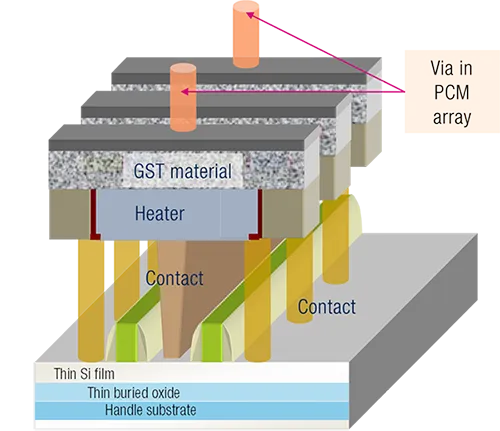
STMicroelectronics is now sampling 28nm FD-SOI microcontrollers (MCUs) with embedded non-volatile memory (eNVM) based on ePCM to alpha customers. Field trials meeting the requirements of automotive applications and full technology qualification are expected in 2020. These MCUs—the world’s first to use ePCM, which stands for embedded Phase-Change Memory—will target powertrain systems, advanced and secure gateways, safety/ADAS applications, and Vehicle Electrification. (Read the full press release here.) [caption id="attachment_14593" align="alignright" width="300"] A cross section of the embedded-PCM bitcell integrated in the 28nm FD-SOI technology shows the heater that quickly flips storage cells between crystalline and amorphous states. (Courtesy: STMicroelectronics)[/caption] “Having applied ST’s process, design, technology, and application expertise to ePCM, we’ve developed an innovative recipe that makes ST the very first to combine this non-volatile memory with 28nm FD-SOI for high-performance, low-power automotive microcontrollers,” said Marco Monti, President Automotive and Discrete Group, STMicroelectronics. “With samples already in some lead-customers’ hands, we’re confirming the outstanding temperature performance of ePCM and its ability to meet all automotive standards, further assuring our confidence in its market adoption and success.” ePCM presents a solution to chip- and system-level challenges, meeting automotive MCU requirements for AEC-Q100 Grade 0, operating at temperature up to +165°C. In addition, ST says its technology assures firmware/data retention through high-temperature soldering reflow processes and immunity to radiation, for additional data safety. Architecture and performance benchmark updates were presented the most recent IEDM (December 2018 in San Francisco) in a paper entitled Truly Innovative 28nm FDSOI Technology for Automotive Micro-Controller Applications embedding 16MB Phase Change Memory (F. Arnaud et al). As of this writing, the IEDM 2018 papers are not yet posted on the IEEE Xplore Digital Library site. However, the ppt that ST presented at the conference is available here. For more in-depth information on ePCM, see the ST PCM page. To learn more about how it compares with competing technologies such as eMRAM, read Embedded Phase-Change Memory Emerges by Mark Lapedus of SemiEngineering. Papers describing other eNVM solutions on FD-SOI were also presented at IEDM 2018. Samsung's is entitled Demonstration of Highly Manufacturable STT-MRAM Embedded in 28nm Logic (Y. J. Song et al). GlobalFoundries' is entitled 22-nm FD-SOI Embedded MRAM Technology for Low-Power Automotive-Grade-1 MCU Applications (K. Lee et al).
Read More
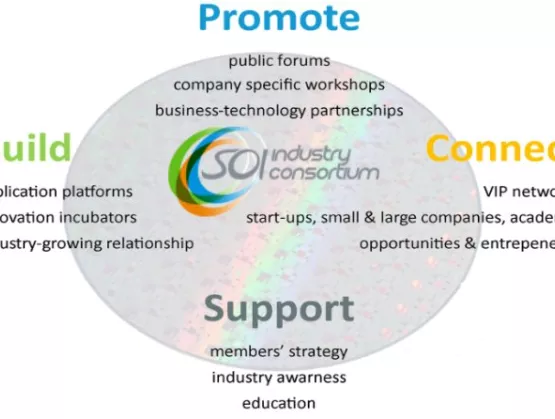
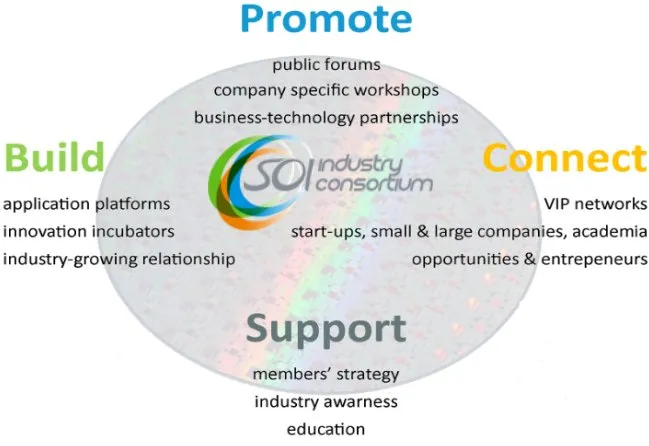
Welcome to our first post for 2019 here at the SOI Consortium's Advanced Substrate News. First and foremost, may we wish you and yours a safe, happy, healthy and prosperous year. It should be a good year across the SOI ecosystem, with new products, players, IP, technologies and tools -- and high volumes. What's new? Let's start with the people, as the Consortium welcomes new team members. Jon Cheek of NXP will join Carlos Mazure as Executive Co-Director. He'll be replacing ST's Giorgio Cesana in that role – and goodness knows those are some big shoes to fill. Giorgio has given of his time and expertise so tirelessly over many years. He'll of course still be a key resource for the SOI ecosystem, and though we'll miss him here at the Consortium, we know he'll be doing great things in SOI at ST. So a heartfelt thanks to Giorgio Cesana from all of us. Jon Cheek has a long history in engineering management at companies that have been leading users of SOI: AMD, Freescale and now NXP. As such, he understands what companies need to design great products, and how the Consortium can help further build, promote, connect and support the ecosystem. The Consortium team also welcomes Jean-Eric Michallet of Leti, who'll bring deep bizdev expertise and a keen sense of what it takes to reach further into the ecosystem. (Astute long-time ASN readers might remember his post from five years ago about 3D monolithic integration – now dubbed “Cool Cube” by Leti.) And finally, look to hear more from and about the Consortium, as our team is rounded out with the addition of the comm marketing savvy of Erin Berard of Soitec. In addition to new team members, the Consortium is very pleased to welcome new member Applied Materials. Though new to the Consortium, AMAT has a long history in the heart of SOI ecosystem – in fact they've been working with SOI wafer-leader Soitec for over 25 years. AMAT ion implanters are a key enabler to what became and is Soitec's industry-leading Smart CutTM SOI wafer manufacturing process. And of course AMAT equipment is used to make virtually every chip in the world, so their breadth of vision as a consortium member is clearly a fabulous addition. 2019 will also be marked by the expansion of the highly successful SOI Academy series, the first of which was held this past fall in Shanghai. We'll keep you posted as these and other Consortium events are announced throughout the year. In fact, 2019 marks a decade of (excellent!) SOI Consortium events events around the world: our first symposium was held back in 2009. Kicking off this year, save April 9th on your calendar for our Annual SOI Silicon Valley Symposium. Then watch this page for more events across the globe. What will the year bring? On the product side, RF-SOI for 5G is of course super hot. Last summer, a SemiconductorEngineering headline proclaimed RF-SOI Wars Begin. And what we heard at the International RF-SOI Workshop last fall in Shanghai (presentations here) certainly confirmed that in the coming year the race will continue unabated. [caption id="attachment_14476" align="alignright" width="300"] Part 3 in SemiconductorEngineering's "Experts at the Table" series on FD-SOI featured James Lamb of Brewer Science, Giorgio Cesana of ST, Olivier Vatel of Screen, and Carlos Mazure of Soitec. (Image courtesy: SemiconductorEngineering.com)[/caption] And for FD-SOI, you might want to read the SE series published over the last six months. The latest, published a couple of weeks ago looks at FD-SOI at the Edge. There are some great insights from SOI Consortium members there. In terms of products, too, there's lots of activity. Last summer, Samsung indicated they'd taped out over 60 products since they first began offering 28FDS three years ago. It's a trend they see accelerating. Full production of 18FDS is slated for this fall. And also last summer GlobalFoundries indicated they had over 50 client designs on 22FDX. “We’re only just beginning,” said GF CEO Tom Caulfield at the time. “We have found a way to separate ourselves from the pack by emphasizing our differentiated FD-SOI roadmap and client-focused offerings that are poised to enable connected intelligence. " For its part, ST, as we learned at the last SOI Consortium Japan Workshop, has been doing FD-SOI for five years now. And while we don't have number, we learned that some of those products are now in their second and third generations, and that some big FD-SOI chips coming out this year with embedded memory and RF, with especially good traction in mmWave, automotive and IoT. So while the outlook for the overall industry is anyone's guess for the coming year, the outlook for chips built on SOI technologies is very good indeed.
Read More
Lots of great information came out of the two days of workshops in Japan recently organized by the SOI Consortium. Some of the presentations are now posted on the consortium website (get them here). The first day (held in Yokohama and sponsored by Silvaco) focused on FD-SOI and RF-SOI design. The second day (held at U. Tokyo) focused on More than Moore (especially silicon photonics, MEMS sensors), and the SOI manufacturing ecosystem. The 1st day panel discussion was so interesting we'll give it a post of its own, then follow up with round-ups of the presentations from both days. And now to ramp! The morning panel discussion on end-user deployment for FD and RF-SOI was moderated by SOI Consortium Executive Director Giorgio Cesana. GF's CTO Subi Kengeri led off saying that that 2017 had been the year of FD-SOI adoption. Samsung Director Adam Lee noted that in the beginning nobody believed it would get traction, but now everybody does, and Samsung is commercializing it: chips coming out this year will ramp in volume in 2019. [caption id="attachment_12578" align="aligncenter" width="875"] Panel on FD-SOI and RF-SOI end-user deployment, SOI Workshop Japan, 2018. Giorgio Cesana, SOI Consortium Executive Director, Moderator; John Carey, ST Director; Adam Lee, Samsung Director; Subramani Kengeri, GF CTO; Wayne Dai, VeriSilicon CEO; Mostafa Emam, Incize CEO. (Courtesy: SOI Consortium)[/caption] VeriSilicon CEO Wayne Dai said he sees great potential in IoT, where the volumes are high but fragmented. In IoT, he said, you need RF, but you really only need very high performance about 20% of the time, which is a perfect fit for FD-SOI. ST Director John Carey noted that ST's been using FD-SOI since 2014. They've fabbed products for cryptocurrency and infrastructure. Now in their second and third generations of designing with it, they've got some big FD-SOI chips coming out next year with embedded memory and RF. He sees it being particularly successful in mmWave, automotive and IoT. The conversation then shifted to RF-SOI. Mostofa Emam, CEO of Incize, explained that since RF-SOI is already in every smart phone, it's in a different situation from FD-SOI. The emphasis here is now on adding more blocks. “RF is an art,” he said. “It takes an artist. You need talented artists and tools.” One of the biggest challenges for fabs that are newcomers is models – not just at the transistor level, but also at the substrate level. The big players have addressed this, but Incize is working to support more foundries with new, innovative approaches, and helping them develop robust PDKs. The industry needs more good RF designers as well as better RF design flow, he concluded. Coming back to FD-SOI, Cesana asked about non-volatile memory (NVM). Samsung's Lee said they've already got NVM options including eMRAM for 28nm, and customers are now requesting eMRAM PDKs for the next node (18FDS). ST's Kengeri added eNVM is important for FD-SOI, especially since flash is not scaling. While there are lots of options, MRAM gives you all the value, and in FD-SOI it only adds three more mask steps, so cost savings are maintained. With respect to local computing for AI with FD-SOI, everyone agreed on the importance of the edge. In addition to RF, FD-SOI gives you density even at 28nm, explained Carey. You can manually control power with back biasing, so you get something very flexible, especially for NB-IoT applications where the battery will have to last for 10 years. In fact Kengeri sees FD-SOI as enabling fog/edge computing. 5G – What's First? The next question was about 5G: which applications would we be seeing first, and how does FD-SOI help? Lee said Samsung's seeing it for apps up to 10GHz as well as mmWave. Customers are telling them they want FD-SOI for technical reasons. Kengeri expanded on that point, saying it comes down to fundamental physics: gate resistance, capacitance, mismatch. FD-SOI has lower Vmin and better Fmax compared to FinFETs, and that's what tier-one players want. Carey brought it back to RF-SOI (noting that ST's introducing a 45nm version), which supports a large number of elements and increased complexity with smaller power budgets. Emam then asked the foundry guys about mmWave. Substrates won't be the bottleneck he said, so what's the FD-SOI/mmWave roadmap? Kengeri responded that GF's ready. Lee said Samsung is also ready, and you'd see it next year on handsets. Samsung has engaged with customers on 30GHz for the middle of next year, he added: it's qualified. Carey said ST sees it first in consumer premises equipment that's connected by satellite. The right enabler Cesana then asked about image sensor processors (ISPs), noting that analyst Handel Jones has said this is a big opportunity for FD-SOI. You can do 3D integration with sensors, but heat makes noise, so you need technology that decreases heat production and doesn't give you hotspots (which would be visible in the image). Kengeri pointed to challenges in power density, thermal envelopes and the RTS (random telegraph noise signal). Although there are a lot of options, FD-SOI plays well for thermals and noise, so GF sees a good opportunity here. Dai added that the industry needs volume applications for FD-SOI, and ISPs need to bring more logic closer to the camera. And he concurred that you need FD-SOI for the thermals: it's very important. In closing, Dai noted that as a design house, “We walk on two legs: FinFETs and FD-SOI.” 28, 22, 18 and 12nm FD-SOI all enable differentiation. In particular, you need something between 20nm and 7nm: FD-SOI is here. Asked about Japan in particular, Dai said beyond automotive he saw lots of potential in ULP for AVR. Kengeri added that for any applications besides performance-at-any-cost, FD-SOI is the right enabler.
Read More
Since about a third of all IoT devices are expected to be connected by Bluetooth, chip designers need IP solutions that will help reduce system cost and greatly improve battery life. And that's just what VeriSilicon has announced for GlobalFoundries' 22FDX® (FD-SOI) process. “By taking advantage of integrated RF capabilities of FD-SOI, in particular GF’s 22FDX, our BLE 5.0 RF IP will significantly reduce the system cost and greatly boost the growth momentum of wearable products such as wireless earplugs,” said Dr. Wayne Dai, Founder, Chairman, President and CEO of VeriSilicon. 22FDX enables efficient single-chip integration of RF, transceiver, baseband, processor, and power management components. GF and VeriSilicon are working on an SoC using VeriSilicon's BLE 5.0 RF IP in GF’s 22FDX process. The latest iteration of Bluetooth is 5, which (like its predecessor 4) has a Low Energy (LE) RF option – but with big improvements. According to the Bluetooth website, “With 4x range, 2x speed and 8x broadcasting message capacity, the enhancements of Bluetooth 5 focus on increasing the functionality of Bluetooth for the IoT.” BLE 5.0 was designed for very low power operation and is optimized for the sorts of short burst data transmissions you'll get with IoT. On the strength of VeriSilicon’s innovative RF architecture and by leveraging GF’s 22FDX technology, VeriSilicon says the new IP product achieves significant improvements in power, area, and cost compared to current offerings, so it will better serve the emerging and increasing wearable devices and IoT applications space. "VeriSilicon's BLE IP complements GF's 22FDX FD-SOI capabilities and is well positioned to support the explosive growth of low-power IoT and connected devices," said Mark Ireland, vice president of ecosystem partnerships at GF. "Together, we broaden our IP and services to further enable our mutual clients to provide power and cost efficient solutions." VeriSilicon BLE 5.0 RF IP includes a transceiver that is compliant with the BLE 5.0 specification and supports GFSK modulation and demodulation. The silicon measurement shows that the sensitivity can be tested up to -98dBm with less than 7mW power dissipation in typical conditions. It largely improves battery life for low power IoT applications. In addition, the RF transceiver saves 40% area compared to a similar implementation on 55nm bulk CMOS. Besides the RF transceiver, this IP integrates on-chip balun, TX/RX switch and 32K RC OSC driver to save the BOM. Moreover, high efficiency DC/DC and LDOs are also available for power management. You can read the full press release in Chinese here and in English here.
Read More
[caption id="attachment_12359" align="alignright" width="300"] (Courtesy: PRNewsfoto/QuickLogic Corporation)[/caption] Some great pieces of FD-SOI news from QuickLogic. The company recently demonstrated its ultra-low power ArcticPro™ embedded FPGA (eFPGA) solutions at the GlobalFoundries Technology Conferences in Santa Clara, California, Munich and Shanghai. The technology is available now. ArcticPro is the industry's first eFPGA offering for GF's 22FDX® process (btw they've been shipping it in volume for GF's 65nm and 40nm bulk processes for years). The company says its ultra-low power eFPGA architecture and mature software offer semiconductor and system companies the ability to integrate programmable hardware accelerators to lower power consumption and the flexibility to reconfigure a device's functionality in the field. [caption id="attachment_12360" align="alignleft" width="300"] (Image courtesy: QuickLogic)[/caption] QuickLogic has also announced that the technical university ETH Zurich will integrate QuickLogic's ArcticPro technology onto the university's PULP platform. PULP is a silicon-proven open-source parallel platform for ultra-low power computing created with the objective of delivering high compute bandwidth combined with high-energy efficiency. ETH will become the first licensee of eFPGA technology from QuickLogic on GF's 22FDX process node. They will develop an SoC integrating ETHZ's open-source RISC-V cores and eFPGA technology, enabling users to offload critical functions from the processor(s) and implement them in eFPGA fabric. This approach creates multiple hardware co-processors that increase system efficiency and performance while decreasing power consumption. "The main goal of the PULP program is to use a multi-disciplinary approach to achieve extremely high-power efficiency for computing applications," said QuickLogic CTO Dr. Timothy Saxe. "QuickLogic has a tremendous depth of experience in achieving low power consumption across a broad range of applications, including AI and IoT at the edge and security, and we look forward to contributing what we've learned along with our eFPGA technology to this groundbreaking initiative in low power computing." ETH's PULP platform with the fully integrated eFPGA is expected to be available Q1' 2019. QuickLogic is part of GF's fast-growing FDXcelerator™ partner ecosystem, offering customers ultra-low power (eFPGA) Intellectual Property, complete software tools and a compiler.
Read More