downloadGroupGroupnoun_press release_995423_000000 copyGroupnoun_Feed_96767_000000Group 19noun_pictures_1817522_000000Member company iconResource item iconStore item iconGroup 19Group 19noun_Photo_2085192_000000 Copynoun_presentation_2096081_000000Group 19Group Copy 7noun_webinar_692730_000000Path
Skip to main content
Default Banner Image

SEMI News

MILPITAS, Calif. – September 23, 2020 – SEMI Nano-Bio Materials Consortium (NBMC) today released a Request for Proposals (RFP) for innovations in ambulatory monitoring, wearable technologies for cognitive assessment, and innovative power sources for wearable monitors. Proposals are also welcome for new concepts to advance mobile human monitoring and diagnostic capabilities. Projects will be awarded with cash budgets ranging from $500,000 to $2 million. The RFP is funded by the U.S. Air Force Research Laboratory (AFRL).

SEMI-NBMC logo

SEMI-NBMC focuses on innovation challenges and opportunities during research and development (R&D) to increase the technology and manufacturing readiness levels (TRL/MRL) of nanotechnologies and biotechnologies. The SEMI-NBMC program and committee encourages submission of novel technical approaches that carry significant risk as well as those that represent evolutionary improvements on existing technical capabilities, which tend to be less risky and involve shorter development and delivery times.

Industry experts on the NBMC RFP Review Committee selected the RFP topics based on an analysis of strategic market gaps and will evaluate all white paper submissions against that gap analysis. To learn more about the aeromedical mission and the status of biomarkers and sensors for telemedicine, watch the SEMI-NBMC and AFRL August MedTech Workshop Series.

After evaluating white papers, the committee will invite select organizations to submit full proposals that will be rigorously evaluated on criteria including budget, collaboration value, dual-use (commercial and military/aerospace) applicability, relevance to the digital healthcare ecosystem, relevance to advancing nano-bio materials for human monitoring, schedule and milestones, deliverables, and overall proposal quality. See the complete SEMI-NBMC 2020 Request for Proposals for more details on the evaluation process.   

The consortium strongly encourages partnerships among industrial companies, R&D organizations and university teams. SEMI-NBMC funding will be matched with funds provided by grant recipients to cover total project cost. Development partners retain ownership of intellectual property developed under a SEMI NBMC contract.

White paper responses, the first step in responding to the RFP, are due October 20, 2020. SEMI-NBMC staff will review the RFP topics and submission and review process during a live webinar on October 2, 2020 at 10:00am PDT. Registration is open to anyone considering submitting a proposal. A recording of the webinar will be available for those unable attend the live event.


About SEMI-NBMC

SEMI-NBMC was founded in 2013 to bring together scientists, engineers and business development professionals from industry, government and universities to collaboratively initiate research and development of electronic technologies to improve human performance monitoring and performance augmentation capabilities. To date, over 25 industry partners have advanced the state-of-the-art in human-performance monitoring in 26 projects. Advancements include subsystems designed for ECG, functionalized biomarker sensors, and hydration sensors.

About SEMI

SEMI® connects more than 2,400 member companies and 1.3 million professionals worldwide to advance the technology and business of electronics design and manufacturing. SEMI members are responsible for the innovations in materials, design, equipment, software, devices, and services that enable smarter, faster, more powerful, and more affordable electronic products. Electronic System Design Alliance (ESD Alliance), FlexTech, the Fab Owners Alliance (FOA) and the MEMS & Sensors Industry Group (MSIG) are SEMI Strategic Technology Communities, defined communities within SEMI focused on specific technologies. Visit www.semi.org to learn more, contact one of our worldwide offices, and connect with SEMI on LinkedIn and Twitter.

Association Contact

Michael Hall/SEMI
Phone: 1.408.943.7988
Email: [email protected]
Solving challenges in semiconductor manufacturing requires an ongoing collaborative effort by customers, device makers, equipment and materials suppliers, and academia. ASMC 2021 will continue efforts to help the industry overcome these hurdles. To that end, we are now soliciting abstracts from industry experts across all areas of semiconductor manufacturing for presentations at the event, May 3-6, 2021 at the Saratoga Hilton/Saratoga Springs City Center in Saratoga Springs, New York.The conference provides an unparalleled platform for semiconductor professionals to network and learn the latest information in the practical application of advanced manufacturing strategies and methodologies. ASMC 2021 will be co-chaired by Ishtiaq Ahsan, Ph.D. of IBM Research and Alexa Greer of KLA.We’re looking for presentations in topic areas including the following: Advanced Metrology Advanced Equipment Processes and Materials Contamination Free Manufacturing Big Data Management and Mining Defect Inspection and Reduction Equipment Optimization Factory Automation Industrial Engineering Smart Manufacturing Yield Methodologies Click here to submit an abstract for a technical presentation. Provide an extended abstract of no more than two pages (max. of 1000 words, MS Word or PDF) with supporting data, charts, figures embedded in the last page. See author kit for details. Summarize the topic and theme in as much detail as allowed by the word count limitation. Include title, author(s), company affiliation(s), contact information, topic and five key words describing the work. The final technical manuscript must show a complete set of data to support initial abstract. Here are key deadlines and dates for industry experts to keep in mind: Abstracts Due: October 30, 2020 Author Notification: December 15, 2020 Manuscripts Due: February 9, 2021 Final Manuscripts Due: April 6, 2021 Presentations Due: April 20, 2021 Conference Dates: May 3-6, 2021 ASMC 2021 could be held as a virtual event depending on progress in containing COVID-19. Whether the event is on-site or virtual, all abstracts accepted for presentation will be published by IEEE. Speakers should be prepared to present live or online.Speakers also may be invited to publish their papers in a special section of ASMC 2021, which will be featured in IEEE Transactions on Semiconductor Manufacturing. All technical presentations will be considered for the ASMC Best Paper Award sponsored by Entegris. Students presenting an oral paper or poster will be considered for the ASMC Best Student Paper Award sponsored by GLOBALFOUNDRIES.For a complete overview of topics and other information, please visit the ASMC 2021 Call for Papers web page.Margaret Kindling is senior manager of Programs for SEMI Americas.
Read More

HSINCHU, Taiwan – September 22, 2020 – SEMICON Taiwan 2020 Hybrid opens tomorrow with advanced, smart and green manufacturing in the spotlight on-site and online as industry visionaries and experts gather for the latest market trends, business opportunities and innovations across the semiconductor supply chain. The first hybrid SEMICON ever, the September 23-25 exhibition at the Taipei Nangang Exhibition Center, Hall 1 (TaiNEX 1), will feature a virtual platform with an exposition hall, live streaming forums, networking opportunities and virtual reality (VR) technology offering an immersive online experience accessible around the world. SEMICON Taiwan 2020 registration is open.

SEMICON Taiwan Hybrid Logo

Entering its 25th year, SEMICON Taiwan features 15 theme pavilions and innovation zones as well as 19 international forums as in-show experience. For the first time, Smart Manufacturing Taiwan, Compound Semiconductor Innovation Zone, Heterogeneous Integration Innovation Zone, and Smart Workforce Pavilion will go virtual.

After registering for SEMICON Taiwan 2020 Hybrid online, attendees can log in to the virtual platform and find all exhibition information on the front page for easy navigation of the event. Key online features include:

  1. Virtual Exhibition Hall: See the latest technologies and solutions from key exhibitors. View a sneak peek video of the hybrid experience.
  2. 1-on-1 Chat: Connect with exhibitors and visitors in real time.
  3. Networking Lounge: Exchange opinions with industry experts worldwide and uncover potential business opportunities and technical solutions.
  4. SEMICON Taiwan Live Tour: Explore exciting activities and behind-the-scenes highlights of SEMICON Taiwan from an exclusive online perspective.
  5. Forum Live Broadcast: Get insights from industry opinion leaders firsthand via live broadcasts of international forums. Visit the SEMICON Taiwan 2020 website for the forum schedule.
  6. Virtual Reality (VR) Experience: For a better, faster visual experience, enter the virtual exhibition hall using a VR device and your smartphone’s screen.

For more information, visit the SEMICON Taiwan 2020 website.

About SEMI

SEMI® connects more than 2,400 member companies and 1.3 million professionals worldwide to advance the technology and business of electronics design and manufacturing. SEMI members are responsible for the innovations in materials, design, equipment, software, devices, and services that enable smarter, faster, more powerful, and more affordable electronic products. Electronic System Design Alliance (ESD Alliance), FlexTech, the Fab Owners Alliance (FOA) and the MEMS & Sensors Industry Group (MSIG) are SEMI Strategic Association Partners, defined communities within SEMI focused on specific technologies. Visit www.semi.org to learn more, contact one of our worldwide offices, and connect with SEMI on LinkedIn and Twitter.


Association Contacts

Jo-ann Su
SEMI Taiwan
Email: [email protected]
Phone: 886.3.560.1777 ext. 202

Irene Huang
SEMI Taiwan
Email: [email protected]
Phone: 886.03.560.1777 ext. 205

MILPITAS, Calif. — September 17, 2020 — North America-based manufacturers of semiconductor equipment posted $2.65 billion in billings worldwide in August 2020 (three-month average basis), according to the August Equipment Market Data Subscription (EMDS) Billings Report published today by SEMI. The billings figure is 3.0 percent higher than the final July 2020 level of $2.57 billion, and is 32.5 percent higher than the August 2019 billings level of $2.00 billion.

“August billings of North America-based semiconductor equipment manufacturers demonstrate solid performance and strong year-over-year growth,” said Ajit Manocha, SEMI president and CEO. “Semiconductor equipment demand remains robust despite supply chain uncertainties and new regulatory constraints.”

The SEMI Billings report uses three-month moving averages of worldwide billings for North American-based semiconductor equipment manufacturers. Billings figures are in millions of U.S. dollars.


Billings
(3-mo. avg.)

Year-Over-Year

March 2020

$2,213.1

21.2%

April 2020

$2,281.3

18.7%

May 2020

$2,343.3

13.5%

June 2020

$2,317.7

14.4%

July 2020 (final)

$2,575.3

26.7%

August 2020 (prelim)

$2,653.3

32.5%

Source: SEMI (www.semi.org), September 2020

SEMI publishes a monthly North American Billings report and issues the Worldwide Semiconductor Equipment Market Statistics (WWSEMS) report in collaboration with the Semiconductor Equipment Association of Japan (SEAJ). The WWSEMS report currently reports billings by 24 equipment segments and by seven end market regions. SEMI also has a long history of tracking semiconductor industry fab investments in detail on a company-by-company and fab-by-fab basis in its World Fab Forecast and SEMI FabView databases. These powerful tools provide access to spending forecasts, capacity ramp, technology transitions, and other information for over 1,000 fabs worldwide. For an overview of available SEMI market data, please visit www.semi.org/en/MarketInfo.

The data contained in this release were compiled by David Powell, Inc., an independent financial services firm, without audit, from data submitted directly by the participants. SEMI and David Powell, Inc. assume no responsibility for the accuracy of the underlying data.

About SEMI

SEMI® connects more than 2,400 member companies and 1.3 million professionals worldwide to advance the technology and business of electronics design and manufacturing. SEMI members are responsible for the innovations in materials, design, equipment, software, devices, and services that enable smarter, faster, more powerful, and more affordable electronic products. Electronic System Design Alliance (ESD Alliance), FlexTech, the Fab Owners Alliance (FOA) and the MEMS & Sensors Industry Group (MSIG) are SEMI Strategic Technology Communities, defined communities within SEMI focused on specific technologies. Visit www.semi.org to learn more, contact one of our worldwide offices, and connect with SEMI on LinkedIn and Twitter.

Association Contact

Michael Hall/SEMI
Phone: 1.408.943.7988
Email: [email protected]
Notes

Next SEMI Billings report is October 22, 2020 at 3:00pm Pacific.

For information on SEAJ Billings Express Report, visit www.seaj.or.jp. 

Every Friday I try to clear out my inbox. It’s a small way to feel like I’m on track with all the different projects we have going on at the SEMI Foundation. As I’m doing that, it’s rare that I’ll open a marketing email about a webinar, webcast, or industry event unless it’s incredibly compelling.One of them did catch my eye last week, from VLSI System Design for its VSDOpen2020.And the email did more than catch my eye. We jumped on the phone with the founders and ended up collaborating with them and the ESD Alliance on the event.The company specializes in training students in chip designs. That’s a great fit for the work we’re doing on your behalf at the SEMI Foundation and SEMI. And the VLSI System Design event is a free, online, one-day set of sessions that focus on designing digital and analog IP using freely available resources.If you have time on Saturday, October 10, I’d encourage you to check it out. They’ve got some great keynote speakers (see below), five IP designer tracks, educational sessions, and they’re even showcasing IP designed by students!It’s a great way to see some innovations in design, interact with students, and make some new contacts in a virtual setting. Below are more event details. Registration is now open.VSDOpen 2020 – Saturday, October 10Keynote speakers Jan Rabaey, the Donald O. Pederson Distinguished Professorship at the University of California at Berkeley, will offer a look at Computation in the Post-Moore Era: Reflecting on the Role of Open Source. Naveed Sherwani, Chairman, CEO and President of SiFive, will describe RISC-V and open source hardware – A golden opportunity for the India semiconductor industry. Michael Wishart, Co-Founder and CEO of efabless, will address Applying Community Models to ICs: Why and How. In addition, Jeremy Bennett, Chief Executive of Embecosm, will deliver an industry talk on A brief history of open hardware: Learning from the free and open source software movement. And Sunita Verma of the Ministry of Electronics and Information Technology will give a presentation on India’s initiatives in electronic system design and manufacturing.There are also networking opportunities for designers, researchers, tool developers, and students. If you want to go deeper, join the lab-based workshops offered in the three days (Oct 7-9) leading up to the event.Check out the full program for more on specific sessions.Shari Liss is executive director of the SEMI Foundation. She oversees SEMI Workforce Development programs from K-12 through re-skilling for veterans.
Read More
Is your company working on the next big thing in flexible, hybrid and printed electronics – a breakthrough or innovation that will make the world safer, healthier or more productive for years to come? If so, we want to hear from you.You’re invited to deliver a technical presentation at virtual FLEX 2021, February 22-26, 2021. The call for abstracts is now open! Celebrating its 20th year, the online event will gather executives, product managers, business development professionals, and engineering directors as well as leading industry analysts and media for the latest developments, trends and innovations in flexible hybrid electronics (FHE). More than 400 companies, universities, R D labs, and government agencies from around the world have participated in FLEX conferences.Technical presentations should focus on the conference theme, 20 Years of Driving Innovation to Make the World Safer, covering flexible hybrid or printed electronics products, equipment, processes, materials, and the applications they enable. FLEX 2021 also takes aim at the future of the planet, so presentations on global sustainability in areas such as impacts, strategies, tactics, successes and progress area also a great fit. To submit your abstract, please complete the online form: Upload your abstract (100-300 words) describing the topic of your presentation and how it applies to the flexible, hybrid, and printed electronics products. Preference is given to original research and advancements in process and materials as they relate to end users. We also invite students from research universities to submit posters describing their work and results for the popular FLEX Poster Competition. As in the past, a panel of industry and academic experts will evaluate the posters and recognize the top three students and their work. Here are key deadlines and dates for industry experts and students to keep in mind: September 30, 2020 – Submit your abstract. October 31, 2020 – We’ll notify you whether your presentation has been accepted by this date. November 15, 2020 – Sign a Speaker Agreement and provide a bio and headshot. February 1, 2021 – Send us an electronic copy of your presentation. We’re looking for presentations in these topic areas: Flexible Hybrid Electronics Systems Materials Processing Sustainability and Power MEMS and Sensors Applications Presentations should include the following: Why the technology presented matters and to whom Practical recommendations for addressing commercialization issues or applications. This includes providing innovative technological or market solutions driven by a use case, the integration challenges you faced, and the system-level architecture decisions you made. Descriptions of how you overcame each challenge Ideas for what as an industry we should be working on and what are you working on to demonstrate sustainability For a full rundown on topics and other information, please visit the FLEX 2021 Call for Papers web page.Michelle Fabiano is a program and event manager for SEMI Americas.
Read More

HSINCHU, Taiwan – September 10, 2020 – Advanced, smart and green manufacturing will take center stage on-site and online September 23-25 as SEMICON Taiwan 2020 gathers industry visionaries and experts for the latest market trends, business opportunities and innovations across the semiconductor supply chain. Bringing together 550 exhibitors across 2,000 booths at the Taipei Nangang Exhibition Center, Hall 1 (TaiNEX 1), the hybrid event will also feature a virtual platform with an expo hall, live streaming forums and virtual reality (VR) technology for an immersive online experience accessible around the world. SEMICON Taiwan 2020 registration is now open.

SEMICON Taiwan Hybrid Logo

The event coincides with the emergence of work from home, cloud services and telemedicine merged as drivers of semiconductor industry growth. Enabling technologies artificial intelligence (AI) and 5G are also key forces at play. The three technology areas – critical bulwarks in the world’s continuing battle against the COVID-19 pandemic – will contribute to a record US$67.7 billion in global fab equipment spending, an increase of 24%, next year, according to SEMI.  

SEMICON Taiwan 2020 Highlights

  • Master Forum – High-technology thought leaders from TSMC, Foxconn, STMicroelectronics, Micron, FET, and Lam Research will explore how the semiconductor industry can leverage AI and 5G to fuel the next wave of innovation.
  • Hi-Tech Corporate Growth & Innovation Forum – Taiwan Tech Arena (TTA) and Taiwania Capital will join SEMI for the first time to discuss how more corporations can make strategic investments to drive sustainable innovation. In addition, more than 10 semiconductor startups will introduce cross-discipline technologies designed to drive innovation.
  • SMART Mobility Forum – Industry experts from IBM, Renesas Electronics, NXP Semiconductors, STMicroelectronics and Jaguar Land Rover will share the latest automotive technologies and market trends.
  • SMART MedTech Forum – Experts from the Ministry of Science Technology (MOST), National Yang-Ming University and Powerchip Semiconductor Manufacturing will introduce cutting-edge medical technologies for the COVID-19 era and beyond.
  • SMART Workforce Pavilion – To help build the electronics industry’s talent pipeline, SEMICON Taiwan 2020 will feature the Talent Cultivation Symposium, Women-in-Tech Forum and Talent Forum. In addition, talent-matching events will connect microelectronics companies with students to help them take an early step in launching their careers in high technology.
  • Theme Pavilions & Innovation Zone – The event’s 15 theme pavilions and innovation zones will focus on critical areas of chip industry innovation and growth ranging from heterogeneous integration to compound and opto semiconductors, testing and materials while targeting macro issues such as circular economy and green power.
  • 5 Concurrent Events – SEMICON Taiwan is co-located with FLEX Taiwan, ITC-Asia, Strategic Materials Conference Taiwan, SiP Global Summit, and SMART Manufacturing Taiwan.

Visitor Safety at SEMICON Taiwan 2020

The safety and well-being of visitors to all SEMI events is SEMI’s top priority. To help protect attendees at the on-site SEMICON Taiwan 2020, SEMI encourages all visitors to wear face masks. Attendees can also take advantage of hand sanitizers and body temperature checks at the event. In addition, contact-tracing information will be gathered.

For more event information, visit SEMICON Taiwan 2020.

About SEMI

SEMI® connects more than 2,400 member companies and 1.3 million professionals worldwide to advance the technology and business of electronics design and manufacturing. SEMI members are responsible for the innovations in materials, design, equipment, software, devices, and services that enable smarter, faster, more powerful, and more affordable electronic products. Electronic System Design Alliance (ESD Alliance), FlexTech, the Fab Owners Alliance (FOA) and the MEMS & Sensors Industry Group (MSIG) are SEMI Strategic Association Partners, defined communities within SEMI focused on specific technologies. Visit www.semi.org to learn more, contact one of our worldwide offices, and connect with SEMI on LinkedIn and Twitter.

Association Contacts
Jo-ann Su
SEMI Taiwan
Email: [email protected]
Phone: 886.3.560.1777 ext. 202

Irene Huang
SEMI Taiwan
Email: [email protected]
Phone: 886.3.560.1777 ext. 205

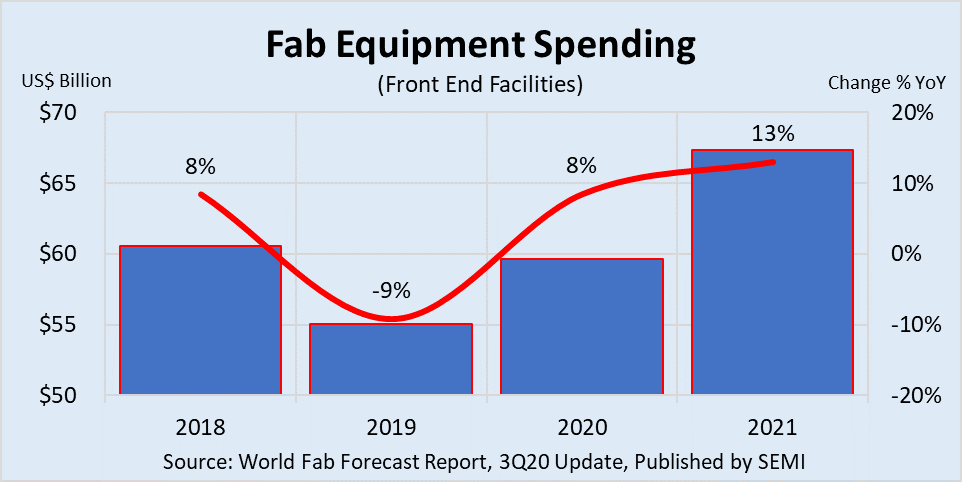
MILPITAS, Calif. – September 8, 2020 – Soaring pandemic-fueled demand for chips that power everything from communications and IT infrastructures to personal computing, gaming and healthcare electronics will drive an 8% increase in global fab equipment spending in 2020 and a 13% increase in 2021, SEMI announced today in its World Fab Forecast report. Rising demand for semiconductors for datacenter infrastructures and server storage along with the buildup of safety stock as U.S.-China trade tensions intensify are also contributing to this year’s growth.   

semi logo

The bullish trend for overall fab equipment investments comes as the semiconductor industry recovers from a 9% decline in fab spending in 2019 and navigates a roller-coaster 2020 with actual and projected spending drops in the first and third quarters mixed with second- and fourth-quarter increases. See figure below.

Figure: Fab Equipment Spending by Year

Of all chip sectors, memory will see the largest spending increase in 2020, growing US$3.7 billion, or 16% year-over-year (YoY), to US$26.4 billion, and tack on an 18% increase to reach US$31.2 billion in 2021. 3D NAND spending will log the largest percentage surge this year, expanding 39%, and register modest growth of 7% in 2021. DRAM is expected to see 4% growth after a slowdown in the second half of 2020 before jumping 39% percent next year.

Equipment spending forecasts for other semiconductor sectors:

  • Foundry, the next largest sector in equipment spending for 2020, is forecast to rise US$2.5 billion, or 12% YoY, to US$23.2 billion and edge up 2% to US$23.5 billion in 2021.
  • MPU equipment spending will decline US$1.2 billion, or 18%, in 2020 and rise 9% to US$6 billion in 2021.
  • Analog spending will grow a robust 48% in 2020 and rise 6% in 2021, an expansion chiefly driven by equipment investments for mixed-signal/power fabs.
  • Image sensors equipment spending is expected to rise 4% to US$3 billion in 2020 and jump 11% to US$3.4 billion in 2021.

The SEMI World Fab Forecast report covers more than 1,300 fabs and lines and includes capacity and technology by fab and construction investments. The report shows 21 new construction projects – ranging from R&D to volume and including high- and low-probability parameters – starting in 2020. China accounts for the most (nine) of the new projects; followed by Taiwan at five; Southeast Asia and the Americas at two each; and Japan, Korea, and Europe/Mideast at one each. The report also tracks 18 new construction projects planned to begin next year – 10 in China, four in the Americas, three in Taiwan, and one in Europe/Mideast.

About SEMI
SEMI® connects more than 2,400 member companies and 1.3 million professionals worldwide to advance the technology and business of electronics design and manufacturing. SEMI members are responsible for the innovations in materials, design, equipment, software, devices, and services that enable smarter, faster, more powerful, and more affordable electronic products. Electronic System Design Alliance (ESD Alliance), FlexTech, the Fab Owners Alliance (FOA) and the MEMS & Sensors Industry Group (MSIG) are SEMI Strategic Technology Communities, defined communities within SEMI focused on specific technologies. Visit www.semi.org to learn more, contact one of our worldwide offices, and connect with SEMI on LinkedIn and Twitter.

Association Contacts
Michael Hall/SEMI
Phone: 1.408.943.7988
Email: [email protected]

Christian G. Dieseldorff/SEMI
Phone: 1.408.943.7940
Email: [email protected]  

MILPITAS, Calif. – September 8, 2020 – Second quarter 2020 global billings for semiconductor manufacturing equipment jumped 26% year-over-year and 8%, to US$16.8 billion, from the first quarter of the year, SEMI announced today in its Worldwide Semiconductor Equipment Market Statistics (WWSEMS) Report.

semi logo

SEMI, the global industry association representing the electronics design and manufacturing supply chain, and the Semiconductor Equipment Association of Japan (SEAJ) gathered the data from more than 80 global equipment companies that report billings figures monthly. Following are quarterly billings data in billions of U.S. dollars quarter-over-quarter and year-over-year change by region:

Region

Q22020

Q12020

Q22019

2Q2020/1Q2020

2Q2020/2Q2019

China

4.59

3.50

 3.36

31%

36%

Korea

4.48

3.36

 2.58

33%

74%

Taiwan

3.51

4.02

 3.21

-13%

9%

Japan

1.72

1.68

 1.38

3%

25%

North America

1.64

1.93

 1.70

-15%

-3%

Europe

0.46

0.64

 0.57

-29%

-19%

Rest of the World

0.37

0.44

 0.51

-18%

-29%

Total

 16.77

15.57

 13.31

8%

26%

Source: SEMI (www.semi.org) and SEAJ (www.seaj.or.jp), September 2020

The SEMI Equipment Market Data Subscription (EMDS) provides comprehensive market data for the global semiconductor equipment market. A subscription includes three reports:

  • Monthly SEMI Billings Report, a perspective on equipment market trends
  • Monthly Worldwide Semiconductor Equipment Market Statistics (WWSEMS), a detailed report of semiconductor equipment billings for seven regions and 24 market segments
  • SEMI Semiconductor Equipment Forecast, an outlook for the semiconductor equipment market

For more information or to subscribe, please contact the SEMI Industry Research and Statistics Group at [email protected]. More information is also available online.

About SEMI
SEMI® connects more than 2,400 member companies and 1.3 million professionals worldwide to advance the technology and business of electronics design and manufacturing. SEMI members are responsible for the innovations in materials, design, equipment, software, devices, and services that enable smarter, faster, more powerful, and more affordable electronic products. Electronic System Design Alliance (ESD Alliance), FlexTech, the Fab Owners Alliance (FOA) and the MEMS & Sensors Industry Group (MSIG) are SEMI Strategic Technology Communities, defined communities within SEMI focused on specific technologies. Visit www.semi.org to learn more, contact one of our worldwide offices, and connect with SEMI on LinkedIn and Twitter.

Association Contact
Michael Hall/SEMI
Phone: 1.408.943.7988
Email: [email protected]

METIS, a Sector Skills Alliance project co-funded by the European Commission’s Erasmus+ Program and coordinated by SEMI, recently launched an online questionnaire aimed at gauging the skills and expertise the industry needs to drive continued growth over the next five years. The survey, which will stay online until 15 October 2020, is a part of the METIS project’s efforts to involve a broad range of stakeholders in the microelectronics industry to assess workforce, future technology and economic trends influencing talent development and the skills needed most today and in the next five years. The survey aims to highlight the skill mismatches in specific job profiles that are of increasing importance to the microelectronics industry. It elaborates on the upskilling and reskilling needs for design engineers. Given that semiconductor design is becoming increasingly crucial for Europe’s competitiveness and technological sovereignty, the new skills required from design engineers are a priority area for the METIS project. Other examples are the manufacturing and maintenance technicians, two job profiles that are currently experiencing significant shifts in their skillsets, as COVID-19 has thoroughly transformed their way of work.While the microelectronics industry has been very aware of the importance of the high level of investment in R D, it is equally crucial to ensure that the workforce of the industry is equipped with knowledge and skills for the rapid technological developments. Maintaining high levels of investment in workforce including attracting talent, updating their knowledge and skills with the latest technological development, and supporting them to lead innovations, is essential for this industry. There is a growing demand for specific requirements for this sector to support innovation in many other sectors such as automotive, energy, healthcare, and government, to foster benefits from emerging digital technologies such as Cloud Services, Internet of Things (IoT), Artificial Intelligence (AI), Digital Reality, and Blockchain.In addition to the online questionnaire, the METIS project consortium is interviewing top experts from leading microelectronics companies, education representatives from universities and training academies, and experts from government agencies and industry associations. The interview outcomes provide inputs on what kind of employee profiles are the most difficult to find, what skills this sector is looking for in a candidate, and what kind of training and policy frameworks are needed to improve employers’ skills. Those inputs are essential to develop the skill strategy and form recommendations on training modules.Furthermore, the METIS project consortium is organizing 10 focus groups. Each of the focus groups is dedicated to a key topic, such as SC design, SC materials, semiconductor manufacturing equipment, etc. For example, one of the METIS focus groups is dedicated to Edge AI, a top priority for the microelectronics industry. Strengthening the AI talent pipeline is essential to harness the potential of Edge AI in Europe and to facilitate the shift from the Cloud to the Edge when possible in order to meet specific demands (e.g. for autonomous driving), reduce energy consumption for data communications, and to increase efficiency. The EU’s White Paper “Artificial Intelligence - A European approach to excellence and trust”[1] , published this February, also emphasizes the importance of upskilling and reskilling to position Europe among the global leaders in AI. Hence, the focus group will work towards pinpointing the skills necessary for the semiconductor workforce to capture the potential of the trend.The results of the survey, interviews and focus groups will be used to form the Microelectronics Skills Strategy. Based on this strategy, the METIS project will design 43 training modules for 1,100 hours learning in four key areas of the microelectronics sector:Component designSystem designBasic of manufacturingKey competencies and innovative thinkingThe METIS project is planning to recruit 2,000 learners in companies and education and training institutes to participate in the trainings and validate the impact. The METIS project will also work with companies, education and training providers to ensure continuity of the initiative and foster cooperation.During the METIS project course (2019 – 2023), the Skills Strategy will be updated yearly to reflect the latest technology and market trends. To enable the Skills Strategy to continue serving the industry, METIS is working on forming a permanent instrument, named Observatory and Skills Council, to continue developing the skills strategy, update the training and facilitate cooperation between industry and education and training providers.Laith Altimime, president of SEMI Europe, and 50 members of the Microelectronics Training, Industry and Skills (METIS) consortium The METIS consortium invites companies and associations involved in microelectronics training and education provision, human resources and career services professionals, technology strategists and policy makers to complete the online questionnaire. Stakeholders are also welcome to subscribe to the METIS newsletter for the latest on METIS programs. For more details, please contact Yanying Li at [email protected].[1] EU’s White Paper on Artificial Intelligence available at: https://ec.europa.eu/info/sites/info/files/commission-white-paper-artificial-intelligence-feb2020_en.pdfDr. Yanying Li is senior manager of Collaborative Projects at SEMI Europe.
Read More