downloadGroupGroupnoun_press release_995423_000000 copyGroupnoun_Feed_96767_000000Group 19noun_pictures_1817522_000000Member company iconResource item iconStore item iconGroup 19Group 19noun_Photo_2085192_000000 Copynoun_presentation_2096081_000000Group 19Group Copy 7noun_webinar_692730_000000Path
Skip to main content
Default Banner Image

Technology and Trends

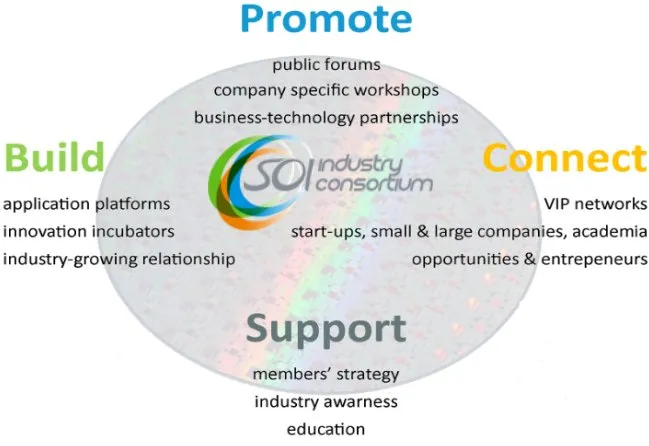
Welcome to our first post for 2019 here at the SOI Consortium's Advanced Substrate News. First and foremost, may we wish you and yours a safe, happy, healthy and prosperous year. It should be a good year across the SOI ecosystem, with new products, players, IP, technologies and tools -- and high volumes. What's new? Let's start with the people, as the Consortium welcomes new team members. Jon Cheek of NXP will join Carlos Mazure as Executive Co-Director. He'll be replacing ST's Giorgio Cesana in that role – and goodness knows those are some big shoes to fill. Giorgio has given of his time and expertise so tirelessly over many years. He'll of course still be a key resource for the SOI ecosystem, and though we'll miss him here at the Consortium, we know he'll be doing great things in SOI at ST. So a heartfelt thanks to Giorgio Cesana from all of us. Jon Cheek has a long history in engineering management at companies that have been leading users of SOI: AMD, Freescale and now NXP. As such, he understands what companies need to design great products, and how the Consortium can help further build, promote, connect and support the ecosystem. The Consortium team also welcomes Jean-Eric Michallet of Leti, who'll bring deep bizdev expertise and a keen sense of what it takes to reach further into the ecosystem. (Astute long-time ASN readers might remember his post from five years ago about 3D monolithic integration – now dubbed “Cool Cube” by Leti.) And finally, look to hear more from and about the Consortium, as our team is rounded out with the addition of the comm marketing savvy of Erin Berard of Soitec. In addition to new team members, the Consortium is very pleased to welcome new member Applied Materials. Though new to the Consortium, AMAT has a long history in the heart of SOI ecosystem – in fact they've been working with SOI wafer-leader Soitec for over 25 years. AMAT ion implanters are a key enabler to what became and is Soitec's industry-leading Smart CutTM SOI wafer manufacturing process. And of course AMAT equipment is used to make virtually every chip in the world, so their breadth of vision as a consortium member is clearly a fabulous addition. 2019 will also be marked by the expansion of the highly successful SOI Academy series, the first of which was held this past fall in Shanghai. We'll keep you posted as these and other Consortium events are announced throughout the year. In fact, 2019 marks a decade of (excellent!) SOI Consortium events events around the world: our first symposium was held back in 2009. Kicking off this year, save April 9th on your calendar for our Annual SOI Silicon Valley Symposium. Then watch this page for more events across the globe. What will the year bring? On the product side, RF-SOI for 5G is of course super hot. Last summer, a SemiconductorEngineering headline proclaimed RF-SOI Wars Begin. And what we heard at the International RF-SOI Workshop last fall in Shanghai (presentations here) certainly confirmed that in the coming year the race will continue unabated. [caption id="attachment_14476" align="alignright" width="300"] Part 3 in SemiconductorEngineering's "Experts at the Table" series on FD-SOI featured James Lamb of Brewer Science, Giorgio Cesana of ST, Olivier Vatel of Screen, and Carlos Mazure of Soitec. (Image courtesy: SemiconductorEngineering.com)[/caption] And for FD-SOI, you might want to read the SE series published over the last six months. The latest, published a couple of weeks ago looks at FD-SOI at the Edge. There are some great insights from SOI Consortium members there. In terms of products, too, there's lots of activity. Last summer, Samsung indicated they'd taped out over 60 products since they first began offering 28FDS three years ago. It's a trend they see accelerating. Full production of 18FDS is slated for this fall. And also last summer GlobalFoundries indicated they had over 50 client designs on 22FDX. “We’re only just beginning,” said GF CEO Tom Caulfield at the time. “We have found a way to separate ourselves from the pack by emphasizing our differentiated FD-SOI roadmap and client-focused offerings that are poised to enable connected intelligence. " For its part, ST, as we learned at the last SOI Consortium Japan Workshop, has been doing FD-SOI for five years now. And while we don't have number, we learned that some of those products are now in their second and third generations, and that some big FD-SOI chips coming out this year with embedded memory and RF, with especially good traction in mmWave, automotive and IoT. So while the outlook for the overall industry is anyone's guess for the coming year, the outlook for chips built on SOI technologies is very good indeed.
Read More
SEMI met with Martin Schrems, director of Strategy and Business Development at AT S AG, to discuss Fan-Out technology trends ahead of SEMI 3D Systems Summit in Dresden, Germany.SEMI: What are the AT S AG mission and vision and your role within the company?Schrems: AT S AG is evolving from a pure PCB manufacturer towards an interconnect solution provider. We can clearly see a continued trend towards miniaturization and modularization by (3D) integration of components such as integrated circuits and passives. Module sizes tend to increase by integrating more functions and system-level requirements. As a PCB maker, we have served such system-level requirements for a long time. Further integration offers opportunities to embed components in PCBs or substrates, offer layout and simulation services, as well as provide assembly and test services depending on specific customer requirements. As director of Strategy and Business Development, I work with my colleagues in AT S, customers, and partners across the industry towards understanding and leveraging this major transformation in the electronics industry.SEMI: What project are you currently working on that you think will make a difference in 2019?Schrems: There are number of very exciting projects, many of them already involving AT S contributions to module integration. Some of these projects involve key customers directly. We see exciting opportunities for integration of larger multi-function modules by combining PCB, substrate, and embedding core competences.SEMI: The focus of your presentation at the 3D Systems Summit will be on "Fan-Out System-in-Board technology enabling module and system-level integration.” What do you see as the key trend in this area?Schrems: Fan-Out technologies are used to distribute I/O pad connections of nanoCMOS ICs over a larger area. This relaxes bump pitch and feature size requirements for subsequent system-level PCB interconnects. In some cases, Fan-Out layers already provide a substitute to currently used Flip-Chip substrates. Well-known examples are Fan-Out packages for application processors for smartphones. There is definitely a trend in the market towards Fan-Out for high-end processor applications. Advantages of such Fan-Out packages are shorter electrical connections and a reduced thickness.However, one weakness of current Fan-Out packages is that only a limited number of components can be integrated due to mechanical stability challenges – a barrier to further component integration in larger modules. Currently, the only way to integrate more components is to use laminate-based PCBs and substrates with conventional Surface Mount Technology. Recent proposals like our “Fan-Out System-in-Board” (FO-SiBTM) technology are expected to provide an alternative Fan-Out packaging option at the board-level in the future.SEMI: Please elaborate. Schrems: Fan-Out capability and integration of more components – typically up to the 100 and more needed for electronics integration at system level – can be achieved simultaneously by combining technologies from the PCB and the packaging world. PCB laminates such as glass particles and organic materials provide mechanical stability for large boards. The recent introduction of substrate-like PCBs (mSAP) has already paved the way to cover applications that were reserved for substrates and classical packaging in the past.With FO-SiBTM technology, we have taken it a step further and offer the option to integrate SAP substrate layers onto the PCB with lines/spaces below 10µm. FO-SiBTM makes it possible to directly contact nanoCMOS chips on PCBs without any intermediate substrates. Further adding Cu pillar technology at panel level will enable Fan-Out structures even for surface-mounted components, making recent R D on panel-level Cu pillar technology very important. Through joint R D, we can drive progress in the industry to further enable cost-effective heterogeneous 3D integration.SEMI: What are your expectations for the 3D Systems Summit in Dresden, and why do you recommend your members and other industry leaders to attend?Schrems: The 3D summit is the high-level conference where key electronics industry players discuss major heterogeneous integration trends. Therefore, we very much appreciate the opportunities to exchange ideas across the supply chain including users, developers of integrated electronics hardware and tool manufacturers. Serena Brischetto is a marketing and communications manager at SEMI Europe.
Read More
Francois Jeanneau, president and CEO of Novasentis, has spent the last two decades building strategic relationships, increasing revenues and catapulting growth at leading consumer OEMs and ODMs. Jeanneau will present the world’s thinnest haptic actuator technology at the upcoming FLEX and MEMS Sensors Technical Congress 2019, February 18-21 in Monterey, Calif. SEMI’s Maria Vetrano interviewed Jeanneau to give FLEX and MSTC attendees a preview of this new technology that will enable rich, customizable haptic experiences with virtual reality (VR), hand-held game controllers and flexible wearable devices such as wristbands.SEMI: What do consumers want from haptic feedback? How can the technology industry improve the user experience with haptics?JEANNEAU: In many applications such as VR and gaming, our visual and auditory senses are satisfied by high-resolution displays and good-quality speakers, but they lack the sensation of realistic touch. That’s because haptic technology has lagged the technological advancements that we have made in displays, microphones and speakers. It’s also fallen far behind what is possible on the software side. At the same time, consumers are demanding more from their VR and gaming experiences.Through improvements in haptics, prospective home-buyers touring a home via VR headset will be able to “feel” those granite countertops in the kitchen, assess whether their couch will fit in the living room and check out the view from the back porch, all from the comfort of their own home. Virtual travelers will be able to touch the marble walls of the Taj Mahal, and sports enthusiasts will feel the impact of a tennis ball when they use their haptics 2.0-enabled controller.Haptics will dramatically improve what’s possible in wearable devices as well. From their smartwatches, consumers will discern hundreds of different sensations, from a mild heartbeat to a sharp reminder that they are steering a car through an intersection. This is all possible through new haptic actuator technologies that can accept hundreds of inputs to generate an entire haptic language of outputs.SEMI: What are some major obstacles to realizing improvements in haptics for flexible devices such as wrist-worn devices?JEANNEAU: The best wrist-worn devices today offer a rudimentary haptic output that merely says, “hey, pay attention to me.” To comprehend the alert, the user must look at the display, press a few buttons and then interact with the device. This distracts the user while riding/driving, creating potentially dangerous situations. It’s also frowned upon, particularly in the middle of a meeting!The legacy haptic technologies – eccentric rotating mass (ERM) motors and linear resonant actuators (LRAs) – that are currently used in today’s devices are problematic on multiple levels. They are bulky, sometimes occupying a third of the real estate in a smartwatch. As they are generally made of metal, they are also heavy and too thick for many devices. Their output tends to be slow, lagging the output in the display, making the whole experience clunky. They tend to be power-hungry as well.SEMI: How is Novasentis approaching these technical challenges?JEANNEAU: Novasentis has created an extremely thin (150 um), flexible and low-power polymer film actuator that is small enough to be easily embedded into the next generation of smarter wearable devices and garments; the actuator can provide hundreds of different types of vibrating feedback to the wearer for improved notification and/or suggested actions. The film actuator (that can replace a mechanical motor vibrator found in smartphones and smartwatches) is made by stacking layers of electroactive polymer and metal to create the piezoelectric structure. Upon power-up via a modulated waveform, the molecules move to align themselves in response, which elongates and relaxes the polymer. This causes the attached substrate (wristband in a watch, for example) to bend and relax, thus, causing the vibration effect, or haptic and audio feedback (which is unique to our material).SEMI: How will you demonstrate your technical approach at FLEX 2019?JEANNEAU: We will bring examples of designs incorporating our technology as we share live demos of wearables, game controllers and other applications. We will also bring actual haptic actuator materials for show and tell.Francois Jeanneau will present Flexible Actuators for Sensational Haptics at Flex and MSTC on Wednesday, February 20 at 8:00 am. Register today to connect with him at the event. To learn more, click here. MSTC Flex 2019 is organized by the MEMS Sensors Industry Group (MSIG) and FlexTech. Maria Vetrano is a public relations consultant at SEMI.
Read More
OSATs (outsourced assembly and test companies) currently handle the bulk of assembly and test activity for the worldwide semiconductor industry. These companies’ factories have a manual operation legacy: Decision-making is manual. Materials and WIP (work in process) movement is manual. Practically everything in these factories is done manually. In addition, OSAT factory environments typically present many physical constraints with respect to equipment layout, material carriers and storage. All of these constraints present challenges when trying to automate material handling in these factories. OSATs also operate with far smaller gross and operating profit margins than IDMs, yet the percentage of worldwide semiconductor product handled by OSATs is currently increasing from year to year while the IDM share is decreasing. The combination of increased business volume with lower margins encourages OSATs to automate their factories, but there are challenges that must be overcome. Technical challenges abound OSATs face many technical challenges when trying to automate production. First, installed legacy equipment in these factories is typically 25 to 30 years old. This older equipment was simply not designed to accommodate automated materials handlers. For example, access doors on older equipment make automated WIP delivery and pickup nearly impossible without significant modifications to the equipment. Second, these factories are not equipped with the infrastructure needed to support automation. To start with, most of this older equipment is not SECS/GEM compliant. (SECS/GEM is the semiconductor industry's standard equipment interface protocol for equipment-to-host data communications.) This capability must either be retrofitted to the existing equipment or some other means of extracting required data from the equipment – getting it from the PLCs controlling the equipment, for example – must be employed. Similarly, the WIP carriers currently in use – wafer carriers, trays, magazines, and the like – are not designed for automation. In contrast to the semiconductor wafer fab industry, it seems that almost every company in the OSAT domain has a different idea concerning what a carrier should look like. In particular, there’s no such thing as the standard 300mm FOUP (Front Opening Unified Pod), which carries wafers from one tool to the next inside of semiconductor fabs. The variations in carrier shapes, configurations, and even gripping handles in the OSAT domain thwarts progress in OSAT factory automation. How do you design a materials-handling robot with the grippers and flexibility needed to adapt to all of these different carriers? It’s a difficult question and an expensive proposition. OSAT facilities themselves are designed for human-based materials handling, not automated materials handling, simply because they were designed at a time when automation was not contemplated. As a result, the equipment in these facilities is packed very closely together (to reduce floor space costs), as shown in Figure 1. Figure 1: Equipment in a test facility is often tightly packed, which impedes the adoption of automated materials handling. It’s very difficult to add automated materials handling equipment at floor level or even at ceiling level in these OSAT factories, as is frequently done inside of a semiconductor wafer fab. You will not see AGVs (automated guided vehicles) moving around inside of legacy OSAT factories because there’s simply no room for them to move around. Tackling the challenges So, what can be done to handle these all of challenges? You must start by understanding the nature of the operations taking place inside of the factory. As stated above, most of these operations are currently performed manually. All of the decisions and the materials transport is performed by humans. There’s simply no way to transition from a fully manual operation to a fully automated operation in one jump. It’s too far a reach. A significant amount of work is needed just to reach the level where automated decision making is possible. Key systems must be added to enable this level of automation. Many companies tried and failed to automate assembly and test in OSAT facilities about 25 years ago. They failed because the required data could not be extracted from the equipment in use and, therefore, there was no data to drive good decision-making. Too many required systems were simply lacking. For example, when AGVs were added, one or two operators had to walk along with the AGV to tell it what to do. There was no benefit from the automation in this example. There was no successful path to automation at the time. Standards needed One of the major obstacles to automating assembly and test in OSAT facilities is a lack of standards for carriers, robotics, layout, and facilities. Many front-end standards exist. The SEMI-E82, SEMI-E84, and SEMI-E88 standards designed for semiconductor fab front ends might apply, but they need to be adapted to requirements for OSAT back-end facilities. In addition, OSATs have special needs that may demand new standards. This is a real opportunity for SEMI and its constituents. An architecture for full assembly and test automation involves four layers, as shown in Figure 2. Figure 2: Full automation for assembly and test involves four layers. Starting with the data layer at the top of Figure 2, a fully automated facility needs to have database systems in place that can supply all of the data needed for making smart scheduling and dispatch decisions. These databases then feed smart, automated scheduling and dispatch applications in the logic layer. The scheduling and dispatch applications then send control commands to the automated transport and materials controllers and the automated equipment handlers in the control layer. You need to start at the top of the diagram to put all of this automation in place. The automated equipment and equipment controllers need commands from the scheduling and dispatch applications, which in turn need data from the databases to make smart decisions. So it’s the data layer and the systems that feed data to this layer that constitute the starting point for the journey to full automation. A significant amount of simulation is needed to develop optimal facility workflows. These simulations are driven by data extracted from the databases. One of the frequently ignored facets of automation is the need for backup plans. For example, what is the backup plan when an AGV fails and cannot deliver material as scheduled? Simulation helps create contingency plans for such events. A case study Applied Materials has worked with assembly and test factories in deploying full automation. Towards this objective, the factories have worked on many modifications (physical and systems) to enable this automation. For example, a die-attach machine was retrofitted for automation by removing all of its equipment doors so that an AGV could load the machine and extract completed work. Additional modifications permitted the mounting of multiple magazines on the die-attach machine’s input and output to provide the buffering needed to smooth the flow of work through the machine. Finally, simple instrumentation and networking was added to the machine to aid in making WIP delivery and pickup decisions. These machine modifications addressed only the bottlenecks in this particular machine, but even these simple modifications helped to reduce the incidence of manual handling errors, such as the misalignment of magazines or trays. Modifications like these also reduce the need for human operators, which in turn reduces operating costs. Such types of incremental enhancements in automation capability have been implemented by leading-edge companies over the past few years. Conclusion Deploying full automation for assembly and test is not only feasible, it’s necessary for future profitability. OSATs must address the challenges of rising manufacturing volumes and thin margins by reducing manufacturing errors and increasing quality. (The quality requirement is increasingly driven by the automotive industry.) Trailblazing deployments have shown that it’s possible to automate these manufacturing lines successfully. While IDMs have a longer history for manufacturing automation, OSATs are now traveling along the same path due to their rising share of worldwide manufacturing volumes. On that path, they’ll need to develop experience and new standards tailored to their unique needs. Shekar Krishnaswamy is a senior manager at Applied Materials responsible for business development and pre-sales of factory automation products and solutions. He has over 27 years of experience in all aspects of semiconductor manufacturing including wafer fab manufacturing, bump, assembly and test. His specific areas of expertise are traditional industrial engineering methods as well as systems-related methodologies such as modeling, scheduling, dispatching and factory automation. Prior to Applied Materials, Shekar held senior technical and management positions at IBM, Motorola and AMD, including management of corporate operations research departments supporting factory and service groups. Shekar has a bachelor’s degree in mechanical engineering and a master’s degree in industrial engineering and operations research. Note: SEMI has a Smart Manufacturing Technology Community. For more information or to get involved, click here.
Read More
SEMI met with Jay Zhang, business development director at Corning Incorporated, to discuss recent innovations at Corning that allow fine granularity CTE engineering as well as high Young’s modulus. We also talked about the impact of this work on in-process warp control, as well as the associated production methodology that provides rapid prototyping and high-volume manufacturing. We spoke ahead of his presentation at the 3D Systems Summit, 28-30 January, 2019, in Dresden, Germany. To register for the event, please click here.SEMI: What is Corning’s mission and vision and your role within the company?Zhang: Corning is one of the world’s leading innovators in materials science with a track record of 165+ years of life-changing innovations. We excel in glass science, ceramics science, and optical physics and succeed through sustained investment in RD E. Our products include Corning® Gorilla® glass, a durable material used on more than six billion mobile devices worldwide, and industry-leading LCD glass for display applications. We have recently dedicated a unit of the company called Precision Glass Solutions to address the emerging need for glass in the semiconductor industry. Here we apply Corning’s long history of glass science expertise and deep customer relationships in consumer electronics to support cutting-edge applications like wafer-level optics for precise 3D sensing and carrier solutions for temporary bonding applications in semiconductor manufacturing. It’s our most recent work in the Carrier Solutions product line that I’m excited to present: a new carrier glass product optimized for fan-out, called Corning Advanced Packaging Carriers.SEMI: What projects are you currently working on that you think will make a difference in 2019?Zhang: My team is excited to introduce Corning Advanced Packaging Carriers this year. This is a new line of product within our portfolio of Carrier Solutions. These ultra-flat glass carriers are specially developed to reduce customers’ challenge of in-process warp by up to 40 percent, which in turn helps advanced packaging customers achieve better yield.Corning Advanced Packaging Carriers feature high-stiffness properties and are available in a wide range of coefficients of thermal expansion (CTE) in fine granularity. These attributes help customers select an ideal glass carrier that will minimize in-process warp for their package. Furthermore, we make sample quantities of these carriers available in just four to six weeks to help maximize efficiency during customers’ R D process.My team is excited about the potential of this new product, but also encouraged by our results. We have already supplied this product and have heard from one of the largest semiconductor companies in Taiwan that it has reduced in-process warp by as much as 150μm.SEMI: Your presentation at the 3D Systems Summit will focus on Agile Manufacturing of Glass Carriers for Advanced Packaging. What exactly will you be sharing?Zhang: There is a lot of interest right now in using glass as a carrier substrate in temporary bonding applications in advanced semiconductor packaging – especially in fan-out processes. We also know that in-process warp is a significant challenge to companies pursuing advanced packaging because different CTE materials are added during the process. My team has done a lot of work to understand the impact that an ideal CTE glass carrier substrate can have on minimizing in-process warp. We have studied the available levers – both theoretical and in real-life fab environments – that can help address this challenge. I will present our findings on how it is possible to select a glass carrier with the ideal CTE and Young’s modulus to reduce in-process warp by up to 40 percent, and how Corning has developed an agile manufacturing platform to support customers with these ideal carriers from their R D stage through mass production.SEMI: What do you think will be a hot topic in the next few years?Zhang: We expect high-end fanout technology to address more applications beyond just mobile APs. There is also an interesting dynamic playing out between wafer-level and panel-level fan-out technologies. Corning is active in both areas. In developing and offering high performance glass carriers, we hope to help enable our customers to expand the fan-out applications space.SEMI: What are your expectations regarding the summit in Dresden, and why do you recommend your members and other industry leaders to attend the 2019 3D Systems Summit?Zhang: Europe is where some of the most advanced packaging technologies are born. Fan-out also saw early commercialization there. I hope to meet many scientists and technologists at 3D Systems Summit and exchange technical and business ideas. We also hope to get early feedback from other attendees about the value of our new product offering. Serena Brischetto is a marketing and communications manager at SEMI Europe.
Read More
SEMI met with Erez Halahmi, vice president at 0eC SA, to discuss a new way to transfer information not only between chips but also between servers to reduce power consumption while boosting performance. The two spoke ahead of his presentation at the 3D Systems Summit, 28-30 January, 2019, in Dresden, Germany. To register for the event, please click here.SEMI: What is Zero energy connection’s (0eC) mission and vision and your role within the company?Halahmi: Prof. Naaman of the Weizmann institute of Science (Israel) and I founded OeC SA and invented the Zero energy connection (0eC) technology. OeC SA offers a completely new and innovative solution for interconnections, which dovetails with the current technological trend of “less is more.” In fact, we constantly search for a reduction in energy consumption in favor of capacity, all while simplifying manufacturing processes. We try to look at things differently. This is why our technology is so out of the box. It is a completely new way to transfer information, not only between chips but also between servers.SEMI: What projects are you currently working on that you think will make a difference in 2019?Halahmi: I am working on several diversified exciting projects including the development of a planar field emitter and a rechargeable battery with energy density higher than 1KWh/Kg. Planar field emission is a field emitter made with standard FAB processes that enable a pixelized matrix of emitters at the resolution of photolithography. The rechargeable battery is a novel battery type that delivers unprecedent energy density.SEMI: Your presentation at the 3D Systems Summit will focus on a new way to transfer data. Why is this a key topic?Halahmi: Metals have been used to transfer data since the realization of the first integrated circuit by Jack Kilby in 1958. What happened next? Photonics slowly entered the market supported by huge investments, and the global market grew over the years. However, even with such enormous growth, photonics is not easily integrated with CMOS processes and the market also faces the conversion energy issue on top of the rising costs of process change. Integrating photonics with CMOS requires converting an electrical signal to a photonic signal and back. This costs energy and adds circuitry complexity. What to do? We identified a need to create something out of the box – on one hand using the same CMOS processes without conversion, and on the other hand significantly increasing performance. More details will be released at my presentation at the 3D Systems Summit in Dresden. I am certain that you will find our invention very intriguing. SEMI: What do you think will be the main focus in the future?Halahmi: My belief regarding many aspects of our life is that history repeats itself. Look for example at the comparison Gallium Arsenide (GaAs) versus Silicon (Si). GaAs was never able to defeat the simplicity of Si. The same applies to data transfer. However, for a solution to overtake the metal interconnect, it is not enough to offer many advantages, but the same order of production simplicity should apply. Consequently, big companies will continue to focus on metal solutions for transferring data, though some smaller companies might adopt our technology due to its relative simplicity of production and great benefits.SEMI: What are your expectations for the summit in Dresden, and why do you recommend other industry leaders to attend the 2019 3D Systems Summit?Halahmi: The summit is a great opportunity to learn about new technologies and meet the people behind these innovations. It is a unique chance to meet and question the inventors themselves and learn more about your competitors. See you soon in Dresden!Serena Brischetto is a marketing and communications manager at SEMI Europe.
Read More
Constant coverage of an invigorating topic like machine intelligence in the media often urges us to consider its use in EDA technology. As is often the case, there are many myths and falsehoods that consume our time and effort when trying to apply machine intelligence to EDA. This article aims to uncover the myths and to provide helpful advice on applying machine intelligence to your EDA project or product.Value PropositionFirst, there needs to be a clear value proposition for adding machine intelligence to an EDA product. Using machine intelligence to create a me-too product adds no value. EDA customers are too busy to understand or care about an EDA tool’s underlying technology. They just want to use the tool and get results. If the tool delivers value, if it delivers tangible benefits, then they’ll use it. Otherwise, they won’t.Currently, EDA tool developers are already experimenting with AI and machine intelligence without considering this fundamental truth – without a higher-end objective. AI must deliver something better or new, whether a speed advantage, a performance advantage, new features, new insights, or perhaps even something pleasantly surprising. Before you write a single line of AI-enhanced code, you need to clearly understand how AI will enhance the product. What is the value proposition?Use ModelThere’s a major barrier to customer adoption of AI and machine intelligence technology for EDA tools: EDA users are averse to make decisions based on probabilistic results. Instead, half a century of EDA tool use has conditioned them to expect deterministic outcomes from their tools.Back in 2003, a prominent visionary and EDA investor was quoted in an interview, saying: “If I open my eyes five years from now, all static analysis in VLSI will be statistical.” Many EDA luminaries have been proven wrong over time for betting that EDA users will accept statistical results. As enthusiastic as I am about using machine intelligence to improve EDA tools, I must urge caution based on the history of EDA failures that employed a probabilistic use model. Decision-makers and EDA tool users want to see deterministic answers to questions about yield or slack, not probabilistic ones.Our experiences at Paripath in developing the PASER (Paripath Accelerated Simulation Environment) tool also bear this out. We discovered that delivering results 50x faster but with 92% accuracy was simply not good enough for end users. EDA users only started to use PASER when its answers became 98+% accurate. To be adopted in the production flow, the tool had to deliver 99% accuracy.Data EngineeringThere are specific ways to achieve these accuracy goals. The first is data engineering. Machine intelligence is a new approach to EDA tool development and it needs to be trained on a data set. If the data is poor or incomplete, training will create an inaccurate model. Fundamental software-development rules still apply. Garbage in, garbage out.Without good training data, there’s no way for you to build good neural-network models. If you train a model with garbage data, you’ll get a garbage model. You must cleanse the data before you use it for training. Otherwise, the model will draw inaccurate conclusions and customers will not use your tool. The model is not to blame here. The model’s not wrong. The problem lies in poor data engineering, poor data cleansing, and a lack of discipline to prepare input data.High DimensionalityNext, machine intelligence has a unique ability to quickly solve problems of high dimensionality. Pure EDA problems often have high dimensionality. Over the years, EDA developers have perfected the art of segmenting the problems into sequencing solutions with lower dimension. Machine intelligence technology can handle problems with thousands of dimensions, but you need to be careful when tackling problems that have high dimensionality. Too many dimensions can produce confused or inaccurate results with AI and deep-learning technology.It helps to visualize the problem and to analyze the data set before using the data to train an AI-enhanced EDA tool. Several visualization methods can help. For example, t-SNE (t-Distributed Stochastic Neighbor Embedding) lets you reduce a data set’s dimensionality from a very large number to a much lower number. Figure 1 shows a high-dimension dataset with a dimensionality of 2000, which has been reduced to a low dimensionality of 3. Figure 1: Visualizing the Data Set with Lower Dimensionality Reducing the dimensionality of a data set to 3 using t-SNE and visualization allows you to quickly see whether the data set defines an easy or a difficult problem. If the problem is difficult, you’ll likely need to lower the problem’s and the data set’s dimensionality before using the data to train a neural network.Technology SelectionOne factor that determines whether it will be easy or difficult to incorporate machine intelligence into your EDA tool is your choice of AI development tools. AI researchers have developed a long list of frameworks, libraries, and languages that they use to develop AI and machine-learning software. Frameworks and libraries such as TensorFlow, Caffe and MXNet are most popular for developing deep-learning models.However, these tools are not yet popular with the EDA development community. The languages of choice in the EDA community are traditionally C and C++ for development and Tcl for prototyping and creating user interfaces. The rest of the software world has moved on to newer development languages such as Python, Java, R, and such. Moreover, machine-learning development segments into two distinct processes: training (i.e. generating the model) and inference (i.e. using the model).Another question to consider is where to generate the model – at the vendor site or the customer site?Consequently, fitting AI and deep-learning development into EDA development environments can feel like fitting a square peg into a round hole. You may need to create corners in your hole.EDA is a very small player in the overall software market. Relatively few software developers are familiar with writing EDA tools. It’s best to select AI and deep-learning development tools that can provide some sort of interface that’s compatible with EDA’s development tools of choice. Some AI frameworks have lower-level C and C++ interface layers that provide a familiar entry point for experienced EDA developers.At Paripath, we chose TensorFlow for exactly this reason. TensorFlow has a lower-level C/C++ interface. Although the resulting development path becomes a longer one using this approach, it’s a more familiar path for EDA developers and therefore it’s a path that can ultimately lead your EDA development team to success. An elaborate study of comparing these frameworks has been published in the book Machine Intelligence in Design Automation.Integration into Legacy SystemsWhen you understand the value that you expect machine intelligence to add to your new EDA tool, when you’ve cleansed and then analyzed the data set, and when you have selected an appropriate set of development tools, you’re finally ready to add machine intelligence to your EDA development. There are two use models for AI-enhanced EDA tools. The first uses a trained model to guide the EDA tool’s decision-making. In this use case, the trained neural network doesn’t change. The software’s accuracy doesn’t improve with use unless the company that developed the EDA tool retrains the underlying neural network. This use case follows the familiar, existing use case associated with EDA tools developed using deterministic algorithms.For the second use case, the end user is able to retrain the underlying neural network, which allows the EDA tool to produce better, more accurate results over time. This use case produces a win/win situation because end users are able to hone their tools and improve them over time, without help from the EDA tool vendor’s application engineers. If the retrained models are also sent back to the EDA developer for incorporation into newer versions of the tool, all users benefit from other users’ training data.It’s not clear how you’d support this second use case in the current EDA business environment where most data sets are proprietary and are carefully guarded. Most large EDA tool customers want to keep their data in house under tight control. Even with this somewhat restrictive situation, however, EDA tools benefit from the incorporation of machine intelligence because each EDA tool customer can customize the tool and improve its results.Machine intelligence has much to add to EDA tools’ capabilities. Only time will tell if the customers want and will accept these new capabilities. Rohit Sharma, founder and CEO of Paripath Inc., is an engineer, author and entrepreneur. He has published many papers in international conferences and journals. He has contributed to electronic design automation domain for over 20 years learning, improvising and designing solutions. He is passionate about many technical topics including machine learning, analysis, characterization, and modeling. It led him to architect guna - an advanced characterization software for modern nodes. Sharma has written a book titled “Machine Intelligence for Design Automation.” You can download code examples and other information here.Note from SEMI-ESD Alliance: ESD Alliance’s Interoperability Committee brings together the industry to discuss interoperability. By focusing the efforts of the electronic system design community onto key compute operating systems, the Interoperability Committee seeks to define a stable, interoperable environment for tools and streamline the resources required to support these environments. The EDA Industry OS Roadmap presents guidelines to EDA vendors and customers for compute platforms to target for design starts. Learn more and view the OS Roadmap overview at our website.
Read More
New SEMI Taiwan Testing Committee to strengthen the last line of defense to ensure the reliability of advanced semiconductor applications.Mobile, high-performance computing (HPC), automotive, and IoT – the four future growth drivers of semiconductor industry, plus the additional boost from artificial intelligence (AI) and 5G – will spur exponential demand for multi-function and high-performance chips. Today, a 3D IC semiconductor structure is beginning to integrate multiple chips to extend functionality and performance, making heterogeneous integration an irreversible trend. As the number of chips integrated in a single package increases, the structural complexity also rises. Not only will this make identifying chip defects harder, but the compatibility and interconnection between components will also introduce uncertainties that can undermine the reliability of the final ICs. Add to these challenges the need for tight cost control and a faster time to market, and it’s clear that semiconductor testing requires disruptive, innovative change. Traditional final-product testing focusing on finished components is now giving way to wafer- and system-level testing.In addition, the traditional notion of design for testing, an approach that enhances testing controllability and observability, is now coupled with the imperative to test for design, which emphasizes drawing analytics insights from collected test data to help reduce design errors and shorten development cycles. Going forward, the relationship among design, manufacturing, packaging, and testing will no longer be un-directional. Instead, it will be a cycle of continuous improvement.This paradigm shift in semiconductor testing, however, will also create a need for new industry standards and regulations, elevate visibility and security levels for shared data, require the optimization of testing time and costs, and lead to a shortage of testing professionals. Solving all these issues will require a joint effort by the industry and academia. "With leading technologies and $4.7 billion in market value, Taiwan still holds the top spot in global semiconductor testing market," said Terry Tsao, President of SEMI Taiwan. "When testing extends beyond the manufacturing process, it can play a critical role in ensuring quality throughout the entire life cycle from design and manufacturing to system integration while maintaining effective controls on development costs and schedules. Taiwan's semiconductor industry is in dire need of a common testing platform to enable the cross-disciplinary collaboration necessary for technical breakthroughs."The SEMI Taiwan Testing Committee was formed to meet that need, gathering testing experts and academics from MediaTek, Intel, NXP Semiconductors, TSMC, UMC, ASE Technology, SPIL, KYEC, Teradyne, Advantest, FormFactor, MJC, Synopsys, Cadence, Mentor, and National Tsing Hua University to collaborate in building a complete testing ecosystem. The committee addresses common technical challenges faced by the industry and cultivates next-generation testing professionals to enable Taiwan to maintain its global leadership in semiconductor testing.The SEMI Taiwan Testing Platform spans communities, expositions, programs, events, networking, business matching, advocacy, and market and technology insights. For more information about the SEMI Taiwan Testing platform, please contact Elaine Lee ([email protected]) or Ana Li ([email protected]). Emmy Yi is a marketing specialist at SEMI Taiwan.
Read More
SCIS is a SEMI Technology Community that tackles critical component defectivity for the semiconductor manufacturing industry. The organization develops test methods for measuring defects in these critical components. Originally, this SEMI community was looking at challenges surrounding sub-10nm process nodes, but our constituents – Integrated Device Manufacturers (IDMs), capital equipment OEMs, and (sub)component suppliers – felt that the immediate need was for standards that would apply to process nodes that are already being used for volume semiconductor device manufacturing.IDMs need ways to tell their supply chain how defects attributable to these critical components factor into the overall process-node defect budgets and wafer-contamination limits. Chipmakers and IDMs needed to start with a baseline: How problematic are existing critical components in the overall fab systems and how do these contaminants contribute to defects and how do they affect overall process yields?These questions must be answered for every component in the fab’s process line including the drums that hold the fab chemistries, fluid delivery systems, and components used in the wafer-processing chamber. All of these critical fab-line components come into contact with each manufactured wafer, in one way or another, and each is a suspect with respect to contamination, defects, and yield problems. SCIS develops test methods for these fab-line critical components testing that are used to identify the defects caused by these components and for establishing baselines.SCIS has seven working groups dealing with various critical components. Each is developing various test methods for many critical fab-line components. There are many facets with respect to testing each of these critical components.Take something as simple as a seal, such as an FFKM (perfluoroelastomer, made from polymers) seal. These seals are ubiquitous in fab lines. In harsher environments, such as inside of a processing chamber, these seals are exposed to high temperatures and harsh chemistries. Different FFKM seals will have different characteristics such as thermal resistivity and chemical resistance, depending on customer specifications, and can also vary from one manufacturer to another. In addition, these characteristics can change depending on environmental conditions – or just the passage of time.SCIS looks at defect traits from the perspective of each component in the fab line and decides which of the components’ parameters contribute most to process defects. Initially, the SCIS Seals Valves Group collected a list of seal-related issues or parameters. The working group then cross-checked these parameters against different manufacturing processes used in the fab including ALD (atomic layer deposition) and CVD (chemical vapor deposition). Some processes are harder on seals than others. Then the working group prioritized these various parameters according to their contribution to the overall process defect budget. IDMs provided important input during these steps because they work with these seals on a daily basis. At this point, the SCIS working group had a prioritized list of parameters, vetted by various stakeholders in the semiconductor manufacturing industry. The group then set to develop standardized measurement methods for these critical parameters.Based on this work, the SCIS Seals Valves Group has already published two documents. The first is a standard that specifies methods for testing seal-induced impurities such as ashing (analysis of metals content of the ash) and TOC (total organic content).The second document published by the Seals Valves Group is a guide that documents BKMs (best known methods) for handling seals – from the moment they’re cured in an oven to packaging, shipping, handling in a fab, and installation – to reduce contamination problems during use. For example, some seals are sensitive to light. Some polymer seals degrade when they come into contact with IPA (isopropyl alcohol), which is often used for prepping. A degraded seal can emit contamination particles during processing, which will cause yields to fall. (This latter bit of information came directly from a major IDM, which demonstrates the invaluable role that users of these components can play in the development of testing standards.)The Seals Valves Group’s current work focuses on developing a standard for measuring seal leak rates. This standard will define test methods for evaluating a seal’s ability to maintain pressure under vacuum. Although there are well-established standard for testing seal CSR (compressive stress relaxation) in the aerospace industry, there’s no such standard for the semiconductor industry. So originally, the Seals Valves Group tried to tackle that challenge by developing a similar standard for SEMI’s constituents. However, a more practical and immediate parametric challenge turned out to be seal leakage rates.Installed seals are exposed to high temperatures and harsh chemistries in the semiconductor fabrication process. The Seals Valves Group decided to develop a test method that would determine how well seals perform over time with respect to leakage rates as the seals are exposed to cyclic harsh conditions. The goal is to simulate the working conditions for these seals, as closely as possible and in a repeatable manner.There are, of course, some challenges associated with this work. For example, IDMs and equipment OEMs don’t want to reveal their exact process conditions as they are proprietary. So the Seals Valves Group took a step back and focused on developing a test method based solely on exposure to elevated temperatures.Development of this thermal test requires the design of a standardized test jig to help ensure consistent, repeatable tests, shown in Figure 1. Figure 1: Elastomer seal test jig developed by the SCIS Seals Valves Group.The seal under test, shown in red in Figure 1, sits at the center of the jig. A second seal, shown in green, is used to seal the actual test environment. Two thermocouples in the jig’s top and bottom monitor of the temperature inside of the jig. There are gas and purge lines for controlling the ambient pressures on either side of the seal under test.Figure 2 illustrates how the jig is connected to the gas sources. Figure 2: The Seals Test Jig is connected to helium and nitrogen gas sources and to a calibrated leak (vacuum) line. The seals leak test is based on a helium leak test. Helium is one of the smallest atoms so it will leak through just about any small gap and, with time, permeate through the material as well. In addition, helium is inert, and testing for helium using a mass spectrometer is a well-established technique for leak testing. Helium leak testing can be one thousand to one million times more sensitive than using mechanical, pressure-decay test techniques. The jig’s nitrogen lines serve to purge the test chambers of helium between leak tests.Developing just a test jig is not sufficient. The Seals Valves Group also developed a test sequence for using the jig. There were no existing standard, so the group needed to use its knowledge of the seals’ composition and operating conditions to develop certain test parameters. For example, the group elected to use 200°C as the maximum temperature for the high-temperature portion of the test because FFKM seals start to degrade at 250°C.At this point, the Seals Valves Group has gone through several iterations of a proposed test sequence. There was some initial reluctance to provide detailed inputs, but after a few iterations of the proposed method (and an understanding that this would become an industry standard to hold suppliers accountable), inputs have become more forthcoming.This is an excellent example that demonstrates why it’s so important for SCIS working groups to get chipmakers, IDMs, component vendors, and even feedstock materials vendors to participate in these standardization efforts. Standards are far more useful if they’re based on real-world conditions.Currently, the SCIS Seals Valves Group is working towards finalizing the seals-leak test sequence. The jig has been designed in AutoCAD and a prototype will soon be manufactured. Although the test and jig have been developed with significant industry participation, the validity of the test has yet to be determined. The validity will be verified though Alpha testing before the jig design and test method are incorporated into a standard.However, SEMI is not a test house. It’s a facilitator. The testing will therefore be performed by a neutral third party capable of carrying out the test under fab-like conditions. SEMI’s role is to work with different testing entities such as SUNY Polytechnic Institute in Utica, New York or IMEC in Belgium.SEMI will solicit bids for this work through its SCIS Executive Advisory Committee, which consists of C-level executives from device makers, semiconductor capital equipment OEMs, and major critical component suppliers. This project has leveraged many of the relationships that SEMI has developed over the years and has broken new ground in standards making for SCIS and for SEMI.For those looking to learn more about SCIS or engage in ongoing efforts, please contact Paul Trio, senior manager of Strategic Initiatives at SEMI, at [email protected].
Read More
I really don’t know clouds at all. – Joni MitchellThe semiconductor industry is finally on the cusp of joining the cloud revolution. The cloud has offered the promise of greatly expanded resources for years, but adoption has been slow due to lingering concerns. The biggest contributing factor for the concern over moving from on-premise EDA servers to cloud-based servers is, surprisingly, the rise of third-party IP. In the old days, if you were developing 100 percent of your own IP, and if you put that IP on a public cloud, and it somehow leaked out, well shame on you. That would certainly be bad for business. It might hurt your reputation a bit. But these days, with so much third-party IP being embedded into chips, if that third-party IP leaks out, that’s a lawsuit-fest in the making.Consequently, semiconductor companies now have even more incentive to protect IP with advanced security. Surprisingly, cloud-based security is far, far better than on-premise security. Why? Because keeping customers’ data secure is the central mission of cloud service suppliers, so they’ve developed a rich set of security tools to protect the data that’s entrusted to them by their clients. In many ways, you can maintain much better security in the cloud than you can with on-premise tools. Image credit: Markus Spiske temporausch.com from Pexels Amazon Web Services: Exemplifying the benefits of cloud computingTake Amazon Web Services (AWS) as an example. (Note: AWS is not the only vendor in the cloud space, but it’s one I’m very familiar with.)AWS has developed the concept of security groups – firewalls that you throw up around any network interface to allow only specific traffic into that secured network. You can do that for just one server or for a fleet of servers, in just seconds. Most on-premise server networks won’t let you work that quickly, or as easily, or with such fine control because most such networks lack the security tools to do this.In addition, AWS allows you to encrypt every bit of data stored on and flowing through its cloud-based storage systems. You can encrypt data at rest in on-premise storage but it’s a lot harder to encrypt data flying through the on-premise network. Amazon’s Elastic File System (EFS), a managed NFS file service, offers the ability to easily encrypt NFS traffic on the wire, a difficult feat at best with an on-premise solution.AWS built-in encryption key-management service can rotate encryption keys automatically. The cloud also allows you to have key policies that are easy to implement and maintain.Internal corporate networks rely heavily on perimeter firewalls for security. Perimeter defense just cannot deliver sufficient security against determined hackers and everyone realizes this. We’ve built big, open, on-premise networks that are just not well-suited to implementing adequate security protocols. Trying to retrofit these network architectures with additional security is time-consuming and costly, and it hurts engineering productivity. Moving to the cloud gives you a greenfield opportunity to right some of the wrongs of the past.Continuing with AWS as an example, here are some additional advantages of EDA in the cloud: AWS provides physical security that’s far above and beyond on-premise security. It doesn’t publish the physical locations of its data centers. It also has professional security staff 24/7, keycard access, and additional security features that far exceed typical on-premise physical security. AWS automatically manages security patches and access controls for their managed services such as database services. AWS gives you plenty of security tools to automate security processes, audits, and so forth to protect your data. AWS gives you so much flexibility that you can get yourself in trouble in you are not careful. If you want, you can create the same sorts of security holes that already exist with on-premise networks. You shouldn’t of course, but you can if you’re not thoughtful about things. You just need to hire the right people to implement and maintain your cloud security.Here are five very big differences between AWS (cloud-based) and on-premise server networking: Elasticity: Cloud-based systems enable you to scale up in minutes. That ability has pluses and minuses depending on how disciplined you are. On the plus side, you can quickly grow your EDA infrastructure as big as you want and then shrink it back down when you no longer need the additional capacity. All you need to do is tell the cloud service that you need more capacity and it will bring that extra capacity online for you in minutes – and will charge you for it. (That’s the minus side.) When you’re done, you can turn off the extra capacity (and stop paying for it) with the same speed. If you want to provision more EDA capacity for your on-premise network, you’ll need to beg, borrow, or steal existing capacity from someone else on your network, or you can order more servers, get the vendor to build and ship them, install them in your server room, provision them, and bring them online. That will take months. Fault tolerance: On-premise networks rely on large, monolithic service architectures, which saddle EDA vendors with more than 30 years of technical debt. The cloud operates on a different model, one that’s based on containers and microservices. This is inherently a redundant, fault-tolerant computing model if you write your code correctly. The difference between redundancy in the cloud and in on-premise networks is night and day. There’s no comparison. No private networks can match the available and growing redundancy of cloud systems, which have redundant servers inside of a data center and redundant data centers in multiple, worldwide geographic locations, which protects your data from natural and man-made disasters. Network segmentation: Many semiconductor developers have several design centers distributed around the world and there may be IP in use on a project that cannot be shared with certain geographic locations either by law or by contract. Cloud networks are already set up with automated tools for network segmentation that can enforce geography-specific rules through VPCs (Virtual Private Clouds), which are easy to set up. VPCs allow you to set up subnets with restrictions based on routing tables so that IP management and control become highly automated. Removal of single points of failure: The typical EDA grid configuration has several built-in single points of failure. For example, a central job dispatcher generally runs on one single node. If that node dies, all EDA work halts. The same is true for EDA license servers and for configuration-management and version-control servers. Again, because cloud networks are based on the microservices concept, the cloud simply doesn’t need to have the same single-point-of-failure vulnerabilities that on-premise networks have. On-premise networksTo get these same advantages with on-premise networks, the grid architecture must fundamentally be changed, starting with the replacement of NFS. EDA systems need to replace huge, monolithic file systems specifically developed for EDA with object storage. That's a tall order – one that requires the rewriting of fundamental assumptions that serve as EDA software’s foundation.In the 1980s, 1990s, and early 2000s, small EDA startups appeared to fill gaps in the offerings of the large EDA players. If they succeeded and grew, they’d eventually be gobbled up by a larger EDA vendor. That flowering of EDA startups seems to have damped down. The market has really matured.Next wave of EDA startups to offer cloud-first toolsGoing forward, I expect the next wave of EDA startups will be offering cloud-first tools that are not burdened by three decades of technical debt. They’ll be able to architect their tools specifically for the cloud.We’re starting to see this happen. For example, Metrics, a Canadian EDA startup, offers a pay-by-the-minute, cloud-based simulator and verification manager. Although one job on one cloud server might run slower than a monolithic simulator running an on-premise server, Metrics has architected its tools so that you can throw more servers at the problem, allowing you to run all of your jobs at once. Here, multiple simulation jobs running concurrently on multiple servers will ultimately finish faster than running the jobs serially on one slightly faster on-premise simulator.That’s the kind of innovation that we’re going to see. That’s the future of EDA.Derek Magill is executive director and president at HPC Pros. Derek has 20 years of experience supporting semiconductor engineering functions. His main focus has been in system architecture and technical management, but over the years he has been involved with technologies such as EDA licensing, ClearCase, HPC architecture, IP management and engineering software support. Derek spent 15 years at Texas Instruments in various technical and managerial roles. He is currently a senior manager, IT at Qualcomm managing the Global License Infrastructure team as well as the lead technical architect for the company's engineering cloud activities. The Electronic System Design (ESD) Alliance, a SEMI Strategic Association Partner, is the central voice to communicate and promote the value of the semiconductor design ecosystem as a vital component of the global electronics industry. As an international association of companies providing goods and services throughout the semiconductor design ecosystem, it provides a forum to address technical, marketing, economic and legislative issues affecting the entire industry. The ESD Alliance also stages events that promote networking, learning and collaboration among member companies. To learn more about the ESD Alliance and how to join the group, visit www.esd-alliance.org or contact Bob Smith at [email protected].
Read More