

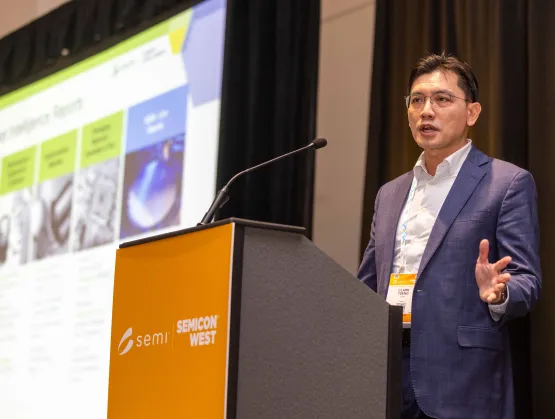
Held at the Moscone Center in San Francisco on October 12, SEMI’s annual Market Symposium kicked off SEMICON West 2026, setting the tone of the show for the week. The Market Symposium was hosted by Clark Tseng, senior director of SEMI Market Intelligence.
The agenda focused on the pressing issues facing the semiconductor industry, enabling the leading analysts and strategists to gain insight into the drivers influencing the semiconductor industry and to guide the day-to-day decisions needed to grow their businesses. While the 2025 symposium focused on the geopolitical landscape, trade policy, and AI-driven investment, the 2026 talks centered on the influence that AI is having on the semiconductor industry, and how it will drive the industry and economics past the $1.5 trillion mark to $3 trillion in revenue over the next decade.
This year’s topics covered how semiconductors are building the critical infrastructure of AI, and what to expect in the near future, from chip types to power consumption to how AI is influencing the global engineering and supply chain—and, of course, what types of revenue the industry might expect as AI continues to scale.
Speakers and talk titles this year included
- Bill J. Wiseman – McKinsey & Company
“Beyond Moore’s Law to Win the Race for AI Inference” - Duncan Meldrum – Hilltop Economics
“Macroeconomic Cross Currents: Are Semiconductors Vulnerable?” - Kunjan Sobhani – Bloomberg Intelligence
“AI Demand in the Next Semiconductor Cycle: GPU, ASICS and Beyond” - Jean-Christophe Eloy – Yole Group
“Powering the Next Phase of AI: The Role of Next-Generation Chips in Driving Industry Transformation” - Syed Alam – McKinsey & Company
“Building the Backbone of the AI Revolution: The Semiconductor Technologies Powering Next-Generation Data Centers” - Joseph C. Fitzgerald – Boston Consulting Group (BCG)
“Scaling Artificial Intelligence, Reshaping Supply: How AI Is Transforming Semiconductor Demand, Engineering, and Global Footprints” - Clark Tseng – SEMI
“AI Demand Meets Manufacturing Reality: Capacity, Equipment, and Supply Chain Outlook”
Economic Influences
As the talk titles suggest, the semiconductor market is being driven by the economics of AI. Clark Tseng and Duncan Meldrum pointed out that AI capital spending is driven by the top four hyperscaler companies. It is estimated that they will spend $750 billion in 2026 on data centers. The total market will be somewhat higher, as was highlighted by Kunjan Sobhani, suggesting the total capex for data centers would be $1.2 trillion in the US by 2027.
According to Meldrum, economic growth is facing two competing forces moving in opposite directions. Inflation is having a negative impact, and AI is having a positive impact. Meldrum's research on AI shows that it is steadily being adopted, but companies are not seeing measurable results they can talk about. He sees a strong continuing AI investment in the U.S., with the risks being changes in policy or disruptions by society as the buildout continues. This suggests that AI will continue its robust growth for at least the near future, with Sobhani predicting a $2.8 trillion total available market (TAM) in 2030, which also includes behind-the-grid power requirements.
The Dynamics and Drivers of AI
The speakers agreed that the industry is moving into the agentic AI era, with inference becoming the dominant driver of AI growth and models for the foreseeable future. Bill Wiseman believes that as AI moves into the agentic era, it will further reshape AI demand. Wiseman’s colleague Syed Alam pointed out that inference will account for 42% of AI demand in 2030. Strong token demand will drive chips, data centers, and power exponentially over the next several years, according to Wiseman, Alam, Sobhani, and Joseph Fitzgerald.
This will place a tremendous strain on the industry as it struggles to keep pace with the demand. Fitzgerald pointed out that AI demand is exceeding supply by 60%. Wiseman stated that AI is growing exponentially while supply, or current processes, are growing linearly, and each of the speakers gave thoughts on ways to deal with the bottlenecks and cost. There is a consensus that the cost per token per joule needs to come down considerably. To achieve lower token cost, the speakers agreed that the industry needs to think differently. Alam suggested using six interconnecting dimensions that will drive a systems-level approach for the future of AI.
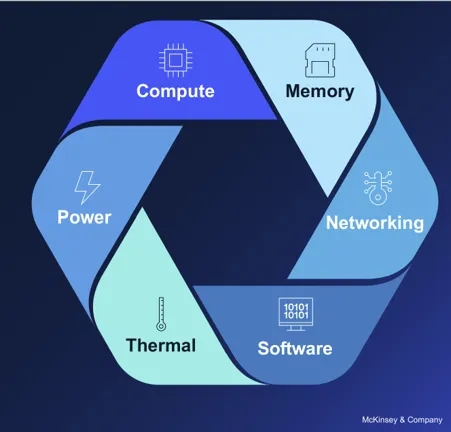
By addressing each of these six dimensions as an interconnected system, the industry can address and reach solutions for the pressing issues challenging AI growth.
Wiseman had slightly different ideas regarding the approach to meeting demand. Using a Peter Drucker quote—"The greatest danger in times of turbulence is not the turbulence; it is to act with yesterday’s logic”—Wiseman then summarized: AI is growing exponentially, and the supply chain is linear. The industry needs visionary thinking that is not business as usual but instead challenges the fundamentals of how integrated circuits currently work together to achieve the needed growth.
Practical Use of AI and Supply Chain
Fitzgerald dealt with some of the more practical aspects of how AI is transforming design. AI has demonstrated gains particularly in product design and design verification. The process moves from sequential to continuous, and engineers are used for final validation, where judgment is required. It is crucial to explore model and agent costs, as they are coming down and differ by model, and the cost savings can be significant.
Fitzgerald also shared information on the supply chain, which is shifting due to tariffs, geopolitical concerns, and the host-nation environment. He concluded by noting that the supply chain will not reset; this means that supply chain leaders should continue to optimize for regional networks through 2030, and likely beyond. The integrated global supply chain will not return. Regional hubs are replacing it, and winners will pick a clear position, commit early, and execute with discipline
Now, down to why the symposium is a must-attend event: the industry outlook.
The AI and Semiconductor Outlook
It's no secret AI is driving the semiconductor industry to new heights. How the industry thinks about forecasting is changing to gigawatts (GW) and tokens per joule. The rapid increase in AI activity and models, along with the rising average selling prices (ASP) of DRAM and accelerators, has made forecasting a moving target, according to Jean-Christophe Eloy.
In 2031, the AI market is estimated to be demanding between 245-300 GW of power, according to Fitzgerald and Alam. The high side will see an accelerated market; the low side of 245 GW will be constrained by power and memory supply. AI inference is expected to be the key growth driver, with inference accounting for 70% of AI in 2025, growing to 90% of AI compute in 2040, according to Wiesman.
This will drive a $2.8 trillion data center TAM, which does not include China, according to Sobhani. He also reported that the accelerator market, which includes GPUs and high-bandwidth memory (HBM), will grow from $400 billion in 2026 to $1.4 trillion in 2030. GPUs and ASICs will expand together in this market. Eloy is in close agreement, citing $464 billion in data center processor revenue in 2026, which includes GPUs, CPUs, networking, and ASICs. This expands to $1,631 billion in 2030.
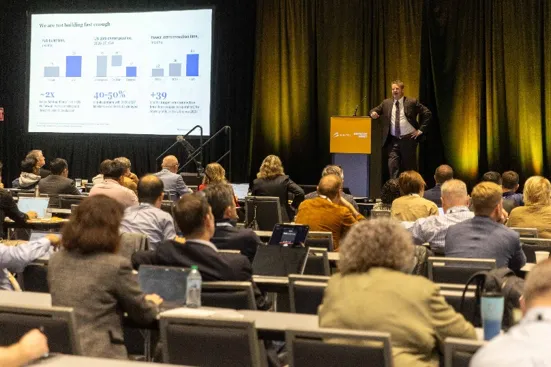 Total semiconductor chip revenue in 2026 is forecast to be $1.5 trillion by SEMI and $1.7 trillion by Yole. As mentioned earlier, these are revisions from Q2, and the increases are driven by the rapidly growing ASP of DRAM, as well as accelerators. The market for 2030 is forecast to be $2.3 trillion by SEMI; Yole’s prediction is $3.5 trillion. While the bulk of the growth is attributed to accelerators and HBM, according to Yole, power semiconductors are expected to see significant growth—from $15,000 per AI rack to $100,000 by 2030.
To drive this growth in semiconductors, SEMI forecasts that 300mm equipment spending will grow from $149 billion in 2026 to $227 billion in 2029, thanks to double-digit growth each year over the time period. The global wafer fab equipment market will rise from $117 billion in 2025 to $220 billion in 2028. Foundry/logic remains the largest segment, increasing from $65.6 billion to $116 billion as AI/HPC and advanced-node ramps continue. DRAM investment expands strongly, reaching $63 billion by 2028, supported by HBM and advanced-node migration and capacity expansion. The growth in AI is also driving packaging and assembly to new heights. Growing from $6.1 billion to 10 billion in $2028. Materials are expected to grow in 2026 and 2027 by 12.85 and 11.4%, reaching $92 billion in 2028.
Wrap-up
The SEMI Market Symposium laid out the industry journey that AI is piloting. While there are discussions of a bubble, the information shared suggests strong growth for the semiconductor industry through 2030, with semiconductor revenue potentially surpassing the $3 trillion mark by then. Equipment and material revenues will keep pace, albeit at a slightly slower growth rate due to market dynamics.
SEMI would like to thank Market Symposium speakers and attendees for their participation at the SEMICON West 2026. For additional market insights, explore the latest SEMI Market Intelligence reports, covering historical reporting, actionable foresight into emerging trends, and technology investments to make confident, forward-looking decisions across the semiconductor and microelectronics value chain.
Please join us in Phoenix on March 29 for the SEMI Market Symposium at SEMICON West 2027.
Dean Freeman is Technology Advisor at Bodewell Group.


