


“Every working family in America knows how hard it is today to find affordable childcare or early childhood education.” – U.S. Senator Bernie Sanders
“Finding solutions to improve affordability of childcare is very much an overall workforce issue.” – U.S. Senator Chuck Grassley
The semiconductor industry will need more than a million new workers to fuel its anticipated growth toward $1 trillion in economic impact by the early 2030s. The types of jobs available within the industry will be as varied and diverse as will the people needed to fill them. This presents an extraordinary opportunity to provide Americans with access to meaningful economic opportunities and pathways to lifelong careers.
Identifying, recruiting, and training these many workers will require a new level of partnership between industry, academia, workforce development networks, and more. Retention of those workers – and employees currently in the industry – is an equally significant challenge. Key to solving the retention problem is childcare – affordable, accessible, and quality childcare for all working parents.
About 40% of the nation’s workforce are parents with children under the age of 18, and about 11% are parents with children under 5 years old. According to a study by the National Women’s Law Center, 23% of families cannot find or pay for care.
Only 12% of U.S. companies provide childcare benefits, and 1 in 4 American parents have been forced to quit their job or leave their education pathways due to a lack of affordable, accessible, and quality child care. More than 50% of Americans live in a “childcare desert” – meaning that for every licensed childcare slot, there are three children who need that slot. All of this equates to huge losses: taxpayers lose $21 billion each year in lower tax revenue; employers lose $23 billion each year due to childcare challenges; and families lose $73 billion a year due to insufficient childcare.
 Companies alone cannot solve the childcare crisis. It will require the partnership of government, industry, advocates, providers, and more. One significant step the federal government has made in improving childcare systems in America is requiring childcare plans from companies who apply for more than $150 million in funding from the CHIPS & Science Act of 2022 – and strongly encouraging all applicants to include them regardless of funding request amounts. This requirement has shown early promise and has shifted the conversation around childcare, even for semiconductor companies not receiving CHIPS funding.
Many chip companies reached out to the SEMI Foundation, SEMI’s nonprofit workforce development arm, seeking support for creating or strengthening company workforce development plans and equity strategies for their CHIPS applications. This led to requests for support for childcare plans as well. To address this need, the SEMI Foundation collaborated with childcare experts - policymakers, providers, and consortia – to best advise companies.
Through this work, SEMI Foundation and the consulting firm Policy Equity Group became thought partners in helping SEMI member companies create stronger childcare benefits and support stronger childcare systems nationwide. This work, called Chips & Childcare, is in partnership with the W.K. Kellogg Foundation and David and Lucile Packard Foundation through the Investing in America Child Care Partnership.
Our work is to not just help families and companies thrive, but to truly understand the problem and find both proven and creative solutions. Why is it so difficult to find affordable, accessible, and quality childcare? Why is childcare such a critical component of workforce development, particularly to the semiconductor industry? Michelle Williams, Executive Director of the SEMI Foundation, sat down with Jeff Capizzano, President and Founder of Policy Equity Group, to ask these questions.
Williams: Jeff, tell me about Policy Equity Group and the company’s mission.
Capizzano: The Policy Equity Group is an early childhood consulting firm. Our main office is located on Capitol Hill in Washington, D.C., but we have staff across the country. We spend our days working with policymakers, advocates, companies, early childhood providers, and families on ways to improve the quality of early care and education and to make it more accessible and affordable to families.
I started the Policy Equity Group to help advocates and to be a bridge between stakeholders and policymakers. Now, we spend our days trying to leverage currently existing policy (like the CHIPS Act), and advocating for new policies that improve the access, affordability, and quality of early care and education programs.
Williams: What is the state of childcare in this country?
Capizzano: The childcare sector is in bad shape. Childcare is expensive, hard to find, and often not of sufficient quality to promote a child’s development and learning. When parents can find childcare, it might not be in the ideal location or type of facility, or meet their scheduling needs.
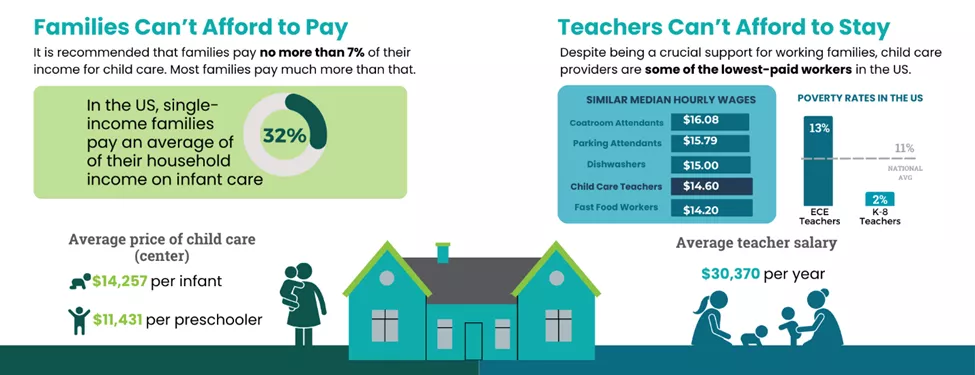
At the heart of the issue is the fact that childcare is a very difficult business model to sustain. Because it involves caring for children as young as six weeks old, it is heavily regulated to ensure that children are healthy and safe while in care. And rightly so. The most important regulation is the number of children that can be cared for per teacher in a childcare setting. At the same time, these regulations make it very difficult for childcare businesses to generate enough revenue based on what parents can afford to pay. This is why you see low pay in the profession, high turnover within the childcare workforce, and a low supply of care, particularly for children younger than three. Researchers at the University of California, Berkeley have a saying: “Families can’t afford to pay, teachers can’t afford to stay.”
Source: Policy Equity Group
Williams: You’ve talked about “childcare deserts”. Tell me more about that term. Are there “deserts” in the three states where we are working together – Arizona, Michigan, and Ohio?
Capizzano: In the early childhood field, we refer to childcare deserts as a specific geographic area where childcare is scarce. The technical definition is a census tract where there are more than three children under age five to one licensed childcare slot. It’s an imperfect measure but is a decent indicator of where the demand for childcare has the potential to far exceed the capacity. Arizona, Ohio, and Michigan have childcare deserts. According to the research, nearly half of families in Arizona live in a childcare desert, compared to 44% of families in Michigan, and 39% in Ohio. Increasing childcare capacity is going to be one of the major challenges of our work with semiconductor companies in these states.
Williams: How does the availability – or lack thereof – of affordable, accessible, and quality childcare affect today’s workers?
Capizzano: The lack of access to affordable, quality childcare has a profound impact on workers. First, when childcare is difficult to access, it has an impact on labor force participation, particularly among women. For example, in the childcare desert areas that I talked about, the labor force participation rates for women are lower (3% on average) than other areas. Equally important, breakdowns in childcare arrangements among workers cause them to miss work, come in late or leave early, be distracted at work, or leave the workforce altogether. The U.S. Chamber of Commerce Foundation has done a good job of documenting the economic losses to businesses and to state economies, and the losses total billions of dollars annually for families, companies, and federal and state budgets.
Williams: We don’t know much about the quality or extent of childcare offerings in the semiconductor industry. The studies I’ve found indicate that we are below the national average in offering childcare benefits – indeed, perhaps as few as 8% of semiconductor companies offer these benefits. SEMI Foundation conducted an informal survey of some members and found that of the small number who offered childcare benefits, fewer than 5% of employees who were parents actually use those benefits. Can you explain why this might be?
Capizzano: I can’t speak specifically to the semiconductor industry (yet), but I know from other sectors that I have worked in that companies have not taken the time to really understand their employees’ childcare needs. As every parent who uses childcare knows, the decision of where to place your child in care can be complicated. Factors involved in this choice include family structure (is there a non-working spouse or relative available), supply, cost, and preference. A company should understand their employees’ childcare needs and preferences before creating a benefits package. Clearly, with a 5% take-up rate in benefits, it’s either an awareness issue or the benefits are not meeting true childcare needs of employees.
Wiliams: The SEMI Foundation and Policy Equity Group have demonstrated the value of bringing together industry and expert childcare consultants who could help companies and their proximate communities build stronger childcare benefits and systems, rooted in research and informed by best practices. Talk a bit about our collaboration – where it is happening, what the process looks like, what the results will be, and how we hope to amplify our findings and our successes.
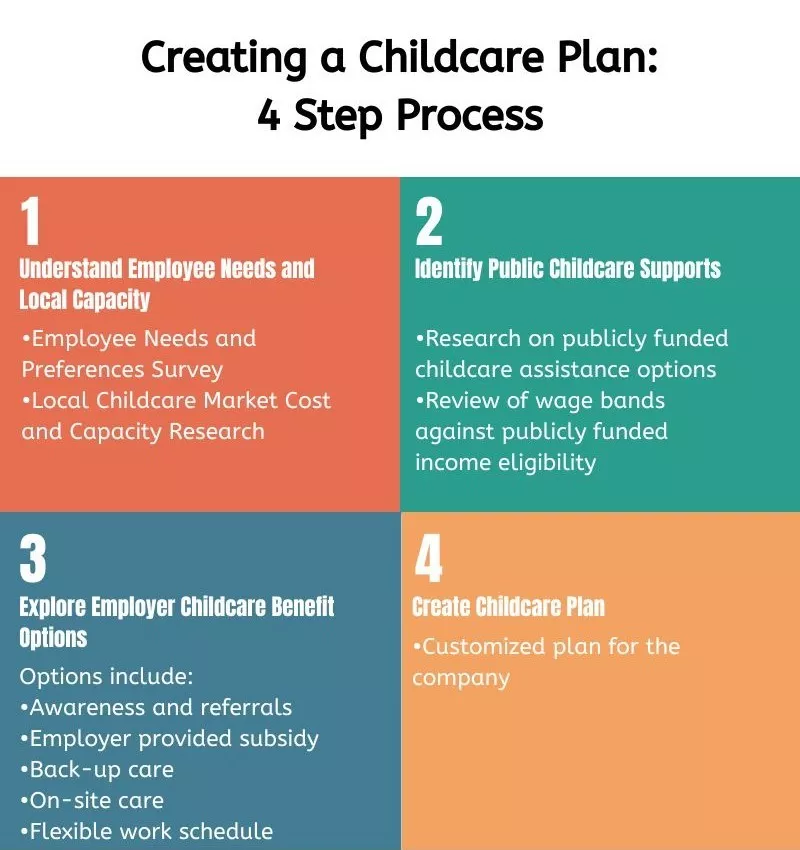
Capizzano: Having a team that knows the ins and outs of both the semiconductor and childcare sectors is a recipe for success. On the childcare side, when we work with companies, we take them through a four-step process to get them to an actionable childcare plan.
Source: Policy Equity Group
We start by working to better understand the childcare needs and preferences of employees and the capacity of the local childcare markets to meet those needs. We survey the employees and then conduct a market analysis to understand the extent to which the childcare supply in the market fits with the needs and preferences of employees.
The second step is what we call a “last dollar in” analysis to determine what publicly funded childcare options could be accessed before companies make their own investments in childcare.
In the third step, we explore different childcare options for the employer. These options include increasing awareness of what the company is already offering or childcare support in the community, helping to make childcare more affordable through stipends, and leveraging potential tax incentives.
Finally, we weave together what we’ve learned to create a childcare plan that is customized and actionable, and that responds to the diversity of families’ needs and preferences, the current market context, and what makes the most sense for the company from a budget and capacity perspective.
Williams: If you had a magic wand, what top two things would you change about how the U.S. approaches childcare?
Capizzano: First, I would change how childcare is perceived by policymakers and U.S. society overall. The research on brain development is very compelling. The birth-to-five period is the most consequential phase of human development and the experiences of children in those early years wire their brains and bodies in a way that impacts the rest of their lives. Yet, society places little value on the programs and teachers that care for and educate our youngest children. Nothing upsets an early childhood teacher more than being called a “babysitter,” and yet this is often how they are perceived. This perception must change. A child’s experiences in a childcare/early education setting is the first and arguably the most important step in a child’s educational journey. We all need to understand that.
Second, I would change how childcare is financed. The childcare system consists of several federal and state programs, but it is primarily financed by the tuition that parents pay. As I mentioned, this creates an unsustainable business model where parents can only pay so much for childcare, and childcare providers can only generate so much revenue per teacher because of the regulations that keep children safe. This causes overall low quality of programs, low wages for teachers, and high teacher turnover.
As a field, we are starting to better understand what it really costs to pay for high-quality childcare that meets parents’ needs and promotes child development. The amount of funding we need to create a high-quality childcare system is going to require significant public financing. The country’s most noted economists, including the Noble Laureate James Heckman, agree that this is a good investment.
Williams: What do you want semiconductor leadership teams to know about childcare?
Capizzano: I would want them to know that childcare is vital to the success of their business. It provides access to a large and diverse labor pool that would otherwise be unavailable if it weren’t for childcare. It makes for more productive workers, reduces stress in the workplace, and supports recruitment and retention of the most talented workers.
And like any other aspect of the business, you must be strategic and data-driven when you address the childcare needs of employees.
We would love to help.

Jeffrey Capizzano is President of the Policy Equity Group, LLC, a consultancy that helps organizations, childcare providers, and families leverage early childhood policies and programs and become stronger advocates for better early childhood systems. Mr. Capizzano is a nationally known advocate and researcher with both private and public sector experience. Prior to founding Policy Equity Group, he served as a Senior Policy Advisor at the Administration for Children and Families within the U.S. Department of Health and Human Services.
Michelle Williams is Executive Director of the SEMI Foundation.


