downloadGroupGroupnoun_press release_995423_000000 copyGroupnoun_Feed_96767_000000Group 19noun_pictures_1817522_000000Member company iconResource item iconStore item iconGroup 19Group 19noun_Photo_2085192_000000 Copynoun_presentation_2096081_000000Group 19Group Copy 7noun_webinar_692730_000000Path
Skip to main content
Default Banner Image

CHIPS Act

“Every working family in America knows how hard it is today to find affordable childcare or early childhood education.” – U.S. Senator Bernie Sanders“Finding solutions to improve affordability of childcare is very much an overall workforce issue.” – U.S. Senator Chuck GrassleyThe semiconductor industry will need more than a million new workers to fuel its anticipated growth toward $1 trillion in economic impact by the early 2030s. The types of jobs available within the industry will be as varied and diverse as will the people needed to fill them. This presents an extraordinary opportunity to provide Americans with access to meaningful economic opportunities and pathways to lifelong careers. Identifying, recruiting, and training these many workers will require a new level of partnership between industry, academia, workforce development networks, and more. Retention of those workers – and employees currently in the industry – is an equally significant challenge. Key to solving the retention problem is childcare – affordable, accessible, and quality childcare for all working parents. About 40% of the nation’s workforce are parents with children under the age of 18, and about 11% are parents with children under 5 years old. According to a study by the National Women’s Law Center, 23% of families cannot find or pay for care. Only 12% of U.S. companies provide childcare benefits, and 1 in 4 American parents have been forced to quit their job or leave their education pathways due to a lack of affordable, accessible, and quality child care. More than 50% of Americans live in a “childcare desert” – meaning that for every licensed childcare slot, there are three children who need that slot. All of this equates to huge losses: taxpayers lose $21 billion each year in lower tax revenue; employers lose $23 billion each year due to childcare challenges; and families lose $73 billion a year due to insufficient childcare. Companies alone cannot solve the childcare crisis. It will require the partnership of government, industry, advocates, providers, and more. One significant step the federal government has made in improving childcare systems in America is requiring childcare plans from companies who apply for more than $150 million in funding from the CHIPS Science Act of 2022 – and strongly encouraging all applicants to include them regardless of funding request amounts. This requirement has shown early promise and has shifted the conversation around childcare, even for semiconductor companies not receiving CHIPS funding.Many chip companies reached out to the SEMI Foundation, SEMI’s nonprofit workforce development arm, seeking support for creating or strengthening company workforce development plans and equity strategies for their CHIPS applications. This led to requests for support for childcare plans as well. To address this need, the SEMI Foundation collaborated with childcare experts - policymakers, providers, and consortia – to best advise companies. Through this work, SEMI Foundation and the consulting firm Policy Equity Group became thought partners in helping SEMI member companies create stronger childcare benefits and support stronger childcare systems nationwide. This work, called Chips Childcare, is in partnership with the W.K. Kellogg Foundation and David and Lucile Packard Foundation through the Investing in America Child Care Partnership.Our work is to not just help families and companies thrive, but to truly understand the problem and find both proven and creative solutions. Why is it so difficult to find affordable, accessible, and quality childcare? Why is childcare such a critical component of workforce development, particularly to the semiconductor industry? Michelle Williams, Executive Director of the SEMI Foundation, sat down with Jeff Capizzano, President and Founder of Policy Equity Group, to ask these questions.Williams: Jeff, tell me about Policy Equity Group and the company’s mission.Capizzano: The Policy Equity Group is an early childhood consulting firm. Our main office is located on Capitol Hill in Washington, D.C., but we have staff across the country. We spend our days working with policymakers, advocates, companies, early childhood providers, and families on ways to improve the quality of early care and education and to make it more accessible and affordable to families. I started the Policy Equity Group to help advocates and to be a bridge between stakeholders and policymakers. Now, we spend our days trying to leverage currently existing policy (like the CHIPS Act), and advocating for new policies that improve the access, affordability, and quality of early care and education programs. Williams: What is the state of childcare in this country? Capizzano: The childcare sector is in bad shape. Childcare is expensive, hard to find, and often not of sufficient quality to promote a child’s development and learning. When parents can find childcare, it might not be in the ideal location or type of facility, or meet their scheduling needs. At the heart of the issue is the fact that childcare is a very difficult business model to sustain. Because it involves caring for children as young as six weeks old, it is heavily regulated to ensure that children are healthy and safe while in care. And rightly so. The most important regulation is the number of children that can be cared for per teacher in a childcare setting. At the same time, these regulations make it very difficult for childcare businesses to generate enough revenue based on what parents can afford to pay. This is why you see low pay in the profession, high turnover within the childcare workforce, and a low supply of care, particularly for children younger than three. Researchers at the University of California, Berkeley have a saying: “Families can’t afford to pay, teachers can’t afford to stay.” Source: Policy Equity GroupWilliams: You’ve talked about “childcare deserts”. Tell me more about that term. Are there “deserts” in the three states where we are working together – Arizona, Michigan, and Ohio?Capizzano: In the early childhood field, we refer to childcare deserts as a specific geographic area where childcare is scarce. The technical definition is a census tract where there are more than three children under age five to one licensed childcare slot. It’s an imperfect measure but is a decent indicator of where the demand for childcare has the potential to far exceed the capacity. Arizona, Ohio, and Michigan have childcare deserts. According to the research, nearly half of families in Arizona live in a childcare desert, compared to 44% of families in Michigan, and 39% in Ohio. Increasing childcare capacity is going to be one of the major challenges of our work with semiconductor companies in these states. Williams: How does the availability – or lack thereof – of affordable, accessible, and quality childcare affect today’s workers? Capizzano: The lack of access to affordable, quality childcare has a profound impact on workers. First, when childcare is difficult to access, it has an impact on labor force participation, particularly among women. For example, in the childcare desert areas that I talked about, the labor force participation rates for women are lower (3% on average) than other areas. Equally important, breakdowns in childcare arrangements among workers cause them to miss work, come in late or leave early, be distracted at work, or leave the workforce altogether. The U.S. Chamber of Commerce Foundation has done a good job of documenting the economic losses to businesses and to state economies, and the losses total billions of dollars annually for families, companies, and federal and state budgets. Williams: We don’t know much about the quality or extent of childcare offerings in the semiconductor industry. The studies I’ve found indicate that we are below the national average in offering childcare benefits – indeed, perhaps as few as 8% of semiconductor companies offer these benefits. SEMI Foundation conducted an informal survey of some members and found that of the small number who offered childcare benefits, fewer than 5% of employees who were parents actually use those benefits. Can you explain why this might be?Capizzano: I can’t speak specifically to the semiconductor industry (yet), but I know from other sectors that I have worked in that companies have not taken the time to really understand their employees’ childcare needs. As every parent who uses childcare knows, the decision of where to place your child in care can be complicated. Factors involved in this choice include family structure (is there a non-working spouse or relative available), supply, cost, and preference. A company should understand their employees’ childcare needs and preferences before creating a benefits package. Clearly, with a 5% take-up rate in benefits, it’s either an awareness issue or the benefits are not meeting true childcare needs of employees. Wiliams: The SEMI Foundation and Policy Equity Group have demonstrated the value of bringing together industry and expert childcare consultants who could help companies and their proximate communities build stronger childcare benefits and systems, rooted in research and informed by best practices. Talk a bit about our collaboration – where it is happening, what the process looks like, what the results will be, and how we hope to amplify our findings and our successes. Capizzano: Having a team that knows the ins and outs of both the semiconductor and childcare sectors is a recipe for success. On the childcare side, when we work with companies, we take them through a four-step process to get them to an actionable childcare plan.Source: Policy Equity GroupWe start by working to better understand the childcare needs and preferences of employees and the capacity of the local childcare markets to meet those needs. We survey the employees and then conduct a market analysis to understand the extent to which the childcare supply in the market fits with the needs and preferences of employees.The second step is what we call a “last dollar in” analysis to determine what publicly funded childcare options could be accessed before companies make their own investments in childcare. In the third step, we explore different childcare options for the employer. These options include increasing awareness of what the company is already offering or childcare support in the community, helping to make childcare more affordable through stipends, and leveraging potential tax incentives. Finally, we weave together what we’ve learned to create a childcare plan that is customized and actionable, and that responds to the diversity of families’ needs and preferences, the current market context, and what makes the most sense for the company from a budget and capacity perspective.Williams: If you had a magic wand, what top two things would you change about how the U.S. approaches childcare?Capizzano: First, I would change how childcare is perceived by policymakers and U.S. society overall. The research on brain development is very compelling. The birth-to-five period is the most consequential phase of human development and the experiences of children in those early years wire their brains and bodies in a way that impacts the rest of their lives. Yet, society places little value on the programs and teachers that care for and educate our youngest children. Nothing upsets an early childhood teacher more than being called a “babysitter,” and yet this is often how they are perceived. This perception must change. A child’s experiences in a childcare/early education setting is the first and arguably the most important step in a child’s educational journey. We all need to understand that. Second, I would change how childcare is financed. The childcare system consists of several federal and state programs, but it is primarily financed by the tuition that parents pay. As I mentioned, this creates an unsustainable business model where parents can only pay so much for childcare, and childcare providers can only generate so much revenue per teacher because of the regulations that keep children safe. This causes overall low quality of programs, low wages for teachers, and high teacher turnover. As a field, we are starting to better understand what it really costs to pay for high-quality childcare that meets parents’ needs and promotes child development. The amount of funding we need to create a high-quality childcare system is going to require significant public financing. The country’s most noted economists, including the Noble Laureate James Heckman, agree that this is a good investment. Williams: What do you want semiconductor leadership teams to know about childcare?Capizzano: I would want them to know that childcare is vital to the success of their business. It provides access to a large and diverse labor pool that would otherwise be unavailable if it weren’t for childcare. It makes for more productive workers, reduces stress in the workplace, and supports recruitment and retention of the most talented workers. And like any other aspect of the business, you must be strategic and data-driven when you address the childcare needs of employees.We would love to help. Jeffrey Capizzano is President of the Policy Equity Group, LLC, a consultancy that helps organizations, childcare providers, and families leverage early childhood policies and programs and become stronger advocates for better early childhood systems. Mr. Capizzano is a nationally known advocate and researcher with both private and public sector experience. Prior to founding Policy Equity Group, he served as a Senior Policy Advisor at the Administration for Children and Families within the U.S. Department of Health and Human Services.Michelle Williams is Executive Director of the SEMI Foundation.
Read More
Leaders in the semiconductor industry are finding ways to balance rapid demand growth with strategies to mitigate the risks of geopolitical uncertainty and a complex supply chain.At the CxO Summit during SEMICON Europa, industry leaders gathered to share insights into the immense opportunities ahead for the semiconductor sector, as well as the challenges that could impede growth. Laith Altimime, President of SEMI Europe, highlighted how discussions last year centered on reaching $1 trillion in global sales by 2030. “The conversation today is about how far above $1 trillion we will be in 2030,” said Altimime. “Artificial intelligence is an amazing and exciting technology, and the semiconductor industry is at the heart of it.”Laith Altimime, President, SEMI EuropeAjit Manocha, President and CEO of SEMI, described the current state of the semiconductor industry with one word – “unprecedented.” Emphasizing quantum computing as the next growth driver after AI, Manocha urged leaders to prepare for the next landmark - $4 trillion in global sales by 2040. However, the challenges facing the industry are equally unprecedented. Manocha identified four key obstacles: geopolitical volatility, the Net Zero challenge, the competition for top talent, and supply chain disruptions. “We need to work together to solve these challenges – we need unprecedented collaboration,” he explained. Ajit Manocha, President and CEO, SEMIA European Perspective on the Industry’s ChallengesWith the CHIPS Act in the US and the European Union (EU) Chips Act, the industry is also seeing unprecedented governmental engagement. Gustav Kolbe, Acting Director of Enabling and Emerging Technologies at Directorate-General for Communications Networks, Content and Technology of the European Commission, explained that Europe had been deeply impacted by the effect of trade tensions and supply chain disruptions. “In the field of semiconductors, we realized that we cannot keep doing business as usual and expect to achieve more resilience and reduced dependence on non-European supply chains,” Kolbe said. Gustav Kolbe, Acting Director of Enabling and Emerging Technologies, DG CONNECT, European CommissionJari Kinaret, Executive Director of the Chips Joint Undertaking (Chips JU), which is responsible for implementing EU Chips Act programs, described how its projects amplify the effect of EU funding by leveraging matching contributions from member states and participating companies. “This means that our budget of €4 billion actually produces investments in the semiconductor industry of about €11 billion,” he noted. Jari Kinaret, Executive Director, Chips JUThe Chips JU funded projects are designed to position Europe at the forefront of advanced semiconductor technology. Belgium’s imec, for example, is operating a Chips JU pilot line focused on leading-edge semiconductor innovation. Luc Van den hove, President and CEO of imec, highlighted the potential for 3D integration, “We can now combine multiple chips through silicon interposers with very fast connectivity between them. This allows us to build compute platforms which are far larger than what can be made with a single silicon chip,” he explained referring to this approach as “CMOS 2.0.” However, Van den hove warned that Europe cannot achieve its goals alone, emphasizing the complex semiconductor value chain and the need for collaboration. “Self-sufficiency leads to mediocrity,” he warned, advocating for a global approach that leverages the “best of the best.”Luc Van den hove, President and CEO, imecStephan Haferl, Chief Executive Officer of Comet Group, introduced the CA20, a tool designed to improve efficiency and quality in semiconductor manufacturing. The CA20 uses advanced imaging and AI to quickly identify and address production challenges, such as defects in solder bumps, without damaging components. Now fully automated, it integrates smoothly into factory workflows, providing real-time information to help manufacturers maintain high standards and increase production yields. This innovation highlights the role of new technologies in overcoming key obstacles and driving progress in the semiconductor industry.Left to right: Isabella Drolz, Vice President Marketing Product Strategy, Comet Yxlon; Laith Altimime, President, SEMI Europe; Stephan Haferl, Chief Executive Officer, Comet Group; and Dionys van de Ven, President, Comet YxlonCarlos Mazure, Chief Strategy Officer at Institute of Microelectronics – A*STAR in Singapore, illustrated this point by highlighting the institute’s focus on advanced packaging, a key Singaporean strength. “We have built a state-of-the-art 300mm prototyping line, enabling companies to implement wafer-to-wafer and chip-to-wafer bonding as well as fanout chip packaging,” Mazure said. Carlos Mazure, Chief Strategy Officer, Institute of Microelectronics – A*STARTurning back to Europe, Pierre Barnabé, CEO of Soitec, highlighted materials science as a regional strength. Soitec’s engineered substrates are driving energy efficiency breakthroughs in electronic, acoustic, and photonic applications. “We can bond anything to anything, creating advanced substrates for any active layer,” Barnabé explained. Pierre Barnabé, CEO, SoitecKai Beckmann, Member of the Executive Board and CEO Electronics at Merck KGaA, Darmstadt, Germany, also emphasized the role of materials in enabling sustainable growth. “The semiconductor industry faces a challenge with the contribution of process gases to its total greenhouse gas emissions. We hope to solve the problem by using AI to support materials research, and to design new molecules – an approach we have learned from the pharmaceuticals industry,” Beckmann shared. Kai Beckmann, Member of the Executive Board and CEO Electronics, Merck KGaA, Darmstadt, GermanyCollaboration Strengthens the Semiconductor Supply Chain Despite the breadth of enabling technologies emerging from Europe, the rapid growth in semiconductor demand has not always been matched by a secure supply. Barbara Frenkel, Member of the Executive Board Purchase at Porsche, shared that the company is collaborating with the industry to improve its access to the chips needed for automotive electrification. This includes joining industry groups such as the SEMI Global Automotive Advisory Council (GAAC) and, as she said, “learning your language.” Frenkel added, “Porsche aims to emulate Apple’s approach with Intel and Motorola to drive innovation – we will do the same with suppliers of automotive chips.”Barbara Frenkel, Member of the Executive Board Purchase, PorscheAnother solution to supply constraints is to widen the supply pipeline. John Behnke, General Manager for Smart Manufacturing at Inficon, described how smart technology can significantly improve efficiency and output. “A semiconductor fab is 100 times more complicated than anything else in the world – it is a mathematical nightmare to model it. That gives massive opportunities for improved productivity if we can implement smart control technologies,” Behnke explained. John Behnke, General Manager for Smart Manufacturing, InficonThe Challenge of Achieving Sustainable GrowthWhile the prospect of exceeding $1 trillion in annual sales energizes the industry, there is widespread recognition that growth must not come at the expense of environmental responsibility. As the industry doubles in size in the 2020s, it cannot afford to double its use of resources, such as energy or greenhouse gas emissions. Frédéric Godemel, Executive Vice President for Power Systems and Services at Schneider Electric, shared that the biggest impact on sustainability could come from “energy frugality” – using energy more efficiently. He explained that implementing data fusion in a semiconductor fab – combining detailed analysis of the operation of chillers with external data sets, such as weather conditions to allow for more efficient use – results in energy savings of 10%. “This approach saved costs, reduced CO2 emissions, and provided a financial payback in less than one year,” Godemel said.Frédéric Godemel, Executive Vice President for Power Systems and Services, Schneider ElectricThe value of smart control in fab operations was also highlighted by Katharina Westrich, Global Vice President of Electronics, Semiconductors Simulation Digital Industries at Siemens. She described how Siemens makes digital twins of factories before they are built. “This is an approach that the semiconductor industry can also adopt,” Westrich said. “A digital twin enables more efficient allocation of resources to the fab and sub-fab, allowing simulation of fab operation and optimization of processes and resources.”Katharina Westrich, Global Vice President of Electronics, Semiconductors Simulation Digital Industries, SiemensThe semiconductor industry faces a future full of opportunity, yet also marked by significant obstacles—ones that delegates at the CxO Summit are now better equipped to tackle head-on.On behalf of SEMI, the SEMI Europe team would like to express appreciation to the industry leaders for sharing their visions and readiness to collaborate during the CxO Summit.SEMI ContactCassandra Melvin, Senior Director of Business Development and OperationsEmail: [email protected]
Read More
As more than 400 speakers took the stages at SEMICON West 2024, sustainability and workforce development stood out as two major focus areas. The second day of this year’s CEO Summit keynote program, themed Seizing the Global Opportunities and Challenges Ahead, featured sessions on both topics. One of the first sessions of the day was the Chief Sustainability Officer (CSO) panel discussion, titled Bracing for the Evolving Global Risk for the Semiconductor Ecosystem, moderated by Vice President of SEMI Global Sustainability Programs, Dr. Mousumi Bhat. Later that morning, Shari Liss, Vice President of SEMI Global Workforce Development Programs and Executive Director of the SEMI Foundation, moderated a fireside chat, Advocating for Real Change: Why Inclusion and Belonging Need to be Everyone’s Concern, with Sandra Mahadwar from KLA Corporation. Bhat and Liss were later interviewed for a podcast by Francoise von Trapp of 3D InCites to share additional insights on sustainability and workforce development, respectively. Bhat was also joined by Paul Kelly, COO of the New York Center for Research, Economic Advancement, Technology, Engineering, and Science (NY CREATES). Creating a More Sustainable Semiconductor Industry During their interview, both Bhat and Kelly emphasized that the industry will need to reduce its use of per and polyfluoroalkyl substances (PFAS) to sustainably innovate at today’s nanometer pace. For this reason, Kelly highlighted the importance of learning to balance current production demands with the health of climate.To achieve this balance, they discussed the efforts of the Semiconductor Climate Consortium (SCC). Much of the SCC’s efforts, they said, will focus on driving the industry toward net zero emissions. SEMI and NY CREATES announced a memorandum of understanding (MOU) at SEMICON West 2024 to promote sustainable practices within the industry, with a focus on PFAS reduction. Kelly pointed to the ability of SCC members to test new materials, gases, and chemicals at NY CREATES’ R D facilities in upstate New York to work toward replacing PFAS with more sustainable alternatives. Bhat also shared that this collaboration helps facilitate prototyping, experimentation, and tests and measurements for newer, more sustainable substances.Dr. Mousumi Bhat of SEMI and Dave Anderson of NY CREATES celebrate their organizations’ sustainability MOU at SEMICON West 2024.“The thought leadership comes from the Consortium, and the support on infrastructure comes from NY CREATES,” said Bhat. “This should become a blueprint to solve some of the challenging problems that we have in our industry.” When it comes to reducing emissions, Bhat mentioned two key objectives. The first, she said, is access to clean energy, and the second is the reduction of greenhouse gases. Bhat cited these as the issues that will take the longest for the industry to solve and pointed to the importance of industry collaboration and partnerships to support the needed experimentation. But while partnerships will bring the industry closer to net zero, both Bhat and Kelly cautioned that it won’t be reached overnight. “Much more needs to be done in the industry to reach that net zero goal,” said Kelly. “New chip technologies, new chemicals, and new processes are very much large leaps to achieving that. But right now, even some of the most advanced will only reduce [emissions] by 70%.” To help bridge this gap, Bhat encouraged others to join and participate in the SCC. “Rather than everybody doing a one-to-one experimentation in their own space and spending those resources, I would like to invite anyone that's not part of the climate consortium,” she said. “And [I invite] those that are part of the climate consortium to engage more actively, so that we are all accelerating the journey toward net zero.” Addressing the Talent Shortage This year’s SEMICON West also featured five keynote sessions dedicated to workforce development, as well as a Workforce Development Pavilion that included several talks around diversity, equity, inclusion, and belonging (DEIB). With the estimated one million jobs the industry will need to fill by 2030, Liss shared that every role is needed – from entry level all the way to Ph.D. researchers. “We need to try and bring in as many people as we can over the next few years,” said Liss. “The talent shortage is a global issue, not just a U.S. one.” Shari Liss of SEMI moderated the fireside chat at SEMICON West 2024 with Sandra Mahadwar from KLA Corporation.To begin to close the talent gap, Liss stressed the importance of educating children about the semiconductor industry. “We are just invisible to kids,” she said. “In every part of the globe, they carry chips in their hands all day every day, and they don’t know. So to me, breaking that barrier and making sure kids know about our work as an industry is going to be so critical to making this successful.” Liss also highlighted differences in workforce development programs across the world, noting that what works in one region may not translate to another. For example, apprenticeships are widely embraced in Europe, she said, but they’re a fairly new practice in the U.S. Conversely, she shared that veteran-focused programs wouldn’t work for some regions, but they’re a “powerful win” in the U.S. Each SEMICON show across the world, she shared, includes similar workforce development and DEIB programming, in addition to targeted sessions for students and HR professionals. Companies can interview for open positions at SEMICON shows as well. To learn more about SEMI’s workforce development initiatives and programming, visit semi foundation.org, or check out this overview of DEIB content at SEMICON West 2024. Samer Bahou is director of Marketing Communications at SEMI.
Read More
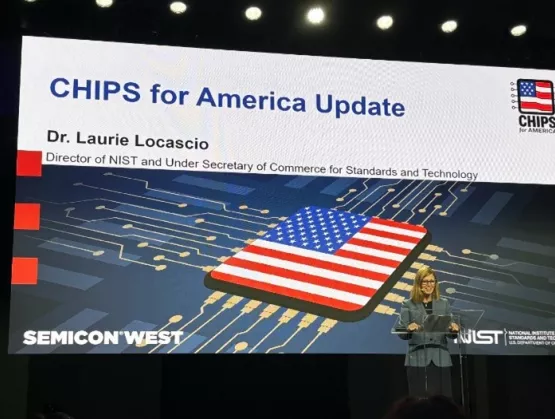
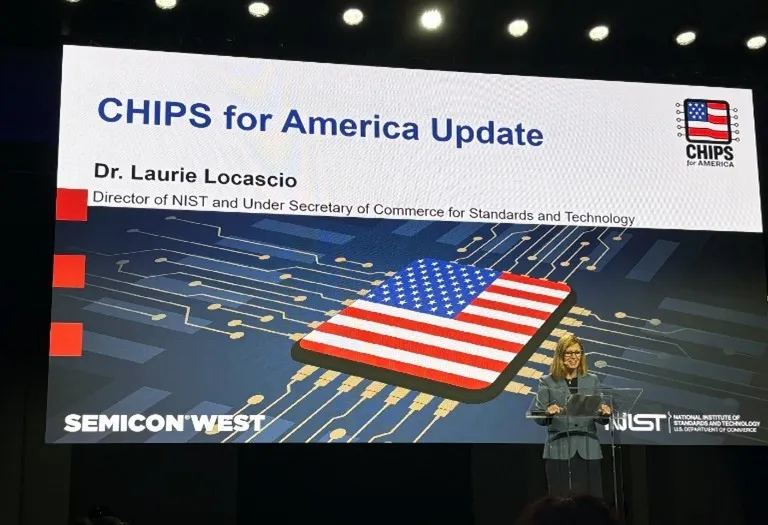
SEMI was honored to welcome U.S. Under Secretary of Commerce for Standards and Technology, Dr. Laurie E. Locascio, to the CEO Summit keynote stage at SEMICON West 2024 on Tuesday, July 9. Locascio, who also serves as the Director of the National Institute of Standards and Technology (NIST), delivered her morning CHIPS Act Update keynote address to a packed room of over 1,000 attendees at the Moscone Center in San Francisco.During her address, Locascio emphasized how far the U.S. chip industry has progressed since 2021. “Prior to 2022 and the passage of the CHIPS and Science Act, the U.S. produced 0% of the world's leading edge chips,” she said. “But now, after these proposed investments, we've changed the global landscape.”Industry Shifts from the CHIPS and Science ActDue to long delays and price increases resulting from supply chain vulnerabilities, Locascio shared that Congress began developing the CHIPS and Science Act with two key goals in mind. The first, she said, was to protect economic security, and the second, was to lower costs for American taxpayers. As part of the CHIPS and Science Act, CHIPS for America was established to advance semiconductor manufacturing in the U.S. CHIPS for America encompasses two offices: The CHIPS Research and Development Office, as well as the CHIPS Program Office - both of which are responsible for implementing CHIPS and Science Act law.CHIPS for America, said Locascio, couldn’t be another procurement program. Instead, it needed to be a purpose-driven approach to build domestic manufacturing capacity. Locascio highlighted that CHIPS for America galvanized several experts from the federal government, R D, and other core areas to work together to revitalize the U.S. semiconductor industry and increase capacity. To achieve this, Locascio pointed to CHIPS for America’s $30 billion in proposed direct funding and $25 billion in proposed direct loans.Locascio also noted diversity of technology as being essential for the American chip industry, citing how Intel, Micron, TSMC, and Samsung have recently expanded in the U.S., with SK Hynix planning to build a fab and R D facility in Indiana. No other economy in the world, she said, has more than two of these companies producing leading edge chips on its shores.“The total public and private investment from our four, leading-edge companies will equal roughly $300 billion between now and the end of the decade, far and away the most investment in new production in the history of the U.S. semiconductor industry,” said Locascio. Industry Investments on the HorizonTo further aid these efforts, Locascio mentioned CHIPS for America’s notice of intent to invest $1.6 billion in an open competition to accelerate advanced packaging domestically and encourage innovation. Funding will be directed toward five key R D areas, including equipment tools, power delivery, connector technology, chiplets, and Electronic Design Automation (EDA), she said. Additionally, Locascio shared that CHIPS for America recently announced its first preliminary memorandum of terms (PMT) to support the upstream supply chain, and shared plans to announce several more PMTs in the future. Lastly, Locascio revealed that CHIPS for America plans to release a model and process for bringing new facilities to life, in partnership with the National Semiconductor Technology Center (NSTC). NSTC members, she said, will gain access to partnership funds and state-of-the-art facilities to support the U.S. semiconductor industry. “Across all these efforts, from manufacturing incentives to research funding, to workforce development efforts, the U.S. must cultivate and build our competitive assets to protect and grow our technological leadership,” said Locascio.In a podcast with Francoise von Trapp of 3D InCites recorded at SEMICON West, Locascio discussed her career background, CHIPS Act investments and the path forward for the semiconductor industry in the U.S. To learn more, check out the podcast interview with 3D InCites. SEMI Global AdvocacyDiscover how SEMI Global Advocacy Public Policy supports the microelectronics industry across trade, taxes, talent, and R D.John Cooney is Vice President of Global Advocacy and Public Policy at SEMI.
Read More