
What SIPS is
SIPS convenes senior leaders from industry, government and academia to turn shared challenges into collaborative growth. Private forums. Real outcomes. Across every major region.
SIPS exists to build partnerships that protect and accelerate growth on our daunting challenges that no single CEO, company or country can address alone.
SIPS Vision: Why Now and Why SEMI
While the industry is expanding and innovating to new heights, rising geopolitical tensions and focus concerns pose risks. SIPS exists to protect and accelerate growth, through partnership no single company or country can deliver alone.
With a network of more than 4,000 companies and fifty years convening the ecosystem, SEMI is the neutral partner both industry and government trust.
Driving Solutions
The summit agendas analyze the status of key industry concerns and progress on solutions with an eye toward optimization.
SIPS Key Pillars include:
 | AI as the organizing lens: imperative connecting every focus. |
 | Energy and critical materials: binding constraints on AI and semiconductor growth and sustainability. |
 | Talent and skills: workforce as a non-negotiable foundation. |
 | EHS and PFAS: priorities for ensuring safe and efficient operations. |
 | Supply chain resilience: the culmination of other pillars, moving the ecosystem from fragility to strategic depth. |
SIPS At A Glance
Hear from an industry leader on how the SIPS platform is advancing the global semiconductor supply chain.
Track record
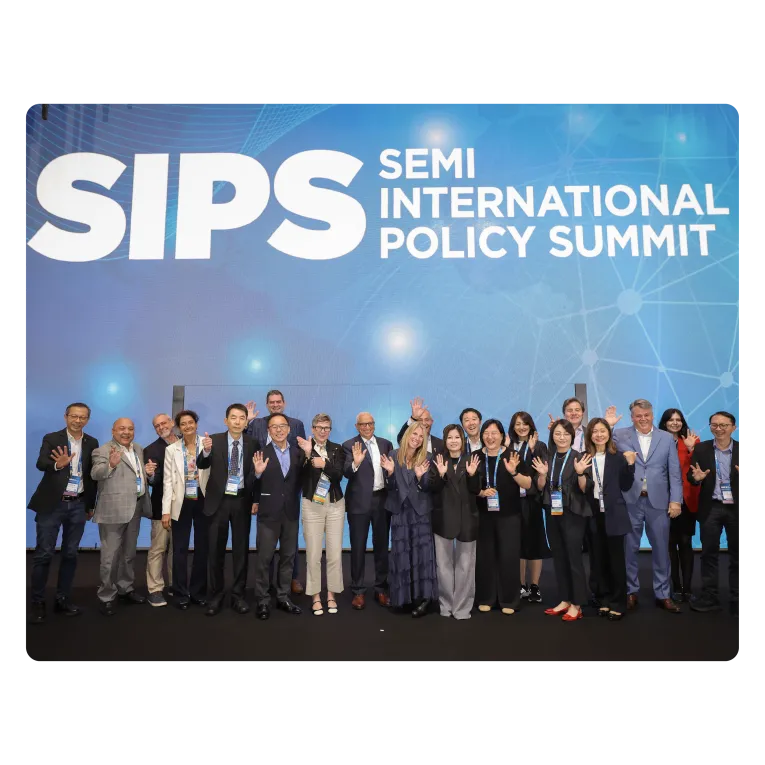
The historic summits have built the shared understanding behind the SIPS Coordinating Council: senior industry, government and academic leaders who guide each summit and hold progress to account.





SIPS Vienna 2026
Collaborative Growth: Advancing Semiconductor Leadership in the AI Era
The fifth SIPS convenes at the historic Hofburg, November 12-13, 2026.
Invited senior leaders will move from dialogue to decision on energy, talent, EHS and supply chain solutions. AI is the lens across every session.
“Our industry is facing challenges that cannot be addressed by any individual CEO, company, or country. The SIPS platform drives unprecedented collaboration across the ‘Quadruple Helix’ of Industry, Government, Academia, and Civil Society.”
Ajit Manocha
SEMI President and CEO


Principles and FAQ
SIPS is held under the Chatham House Rule. Attendees may use what is said, but no one may reveal who said it.
- The event is closed to press and off the record. No external reports are published.
- Participants refrain from negative commentary on any country, politician or policymaker.
1. What is SIPS?
The SEMI International Policy Summit (SIPS) is the global semiconductor industry’s premier platform for sustained dialogue between industry leaders and government officials responsible for shaping semiconductor policy. Through focused summits and working groups, SIPS helps align stakeholders on shared priorities and practical actions that strengthen innovation, resilience, and growth across the global electronics manufacturing supply chain.
2. How does the semiconductor industry address challenges that cross borders?
The industry addresses global challenges through structured collaboration across companies, governments, academia, and civil society. The SEMI International Policy Summit supports this approach by bringing stakeholders together to define common priorities, map potential solutions, and advance coordinated action on complex issues such as workforce development, sustainability, energy use, EHS, PFAS, supply chain resilience, and the impact of AI. It is supported by SEMI’s Global Advocacy work, Regional SIPS Working Groups, and the SIPS Coordinating Council, which convene leaders from key semiconductor ecosystem regions to evaluate progress, identify high-value policy and industry actions, and guide future summit priorities.
3. Who attends SIPS?
SIPS convenes senior leaders from across the global semiconductor ecosystem, including executives from chip design and manufacturing, equipment and materials suppliers, technology companies, government agencies, academia, and civil society. Participants are selected to support candid, cross-sector dialogue on the policy and industry actions needed to address shared challenges and advance the industry’s long-term growth.
4. Why is collaboration between governments and the semiconductor industry especially important now?
The semiconductor industry is positioned for significant growth as chips become increasingly critical to AI, mobility, connectivity, energy systems, and advanced manufacturing. At the same time, geopolitical uncertainty, talent shortages, environmental requirements, and evolving technology demands are creating challenges no single company or country can solve alone. The SEMI International Policy Summit provides a trusted forum to advance the kind of international cooperation needed to secure the industry’s future and the economic and societal benefits it enables.