downloadGroupGroupnoun_press release_995423_000000 copyGroupnoun_Feed_96767_000000Group 19noun_pictures_1817522_000000Member company iconResource item iconStore item iconGroup 19Group 19noun_Photo_2085192_000000 Copynoun_presentation_2096081_000000Group 19Group Copy 7noun_webinar_692730_000000Path
Skip to main content
Default Banner Image

Market Intelligence

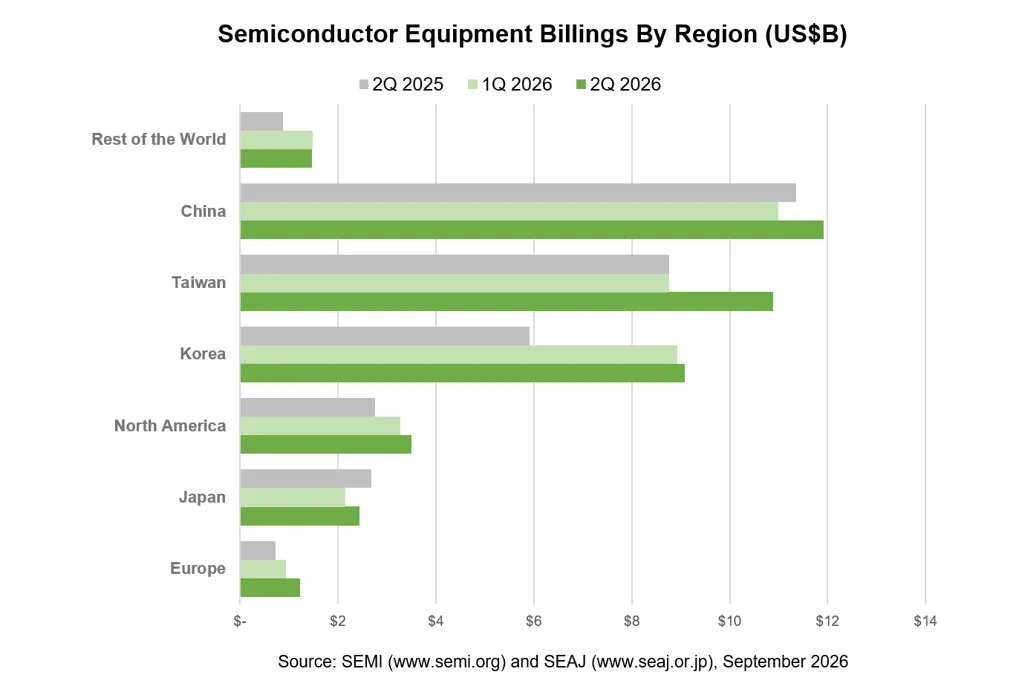
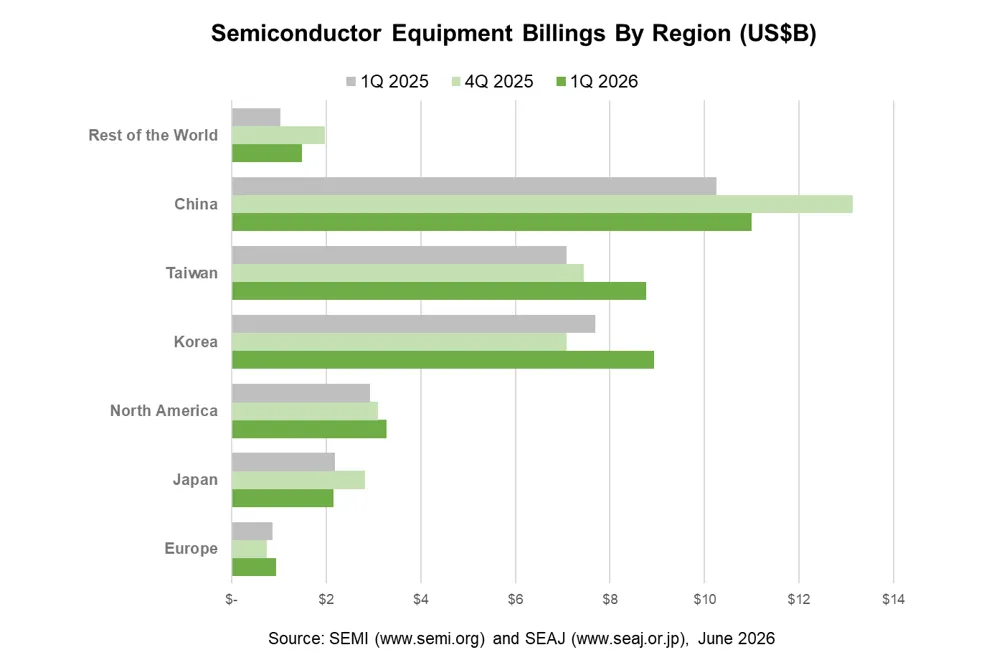
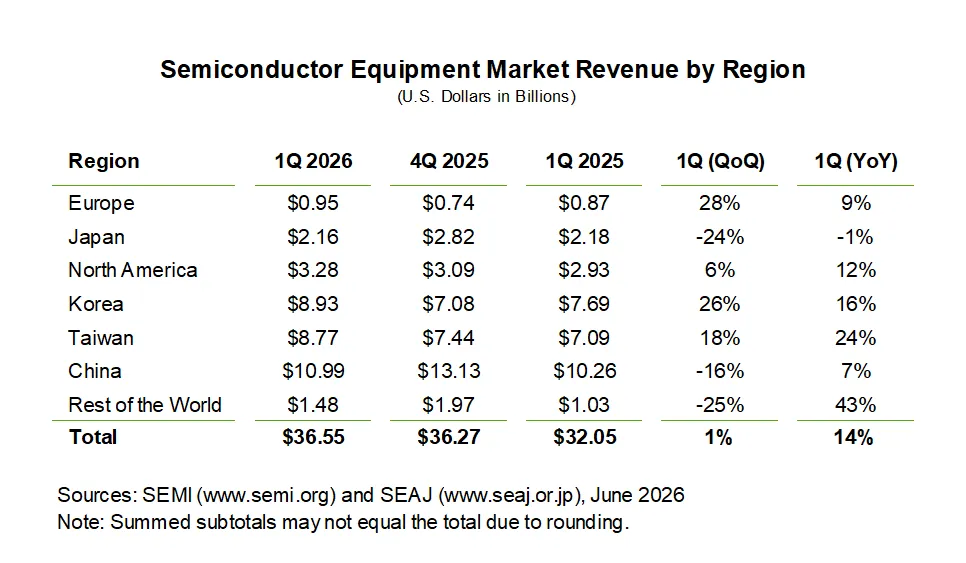
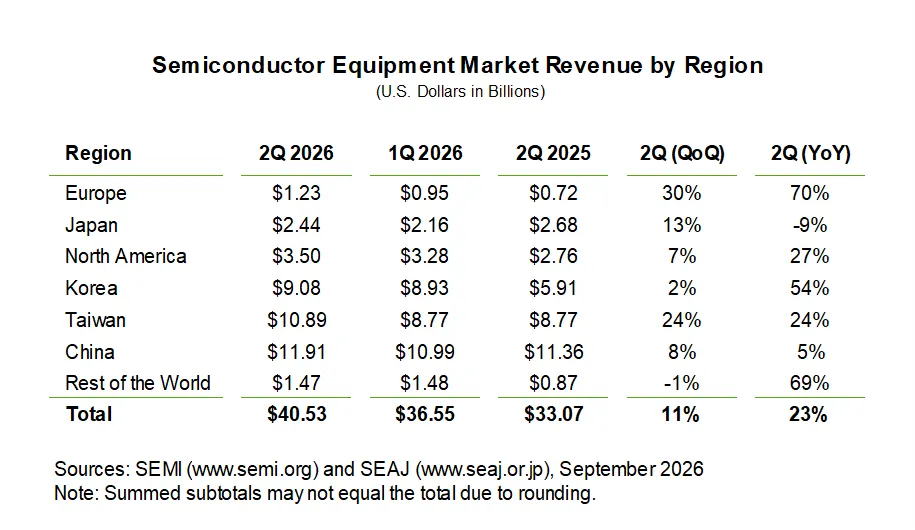
MILPITAS, Calif. – June 4, 2026 – SEMI, the industry association serving the global semiconductor and electronics design and manufacturing supply chain, today announced in its Worldwide Semiconductor Equipment Market Statistics (WWSEMS) report that global semiconductor equipment billings increased 14% year-over-year to US$36.55 billion in the first quarter of 2026. First quarter 2026 billings registered a 1% quarter-over-quarter growth.

Record quarterly billings were driven by continued AI-related investment, including capacity expansion and technology upgrades supporting leading-edge logic, DRAM, and advanced packaging. 

“The strong start to 2026 reflects continued industry investment in the capacity and infrastructure needed to support AI-driven semiconductor growth,” said Ajit Manocha, SEMI President and CEO. “Record first-quarter billings highlight ongoing momentum in leading-edge manufacturing and advanced packaging.”


Compiled from data submitted by members of SEMI and the Semiconductor Equipment Association of Japan (SEAJ), the WWSEMS report is a summary of the monthly billings figures for the global semiconductor equipment industry. 

The following are quarterly billings data in billions of U.S. dollars, with quarter-over-quarter and year-over-year changes by region:
 

About SEMI Equipment Market Data Subscription (EMDS)

The Equipment Market Data Subscription (EMDS) from SEMI provides comprehensive market data for the global semiconductor equipment market. A subscription includes three reports: 

  • Monthly SEMI North American Billings Report, an early perspective of equipment market trends
  • Monthly Worldwide Semiconductor Equipment Market Statistics (WWSEMS), a detailed report of semiconductor equipment billings for seven regions and more than 22 market segments
  • Bi-annual Total Semiconductor Equipment Forecast – OEM Perspective, an outlook for the semiconductor equipment market

Download a sample EMDS report.

For more information about the report or to subscribe, please contact the SEMI Market Intelligence Team at [email protected]. More details are also available on the SEMI Market Data webpage.  

Follow SEMI Market Intelligence

Follow SEMI 

About SEMI

SEMI® is the global industry association connecting over 4,000 companies and 1.5 million professionals worldwide across the semiconductor and electronics design and manufacturing supply chain. We accelerate member collaboration on solutions to top industry challenges through Advocacy, Workforce Development, Sustainability, Supply Chain Management and other programs. Our SEMICON® expositions and events, technology communities, standards and market intelligence help advance our members’ business growth and innovations in design, devices, equipment, materials, services and software, enabling smarter, faster, more secure electronics. Visit www.semi.org, contact a regional office, and connect with SEMI on LinkedIn and X to learn more.

MILPITAS, Calif. — May 27, 2026 — SEMI, the industry association serving the global semiconductor and electronics design and manufacturing supply chain, today announced the availability of a new industry research report focused on the glass core substrate market and trends, produced in collaboration with Global Net Corp. (GNC). The Glass Core Substrate Market and Development Trends Report examines the emerging market for glass core substrates, a potential next-generation packaging technology attracting increased attention as AI and high-performance computing (HPC) drive demand for larger and more advanced semiconductor packages.

“As chipmakers look for new ways to improve system performance beyond traditional device scaling, advanced packaging has become a critical area of innovation,” said Clark Tseng, Senior Director of Market Intelligence, SEMI. “Glass core substrates are being evaluated as one possible solution for future high-end packages because they may help support larger package sizes, finer interconnects, and improved dimensional stability compared to conventional package-substrate materials. This new report helps industry stakeholders understand where glass core substrates may fit in the next phase of packaging technology and what challenges must be addressed to achieve broader adoption.”

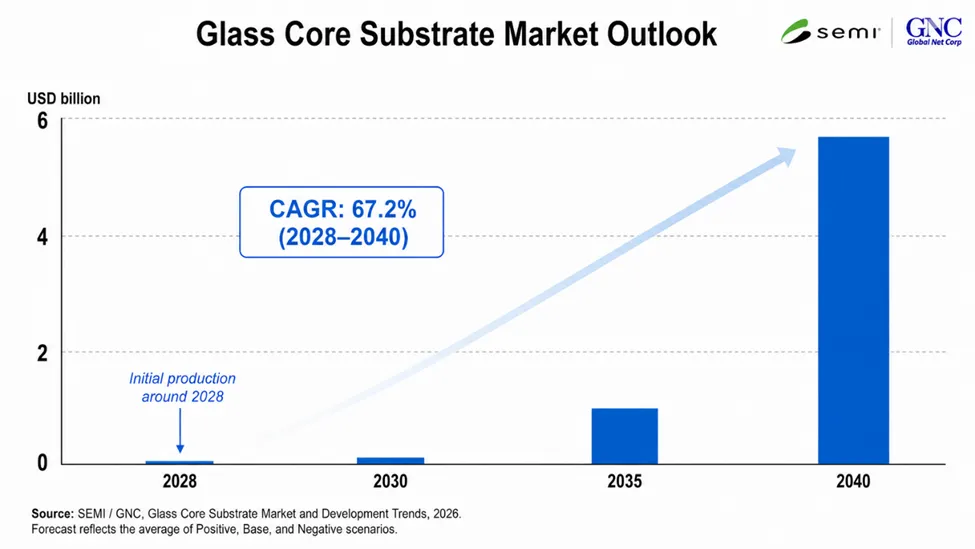
The report highlights increasing industry activity and investment around glass core substrates as companies prepare for the next phase of advanced packaging—providing an independent view of the technology’s market potential, development status, key players, and remaining barriers to commercialization. Under the report’s market-development scenarios, initial production could begin around 2028 in selected high-performance applications, with adoption expanding over time across larger and more complex package architectures. Based on the average of its Positive, Base, and Negative scenarios, the report projects a compound annual growth rate (CAGR) of 67.2% from 2028 to 2040. It also maps an increasingly active global development ecosystem, with companies and research organizations across Asia, North America and Europe advancing glass core substrate technologies.


Key topics covered in the report include:

  • Market outlook and adoption scenarios for glass core substrates 
  • Technology drivers and barriers to commercialization 
  • Expected applications in AI, HPC, advanced processors, co-packaged optics, and image sensors 
  • Company activities across substrates, glass materials, equipment, processing, inspection, and related supply-chain segments 
  • Development hubs, consortia, and supply-chain structure 
  • Forecast scenarios through 2040 

The Glass Core Substrate Market and Development Trends report is available in English and Japanese editions through SEMI Market Intelligence. Download the report.

For more information, please visit the Glass Core Substrate Market and Development Trends page or contact the SEMI Market Intelligence Team at [email protected].

Follow SEMI Market Intelligence

Follow SEMI 

About Global Net Corp.

Global Net Corp. is a Tokyo-based company serving the semiconductor and electronics industries. Established in 1990, the company provides wafer processing, equipment sales, consulting, technical seminars, research groups, and industry publishing services. Its technical and market coverage spans semiconductors, electronics, FPD, packaging, CMP, and related manufacturing processes.

About SEMI

SEMI® is the global industry association connecting over 4,000 companies and 1.5 million professionals worldwide across the semiconductor and electronics design and manufacturing supply chain. We accelerate member collaboration on solutions to top industry challenges through Advocacy, Workforce Development, Sustainability, Supply Chain Management and other programs. Our SEMICON® expositions and events, technology coalitions, standards and market intelligence help advance our members’ business growth and innovations in design, devices, equipment, materials, services and software, enabling smarter, faster, more secure electronics. Visit www.semi.org, contact a regional office, and connect with SEMI on LinkedIn and X to learn more.

MILPITAS, Calif. — May 12, 2026 — Global semiconductor materials market revenue increased 6.8% year-over-year to $73.2 billion in 2025, SEMI, reported today in its Materials Market Data Subscription (MMDS). Growth was supported by gains in both the wafer fab materials and packaging materials segments, reflecting higher process complexity, advanced-node demand, and continued investment in high-performance computing and high-bandwidth memory manufacturing. 

Wafer fabrication materials revenue increased 5.4% to $45.8 billion. Lithography-related materials, including photomask, photoresist and ancillaries, along with wet chemicals, posted strong double-digit growth as higher process intensity and tighter lithography requirements continued to increase materials consumption.
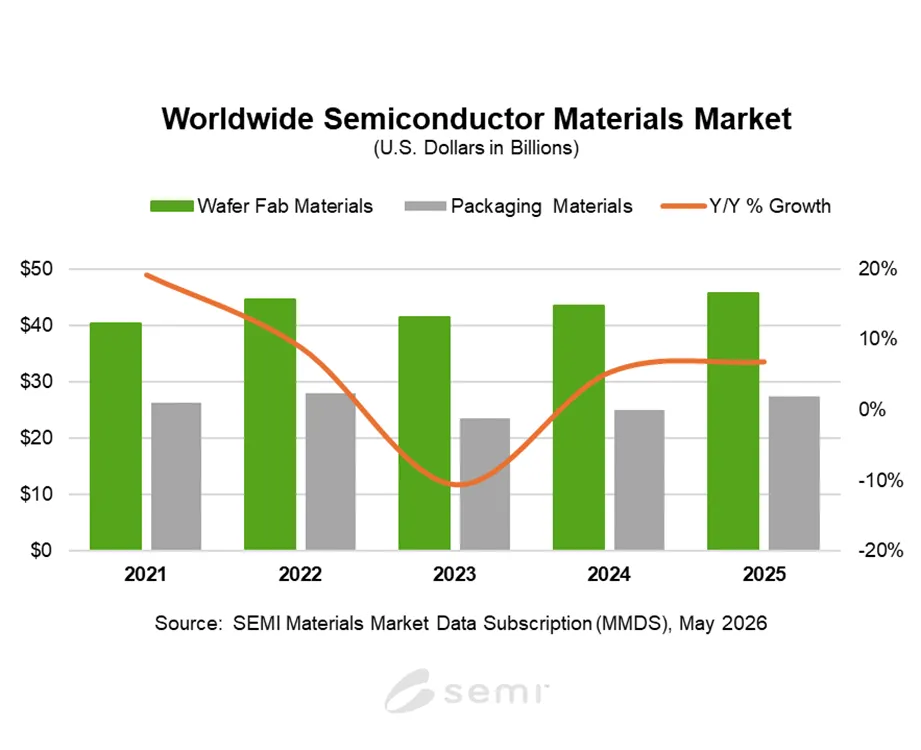
Packaging materials revenue grew 9.3% to $27.4 billion in 2025. Substrates and bonding wire led the increase, supported by higher gold prices in bonding wire and stronger demand for advanced substrates.

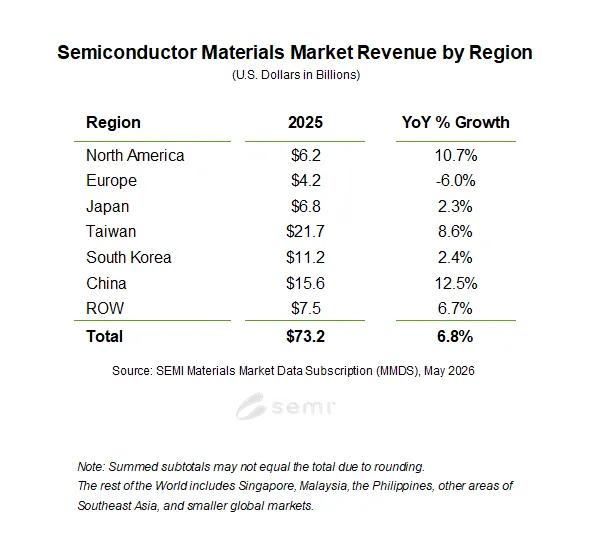
Taiwan remained the largest consumer of semiconductor materials for the 16th consecutive year, with revenue of $21.7 billion in 2025. China ranked second at $15.6 billion, supported by double-digit growth, followed by South Korea at $11.2 billion. All regions except Europe posted year-over-year increases, with China and North America recording the strongest growth among major regions.

The Materials Market Data Subscription (MMDS) from SEMI provides annual revenue with 10 years of historical data and a two-year forecast. The annual subscription includes quarterly updates for the materials segment and reports revenue for seven market regions (North America, Europe, Japan, Taiwan, South Korea, China and Rest of World). The report also features detailed historical data for silicon shipments and revenues for photoresist, photoresist ancillaries, process gases and lead frames.

For more information about the report or to subscribe, please contact the SEMI Market Intelligence Team at [email protected]. More details are also available on the SEMI Market Data webpage.  

Download a sample of the MMDS report

Follow SEMI Market Intelligence

Follow SEMI 

About SEMI

SEMI® is the global industry association connecting over 4,000 companies and 1.5 million professionals worldwide across the semiconductor and electronics design and manufacturing supply chain. We accelerate member collaboration on solutions to top industry challenges through Advocacy, Workforce Development, Sustainability, Supply Chain Management and other programs. Our SEMICON® expositions and events, technology communities, standards and market intelligence help advance our members’ business growth and innovations in design, devices, equipment, materials, services and software, enabling smarter, faster, more secure electronics. Visit www.semi.org, contact a regional office, and connect with SEMI on LinkedIn and X to learn more.

Semiconductor industry leader takes the helm to accelerate Beneq’s next phase of growth in atomic layer deposition

Espoo, Finland, 8 May, 2026 – Beneq Oy, the home of atomic layer deposition (ALD), today announced the appointment of Dr. Jason Harrison as Chief Executive Officer. Dr. Harrison succeeds Dr. Tommi Vainio and will lead Beneq into its next phase of growth across semiconductor, optical, and emerging technology markets.

A Strategic Leadership Transition
Beneq enters its next phase of growth from a position of strong commercial momentum. Recent milestones include the qualification of the Beneq Transform® cluster tool for volume production of GaN power and RF filter devices; the introduction of Beneq Transmute™ and Beneq Transform® XP, both engineered for high-volume manufacturing (HVM) of specialty semiconductors; growing adoption of the P-Series for coating critical chamber parts in advanced node devices; and selection of the C2R™ for AR waveguide production in next-generation XR optics.

Against this backdrop, the Board of Directors has determined that the time is right to align executive leadership with the company's evolving strategic priorities. As part of this transition, Dr. Tommi Vainio has decided to step down as CEO to pursue other opportunities. The Board of Directors extends its sincere thanks to Tommi, whose leadership advanced Beneq's technology platform, strengthened its market position in thin film deposition, and guided the company through important stages of its development.

A Proven Leader for a Scaling ALD Business
Dr. Harrison brings extensive global experience across the semiconductor and advanced technology sectors. He holds a Ph.D. in Quantum Chemistry and has built a distinguished career spanning device manufacturing, process development, and equipment solutions, with senior leadership roles at Intel, Lam Research, Veeco, and Applied Materials covering research and development, new product introduction, global account management, and business unit leadership. This combination of technical depth and commercial acumen positions him to scale Beneq’s commercial execution and growth across its global customer base.

Looking Ahead
Under Jason’s leadership, Beneq will accelerate strategic execution across its expanding portfolio, deepen customer engagement across North America, Asia, and Europe, and continue investing in innovative ALD solutions from R&D to HVM to deliver long-term value to customers, employees, and stakeholders.

Dr. Patrick Rabinzohn, Member of the Board of Directors, Beneq, said: “Jason brings the technical depth, the business and account management experience, and the global perspective Beneq needs at this stage of its growth. His academic background and compelling track record across the semiconductor industry positions Jason to build on the momentum the company generated especially.”

Dr. Jason Harrison, Chief Executive Officer, Beneq, added: “Beneq has a strong technology foundation, a talented team, and a growing pipeline of customers in some of the most important markets in semiconductors and optics. I look forward to working with the team to accelerate execution and deliver on the trust our customers place in us.”

About Beneq
Beneq pioneered industrial production of Atomic Layer Deposition (ALD) with the introduction of the first commercial ALD equipment in 1984. Today, Beneq advances ALD adoption and validation with a portfolio that includes the Beneq Transform®, Transform XP, Transform 300, and Transmute™ for specialty semiconductor device fabrication; TFS 200 and TFS 500 for R&D; the P400A, P800, and P1500 batch systems for coating critical semiconductor chamber components and complex part geometries; and spatial ALD platforms such as the C2R™ and roll-to-roll processing equipment. Headquartered in Espoo, Finland, Beneq enables ALD integration from lab to fab for semiconductors, optics, and functional coatings.

Press Contacts
Lie Luo
Head of Marketing
[email protected]

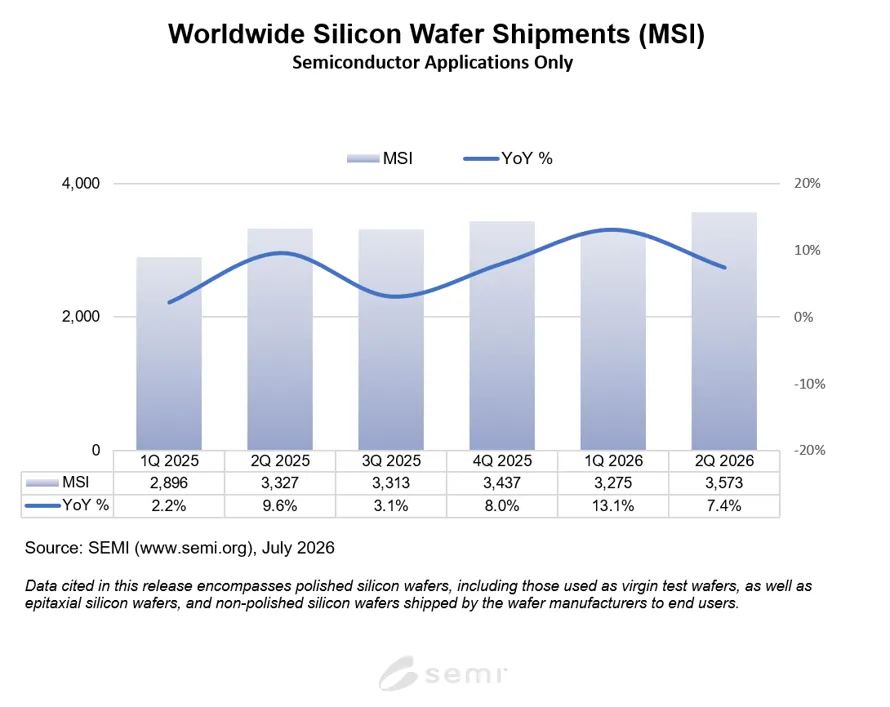
MILPITAS, Calif. — April 29, 2026 — The SEMI Silicon Manufacturers Group (SMG) reported today, in its quarterly analysis of the silicon wafer industry, that worldwide silicon wafer shipments increased 13.1% year-on-year to 3,275 million square inches (MSI) from the 2,896 MSI recorded during the same quarter of 2025. Sequentially, shipments declined 4.7% quarter-over-quarter from the 3,437 MSI recorded during the fourth quarter of 2025 in line with typical seasonality. 

“Silicon wafer demand related to AI data centers continues to be strong, including advanced logic and memory, and also now extending to power management devices,” said Ginji Yada, Chairman of SEMI SMG and Managing Executive Officer, General Manager, Sales and Marketing Division at SUMCO Corporation. “Overall, silicon wafer demand has improved, but the recovery is not uniform. Many device companies have noted improvements in the industrial semiconductor segment, and this is creating a more broad-based recovery as wafer inventory is absorbed. Weaker smartphone and PC shipments in the first quarter of this year may show the impact of tighter supply of memory due to AI high bandwidth memory (HBM) allocation decisions.”

Silicon wafers are the fundamental building material for the majority of semiconductors, which are vital components of all electronic devices. The highly engineered thin disks are produced in diameters of up to 300 mm and serve as the substrate material on which most semiconductors are fabricated.

The SMG is a sub-committee of the SEMI Electronic Materials Group (EMG) and is open to SEMI members involved in manufacturing polycrystalline silicon, monocrystalline silicon or silicon wafers (e.g., as cut, polished, epitaxial). The SMG facilitates collective efforts on issues related to the silicon industry, including the development of statistics about the silicon industry.

For more information, visit SEMI Worldwide Silicon Wafer Shipment Statistics.

Follow SEMI Market Intelligence

Follow SEMI 

About SEMI

SEMI® is the global industry association connecting over 4,000 companies and 1.5 million professionals worldwide across the semiconductor and electronics design and manufacturing supply chain. We accelerate member collaboration on solutions to top industry challenges through Advocacy, Workforce Development, Sustainability, Supply Chain Management and other programs. Our SEMICON® expositions and events, technology communities, standards and market intelligence help advance our members’ business growth and innovations in design, devices, equipment, materials, services and software, enabling smarter, faster, more secure electronics. Visit www.semi.org, contact a regional office, and connect with SEMI on LinkedIn and X to learn more.
 

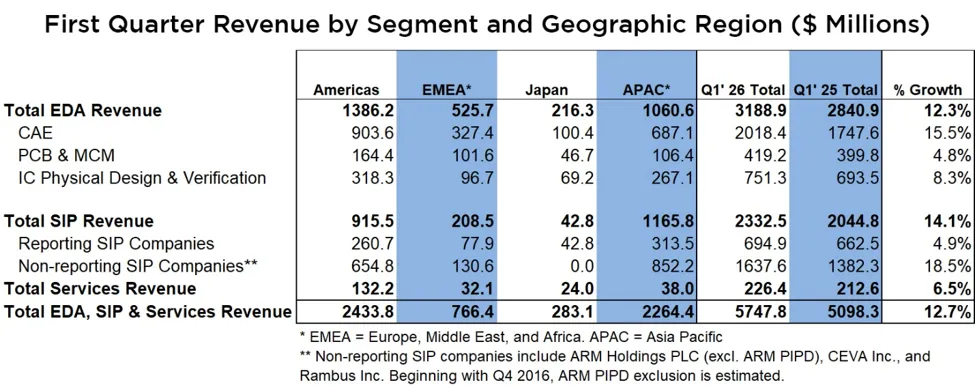
MILPITAS, Calif. — April 13, 2026 — Electronic System Design (ESD) industry revenue increased 10.3% to $5,466.3 million in the fourth quarter of 2025 from the $4,955.2 million registered in the fourth quarter of 2024, the ESD Alliance, a SEMI Technology Community, announced today in its latest Electronic Design Market Data (EDMD) report. The four-quarter moving average rose 10.1%, based on a comparison of the most recent four quarters to the prior four.

“The electronic design automation (EDA) industry continues to report strong year-over-year revenue growth in Q4 2025,” said Walden C. Rhines, Executive Sponsor of the SEMI Electronic Design Market Data report. “Product categories CAE, PCB and MCM, Semiconductor IP (SIP), and Services all reported gains. Geographic regions including Americas, EMEA, and APAC reported growth in Q4, with a double digit increase in Americas and APAC.”

The companies tracked in the EDMD report employed 71,517 people globally in Q4 2025, a 13.8% increase over the Q4 2024 headcount of 62,833 but down 2.3% compared to Q3 2025. 

The quarterly EDMD report contains detailed revenue information within the following category and geographic breakdowns. 

Revenue by Product and Application Category – Year-Over-Year Change

  • Computer-Aided Engineering (CAE) revenue increased 9.4% to $1,887.4 million. The four-quarter CAE moving average increased 10.8%. 
  • IC Physical Design and Verification revenue decreased 2.6% to $777.2 million. The four-quarter moving average for the category decreased 5.1%. 
  • Printed Circuit Board and Multi-Chip Module (PCB and MCM) revenue rose 1.8% to $484.6 million. The four-quarter moving average for PCB and MCM rose 4.5%.
  • Semiconductor Intellectual Property (SIP) revenue increased 18.3% to $2,083.2 million. The four-quarter SIP moving average rose 17.4%.
  • Services revenue increased 19.6% to $233.9 million. The four-quarter Services moving average rose 15.9%.

Revenue by Region – Year-Over-Year Change

  • The Americas, the largest reporting region by revenue, procured $2,473.5 million of electronic system design products and services in Q4 2025, a 13.9% increase. The four-quarter moving average for the Americas rose 10.6%. 
  • Europe, Middle East, and Africa(EMEA) procured $683.4 million of electronic system design products and services in Q4 2025, a 9.8% increase. The four-quarter moving average for EMEA grew 9.4%. 
  • Japan’s procurement of electronic system design products and services decreased 18.8% to $258.5 million in Q4 2025. The four-quarter moving average for Japan decreased 7.4%. 
  • Asia Pacific (APAC) procured $2,050.8 million of electronic system design products and services in Q4 2025, an 11.3% increase. The four-quarter moving average for APAC grew 12.6%. 

About the EDMD Report

The ESD Alliance Electronic Design Market Data (formerly the Market Statistics Service) report presents Electronic Design Automation (EDA), SIP and Services industry revenue data quarterly. Both public and private companies contribute data to the report available from SEMI. Each quarterly report is published approximately three months after quarter close. EDMD report data is segmented as follows: 

  • Revenue by product category (CAE, IC Physical Design and Verification, SIP, PCB and MCM Layout, and Services) including numerous detailed sub-categories
  • Revenue by geographic region (Americas, EMEA, Japan and APAC)
  • Total employment at participating companies

For information about SEMI market research reports, visit the SEMI Market Research Reports and Databases Catalog.

About the Electronic System Design Alliance

The Electronic System Design (ESD) Alliance, a SEMI Technology Community, is the central voice to communicate and promote the value of the semiconductor design ecosystem as a vital component of the global electronics industry. As an international association of companies providing goods and services throughout the semiconductor design ecosystem, it is a forum to address technical, marketing, economic and legislative issues affecting the entire industry. For more information about the ESD Alliance, visit http://esd-alliance.org.

Follow the ESD Alliance

About SEMI

SEMI® is the global industry association connecting over 3,000 member companies and 1.5 million professionals worldwide across the semiconductor and electronics design and manufacturing supply chain. We accelerate member collaboration on solutions to top industry challenges through Advocacy, Workforce Development, Sustainability, Supply Chain Management and other programs. Our SEMICON® expositions and events, technology communities, standards and market intelligence help advance our members’ business growth and innovations in design, devices, equipment, materials, services and software, enabling smarter, faster, more secure electronics. Visit www.semi.org, contact a regional office, and connect with SEMI on LinkedIn and X to learn more.

The information supplied by the ESD Alliance is believed to be accurate and reliable, but the ESD Alliance assumes no responsibility for any errors that may appear in this document. All trademarks and registered trademarks are the property of their respective owners.

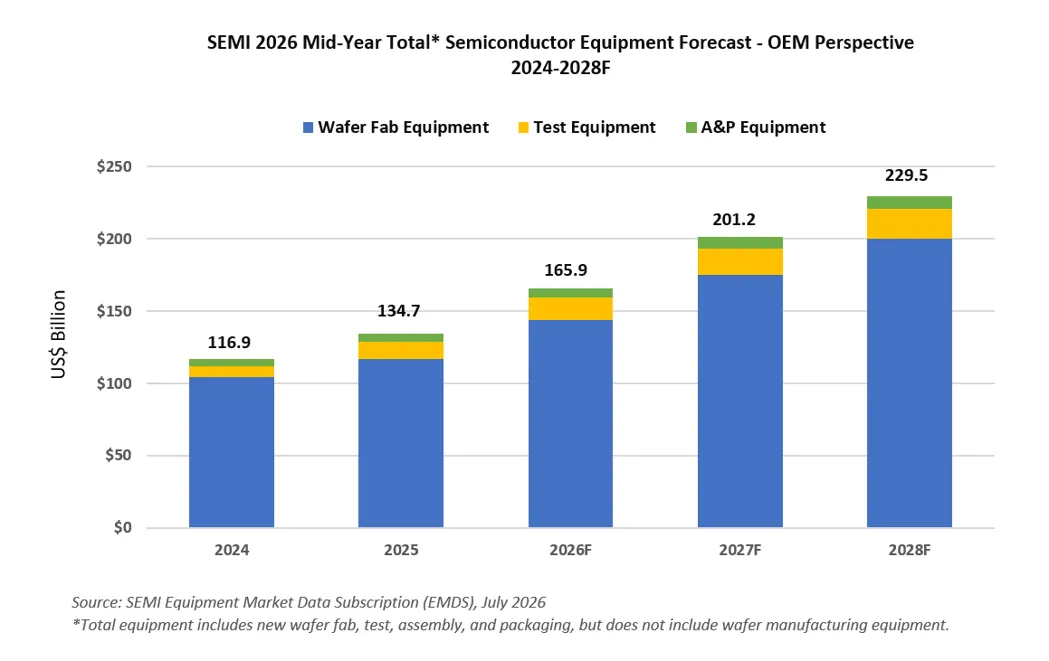
MILPITAS, Calif. – April 7, 2026 – Worldwide sales of semiconductor manufacturing equipment increased 15% to $135.1 billion in 2025 from $117.1 billion in 2024, driven by continued investment in advanced logic, memory, and AI-related capacity expansion, SEMI, the industry association representing the global electronics design and manufacturing supply chain, reported today. The data is available in the Worldwide Semiconductor Equipment Market Statistics (WWSEMS) report. 

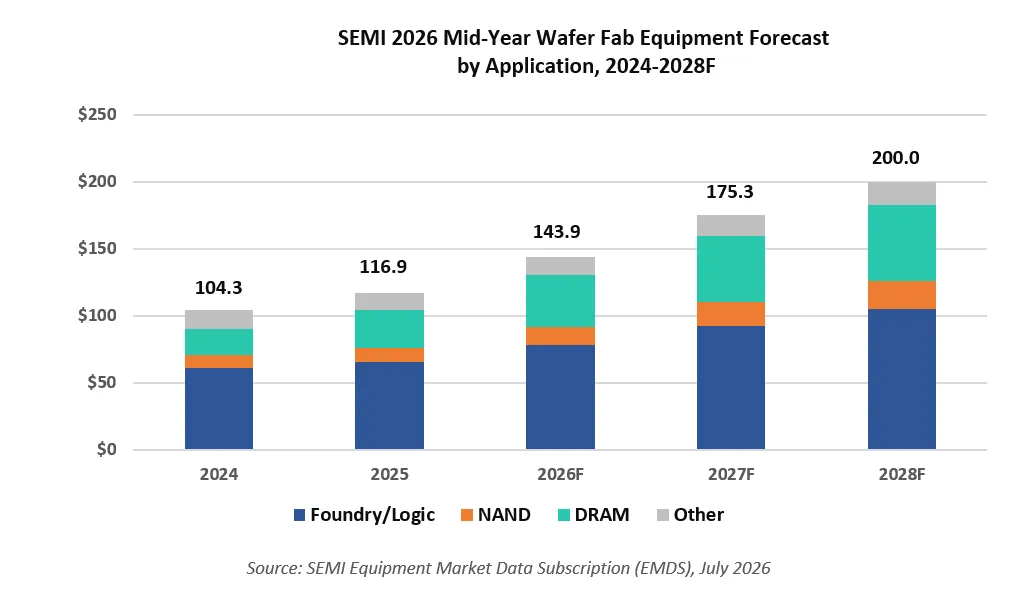
SEMIIn 2025, the global front-end semiconductor equipment market posted solid growth, with wafer processing equipment sales increasing 12% and other front-end segments rising 13%. The expansion was driven primarily by continued investment in leading-edge logic and memory capacity, supported by AI-related demand and ongoing node and technology migrations.

The back-end equipment segment also recorded strong growth in 2025. Test equipment billings surged 55% year-over-year as AI devices and high-bandwidth memory (HBM) increased performance requirements and test intensity, while assembly and packaging equipment sales rose 21% as adoption of advanced packaging technologies continued to expand.

"Record semiconductor equipment billings of $135 billion in 2025 underscore the scale and urgency of the industry's buildout as AI accelerates demand for leading-edge logic, advanced memory and high-bandwidth architectures," said Ajit Manocha, SEMI President and CEO. "From wafer fab investments to the rapid rise of advanced packaging and test, the global ecosystem is expanding capacity and capability to support the next wave of innovation."

Regionally, semiconductor equipment spending remained concentrated in Asia in 2025, with China, Taiwan, and Korea together accounting for 79% of the global market, compared with 74% in 2024.

In 2025, spending in China remained near record levels at $49.3 billion, down just 0.5% from the prior year, as domestic chipmakers continued to invest in mature nodes and select advanced capacity. Equipment spending in Taiwan rose 90% year-over-year to a record $31.5 billion, reflecting AI- and HPC-driven capacity expansion. Korea increased 26% to $25.8 billion as investment in HBM and DRAM remained strong. 

In 2025, spending in China remained near record levels at $49.3 billion, down just 0.5% from the prior year, as domestic chipmakers continued to invest in mature nodes and select advanced capacity. Equipment spending in Taiwan rose 90% year-over-year to a record $31.5 billion, reflecting AI- and HPC-driven capacity expansion. Korea increased 26% to $25.8 billion as investment in HBM and DRAM remained strong. 

Japan recorded 22% growth to $9.5 billion, supported by continued investment in domestic advanced-node manufacturing. Europe declined 41% to $2.9 billion, marking a second consecutive year of contraction amid ongoing weakness in automotive and industrial demand. North America fell 20% to $10.9 billion as spending moderated following earlier capacity expansion. The rest of the world increased 25% to $5.2 billion, reflecting expanding activity in emerging semiconductor production markets.

Compiled from data submitted by members of SEMI and the Semiconductor Equipment Association of Japan (SEAJ), the WWSEMS report is a summary of the monthly billings figures for the global semiconductor equipment industry.

About SEMI Market Data

The Equipment Market Data Subscription (EMDS) from SEMI provides comprehensive market data for the global semiconductor equipment market. A subscription includes three reports: 

  • Monthly SEMI North American Billings Report, an early perspective of equipment market trends
  • Monthly Worldwide Semiconductor Equipment Market Statistics (WWSEMS), a detailed report of semiconductor equipment billings for seven regions and more than 22 market segments
  • Bi-annual Total Semiconductor Equipment Forecast – OEM Perspective, an outlook for the semiconductor equipment market

Download a sample EMDS report.

For more information or to subscribe, please contact SEMI Market Intelligence at [email protected]. Details on SEMI market data are available at SEMI Market Data.   

Follow SEMI Market Intelligence

Follow SEMI 

About SEMI

SEMI® is the global industry association connecting over 3,000 member companies and 1.5 million professionals worldwide across the semiconductor and electronics design and manufacturing supply chain. We accelerate member collaboration on solutions to top industry challenges through Advocacy, Workforce Development, Sustainability, Supply Chain Management and other programs. Our SEMICON® expositions and events, technology communities, standards and market intelligence help advance our members' business growth and innovations in design, devices, equipment, materials, services and software, enabling smarter, faster, more secure electronics. Visit www.semi.org, contact a regional office, and connect with SEMI on LinkedIn and X to learn more.


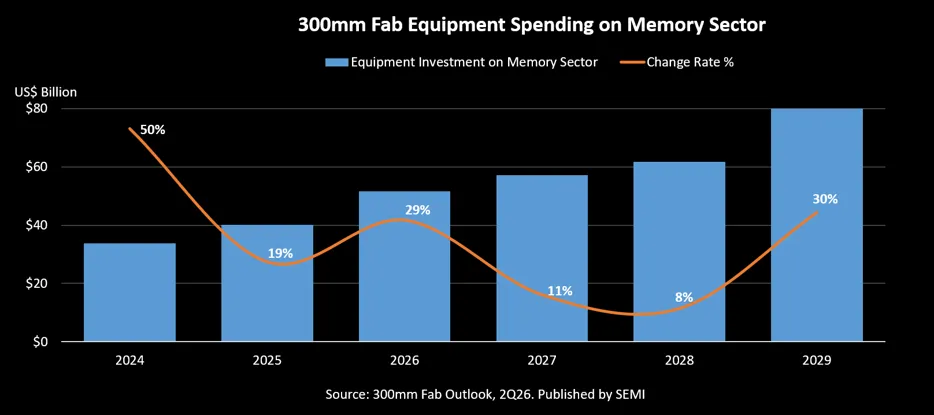
MILPITAS, Calif. – April 1, 2026 – Worldwide 300mm fab equipment spending is expected to increase 18% to $133 billion in 2026 and 14% to $151 billion in 2027, SEMI reported today in its latest 300mm Fab Outlook. This strong growth reflects surging AI chip demand for data centers and edge devices, as well as the growing commitment to semiconductor self-sufficiency across key regions through localized industrial ecosystems and supply chain restructuring.

Looking further out, the report projects investment will continue to increase 3% to $155 billion in 2028 and another 11% to $172 billion in 2029, respectively.

“AI is resetting the scale of semiconductor manufacturing investment,” said Ajit Manocha, President and CEO of SEMI. “With global 300mm fab equipment spending projected to exceed $150 billion in 2027 for the first time, the industry is making historic, sustained commitments to the advanced capacity and resilient supply chains needed to power the AI era.”


Segment Growth

The Logic & Micro segment is expected to spearhead equipment expansion with $228 billion in total investments from 2027 to 2029 mainly due to strong foundry sector demand, driven by sub-2nm cutting-edge capacity investments. Advanced node technology is essential to enhance chip performance and power efficiency to meet rigorous chip design requirements for various AI applications. More advanced node technology is expected to enter volume production from 2027 to 2029. Additionally, AI performance improvements are anticipated to drive massive growth in various edge AI devices. Beyond advanced nodes, demand across all nodes and various electronics devices is anticipated to grow moderately, supporting investment in mature nodes as well.

The memory segment is projected to rank second in equipment spending, totaling $175 billion from 2027 to 2029. This period marks the start of a new growth cycle for the segment. Within the memory category, DRAM equipment spending is expected to reach $111 billion cumulatively from 2027 to 2029, while 3D NAND equipment spending is estimated to be $62 billion during the same time frame. 

The demand for memory has significantly increased due to AI training and inference. AI training has notably driven up the demand for High Bandwidth Memory (HBM), while model inference has created substantial demand for storage capacity, thus boosting the growth of NAND Flash applications in data centers. This strong demand has led to sustained high levels of investment in the memory supply chain over the near and long term, helping to cushion potential downturns from traditional memory cycle fluctuations.

Regional Investment Trends

Global 300mm fab equipment investment is expected to remain broadly distributed across the major semiconductor manufacturing regions from 2027 to 2029, reflecting a mix of advanced-node expansion, memory capacity additions, and policy-supported supply chain localization. China, Taiwan, Korea, and the Americas are each expected to see substantial levels of spending during the period, while Japan, Europe & Middle East, and Southeast Asia also continue to expand investment from a smaller base. 

In China, investment is expected to remain supported by ongoing domestic capacity expansion and national initiatives aimed at strengthening semiconductor manufacturing capabilities. In the Taiwan region, spending is projected to be driven primarily by continued expansion of leading-edge foundry capacity, including 2nm and sub-2nm technologies. Korea’s investment outlook remains closely tied to the memory sector, where AI-related demand is supporting another cycle of capacity and technology upgrades. In the Americas, spending is expected to be underpinned by advanced process expansion and broader efforts to strengthen domestic manufacturing ecosystems. 

Japan, Europe & Middle East, and Southeast Asia are also expected to post meaningful growth through 2029. In these regions, equipment investment is supported by a combination of government incentives, supply chain resilience strategies, and targeted efforts to expand semiconductor manufacturing capacity.

Part of the SEMI Fab Forecast database, the SEMI 300mm Fab Outlook lists 404 facilities and lines globally. The report reflects 198 updates and 9 new fabs/lines projects since its last publication in December 2025. 

For more information on the report or to subscribe, please contact the SEMI Market Intelligence Team at [email protected]. Details on SEMI market data are available at SEMI Market Intelligence.  

Follow SEMI 

About SEMI

SEMI® is the global industry association connecting over 3,000 member companies and 1.5 million professionals worldwide across the semiconductor and electronics design and manufacturing supply chain. We accelerate member collaboration on solutions to top industry challenges through Advocacy, Workforce Development, Sustainability, Supply Chain Management and other programs. Our SEMICON® expositions and events, technology communities, standards and market intelligence help advance our members’ business growth and innovations in design, devices, equipment, materials, services and software, enabling smarter, faster, more secure electronics. Visit www.semi.org, contact a regional office, and connect with SEMI on LinkedIn and X to learn more

MILPITAS, Calif. — February 10, 2026 — Worldwide silicon wafer shipments in 2025 increased 5.8% to 12,973 million square inches (MSI) while wafer revenue slipped 1.2% to $11.4 billion over the same period, the SEMI Silicon Manufacturers Group (SMG) reported in its year-end analysis of the silicon wafer industry. 

SEMI Logo2025 marks an inflection year for wafer shipments, with silicon MSI resuming growth supported by strong demand for advanced epitaxial wafers in logic and polished wafers for high-bandwidth memory (HBM), driven by AI applications. Softness in wafer revenue is mostly attributed to the slow momentum in traditional semiconductor applications where the demand and pricing environment are yet to improve.

“The 2025–2026 wafer market is shaped by diverging trends across technology nodes,” said Ginji Yada, Chairman of SEMI SMG and Executive Office Deputy General Manager, Sales and Marketing Division at SUMCO Corporation. “Demand for 300mm wafers remains strong in advanced applications, particularly in AI-driven logic and high-bandwidth memory (HBM), supported by the ongoing adoption of sub-3nm processes. These technology transitions are driving increased requirements for wafer quality and consistency, reinforcing the need for advanced material solutions. Investments in data centers and generative AI continue to underpin demand in leading-edge segments, where performance and reliability are critical. 

“In contrast, the legacy semiconductor segment shows gradual signs of stabilization. Wafer and chip inventory levels in mature-node applications—such as automotive, industrial, and consumer electronics—have begun to normalize after extended inventory adjustments. While supply-demand conditions are improving sequentially, the pace of recovery remains moderate, with demand recovery still sensitive to macroeconomic factors and end-market dynamics. As a result, the overall market outlook reflects a two-track trajectory: sustained demand and technical advancement in advanced nodes, alongside a cautious and incremental rebound for demand in mature technology segments.”

MSI

Silicon wafers are the fundamental building material for the majority of semiconductors, which are vital components of all electronic devices. The highly engineered thin disks are produced in diameters of up to 300 mm and serve as the substrate material on which most semiconductors are fabricated.

The SMG is a sub-committee of the SEMI Electronic Materials Group (EMG) and is open to SEMI members involved in manufacturing polycrystalline silicon, monocrystalline silicon or silicon wafers (e.g., as cut, polished, epitaxial). The SMG facilitates collective efforts on issues related to the silicon industry, including the development of statistics about the silicon industry.

For more information, visit SEMI Worldwide Silicon Wafer Shipment Statistics or contact the SEMI Market Intelligence Team at [email protected]. Additional details on SEMI market data are available at SEMI Market Intelligence.

Follow SEMI

About SEMI

SEMI® is the global industry association connecting over 3,000 member companies and 1.5 million professionals worldwide across the semiconductor and electronics design and manufacturing supply chain. We accelerate member collaboration on solutions to top industry challenges through Advocacy, Workforce Development, Sustainability, Supply Chain Management and other programs. Our SEMICON® expositions and events, technology communities, standards and market intelligence help advance our members’ business growth and innovations in design, devices, equipment, materials, services and software, enabling smarter, faster, more secure electronics. Visit www.semi.org, contact a regional office, and connect with SEMI on LinkedIn and X to learn more.


MILPITAS, Calif. — January 12, 2026 — Electronic System Design (ESD) industry revenue increased 8.8% to $5,566.4 million in the third quarter of 2025 from the $5,114.5 million registered in the third quarter of 2024, the ESD Alliance, a SEMI Technology Community, announced today in its latest Electronic Design Market Data (EDMD) report. The four-quarter moving average rose 10.4%, based on a comparison of the most recent four quarters to the prior four.

“The electronic design automation (EDA) industry continues to report strong year-over-year revenue growth in Q3 2025,” said Walden C. Rhines, Executive Sponsor of the SEMI Electronic Design Market Data report. “All product categories reported increases, with Semiconductor IP (SIP) and Services showing double digit gains. Geographic regions including Americas, EMEA, and APAC reported growth in Q3, with a double digit increase in APAC.”

The companies tracked in the EDMD report employed 73,185 people globally in Q3 2025, a 17.3% increase over the Q3 2024 headcount of 62,417 and up 0.9% compared to Q2 2025.

The quarterly EDMD report contains detailed revenue information within the following category and geographic breakdowns. 

Revenue by Product and Application Category – Year-Over-Year Change

  • Computer-Aided Engineering (CAE) revenue increased 9.1% to $2,097.8 million. The four-quarter CAE moving average increased 11.6%.
  • IC Physical Design and Verification revenue increased 1.3% to $865.4 million. The four-quarter moving average for the category decreased 1.2%.
  • Printed Circuit Board and Multi-Chip Module (PCB and MCM) revenue rose 3.4% to $466.2 million. The four-quarter moving average for PCB and MCM rose 8.1%.
  • Semiconductor Intellectual Property (SIP) revenue increased 13.6% to $1,915.7 million. The four-quarter SIP moving average rose 14.8%.
  • Services revenue increased 10.2% to $221.4 million. The four-quarter Services moving average rose 13.7%.

Revenue by Region – Year-Over-Year Change

  • The Americas, the largest reporting region by revenue, procured $2,402.2 million of electronic system design products and services in Q3 2025, a 3.4% increase. The four-quarter moving average for the Americas rose 10.3%.
  • Europe, Middle East, and Africa (EMEA) procured $675.1 million of electronic system design products and services in Q3 2025, a 4.6% increase. The four-quarter moving average for EMEA grew 7.6%.
  • Japan’s procurement of electronic system design products and services decreased 11.5% to $264.0 million in Q3 2025. The four-quarter moving average for Japan increased 2.4%.
  • Asia Pacific (APAC) procured $2,223.0 million of electronic system design products and services in Q3 2025, a 20.5% increase. The four-quarter moving average for APAC grew 12.8%. 

About the EDMD Report

The ESD Alliance Electronic Design Market Data (formerly the Market Statistics Service) report presents Electronic Design Automation (EDA), SIP and Services industry revenue data quarterly. Both public and private companies contribute data to the report available from SEMI. Each quarterly report is published approximately three months after quarter close. EDMD report data is segmented as follows: 

  • Revenue by product category (CAE, IC Physical Design and Verification, SIP, PCB/MCM Layout, and Services) including numerous detailed sub-categories
  • Revenue by geographic region (Americas, EMEA, Japan and APAC)
  • Total employment at participating companies

For information about SEMI market research reports, visit the SEMI Market Research Reports and Databases Catalog.

About the Electronic System Design Alliance

The Electronic System Design (ESD) Alliance, a SEMI Technology Community, is the central voice to communicate and promote the value of the semiconductor design ecosystem as a vital component of the global electronics industry. As an international association of companies providing goods and services throughout the semiconductor design ecosystem, it is a forum to address technical, marketing, economic and legislative issues affecting the entire industry. For more information about the ESD Alliance, visit http://esd-alliance.org.

Follow the ESD Alliance

About SEMI

SEMI® is the global industry association connecting over 3,000 member companies and 1.5 million professionals worldwide across the semiconductor and electronics design and manufacturing supply chain. We accelerate member collaboration on solutions to top industry challenges through Advocacy, Workforce Development, Sustainability, Supply Chain Management and other programs. Our SEMICON® expositions and events, technology communities, standards and market intelligence help advance our members’ business growth and innovations in design, devices, equipment, materials, services and software, enabling smarter, faster, more secure electronics. Visit www.semi.org, contact a regional office, and connect with SEMI on LinkedIn and X to learn more.

The information supplied by the ESD Alliance is believed to be accurate and reliable, but the ESD Alliance assumes no responsibility for any errors that may appear in this document. All trademarks and registered trademarks are the property of their respective owners.