downloadGroupGroupnoun_press release_995423_000000 copyGroupnoun_Feed_96767_000000Group 19noun_pictures_1817522_000000Member company iconResource item iconStore item iconGroup 19Group 19noun_Photo_2085192_000000 Copynoun_presentation_2096081_000000Group 19Group Copy 7noun_webinar_692730_000000Path
Skip to main content
Default Banner Image

intellectual property

With IP the lifeblood of today’s globally integrated microelectronics supply chain, protecting confidential information is vital to electronics companies around the world. Additionally, the industry’s central role in ensuring the national security and economic competitiveness of every country ups the ante. Yet the supply chain is fraught with security risks. Malicious actors never rest in their work to infiltrate factory systems or human resources databases with the intent to steal IP, disrupt production or embed malicious software that can open the door to future attacks. Cyberattacks in the financial and retail sectors typically draw much more public attention than IT security breaches in the semiconductor industry. While large microelectronics companies are not immune to these threats, they tend to deploy some of the world’s strongest security systems and implement robust security policies and protocols to help mitigate risks. Many of their small and mid-sized counterparts with modest IT budgets and limited expertise, on the other hand, struggle to maintain a similar level of cyberhealth – a critical gap in the microelectronics industry, one of the most strategically important in the world. SEMI is out to help change that by collaborating with cybersecurity experts to help members strengthen their cybersecurity defenses. SEMI plans to increase cybersecurity awareness within the microelectronics workforce and offer cybersecurity assessments to member companies through a third-party provider as part of its SEMI Works® program. Working with experts, SEMI will add cybersecurity-related competencies to the SEMI Works® Skills Portal database to help ensure educational and training programs address these skills. As part of SEMI’s recently launched Curated Content Initiative, member companies will have access to workforce training courses on how to raise awareness of cybersecurity risks and mitigate them. Strengthening IP protections across smart technologies and industries driving the next wave of microelectronics industry growth such as artificial intelligence (AI), 5G, medtech and mobility starts in chip design and extends through fabrication to packaging and ultimately end-use applications. Helping to establish a baseline understanding and awareness of cybersecurity risks and how to mitigate them throughout the supply chain is critical. Bolstering cyber protections at small and mid-sized member companies is a key step in that direction. Commercial success, national security and the security of the ubiquitous IT infrastructures at the center of how we work and live depend on it. Mike Russo is vice president of Industry Advancement and Government Programs at SEMI.
Read More
The White House and House Speaker Nancy Pelosi announced that the United States has reached final terms on the U.S.-Mexico-Canada free trade agreement (USMCA). The USMCA provides important modifications and updates to the 25-year old North American Free Trade Agreement (NAFTA), and SEMI supports its timely ratification in the U.S. Congress. The USMCA includes significant provisions to protect continued innovation and North American market access across product design and manufacturing supply chains for the electronics industry. The agreement strengthens requirements for the protection and enforcement of intellectual property rights, including trade secrets. The U.S. microelectronics industry will benefit greatly from USMCA’s strong enforcement mechanism for the misappropriation of trade secrets including civil procedures and remedies, criminal penalties, and judicial procedures to prevent disclosure of trade secrets in litigation.The agreement also establishes new rules to enhance and protect digital trade to benefit companies of all sizes and consumers. The USMCA prohibits tariffs, taxes and other barriers to cross-border data flows and minimizes restrictions on where data can be stored and processed. These provisions establish important precedents for data and digital technology in future trade agreements. The USMCA aligns with SEMI’s core principles including open global markets, fair competition and the protection of intellectual property rights. Mexico and Canada are two of the United States’ most important trading partners, and strengthening the three countries’ mutual obligations under USMCA will greatly benefit SEMI members. SEMI welcomes final passage of the USMCA and the critical certainty it will bring to trade rules within North America going forward.Joe Pasetti is Vice President, Global Public Policy Advocacy, at SEMI.
Read More
Global and regional forces shaping the $2 trillion electronics industry have intensified more in the past few years than at any other time I can recall. The uncertainty bred by trade wars, corporate tax changes, new environmental regulations, immigration issues and STEM talent shortages is vexing the global microelectronics supply chain as companies shift investments and operational strategies to adjust to the unrelenting change and new realities with heightened urgency.In our industry, an increasingly dynamic world requires a more determined and strategic approach to advocacy. To meet the industry’s rapidly evolving needs, SEMI is transforming its global advocacy initiatives and programs. In the past 18 months, we have honed the focus of SEMI Global Advocacy to better serve member interests and needs, respond more quickly to fast-moving geopolitical developments, and deliver more value to help spur growth across the end-to-end electronics supply chain.Most importantly, SEMI Global Advocacy is now much more forward-looking and proactive. We have expanded our focus from primarily U.S. and independent regional issues to global affairs, allowing us to better leverage the power of our worldwide platforms. Organizationally, SEMI continues to add specialized staff advocates and calibrate its operational and member-driven engagement models to increase their involvement. There will be more to come, and with your continued support, we’ll be in a stronger position to meet your needs. Thank you!Strengthening the industry’s voiceThe rapid shift to a more proactive advocacy approach across all our initiatives was triggered by one disruptive action a little more than a year ago – the buildup and onset of the trade war between the United States and China. From the outset, SEMI formed strong member coalitions to intensify our lobbying efforts, met frequently with policymakers, submitted written comments to government panels, and issued public communications, all aimed at amplifying our collective voice. SEMI has taken a principled approach to advocacy, publicly stating its positions based on its trade pillars of free and fair trade/open markets, supply chain growth, respect for IP and national security.That approach was on full display as Japan tightened controls on exports to the Republic of Korea, sending shockwaves through the microelectronics industry. To minimize the industry impact, we leveraged our global reach and the counsel of our International Board of Directors to engage with both governments early on and ensure that Japan took into account our members’ interests in developing and implementing the new rules. In general, SEMI opposes the use of tariffs and limiting market access as levers to correct trade imbalances and other structural issues. Instead, we support dialogue and negotiations that lead to multilateral agreements aligned with our members’ interests and global trade principles.This year in the U.S. alone, SEMI advocates have met with more than 70 policymakers in Washington, D.C., including members of Congress and representatives from the White House, federal agencies and the Trade Representative’s office. We have also spoken with representatives from European and Asian government delegations. Since the trade war erupted, we have met with more than 220 policymakers worldwide, giving SEMI a seat at the table – a louder voice for our members – as we are increasingly seen as the voice of the end-to-end electronics manufacturing and design supply chain. SEMI Global Advocacy has also broadened its focus beyond public policy to address other areas of strategic importance to the industry such as the talent shortage.Expanding Advocacy’s global influenceSEMI’s public policy efforts now reach well beyond Washington, D.C. to all seven major manufacturing centers worldwide where we have regional offices, with SEMI advocacy staff in every location. This has created a network multiplier effect that allows us to rally our collective strength around common member interests. It’s no coincidence that our member-driven advocacy initiatives and programs have improved in parallel with expanded global participation by our member companies on our various policy and advocacy committees.Our Trade Advisory Committee, for example, has grown from 16 to 60 active members in the past year alone. This year, we have also formed working groups with SEMI members around the world to address talent pipeline challenges. The upshot is that we are now much more focused in attacking regional issues. Thank you once again.Despite changes in the strategic approach of SEMI Global Advocacy, we remain squarely focused on critical issues affecting industry growth and our members’ interests. In a nutshell, we call these the four T's: Tax – We strive to encourage rates that are fair to all companies, leveling the playing field globally Technology – We seek government investment in technology and innovation (R D) Trade – We advocate for open markets, free and fair trade as we promote our 10 Principles for the Global Semiconductor Supply Chain in Modern Trade Agreements worldwide Talent – We support education investments and immigration policies that provide opportunities and build the talent pipeline In addition, SEMI has long been a leading voice in promoting Environment, Health and Safety regulations that enable industry growth and demonstrate environmental stewardship – and we continue to make investments at this critical juncture as new technologies are driving changes in the regulatory landscape.Maintaining laser focus on member priorities amid shifting geopoliticsThe only way for SEMI Global Advocacy to navigate the cauldron of geopolitical disruption is to remain laser-focused on our members’ top priorities including trade, tax, technology and talent. And we will stick to what SEMI has done best for almost 50 years – facilitate public-private collaborations and more investment on behalf of our members.In workforce development, SEMI is taking bold steps to develop a robust talent pipeline, as much a growth and innovation driver for SEMI members and the industry as any technology. Announced earlier this year, SEMI Works™, our landmark talent development initiative, is already gaining steam with U.S. government investment and our rapid progress in laying its foundation with a database of standardized competencies for technical jobs as well as a certification and credentialing process for curriculum, education and training programs.The future for SEMI members and the industry is brimming with possibility. The strides SEMI Global Advocacy has made over the past year have only been possible through your support and involvement. As we broaden our scope beyond policy, we recognize that more progress needs to be made. We look forward to your continued participation as, together, we help our industry fulfill its great potential.Mike Russo is Vice President of Global Industry Advocacy at SEMI.
Read More
New system-on-chip (SoC) devices are driving new memory architectures and photonic interfaces, while specialized new intellectual property (IP) requires analysis down to the nanometer and atomic levels because of single nanometer process nodes. According to Babak Taheri, CTO and EVP of products at Silvaco, a leading EDA Software, semiconductor IP company, a member of SEMI and the ESD Alliance, a SEMI Strategic Association Partner, design technology co-optimization and proven IP are required for this analysis.Taheri recently discussed atoms to systems in next-generation SoC designs with Nanette Collins ahead of ES Design West, co-located with SEMICON West, July 9-11 at the Moscone Center in San Francisco.ESD Alliance: For years now, the assumption is that each new chip design is more complex than the last. Why are the latest SoC designs even more complex than before?Taheri: New SoC devices for mobile phones, automobiles, intelligent edge nodes, big data compute and storage are adopting artificial intelligence and machine learning technologies. This is driving new compute, data flow, as well as memory architectures that are bandwidth-limited and some require photonic interfaces.One common denominator in present SoC design are the numerous blocks of IP. On average, over 85% of these blocks are reused. It’s cost-prohibitive to make these chips over and over again with new IP. According to some estimates, 90% of IP used in an SoC design by 2025 will be reused – only 10% is new technologies. That 10% is significant.ESD Alliance: How so?Taheri: Complex new technologies including flash memory, other advanced non-volatile memory technologies such as MRAM, RRAM and SoCs such as NVIDIA’s Xavier and Apple’s A12 use and reuse design IP at the architectural level.New technologies mean new materials and new processes. Single nanometer process nodes require specialized new IP that needs to be simulated and analyzed down to the nanometer and atomic levels.ESD Alliance: Does the atomic level changes the design equation?Taheri: Yes, it does. Designers need to be able to simulate at the atomic level and understand properties of these materials, and how they behave in at-process and at-device levels. They need be able to simulate the material's nanometer geometries, how molecules behave and how they interact for device operations. When they put together a process and a device, they need to know how the pieces behave and simulate before production.In other words, they run quite a few design experiments and quite a bit of simulation before they finalize the circuits and devices to silicon to save money.ESD Alliance: It’s obvious design automation will continue to have a vital role in design.Taheri: Yes, absolutely. Design technology co-optimization (DTCO) using TCAD solutions and proven design IP are needed to address the span from architecture to device and process physics. The importance of simulation, emulation and design technology co-optimization, along with fully verified and proven IP for SoC design, cannot be overstated. As designers generate devices and processors, they take that up to circuit-level simulation and high-level simulation, schematic capture, extractions and back annotation. They can go from atoms to simulating systems to the ability to do that under the same umbrella in order to get better chips, better yield and lower cost.Taheri’s talk Next Generation of SoC Design: From Atoms to Systems will be part of the Meet the Experts More than Moore session Tuesday, July 9, at 11:30 a.m. at the ES Design West SMART Design Pavilion. SEMICON West attendees are invited to Moscone Center’s South Hall to learn more about electronic system and semiconductor design and its links to the electronic product manufacturing and supply chain. Register for ES Design West or SEMICON West.Babak Taheri is Silvaco’s CTO and EVP of products, has more than 25 years of design experience. His current role managing Silvaco’s Technology CAD (TCAD), electronic design automation (EDA) and IP product divisions makes him an expert on what’s needed for the design of next-generation system-on-chips (SoCs). Previously, he was the CEO and president of IBT working with investors, private equity firms, and startups on M A, technology and business diligence. Babak received his Ph.D. in biomedical engineering from the University of California Davis with Bachelor of Science degrees in Electrical Engineering and Computer Science and Neurosciences. He has published more than 20 articles and holds 28 issued patents.Nanette Collins is a public relations representative for the Electronic System Design Alliance.
Read More
In testimony today before a U.S. government interagency panel considering tariffs on $300 billion worth of Chinese goods, SEMI called for the removal of about 30 tariff lines, which cover items central to the semiconductor manufacturing process.Mike Russo, vice president of global industry advocacy at SEMI, explained in his testimony that while SEMI strongly supports efforts to better protect valuable intellectual property (IP), tariffs will not help address Chinese trade practices, and will ultimately have significant and unintended consequences.SEMI asserts that these tariffs will harm not only companies operating in the U.S., but other companies as well in the semiconductor supply chain by increasing costs, introducing uncertainty, and most problematically, stifling innovation. Collectively, SEMI estimates that this round of tariffs will cost its 430 U.S. members millions annually in additional duties. All told, SEMI estimates that all U.S. and Chinese retaliatory tariffs will cost members nearly $800 million in annual duties.SEMI’s full written comments note that these tariffs, on top of those already in force and the retaliatory tariffs, will hamstring the industry. The tariffs seem to target firms for simply operating in China. Given that tools, materials, and related products are extremely complex, precise, and difficult to manufacture, it is unreasonable to believe that a constituent component can simply be replaced with a part or tool from another source. Further, this U.S. government approach does not take into account that many items subject to these tariffs are not available, at sufficient quality and cost, from domestic sources, or even non-Chinese sources.Over the past year, SEMI has submitted written comments and offered testimony on the three previous rounds of tariffs, which covered about $250 billion worth of Chinese goods, or about half of all imports from China. The tariffs hit various components in the electronics manufacturing supply chain critical to the semiconductor industry, including materials and equipment used to manufacture wafers, boules, and chips as well as test, inspection and sensing equipment. We urge SEMI members to review the $300 billion U.S. tariff list to determine the level, if any, of impact. We also strongly encourage members to review Chinese retaliatory lists as well. Any SEMI members with questions should contact Jay Chittooran, Global Public Policy Manager at SEMI, at [email protected].
Read More
Yesterday, President Trump extended the deadline for List 3, which would have raised U.S. tariffs on $200 billion worth of goods from China. SEMI welcomes the deadline extension.Over the past three months, the United States and China have engaged in bilateral discussions to address structural issues like intellectual property protection and requirements for the use of joint ventures as well as trade balance concerns. President Trump announced that these talks have yielded significant and substantial progress in all areas. That said, it’s been reported that discussions on structural issues, such as forced technology transfer, have seen limited progress.Certainly, questions remain on the specifics of liberalization, the structure of the agreement and, most notably, enforcement. Any new commitment will be toothless without a firm and binding enforcement mechanism. While the date of the new deadline hasn’t been clarified, we believe that the tariffs won’t be increased before Presidents Trump and Xi meet, which could happen in late March at Mar-a-Lago.List 3 covers a range of items, including a number of consumer goods, but also directly impacts items critical to the semiconductor manufacturing process, including materials and machines. SEMI estimates that all U.S. and Chinese retaliatory tariffs – which hit machines and tools central to the semiconductor industry, including equipment used to manufacture wafers, boules, and chips as well as test, inspection and sensing equipment – will cost members more than $700 million in annual duties.While SEMI strongly supports stronger protections for valuable intellectual property (IP), tariffs will not help address Chinese trade practices and will ultimately have significant and unintended consequences. SEMI asserts that these tariffs will harm companies in the semiconductor supply chain by increasing business costs, introducing uncertainty, and stifling innovation. The tariffs seem to target U.S. firms for simply operating in China.Given that chips, tools, and materials are extremely complex, precise, and difficult to manufacture, it is not reasonable to believe that any component can easily be replaced with a part from another source. Further, this U.S. government approach does not take into account that many items subject to these tariffs are not available, at sufficient quality and cost, from domestic sources, or even non-Chinese sources. We stand steadfast in our belief that this trade action will raise prices, put thousands of high-paying and high skill jobs at risk, and curb growth.SEMI will continue monitoring new developments in this area. Any SEMI members with questions should contact Jay Chittooran, Global Public Policy Manager at SEMI, at [email protected].
Read More
With (most of) the election results in from the U.S. midterms, the expected Democratic takeover of the House and the Republican’s maintaining control of the Senate is now a reality. The day of the election, DC insiders expected that the House would go to the Democrats by a margin of +/- 20, with the Republicans gaining 2-3 seats in the Senate. Not a bad prediction, which is a far cry from what the same insiders called in advance of the 2016 Presidential election.What does that mean for our members and the tech sector in general? Will there be an ease of trade tensions or less of a chance of tighter export controls? Some believe that with the midterm elections over, President Trump will have some room to take a less aggressive stance against China, setting up a “win” that he can carry into 2020. With the recent more aggressive stance by North Korea against the U.S. regarding its nuclear program, China may well have some leverage at the trade table … and the U.S. may want to make a deal that provides a path for a “win” on both fronts. Indeed, there are the makings of a potential win-win leading into the G20 meeting in Argentina when President Xi Jinping and President Trump are scheduled to meet on Dec. 1.One can see a scenario where there is a meeting of the minds and some degree of lessening tariffs; that does not mean that the effort to enhance export controls will go away. The need for tighter restrictions on export controls is driven to a great degree by the U.S. Department of Defense (DoD) and is a follow on from the previous FIRRMA legislation and attempts to curb the loss of U.S. technology critical to global competitiveness and national security. This issue will not go away anytime soon, and cases like the recent one involving Jinhua only add fuel to the fire. In addition, given how these cases can be leveraged at the negotiating table, they will continue to surface.SEMI’s approach has been to educate governments, lawmakers and administration officials on the strategic importance of the globally connected and highly complex semiconductor supply chain, and how some of the approaches will not achieve the attended goals. This approach helps to ensure that when and if it comes time to make decisions based on merit, the principals are informed. It also helps SEMI and its members develop and maintain important relationships and positions SEMI as an industry leader and spokesperson, making it a more effective advocate. As an example, on Nov 8th SEMI released its Global Trade Principles with the intention of providing a framework to all governments to guide various trade talks. It also helps to inform member companies and others from the broader tech sector of our industry position(s) so we are able to speak with one voice. These principles are aligned with our fundamental advocacy pillars of promoting free trade and market access, respect for IP, cybersecurity and national security.Will the fact that power is now split between the two chambers of Congress help or hurt? Will the House focus on investigations limit the ability to move productive legislation? Besides taking time, it may well put them at increasingly worse odds with the Senate and the President (if that is possible), creating deadlock. Some argue that if nothing moves, no harm can be done. Some also say that it may drive the President to take independent and more aggressive actions in order to demonstrate (his) effectiveness to his base. There is another view: that with the Democrats, the President may be able to lead in the advancement of legislation that will show he can get things done when others couldn’t in areas that benefit the greater good…some of which may impact our industry…such as investments in education and infrastructure development. This would be a way that he could pull in some of the votes from the middle that he has lost in his first two years in office. They say “politics makes for strange bedfellows”; one never knows what might happen in this case.Regardless of what happens, some things will not change: the global nature of our business and the needs of our members to have access to markets…and to be able to safely and efficiently leverage their technologies in the way they see fit in order to grow their business. SEMI will continue to advance the interests in what is an extremely challenging and dynamic global policy environment today. As ruling parties and representatives change around the globe, we will continue to build new relationships and educate lawmakers so they are able to make informed decisions that benefit our members. Mike Russo is VP of Public Policy and Talent Advocacy at SEMI.
Read More
Tensions between the U.S. and China have reached fever pitch as the Trump administration imposed higher tariffs on $200 billion of Chinese goods last Monday, adding to the $50 billion in goods hit with higher duties earlier this year. Bloomberg News reported that “the combined $250 billion in products facing levies is almost half the value of imports from China last year.”China countered by meting out stiffer tariffs on $60 billion in U.S. goods, on top of the $50 billion already levied, and canceling planned trade negotiations with the Trump administration.Days before the sharp escalation of the trade conflict, SEMI president and CEO Ajit Manocha joined SEMI China president Lung Chu in hosting a closed-door round table with 16 senior semiconductor industry executives in Shanghai. The goal: An update from the China semiconductor sector on its needs as the chip industry braces to weather the conflict. Manocha and Chu then met with influential China media outlets including Semiconductor Manufacturing, China Integrated Circuit, Silicon Semiconductor and IC Café to reiterate SEMI’s position on trade.“The basic principles of SEMI are free and fair trade, open markets, cooperation for mutual benefit, and protection of intellectual property rights,” Manocha told the reporters. “Tariffs and trade frictions are bound to harm the industry’s development.”Manocha highlighted efforts over the past few months by the SEMI advocacy team to educate U.S. policymakers on the impact of tariffs on the development of the semiconductor industry. Last month, the office of the U.S. Trade Representative (USTR) held a hearing in Washington, D.C. to solicit public comment on then-proposed tariffs on $200 billion of Chinese imports to the U.S. Testifying on behalf of the semiconductor industry, SEMI stressed that tariffs on more than 100 tariff lines covering items critical to semiconductor manufacturing “will harm companies in the semiconductor supply chain by increasing business costs, introducing uncertainty, and stifling innovation.” SEMI had testified twice before this year – the first time in May, opposing levies on $34 billion in Chinese goods, and the second in July to speak out against higher duties on $16 billion worth of Chinese products.SEMI China president Lung Chu made clear the consensus of China’s semiconductor sector: The trade war will profoundly impact the global semiconductor industry. He also stressed that SEMI, as a global industry organization linking the global electronic semiconductor industry chain, will continue to promote win-win cooperation between the U.S. and China.Manocha reaffirmed SEMI’s longstanding commitment to promote cooperation among nations and policies that foster industry growth.“For the growth of the semiconductor industry, SEMI is focused on four important factors, and we call them the 4 T’s, namely Tax, Technology, Talent, Trade,” Manocha told the media. “All are indispensable for the development of the industry.” SEMI president and CEO Ajit Manocha and SEMI China president Lung Chu host press conference in Shanghai.Because the semiconductor industry is international, with key features spread across a number of regions, cross-border cooperation is an eternal theme, Chu told the gathering. To maintain the vitality of China's semiconductor industry, the region must deepen its integration with the international semiconductor ecosphere. He acknowledged that there will be no quick answers to easing trade tensions between the U.S. and China but that SEMI would continue to press ahead in efforts to help improve relations. Despite the conflict, the industry remains optimistic about the growth of China’s semiconductor industry, he said."However, we need to face up to the fact that there is still a certain gap between the domestic semiconductor industry and that of international advanced level,” Lu said. “Therefore, international cooperation is the key to industry growth."Of the four cornerstones of the semiconductor industry – design, manufacturing, testing and equipment materials – China in recent years has narrowed the gap with its international counterparts in testing capabilities, Chu said. For China’s semiconductor industry to flower, the region must build strengths in design, manufacturing and materials too.“The semiconductor industry needs long-term investment, persistence and patience, and also needs win-win cooperation, continuous innovation and product applications across the entire industry,” Chu said. “Money is not the only incentive.”Manocha emphasized the theme of international cooperation, with the global semiconductor industry working in harmony.“The global semiconductor industry chain is inseparable, and each region has its own advantages,” Manocha said. “So, we will continue to work hard to create a win-win, inclusive global industrial atmosphere.”For its part, SEMI China is focused on becoming the best partner for China to realize its semiconductor dream by continuing to provide services that encourage international cooperation. That role will grow in importance with SEMI’s expansion into application areas such as smart manufacturing, smart transportation, smart data and smart automotive – all requiring tighter integration of the electronics industry supply chain.Cherry Sun is a marketing manager at SEMI China.
Read More
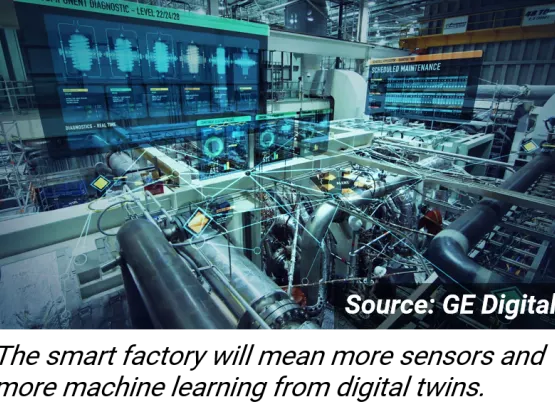
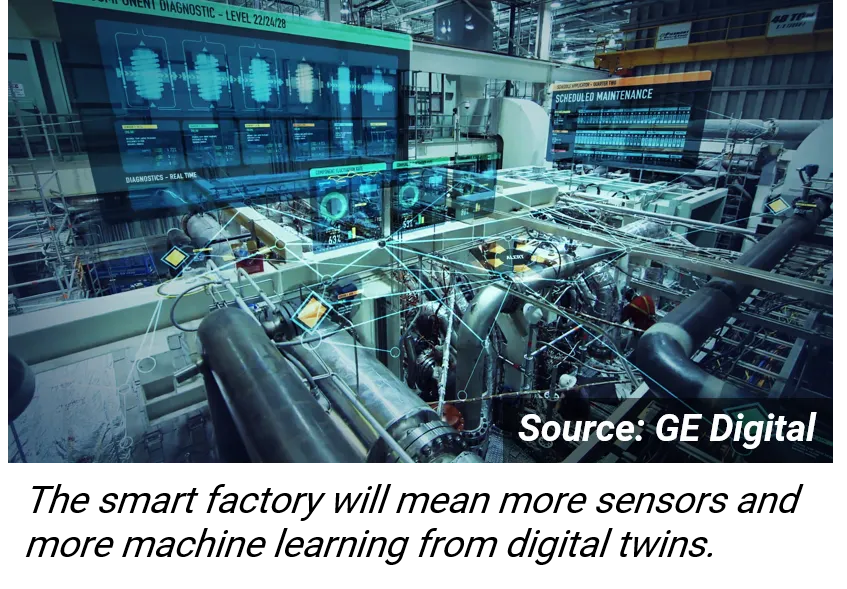
The fast-maturing hardware and software that are enabling practical applications of equipment intelligence and machine learning mean disruptive change for microelectronics manufacturing. But first comes the basic work of building the basic infrastructure, figuring out IP separation, and learning to solve physical problems in the digital world. Just how much can the semiconductor industry leverage industrial IoT practices from other industries? Common wisdom may be that industrial software solutions aren’t well suited to the IC sector’s complex needs. But GE Digital enterprise account executive Luke Smaul, currently working with Intel, argues that semiconductor fabs and toolmakers are dealing with similar issues as GE did when it first started working with Delta Airlines to monitor the GE engines on Delta planes. Smaul will speak at SEMICON West about GE’s work with Intel over the past few years and, in particular, how its solution for cloud security and IP separation can work for ICs. “GE learned to provide IP security and separation in the aviation space with its suppliers, which moved us all up the value chain, providing a big engine for growth,” says Smaul, who started his career as an IC engineer. “GE Aviation saw a 25 percent increase in issue detection rates by leveraging the same common platform. We’ve shown that we can protect Intel intellectual property in its own cloud space and control who can access what.” A toolmaker can access only particular fab data as needed for analysis, and then can reveal only the output from the analysis and a subset of supporting data. “IP separation has to happen, and it will unlock huge added value,” Smaul says. GE’s Predix solution aims to supply an easy-to-use, plug-and-play system for analytics to enable a yield engineer without a deep data background to select a supported sensor, a gateway to connect automatically to the cloud, and an analytics application to test a hypothesis of how the collected data relates to yield. “This empowers the yield engineer to use and unlock information for a quick improvement, even for simple things such as looking at the impact of degradation of fan performance over time on yield,” says Smaul. “Though the scope may be small, the impact on yield in aggregate, and when scaled, is large.” “There needs to be much more collaboration across the industry to make this work, and to share best practices,” says Smaul. “Just as GE moved from selling gas turbines to selling power-as-a-service, vendors of other big, expensive assets like IC equipment will likely change their business model from selling tools towards selling yield-as-a-service. This will simplify life for the fab while bringing the toolmaker more opportunity to sell improved capabilities on existing tools.” More human intelligence makes AI smarter Applying AI neural network approaches such as deep learning to predict outcomes from digital models is enabling disruptive advances in speech and image recognition, but applying it to complex IC manufacturing problems such as predictive maintenance has been a challenge. These neural networks require massive amounts of data to train, and the IC sector doesn’t really have big data, just a lot of little data clusters due to the dynamics and context richness of processes. This data is difficult to combine for analysis. In addition, the neural network provides only an answer but can’t explain why, notes Michael Armacost, managing director of advanced service engineering at Applied Materials. “We’ve learned that it works better if we do not ignore what we know already, but rather incorporate expert knowledge in a structured way to help us focus on the key features and the key data,” says Armacost, who will also speak in the program. This includes choosing the most important steps to include in the model, identifying the limited data to collect and how to filter the data for outliers, and then selecting the final parameters and features, adjusting the limits, and making adjustments as results drift change over time. The less data needed, the better for the complicated issue of IP protection as well. The big gains from these new analysis approaches will likely require data from more than one company and supporting security for remote connectivity. “Some end users are attempting to do the AI all themselves, but in the long term there will need to be collaboration across companies,” says James Moyne, University of Michigan professor and consultant to Applied Materials, another speaker. Collaboration will need to balance the value of the solution against the risk of compromising IP. “The low-hanging fruit are applications such as predictive maintenance in areas that do not involve high-priority IP. Another approach will be to limit the amount of shared data needed – to first build the model on a wide range of data, but then to use only a very small amount of data to operate the models.” Ready-made models could speed the process Coventor’s semiconductor process models are finding initial applications in R D whereby companies use the simulation to understand the effect of process variation on their complex designs. Instead of running dozens of actual wafers to optimize semiconductor processes, users can instead quickly simulate the results of complex process interactions on their design. Going forward, the process models could find a wide range of applications, from accelerating stabilization of new processes in the fab to enabling real-time co-optimized control across previously independent unit steps to improve wafer uniformity. “This improved uniformity across wafers and equipment could potentially reduce the need for costly physical silicon validation,” suggests Joseph Ervin, Coventor director, semiconductor process and integration, another SEMICON speaker. “Making use of in-situ metrology for real-time control also demands a digital model to process and analyze the collected data for quick response. This area has tremendous potential for improving semiconductor process control.” SEMICON West features a Smart Manufacturing Pavilion with displays and three full days of speakers on building the infrastructure needed to enable disruptive artificial intelligence in the microelectronics sector. www.semiconwest.org The SEMICON West Smart Manufacturing Pavilion features interactive Touch Liquid Crystal Displays (TLCD) and working production equipment on the floor from Bosch Rexroth, Cimetrix, Rudolph Technologies, Inficon/Final Phase Systems, OMRON, DISCO and Edwards Vacuum. For information on the SEMI Smart Manufacturing Initiative and how to get involved, please click here. Paula Doe, SEMI
Read More