

MILPITAS, Calif. — January 17, 2022 — Electronic System Design (ESD) industry revenue increased 17.1% year-over-year from $2,953.9 million to $3,458.1 million in Q3 2021, the ESD Alliance, a SEMI Technology Community, announced today in its latest Electronic Design Market Data (EDMD) report. The four-quarter moving average, which compares the most recent four quarters to the prior four, rose 16.1%.
 “The industry reported double-digit year-over-year revenue growth for Q3 2021,” said Walden C. Rhines, Executive Sponsor of the SEMI Electronic Design Market Data report. “Geographically, all regions reported double-digit growth, with product categories CAE, Printed Circuit Board and Multi-Chip Module, SIP, and Services also showing double-digit growth.”
The companies tracked in the EDMD report employed 51,182 people globally in Q3 2021, an 8.7% increase over the Q3 2020 headcount of 47,087 and up 2.4% compared to Q2 2021.
The quarterly EDMD report contains detailed revenue information with the following category and geographic breakdowns.
Revenue by Product and Application Category – Year-Over-Year Change
- CAE revenue increased 13.7% to $1,054.7 million. The four-quarter CAE moving average increased 11.8%.
- IC Physical Design and Verification revenue increased 0.7% to $612.6 million. The four-quarter moving average for the category rose 16%.
- Printed Circuit Board and Multi-Chip Module (PCB and MCM) revenue increased 14.5% to $298.3 million. The four-quarter moving average for PCB and MCM increased 10.9%.
- SIP revenue rose 30.6% to $1,373.3 million. The four-quarter SIP moving average grew 22.1%.
- Services revenue increased 12.5% to $119.1 million. The four-quarter Services moving average increased 9.2%.
Revenue by Region – Year-Over-Year Change
- The Americas, the largest reporting region by revenue, purchased $1,494.5 million of electronic system design products and services in Q3 2021, a 14.3% increase. The four-quarter moving average for the Americas rose 15.8%.
- Europe, Middle East, and Africa (EMEA) revenue increased 22.6% to $451.7 million. The four-quarter moving average for EMEA grew 11.9%.
- Japan revenue increased 11.8% to $259.8 million. The four-quarter moving average for Japan rose 3.3%.
- Asia Pacific (APAC) revenue increased 19.7% to $1,252.1 million. The four-quarter moving average for APAC increased 21.3%.
About the EDMD Report
The ESD Alliance Electronic Design Market Data (formerly the Market Statistics Service) report presents EDA, SIP and services industry revenue data quarterly. Both public and private companies contribute data to the report available from SEMI. Each quarterly report is published approximately three months after quarter close. EDMD report data is segmented as follows:
- Revenue by product category (CAE, IC Physical Design and Verification, Semiconductor IP, PCB/MCM Layout, and Services) including numerous detailed sub-categories
- Revenue by geographic region (Americas, EMEA, Japan and APAC)
- Total employment at participating companies
For information about SEMI market research reports, visit the SEMI Market Research Reports and Databases Catalog.
About the Electronic System Design Alliance
The Electronic System Design (ESD) Alliance, a SEMI Technology Community, is the central voice to communicate and promote the value of the semiconductor design ecosystem as a vital component of the global electronics industry. As an international association of companies providing goods and services throughout the semiconductor design ecosystem, it is a forum to address technical, marketing, economic and legislative issues affecting the entire industry. For more information about the ESD Alliance, visit http://esd-alliance.org.
About SEMI
SEMI® connects more than 2,400 member companies and 1.3 million professionals worldwide to advance the technology and business of electronics design and manufacturing. SEMI members are responsible for the innovations in materials, design, equipment, software, devices, and services that enable smarter, faster, more powerful, and more affordable electronic products. Electronic System Design Alliance (ESD Alliance), FlexTech, the Fab Owners Alliance (FOA), the MEMS & Sensors Industry Group (MSIG) and SOI Consortium are SEMI Strategic Technology Communities. Visit www.semi.org to learn more, contact one of our worldwide offices, and connect with SEMI on LinkedIn and Twitter.
The information supplied by the ESD Alliance is believed to be accurate and reliable, but the ESD Alliance assumes no responsibility for any errors that may appear in this document. All trademarks and registered trademarks are the property of their respective owners.
Press Contacts
Paul Cohen
ESD Alliance
A SEMI Technology Community
978-769-2106
Jack Taylor
Siemens EDA PR
Siemens Digital Industries Software
512-560-7143
 “The new projects push the limits of technology in ways that are not funded by private sector alone, illustrating the vital importance of the SEMI FlexTech program in evolving FHE technology development across multiple high-growth industries,” said Gity Samadi, Director of R&D Programs for SEMI FlexTech. “Flexible hybrid electronics help transform traditional rigid products into devices that are conforming, highly reliable, and often more sustainable.”




 “Semiconductors must remain at the core of Europe’s industrial and technological ambitions,” said Laith Altimime, president of SEMI Europe. “With the launch of the
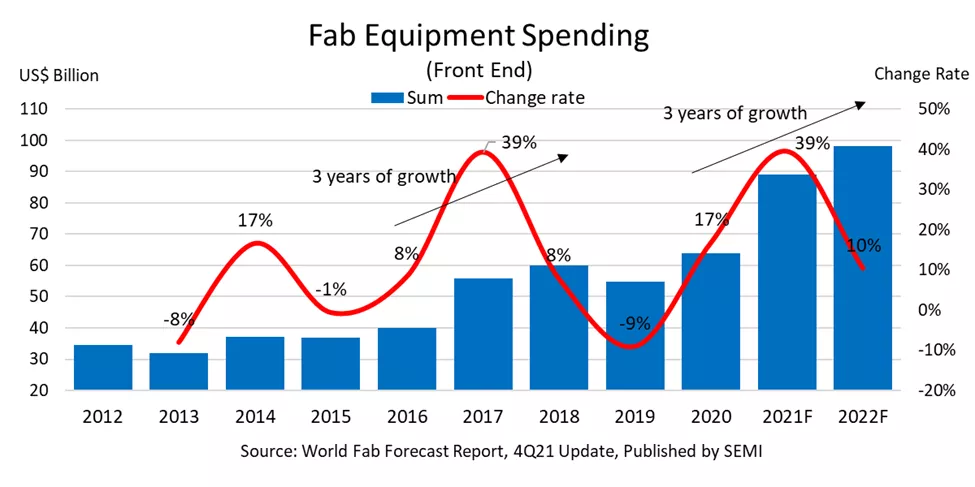
 The fab equipment spending increase in 2022 would follow a 39% jump in 2021 and 17% in 2020. The industry last saw three consecutive years of growth from 2016 to 2018, more than 20 years after logging a three-year run in the mid-1990s.
 “SEMI continues to make the health and safety of event attendees our top priority,” said David Anderson, president of SEMI Americas and host of ISS. “We have followed recommended safety guidelines since the pandemic hit and successfully hosted many onsite events in the U.S. and around the world, but we felt it best to reschedule ISS due to current circumstances. We look forward to convening in April at Half Moon Bay to help companies across the semiconductor supply chain navigate challenges and seize business and innovation opportunities in the year ahead.”
 SEMI Europe President Laith Altimime and Soitec CEO Paul Boudre, vice chair of the SEMI Europe Advisory Board, sent a letter to Emmanuel Macron, president of the French Republic, to request that the upcoming French Presidency of the Council of the European Union make it a key priority to encourage deeper collaboration among member states in the interest of advancing the semiconductor industry.
 “Billings of North America-based semiconductor equipment manufacturers extended a robust uptrend to reach another new record in November,” said Ajit Manocha, president and CEO of SEMI. “Industry performance remains unprecedented despite persistent supply chain challenges.”

 At Tokyo Electron, Tsuneishi drove a mindset transformation of selling beyond Japan-based companies, first developing a strategic vision for investing in global operations in the U.S. and then replicating it in Korea, Taiwan, Europe, Singapore and China. He benefitted customers in these regions by enabling them to deliver better value and cost-of-ownership. By bringing the focus of exceptional Japanese quality to more customers, Tsuneishi helped drive the adoption of these standards worldwide to strengthen and grow the global semiconductor industry. Access to top-notch local technology centers and the delivery of local solutions by service and support organizations underpinned his quality standards.
 Featuring 2,000 booths, SEMICON Korea 2022 Hybrid will host nearly 120 semiconductor industry experts from around the world at 20 virtual conferences. On-demand conferences will be available until February 25, 2022.