downloadGroupGroupnoun_press release_995423_000000 copyGroupnoun_Feed_96767_000000Group 19noun_pictures_1817522_000000Member company iconResource item iconStore item iconGroup 19Group 19noun_Photo_2085192_000000 Copynoun_presentation_2096081_000000Group 19Group Copy 7noun_webinar_692730_000000Path
Skip to main content
Default Banner Image

semiconductor industry

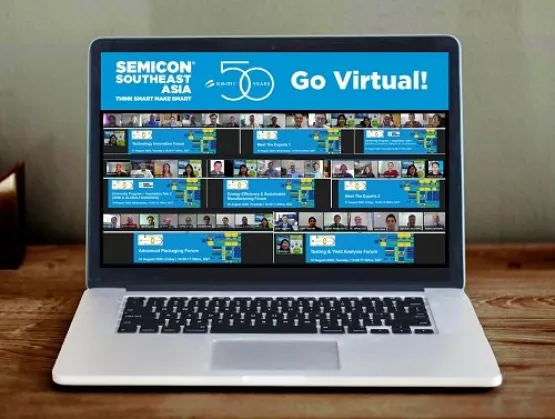
Never before had we expected that SEMICON SEA 2020 would go virtual.The COVID-19 crisis abruptly halted our ability to hold our premier Southeast Asia electronics manufacturing exposition as we typically do – in the physical realm. The pandemic tested our adaptability, challenged our willingness to experiment and, perhaps above all, accelerated not only our own but the world’s digital transformation. We had to change our way of doing business and learn to connect virtually like we had never had before. SEMI continues to believe that virtual interaction is no replacement for face-to-face engagement. But, like the rest of the world, we fast-tracked our digital education and staged the virtual event 20 July to 21 August 2020 to gather supply chain players and help fulfill the tremendous potential of our great industry. For all the suffering the COVID-19 has caused, the pandemic has underscored an important truth – that we need innovation through collaboration now more than ever to help solve the world’s greatest problems. We thank all our event sponsors as we turned what started as a grand experiment into a successful event that drew nearly 3,000 attendees to our webinars, business matching sessions and other online offerings designed to help them uncover new business opportunities. Following are other highlights. Southeast Asia Pavilion at Virtual SEMICON West 2020 In our first collaboration with SEMICON West, our Southeast Asia Pavilion at the event welcomed virtual visitors from around the globe to help them form new connections and grow their businesses. Business Matching Sessions Technical buyers from more than 15 multinational companies along with 141 pre-qualified suppliers attended more than 50 meetings across four online business matching sessions.Technical WebinarsCompany representatives from regions including Malaysia, Singapore, Vietnam, Taiwan, the United States, the UK, Israel, China and Japan shared their expertise and industry insights at SEMICON Southeast Asia 2020 webinars. In addition, experts from leading semiconductor companies such as Micron Semiconductor Asia Operations, ViTrox Corporation Berhad and A*STAR took part in our technical exchange by sharing the latest trends in the rapidly evolving semiconductor industry. Talent Development: Inspirational University Program Talks With building the talent pipeline critical to sustaining growth of Southeast Asia semiconductor manufacturing dynamics, talent champions from Lam Research and GLOBALFOUNDRIES highlighted career opportunities and pathways for young engineers while generating recruiting leads. More than 750 students from Malaysia and Singapore engaged panelists with questions during the sessions. The SEMICON Southeast Asia team extends its tremendous thanks to sponsors and attendees for their support. As we all navigate the pandemic and hope in the near future to awaken to a brighter day, we will continue to connect virtually and, whenever possible, in person as the semiconductor industry evolves and flourishes. The SEMICON SEA 2020 team In the meantime, we will all continue to pull together to support our resilient industry as it outperforms most other manufacturing sectors. Semiconductor capital equipment shipments were up 23% globally in the second quarter of 2020 versus the same period in 2019 and semiconductor chip growth remains in positive territory. Our team has already started planning for SEMICON SEA 2021, scheduled to take place at the Setia Spice Convention Centre in Penang, 18-20 May 2021.We look forward to seeing you again soon as we continue to strengthen the microelectronics ecosystem!Bee Bee Ng is president of SEMI Southeast Asia.
Read More
About 70% of the U.S. Gross Domestic Product (GDP) is driven by consumer demand. What consumers are looking for is influenced by, for example, fashion trends, product innovations, environmental forces, and personal interests. Regarding personal interests: Sales of electronic components at Fry’s are poor. Radio Shack stores even vanished completely. Today’s consumers do not like to tinker; they want to buy software-enabled, user-friendly systems with over-the-air updating that serves their current and future requirements well – e.g. smartphones. System vendors followed the same transition, and so did semiconductor vendors. Instead of offering (low margin) components, they develop and manufacture big portions of, if not complete, (high value) hardware and software solutions for electronic systems, targeted at specific markets.Mid-August, two SEMI webinars outlined the Smart Mobility market and what it expects from system and semiconductor vendors.SEMI's Smart Initiative“None of us knows as much as all of us,” “Connect – Collaborate – Innovate,” and other strategic considerations have motivated SEMI to become the gateway for the $2 Trillion (= 2,000 Billion) global electronic design and manufacturing supply chain. Figure 1 shows how many companies and organizations have joined this large industry organization, to work together efficiently and serve customer demands cost-effectively. Especially in four high-growth markets/application areas – Smart Data, Smart Mobility, Smart MedTech, and Smart Manufacturing – SEMI enables highly rewarding cooperation. Figure 1: Overview of SEMI members, technology communities, and areas of focus. (Courtesy: SEMI) MEMS and Sensors for Smart Mobility Tim Brosnihan, executive director of MEMS Sensor Industry Group (MSIG), moderated the webinar on MEMS and sensors for Smart Mobility. Bettina Weiss, Chief of Staff and Global Smart Mobility Lead at SEMI, presented the overview. In addition to Figure 1 above, she showed how many companies are now supporting SEMI’s Smart Mobility efforts and have joined the Global Automotive Advisory Council (GAAC). The European GAAC was founded in 2018, based on requests from VW and Audi. Regional chapters have also been formed in the U.S., China, Taiwan, and Japan. Figure 2 shows the current members of the American GAAC – new members are welcomed in all five regions. Figure 2: Current GAAC members in the Americas. (Courtesy: SEMI) Market Trends and Technology Innovations in MEMS Sensors Andreas Breiter, Partner at McKinsey Company, addressed markets, and Armen Mkrtchyan, Associate Partner at McKinsey Company, spoke about technology. Breiter addressed both vehicle and infrastructure changes required, as well as many ongoing and planned activities to enable Smart Mobility. He outlined autonomy, connectivity, electrification, and shared mobility of vehicles as the major opportunities for MEMS sensors. Mkrtchyan showed which technologies enable Smart Mobility and which regions will invest how much in software, hardware, and services by 2030, to capture data and process it in partially/fully autonomous vehicles’ Domain Control Units (DCUs) – see Figure 3. Figure 3: Pre-COVID market estimates. (Courtesy: McKinsey Company) MEMS-based sensors are used in vehicles to monitor pressures and perform as accelerometers or gyroscopes. Non-MEMS-based sensors capture light (e.g. for time-of-flight distance measurements) or magnetic fields (e.g. for RPM measurements). Regarding the many infrastructure upgrades needed for enabling autonomous vehicles on the roads, in Figure 4, Breiter gives road planners a lot of food for thought and planning work. City planners face much more complex challenges. That’s why electronic systems will also be needed to make these large infrastructure investments earn returns. Figure 4: Smart roads are essential for autonomous driving. (Courtesy: McKinsey Company) EDA and Smart Mobility The second Smart Mobility webinar focused on how Electronic Design Automation (EDA) tool vendors, Intellectual Property (IP, System Building Blocks) vendors, and system/IC Design Services can contribute to the success of Smart Mobility. Bob Smith, executive director of Electronic System Design Alliance (ESDA), moderated the webinar, highlighting where the relatively small but essential ESDA and its members fit in the semiconductor ecosystem – see Figure 5. Figure 5: EDA, IP, and design services enable the entire electronics ecosystem. (Courtesy: ESDA) Bettina Weiss explained how SEMI and the Smart Mobility Team are working to bring together stakeholders in the semiconductor ecosystem in general and the Smart Mobility segment specifically, to jointly address topics of common interest, work on solutions and agree upon standards where and when needed. Market Trends and Technology Innovations in EDA, IP and Design Services Andreas Breiter and Armen Mkrtchyan presented McKinsey’s perspectives regarding these topics. In addition to the above-mentioned market data, Breiter emphasized that DCUs are playing an increasingly important role in capturing the data provided by smart sensors, are processing it, and initiating appropriate actions. Together with application-specific software, these DCUs perform tasks like sensor fusion, manage creature comfort, assure safe operation of the vehicle, and secure communication with the outside world (Figure 6). Figure 6: High growth for DCU; likely shift in business models. (Courtesy: McKinsey Company) Mkrtchyan addressed EDA, IP, and services for Smart Mobility from 10 different technical perspectives. Here are the highlights. Component failures can and will have severe consequences in Smart Mobility. Therefore screening, testing, and exhaustive verification are extremely important. Software content is likely to increase at 10% CAGR during this decade. To increase the productivity of software and middleware developers, he emphasized that standards need to be agreed upon. Over-the-air (OTA) updating capabilities are needed. That’s why cybersecurity is important to keep vehicles current and safe. Power train electronics need to function at up to 150°C. New materials will be needed to increase reliability, reduce cooling efforts, and lower unit costs. Last, but not least, Mkrtchyan emphasized that every city needs to design its own infrastructure, not only to enable Smart Mobility but also to monetize the large investments needed; EDA, IP and design support will help to achieve both. In summary, he stated that Design and IP as well as packaging and test will be the most impacted areas in the transition to Smart Mobility. Personal Comments After having attended several MSIG events, I am impressed by how MEMS, NEMS (Nano…), and sensors can lend machines in many ways sight, smell, taste, touch, and hearing. They can replicate these human senses, often better than found in us. If you, like me, celebrated when your first modem enabled your PC to communicate with the entire world, you’ll appreciate the value MEMS and sensors can and will add to machines’ “communication skills.” Also, I can assure you that innovative engineers in this field will find many new ways to capture data in the physical, chemical, and biological domains and enable machines to keep humans safe. (I look forward to a handheld Covid-19 sensor that provides results within a few seconds!) Having worked for a small, then a large EDA vendor, many years ago, and for the ESD Alliance several years ago, I know how difficult it is to motivate innovative software developers to work together or agree upon standards. I am glad that the ESD Alliance is now working closely with SEMI. Most SEMI member companies, and their innovative employees, have learned over the years how important standards are to reduce development cost, processing, and test time, as well as time to profit. I wish Bob Smith and the ESDA members all the best for cooperating closely to define design standards, bi-directional hand-off points up and down the entire supply chain, primarily at the interface between design and manufacturing. I want to encourage EDA and IP experts to work closely with the experienced and knowledgeable people in materials, equipment, manufacturing, and test. 5G mm-wave communication, artificial intelligence/machine learning (AI/ML), reliable solutions for Smart Mobility, and development/characterization of new materials offer great opportunities and challenges for design AND manufacturing. Together, these two big camps can monetize required solutions much better and faster, than on their own. Your contact at SEMI can tell you how and where you can watch the webinar recordings and/or download all the slides. P.S.: Having two eCars and one eBike in our garage encourages me to appreciate SEMI’s efforts in advance Smart Mobility! Republished with permission from 3D InCites.
Read More
To attract and cultivate new talent across the microelectronics industry, virtual SEMICON West 2020 offered wide-ranging career insights for engineering students seeking that vital first job and young employees embarking on their careers. They learned about overcoming challenges at work and gained a competitive edge by connecting with industry leaders for insider knowledge. These are just some examples of how the SEMI Foundation and the SEMI Workforce Development and Diversity, Equity and Inclusion (DEI) initiatives serve as a springboard to careers in the industry and help close its talent gap.Following are experiences of aspiring engineers at SEMICON West and career lessons presented to help them shape the future of our semiconductor industry.Jump-Starting Careers at SEMICON West 2020More than 600 students from over 50 colleges and universities across the Unites States joined SEMICON West 2020 to jump-start their careers in the semiconductor industry. With free access to SEMI’s first virtual expo, they connected with recruiters and companies in the exhibit hall, and sponged up insights from speakers about digital internships, job opportunities, and key trends shaping the digital future.“It was almost overwhelming,” said Jason Wong, 20, a junior at San Jose State University working toward an advanced degree in mechanical engineering. “It was kind of like an engineering student’s dream for contacts and knowledge all on one platform.”Wong visited about 15 booths in the online exhibit hall to speak with company representatives about his field of interest – microelectromechanical systems (MEMS).“MEMS is a pretty niche area, so it was really surprising how many companies were there in this category alone,” Wong said.Through the expo’s chat tool, Wong made some solid contacts and has followed up with several engineers via email, LinkedIn and Zoom meetings, cultivating what he believes will be “some long-lasting and valuable connections.”“I’m not really looking for a job at the moment, but I hope to get an internship at some point,” Wong said. “With the current (COVID-19) outbreak, a lot of events with opportunities to interact are no longer available, so this was an enlightening and useful experience for me I plan to attend again.”On the other side of the country in Virginia, Devayani Pawar, 23, found it easy to network at SEMICON West. She especially appreciated the free pass for students and practical sessions in the Smart Workforce Pavilion tailored to help early-career job seekers find opportunities, build contacts, and polish resumes.She was drawn to the Smart Manufacturing Pavilion because of her skills and interests in toolmaking and wafers.“I understand manufacturing and it’s a hot field right now,” said Pawar, who recently earned her master’s degree in data science from George Mason University. “It’s interesting to me how such tiny components can do so much powerful work.”“A lot of people my age aren’t very aware of the microchip industry – they’re mostly focused on information technology and companies like Google, Amazon, or Facebook,” Pawar said.After landing an internship at Micron Technology analyzing wafers and working in clean rooms, she was wowed by the potential of nanotechnology. Pawar learned about the strong demand for data scientists in semiconductor manufacturing. After making connections at SEMICON West and absorbing information, she now has a better handle on career opportunities.“The recruiters and other contacts I made have been so responsive, and now I have a better understanding of use cases and what companies are seeking,” she said.A Day in the Life of an EngineerRight after college in 2017, Erika Gabrielle Hansen joined Applied Materials as an engineer. She told management she wanted to travel, learn about the “big picture” behind the company’s products, and work with customers.In her presentation A Day in the Life of an Engineer at the SEMICON West Smart Workforce Pavilion, she recalled a whirlwind of unforeseen opportunities, soul-searching challenges, and the rewards of personal, professional, and community growth. She also candidly shared lessons learned about pride, collaboration, and resilience.Her journey began when she had the opportunity to share her aspirations for her at career at Applied and landed a dual role as a process engineer and customer account technologist.In her job as a process engineer, Hansen puts her materials engineering degree from Cal Poly, San Luis Obispo to good use analyzing data, solving technical problems, developing new processes to meet customer requirements, and working with cutting-edge technologies. At one moment she might be in a clean-room laboratory wearing a bunny suit doing hands-on work with tools. In another, she could be videoconferencing with hardware, software, and systems engineers worldwide, or preparing a report for upper management.“I was very nervous at first as a process engineer,” Hansen said. “I was the only person in my group who didn’t have a Ph.D. and tried to compensate for that by doing things on my own and not asking for help.”After making a few mistakes, she began to turn to her team for their expertise and sharing the results of her work – both good and bad – with them.“Having humility to ask for help and not let pride get in the way was a huge learning point for me,” she said.As a customer account technologist, she has made a dozen trips to customer sites in four countries to implement new processes or resolve technical issues. By seeing tools in action, she now has what she calls a “whole picture” perspective on their effectiveness, while enjoying the camaraderie of colleagues and sampling local cuisines, sites, and scenes around the world.At one point, she was assigned to lead an international team to resolve an issue with a major customer – her greatest challenge yet and her first time in such a role. She struggled to overcome language barriers and eventually told her boss she might not be the best person to lead the project. He promised to provide more support, and her team went on to resolve the customer’s problem.“I picked myself up, reached out to people with international experience, and changed my communication style,” Hansen said. “I learned it’s okay to be uncomfortable, to flex my leadership style, and be resilient, which is a learned skill.”Building a Better Network: Crucial ConnectionsAndrew Carnegie, one of history’s richest industrialists and most generous philanthropists, said 85 percent of a person’s success is based on “interpersonal relationships” and “abilities to be a human being.” Professional skills account for just 15 percent of success.While advancing to her current role as Chief Marketing Officer for FormFactor, Amy Leong found this advice critical to her career trajectory. Just like the challenge of raising a strong family, building a successful career “takes a village… you can’t do it alone,” she said in her Smart Workforce Pavilion presentation Building a Better Network: Crucial Connections.Outperforming expectations might be essential early in one’s career to get promotions, raises, and the attention, but that mindset goes only so far.“As seniority levels increase, people already know you’re a phenomenal performer and expect nothing less,” Leong said. “So, the higher you go the more vital it is to spend almost a disproportionate amount of effort on building relationships.”Building your network isn’t about the quantity of one’s business cards or LinkedIn connections; it’s about building quality relationships with mutual benefits over the long run.“We need to be smart about return on investment when building our professional network,” she said. “You help me, and I help you. It’s win-win horse trading.”And the most important factor in career success? For Leong, a strong family foundation has mattered most.“Family comes first,” said Leong, who has twin teenagers. “Take care of the ones you love. Check in with your family whenever you can. Family relationships are bound by blood. Thanks to my retired parents and a helpful husband, we tough it through.”She reemphasized the importance of mutually beneficial relationships, noting “A rising tide will lift all boats.”Fostering Talent for the Industry’s FutureDeveloping young talent and future leaders in microelectronics stands as a persistent and growing need – and a critical challenge to realizing expected growth. Emerging technologies such as artificial intelligence, quantum computing, and augmented/virtual reality are expected to impact a huge range of markets, leading to projections that the semiconductor industry will double in size in the next 10 to 15 years.The opportunities for growth and technologies that promise to improve the quality of human life worldwide are breathtaking. The industry’s talent pool will need to scale accordingly, magnifying the importance of expanding industry-wide programs such as the Workforce Development and DEI initiatives that the SEMI Foundation are building. Learn more about how you and your company can get involved with these initiatives on the SEMI Foundation website.Shari Liss is executive director of the SEMI Foundation. She oversees SEMI Workforce Development programs from K-12 through re-skilling for veterans.
Read More
Internships provide a wealth of benefits for students and corporate managers as they work side-by-side in a real-world environment. Students gain practical, hands-on experience and employers get an infusion of fresh energy, diverse ideas and eager talent.The full value of an on-site internship – the ultimate job interview – flowers when it leads to full-time employment.That was before “everything went crazy,” said Tina Revels, university relations manager at KLA, during her Smart Workforce Pavilion presentation The New Reality: Digital Internships at the virtual SEMICON West 2020. Today, amid COVID-19 restrictions, everyone must adjust to a new reality – a virtual reality. Part of this substantial shift has led to internships going digital.“Internships are more important than ever as we shift to a virtual reality,” Revels said, explaining how today’s job seekers and companies alike can make sure digital internships sustain the same mutual benefits as traditional ones.At companies turning to digital internships, managers need to do more upfront planning to re-create real-world experiences that make interns “feel engaged and connected with one another,” Revels said. For prospective interns, digital internships require greater independence, self-management discipline, and responsibility than traditional internships – all critical skills that can lead to permanent employment.Watch Revels’ full presentation below to learn how to get the most out of digital internships. Register for virtual SEMICON West 2020 to access the additional Smart Workforce and Diversity, Equity and Inclusion sessions, which covered dynamic topics such as job searches during uncertain times, creating a culture of inclusivity, supplier diversity, and hiring military veterans. The content is available until September 20, 2020.Learn more about the SEMI Foundation and how its Workforce Development and Diversity, Equity and Inclusion initiatives are helping build the electronics manufacturing and design supply chain’s talent pipeline.Bryson Gauff is program manager for SEMI High Tech U.
Read More
Japan’s semiconductor industry has weathered the COVID-19 pandemic to post robust growth. Far from a temporary setback, COVID-19 will lead to enduring change in how we work and live. And just as automation has been a bulwark against the devastating business impacts of the virus outbreak, increasing digitization will lead to new efficiencies in our industry.These were some of the key takeaways from three SEMI Japan Members Day webinars in June and July that offered the latest updates on COVID-19 impacts to the semiconductor industry and restart strategies for SEMI members. More than 2,000 SEMI members across Japan’s islands attended the webinars featuring the following five speakers: Hideki Kanewaka, Marketing Director, Consulting Lead, Japan, Accenture Japan Ltd. Takayuki Komori, Manager, Marketing Engineering Dept, SUMCO Corporation Taketoshi Hamaguchi, Director, Manufacturing Industry, Microsoft Corporation Akira Minamikawa, Senior Consulting Director, OMDIA (Informa Intelligence LCC) Yuichi Koshiba, Managing Director Partner, Boston Consulting Group COVID-19 Impact on Japan Semiconductor Industry is ModestThe consensus view of the five speakers from various quarters of the industry – consultant, IT service provider, materials supplier, market analyst – was that the Japan semiconductor industry withstood the heavy blows COVID-19 dealt to other industries thanks to strong demand for chips. Shelter-in-place policies and lockdowns spawned by COVID-19 has accelerated the digital transformation rippling around the world as electronics sales have soared to support everything from remote work and education to healthcare and home entertainment including gaming.The rapid growth of cloud usage for video streaming, gaming and remote work is taxing communications network capacity and placing more bandwidth demands on servers, said Akira Minamikawa of OMDIA. According to a recent report by Nokia, communications network traffic has skyrocketed 300 percent for online meetings and 400 percent for gaming, bringing the networks closer to their capacity limits. Minamikawa sees server shipments increasing at 8 percent CAGR through 2024. For the broader chip market, he expects demand for notebooks, solid state and hard disk drives, and gaming to remain strong in 2020. He also predicts rapid 5G penetration for smartphones will boost semiconductor chip industry growth.Still, not all semiconductor segments are expanding, said Yuichi Koshiba of Boston Consulting Group. Chip shipments for end products in markets such as automotive, industrial equipment and aircrafts are on the decline. Slowing demand for chips that power automotive applications in particular could pare sales for some chip companies and distributors since the segment accounts for a high proportion of their overall revenue.State of the Semiconductor IndustryFrom SUMCO’s vantagepoint as a major silicon wafer supplier, the company’s Takayuki Komori sees a number of changes unfolding in the semiconductor industry: Smartphones are driving growing demand for process technology (smaller nodes) and 300mm wafers. Komori estimates the typical high-end smartphone sports 1,700 square millimeters of silicon. 300mm wafers account for 80 percent of that total while more than 50 percent of the devices use leading edge multi-patterning technologies. Smartphones will need more RF chips to support 5G’s high-speed communications and added frequency ranges. Substrates for RF switches and tuners have been shifting from gallium arsenide (GaAs) and other compound semiconductors to silicon. 5G smartphone penetration will accelerate as the cost of integrating CPUs and modem functions into a single chip sees a swift decline. While the sensitivity and resolution of CMOS image sensors have evolved to incorporate innovative backside illumination and stacking technologies, future advances will focus more on products for machine vision applications capable of sensing invisible light bands. Rising adoption of electric vehicles and robotics applications will drive growing demand for power semiconductors that control their motors such as IGBTs and MOSFETs as the production capacity for the devices expands and shifts to 300mm wafer lines. For memory fabs, Minamikawa said utilization remains high as a result of a spending slowdown by major chip manufacturers and will stay elevated even once additional capacity ramps to support robust demand. Foundry fab utilization also remains high despite the pandemic-driven cancellation of smartphone chip orders in March. Minamikawa also sees the utilization rate of micro rising with the surge in demand for notebooks, PCs and servers in the second half of 2020.Transition to New NormalAs people around the world start to settle into new ways of living and working, there’s a growing acceptance that the transformation will be long-lasting. And no area of people’s lives is changing more than their work. Boosted by government subsidies, many small and midsize companies in Japan have started to implement work-from-home policies, an area where major electronics and IT businesses had already instituted reforms, said Hideki Kanewaka of Accenture. A few examples: Nippon Telegraph and Telephone Corporation (NTT) announced that half of its employees will continue to work from home in the future. A five-year plan Toshiba launched in 2019 to allow all employees to work from home will likely accelerate. Hitachi plans to allow all employees to work from home starting in April 2021. dwango, a major internet-based entertainment company in Japan, announced it will allow in principle any employees to work remotely. In the critical area of remote sales, Kanewaka pointed to the importance of going beyond online business meetings, paperless transactions and virtual events to devise new ways to attract customers and close deals. Creating online communities and providing rich digital content are also important measures to consider, he said.Manufacturing's Digital TransformationTravel restrictions by most countries to curb the COVID-19 outbreak have also raised barriers to chip companies sending engineers overseas sites to service state-of-art equipment and provide other technical support. Microsoft’s remote assist system deployed by ASML is one tool semiconductor makers can use to overcome this challenge, said Taketoshi Hamaguchi of Microsoft.The system connects a remote equipment service expert with an onsite worker through the internet, allowing the technical expert to provide support through a goggle display with a camera worn by the worker. Guided by the expert, the worker can perform complex services. A Natural User Interface (NUI) helps give the factory worker a clear understanding of the often highly technical instructions.Using artificial intelligence (AI) to increase automation will also help reduce the reliance of semiconductor factories on onsite workers. For example, AI deep learning can be deployed to calibrate equipment autonomously and reduce downtime after scheduled maintenances, Hamaguchi said.Corporate Restart Strategies Beyond factory considerations tied to COVID-19, semiconductor companies will need to adapt their business strategies to new ways of operating. For example, global supply chains will shift to domestic sources and increase redundancy to ensure a steady supply, a change leading to higher overall costs, Koshiba said. Trade routes among regions will also be redrawn as the trade rift between the United States and China and other geopolitical tensions intensify. The total value of those routes is expected to recover by 2023.Koshiba advised companies to evaluate the supply chain trade-offs between stability and cost and factor in potential risks to improve their short-term resilience and drive mid- to long-term supply chain restructuring.After past recessions, 14 percent of companies restored sales growth, Koshiba said. He recommended investing aggressively in growth and seizing M A opportunities during the downturn. Chip companies must also adapt to supply chain changes faster than competitors.Become a SEMI MemberWebinars like the recent SEMI Japan Members Day series have become increasingly important in the mix of programs and services SEMI offers members to help them connect, collaborate and innovate in the microelectronics community. To become a SEMI member, please visit the SEMI website or contact your nearest SEMI office.Jim Hamajima is president of SEMI Japan.
Read More
I recently spoke with Andrew Goh, Vice President at General Manager at Lam Research Southeast Asia, about the importance of the company's new production facility in Penang and its COVID-19 relief efforts. Ng: Before we delve into details, please provide a quick introduction to Lam Research Southeast Asia for our readers who aren't as familiar with your work. Goh: As you know, Lam Research is a leading supplier of wafer fabrication equipment and services to the global semiconductor industry. Since we were established in 1980, Lam has played a key role in contributing to the extraordinary pace of innovation in the semiconductor industry. We have always developed innovative solutions that help our customers build smaller, faster, more powerful, and more power-efficient electronic devices – the kind that are driving the proliferation of technology in our everyday lives.Further to this, we established Lam Research Southeast Asia in 1992 to better serve our customers in this region. We have about 260 employees in both Malaysia and Singapore, with more than two-thirds of them in engineering or technical roles.Ng: Early this year, Lam Research announced a new advanced technology production facility in Malaysia. Please tell us about it.Goh: Yes, Lam Research and the Malaysian Investment Development Authority jointly announced in February 2020 that Lam selected Batu Kawan Industrial Park in Penang, Malaysia as the location for a new advanced technology production facility.Our new state-of-the-art manufacturing site in Penang’s Batu Kawan will open in May 2021 and be the largest in our network. The current plan envisions a 700,000 square-foot facility with expansions already anticipated to serve current and future customers. Construction started in May 2020, and we aim to have our first shipment by 2021. We are currently at our temporary site in Bayan Lepas.Ng: As Lam’s manufacturing site, what role does it play in the larger organisation?Goh: The semiconductor industry is expanding and so are we. To help our customers move the world forward, we need a dynamic, energized team with initiative and focus to help establish our footprint in Malaysia. This has led to the expansion of our existing global production footprint with locations in the United States, South Korea, and Austria. As the industry moves forward, we at Lam Manufacturing Malaysia will work on the entire portfolio of our leading-edge products, collaborating closely with customers to create some of the world’s most sophisticated processes and fabrication equipment. We chose Penang for its talented workforce with experience in aerospace, health sciences manufacturing and other high-tech fields. We are currently hiring now for our site in Penang. Anyone interested in exploring job opportunities at the site can send learn more and apply at www.MakeAtLamPenang.com. Artist's rendering of new Lam Research production facility at the Batu Kawan Industrial Park in Penang. Ng: With the world now thrown into an unprecedented situation, do you expect any delay in the construction schedule?Goh: Despite the COVID-19 pandemic, construction began in May 2020. We still expect to make our first shipment from the Batu Kawan factory around mid 2021, in line with our initial estimates. Close cooperation with and timely support from MIDA and Invest Penang have allowed us to stay on track.Ng: How has Lam done supported COVID-19 relief or recovery efforts during this pandemic?Goh: Just as with any other business, this pandemic indeed is a trying time for all of us around the world. We announced on April 8 that we are donating $25 million to global COVID-19 relief and recovery efforts, which includes relief funds to employees, employee benefit resources, and additional support for the areas in which we operate. This support includes supplies for hospitals, both short-term and long-term community assistance, and our 2-for-1 gift matching for eligible COVID-19 relief programmes.In addition to the fund, we have also donated our surplus inventory of masks for immediate relief to local hospitals. At the same time, our innovative engineers and others with 3D printers at home have begun developing prototypes and printing protective face shields.Consistent with current guidance from the U.S. as well as the region’s respective Centers for Disease Control (CDC) and World Health Organization (WHO), we have activated our business continuity plan (BCP) to safeguard the health and well-being of our employees and their families, as well as to mitigate business disruptions to our customers. Measures we've implemented include strict social distancing, quarantine measures and travel restrictions.Bee Bee Ng is president of SEMI Southeast Asia.
Read More
At SEMICON West 2020, the Honorable Al Gore, former U.S. Vice President and recipient of the Nobel Peace Prize for environmental activism, commented on the world being in the midst of a “sustainability revolution.” Just what did he mean by that, and why bring that message to us? The answer is that he believes the digital transformation wields the magnitude of the agricultural and industrial revolutions, but with the exponential speed that the semiconductor industry created and enabled. Ok, that would put him in the right place… SEMICON West.Among a rich lineup of speakers to mark the 50th anniversary of the event – and 50 years of the semiconductor industry facilitating the innovation of the Information Age -- Gore joined other icons in their fields who graced the virtual stage for our featured keynotes. Each analyzed how microchip advances are critical to solving some of the world’s greatest challenges.As host of the conference, I had the privilege of introducing Gore; Gary Dickerson, President and CEO of Applied Materials; and, Dr. John Kelly III, Executive Vice President and Director of IBM Research, along with other renowned speakers. Their insights seemed especially timely for how our global supply chain can help to build a more sustainable future. Following are a few of the highlights from their discussions. Al Gore – The Planet Faces Existential CrisisIn his keynote conversation with Greenbiz editorial director Heather Clancy kicking off SEMICON West 2020, Gore emphasized that digital technology advances – and in particular microchip innovation – provide the greatest opportunities to overcome the world’s most epic challenges. Chip breakthroughs will be the cutting edge of what he called the rapidly growing sustainability revolution to improve energy efficiency, reduce our reliance on fossil fuels, and optimize the performance of renewable energy generated by solar, wind, and electric battery sources.“We face an inflection point as we rely more on data and communications technology, particularly in areas like cloud computing and artificial intelligence,” Gore said. “Industry is aware of this and working on it, but this meeting (SEMICON West 2020) with your present leadership marks a real turning point. It’s something to be proud of, something to be celebrated. It’s what gives me hope.”Citing Moore’s Law and enormous strides made in chip efficiency and effectiveness, Gore said that within two years smart chips will make everything from solar panels and batteries to renewable energy plants and electric vehicles to be both cost- and performance-competitive with traditional energy sources. Afterwards, renewable energy will be more attractive. Gore urged the energy-intensive semiconductor industry to shift to more renewable power sources for manufacturing. To meet this challenge, Gore encouraged the industry to embrace strategies for “step changes”: First, collaborate and share best practices more transparently across the entire microelectronics value chain. Examples already abound where “cutting-edge apps, AI, and deep learning reduced data server energy use significantly without hardware changes,” he said. Second, reduce electricity required to manufacture smarter and smaller semiconductors. Gore encouraged “all of the equipment manufacturers to work together to reduce the amount of carbon dioxide emissions in manufacturing these advanced semiconductors.” Third, follow the lead of a growing number of companies that “continue decarbonizing the power supply on which data centers operate,” he said. Fourth, work with government through the Science Based Target Initiative, which sets decarbonization limits that keep global temperatures no more than two degrees Celsius above preindustrial levels. Finally, rely on “diversity of thought” and “collective thinking” when innovating for the digital future. Research and experience prove that different points of view lead to better decisions. The technology industry has made progress in workforce diversity, but more can be done, Gore said. This last point plays to our collaborative strengths as SEMI members and an industry. “It is just unbearable to imagine a future generation living with the kinds of consequences scientists tell us would ensue if we don’t heed their warnings and solve this crisis,” Gore said, drawing parallels to the COVID-19 pandemic. “We have to accept the situation and make sure we do everything we can. I am inspired by this industry’s leadership, innovation, and spirit to rise to the challenge and make a difference.”Gary Dickerson – Making Possible A Better FutureTo ensure another 50 years of accelerating growth and innovation, today’s semiconductor leaders must share a deep commitment to a more sustainable and just supply chain industrywide.“The first thing we need to do is decouple our growth from environmental impacts,” Dickerson said in his keynote. “Our responsibility as leaders is to leave the world a better place.”Dickerson said that while he firmly believes the explosion of processing and storage data has “the potential to change the world,” the downside is that it also has the potential to rapidly expand our industry’s carbon footprint. Without dramatic change, electrical usage will continue to rise as machines generate and consume more data, compute performance progresses, and workloads from the edge to the cloud grow.“It will be impossible to create neural networks (using AI) with the rate of today’s power consumption,” Dickerson said, noting that more improvements must be made in the performance and efficiency of semiconductor devices, architectures, structures, materials, and advanced packaging.Dickerson urged the electronics ecosystem to “permanently think and act differently” by breaking down communication barriers among systems integrators, equipment suppliers, design and manufacturing service providers, and other industry players. Sharing learnings and best practices will be vital to this change, he said. Dickerson unveiled SuCCESS2030 (Supply Chain Certification for Environmental and Social Sustainability) – Applied Materials’ 10-year roadmap for creating a more sustainable supply chain – during his talk. Under the SuCCESS2030 initiative, Applied Materials will hold its suppliers to the company’s own high standards for committing to renewable energy and workforce diversity by setting targets such as: Reducing supply chain carbon emissions 15 percent in four years by relying more on intermodal shipping than air freight Transitioning the supply chain to recycled content packaging, with a target of 80 percent by the end of 2023 Eliminating phosphate-based, pre-treatment of metal surfaces by 2024 Working with trade associations like SEMI to develop diversity and inclusion strategies to increase underrepresented minorities in the workplace Dickerson said that deeper and more open partnerships between Applied Materials and its customers and suppliers have led to a number of promising outcomes. Examples include hardware and software upgrades, product and service optimizations, and improvements in chip architectures that increased throughput density for higher system performance while decreasing power and chemical consumption, costs, and space requirements. What’s more, Applied Materials recently introduced its Selective Tungsten Process Technology, which uses new materials, atomic-level designs, and ultra-clean rooms to improve the performance of interconnected transistors while lowering power consumption.Dickerson said the COVID-19 pandemic has awakened the world to the power of digital technologies that make it possible to communicate, collaborate, and share data across the globe while sheltering in place. “When I think of the world’s grand challenges, it’s clear the semiconductor industry has a critical role to play,” Dickerson said. “I strongly believe we’re in a position to shape the future and leave the world a better place.”John E. Kelly III – 50 Years That Changed The World … And We’re Just Getting Started During the past half century, semiconductors have given rise to essentially every major technology advance, Kelly said in his keynote. Microchip innovation has played a central role in rocketing humans to the moon, simulating nuclear weapons on a supercomputer, connecting people to nearly everything via mobile devices, and keeping people alive with pacemakers and other electronic medical devices.The strides in innovation have been staggering. In 1970, a semiconductor chip featured a few thousand components. Today, that number stands at 50 billion. Breakthroughs in everything from materials and chemicals to polishing, processes and interconnectivity have driven gains in power-efficiency and performance while reducing chip size.Moore’s Law is far from dead. Paraphrasing Winston Churchill, Kelly said, semiconductor innovation today is not at “the beginning of the end, but at the end of the beginning, and the best is yet to come – driven by extreme collaboration and extreme innovation to solve the world’s biggest challenges.”Kelly said he believes technology is the only answer to the onslaught of grand challenges confronting societies and people today, including air and water pollution, climate change, diminishing natural resources, storm-related disasters, food supply shortages, and the COVID-19 pandemic.Kelly lamented that the world’s response to COVID-19 illustrates that “not much has changed” since the Spanish Flu crisis a century ago. The same technology – masks – remains the primary defense. “I think if we had used digital technologies and computer modeling earlier on, we could have detected the spread of this flu” to minimize its impact, Kelly said.Today’s computer modeling and analytics capabilities aren’t quite ready yet to tackle such complex problems as pandemics, global warming, or water contamination. However, Kelly said, several game-changing technologies – all powered by semiconductors – are emerging as promising answers to our most daunting challenges.“It’s all about the data, and artificial intelligence is the way forward – it’s analytics on steroids, and many new devices will be required to drive AI at the scale of these problems,” Kelly said. “The second technology revolves around not just cloud computing but edge computing and cloud at the edge. Data will be generated in enormous amounts at the edge, which is where we will need to store and compute the data. The next is Quantum Computing. Frankly, we do not have enough computing power yet to look at some of the biggest challenges we have.”All these advances will present new challenges for the semiconductor industry, such as developing new materials, new chip architectures and new mapping structures for AI-embedded devices to reach their full potential.With many of these disruptive innovations too large for any company to solve singlehandedly, Kelly advised industry players to form more “radical partnerships.”“Extreme collaboration and extreme innovation will drive solutions to all these world challenges,” Kelly said. “The best is yet to come.”Radical partnerships… Sustainable revolutions… Extreme innovation… It’s been 50 years of SEMICON West, but it sounds like we’re just getting the real magic started. Like John Kelly said and the other keynoters emphasized, the best is yet to come.Dave Anderson is president of SEMI Americas.
Read More
A lot has happened in fifty years, particularly when it comes to the microelectronics industry. Founded in 1970 by a group of semiconductor industry pioneers who believed that co-opetition — instead of traditional competition—would produce a more vibrant emerging industry, SEMI was born as an industry association.It's fitting during this week’s 50th annual SEMICON West (July 20-23, 2020) — a virtual event for the first time — that SEMI Chief of Staff Bettina Weiss offers her perspectives on the evolution of SEMI from one of the best seats in the house: the 24 years that she has spent helping the association change and grow.Vetrano: You’ve enjoyed a long rich history with SEMI, and now serve as the association’s first chief of staff. What roles have you played at SEMI up to this point?Weiss: I cut my teeth at SEMI by joining SEMI Standards, first serving as standards coordinator at SEMI Europe from ’96-’97. Over the next 11 years, I held a variety of positions at SEMI Standards, culminating with director of international standards from 2003-2008. Given that experience, I have to admit that SEMI Standards are still near and dear to my heart.I moved on to several leadership positions in our former global photovoltaics/solar business through 2014, and toward the end of that stint, I assumed additional responsibilities, becoming vice president of business development. That’s where I dove headfirst into expanding SEMI into emerging regions, including Vietnam, India and Latin America. SEMI goes where members see (or want to better understand) new opportunities, especially in places that had ambitious plans for fabs for microelectronics, including semiconductors and MEMS.In 2018, I became SEMI chief of staff, reporting directly to our president and CEO Ajit Manocha.Vetrano: Now I hardly know where to start! Since I have to decide, what does it mean to be SEMI chief of staff?Weiss: As the first chief of staff, I’ve been able to shape the position, combining the support of critical efforts driven by Ajit with additional project management responsibilities like our Smart Mobility initiative.Working with experienced leaders in our industry, such as the Board of Industry Leaders (BIL), is one of the more rewarding parts of my role at SEMI. The BIL is a group of global executives tasked with advising SEMI on strategic planning, especially when it comes to future-looking initiatives like Smart Mobility, Smart MedTech, Smart Manufacturing, and Smart Data/AI.A lot of the other things I do are meant to support the whole SEMI organization, in partnership with other senior leaders such as Michael Ciesinski, vice president of technology communities, as we create business plans and examine new revenue models that will keep SEMI sustainable and viable for the future. This includes issues as varied as workforce development and diversity and inclusion, and the new digital platforms we use to engage with our members.Vetrano: How does SEMI Smart Mobility initiative exemplify the model of engaging end customers in vertical markets that are important to members?Weiss: When you look at the rapidly increasing number of chips and sensors in and around vehicles, Smart Mobility at its core brings together both the semiconductor/sensor and automotive/mobility supply chains for a more transparent dialogue about needs and wants along the entire supply chain. We are thrilled to count automotive OEMs Volkswagen and Audi as SEMI members. We also work with Tier 1 suppliers such as Continental and many others to promote the open exchange of ideas and foster collaboration among all stakeholders.Smart Mobility is a good example of how SEMI connects two worlds that are now interdependent for the mutual benefit of all players. Automotive companies and component suppliers want to better understand new technology capabilities that enable tomorrow’s infotainment, safety, security and communication protocols. And semiconductor, sensor and component companies see huge upside in supplying the equipment, materials, devices and subsystems that enable the future of mobility. Smart Mobility is a win-win, and the founding concept of our Global Automotive Advisory Council (GAAC).Vetrano: As we look to COVID-19, the single most important event to influence the microelectronics industry — and every other industry — why is SEMI membership more important now than ever?Weiss: Our industry is facing a triple whammy of challenges: a global pandemic, ongoing global trade tensions that impact interdependent supply chains, and a global economic crisis. All these challenges will require our members’ ingenuity, innovation and collective action to overcome them. But inherent in those challenges are tremendous opportunities, and I have no doubt that our members and the entire global electronics ecosystems will find ways to help everyone prosper and advance.COVID-19 has had a huge impact on our members. From the onset of the pandemic, we’ve provided our members with resources including best business practices, insights and data from industry experts to help them respond to a virus that has already changed so many things we took for granted before March. Additionally, SEMI has also advocated with governments around the world on behalf of the industry for essential business status and essential travel to sustain operations. Visit SEMI COVID-19 Resource page for information on industry best practices and much more.Vetrano: Before we look forward, what has changed dramatically in microelectronics since you started at SEMI?Weiss: Through my work with SEMI, I’ve witnessed dynamic, dramatic and sustained change in the microelectronics supply chain. Into the late 1990s, SEMI represented primarily semiconductor equipment and materials suppliers, and we worked with chipmakers – our members’ customers. That’s where a lot of important Standards work happened, for example, and the supplier-device maker relationship was pretty much our world. Over the years, we saw significant change in how companies partner and do business with one another. The digital transformation we’ve been witnessing for the past few years was the impetus for expanding our reach to bring companies in the extended electronics manufacturing and design supply chain together, from sand to system, so to speak. That was also when we invited associations representing flexible hybrid and printed electronics (FlexTech), MEMS and sensors (MSIG), and electronic system design (ESD Alliance) companies to join SEMI and our other technology communities for maximum cross-pollination. That’s because everything needs microelectronic devices and systems. Vetrano: Looking ahead now, what is can the microelectronics industry do to benefit humanity?Weiss: Semiconductors and sensors are often the unsung heroes of progress. Microelectronics can help bring prosperity to the billions of people now struggling on our planet. It can improve access to education for people through e-learning, it can advance agricultural production and streamline the food supply chain to help feed the world’s hungry, it can monitor the quality of the water we drink and the air we breathe, and it can get you in front of a doctor even in the most remote village in India.The beauty of microelectronics is that we are not gated by innovation. As the brilliant visionary Arthur C. Clarke once said, “The only way of discovering the limits of the possible is to venture a little way past them into the impossible.”As an industry association that helps technologists to venture beyond “the limits of the possible,” I invite like-minded technology adventurers to engage with SEMI, starting with registration to this week’s SEMICON West – our first virtual show.As chief of staff, Bettina Weiss reports to SEMI President and CEO Ajit Manocha and manages a broad portfolio of responsibilities. Major focus areas include advancing specific global strategic initiatives such as thought leadership (Think Tanks) and SEMI Smart Transportation vertical application platform, improving organizational efficiency, alignment and financial sustainability, acting as senior liaison to SEMI Board of Industry Leaders, leading strategic partnerships and M A activity, and supporting Manocha in creating a highly effective, agile global association.Maria Vetrano is a PR consultant at SEMI.
Read More