downloadGroupGroupnoun_press release_995423_000000 copyGroupnoun_Feed_96767_000000Group 19noun_pictures_1817522_000000Member company iconResource item iconStore item iconGroup 19Group 19noun_Photo_2085192_000000 Copynoun_presentation_2096081_000000Group 19Group Copy 7noun_webinar_692730_000000Path
Skip to main content
Default Banner Image

semiconductor industry

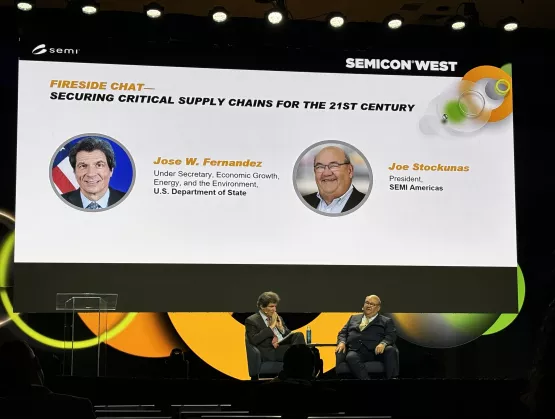
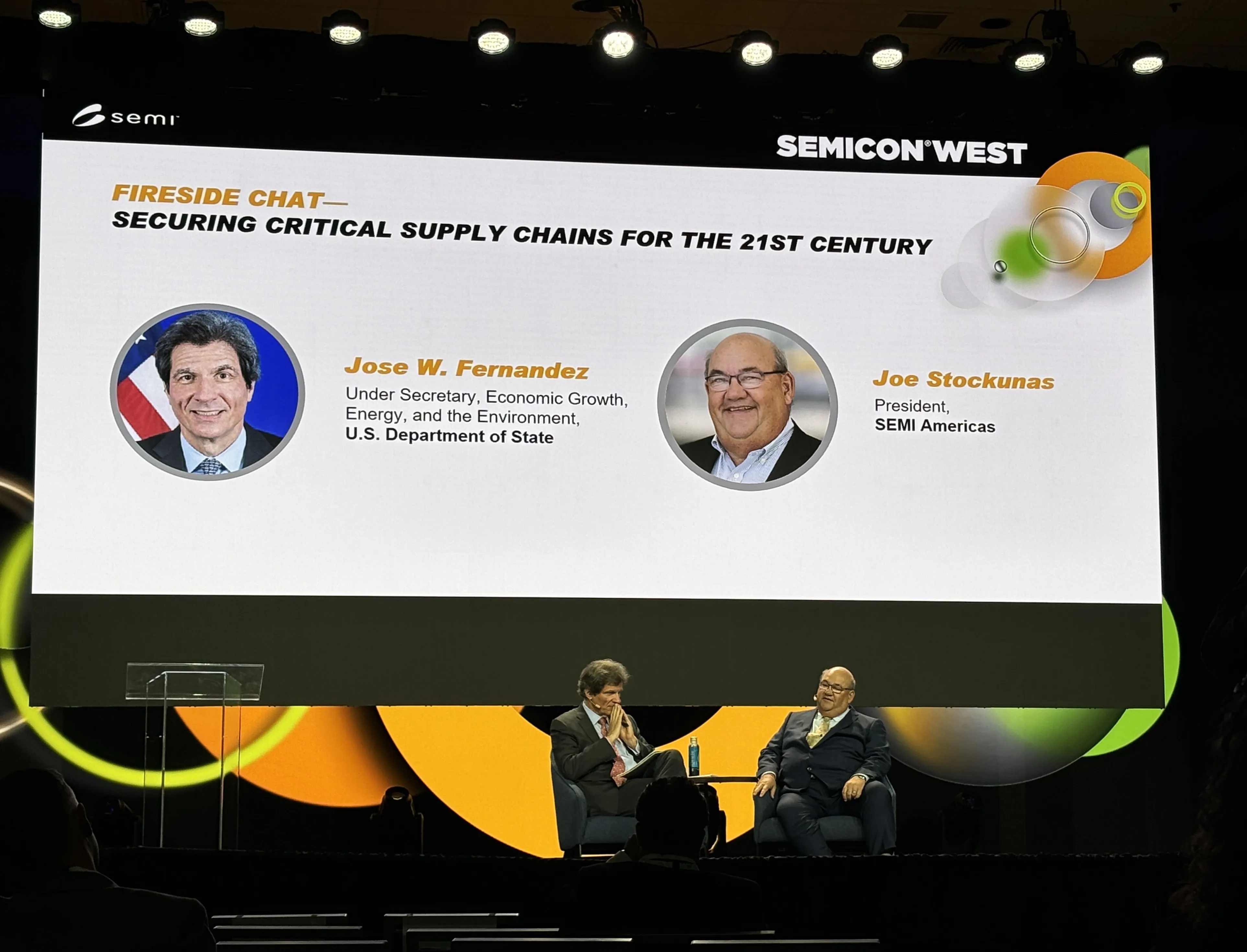
Jose Fernandez, U.S. Under Secretary of State for Economic Growth, Energy, and the Environment, sat down with Joe Stockunas, President of SEMI Americas, for a fireside chat on the CEO Summit keynote stage at SEMICON West 2024. In the Securing Critical Supply Chains for the 21st Century discussion, Fernandez emphasized the need to form partnerships to address vulnerabilities as the key to creating stable supply chains. It’s important to band together, he said, to protect our standards, values, and democracy. Diversifying the Global Mineral Supply ChainBecause chip fabricators depend on minerals like germanium, gallium, arsenic, indium, and rare earth elements, he highlighted how imperative it is for the industry to access them sustainably. To accomplish this, he stressed the importance of protection against supply chain bottlenecks in the mineral market. “According to a number of experts, we’re going to need 42x the amount of lithium by 2050, 25x the amount of manganese, and 25x the amount of cobalt,” he said. “Those minerals are basically controlled by one country, and that's a vulnerability.”To address these concerns, he shared that the State Department is working to strengthen the upstream and downstream portions of the semiconductor value chain, with the goal of supporting economic security across the globe. Foreign export controls, he said, have led to supply chain disruptions of key minerals, and bans on rare earth elements, processing equipment, and other technologies. As evidence of the State Department’s efforts to diversify, he highlighted the Minerals Security Partnership (MSP) and its work to seek mineral alternatives. Led by the U.S., it currently includes 13 other countries plus the European Union. Partnership and Investment Opportunities To further secure the industry's supply chain, Fernandez discussed the State Department’s efforts to partner with mining countries with untapped semiconductor resources. These countries, he said, also want alternate options for securing critical minerals. Fernandez highlighted Latin America as a key nearshoring focus area, pointing to the Americas Partnership for Economic Prosperity (APEP) as a solution for addressing obstacles to investment in the region. Obstacles, he said, include education levels, insecurity, and rule of law.To overcome such hurdles, he stressed the importance of fostering economic conditions that will attract investments, emphasizing the importance of workforce development initiatives and private sector involvement. “We don’t have enough trained workers in the U.S., and we certainly don’t have enough trained workers abroad,” he said. Fernandez shared that workforce development programs are being established through the U.S. Department of State International Technology Security and Innovation (ITSI) Fund, as well as private sector efforts and university partnerships. Currently, seven countries have been selected for ITSI funding, he said. “We’ve partnered with a number of universities to address the workforce gaps we see in our ITSI partners,” he said. “We’ve created workforce seminars, and we’re going to spend more time training the labor force.” These efforts supplement the work of the SEMI Foundation to develop a holistic workforce development program for the global semiconductor industry.Preventing Chips From Entering RussiaWith U.S. chips crossing into Russia through third parties, Stockunas asked Fernandez how the semiconductor industry could help address this. Despite existing sanctions against Russia, Fernandez shared that Russia still managed to import $1.7 billion worth of microchips from both the U.S. and Europe in 2023. To help slow this down, he highlighted additional due diligence for companies whose products often make their way into the country. The federal government, he said, speaks with these companies about complying beyond what the law requires.Fernandez shared that private sector cooperation with more stringent standards has been positive, noting that some companies have cut hundreds of distributors to further aid in prevention. In addition, he mentioned that sanctions have made a promising impact overall.“[Russia] has had to use outdated equipment, they’re engaging in counterfeiting, and they’re getting help from other countries,” he said. ​​Official SEMICON West Podcast In a podcast with Francoise von Trapp of 3D InCites recorded at SEMICON West, Fernandez discussed critical mineral partnerships, benefits and setbacks of regional supply chains, and chip sanctions against Russia. To learn more, check out the podcast interview with 3D InCites. SEMI Global AdvocacyDiscover how SEMI Global Advocacy Public Policy supports the microelectronics industry across trade, taxes, talent, and R D.John Cooney is Vice President of Global Advocacy and Public Policy at SEMI.
Read More
Presentations at this year’s FLEX Conference illustrated the ongoing development of manufacturing tools and processes, materials, and test and reliability evaluation techniques for the growing field of hybrid electronics, which includes printed electronics and flexible hybrid electronics (FHE). Additionally, the field includes the use of additive manufacturing processes for electronics packaging and system assembly, from die attach to flexible printed circuits.Hosted by FlexTech, a SEMI Strategic Technology Community, the conference provides an opportunity for the device making supply chain to connect to R D, design and manufacturing innovations. A review of some of the key developments highlighted in FLEX presentations follows.Innovations in Flexible Printed CircuitsTokyo-based Elephantech has been focused on using advanced inkjet systems to produce flexible printed circuits. Using additive methods instead of subtractive to produce PCBs can enable reductions in carbon footprint, copper usage and water consumption. In order to achieve these benefits, Elephantech has developed processes for combining inkjet printing of metals and electroless plating. The company synthesizes copper nano particles, which it uses to formulate metal ink. It has implemented artificial intelligence to increase print accuracy, showing the capability of average drop position error of less than 2μm, and depositing 20μm droplets into 40μm grooves and wells (Fig 1).Fig. 1. Elephantech inkjet results showing ~2μm precision and prototypes with 50μm line widthExamples of Elephantech’s use of flexible printed circuit technology include a set of switches for a curved monitor and a pressure sensor with reduced footprint and component count. The company intends to directly compete with larger, rigid PCBs, and is developing a mass-production system with 57,840 nozzles that can process sheet sizes of 500 x 830 mm.Traditional processes for component attach on PCBs include mass reflow ovens, thermal compression bonding, and spot laser reflow. Laserssel has developed laser selective reflow, which promises warpage- and damage-free bonding at increased processing speeds. In addition to improving the productivity of rigid PCB production, the laser selective reflow could also enable in-line processing of roll-to-roll flexible printed circuits, replacing the use of trays for bonding to flexible printed circuits.Scrona, which spun out from ETH Zurich, has developed MEMS-based printheads to improve electrohydrodynamic (EHD) printing. By using an electric field to pull droplets out of the print nozzle, EHD can enable much higher print resolution (sub-micron, compared to tens of microns), and enable the use of higher viscosity inks than would be possible with traditional inkjet heads. While EHD has been under development for some time, its application has been limited by crosstalk, in which the electric fields of adjacent nozzles interact with each other, and the requirement for the nozzle to be within tens of microns from the substrate to enable high print accuracy.Scrona’s MEMS-based nozzles address these EHD problems by shielding adjacent nozzles to prevent crosstalk and by creating a uniform electric acceleration field, which increases print distance to the order of a millimeter. The company has used its system to print a variety of inks on different substrates, as well as conformal printing on 3D surfaces (Fig. 2).Fig. 2. Example of printing silver wires across a polished glass edge; line pitch 25μm, glass thickness 1mmThe Rochester Institute of Technology (RIT) has been developing an additive technique called liquid metal droplet jetting, which can deposit metal traces functionally equivalent to solid wires. The process uses metal wire as a feedstock, which is a fraction of the cost of nanoparticle metals. While tin, zinc, and aluminum have been used, silver and copper are still under development. The wire is melted in a micro-crucible, which feeds a nozzle; metal droplets are then jetted on demand in an argon environment to prevent oxidation (Fig. 3, l). Upon hitting the substrate, the drops solidify into metal traces equivalent to solid wire, quickly enough to avoid melting flexible films, and without curing or drying.Several methods have been explored to eject the jets from the nozzle, including magnetohydrodynamic using electromagnetic pulses, piezo-actuated pistons, and pneumatic jetting using compressed gas (Fig. 3, r). These techniques range from high-jetting-frequency and high-cost to simple and low-cost but low-frequency. Higher frequency enables overlap of droplets, increasing conductivity, and reduced processing time.Fig. 3. Concept of liquid metal droplet jetting (l); pneumatic droplet ejection approach (r)In addition to ongoing development of deposition tools and processes, the material set for additively printed electronics continues to expand. Iris Light Technologies, which spun out of Argonne National Lab and Northwestern University, is developing photonic inks for wafer-scale production of active devices including photodetectors, LEDs, and lasers. The semiconductor-based ink can be deposited via aerosol jet onto silicon wafers. Iris Light is focused on 2D semiconductors, specifically black phosphorous, which has a wider spectral coverage than graphene, is tunable in emission and absorption, and has high mobility.An example of the broadening of the additive manufacturing supply chain, Kraetonics has developed software for creating slices to be used in designing 3D-printed structures and elements. The software enables manufacturing 3D volumetric circuits with reduced size, weight, and power compared to 2D PCBs. The process involves 3D printing of hybrid mechanical-electrical assemblies such as circuits and antennas.Innovations in Test and ReliabilityAn area of active interest in the hybrid electronics community is that of test and reliability. American Semiconductor, a developer of flexible circuitry, and Bayflex, a value-added partner of Japanese equipment company Yuasa, are conducting a project on dynamic harsh environmental FHE reliability testing. The goal is to identify root causes of FHE material and system failures.The companies are developing extended temperature and humidity tests to determine FHE system lifetimes and identify causes of failures from physically deforming FHE materials and systems in harsh temperature and humidity environments. Materials under consideration for testing include:Copper on polyimide substrate with a small outline package IC and surface-mounted componentsNobleflexTM, a multilayer substrate with gold on polyimide in development for medical devicesSilver on PET substrate, with small outline package IC.The team is soliciting other test devices and is planning to coordinate with ongoing development of FHE test standards coordinated by SEMI.Henkel reported on an investigation of accelerated temperature cycling test methods, in which the company applied different combinations of temperature range, stress, and frequency of mechanical force in an effort to reduce cycle time for testing component attach reliability. The study was able to achieve similar failure modes using an accelerated test method in the case of a bonding position shift in which cracking of the die attach film was the failure mode (Fig. 4, approach 4). The study found the greatest acceleration in the case of reduced thermal shock cycles (Fig. 4, approach 1).Fig. 4. Approaches evaluated for accelerated testing of component attach.Engineering consulting firm Exponent presented the results of a study on mechanical testing for characterizing fatigue performance of flexible electronics, conducted with continuous monitoring of fatigue for 6-pin flexible flat cables from seven different vendors. Exponent found that continuous monitoring during bending fatigue testing provided greater resolution in test results including detection of intermittent failure in each sample. The study also found that strain amplitude was a critical factor for determining fatigue life, and that flat flexible cables with larger pitches showed improved fatigue performance.About SEMI FlexTechFlexTech, a SEMI Strategic Technology Community, promotes the growth, profitability and success of the flexible hybrid electronics industry by developing educational forums, directing research, and promoting technology innovation.SEMI FlexTech members benefit from speaking and business networking opportunities, introductions to key industry players, research reports, technical funding, access to end users and industry advocacy at FLEX Conferences.Gity Samadi is Director of SEMI research and development funding programs and SEMI FlexTech and SEMI Nano-Bio Materials Consortium (NBMC). Paul Semenza is an advisor to SEMI on special projects. He was previously with NextFlex, the Flexible Hybrid Electronics Manufacturing Innovation Institute.
Read More
As more than 400 speakers took the stages at SEMICON West 2024, sustainability and workforce development stood out as two major focus areas. The second day of this year’s CEO Summit keynote program, themed Seizing the Global Opportunities and Challenges Ahead, featured sessions on both topics. One of the first sessions of the day was the Chief Sustainability Officer (CSO) panel discussion, titled Bracing for the Evolving Global Risk for the Semiconductor Ecosystem, moderated by Vice President of SEMI Global Sustainability Programs, Dr. Mousumi Bhat. Later that morning, Shari Liss, Vice President of SEMI Global Workforce Development Programs and Executive Director of the SEMI Foundation, moderated a fireside chat, Advocating for Real Change: Why Inclusion and Belonging Need to be Everyone’s Concern, with Sandra Mahadwar from KLA Corporation. Bhat and Liss were later interviewed for a podcast by Francoise von Trapp of 3D InCites to share additional insights on sustainability and workforce development, respectively. Bhat was also joined by Paul Kelly, COO of the New York Center for Research, Economic Advancement, Technology, Engineering, and Science (NY CREATES). Creating a More Sustainable Semiconductor Industry During their interview, both Bhat and Kelly emphasized that the industry will need to reduce its use of per and polyfluoroalkyl substances (PFAS) to sustainably innovate at today’s nanometer pace. For this reason, Kelly highlighted the importance of learning to balance current production demands with the health of climate.To achieve this balance, they discussed the efforts of the Semiconductor Climate Consortium (SCC). Much of the SCC’s efforts, they said, will focus on driving the industry toward net zero emissions. SEMI and NY CREATES announced a memorandum of understanding (MOU) at SEMICON West 2024 to promote sustainable practices within the industry, with a focus on PFAS reduction. Kelly pointed to the ability of SCC members to test new materials, gases, and chemicals at NY CREATES’ R D facilities in upstate New York to work toward replacing PFAS with more sustainable alternatives. Bhat also shared that this collaboration helps facilitate prototyping, experimentation, and tests and measurements for newer, more sustainable substances.Dr. Mousumi Bhat of SEMI and Dave Anderson of NY CREATES celebrate their organizations’ sustainability MOU at SEMICON West 2024.“The thought leadership comes from the Consortium, and the support on infrastructure comes from NY CREATES,” said Bhat. “This should become a blueprint to solve some of the challenging problems that we have in our industry.” When it comes to reducing emissions, Bhat mentioned two key objectives. The first, she said, is access to clean energy, and the second is the reduction of greenhouse gases. Bhat cited these as the issues that will take the longest for the industry to solve and pointed to the importance of industry collaboration and partnerships to support the needed experimentation. But while partnerships will bring the industry closer to net zero, both Bhat and Kelly cautioned that it won’t be reached overnight. “Much more needs to be done in the industry to reach that net zero goal,” said Kelly. “New chip technologies, new chemicals, and new processes are very much large leaps to achieving that. But right now, even some of the most advanced will only reduce [emissions] by 70%.” To help bridge this gap, Bhat encouraged others to join and participate in the SCC. “Rather than everybody doing a one-to-one experimentation in their own space and spending those resources, I would like to invite anyone that's not part of the climate consortium,” she said. “And [I invite] those that are part of the climate consortium to engage more actively, so that we are all accelerating the journey toward net zero.” Addressing the Talent Shortage This year’s SEMICON West also featured five keynote sessions dedicated to workforce development, as well as a Workforce Development Pavilion that included several talks around diversity, equity, inclusion, and belonging (DEIB). With the estimated one million jobs the industry will need to fill by 2030, Liss shared that every role is needed – from entry level all the way to Ph.D. researchers. “We need to try and bring in as many people as we can over the next few years,” said Liss. “The talent shortage is a global issue, not just a U.S. one.” Shari Liss of SEMI moderated the fireside chat at SEMICON West 2024 with Sandra Mahadwar from KLA Corporation.To begin to close the talent gap, Liss stressed the importance of educating children about the semiconductor industry. “We are just invisible to kids,” she said. “In every part of the globe, they carry chips in their hands all day every day, and they don’t know. So to me, breaking that barrier and making sure kids know about our work as an industry is going to be so critical to making this successful.” Liss also highlighted differences in workforce development programs across the world, noting that what works in one region may not translate to another. For example, apprenticeships are widely embraced in Europe, she said, but they’re a fairly new practice in the U.S. Conversely, she shared that veteran-focused programs wouldn’t work for some regions, but they’re a “powerful win” in the U.S. Each SEMICON show across the world, she shared, includes similar workforce development and DEIB programming, in addition to targeted sessions for students and HR professionals. Companies can interview for open positions at SEMICON shows as well. To learn more about SEMI’s workforce development initiatives and programming, visit semi foundation.org, or check out this overview of DEIB content at SEMICON West 2024. Samer Bahou is director of Marketing Communications at SEMI.
Read More
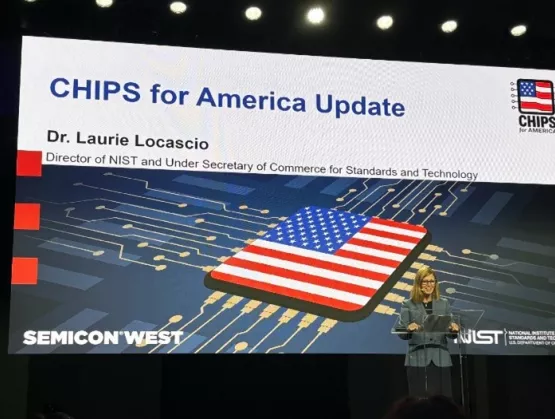
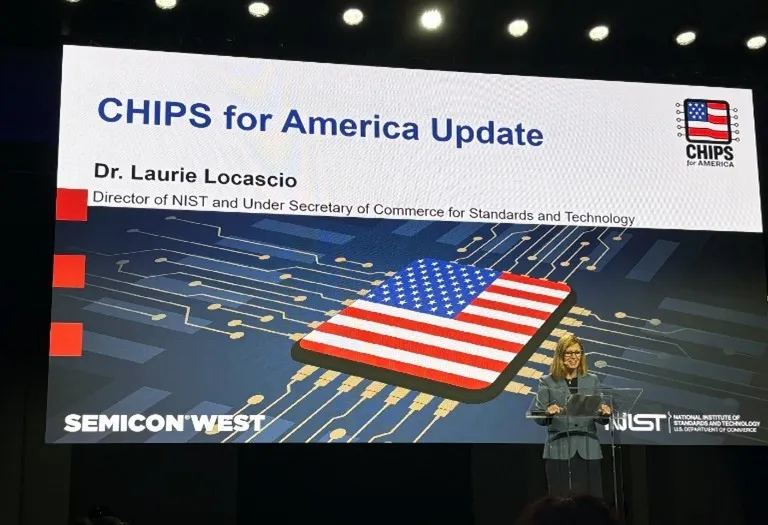
SEMI was honored to welcome U.S. Under Secretary of Commerce for Standards and Technology, Dr. Laurie E. Locascio, to the CEO Summit keynote stage at SEMICON West 2024 on Tuesday, July 9. Locascio, who also serves as the Director of the National Institute of Standards and Technology (NIST), delivered her morning CHIPS Act Update keynote address to a packed room of over 1,000 attendees at the Moscone Center in San Francisco.During her address, Locascio emphasized how far the U.S. chip industry has progressed since 2021. “Prior to 2022 and the passage of the CHIPS and Science Act, the U.S. produced 0% of the world's leading edge chips,” she said. “But now, after these proposed investments, we've changed the global landscape.”Industry Shifts from the CHIPS and Science ActDue to long delays and price increases resulting from supply chain vulnerabilities, Locascio shared that Congress began developing the CHIPS and Science Act with two key goals in mind. The first, she said, was to protect economic security, and the second, was to lower costs for American taxpayers. As part of the CHIPS and Science Act, CHIPS for America was established to advance semiconductor manufacturing in the U.S. CHIPS for America encompasses two offices: The CHIPS Research and Development Office, as well as the CHIPS Program Office - both of which are responsible for implementing CHIPS and Science Act law.CHIPS for America, said Locascio, couldn’t be another procurement program. Instead, it needed to be a purpose-driven approach to build domestic manufacturing capacity. Locascio highlighted that CHIPS for America galvanized several experts from the federal government, R D, and other core areas to work together to revitalize the U.S. semiconductor industry and increase capacity. To achieve this, Locascio pointed to CHIPS for America’s $30 billion in proposed direct funding and $25 billion in proposed direct loans.Locascio also noted diversity of technology as being essential for the American chip industry, citing how Intel, Micron, TSMC, and Samsung have recently expanded in the U.S., with SK Hynix planning to build a fab and R D facility in Indiana. No other economy in the world, she said, has more than two of these companies producing leading edge chips on its shores.“The total public and private investment from our four, leading-edge companies will equal roughly $300 billion between now and the end of the decade, far and away the most investment in new production in the history of the U.S. semiconductor industry,” said Locascio. Industry Investments on the HorizonTo further aid these efforts, Locascio mentioned CHIPS for America’s notice of intent to invest $1.6 billion in an open competition to accelerate advanced packaging domestically and encourage innovation. Funding will be directed toward five key R D areas, including equipment tools, power delivery, connector technology, chiplets, and Electronic Design Automation (EDA), she said. Additionally, Locascio shared that CHIPS for America recently announced its first preliminary memorandum of terms (PMT) to support the upstream supply chain, and shared plans to announce several more PMTs in the future. Lastly, Locascio revealed that CHIPS for America plans to release a model and process for bringing new facilities to life, in partnership with the National Semiconductor Technology Center (NSTC). NSTC members, she said, will gain access to partnership funds and state-of-the-art facilities to support the U.S. semiconductor industry. “Across all these efforts, from manufacturing incentives to research funding, to workforce development efforts, the U.S. must cultivate and build our competitive assets to protect and grow our technological leadership,” said Locascio.In a podcast with Francoise von Trapp of 3D InCites recorded at SEMICON West, Locascio discussed her career background, CHIPS Act investments and the path forward for the semiconductor industry in the U.S. To learn more, check out the podcast interview with 3D InCites. SEMI Global AdvocacyDiscover how SEMI Global Advocacy Public Policy supports the microelectronics industry across trade, taxes, talent, and R D.John Cooney is Vice President of Global Advocacy and Public Policy at SEMI.
Read More
As the semiconductor industry works to attract talent to overcome its labor shortage, governments, educators, and the private sector must collaborate to make industry career opportunities more accessible for prospective employees. This concept provided the framework for a panel discussion during SEMI’s 35th annual Advanced Semiconductor Manufacturing Conference (ASMC) that took place in Albany, New York in mid-May.Despite extensive CHIPS and Science Act news coverage and escalating efforts to promote semiconductor career development initiatives, there’s still a tremendous amount of work to do, noted Fran Dillard, Vice President and Chief Diversity Inclusion Officer at Micron. “We're going to have to work to reduce barriers to this industry, and we have a chance to make a generational difference for American citizens,” she said. The panel, titled Talent Pipeline: Building a Sustainable and Diverse Semiconductor Workforce, featured Dillard and representatives from government and education who shared insights on growing the industry to fulfill unprecedented chip demand. Dillard was joined by Kylie Patterson, Chief Opportunity and Inclusion Officer at CHIPS for America; Kevin Younis, Chief Opportunity Officer and Executive Deputy Commissioner at Empire State Development; and Hector M. Rodriguez, Ph.D., Dean of Science, Technology, Engineering and Math at Hudson Valley Community College. Shari Liss, Executive Director of the SEMI Foundation, moderated the panel.Building the Future Together The need for extensive collaboration to bring semiconductor manufacturing back to the United States fueled the discussion. Patterson explained that given current investments in the semiconductor industry, the U.S. must double its workforce and triple its graduates in technical and construction-related fields. Overall, she estimated the industry will need to train around 100,000 new technicians.To achieve these goals, Rodriguez said that representatives from GlobalFoundries, the New York State Department of Labor, State University of New York, Center for Economic Growth, and the National Institute for Innovation and Technology, meet monthly to discuss on-the-job training programs for high school graduates and General Educational Development (GED) holders. He explained that by frequently evaluating training programs, they can quickly adjust curriculums if results don’t meet expectations. Younis said that bringing manufacturing back to the U.S. creates a unique alignment of interests between the government and the private sector. He highlighted the opportunity to work together to build the country’s manufacturing capacity, citing Empire State Development and Micron’s Green CHIPS Community Investment Fund for Central New York as an example of public and private collaboration. Part of the fund, he explained, will go toward workforce development. “We can focus on succeeding, with everyone marching in the same direction,” he said. Tapping Underrepresented Populations To find the talent needed to sustain the pace of semiconductor innovation, the panel stressed the importance of attracting people from all backgrounds and exposing them to the industry earlier in life. Dillard pointed out that women account for just 10-15% of workers in technical roles, and that percentage is even lower for people of color. “If we’re going to resource the semiconductor industry over the next 10-20 years, we’ve got to bring everyone with us,” she said.Helping those from underrepresented communities overcome barriers like limited access to childcare and transportation is important, said Rodriguez. He noted that wraparound services can be essential for transitioning these individuals into industry careers. Younis also highlighted Empire State Development’s One Network for Regional Advanced Manufacturing Partnerships (ON-RAMP) program, which will help provide these services in Upstate New York. If we’re going to get the people the industry needs, we must look for every opportunity, Rodriguez said, as they need to see that a great job is on the other side of the fence. Patterson said schoolchildren should be exposed to the semiconductor industry at a younger age, particularly girls and those from underrepresented groups. She cited a study about LEGO blocks, explaining that when the toy is introduced in primary school, boys are often excited, but girls are generally uncomfortable. “This is an example of the role of exposure,” she said. “If you’re not exposed to something, you have a lack of comfort, and that lack of comfort means you also have a lack of persistence to arrive at a level of competence.” Retaining the WorkforceAs an example of how to retain employees, Dillard pointed to the success of Micron’s Employee Resource Groups, as evidenced by the company’s internal data. These groups offer space for Micron’s underrepresented populations to connect with peers from similar backgrounds. Currently, the company has 10 groups, including groups for veterans, women, disabled employees, racial groups, and others. Diversity within leadership was also noted as key for retaining employees. Rodriguez said that when employees see people from similar backgrounds to their own in leadership roles, those employees are more likely to stay with those companies. Leadership training around psychological safety and working cross-culturally was also mentioned, with Dillard highlighting the importance of developing leaders that value inclusion. The cyclical nature of the industry was addressed during the Q A as a reason people may not stay long-term. Part of the solution, Patterson said, is to be transparent about market challenges and the importance of having a few months’ worth of savings. When employees encounter market challenges, they may be forced to switch industries if they don’t have savings to cover them. “There’s a role for us to be playing when it comes to supporting the financial literacy of our employees,” she said. View the full 2024 panel discussion to learn more. Additional ASMC 2024 HiglightsASMC 2024 featured keynotes by thought leaders from IBM, Wolfspeed, and Semiconductor Advisors. ASMC is the leading international technical conference for discussing solutions that improve the collective manufacturing expertise of the semiconductor industry. Solving the challenges presented by semiconductor manufacturing is a combined effort by device makers, equipment and materials suppliers, and academics. ASMC provides a platform for semiconductor professionals to network and learn the latest in the practical application of advanced manufacturing strategies and methodologies. Technical presentations at ASMC highlight industry innovations with specific results and select ASMC manuscripts are published in the ASMC Special Section of IEEE Transactions on Semiconductor Manufacturing.Krish Raghunath is Sr. Specialist for Conferences Committees at SEMI Americas.
Read More