downloadGroupGroupnoun_press release_995423_000000 copyGroupnoun_Feed_96767_000000Group 19noun_pictures_1817522_000000Member company iconResource item iconStore item iconGroup 19Group 19noun_Photo_2085192_000000 Copynoun_presentation_2096081_000000Group 19Group Copy 7noun_webinar_692730_000000Path
Skip to main content
Default Banner Image

talent

The Rising Stars: 20 Under 30 blog series celebrates the brightest young leaders shaping the future of the semiconductor industry. These exceptional individuals have earned the SEMI Europe 20 Under 30 Award for making a remarkable impact across the supply chain—whether in engineering, sales, marketing, or R D. The series spotlights these rising stars for their career achievements, commitment to innovation, leadership skills, and dedication to driving both business success and community growth.Follow their inspiring journeys, and discover how they are thriving and paving the way for future generations in the semiconductor world.Introducing Kai Hahn: Project Manager R D at Comet, Industrial X-Ray Systems DivisionKai Hahn’s journey began when he joined the company as a bachelor’s thesis student. His early drive and exceptional contributions quickly set him apart, earning him a role as a cooperative student while simultaneously serving as a "Change Manager." In this capacity, Hahn led high-impact business excellence initiatives, overseeing cross-functional projects at the executive level. Now, as a Project Manager in R D, Hahn leads agile teams developing cutting-edge automated inspection solutions. His leadership, marked by a commitment to innovation, collaboration, and customer satisfaction, drives both personal and organizational growth, making him a standout in the semiconductor industry.SEMI: What inspired you to join the semiconductor industry? Hahn: I didn't actively choose the semiconductor industry; rather, I grew into it together with our brands Comet Yxlon Dragonfly. Beyond the pioneering spirit our X-Ray System division has, what excites me the most is our direct connection to semiconductors. From turning off your morning alarm to driving to work, staying connected with friends and family, or watching a sports game on TV — semiconductors are everywhere and shape our daily lives. Working in this industry is both exciting and challenging. Every day, I look forward tackling new projects that push the boundaries of innovation. But what inspires me the most is the transformation that our division is undergoing. We are continuously adapting our processes and procedures to meet the growing demands of the market and our customers. Being part of this dynamic evolution is rewarding and exhilarating. SEMI: How did your early experiences and education shape your career path?Hahn: With my degree in business and engineering, I chose a program that covered a wide range of subjects. While I gained knowledge from a broad field, by the end of my bachelor's degree, I realized I lacked practical experience and a clear direction for my career.Joining Comet as an intern during my final year helped me anchor my career path. I decided to pursue my master's degree while working part-time for the company. This decision allowed me to gain relevant professional experience early on and apply the knowledge from my studies directly to real-world challenges. SEMI: Can you share a professional accomplishment you’re most proud of, and explain why it’s significant to you?Hahn: Combining the strengths of Comet Yxlon’s software and Dragonfly’s AI powerhouse — I was the dedicated project manager to support the global technological cooperation of our two software environments to accelerate the 3D IC go to market challenge. My goal was to facilitate methodological collaboration to develop new software inspection workflows for the semiconductor industry.Looking back, I am proud of what we accomplished: building a cohesive team from different cultures, working across time zones, adapting to various working styles, and successfully launching our first product.SEMI: As a young professional in the industry, what is your greatest challenge? Hahn: One of the biggest challenges is the rapid pace of industry change. For development teams, this means shorter development cycles and closer collaboration with international customers. For young professionals, it's essential to maintain a continuous learning cycle to stay current and develop the ability to work effectively across diverse cultures. This ensures we understand the different customer requirements and can implement them effectively.SEMI: What advice would you give to younger generations aspiring to make an impact in this industry?Hahn: Gaining practical experience alongside your studies as early as possible is crucial. Internships or working student positions offer valuable opportunities, and sometimes, it’s beneficial to proactively reach out to companies, even if no vacancies are advertised. For me, these experiences made my studies more engaging by linking theory to real-world applications and deepening my understanding of the subjects. Beyond acquiring practical skills and expanding your network, this approach helps clarify the career path you want to pursue after graduation.SEMI: How do you envision future work environments? Hahn: Working from home has increasingly become the standard in recent years. While offering many advantages, a significant challenge for companies is maintaining a sense of community. This is easier to achieve when employees are physically present, as in-person interactions tend to be more impactful. It raises the question of how companies can foster a strong sense of community and belonging in the long term without requiring workers to be physically present in the office.SEMI: What impact has the 20 Under 30 Award had on your career? Hahn: Overall, this recognition has been both a validation of my efforts and a source of inspiration to continue pushing the boundaries in my work. Beyond the recognition of my contributions and achievements, the award provided a platform to engage with like-minded young professionals beyond my usual network.Following 20 Under 30 JourneysKai Hahn’s journey from a bachelor’s student to a leading Project Manager at Comet, Industrial X-Ray Division is a testament to his dedication, innovation, and leadership in the semiconductor industry. His achievements in integrating teams, developing cutting-edge solutions, and driving organizational transformation highlight the significant impact young professionals can make. Hahn’s story is an inspiring example of how passion and perseverance can lead to remarkable accomplishments. As he continues to push boundaries and shape the future, SEMI looks forward to seeing the continued influence of his work in the semiconductor field.The Rising Stars: 20 Under 30 blog series celebrates the exceptional talent and leadership driving the future of the semiconductor industry. Each of the young innovators honored is not only excelling in their respective fields but also shaping the landscape of technology and business with their visionary approaches and dedication. Their stories exemplify the remarkable achievements and unwavering commitment that define the next generation of industry leaders. The series is intended to inspire and motivate future professionals to pursue their passions and embrace the opportunities within this dynamic industry. Stay tuned for more stories of rising stars who are paving the way for continued growth and innovation in the semiconductor world.Learn more about the SEMI Europe 20 Under 30 Award and the recipients honored at SEMICON Europa 2023. Nominations for the 20 Under 30 program at SEMICON Europa 2024 close on September 30.Maria Daniela Perez is Communications Manager at SEMI Europe.
Read More
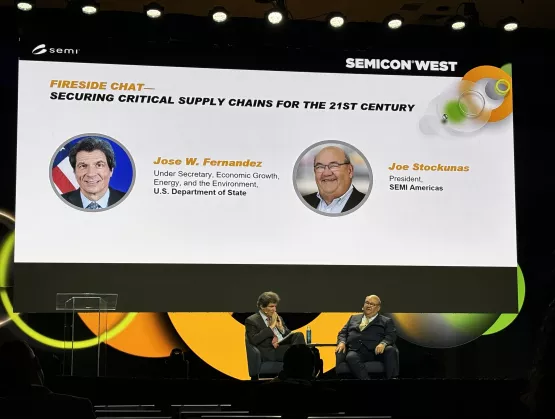
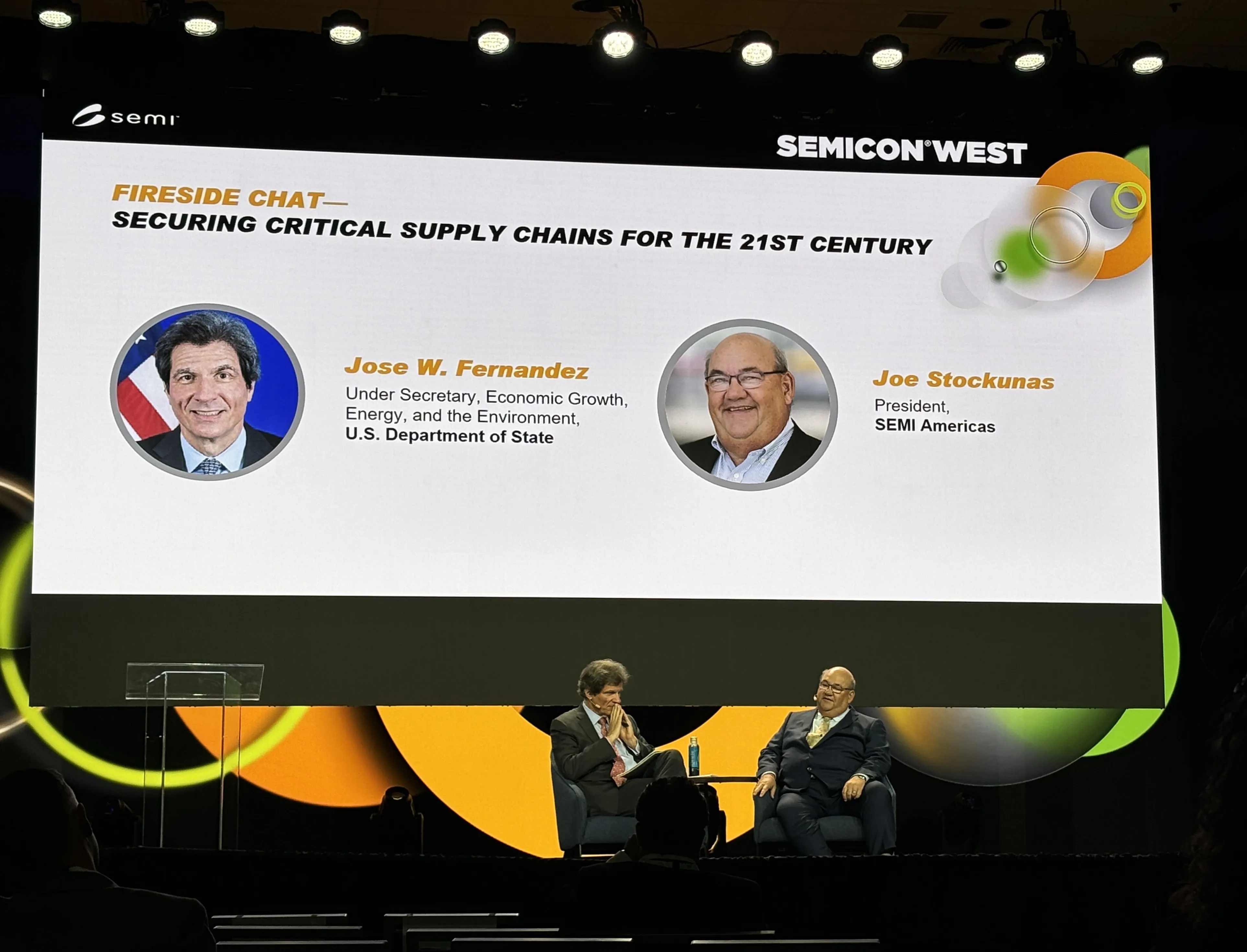
Jose Fernandez, U.S. Under Secretary of State for Economic Growth, Energy, and the Environment, sat down with Joe Stockunas, President of SEMI Americas, for a fireside chat on the CEO Summit keynote stage at SEMICON West 2024. In the Securing Critical Supply Chains for the 21st Century discussion, Fernandez emphasized the need to form partnerships to address vulnerabilities as the key to creating stable supply chains. It’s important to band together, he said, to protect our standards, values, and democracy. Diversifying the Global Mineral Supply ChainBecause chip fabricators depend on minerals like germanium, gallium, arsenic, indium, and rare earth elements, he highlighted how imperative it is for the industry to access them sustainably. To accomplish this, he stressed the importance of protection against supply chain bottlenecks in the mineral market. “According to a number of experts, we’re going to need 42x the amount of lithium by 2050, 25x the amount of manganese, and 25x the amount of cobalt,” he said. “Those minerals are basically controlled by one country, and that's a vulnerability.”To address these concerns, he shared that the State Department is working to strengthen the upstream and downstream portions of the semiconductor value chain, with the goal of supporting economic security across the globe. Foreign export controls, he said, have led to supply chain disruptions of key minerals, and bans on rare earth elements, processing equipment, and other technologies. As evidence of the State Department’s efforts to diversify, he highlighted the Minerals Security Partnership (MSP) and its work to seek mineral alternatives. Led by the U.S., it currently includes 13 other countries plus the European Union. Partnership and Investment Opportunities To further secure the industry's supply chain, Fernandez discussed the State Department’s efforts to partner with mining countries with untapped semiconductor resources. These countries, he said, also want alternate options for securing critical minerals. Fernandez highlighted Latin America as a key nearshoring focus area, pointing to the Americas Partnership for Economic Prosperity (APEP) as a solution for addressing obstacles to investment in the region. Obstacles, he said, include education levels, insecurity, and rule of law.To overcome such hurdles, he stressed the importance of fostering economic conditions that will attract investments, emphasizing the importance of workforce development initiatives and private sector involvement. “We don’t have enough trained workers in the U.S., and we certainly don’t have enough trained workers abroad,” he said. Fernandez shared that workforce development programs are being established through the U.S. Department of State International Technology Security and Innovation (ITSI) Fund, as well as private sector efforts and university partnerships. Currently, seven countries have been selected for ITSI funding, he said. “We’ve partnered with a number of universities to address the workforce gaps we see in our ITSI partners,” he said. “We’ve created workforce seminars, and we’re going to spend more time training the labor force.” These efforts supplement the work of the SEMI Foundation to develop a holistic workforce development program for the global semiconductor industry.Preventing Chips From Entering RussiaWith U.S. chips crossing into Russia through third parties, Stockunas asked Fernandez how the semiconductor industry could help address this. Despite existing sanctions against Russia, Fernandez shared that Russia still managed to import $1.7 billion worth of microchips from both the U.S. and Europe in 2023. To help slow this down, he highlighted additional due diligence for companies whose products often make their way into the country. The federal government, he said, speaks with these companies about complying beyond what the law requires.Fernandez shared that private sector cooperation with more stringent standards has been positive, noting that some companies have cut hundreds of distributors to further aid in prevention. In addition, he mentioned that sanctions have made a promising impact overall.“[Russia] has had to use outdated equipment, they’re engaging in counterfeiting, and they’re getting help from other countries,” he said. ​​Official SEMICON West Podcast In a podcast with Francoise von Trapp of 3D InCites recorded at SEMICON West, Fernandez discussed critical mineral partnerships, benefits and setbacks of regional supply chains, and chip sanctions against Russia. To learn more, check out the podcast interview with 3D InCites. SEMI Global AdvocacyDiscover how SEMI Global Advocacy Public Policy supports the microelectronics industry across trade, taxes, talent, and R D.John Cooney is Vice President of Global Advocacy and Public Policy at SEMI.
Read More
As more than 400 speakers took the stages at SEMICON West 2024, sustainability and workforce development stood out as two major focus areas. The second day of this year’s CEO Summit keynote program, themed Seizing the Global Opportunities and Challenges Ahead, featured sessions on both topics. One of the first sessions of the day was the Chief Sustainability Officer (CSO) panel discussion, titled Bracing for the Evolving Global Risk for the Semiconductor Ecosystem, moderated by Vice President of SEMI Global Sustainability Programs, Dr. Mousumi Bhat. Later that morning, Shari Liss, Vice President of SEMI Global Workforce Development Programs and Executive Director of the SEMI Foundation, moderated a fireside chat, Advocating for Real Change: Why Inclusion and Belonging Need to be Everyone’s Concern, with Sandra Mahadwar from KLA Corporation. Bhat and Liss were later interviewed for a podcast by Francoise von Trapp of 3D InCites to share additional insights on sustainability and workforce development, respectively. Bhat was also joined by Paul Kelly, COO of the New York Center for Research, Economic Advancement, Technology, Engineering, and Science (NY CREATES). Creating a More Sustainable Semiconductor Industry During their interview, both Bhat and Kelly emphasized that the industry will need to reduce its use of per and polyfluoroalkyl substances (PFAS) to sustainably innovate at today’s nanometer pace. For this reason, Kelly highlighted the importance of learning to balance current production demands with the health of climate.To achieve this balance, they discussed the efforts of the Semiconductor Climate Consortium (SCC). Much of the SCC’s efforts, they said, will focus on driving the industry toward net zero emissions. SEMI and NY CREATES announced a memorandum of understanding (MOU) at SEMICON West 2024 to promote sustainable practices within the industry, with a focus on PFAS reduction. Kelly pointed to the ability of SCC members to test new materials, gases, and chemicals at NY CREATES’ R D facilities in upstate New York to work toward replacing PFAS with more sustainable alternatives. Bhat also shared that this collaboration helps facilitate prototyping, experimentation, and tests and measurements for newer, more sustainable substances.Dr. Mousumi Bhat of SEMI and Dave Anderson of NY CREATES celebrate their organizations’ sustainability MOU at SEMICON West 2024.“The thought leadership comes from the Consortium, and the support on infrastructure comes from NY CREATES,” said Bhat. “This should become a blueprint to solve some of the challenging problems that we have in our industry.” When it comes to reducing emissions, Bhat mentioned two key objectives. The first, she said, is access to clean energy, and the second is the reduction of greenhouse gases. Bhat cited these as the issues that will take the longest for the industry to solve and pointed to the importance of industry collaboration and partnerships to support the needed experimentation. But while partnerships will bring the industry closer to net zero, both Bhat and Kelly cautioned that it won’t be reached overnight. “Much more needs to be done in the industry to reach that net zero goal,” said Kelly. “New chip technologies, new chemicals, and new processes are very much large leaps to achieving that. But right now, even some of the most advanced will only reduce [emissions] by 70%.” To help bridge this gap, Bhat encouraged others to join and participate in the SCC. “Rather than everybody doing a one-to-one experimentation in their own space and spending those resources, I would like to invite anyone that's not part of the climate consortium,” she said. “And [I invite] those that are part of the climate consortium to engage more actively, so that we are all accelerating the journey toward net zero.” Addressing the Talent Shortage This year’s SEMICON West also featured five keynote sessions dedicated to workforce development, as well as a Workforce Development Pavilion that included several talks around diversity, equity, inclusion, and belonging (DEIB). With the estimated one million jobs the industry will need to fill by 2030, Liss shared that every role is needed – from entry level all the way to Ph.D. researchers. “We need to try and bring in as many people as we can over the next few years,” said Liss. “The talent shortage is a global issue, not just a U.S. one.” Shari Liss of SEMI moderated the fireside chat at SEMICON West 2024 with Sandra Mahadwar from KLA Corporation.To begin to close the talent gap, Liss stressed the importance of educating children about the semiconductor industry. “We are just invisible to kids,” she said. “In every part of the globe, they carry chips in their hands all day every day, and they don’t know. So to me, breaking that barrier and making sure kids know about our work as an industry is going to be so critical to making this successful.” Liss also highlighted differences in workforce development programs across the world, noting that what works in one region may not translate to another. For example, apprenticeships are widely embraced in Europe, she said, but they’re a fairly new practice in the U.S. Conversely, she shared that veteran-focused programs wouldn’t work for some regions, but they’re a “powerful win” in the U.S. Each SEMICON show across the world, she shared, includes similar workforce development and DEIB programming, in addition to targeted sessions for students and HR professionals. Companies can interview for open positions at SEMICON shows as well. To learn more about SEMI’s workforce development initiatives and programming, visit semi foundation.org, or check out this overview of DEIB content at SEMICON West 2024. Samer Bahou is director of Marketing Communications at SEMI.
Read More
As the semiconductor industry works to attract talent to overcome its labor shortage, governments, educators, and the private sector must collaborate to make industry career opportunities more accessible for prospective employees. This concept provided the framework for a panel discussion during SEMI’s 35th annual Advanced Semiconductor Manufacturing Conference (ASMC) that took place in Albany, New York in mid-May.Despite extensive CHIPS and Science Act news coverage and escalating efforts to promote semiconductor career development initiatives, there’s still a tremendous amount of work to do, noted Fran Dillard, Vice President and Chief Diversity Inclusion Officer at Micron. “We're going to have to work to reduce barriers to this industry, and we have a chance to make a generational difference for American citizens,” she said. The panel, titled Talent Pipeline: Building a Sustainable and Diverse Semiconductor Workforce, featured Dillard and representatives from government and education who shared insights on growing the industry to fulfill unprecedented chip demand. Dillard was joined by Kylie Patterson, Chief Opportunity and Inclusion Officer at CHIPS for America; Kevin Younis, Chief Opportunity Officer and Executive Deputy Commissioner at Empire State Development; and Hector M. Rodriguez, Ph.D., Dean of Science, Technology, Engineering and Math at Hudson Valley Community College. Shari Liss, Executive Director of the SEMI Foundation, moderated the panel.Building the Future Together The need for extensive collaboration to bring semiconductor manufacturing back to the United States fueled the discussion. Patterson explained that given current investments in the semiconductor industry, the U.S. must double its workforce and triple its graduates in technical and construction-related fields. Overall, she estimated the industry will need to train around 100,000 new technicians.To achieve these goals, Rodriguez said that representatives from GlobalFoundries, the New York State Department of Labor, State University of New York, Center for Economic Growth, and the National Institute for Innovation and Technology, meet monthly to discuss on-the-job training programs for high school graduates and General Educational Development (GED) holders. He explained that by frequently evaluating training programs, they can quickly adjust curriculums if results don’t meet expectations. Younis said that bringing manufacturing back to the U.S. creates a unique alignment of interests between the government and the private sector. He highlighted the opportunity to work together to build the country’s manufacturing capacity, citing Empire State Development and Micron’s Green CHIPS Community Investment Fund for Central New York as an example of public and private collaboration. Part of the fund, he explained, will go toward workforce development. “We can focus on succeeding, with everyone marching in the same direction,” he said. Tapping Underrepresented Populations To find the talent needed to sustain the pace of semiconductor innovation, the panel stressed the importance of attracting people from all backgrounds and exposing them to the industry earlier in life. Dillard pointed out that women account for just 10-15% of workers in technical roles, and that percentage is even lower for people of color. “If we’re going to resource the semiconductor industry over the next 10-20 years, we’ve got to bring everyone with us,” she said.Helping those from underrepresented communities overcome barriers like limited access to childcare and transportation is important, said Rodriguez. He noted that wraparound services can be essential for transitioning these individuals into industry careers. Younis also highlighted Empire State Development’s One Network for Regional Advanced Manufacturing Partnerships (ON-RAMP) program, which will help provide these services in Upstate New York. If we’re going to get the people the industry needs, we must look for every opportunity, Rodriguez said, as they need to see that a great job is on the other side of the fence. Patterson said schoolchildren should be exposed to the semiconductor industry at a younger age, particularly girls and those from underrepresented groups. She cited a study about LEGO blocks, explaining that when the toy is introduced in primary school, boys are often excited, but girls are generally uncomfortable. “This is an example of the role of exposure,” she said. “If you’re not exposed to something, you have a lack of comfort, and that lack of comfort means you also have a lack of persistence to arrive at a level of competence.” Retaining the WorkforceAs an example of how to retain employees, Dillard pointed to the success of Micron’s Employee Resource Groups, as evidenced by the company’s internal data. These groups offer space for Micron’s underrepresented populations to connect with peers from similar backgrounds. Currently, the company has 10 groups, including groups for veterans, women, disabled employees, racial groups, and others. Diversity within leadership was also noted as key for retaining employees. Rodriguez said that when employees see people from similar backgrounds to their own in leadership roles, those employees are more likely to stay with those companies. Leadership training around psychological safety and working cross-culturally was also mentioned, with Dillard highlighting the importance of developing leaders that value inclusion. The cyclical nature of the industry was addressed during the Q A as a reason people may not stay long-term. Part of the solution, Patterson said, is to be transparent about market challenges and the importance of having a few months’ worth of savings. When employees encounter market challenges, they may be forced to switch industries if they don’t have savings to cover them. “There’s a role for us to be playing when it comes to supporting the financial literacy of our employees,” she said. View the full 2024 panel discussion to learn more. Additional ASMC 2024 HiglightsASMC 2024 featured keynotes by thought leaders from IBM, Wolfspeed, and Semiconductor Advisors. ASMC is the leading international technical conference for discussing solutions that improve the collective manufacturing expertise of the semiconductor industry. Solving the challenges presented by semiconductor manufacturing is a combined effort by device makers, equipment and materials suppliers, and academics. ASMC provides a platform for semiconductor professionals to network and learn the latest in the practical application of advanced manufacturing strategies and methodologies. Technical presentations at ASMC highlight industry innovations with specific results and select ASMC manuscripts are published in the ASMC Special Section of IEEE Transactions on Semiconductor Manufacturing.Krish Raghunath is Sr. Specialist for Conferences Committees at SEMI Americas.
Read More