

Global silicon wafer shipments are forecast to grow 11.8% in 2026, according to the Q3 2026 SEMI Silicon Wafer Market Monitor. This increase is primarily due to strong demand for AI, which is projected to drive shipments through 2029.
Alongside AI, rising process material sales are also supporting recovery. The positive correlation between material sales and silicon wafer demand not only reflects growth in manufacturing complexity, but it also points to greater material consumption per wafer.
Finally, increases in memory demand, precautionary inventory building, and global fab capacity expansions are boosting silicon wafer shipments as well.
To better understand today’s landscape, it’s helpful to revisit past silicon wafer demand curves. From 2018 to 2019 and from 2022 to 2023, silicon wafer shipments rose ahead of major increases in memory work-in-process (WIP) inventories, or unfinished memory chips undergoing fabrication. However, shipments lagged at the same time WIP inventory peaked. Because fabrication lines were already producing at full capacity, their need for silicon wafers slowed.
While this pattern provides historical context for today’s demand recovery, the high number of new and upcoming production lines is a unique factor influencing this particular cycle.
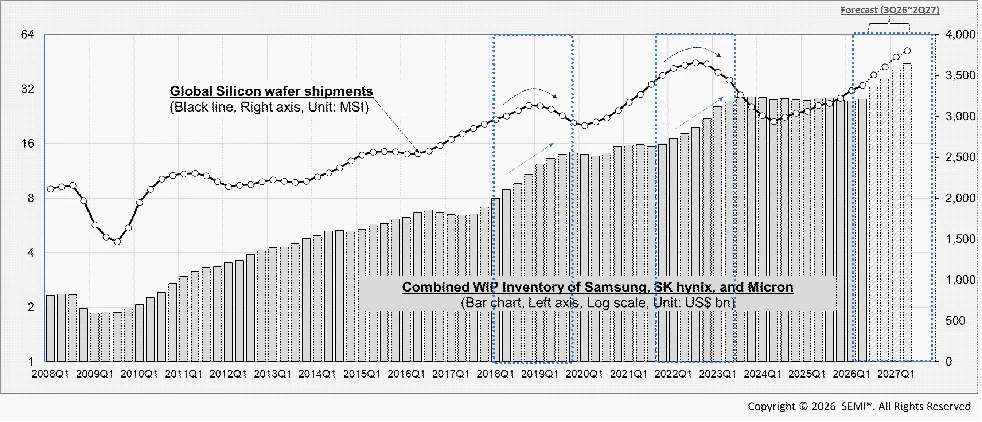
Silicon Wafer Shipments and Memory WIP: Historical Lead–Lag Pattern. Both series use four-quarter moving averages. Sources: SEMI SMG and financial disclosures from Samsung Electronics, SK hynix, and Micron. Data for 3Q26–2Q27 are forecasts.
Fab Investments Support Wafer Demand
SEMI’s fab investment outlook predicts continued growth in planned equipment spending beyond 2026. So long as investment plans remain broadly on track, ongoing equipment installation and capacity ramps are likely to support silicon wafer demand. The report also demonstrated a widening gap between YoY growth rates for semiconductor fab equipment spending and silicon wafer manufacturing equipment spending, suggesting that investment support for wafer demand may persist longer than initially expected.
This also helps explain why the historical relationship between wafer shipments and WIP does not necessarily imply an imminent slowdown. Wafer procurement momentum can moderate before WIP inventories peak, although investment support may slow if moderation becomes visible in wafer shipments.
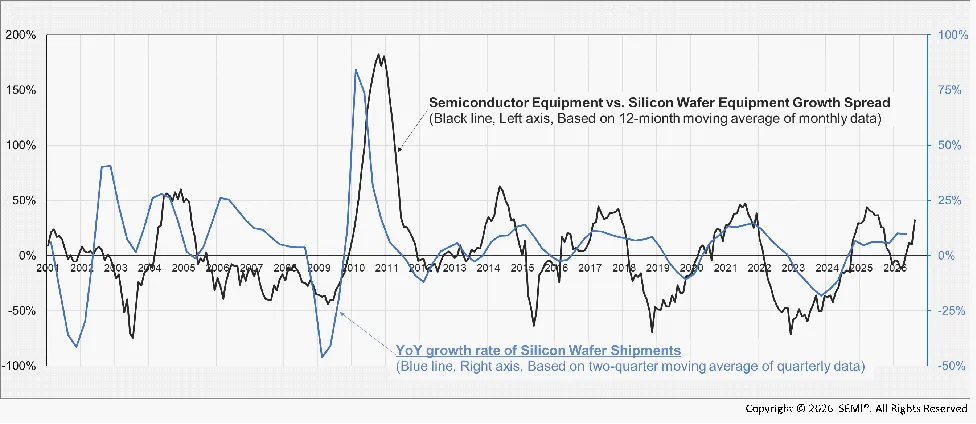
Investment Spread: A Signal of a Later Wafer-Cycle Slowdown. Spread between the YoY growth rates of semiconductor fab equipment spending and silicon wafer manufacturers' equipment spending, compared with silicon wafer shipment trends. Sources: SEMI Silicon Wafer Shipment Statistics and SEMI WWSEMS. Shipment data are updated through 2Q26, while equipment spending data are updated through August 2026.
The Next Test is Inventory Absorption
SEMI projects continued wafer shipment growth in 2027, although growth will likely be more moderate than it was in 2026. As inventory stockpiles subside, ongoing production will be important for sustaining demand. If planned capacity expansions continue and customers buy the resulting chips, semiconductor companies can gradually reduce their wafer inventories while also maintaining their purchase rate. However, investment delays or weaker demand for semiconductors would slow this absorption and increase the risk of declining silicon wafer orders.
While AI-related investment is a critical source of support, broader semiconductor recovery is still uneven. Because of this, the key to maintaining demand growth will be how quickly fabs can use wafers purchased in advance. Doing so will help shape the duration of this recovery period and the depth of any subsequent wafer inventory adjustments.
The Q3 2026 SEMI Silicon Wafer Market Monitor provides a deeper analysis of these dynamics. Its Market Update section offers insights from eight analysts and a scenario table that examines how inventory rebuilding, forward procurement, and fab investment may shape the wafer cycle through 2029. The full report package also includes a comprehensive market presentation and supporting Excel chart data.
Additional details on the Q3 2026 SEMI Silicon Wafer Market Monitor and purchasing information are available at: www.semi.org/en/products-services/market-data/si-wafer-monitor.
Sungho Yoon is a Principal Analyst on the SEMI Market Intelligence team.


