


Superconducting Naturally – Miassite is a naturally occurring mineral which scientists at Ames National Laboratory have identified as the first unconventional superconductor found in nature. Unlike conventional superconductors that follow the Bardeen-Cooper-Schrieffer (BCS) theory, minerals such as miassite exhibit unique properties outside of this framework. Made of rhodium and sulfur, miassite was initially recognized as a regular superconductor in 2010. Recent tests confirm it joins a small, exclusive group of unconventional superconductors previously limited to lab-made materials.
Lab tests on miassite involved measuring magnetic reactions, inducing defects, and analyzing energy gaps, all confirming its unconventional behavior. While naturally occurring, samples are unlikely to be superconductive due to their disordered state, miassite’s lab-verified properties open doors to new research and highlight its unique duality as both a conventional and unconventional superconductor.
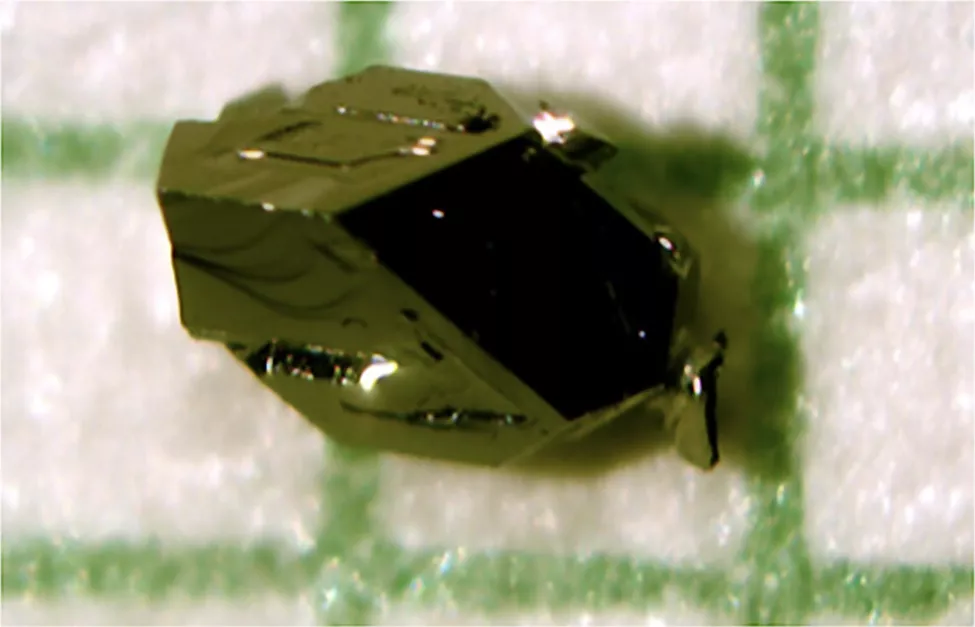
Source: A Superconductor Found in Nature Has Rocked the Scientific World
Pheromones + vision = mate selection – When choosing a mate, Heliconius butterflies, despite their tiny brains can outperform current AI in multi-sensory decision-making by processing visual and chemical cues simultaneously. This discovery inspired Penn State researchers to develop a low-energy, multi-sensory AI platform using 2D materials. The device combines molybdenum sulfide (MoS2) to mimic visual capabilities and graphene to detect chemical signals like pheromones.
The device could integrate visual and chemical cues, offering adaptability like a butterfly’s mating behavior. This innovation addresses limitations in current AI, which relies heavily on energy-intensive, single-sensory processes. Researchers aim to expand the device to process three senses, like crayfish using visual, tactile, and chemical cues. The work, supported by the U.S. Army Research Office and the U.S. National Science Foundation, could revolutionize applications in robotics, smart sensors, and critical environments, by enabling AI systems to detect issues using multiple sensory inputs efficiently.
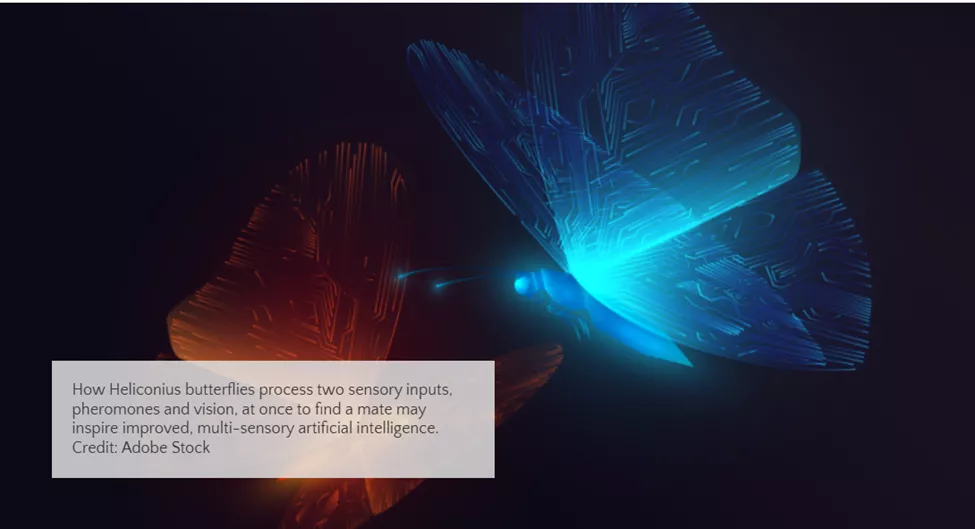
Imaging of Heliconius Butterfly
A Butterfly Effect – Proving once again that there is a lot to be learned from nature, researchers from the Fraunhofer Institute for Solar Energy Systems ISE have developed innovative, colored solar facade elements inspired by morpho butterfly mimicry. These panels are aesthetically pleasing, integrate seamlessly into building exteriors, and retain high efficiency, achieving 95% of the power output of uncoated panels. Using vacuum-applied 3D photonic structures like those on butterfly wings, the panels produce vibrant, angularly stable colors with minimal energy loss. This MorphoColor® technology addresses architects’ and building owners’ concerns about design, offering an efficient, visually appealing solution for building-integrated photovoltaics while surpassing other technologies currently available.
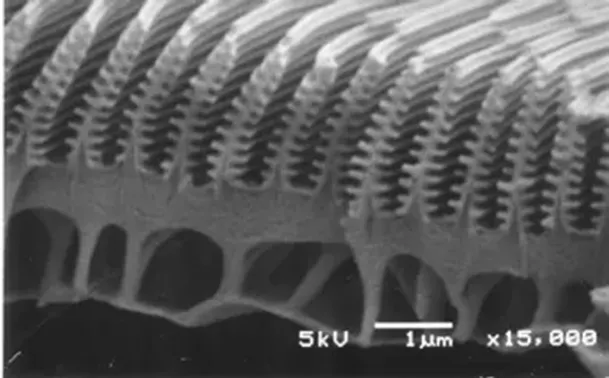
Close up of a morpho butterfly wing
Sustainable Flight – The world’s fastest supercomputer, Frontier, located at Oak Ridge National Laboratory, enables unprecedented advancements in sustainable aviation technology. Capable of over a quintillion calculations per second, Frontier allows GE Aerospace to conduct full-scale simulations of its revolutionary Open Fan engine design, accelerating insights into aerodynamics and turbulence. This groundbreaking tool aids the CFM RISE program, which aims to cut fuel consumption and CO2 emissions by at least 20%. Frontier’s detailed simulations predict engine performance under real-world conditions, saving years of testing. The partnership between GE Aerospace and Oak Ridge is expanding, promising future collaborations in climate modeling and advanced simulation techniques.
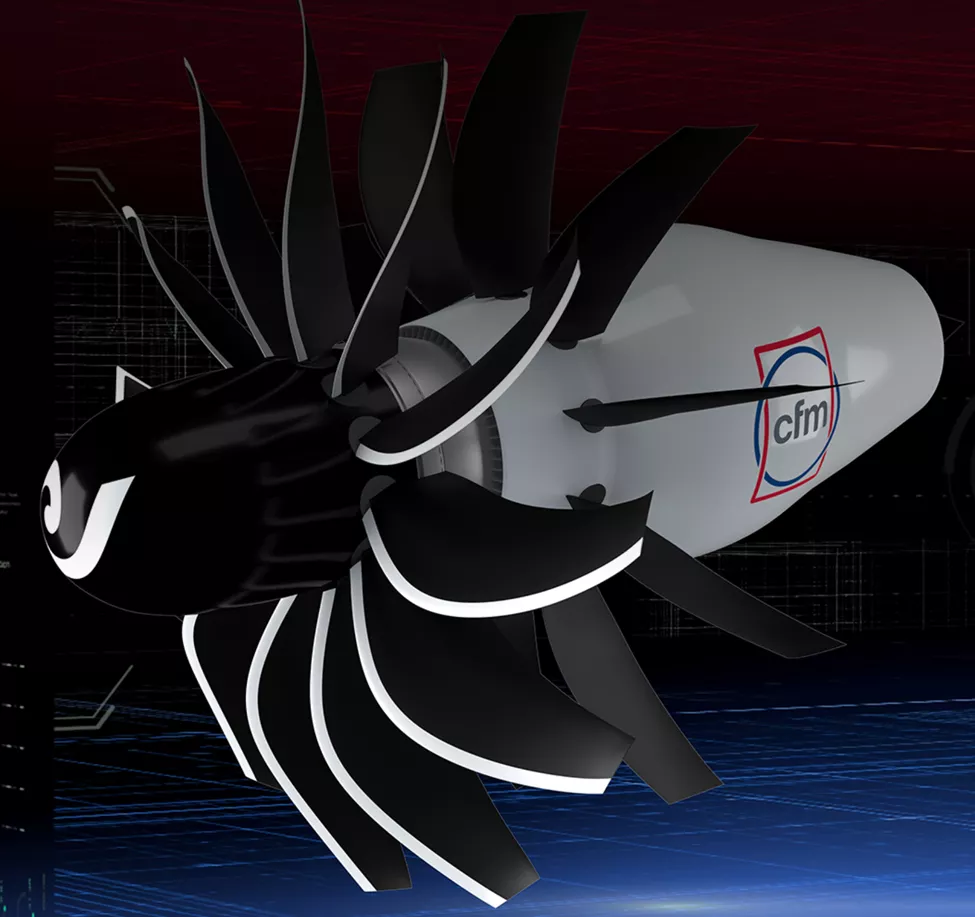
An Open Fan engine design developed as part of a new project led by GE Aerospace
Margaret Kindling is Senior Program Manager at the SEMI Foundation. She promotes inclusive workplaces via initiatives like Women in Semiconductors, Semiconductor PRIDE and workforce development programming at SEMICON West and SEMIEXPO Heartland.


