

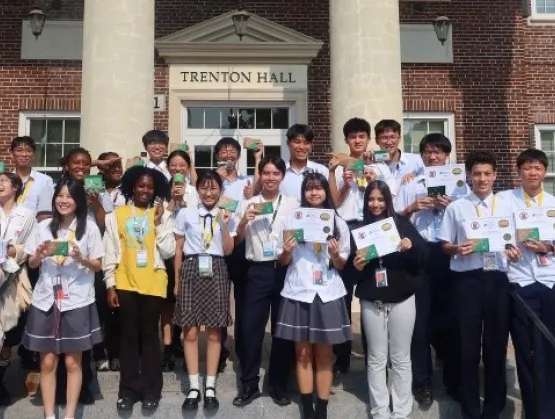
This summer, the SEMI Foundation brought together 16 high school students from Taiwan and four students from Pennsylvania for the inaugural SEMI Global Schools Academy, a five-day learning experience connecting sustainability, emerging technology, semiconductor careers, and global collaboration.
The Academy is one part of the broader SEMI Global Schools model. Classroom and school-based programs give students opportunities to explore semiconductors, sustainability, artificial intelligence, and related careers where they already learn. The Academy builds on that approach by giving a smaller group of students a deeper opportunity to learn across institutions and communities.
Students used Micro:bit sensors and AI-driven data analysis to explore environmental challenges including air quality, flooding, wastewater, and sea-level rise, with hands-on activities ranking among the most highly rated parts of the Academy.
Following the Academy, nine in 10 participating students reported interest in the semiconductor industry—an encouraging indication that meaningful exposure can help young people see possibilities they may not have previously considered.
Connecting Institutions Across Borders
What made the Academy possible was not a single organization or campus, but a network of institutions working together.
In Taiwan, schools, educators, government partners, and advisers helped prepare and support the participating students. In the United States, universities, local governments, educators, community organizations, and industry partners contributed expertise and learning opportunities.
SEMI Global Schools serves as a connector across that ecosystem, bringing together institutions that already have strong relationships with students, communities, technology, and the semiconductor industry.
That approach also makes the model adaptable. Rather than creating something entirely new in every region, Global Schools can build on the schools, universities, government partners, community organizations, and companies already there.
Learning Through Technology, Sustainability, and Community
Students began their week at The College of New Jersey, where a sustainability professor from the New Jersey Institute of Technology (NJIT) introduced climate change, systems thinking, and the United Nations Sustainable Development Goals.
Throughout the week, students explored artificial intelligence, semiconductors, sensors, coding, micro:bits, environmental monitoring, and data. They considered how technology might help address real-world challenges involving air quality, energy, transportation, infrastructure, and community well-being.
The goal was not to turn students into semiconductor experts in five days. It was to help them understand that the technologies they use every day are connected to a much larger ecosystem—and that there are many different ways to participate in it.
Students also learned that the semiconductor workforce extends beyond engineering to areas including sustainability, data science, supply chain, business, communications, education, public policy, and workforce development.
Learning Beyond the Classroom
The Academy also gave students opportunities to experience that ecosystem firsthand.
Students learned at The College of New Jersey and the New Jersey Institute of Technology, participated in outdoor environmental learning at the New Jersey School of Conservation, visited Princeton University, and engaged with technology and semiconductor professionals.
They also interacted with Princeton Mayor Mark Freda and Chester Mayor Stefan Roots, connecting their learning to broader conversations about education, technology, workforce development, and community opportunities.
Just as importantly, Taiwanese and American students worked together throughout the week, sharing perspectives, solving problems, and learning across cultural and language differences.
Building on What Already Works
The Academy is one part of a broader Global Schools model that also includes classroom and school-based programs. Those programs can reach students where they already learn, while experiences like the Academy provide a deeper opportunity to engage across institutions and communities.
The inaugural Academy offered an early example of what that model can look like: students from Taiwan and Pennsylvania learning together about sustainability, AI, semiconductors, and community challenges while engaging universities, industry, educators, and civic leaders.
As the semiconductor industry grows globally, helping young people understand that ecosystem earlier matters.
That is the vision behind SEMI Global Schools: connect strong institutions and create meaningful opportunities for more students to see where they might fit in the technology workforce of the future.
As the semiconductor industry expands, workforce development, education, community capacity, and strong local institutions will increasingly be part of the infrastructure that supports sustainable growth.
Learn more about the SEMI Foundation and SEMI workforce development programs addressing the global semiconductor industry’s talent gap.
Acknowledgments
- Dr. Prabhakar Shrestha, Assistant Director of Sustainability, New Jersey Institute of Technology
- Randall Solomon, Executive Director, Sustainable Jersey for Schools
- The New Jersey School of Conservation
- Melissa Taggart, Senior Director, Project Learning Tree Development and Strategy
- Mary Westlund, Manager, Education Systems, Project Learning Tree
Bia Hamed, Ph.D., is Program Manager, Global Education Initiatives at the SEMI Foundation, Dr. Yi-Hsuan (Tim) Hsu is Adjunct Professor at National Tainan University in Taiwan, and Justin Harris is Senior Advisor for Climate Equity & Social Impact at SEMI.


