downloadGroupGroupnoun_press release_995423_000000 copyGroupnoun_Feed_96767_000000Group 19noun_pictures_1817522_000000Member company iconResource item iconStore item iconGroup 19Group 19noun_Photo_2085192_000000 Copynoun_presentation_2096081_000000Group 19Group Copy 7noun_webinar_692730_000000Path
Skip to main content
Default Banner Image

ESDA

MILPITAS, Calif. — July 15, 2024 — Electronic System Design (ESD) industry revenue increased 14.4% to $4,521.6 million in the first quarter of 2024 from the $3,951.1 million registered in the first quarter of 2023, the ESD Alliance, a SEMI Technology Community, announced today in its latest Electronic Design Market Data (EDMD) report. The four-quarter moving average, which compares the most recent four quarters to the prior four, rose 14.8%.

“The electronic design automation (EDA) industry continued to report strong revenue growth in Q1 2024,” said Walden C. Rhines, Executive Sponsor of the SEMI Electronic Design Market Data report. “All product categories reported increases, with CAE, IC Physical, Semiconductor IP and Services posting double-digit upticks. Further, all geographic regions reported growth, with the Americas and Asia Pacific logging double-digit revenue gains.”

The companies tracked in the EDMD report employed 61,653 people globally in Q1 2024, a 6.9% jump over the Q1 2023 headcount of 57,696 and up 2.6% compared to Q4 2023.

The quarterly EDMD report contains detailed revenue information with the following category and geographic breakdowns.

Revenue by Product and Application Category – Year-Over-Year Change

  • Computer-Aided Engineering (CAE) revenue increased 13% to $1,621.1 million. The four-quarter CAE moving average increased 18.9%.
  • IC Physical Design and Verification revenue grew 13.9% to $769.6 million. The four-quarter moving average for the category increased 17.5%.
  • Printed Circuit Board and Multi-Chip Module (PCB and MCM) revenue rose 2.8% to $378.9 million. The four-quarter moving average for PCB and MCM rose 13.2%.
  • Semiconductor Intellectual Property (SIP) revenue increased 18.6% to $1,578.1 million. The four-quarter SIP moving average rose 10.3%.
  • Services revenue jumped 22.3% to $173.9 million. The four-quarter Services moving average rose 12.3%.

Revenue by Region – Year-Over-Year Change

  • The Americas, the largest reporting region by revenue, procured $1,937.2 million of electronic system design products and services in Q1 2024, a 14.1% increase. The four-quarter moving average for the Americas rose 12.1%.
  • Europe, Middle East, and Africa (EMEA) procured $579.0 million of electronic system design products and services in Q1 2024, a 9.2% increase. The four-quarter moving average for EMEA grew 14.6%.
  • Japan’s procurement of electronic system design products and services grew 2.8% to $280.7 million. The four-quarter moving average for Japan increased 8.9%.
  • Asia Pacific (APAC) procured $1,724.7 million of electronic system design products and services in Q1 2024, a 19% increase. The four-quarter moving average for APAC grew 19.2%.

About the EDMD Report

The ESD Alliance Electronic Design Market Data (formerly the Market Statistics Service) report presents Electronic Design Automation (EDA), SIP and Services industry revenue data quarterly. Both public and private companies contribute data to the report available from SEMI. Each quarterly report is published approximately three months after quarter close. EDMD report data is segmented as follows:

  • Revenue by product category (CAE, IC Physical Design and Verification, SIP, PCB/MCM Layout, and Services) including numerous detailed sub-categories
  • Revenue by geographic region (Americas, EMEA, Japan and APAC)
  • Total employment at participating companies

For information about SEMI market research reports, visit the SEMI Market Research Reports and Databases Catalog.

About the Electronic System Design Alliance
The Electronic System Design (ESD) Alliance, a SEMI Technology Community, is the central voice to communicate and promote the value of the semiconductor design ecosystem as a vital component of the global electronics industry. As an international association of companies providing goods and services throughout the semiconductor design ecosystem, it is a forum to address technical, marketing, economic and legislative issues affecting the entire industry. For more information about the ESD Alliance, visit http://esd-alliance.org.

About SEMI
SEMI® is the global industry association connecting over 3,000 member companies and 1.5 million professionals worldwide across the semiconductor and electronics design and manufacturing supply chain. We accelerate member collaboration on solutions to top industry challenges through Advocacy, Workforce Development, Sustainability, Supply Chain Management and other programs. Our SEMICON® expositions and events, technology communities, standards and market intelligence help advance our members’ business growth and innovations in design, devices, equipment, materials, services and software, enabling smarter, faster, more secure electronics. Visit www.semi.org, contact a regional office, and connect with SEMI on LinkedIn and X to learn more.

The information supplied by the ESD Alliance is believed to be accurate and reliable, but the ESD Alliance assumes no responsibility for any errors that may appear in this document. All trademarks and registered trademarks are the property of their respective owners.

Association Contacts

Paul Cohen
Phone: 978-769-2106
Email: [email protected]

Jack Taylor
Phone: 512-560-7143
Email: [email protected]

MILPITAS, Calif. — April 8, 2024 — Electronic System Design (ESD) industry revenue increased 14% to $4,423 million in the fourth quarter of 2023 from the $3,879.9 million logged in the third quarter of 2023, the ESD Alliance, a SEMI Technology Community, announced today in its latest Electronic Design Market Data (EDMD) report. The four-quarter moving average, which compares the most recent four quarters to the prior four, rose 14.1%.

“Electronic design automation (EDA) continued to report strong revenue growth in Q4 2023,” said Walden C. Rhines, Executive Sponsor of the SEMI Electronic Design Market Data report. “The Computer-Aided Engineering, Printed Circuit Board and Multi-Chip Module, Semiconductor Intellectual Property, and Services categories reported double-digit growth. Further, all geographic regions reported substantial growth.”


The companies tracked in the EDMD report employed 60,106 people globally in Q4 2023, an 8.9% jump over the Q4 2022 headcount of 55,192 and up 0.6% compared to Q3 2023.

The quarterly EDMD report contains detailed revenue information with the following category and geographic breakdowns.

Revenue by Product and Application Category – Year-Over-Year Change

  • Computer-Aided Engineering (CAE) revenue increased 19.5% to $1,512.1 million. The four-quarter CAE moving average increased 19.3%.
  • IC Physical Design and Verification revenue declined 1% to $691.5 million. The four-quarter moving average for the category increased 20%.
  • Printed Circuit Board and Multi-Chip Module (PCB and MCM) revenue rose 21% to $410.8 million. The four-quarter moving average for PCB and MCM rose 18.9%.
  • Semiconductor Intellectual Property (SIP) revenue increased 13.7% to $1,632.4 million. The four-quarter SIP moving average rose 5.9%.
  • Services revenue jumped 25.4% to $176.2 million. The four-quarter Services moving average rose 10.8%.

Revenue by Region – Year-Over-Year Change

  • The Americas, the largest reporting region by revenue, procured $1,921 million of electronic system design products and services in Q4 2023, an 11.9% increase. The four-quarter moving average for the Americas rose 11.6%.
  • Europe, Middle East, and Africa (EMEA) procured $608.2 million of electronic system design products and services in Q4 2023, a 20.5% increase. The four-quarter moving average for EMEA grew 17.8%.
  • Japan’s procurement of electronic system design products and services grew 8.3% to $262 million. The four-quarter moving average for Japan increased 9.4%.
  • Asia Pacific (APAC) procured $1,631.8 million of electronic system design products and services in Q4 2023, a 15.2% increase. The four-quarter moving average for APAC grew 16.7%.

About the EDMD Report
The ESD Alliance Electronic Design Market Data (formerly the Market Statistics Service) report presents Electronic Design Automation (EDA), SIP and Services industry revenue data quarterly. Both public and private companies contribute data to the report available from SEMI. Each quarterly report is published approximately three months after quarter close. EDMD report data is segmented as follows:

  • Revenue by product category (CAE, IC Physical Design and Verification, SIP, PCB/MCM Layout, and Services) including numerous detailed sub-categories
  • Revenue by geographic region (Americas, EMEA, Japan and APAC)
  • Total employment at participating companies

For information about SEMI market research reports, visit the SEMI Market Research Reports and Databases Catalog.

About the Electronic System Design Alliance
The Electronic System Design (ESD) Alliance, a SEMI Technology Community, is the central voice to communicate and promote the value of the semiconductor design ecosystem as a vital component of the global electronics industry. As an international association of companies providing goods and services throughout the semiconductor design ecosystem, it is a forum to address technical, marketing, economic and legislative issues affecting the entire industry. For more information about the ESD Alliance, visit http://esd-alliance.org.

About SEMI
SEMI® is the global industry association connecting over 3,000 member companies and 1.5 million professionals worldwide across the semiconductor and electronics design and manufacturing supply chain. We accelerate member collaboration on solutions to top industry challenges through Advocacy, Workforce Development, Sustainability, Supply Chain Management and other programs. Our SEMICON® expositions and events, technology communities, standards and market intelligence help advance our members’ business growth and innovations in design, devices, equipment, materials, services and software, enabling smarter, faster, more secure electronics. Visit www.semi.org, contact a regional office, and connect with SEMI on LinkedIn and X to learn more.

The information supplied by the ESD Alliance is believed to be accurate and reliable, but the ESD Alliance assumes no responsibility for any errors that may appear in this document. All trademarks and registered trademarks are the property of their respective owners.
 

Association Contacts

Paul Cohen
Phone: 978-769-2106
Email: [email protected]

Jack Taylor
Phone: 512-560-7143
Email: [email protected]

Executives from RISC-V International, SiFive, Keysight, D2S, Breker, PDF Solutions and Real Intent to Share Industry Insights

MILPITAS, Calif. –– March 26, 2024 –– Key executives from leading semiconductor EDA and IP companies will gather to discuss the latest industry trends, challenges and opportunities Thursday, May 9, in Santa Clara, California at the annual CEO Executive Outlook, hosted by the Electronic System Design Alliance (ESD Alliance), a SEMI Technology Community, and Keysight Technologies. Registration is open.


Kicking off the program, Calista Redmond, CEO of RISC-V International, the industry group representing the RISC-V ecosystem, and Patrick Little, CEO of SiFive, a RISC-V IP provider, will address the state of the developing RISC-V market.

A panel discussion with executives from leading companies in the design ecosystem will immediately follow. Participants include:

  • Niels Faché of Keysight
  • Aki Fujimura of D2S
  • Dave Kelf of Breker
  • John Kibarian of PDF Solutions
  • Prakash Narain of Real Intent
  • Moderator: Bob Smith, Executive Director of the ESD Alliance

The event will be held at Keysight Technologies, 5301 Stevens Creek Blvd. in Santa Clara, beginning at 5:30 p.m. with networking, dinner and beverages. The RISC-V speaker program starts at 6:45 p.m. with the executive panel discussion to follow at 7:30 p.m. Tickets for the event are $25 per person for SEMI members and $50 per person for non-members.

About The ESD Alliance

The ESD Alliance, a SEMI Technology Community, represents members of the design ecosystem that provide goods and services spanning the conceptualization, design, verification, manufacturing and deployment of semiconductor chips and electronic systems.

The ESD Alliance focuses on:

  • Coordinating and amplifying the collective voice of the design industry
  • Promoting the value the design industry delivers to the global semiconductor and electronics industry
  • Addressing and defending against threats and reducing risks
  • Achieving efficiencies for the industry
  • Marketing the attractiveness of the design industry as an ideal place to pursue a career
  • Enabling networking, sharing and collaboration among its members

Engage with the ESD Alliance

www.esd-alliance.org
ESD Alliance Bridging the Frontier blog
X @ESDAlliance
LinkedIn
Facebook


About SEMI
SEMI® is the global industry association connecting over 3,000 member companies and 1.5 million professionals worldwide across the semiconductor and electronics design and manufacturing supply chain. We accelerate member collaboration on solutions to top industry challenges through Advocacy, Workforce Development, Sustainability, Supply Chain Management and other programs. Our SEMICON® expositions and events, technology communities, standards and market intelligence help advance our members’ business growth and innovations in design, devices, equipment, materials, services and software, enabling smarter, faster, more secure electronics. Visit www.semi.org, contact a regional office, and connect with SEMI on LinkedIn and X to learn more.

All trademarks and registered trademarks are the property of their respective owners.
 

Association Contact

Michael Hall/SEMI
Phone: 1.408.943.7988
Email: [email protected]

Nanette Collins/ESD Alliance
Phone: 1.617.437.1822
Email: [email protected]

Event to Honor Dr. Lawrence T. Pileggi of Carnegie Mellon University for Significant Contributions to the Electronic System Design Industry

MILPITAS, Calif. –– January 30, 2024 –– The Phil Kaufman Award ceremony and banquet honoring Dr. Lawrence Pileggi of Carnegie Mellon University (CMU) as the 2023 award recipient will be held Thursday, February 22, 6:30-9:30pm at The GlassHouse in San Jose, Calif.


Dr. Pileggi, CMU’s Coraluppi Head and Tanoto Professor of Electrical and Computer Engineering, received the award for his pioneering contributions to circuit simulation and optimization. These advances have enabled the electronics system design industry to address the challenge of interconnect delay dominated designs. Dr. Pileggi has also contributed to innovations in Electrical & Computer Engineering (ECE) education.

Dr. Walden Rhines, President and CEO of Cornami, Inc., former CEO of Mentor Graphics (now Siemens), and the 2015 Phil Kaufman Award recipient, will emcee the ceremony. The tribute speaker will be Dr. Andrzej Strojwas of CMU, the CTO of PDF Solutions and the 2016 Phil Kaufman Award recipient.

The annual award ceremony and banquet are sponsored by the Electronic System Design Alliance (ESD Alliance), a SEMI Technology Community, and the IEEE Council on Electronic Design Automation (CEDA). Tickets are $250 for members of SEMI and IEEE and $300 per non-member. Registration for the event on the ESD Alliance or CEDA websites.

About the Phil Kaufman Award
The Phil Kaufman Award honors individuals who have had a demonstrable impact on the field of electronic system design through technology innovations, education/mentoring, or business or industry leadership. The award was established as a tribute to Phil Kaufman, the late industry pioneer who turned innovative technologies into commercial businesses that have benefited electronic designers. The 2022 recipient was Dr. Giovanni de Micheli, Professor and Director of the Institute of Electrical Engineering and of the Integrated Systems Centre at EPF Lausanne, Switzerland.

About the IEEE Council on Electronic Design Automation (CEDA)
The IEEE Council on Electronic Design Automation (CEDA) provides a focal point for EDA activities spread across seven IEEE societies –Antennas and Propagation, Circuits and Systems, Computer, Electron Devices, Electronics Packaging, Microwave Theory and Techniques, and Solid-State Circuits). CEDA sponsors a portfolio of over 30 conferences including ASP-DAC, DATE, DAC, ESWEEK, and ICCAD. Its award program recognizes EDA professionals which includes the A. Richard Newton, Phil Kaufman, and Ernest S. Kuh Early Career awards.

Stay in touch with IEEE CEDA

About the Electronic System Design Alliance
The Electronic System Design (ESD) Alliance, a SEMI Technology Community representing members in the electronic system and semiconductor design ecosystem, is a community that addresses technical, marketing, economic and legislative issues affecting the entire industry. It acts as the central voice to communicate and promote the value of the semiconductor design ecosystem as a vital component of the global electronics industry. Visit the ESD Alliance to learn more.

Follow the ESD Alliance

About SEMI
SEMI® is the global industry association connecting over 3,000 member companies and 1.5 million professionals worldwide across the semiconductor and electronics design and manufacturing supply chain. We accelerate member collaboration on solutions to top industry challenges through Advocacy, Workforce Development, Sustainability, Supply Chain Management and other programs. Our SEMICON® expositions and events, technology communities, standards and market intelligence help advance our members’ business growth and innovations in design, devices, equipment, materials, services and software, enabling smarter, faster, more secure electronics. Visit www.semi.org, contact a regional office, and connect with SEMI on LinkedIn and X to learn more.

All trademarks and registered trademarks are the property of their respective owners.
 

Association Contacts

Nanette Collins/ESDA
Phone: 1.617.437.1822
Email: [email protected]

Michael Hall/SEMI
Phone: 1.408.943.7988
Email: [email protected]

Amanda Osborn/IEEE-CEDA
Phone: 1.352.872.5544 ext. 123
Email: [email protected]

Summary
ChipAgents is expanding its agentic AI platform across digital and analog chip design, bringing traditionally fragmented workflows onto a common AI-native foundation.
The platform is powered by IC-star, the chip neural engine that combines persistent design knowledge, advanced reasoning and orchestration, dynamic model routing and physics-aware models.
ChipAgents’ full-stack approach builds on more than 200 semiconductor enterprise deployments and will be featured in a technical deep-dive webinar on Oct. 29.
ChipAgents is expanding its collaboration with NVIDIA to fine-tune NVIDIA Nemotron open models for digital and analog chip design, helping AI agents reason over design context and act on simulation and verification feedback.
SANTA CLARA, Calif. — Oct. 27, 2026 — ChipAgents, the category leader in agentic AI platforms for semiconductor design, announced the expansion of its AI-native engineering platform across digital and analog chip design, bringing more of the semiconductor development flow onto a shared agentic foundation.

AI models are evolving on a months-long cadence, while traditional chip development can take 12–18 months or longer. Building the next generation of custom silicon for AI requires engineering teams to move faster across increasingly complex digital and analog design cycles. Yet much of that work still happens across fragmented tools, teams and workflows, forcing engineers to manually carry context from one stage of the design process to the next.

ChipAgents’ full-stack approach enables engineers to define objectives, constraints and critical judgment calls while AI agents carry more of the execution forward, reasoning over design context, operating engineering tools, evaluating results and determining the next action toward closure.

“Autonomous semiconductor engineering is a systems problem,” said William Wang, founder and CEO of ChipAgents. “It is not enough to make an individual model stronger or add more agents to a workflow. The AI needs to understand the organization’s design knowledge, coordinate the right models and tools, evaluate real engineering results and account for the physical consequences of each decision. We built ChipAgents around that entire system so engineers can focus on the design objective while AI handles more of the execution underneath.”

Powering the platform is IC-star, ChipAgents’ chip neural engine for digital and analog semiconductor engineering. IC-star is designed to navigate the enormous semiconductor design space by evaluating the current design state and determining the next best action rather than requiring engineers to manually decide which model, tool or workflow to run next.

IC-star brings together four tightly integrated capabilities:

IC Design Ontology: A persistent context layer for engineers and agents that unifies design knowledge, plans, reusable skills and customer-specific methodologies, continuously improving the system through engineering feedback.
Reasoning Core: Plans and coordinates agents, models and engineering tools around an objective to execute long-horizon workflows such as root-cause analysis, PPA-aware RTL closure and analog layout generation.
Multiphysics-Aware Models: Predict timing, PPA, DRC, DFT and analog physical design to enable multi-objective co-optimization at generation time. Renoir, ChipAgents’ semiconductor-specific, physics-aware LLM, serves as a core domain model within this layer.
Design-Driven Model Navigator: Dynamically routes work across AI models based on the task, balancing quality of results, time to results and cost.
Together, those capabilities allow ChipAgents to co-optimize model choice, token consumption, tool execution, engineering review and physical feedback around the total engineering outcome, rather than optimizing each AI task independently. ChipAgents measures value in the time it takes for designs to converge, engineering effort and overall execution costs across both digital and analog chip design.

The same foundation spans both digital and analog engineering. Digital workflows supported by ChipAgents include specification analysis, architecture exploration, RTL design, functional and formal verification, root-cause analysis and debug, coverage closure and PPA-aware optimization. Analog workflows extend across topology and schematic design, simulation, behavioral modeling, layout generation and physical verification.

ChipAgents is expanding its collaboration with NVIDIA to fine-tune Nemotron models for AI-native digital and analog design workflows. ChipAgents reports initial results show that the post-trained Nemotron model achieves performance competitive with frontier models, including Fable 5.1 and GPT-6 Astra, based on open benchmarks, while delivering the highest performance and best cost efficiency among the open-weight models evaluated. These results mark a meaningful step toward AI that can carry engineering intent from specification through physical implementation, making autonomous chip design more reliable and practical for engineering teams.

“For Ambiq, advancing ultra-low-power design means optimizing power, performance, and area together. ChipAgents’ IC-star brings multi-objective optimization to our digital design workflows, helping us accelerate RTL development, test case generation, and root cause analysis,” said Scott Hanson, founder and CTO of Ambiq. “Security is a fundamental requirement for us, and ChipAgents’ focus on protecting sensitive data and IP is essential to enabling AI-native flows in our engineering environment.”

Analog design presents a particularly challenging environment for AI because engineering decisions depend on circuit behavior, waveforms and physical tradeoffs that cannot be captured through code generation alone. By connecting agentic execution with design context and physics-aware models, ChipAgents can create dynamically programmable autonomous workflows in which AI generates, simulates, evaluates and iterates while engineers retain control over requirements and signoff.

“IC design demands deep engineering expertise and meticulous attention to detail. Over the past year, we have worked with ChipAgents to bring AI into our development workflows, creating a foundation that blends engineering knowledge with AI-powered assistance across the IC design lifecycle,” said Dave Brownell, vice president of engineering enablement at Analog Devices. “We see tremendous potential to build on this foundation, helping our teams accelerate development and focus more of their expertise on delivering innovative, high-performance products.”

“We are adopting ChipAgents to accelerate our chip and IP design and verification workflows,” said Simon Blake-Wilson, senior vice president and general manager of silicon IP at Rambus. “By combining Rambus’ deep semiconductor and silicon IP expertise with ChipAgents’ IC-star engine, we see an opportunity to help our customers bring advanced chips to market faster and achieve better design outcomes within their preferred design environments.”

“The opportunity for agentic AI is to turn a chip team’s accumulated design knowledge into the ability to explore more ideas, learn from simulation and resolve engineering tradeoffs faster,” said Tim Costa, vice president and general manager of industrial and computational engineering at NVIDIA. “Pairing specialized NVIDIA Nemotron models with ChipAgents’ physics-aware workflows can shift the engineer’s role from managing each tool run to directing a design strategy, with agents translating simulation and verification feedback into the next design decision.”

The expanded platform builds on more than 200 semiconductor enterprise deployments across a growing range of design and verification workflows. Recent deployments illustrate the measurable impact of moving AI deeper into semiconductor engineering. Andes Technology reduced one processor-verification workflow from two to three months to approximately three weeks and shortened a processor customization project by 30%. eMemory reduced engineering effort for datasheet analysis and verification-testbench construction by approximately 80%. Whalechip reduced semiconductor root-cause analysis from days to approximately 15–60 minutes per round while identifying four critical bugs.

ChipAgents integrates securely with customers’ existing tools and workflows, whether deployed on-premises or in the cloud. The architecture preserves organizational knowledge and supports on-premises self-improvement for organizations requiring greater control over proprietary design data.

ChipAgents will provide a deeper technical look at the IC-star engine and its application across digital and analog design during an Oct. 29 webinar.

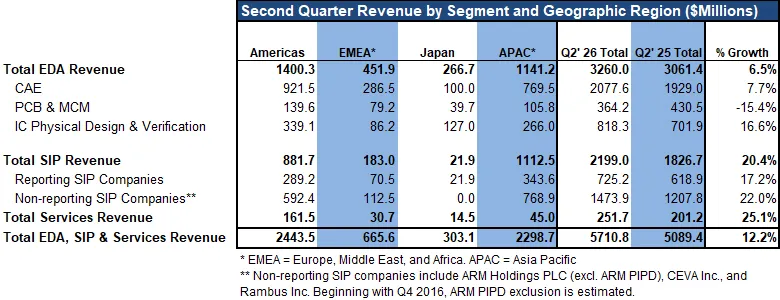
MILPITAS, Calif. — October 19, 2026 — Electronic System Design (ESD) industry revenue increased 12.2% to $5,710.8 million in the second quarter of 2026 from the $5,089.4 million registered in the second quarter of 2025, the ESD Alliance, a SEMI Technology Coalition, announced today in its latest Electronic Design Market Data (EDMD) report. The four-quarter moving average rose 11.2%, based on a comparison of the most recent four quarters to the prior four.

“The electronic design automation industry once again reported strong year-over-year revenue growth in Q2 2026,” said Walden C. Rhines, Executive Sponsor of the SEMI Electronic Design Market Data report and Chief Executive Officer of Silvaco Group, Inc. “All product categories except Printed Circuit Board and Multi-Chip Module reported gains, with IC Physical Design and Verification, Semiconductor IP, and Services showing double digit growth. All geographic regions reported growth in Q2, with double digit increases in the APAC region.”

The companies tracked in the EDMD report employed 71,396 people globally in Q2 2026, a 1.6% decrease from the Q2 2025 headcount of 72,529 and down 1.6% compared to Q1 2026. 

The quarterly EDMD report contains detailed revenue information within the following category and geographic breakdowns. 


Revenue by Product and Application Category – Year-Over-Year Change

  • Computer-Aided Engineering (CAE) revenue increased 7.7% to $2,077.6 million. The four-quarter CAE moving average increased 10.7%. 
  • IC Physical Design and Verification revenue increased 16.6% to $818.3 million. The four-quarter moving average for the category increased 5.4%. 
  • Printed Circuit Board and Multi-Chip Module (PCB and MCM) revenue dropped 15.4% to $364.2 million. The four-quarter moving average for PCB and MCM decreased 1.3%.
  • Semiconductor Intellectual Property (SIP) revenue increased 20.4% to $2,199.0 million. The four-quarter SIP moving average rose 16.6%.
  • Services revenue increased 25.1% to $251.7 million. The four-quarter Services moving average rose 15.2%.
     

Revenue by Region – Year-Over-Year Change

  • The Americas, the largest reporting region by revenue, procured $2,443.5 million of electronic system design products and services in Q2 2026, a 7.1% increase. The four-quarter moving average for the Americas rose 8.6%. 
  • Europe, Middle East, and Africa (EMEA) procured $665.6 million of electronic system design products and services in Q2 2026, a 2.3% increase. The four-quarter moving average for EMEA grew 8.6%. 
  • Japan’s procurement of electronic system design products and services increased 9.3% to $303.1 million in Q2 2026. The four-quarter moving average for Japan decreased 8.2%. 
  • Asia Pacific (APAC) procured $2,298.7 million of electronic system design products and services in Q2 2026, a 22.4% increase. The four-quarter moving average for APAC grew 18.3%. 


About the EDMD Report

The ESD Alliance Electronic Design Market Data (formerly the Market Statistics Service) report presents Electronic Design Automation (EDA), SIP and Services industry revenue data quarterly. Both public and private companies contribute data to the report available from SEMI. Each quarterly report is published approximately three months after quarter close. EDMD report data is segmented as follows: 

  • Revenue by product category (CAE, IC Physical Design and Verification, SIP, PCB and MCM Layout, and Services) including numerous detailed sub-categories
  • Revenue by geographic region (Americas, EMEA, Japan and APAC)
  • Total employment at participating companies

For information about SEMI market research reports, visit the SEMI Market Research Reports and Databases Catalog. 


About the Electronic System Design Alliance

The Electronic System Design (ESD) Alliance, a SEMI Technology Coalition, is the central voice to communicate and promote the value of the semiconductor design ecosystem as a vital component of the global electronics industry. As an international association of companies providing goods and services throughout the semiconductor design ecosystem, it is a forum to address technical, marketing, economic and legislative issues affecting the entire industry. For more information about the ESD Alliance, visit http://esd-alliance.org.


Follow the ESD Alliance


About SEMI

SEMI® is the global industry association connecting over 4,000 companies and 1.5 million professionals worldwide across the semiconductor and electronics design and manufacturing supply chain. We accelerate member collaboration on solutions to top industry challenges through Advocacy, Workforce Development, Sustainability, Supply Chain Management and other programs. Our SEMICON® expositions and events, technology communities, standards and market intelligence help advance our members’ business growth and innovations in design, devices, equipment, materials, services and software, enabling smarter, faster, more secure electronics. Visit www.semi.org, contact a regional office, and connect with SEMI on LinkedIn and X to learn more.

The information supplied by the ESD Alliance is believed to be accurate and reliable, but the ESD Alliance assumes no responsibility for any errors that may appear in this document. All trademarks and registered trademarks are the property of their respective owners.


MILPITAS, Calif. — July 31, 2026 — The Electronic System Design Alliance (ESDA), a SEMI Technology Coalition, today appointed Ankur Gupta, Executive Vice President, IC Portfolio, Siemens EDA, Siemens Digital Industries Software, and Dr. Walden “Wally” C. Rhines, CEO and Director of Silvaco (Nasdaq: SVCO), to its 10-member Governing Council. ESDA also welcomed two new member companies, startups ChipAgents and Rydev.

“Ankur and Wally are welcome additions to our Governing Council who join executives from member companies whose role is to guide the ESD Alliance and its initiatives,” said Julie Rogers, Executive Director of ESDA. “In addition, we are pleased to support two emerging companies, ChipAgents and Rydev, as the newest members of ESDA. We look forward to their contributions and participation as we continue building our momentum and standing as the industry’s foremost emerging company networking hub.”

“ESDA drives the design ecosystem and plays a significant role as the center of electronic system design,” said Rhines. “Every company, startup, mid-size or large enterprise that considers itself to be part of the design ecosystem must be part of an organization’s membership that opens the door to a world of technology coalitions and member-driven initiatives.”

“Siemens fully supports the ESDA’s many and varied initiatives that focus on technical, marketing, economic and legislative issues affecting member companies and the entire industry,” said Gupta. “I welcome the opportunity to work with other governing council members and contribute to the ESDA’s success now and in the future.”

The Governing Council

Gupta and Dr. Rhines join Governing Council Co-Chairs Maheen Hamid, Chief Operating Officer and Chief Financial Officer of Breker Verification Systems, and John Kibarian, President, CEO, Director, and Co-Founder of PDF Solutions.

Other members of the 10-member Governing Council are: Rogers; Aart de Geus, Executive Chairman and Founder of Synopsys; Anirudh Devgan, President and CEO of Cadence Design Systems; Niels Faché, Vice President and General Manager from Keysight; Aki Fujimura, Chairman and CEO of D2S; and Prakash Narain, President and CEO at Real Intent.

As Executive Vice President of Siemens EDA’s IC Portfolio, Gupta and his global team are responsible for developing and marketing best-in-class EDA solutions for the semiconductor industry, including Siemens’ comprehensive portfolio of IC design, verification, and manufacturing solutions. He brings more than 20 years of experience in design, implementation and signoff. He oversaw several deployments of an RTL2GDS solution, while at Cadence. Later, at Ansys, he oversaw the launch and deployment of a market leading digital power-grid signoff product.

Dr. Rhines has served as CEO of Silvaco since August 2025, and as a member of its board of directors since September 2022. He is also currently an advisor to ChipAgents, is former President and Chief Executive Officer of Mentor Graphics Corporation, and a member of the EDA Consortium (EDAC, now ESDA) until Mentor was acquired by Siemens in 2017. He founded its Market Statistics Service (MSS), now known as the Electronic Design Market Data (EDMD), and has served as Executive Sponsor since its inception in 1994. Dr. Rhines is also the 2015 recipient of the Phil Kaufman Award that honors individuals showing demonstrable impact on electronic design through contributions in the field of Electronic System Design. Dr. Rhines received a B.S.E. in metallurgical engineering from the University of Michigan, an M.S. and Ph.D. in materials science and engineering from Stanford University, and a M.B.A. from the Southern Methodist University, Cox School of Business. 

New Member Companies

Entrepreneurial startups ChipAgents and Rydev value the ESDA and its member benefits, especially as the industry expands into the agentic AI era that will set the tone for the future of chip design.

“Joining the ESD Alliance reflects ChipAgents’ commitment to advancing agentic AI in semiconductor engineering,” said William Wang, CEO and Founder, ChipAgents. “ESDA brings together the companies shaping the future of electronic system design, including EDA vendors, IP providers, semiconductor companies, and research institutions. As agentic AI reshapes every layer of this ecosystem, ChipAgents aims to contribute its expertise to the standards, frameworks, and best practices that will define the next era of semiconductor design.”

“By joining the ESD Alliance, Rydev has integrated our cutting-edge engineering directly into the global semiconductor ecosystem, a strategic move intended to significantly increase the added value to our clients across the globe,” said Alfonso Chacón Rodríguez, CEO, Rydev. “This membership ensures our methodologies and services are aligned with the latest industry standard procedures, foundry constraints and interoperability standards long before tape-out. For our customers, this means absolute design certainty, reduced time-to-market and the peace of mind that they are collaborating with a vetted, forward-thinking partner who sits at the same table as global semiconductor leaders to actively shape the future of chip design. For us, it means a step to ensure our ‘first-silicon’ philosophy is actively engaged in every project and deliverable.”

About ChipAgents

ChipAgents is a category leader in agentic AI platforms for semiconductor design. Its multi-agent systems autonomously reason, plan, and execute complex end-to-end design and verification workflows, helping engineering teams shorten development timelines and bring new chip designs to market faster. Already deployed by more than 120 leading semiconductor companies, ChipAgents is driving a fundamental shift in how chips are designed, verified, and optimized. Visit ChipAgents.ai for more details.

About Rydev

Rydev is an ASIC design house that delivers comprehensive, end-to-end VLSI engineering services tailored for complex, high-performance applications. Lead by a highly credentialed team with extensive academic, research and industry expertise, Rydev boasts a proven track record of successful industry-level tape-outs across cutting-edge nodes down to 3nm. Rydev specializes in advanced digital design, comprehensive UVM-based verification, custom analog/mixed-signal IC design, and high-speed signal and power integrity analysis. Operating with technical hubs in Costa Rica, Argentina and Uruguay, and incorporated in the U.S., Rydev acts as strategic, agile and client-centric technical partner that helps accelerate time-to-market, mitigate tape-out risks and bridge critical engineering gaps with a “first-silicon” philosophy. More information can be found at Rydev.com. 

About the Electronic System Design Alliance

The Electronic System Design (ESD) Alliance, a SEMI Technology Coalition, is the central voice to communicate and promote the value of the semiconductor design ecosystem as a vital component of the global electronics industry. As an international association of companies providing goods and services throughout the semiconductor design ecosystem, it is a forum to address technical, marketing, economic and legislative issues affecting the entire industry. For more information about the ESD Alliance, visit http://esd-alliance.org.

Follow the ESD Alliance:

About SEMI

SEMI® is the global industry association connecting over 4,000 member companies and 1.5 million professionals worldwide across the semiconductor and electronics design and manufacturing supply chain. We accelerate member collaboration on solutions to top industry challenges through Advocacy, Workforce Development, Sustainability, Supply Chain Management and other programs. Our SEMICON® expositions and events, technology communities, standards and market intelligence help advance our members’ business growth and innovations in design, devices, equipment, materials, services and software, enabling smarter, faster, more secure electronics. Visit www.semi.org, contact a regional office, and connect with SEMI on LinkedIn and X to learn more.

The information supplied by the ESD Alliance is believed to be accurate and reliable, but the ESD Alliance assumes no responsibility for any errors that may appear in this document. All trademarks and registered trademarks are the property of their respective owners.

Verific App Store Opens with
Downloadable Examples of Parser Platform Applications

• Initial offerings include a hierarchy explorer, linter, HDL editor, signal tracer, essential tools for hardware design and verification
• Verific App Store opens July 27 as 63rd DAC begins in Long Beach, Calif.

ALAMEDA, CALIF. –– July 22, 2026 –– Verific Design Automation today announced the Verific App Store with a toolkit and downloadable example applications showcasing a variety of essential electronic design automation (EDA) point tools and solutions built using its Parser Platforms.

The Verfic App Store will open Monday, July 27, as the 63rd Design Automation Conference (DAC) convenes at the Long Beach Convention Center in Long Beach, Calif. Verific will offer in DAC Booth #1052 demonstrations of the new Verific App Store examples along with demonstrations of its SystemVerilog, Verilog, VHDL and UPF front-end Parser Platforms.

“We want to show how you can build really cool EDA products with our Platform," remarks Rob Dekker, Verific's president, founder and CTO. "In the Verific App Store, we started with a number of useful EDA point tools that are fast running, simple to license and easy to use by AI and HI (Human Intelligence) alike.”

As the leading provider of front-end platforms, Verific powers EDA with its SystemVerilog, Verilog, VHDL and UPF parser software used as the foundation for both in-house and commercially available EDA tools and flows. Applications range from synthesis and formal verification to emulation, debugging, virtual prototyping, low-power design and design-for-test tools.

Currently Available Parser Platform Apps
Example apps currently available at the Verific App Store include a hierarchy explorer, a linter, an HDL editor and a signal tracer, essential tools for hardware design and verification.

HierRTL is a Hierarchy Explorer that reports the structural hierarchy of Verilog, SystemVerilog, and VHDL designs directly from the parse tree without the need for elaboration. Engineers can visualize and navigate the hierarchical structure of their designs and understand relationships between different modules and components, making it easier to manage complex designs.

LintRTL is a Linter tool for SystemVerilog and VHDL that identifies design issues early with configurable lint rules and advanced synthesizability checks. It analyzes code for potential errors, style issues and adherence to coding standards. It helps ensure that the HDL code is clean and maintainable, reducing bugs before simulation or synthesis.

SnapRTL is an automated HDL editor used to analyze, modify and export designs while preserving the original code and formatting. It gives engineers confidence to be able to modify their designs in a specialized environment for writing and editing HDL code. SnapRTL features syntax highlighting, code completion and error detection, streamlining the coding process and improving productivity.

TraceRTL is a Signal Tracer for SystemVerilog and VHDL to improve traceability and speed debug. It monitors and analyzes signals within the design and provides insights into signal behavior during simulation, helping engineers effectively debug and optimize their designs.

Additional apps will be added in the future.

Availability and Pricing
"We will be adding more EDA point tools as we go,” says Dekker. “Currently most base products are free of charge, and we only charge a small fee for more advanced product features.”

The Verific App Store will open July 27. Tool flow developers can download the tools in the Verific Toolkit with or without being an existing Verific customer, but registration is required. New users will be asked to register with a Verific Passport account.

Basic tools are currently free, but advanced features require a monthly subscription fee. Free evaluations are available for 14 days.

The Verific App Store can be found at: https://store.verific.com/

Verific at DAC
Attendees can arrange demos or private meetings with Verific during DAC exhibit hours July 27-29 by sending email to [email protected].

DAC registration is open.

About Verific Design Automation
Verific Design Automation is the leading provider of SystemVerilog, Verilog, VHDL and UPF Parser Platforms that enable project groups worldwide to develop advanced electronic design automation (EDA) products quickly and cost effectively. Verific’s software serves as the front end to synthesis, formal verification, emulation, debugging, virtual prototyping, low-power design and design-for-test tools. With offices in Alameda, Calif., and Kolkata, India, Verific has shipped more than 80,000 copies of its software used by the EDA and semiconductor industry since it was founded in 1999.

Engage with Verific at:
Email: [email protected]
Website: www.verific.com
LinkedIn: https://www.linkedin.com/company/verific-design-automation-inc/

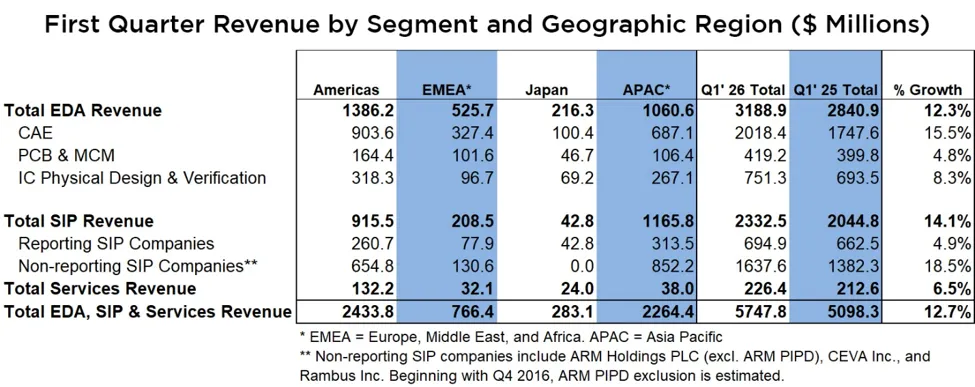
MILPITAS, Calif. — July 13, 2026 — Electronic System Design (ESD) industry revenue increased 12.7% to $5,747.8 million in the first quarter of 2026 from the $5,098.3 million registered in the first quarter of 2025, the ESD Alliance, a SEMI Technology Coalition, announced today in its latest Electronic Design Market Data (EDMD) report. The four-quarter moving average rose 10.3%, based on a comparison of the most recent four quarters to the prior four.

A black and white image of a number

Description automatically generated with medium confidence“The electronic design automation industry continued to report strong year-over-year revenue growth in Q1 2026,” said Walden C. Rhines, Executive Sponsor of the SEMI Electronic Design Market Data report and Chief Executive Officer of Silvaco Group, Inc. “All product categories reported gains, with Computer-Aided Engineering and Semiconductor IP showing double digit growth. The Americas, EMEA, and APAC geographic regions reported growth in Q1, with double digit increases in EMEA and APAC.”

The companies tracked in the EDMD report employed 72,544 people globally in Q1 2026, a 12.6% increase over the Q1 2025 headcount of 64,403 and up 1.1% compared to Q4 2025.

The quarterly EDMD report contains detailed revenue information within the following category and geographic breakdowns. 


Revenue by Product and Application Category – Year-Over-Year Change

  • Computer-Aided Engineering (CAE) revenue increased 15.5% to $2,018.4 million. The four-quarter CAE moving average increased 13.1%. 
  • IC Physical Design and Verification revenue increased 8.3% to $751.3 million. The four-quarter moving average for the category decreased 0.9%. 
  • Printed Circuit Board and Multi-Chip Module (PCB and MCM) revenue rose 4.8% to $419.2 million. The four-quarter moving average for PCB and MCM rose 4.3%.
  • Semiconductor Intellectual Property (SIP) revenue increased 14.1% to $2,332.5 million. The four-quarter SIP moving average rose 13.7%.
  • Services revenue increased 6.5% to $226.4 million. The four-quarter Services moving average rose 11.9%.

Revenue by Region – Year-Over-Year Change

  • The Americas, the largest reporting region by revenue, procured $2,433.8 million of electronic system design products and services in Q1 2026, a 10.2% increase. The four-quarter moving average for the Americas rose 9.8%. 
  • Europe, Middle East, and Africa (EMEA) procured $766.4 million of electronic system design products and services in Q1 2026, a 17.6% increase. The four-quarter moving average for EMEA grew 10.9%. 
  • Japan’s procurement of electronic system design products and services decreased 9.9% to $283.1 million in Q1 2026. The four-quarter moving average for Japan decreased 12.4%. 
  • Asia Pacific (APAC) procured $2,264.4 million of electronic system design products and services in Q1 2026, a 17.7% increase. The four-quarter moving average for APAC grew 14.5%. 

About the EDMD Report

The ESD Alliance Electronic Design Market Data (formerly the Market Statistics Service) report presents Electronic Design Automation (EDA), SIP and Services industry revenue data quarterly. Both public and private companies contribute data to the report available from SEMI. Each quarterly report is published approximately three months after quarter close. EDMD report data is segmented as follows: 

  • Revenue by product category (CAE, IC Physical Design and Verification, SIP, PCB and MCM Layout, and Services) including numerous detailed sub-categories
  • Revenue by geographic region (Americas, EMEA, Japan and APAC)
  • Total employment at participating companies

For information about SEMI market research reports, visit the SEMI Market Research Reports and Databases Catalog. 

About the Electronic System Design Alliance

The Electronic System Design (ESD) Alliance, a SEMI Technology Coalition, is the central voice to communicate and promote the value of the semiconductor design ecosystem as a vital component of the global electronics industry. As an international association of companies providing goods and services throughout the semiconductor design ecosystem, it is a forum to address technical, marketing, economic and legislative issues affecting the entire industry. For more information about the ESD Alliance, visit http://esd-alliance.org.

Follow the ESD Alliance

About SEMI

SEMI® is the global industry association connecting over 4,000 companies and 1.5 million professionals worldwide across the semiconductor and electronics design and manufacturing supply chain. We accelerate member collaboration on solutions to top industry challenges through Advocacy, Workforce Development, Sustainability, Supply Chain Management and other programs. Our SEMICON® expositions and events, technology communities, standards and market intelligence help advance our members’ business growth and innovations in design, devices, equipment, materials, services and software, enabling smarter, faster, more secure electronics. Visit www.semi.org, contact a regional office, and connect with SEMI on LinkedIn and X to learn more.

The information supplied by the ESD Alliance is believed to be accurate and reliable, but the ESD Alliance assumes no responsibility for any errors that may appear in this document. All trademarks and registered trademarks are the property of their respective owners.

MILPITAS, Calif. — April 30, 2026 — SEMI, the industry association serving the global semiconductor and electronics design and manufacturing supply chain, today announced the appointment of Julie Rogers as Executive Director of the Electronic System Design Alliance (ESDA), a SEMI Technology Community.

In her new position, Rogers will lead global programs supporting the electronic design automation (EDA) and semiconductor ecosystem. She will oversee strategy, member initiatives, and high-impact events that connect EDA leaders, semiconductor companies, and system designers. Rogers replaces Robert P. Smith who has moved into an advisory role after serving as Executive Director for 11 years. 

“Julie’s leadership, industry insight, and collaborative approach will bring fresh energy and new ideas to strengthen the ESD Alliance and deliver even greater value to our global members,” said Ajit Manocha, President and CEO, SEMI. “Her longstanding tenure with SEMI and the ESDA has given her a deep understanding of our members’ needs and the evolving semiconductor industry landscape. We extend our gratitude to Bob Smith for his leadership as Executive Director over the past 11 years and look forward to his continued support as an ESDA advisor.”

Rogers brings more than 30 years of experience driving growth, visibility, and alignment across complex, highly technical markets. She is widely recognized for her leadership in driving industry collaboration, technical conferences, executive engagement, and ecosystem development. Over the past decade, she served as Director of Marketing and Operations for ESDA, congruent with over seven years as Director of Marketing for SEMI Americas, where she led integrated marketing campaigns, digital strategy, member development, brand advancement, media trades, and public relations efforts. 

Earlier in her career, Rogers founded and led a successful marketing firm specializing in large‑scale event planning and grant writing for healthcare technology and medical device companies. She also brings a strong background in broadcast media, further strengthening her ability to amplify thought leadership and industry impact. Rogers holds a Bachelor of Arts in Marketing from California State University, Sacramento.

About the Electronic System Design Alliance

The Electronic System Design (ESD) Alliance, a SEMI Technology Community, is the central voice to communicate and promote the value of the semiconductor design ecosystem as a vital component of the global electronics industry. As an international association of companies providing goods and services throughout the semiconductor design ecosystem, it is a forum to address technical, marketing, economic and legislative issues affecting the entire industry. For more information about the ESD Alliance, visit http://esd-alliance.org.

Follow the ESD Alliance

About SEMI

SEMI® is the global industry association connecting over 4,000 companies and 1.5 million professionals worldwide across the semiconductor and electronics design and manufacturing supply chain. We accelerate member collaboration on solutions to top industry challenges through Advocacy, Workforce Development, Sustainability, Supply Chain Management and other programs. Our SEMICON® expositions and events, technology communities, standards and market intelligence help advance our members’ business growth and innovations in design, devices, equipment, materials, services and software, enabling smarter, faster, more secure electronics. Visit www.semi.org, contact a regional office, and connect with SEMI on LinkedIn and X to learn more.