downloadGroupGroupnoun_press release_995423_000000 copyGroupnoun_Feed_96767_000000Group 19noun_pictures_1817522_000000Member company iconResource item iconStore item iconGroup 19Group 19noun_Photo_2085192_000000 Copynoun_presentation_2096081_000000Group 19Group Copy 7noun_webinar_692730_000000Path
Skip to main content
Default Banner Image

fabs

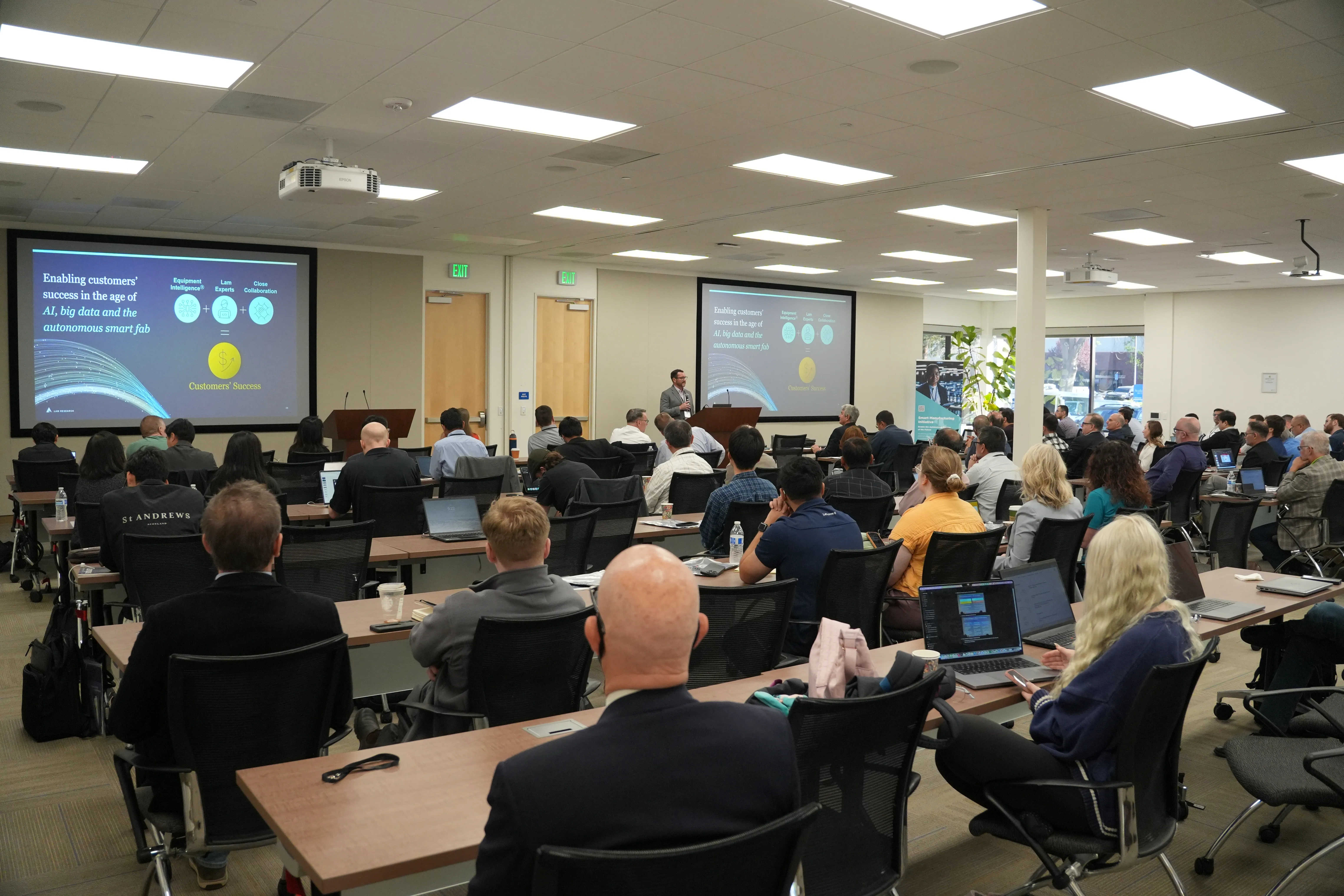
With edge AI emerging as a clear driver of smart manufacturing, SEMI hosted a two-day workshop detailing the future of this technology. The workshop, Smarter Sensors, Smarter Fabs: AI at the Edge in Semiconductor Manufacturing, was held in-person from March 18-19 in Milpitas, California. It convened industry professionals to explore how AI-driven sensors and edge intelligence are fostering scalable and resilient solutions for the next generation of semiconductor manufacturing. The workshop took place across four sessions, with each highlighting a unique edge-AI implementation area – including process control, yield enhancement, tool coordination, and predictive maintenance – and featured keynotes from leaders at Lam Research and KUKA. Didn’t get a chance to attend in person? View this workshop on demand. Session 1 - Smart Sensors and Edge Intelligence for Advanced Process Control​The semiconductor industry has always been defined by precision. However, as device architectures shrink to angstrom-scale dimensions, and as wafers become thinner and more fragile, traditional process control tools are reaching their limits. Sampled, low-frequency, univariate monitoring systems were built for an era where deviations were visible, failures were catchable later, and a handful of sensors per tool were enough to keep yield in check. Session 1 explored the latest sensor technologies, discussing how data collection at the point of production, with AI embedded directly into the tool, is becoming paramount for success. Advanced in-situ sensors were brought up as an example of this in practice. Although these sensors are generating richer signals than in the past, reaching lower latency requires AI models deployed at the edge.In addition, AI is extending into the physical world through robots that can handle various tasks autonomously. These robots are enabled by digital twins that provide simulation environments for training and validation before they ever see the fab floor. The common thread across Session 1 was the growing need for data and knowledge integration in fabs. Smart sensors must be built into AI systems, and those systems must be scalable across tools without sacrificing speed or reliability. Finally, the insights they generate must flow back into maintenance optimization and equipment health monitoring to promote a continuous cycle of learning. Session 2 - Yield Enhancement Through Edge-Driven Defect Detection and Classification​ Session 2 focused on how edge AI models, process sensors, and image data can identify yield-impacting defects earlier in the manufacturing process. As semiconductor devices lean into 3D architectures, the complexity and volume of data have outpaced the capabilities of traditional monitoring tools. Today's fabs are required to evaluate terabytes of inspection images per hour, as well as tool sensor traces that require analysis across dozens of parameters simultaneously. Each speaker approached this challenge from a different angle, yet the solutions fit together into a coherent architecture. One introduced Gaussian Process Regression, a model for assessing both predictions and uncertainties, as a statistically rigorous, data-efficient method for learning "golden trajectory" baselines for tool sensor signals. This generates actionable scores and maintenance guidance beyond standard anomaly alerts. Another speaker demonstrated the ability of deep learning models to triage multi-gigabit-per-second image streams in milliseconds. AI-based defect classification was shown to compress root cause analysis timelines from days to hours, with demonstrated gains of a 0.3% die yield recovery and 0.5–1% yield exposure prevention. Predictive metrology for RF filter frequency also assessed device performance using upstream process data, with less than 0.02% error.Lastly, a software-defined automation framework built on open standards and vendor-neutral architecture demonstrated effective workload consolidation onto a single edge platform. It was shown to be scalable across fabs without replacing legacy infrastructure.These presentations stressed the importance of measurement and action in real-time at the tool level. Gathering information as early as possible, using AI to triage and classify, and feeding insights back into process control and maintenance workflows, allows for a continuous cycle of improvement.Session 3 - Autonomous Work in Process Movement: Robots, Sensors, and Edge AI Coordination​The "lights out" factory is shifting from an aspiration to a concrete, engineering roadmap. To fully realize this, each presentation in Session 3 highlighted the importance of supplementing human-dependent workflows with AI systems that can act in real-time. This shift will require a mix of deep reinforcement learning and AI-based perception approaches. Currently, deep reinforcement learning is training agents to discover new routing strategies that optimize yield, equipment effectiveness, cycle time, and queue-time compliance – including joint front and back-end-of-line coordination for advanced packaging. AI-based perception is also on its way to replacing manual, pre-shipment inspection checklists, demonstrating inspection time reduction by as much as 78%. To enable these improvements, presenters suggested private 5G as the foundational connectivity infrastructure. Currently, private 5G is helping eliminate dead zones and bandwidth issues that are preventing real-time machine data and connected robotics from reaching their full potential.Based on these presentations, the prevailing formula is to integrate intelligence at every level. This includes precise in-situ sensing to eliminate manual setup and measurement, edge AI models that act on data immediately, platforms that coordinate across tools without humans, and lastly, a reliable connectivity infrastructure.Session 4 - Predictive Maintenance at the Edge: From Vibration to VisionSemiconductor fabs have long operated in a state of crisis management. Fab managers spend between 40% and 70% of their time firefighting unexpected equipment failures, rather than executing planned maintenance strategies. Unplanned downtime in semiconductor manufacturing can cost up to $1 million per hour, yet the maintenance industry has been slow to move beyond reactive repairs. Fab managers need faster ways to determine issues and act on that knowledge before wafers are lost. Session 4 outlined a framework for how this transformation will happen. At the foundation, smarter sensors (vibration, acoustic, thermal, spectral, and vision) are generating the high-fidelity, multi-modal data streams that make predictive models possible. In addition, "ultra edge" AI accelerators are enabling machine learning inference to happen directly inside MEMS sensors and on-device hardware without cloud dependency. Fabs require low-latency, data-sovereign, real-time decisions that the cloud is unable to support, and the path forward requires an integrated chain of sensing, edge inference, health scoring, and maintenance scheduling. This session also made the case that irrelevant correlations and confounding variables make purely statistical AI unreliable for root cause analysis, and that causal AI models are required to give fabs actionable information. It concluded that cybersecurity concerns, soaring cloud infrastructure costs (datacenter GPU prices reaching $25,000–$50,000 each in 2025–2026), and latency requirements have made distributed, machine-local intelligence the only viable path to achieving autonomous fabs. SummaryThis workshop highlighted how edge AI, smart sensors, and advanced connectivity are transforming semiconductor manufacturing by enabling real-time process control, faster defect detection, and more autonomous operations. Across sessions, experts emphasized that integrating AI directly at the source of data is essential for improving yield, reducing downtime, and building scalable, resilient “smart fabs.”Learn more by registering for this workshop on demand, or view the recap videos on LinkedIn. Day 1 recap Day 2 recap The SEMI Manufacturing Coalitions include Smart Manufacturing, Fab Owners Alliance (FOA), MEMS and Sensors Industry Group (MSIG), Advanced Packaging Heterogeneous Integration (APHI) and Semiconductor Components, Instruments, and Subsystems (SCIS).Anshu Bahadur leads the Smart Manufacturing Initiative, Karim Somani leads the Fab Owners Alliance (FOA), and Paul Carey leads the MEMS and Sensors Industry Group (MSIG), all of which are part of the Technology Coalitions at SEMI.
Read More
For years, cybersecurity in manufacturing was often treated as a mere compliance issue. Suppliers filled out questionnaires. A scan report was produced before shipment. A checklist was reviewed during qualification. A document proved that the equipment was "secure enough" at a given point in time. This model is no longer sufficient. As equipment becomes more software-driven, connected, and remotely maintained, cybersecurity responsibility is moving closer to the product itself and therefore closer to the OEM. Fabs still define their security expectations, but OEMs are increasingly expected to provide evidence that their equipment can remain secure throughout its lifecycle.Semiconductor manufacturing is entering a new phase of cybersecurity. The question is no longer simply, "Was this equipment compliant when it was delivered?" A stronger question is emerging: "Can this equipment continuously demonstrate that it is operating securely and reliably?" This shift matters because semiconductor equipment is no longer isolated machinery. It is software-intensive, networked, remotely maintained, data-producing, and deeply integrated into fab operations. Equipment controllers, factory interfaces, service laptops, recipes, logs, remote access tools, operating systems, middleware, and data acquisition services now comprise a significant digital presence surrounding the physical process. The risk is not theoretical. Industrial automation and control systems are now considered cybersecurity assets throughout their lifecycle rather than merely engineering systems. In the global semiconductor manufacturing industry, this shift is evident through the following SEMI standards:SEMI E169 provides guidance for equipment information system security. SEMI E187 defines cybersecurity requirements for fab equipment.SEMI E191 addresses cybersecurity status reporting for computing devices connected to the factory network.These semiconductor-specific standards align with the broader industrial cybersecurity trend. The ISA/IEC 62443 series addresses cybersecurity throughout the industrial automation lifecycle, including product development, integration, operation, maintenance, and supplier responsibility. The National Institute of Standards and Technology (NIST) has moved in the same direction with Cybersecurity Framework 2.0 by adding "govern" as a core function and making cybersecurity the responsibility of leadership, risk management, and the supply chain rather than just a technical activity.In Europe, this shift is also becoming regulatory. Under the Cyber Resilience Act, starting September 11, 2026, manufacturers will be required to actively report vulnerabilities and severe incidents affecting products with digital elements. They must provide an early warning within 24 hours and a full notification within 72 hours. This will encourage many industrial suppliers to strengthen their vulnerability management.A fab does not only need to know that an equipment was shipped with a supported operating system. It also needs to know if the system remains aligned with the approved configuration after installation, maintenance, remote support, patches, upgrades, troubleshooting, and years of production use.A fab needs more than a document saying that network security was considered. It needs practical evidence showing which ports are open, which services are active, which accounts exist, which software is running, and whether local protection mechanisms are still enabled. A fab does not only need supplier declarations. It needs operational proof.This is where the semiconductor industry faces a specific challenge. A fab cannot simply copy standard IT cybersecurity practices and apply them directly to production tools. The cost of disruption is too high. A patch that is harmless in an office system may affect equipment behavior, timing, qualification, or process stability. A security scan that is acceptable in IT may be intrusive in a production environment. Generic endpoint controls can create unacceptable side effects if they interfere with motion, recipes, automation, or equipment availability.Therefore, semiconductor cybersecurity must balance three constraints simultaneously:Protect the equipment and the factory network.Preserve deterministic production behavior.Generate evidence that can be trusted by fabs, suppliers, auditors, and increasingly, regulators.For this reason, the future of cybersecurity in semiconductor manufacturing will likely be built around five practical pillars.1. Secure by design, but validated in operationSecurity measures must be implemented from the outset of equipment architecture. The product baseline should include supported operating systems, hardened configurations, secure communication channels, access control, logging, and vulnerability handling. Figure 1: Equipment controllers expose trusted security context However, design is only the starting point. The equipment must also support validation after delivery. Fabs need a way to confirm that the deployed configuration still matches the secure baseline. This is especially important after field service, software updates, recipe changes, local troubleshooting, or remote maintenance. The industry is shifting from "trust me, it was secure at release" to "here is the evidence that it is still secure today."2. Cybersecurity evidence must become structured dataAll too often, cybersecurity evidence remains trapped in PDFs, spreadsheets, emails, and manual audit reports. This approach is not scalable. A modern factory needs structured, machine-readable cybersecurity information. This data does not need to be collected at the same frequency as process data, it should rather be collected at the right frequency for assurance, such as daily, weekly, after a restart or maintenance, or before a production release.This creates a strong opportunity for equipment manufacturers. The equipment controller can serve as a source of trusted security context. It can provide controlled, well-defined information about the current state of the equipment's software and configuration. This does not replace cybersecurity tools. Rather, it complements them with equipment-native context.This is important because the equipment itself knows things that external tools may not: which services are expected, which processes are part of the controller, which ports are required for automation, which accounts are intended for servicing, and which configuration belongs to the validated release.3. Communication security must move closer to the protocol layerMany industrial environments have relied on network segmentation, virtual private networks (VPNs), and perimeter controls. While these controls remain useful, they are insufficient for a Zero Trust approach.The next step is establishing stronger identities and trust between communicating systems. When equipment and factory systems exchange messages, they must know with whom they are communicating, and the communication channel must protect the confidentiality and integrity of the messages.This direction already exists in part of the semiconductor communication landscape. In EDA, also known as Interface A, SEMI E132 defines equipment client authentication and authorization, requiring clients to authenticate before further communication and enabling authorization controls for access to equipment functions and data.The same trust expectation is now emerging more visibly for SECS/GEM communication. A SEMI task force is working to secure HSMS communication, which is central to SECS/GEM-based host-equipment integration. The objective is to improve trust at the communication layer while preserving the proven behavior and interoperability that made HSMS successful in fabs.For semiconductor manufacturing, this must be done carefully. The industry cannot disrupt decades of host-equipment interoperability. The practical approach is to secure communication while maintaining existing automation behavior. This is a good example of the semiconductor cybersecurity challenge: modernizing the trust model without destabilizing the production model.4. Cybersecurity must be lifecycle-managedA semiconductor tool can remain in operation for many years. During that time, operating systems age, third-party components evolve, vulnerabilities are discovered, remote support practices change, and fab expectations become stricter. This means cybersecurity cannot be treated as a delivery milestone. It must be managed as a lifecycle capability, from design and release to installation, maintenance, upgrades, and end-of-support planning.For semiconductor OEMs, this creates a very practical challenge. They need clearer answers to questions that fabs will increasingly ask:Practical questionWhy it mattersWhat is the support status of each software component?To understand exposure to known vulnerabilities and end-of-support riskHow are vulnerabilities evaluated?To separate theoretical exposure from real equipment riskHow are patches qualified without creating regression risk?To protect cybersecurity without compromising process stability or tool availabilityHow is the customer informed?To support faster risk decisions and stronger supplier trustWhat is the fallback if a patch cannot be deployed?To define compensating measures and avoid unmanaged riskHow is the secure baseline restored after maintenance?To prevent configuration drift after service actionsHow is evidence retained?To support audits, incident response, and lifecycle traceability The answer is not simply more documentation. The answer is better evidence: structured, repeatable, and linked to the real equipment state. For semiconductor OEMs, the practical task is to convert cybersecurity requirements into evidence that fabs can verify during integration, operation, maintenance, and upgrades.Evidence categoryWhat the fab needs to knowWhy it mattersOS and software baselineSupported OS, installed components, patch statusReduces exposure to known vulnerabilitiesNetwork exposureOpen ports, active services, remote connectionsHelps detect unexpected attack surfacesAccess controlLocal accounts, roles, privilege modelLimits persistence and unauthorized accessEndpoint protectionFirewall, anti-malware, hardening statusConfirms local defenses remain activeLogs and monitoringSecurity events, configuration changes, authentication eventsSupports investigation and traceabilityMaintenance historyUpdates, remote sessions, service actionsShows what changed and whenVulnerability handlingKnown vulnerabilities, mitigation status, patch planSupports lifecycle accountability This lifecycle view is important because every change can modify the equipment security posture. A patch, a remote support session, a local service action, a new account, an opened port, or a firmware update can all move the tool away from its validated baseline. Figure 2: Cybersecurity becomes a lifecycle process This is also where upcoming regulations will change the supplier conversation. Vulnerability handling, reporting, and product security documentation will become part of business trust, not only technical trust. For semiconductor OEMs, the direction is clear: cybersecurity evidence must become part of the product lifecycle, not a separate compliance package prepared only when the customer asks for it.5. Compliance must be risk-based, not tool-prescriptiveOne of the important lessons from industrial cybersecurity is that standards and customer requirements are most effective when they specify the necessary capabilities and evidence rather than forcing every supplier to use the same tools or implementation methods. In the semiconductor industry, the SEMI Standardized Semiconductor Cyber Assessment (SSCA) is a useful example of this direction. It provides a semiconductor-specific assessment framework designed to evaluate cyber readiness and risk across the supply chain, from device manufacturers to OEMs and beyond. It also uses maturity-based questions to help assess the security posture of an organization, which supports a more risk-based view of cybersecurity capability rather than a simple pass/fail interpretation.This risk-based and maturity-based approach is also important at the equipment level. Semiconductor tools are not uniform products with identical architectures. A metrology tool, a sorter, an inspection system, an etcher, and an AMHS component may have different risk profiles, software stacks, connectivity models, and operational constraints. Even within one piece of equipment, cybersecurity responsibility is distributed across multiple layers: the main equipment controller, load ports, robots, sensors, embedded PCs, software libraries, remote access components, and third-party subsystems. The right question is not: "Did every OEM use the same scanner, report format, or internal process?" A better question is, "Can each OEM demonstrate that the equipment meets the required cybersecurity outcome, that the evidence is repeatable, and that the lifecycle process is controlled?"This question must also be addressed recursively across the supplier chain. A fab will ask the OEM for evidence. The OEM, in turn, must obtain and manage evidence from its subsystem suppliers. Those suppliers may need evidence from their own module, software, firmware, and component suppliers. In practice, cybersecurity assurance becomes a chain of trust that runs from the fab down to the lowest relevant technical layer. Figure 3: Cybersecurity assurance becomes a chain of trust The strategic direction is clear for semiconductor OEMs. Cybersecurity should be part of the equipment's value proposition. A secure equipment controller will execute more than just automation logic. It will also support secure communication, controlled access, structured logs, lifecycle traceability, vulnerability management, configuration evidence, and visibility into the security state.This is not just about reducing cyber risk. It is also about reducing integration friction with advanced fabs. It is about conducting audits more quickly. It is about limiting late-stage surprises. It is about giving customers confidence that they can operate, maintain, and upgrade the equipment without compromising factory security.The semiconductor industry is entering a phase in which cybersecurity will be judged less by static declarations and more by operational proof. That is a healthier model. Static compliance tells a fab what was once true. Operational proof shows what is true now. For semiconductor manufacturing, this distinction will become more crucial.About Dr. Fahad GolraAs Director of Product Innovation for Agileo Automation, Dr. Fahad Golra drives next-generation solutions in connectivity, data modeling, and communication architectures. Since joining the company in 2019, he has been a key force behind Agileo’s push toward Industry 4.0, championing interoperability, digital twins, and edge-to-cloud systems. With 15 years of experience spanning academia, research, and industry, Fahad brings deep technical insight and thought leadership to the semiconductor industry. An active contributor to SEMI, the Semiconductor Manufacturing Cybersecurity Consortium (SMCC) and the OPC Foundation, he is a frequent speaker at industry events and a published author advancing the dialogue around smart manufacturing and automation.
Read More
The semiconductor industry is hitting a structural inflection point: explosive AI‑driven demand, rapidly rising manufacturing complexity, and stringent sustainability expectations are converging at once. In this context, edge AI deployed directly on tools, sensors, and local controllers, is shifting from experimental to essential, particularly in fabs where milliseconds matter. SEMI’s timely workshop, Smarter Sensors, Smarter Fabs: AI at the Edge in Semiconductor Manufacturing, taking place March 18–19, 2026 in Milpitas, CA, will address this important topic.From sparse sensing to dense instrumentationTwo decades ago, most process tools relied on dozens of sensors per chamber. Today, leading etch, deposition, CMP, and lithography systems routinely integrate hundreds of sensing channels spanning pressure, flow, RF power, optical endpoint, vibration, and chemistry. At 3 nm and 2 nm, process windows are so tight that yield hinges on multivariate understanding of chamber conditions and tool state rather than a few independent alarms. Sensor proliferation has turned fabs into rich data environments—but also exposed the limits of traditional, centrally managed control.Why edge AI is displacing cloud‑only controlConventional architectures push heavy analytics to centralized servers or the cloud, with supervisory systems periodically updating recipes, setpoints, or dispatch rules. Across manufacturing, measured cloud round‑trip times commonly range from 800 to 2,400 ms, whereas edge systems co-located with equipment can respond in 15–45 ms, roughly 50–160× faster. For safety‑ and yield‑critical loops in semiconductor manufacturing, that latency gap is often unacceptable.At the same time, new generations of low‑power neural processing units (NPUs) and edge accelerators deliver tens of trillions of operations per second (TOPS) at single‑digit watt budgets, making always‑on inference viable inside tools, cameras, and controllers. The result is a decisive move toward edge‑native architectures: models execute where data is produced, while cloud resources are reserved for retraining and fleet‑wide learning.Edge AI on the line: control, inspection, and maintenanceIn process control, edge AI is enabling a shift from univariate threshold checks to multivariate models that understand the joint dynamics of sensor streams. Platforms today embed deep‑learning and statistical models directly at or near the tool, performing real‑time endpoint prediction and anomaly detection from high‑dimensional time series. Similar approaches are emerging in lithography and CMP, where local inference helps keep focus, overlay, and removal rate within spec before wafers drift out of control.Inspection and logistics are undergoing a similar transformation. Vision systems with embedded NPUs classify defects at line speed, often above 100 parts per minute, eliminating the need to ship large image volumes to a central cluster. Robots and autonomous mobile robots (AMRs) use local intelligence for short‑horizon planning and collision avoidance, while higher‑level systems focus on global scheduling and optimization.Predictive maintenance is one of the most mature applications: vibration, acoustic, temperature, and pressure data are analyzed locally to detect anomaly signatures hours or days before conventional thresholds trip. Reported benefits include reductions in unplanned downtime, longer component life, and lower maintenance costs when these models are integrated into manufacturing execution systems (MES) and maintenance workflows.Digital twins and agentic AI on top of edge dataDigital twins build on this sensing and edge‑analytics foundation. By maintaining virtual, live‑updated models of tools, lines, and entire fabs, they enable scenario testing, debottlenecking, and root‑cause analysis without putting WIP at risk. Vendors and early adopters report that such twins can shorten process‑node ramps and facility bring‑up by enabling thousands of “what‑if” experiments before physical changes are made.​Agentic AI is now emerging as the orchestration layer above these twins. In semiconductor case studies, agents connected to MES, advanced process control (APC), and planning systems have delivered double‑digit improvements in throughput, cycle time, and tool utilization by autonomously adjusting routing, batch sizes, and scheduling in response to live fab conditions. Other agents mine unstructured engineering notes and fault reports to accelerate root‑cause analysis, turning hard‑won lessons into repeatable, codified behavior.Sustainability as a first‑class requirementSustainability pressures are reinforcing this stack. Semiconductor manufacturing is energy‑ and resource‑intensive, and regulators and customers alike are demanding more transparency and improvement. Edge‑connected monitoring of energy, utilities, and emissions has already helped some fabs cut energy‑related costs by around 20 percent through tighter control of HVAC, process gases, and idle modes. Research initiatives such as imec’s Sustainable Semiconductor Technologies and Systems (SSTS) program are using virtual fab methods and detailed life‑cycle assessment to guide process and equipment choices for lower environmental impact.Strategic takeaways and where to learn moreThe trajectory is clear: fabs that combine dense sensing, edge AI, digital twins, and agentic AI are building toward continuously learning, self‑optimizing operations. Architectures will need to be edge‑first rather than cloud‑only. Simply adding sensors without local intelligence will not deliver competitive advantage, and environmental KPIs are likely to be optimized with the same rigor as yield and cycle time.For practitioners who want to translate these trends into roadmaps, the Smarter Sensors, Smarter Fabs: AI at the Edge in Semiconductor Manufacturing” workshop (March 18–19, 2026, Milpitas, CA) spearheaded by the SEMI Manufacturing Coalitions* will bring together experts in sensing, edge architectures, digital twins, and agentic AI to share concrete deployments and architectures tailored to semiconductor fabs.*The SEMI Manufacturing Coalitions include Smart Manufacturing, Fab Owners Alliance (FOA) MEMS and Sensors Industry Group (MSIG), Advanced Packaging Heterogenous Integration (APHI) and Semiconductor Components, Instruments, and Subsystems (SCIS). Anshu Bahadur is Senior Program Manager, Technology Communities at SEMI. Mark da Silva is Senior Director, Manufacturing Coalitions at SEMI.
Read More
Demand for hi-tech manufactured goods is at an all-time high and is expected to grow significantly in our new digital age, COVID-19 economy. This is especially true for semiconductor chips. Chip manufacturers have been working to meet this demand by building new factories and by optimizing processes and equipment in existing fabs. While there is much media coverage about new factories planned by leading-edge chipmakers and government investments in the semiconductor sector, greenfield fabs entail significant capital expenditures and are sometimes fraught with complex political concerns. As a result, they can take several years to complete and reach their planned production capacity. Instead, the semiconductor industry needs to optimize existing factories in order to increase productivity and yield and meet growing demand by implementing smart manufacturing solutions. Smart manufacturing solutions will inherently reduce costs with more efficient and automated processes, and those savings can be reinvested for the next wave of solutions. Chip Industry on the Bleeding Edge Semiconductor manufacturers have always been focused on bleeding-edge technology to outflank strong competition and build the best products – faster and cheaper. Today, pioneering organizations are using data to optimize manufacturing processes and equipment, a practice known as Smart Manufacturing. While there are many definitions of Smart Manufacturing, the essence is maximizing the utility of big data generated in these factories by leveraging three pillars: Sensing, Connecting, and Predicting. It is not just the digitization in manufacturing, but it is also about turning the data into actions that generate value – an effort the SEMI Smart Manufacturing Committee is driving based on the three pillars. Optimizing return on investment is the ultimate goal. SEMI Smart Manufacturing Initiative activity is based on three pillars that support the goal of increasing ROI. Making the Right Decision, Faster Smart manufacturing practices enable organizations to make the right decisions and take action faster based on insights generated from real-time and historical data. This requires data management technologies and applications that can process, analyze, and act on information instantly. It has become ever more difficult to process and discern the relevant data or signal from the vast volume of data, perform analytics or develop new ML or AI analytic tools, and then make the critical decisions to solve problems as close to real-time as possible. Who’s Responsible – IT or OT? In the past IT (Information Technology) and OT (Operations Technology) were separate entities within organizations, with IT focused on storing large amounts of data for enterprise systems and OT concentrated on using data to perform specific functions. Smart Manufacturing often demands combining IT and OT, difficult in rigid organizations that operate the two organizations independently and lack the infrastructure to implement comprehensive solutions. Success requires executive leadership sponsorship, motivated technical personnel and, most importantly, a clear deliverable on the value in implementing Smart Manufacturing. Many organizations have introduced top-level leadership positions such as a Chief Information Officer or Chief Data and Analytics Officer to address this convergence and many of these leaders are embracing Smart Manufacturing practices. The SEMI Smart Manufacturing community includes many of these leaders and therefore has highlighted the importance in the return on investment for Smart Manufacturing solutions. Read more about IT and OT convergence and note that Smart Manufacturing is synonymous with Industry 4.0. The SEMI Smart Manufacturing Initiative covers the entire supply chain. Get Smart in Smart Manufacturing While new technologies and applications are being created to deal with mountains of data, it is the underlying methodologies and practices that are key to a successful Smart Manufacturing deployment. SEMI, the trade association representing the electronics manufacturing and design supply chain, is in a perfect position to evangelize Smart Manufacturing experiences and best practices for the entire manufacturing community. The more than 30 member companies participating in the SEMI Smart Manufacturing Initiative bring more than 500 years of collective experience and knowledge to the topic. Many segments of the supply chain participate in the SEMI Smart Manufacturing Initiative including packaging, assembly, SMT and PCB assembly, test, software, data management, sensor and material suppliers. Learn How to Manufacture Smarter SEMI SMART Manufacturing is hosting two great conferences in the coming months – the Global Smart Manufacturing Conference (GSMC) and the SEMICON West Smart Manufacturing Pavilion. As a leader of the organizing committee and chair for the SEMICON West Smart Manufacturing Pavilion, I encourage people who want to learn how to implement Smart Manufacturing or expand their knowledge of Smart Manufacturing to attend these events. The GSMC will feature keynotes highlighting the value of Smart Manufacturing, offer tutorials on the three pillars, and introduce several case studies for each of the pillars. Thirty-two organizations – ranging from global cloud providers, semiconductor factory operators, leading equipment vendors and software application solution companies – will present. See the full agenda here. The SEMICON West Smart Manufacturing Pavilion will compliment GSMC by showcasing a number of use cases that highlight the value of Smart Manufacturing. Panel discussions will deep dive into the challenges of implementing these best practices and the direction smart manufacturing is taking in the coming years. Our goal for these events is for you to take this knowledge back to your companies, implement and improve on the detailed solutions highlighted at the conferences, and return next year to share your success stories with the community. See you soon, in person or virtually! About the Author Bill Pierson is VP of Semiconductors and Manufacturing at KX, leading the growth of streaming data analytics in this vertical. Bill is also a chair for the SEMICON West Smart Manufacturing Conference and an active team member of the SEMI Americas Chapter. He has extensive experience in the semiconductor industry including previous experiences at Samsung, ASML and KLA. Bill specializes in applications, analytics, and control. He lives in Austin, Texas, and when not at work can be found on the rock-climbing cliffs or at his son’s soccer matches.
Read More