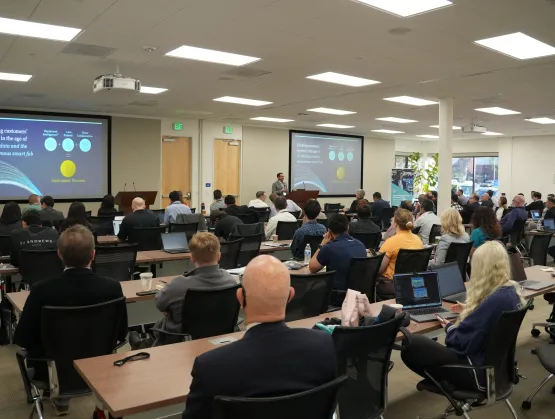
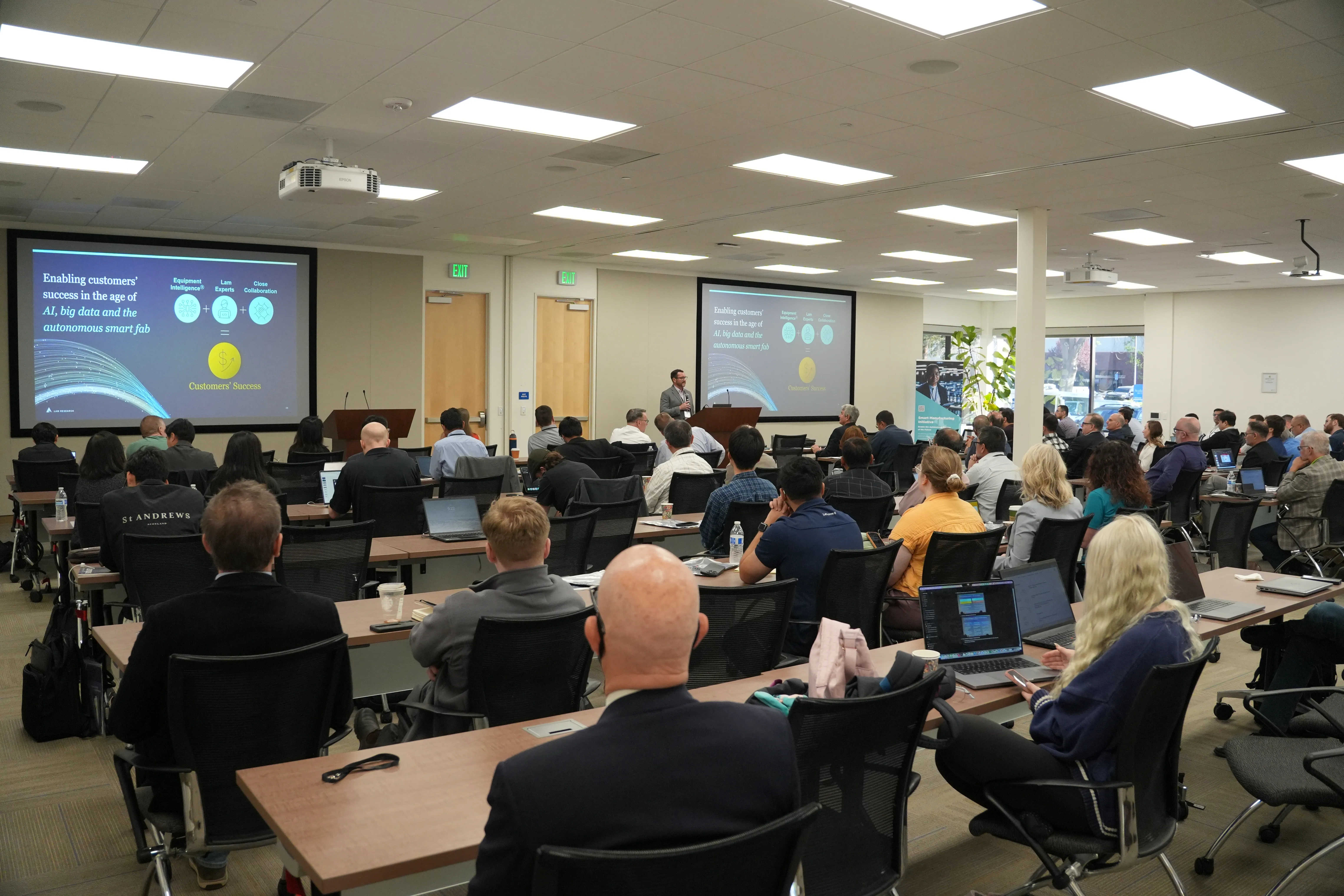
With edge AI emerging as a clear driver of smart manufacturing, SEMI hosted a two-day workshop detailing the future of this technology. The workshop, Smarter Sensors, Smarter Fabs: AI at the Edge in Semiconductor Manufacturing, was held in-person from March 18-19 in Milpitas, California. It convened industry professionals to explore how AI-driven sensors and edge intelligence are fostering scalable and resilient solutions for the next generation of semiconductor manufacturing. The workshop took place across four sessions, with each highlighting a unique edge-AI implementation area – including process control, yield enhancement, tool coordination, and predictive maintenance – and featured keynotes from leaders at Lam Research and KUKA. Didn’t get a chance to attend in person? View this workshop on demand. Session 1 - Smart Sensors and Edge Intelligence for Advanced Process ControlThe semiconductor industry has always been defined by precision. However, as device architectures shrink to angstrom-scale dimensions, and as wafers become thinner and more fragile, traditional process control tools are reaching their limits. Sampled, low-frequency, univariate monitoring systems were built for an era where deviations were visible, failures were catchable later, and a handful of sensors per tool were enough to keep yield in check. Session 1 explored the latest sensor technologies, discussing how data collection at the point of production, with AI embedded directly into the tool, is becoming paramount for success. Advanced in-situ sensors were brought up as an example of this in practice. Although these sensors are generating richer signals than in the past, reaching lower latency requires AI models deployed at the edge.In addition, AI is extending into the physical world through robots that can handle various tasks autonomously. These robots are enabled by digital twins that provide simulation environments for training and validation before they ever see the fab floor. The common thread across Session 1 was the growing need for data and knowledge integration in fabs. Smart sensors must be built into AI systems, and those systems must be scalable across tools without sacrificing speed or reliability. Finally, the insights they generate must flow back into maintenance optimization and equipment health monitoring to promote a continuous cycle of learning. Session 2 - Yield Enhancement Through Edge-Driven Defect Detection and Classification Session 2 focused on how edge AI models, process sensors, and image data can identify yield-impacting defects earlier in the manufacturing process. As semiconductor devices lean into 3D architectures, the complexity and volume of data have outpaced the capabilities of traditional monitoring tools. Today's fabs are required to evaluate terabytes of inspection images per hour, as well as tool sensor traces that require analysis across dozens of parameters simultaneously. Each speaker approached this challenge from a different angle, yet the solutions fit together into a coherent architecture. One introduced Gaussian Process Regression, a model for assessing both predictions and uncertainties, as a statistically rigorous, data-efficient method for learning "golden trajectory" baselines for tool sensor signals. This generates actionable scores and maintenance guidance beyond standard anomaly alerts. Another speaker demonstrated the ability of deep learning models to triage multi-gigabit-per-second image streams in milliseconds. AI-based defect classification was shown to compress root cause analysis timelines from days to hours, with demonstrated gains of a 0.3% die yield recovery and 0.5–1% yield exposure prevention. Predictive metrology for RF filter frequency also assessed device performance using upstream process data, with less than 0.02% error.Lastly, a software-defined automation framework built on open standards and vendor-neutral architecture demonstrated effective workload consolidation onto a single edge platform. It was shown to be scalable across fabs without replacing legacy infrastructure.These presentations stressed the importance of measurement and action in real-time at the tool level. Gathering information as early as possible, using AI to triage and classify, and feeding insights back into process control and maintenance workflows, allows for a continuous cycle of improvement.Session 3 - Autonomous Work in Process Movement: Robots, Sensors, and Edge AI CoordinationThe "lights out" factory is shifting from an aspiration to a concrete, engineering roadmap. To fully realize this, each presentation in Session 3 highlighted the importance of supplementing human-dependent workflows with AI systems that can act in real-time. This shift will require a mix of deep reinforcement learning and AI-based perception approaches. Currently, deep reinforcement learning is training agents to discover new routing strategies that optimize yield, equipment effectiveness, cycle time, and queue-time compliance – including joint front and back-end-of-line coordination for advanced packaging. AI-based perception is also on its way to replacing manual, pre-shipment inspection checklists, demonstrating inspection time reduction by as much as 78%. To enable these improvements, presenters suggested private 5G as the foundational connectivity infrastructure. Currently, private 5G is helping eliminate dead zones and bandwidth issues that are preventing real-time machine data and connected robotics from reaching their full potential.Based on these presentations, the prevailing formula is to integrate intelligence at every level. This includes precise in-situ sensing to eliminate manual setup and measurement, edge AI models that act on data immediately, platforms that coordinate across tools without humans, and lastly, a reliable connectivity infrastructure.Session 4 - Predictive Maintenance at the Edge: From Vibration to VisionSemiconductor fabs have long operated in a state of crisis management. Fab managers spend between 40% and 70% of their time firefighting unexpected equipment failures, rather than executing planned maintenance strategies. Unplanned downtime in semiconductor manufacturing can cost up to $1 million per hour, yet the maintenance industry has been slow to move beyond reactive repairs. Fab managers need faster ways to determine issues and act on that knowledge before wafers are lost. Session 4 outlined a framework for how this transformation will happen. At the foundation, smarter sensors (vibration, acoustic, thermal, spectral, and vision) are generating the high-fidelity, multi-modal data streams that make predictive models possible. In addition, "ultra edge" AI accelerators are enabling machine learning inference to happen directly inside MEMS sensors and on-device hardware without cloud dependency. Fabs require low-latency, data-sovereign, real-time decisions that the cloud is unable to support, and the path forward requires an integrated chain of sensing, edge inference, health scoring, and maintenance scheduling. This session also made the case that irrelevant correlations and confounding variables make purely statistical AI unreliable for root cause analysis, and that causal AI models are required to give fabs actionable information. It concluded that cybersecurity concerns, soaring cloud infrastructure costs (datacenter GPU prices reaching $25,000–$50,000 each in 2025–2026), and latency requirements have made distributed, machine-local intelligence the only viable path to achieving autonomous fabs. SummaryThis workshop highlighted how edge AI, smart sensors, and advanced connectivity are transforming semiconductor manufacturing by enabling real-time process control, faster defect detection, and more autonomous operations. Across sessions, experts emphasized that integrating AI directly at the source of data is essential for improving yield, reducing downtime, and building scalable, resilient “smart fabs.”Learn more by registering for this workshop on demand, or view the recap videos on LinkedIn. Day 1 recap Day 2 recap The SEMI Manufacturing Coalitions include Smart Manufacturing, Fab Owners Alliance (FOA), MEMS and Sensors Industry Group (MSIG), Advanced Packaging Heterogeneous Integration (APHI) and Semiconductor Components, Instruments, and Subsystems (SCIS).Anshu Bahadur leads the Smart Manufacturing Initiative, Karim Somani leads the Fab Owners Alliance (FOA), and Paul Carey leads the MEMS and Sensors Industry Group (MSIG), all of which are part of the Technology Coalitions at SEMI.