downloadGroupGroupnoun_press release_995423_000000 copyGroupnoun_Feed_96767_000000Group 19noun_pictures_1817522_000000Member company iconResource item iconStore item iconGroup 19Group 19noun_Photo_2085192_000000 Copynoun_presentation_2096081_000000Group 19Group Copy 7noun_webinar_692730_000000Path
Skip to main content
Default Banner Image

manufacturing

For years, cybersecurity in manufacturing was often treated as a mere compliance issue. Suppliers filled out questionnaires. A scan report was produced before shipment. A checklist was reviewed during qualification. A document proved that the equipment was "secure enough" at a given point in time. This model is no longer sufficient. As equipment becomes more software-driven, connected, and remotely maintained, cybersecurity responsibility is moving closer to the product itself and therefore closer to the OEM. Fabs still define their security expectations, but OEMs are increasingly expected to provide evidence that their equipment can remain secure throughout its lifecycle.Semiconductor manufacturing is entering a new phase of cybersecurity. The question is no longer simply, "Was this equipment compliant when it was delivered?" A stronger question is emerging: "Can this equipment continuously demonstrate that it is operating securely and reliably?" This shift matters because semiconductor equipment is no longer isolated machinery. It is software-intensive, networked, remotely maintained, data-producing, and deeply integrated into fab operations. Equipment controllers, factory interfaces, service laptops, recipes, logs, remote access tools, operating systems, middleware, and data acquisition services now comprise a significant digital presence surrounding the physical process. The risk is not theoretical. Industrial automation and control systems are now considered cybersecurity assets throughout their lifecycle rather than merely engineering systems. In the global semiconductor manufacturing industry, this shift is evident through the following SEMI standards:SEMI E169 provides guidance for equipment information system security. SEMI E187 defines cybersecurity requirements for fab equipment.SEMI E191 addresses cybersecurity status reporting for computing devices connected to the factory network.These semiconductor-specific standards align with the broader industrial cybersecurity trend. The ISA/IEC 62443 series addresses cybersecurity throughout the industrial automation lifecycle, including product development, integration, operation, maintenance, and supplier responsibility. The National Institute of Standards and Technology (NIST) has moved in the same direction with Cybersecurity Framework 2.0 by adding "govern" as a core function and making cybersecurity the responsibility of leadership, risk management, and the supply chain rather than just a technical activity.In Europe, this shift is also becoming regulatory. Under the Cyber Resilience Act, starting September 11, 2026, manufacturers will be required to actively report vulnerabilities and severe incidents affecting products with digital elements. They must provide an early warning within 24 hours and a full notification within 72 hours. This will encourage many industrial suppliers to strengthen their vulnerability management.A fab does not only need to know that an equipment was shipped with a supported operating system. It also needs to know if the system remains aligned with the approved configuration after installation, maintenance, remote support, patches, upgrades, troubleshooting, and years of production use.A fab needs more than a document saying that network security was considered. It needs practical evidence showing which ports are open, which services are active, which accounts exist, which software is running, and whether local protection mechanisms are still enabled. A fab does not only need supplier declarations. It needs operational proof.This is where the semiconductor industry faces a specific challenge. A fab cannot simply copy standard IT cybersecurity practices and apply them directly to production tools. The cost of disruption is too high. A patch that is harmless in an office system may affect equipment behavior, timing, qualification, or process stability. A security scan that is acceptable in IT may be intrusive in a production environment. Generic endpoint controls can create unacceptable side effects if they interfere with motion, recipes, automation, or equipment availability.Therefore, semiconductor cybersecurity must balance three constraints simultaneously:Protect the equipment and the factory network.Preserve deterministic production behavior.Generate evidence that can be trusted by fabs, suppliers, auditors, and increasingly, regulators.For this reason, the future of cybersecurity in semiconductor manufacturing will likely be built around five practical pillars.1. Secure by design, but validated in operationSecurity measures must be implemented from the outset of equipment architecture. The product baseline should include supported operating systems, hardened configurations, secure communication channels, access control, logging, and vulnerability handling. Figure 1: Equipment controllers expose trusted security context However, design is only the starting point. The equipment must also support validation after delivery. Fabs need a way to confirm that the deployed configuration still matches the secure baseline. This is especially important after field service, software updates, recipe changes, local troubleshooting, or remote maintenance. The industry is shifting from "trust me, it was secure at release" to "here is the evidence that it is still secure today."2. Cybersecurity evidence must become structured dataAll too often, cybersecurity evidence remains trapped in PDFs, spreadsheets, emails, and manual audit reports. This approach is not scalable. A modern factory needs structured, machine-readable cybersecurity information. This data does not need to be collected at the same frequency as process data, it should rather be collected at the right frequency for assurance, such as daily, weekly, after a restart or maintenance, or before a production release.This creates a strong opportunity for equipment manufacturers. The equipment controller can serve as a source of trusted security context. It can provide controlled, well-defined information about the current state of the equipment's software and configuration. This does not replace cybersecurity tools. Rather, it complements them with equipment-native context.This is important because the equipment itself knows things that external tools may not: which services are expected, which processes are part of the controller, which ports are required for automation, which accounts are intended for servicing, and which configuration belongs to the validated release.3. Communication security must move closer to the protocol layerMany industrial environments have relied on network segmentation, virtual private networks (VPNs), and perimeter controls. While these controls remain useful, they are insufficient for a Zero Trust approach.The next step is establishing stronger identities and trust between communicating systems. When equipment and factory systems exchange messages, they must know with whom they are communicating, and the communication channel must protect the confidentiality and integrity of the messages.This direction already exists in part of the semiconductor communication landscape. In EDA, also known as Interface A, SEMI E132 defines equipment client authentication and authorization, requiring clients to authenticate before further communication and enabling authorization controls for access to equipment functions and data.The same trust expectation is now emerging more visibly for SECS/GEM communication. A SEMI task force is working to secure HSMS communication, which is central to SECS/GEM-based host-equipment integration. The objective is to improve trust at the communication layer while preserving the proven behavior and interoperability that made HSMS successful in fabs.For semiconductor manufacturing, this must be done carefully. The industry cannot disrupt decades of host-equipment interoperability. The practical approach is to secure communication while maintaining existing automation behavior. This is a good example of the semiconductor cybersecurity challenge: modernizing the trust model without destabilizing the production model.4. Cybersecurity must be lifecycle-managedA semiconductor tool can remain in operation for many years. During that time, operating systems age, third-party components evolve, vulnerabilities are discovered, remote support practices change, and fab expectations become stricter. This means cybersecurity cannot be treated as a delivery milestone. It must be managed as a lifecycle capability, from design and release to installation, maintenance, upgrades, and end-of-support planning.For semiconductor OEMs, this creates a very practical challenge. They need clearer answers to questions that fabs will increasingly ask:Practical questionWhy it mattersWhat is the support status of each software component?To understand exposure to known vulnerabilities and end-of-support riskHow are vulnerabilities evaluated?To separate theoretical exposure from real equipment riskHow are patches qualified without creating regression risk?To protect cybersecurity without compromising process stability or tool availabilityHow is the customer informed?To support faster risk decisions and stronger supplier trustWhat is the fallback if a patch cannot be deployed?To define compensating measures and avoid unmanaged riskHow is the secure baseline restored after maintenance?To prevent configuration drift after service actionsHow is evidence retained?To support audits, incident response, and lifecycle traceability The answer is not simply more documentation. The answer is better evidence: structured, repeatable, and linked to the real equipment state. For semiconductor OEMs, the practical task is to convert cybersecurity requirements into evidence that fabs can verify during integration, operation, maintenance, and upgrades.Evidence categoryWhat the fab needs to knowWhy it mattersOS and software baselineSupported OS, installed components, patch statusReduces exposure to known vulnerabilitiesNetwork exposureOpen ports, active services, remote connectionsHelps detect unexpected attack surfacesAccess controlLocal accounts, roles, privilege modelLimits persistence and unauthorized accessEndpoint protectionFirewall, anti-malware, hardening statusConfirms local defenses remain activeLogs and monitoringSecurity events, configuration changes, authentication eventsSupports investigation and traceabilityMaintenance historyUpdates, remote sessions, service actionsShows what changed and whenVulnerability handlingKnown vulnerabilities, mitigation status, patch planSupports lifecycle accountability This lifecycle view is important because every change can modify the equipment security posture. A patch, a remote support session, a local service action, a new account, an opened port, or a firmware update can all move the tool away from its validated baseline. Figure 2: Cybersecurity becomes a lifecycle process This is also where upcoming regulations will change the supplier conversation. Vulnerability handling, reporting, and product security documentation will become part of business trust, not only technical trust. For semiconductor OEMs, the direction is clear: cybersecurity evidence must become part of the product lifecycle, not a separate compliance package prepared only when the customer asks for it.5. Compliance must be risk-based, not tool-prescriptiveOne of the important lessons from industrial cybersecurity is that standards and customer requirements are most effective when they specify the necessary capabilities and evidence rather than forcing every supplier to use the same tools or implementation methods. In the semiconductor industry, the SEMI Standardized Semiconductor Cyber Assessment (SSCA) is a useful example of this direction. It provides a semiconductor-specific assessment framework designed to evaluate cyber readiness and risk across the supply chain, from device manufacturers to OEMs and beyond. It also uses maturity-based questions to help assess the security posture of an organization, which supports a more risk-based view of cybersecurity capability rather than a simple pass/fail interpretation.This risk-based and maturity-based approach is also important at the equipment level. Semiconductor tools are not uniform products with identical architectures. A metrology tool, a sorter, an inspection system, an etcher, and an AMHS component may have different risk profiles, software stacks, connectivity models, and operational constraints. Even within one piece of equipment, cybersecurity responsibility is distributed across multiple layers: the main equipment controller, load ports, robots, sensors, embedded PCs, software libraries, remote access components, and third-party subsystems. The right question is not: "Did every OEM use the same scanner, report format, or internal process?" A better question is, "Can each OEM demonstrate that the equipment meets the required cybersecurity outcome, that the evidence is repeatable, and that the lifecycle process is controlled?"This question must also be addressed recursively across the supplier chain. A fab will ask the OEM for evidence. The OEM, in turn, must obtain and manage evidence from its subsystem suppliers. Those suppliers may need evidence from their own module, software, firmware, and component suppliers. In practice, cybersecurity assurance becomes a chain of trust that runs from the fab down to the lowest relevant technical layer. Figure 3: Cybersecurity assurance becomes a chain of trust The strategic direction is clear for semiconductor OEMs. Cybersecurity should be part of the equipment's value proposition. A secure equipment controller will execute more than just automation logic. It will also support secure communication, controlled access, structured logs, lifecycle traceability, vulnerability management, configuration evidence, and visibility into the security state.This is not just about reducing cyber risk. It is also about reducing integration friction with advanced fabs. It is about conducting audits more quickly. It is about limiting late-stage surprises. It is about giving customers confidence that they can operate, maintain, and upgrade the equipment without compromising factory security.The semiconductor industry is entering a phase in which cybersecurity will be judged less by static declarations and more by operational proof. That is a healthier model. Static compliance tells a fab what was once true. Operational proof shows what is true now. For semiconductor manufacturing, this distinction will become more crucial.About Dr. Fahad GolraAs Director of Product Innovation for Agileo Automation, Dr. Fahad Golra drives next-generation solutions in connectivity, data modeling, and communication architectures. Since joining the company in 2019, he has been a key force behind Agileo’s push toward Industry 4.0, championing interoperability, digital twins, and edge-to-cloud systems. With 15 years of experience spanning academia, research, and industry, Fahad brings deep technical insight and thought leadership to the semiconductor industry. An active contributor to SEMI, the Semiconductor Manufacturing Cybersecurity Consortium (SMCC) and the OPC Foundation, he is a frequent speaker at industry events and a published author advancing the dialogue around smart manufacturing and automation.
Read More
Aki Fujimura has been at the forefront of chip design innovations from the beginning of his career and his technology leadership continues today. He serves as Chairman and CEO of D2S, co-founder of the eBeam Initiative, President of BACUS, and a Governing Council member of the ESD Alliance, a SEMI Technology Community. At Tangent (now Cadence), Fujimura and Steve Teig (a chip designer for the last 20 years and now Vice President and Distinguished Engineer at Amazon) built the first commercial over-the-cell routing system dedicated to fully synchronous designs with timing assurance and automated test-scan insertion. Fujimura and Tom Kronmiller developed LEF/DEF for efficient representation of Manhattan routing, both used as standards in the automated place and route (P R) flow to this day. He again teamed with Teig and Kronmiller to develop the X Architecture, an interconnect architecture based on the pervasive use of 45o diagonal routing. I was thinking about his background as I called him to chat about his evolution from chip design before focusing on chip manufacturing via eBeam technology at D2S.Smith: Let’s talk about your journey from focusing on how to do physical design of chips to chip manufacturing. How did this happen?Fujimura: GPUs weren’t a thing until late 1990s. With CPUs, Manhattan design was the obvious choice for computational efficiency. Largely gridded metal n that went up and down, and metal n+1 that went left and right with vias to connect the line segments were how all automated layout worked. PCB routing and packaging (even back then) used diagonal routing and even curved routing. But chip P R was all Manhattan. That was still true when we worked on the X Architecture at Simplex Solutions (now Cadence). ATi (now inside AMD), NVIDIA and several other GPU companies started in the late 1980s to 1990s, but they were targeting video and gaming more than scientific computing at the time. It’s when Teig came up with the idea for the X Architecture that he wanted to know if 60-degree routing was possible “because a hexagon tessellates a plane.” A good question. I set out to try to find out what the actual limits were in manufacturing that create the limitation to Manhattan shapes. I got introduced to the late Bill Arnold of ASML, who then introduced me to a lot of people in manufacturing who helped me get the answer. Naoya Hayashi of DNP was instrumental in helping me understand that mask making is where the limit exists. Hayashi-san kindly explained to me about the two mask writers. I had to dig around a lot more to make sure that that was the only barrier, but that’s how I came to understand that before masks, everything is data, and after masks, everything is physical. Mask making is the key that enables 45 degrees, but not 60 degrees. The lessons I learned then are still very important to me today. That’s when I saw and appreciated the opportunity there is for software for semiconductor manufacturing.Smith: But you still couldn’t use GPUs for the X Architecture work?Fujimura: Right. Way too early. The idea that GPU-accelerated gaming machines can be connected together to do video editing, or that large scientific simulations can be done on a connected set of gaming machines, was being explored in the 1990s already. It was only 20 years ago (2006) when Jensen Huang announced his bet with the CUDA software stack for general purpose GPUs (GP GPUs) for nodes in racks of CPUs, GPUs, memory and communication to create the modern scientific computer. Six years later in 2012, AlexNet won the ImageNet Large Scale Visual Recognition Challenge (ILSVRC) with CUDA, and the rest is history. But no, we didn’t use GPUs at Simplex. But we did help design GPUs, including with the X Architecture.Editor’s Note: ILSVRC evaluates algorithms for object detection and image classification at large scale. Smith: Now, everything you do at D2S is with GPU acceleration. When and how did that change come about?Fujimura: It was back in 2009, two years after D2S was founded. An extraordinary engineer, Harold Zable, noticed that simulation-based manipulation (rather than rules-based manipulation) of mask shapes, both for wafer manufacturing and for mask manufacturing, would be the ideal application for GPU acceleration. Fast-Fourier Transforms (needed for lithography simulation and optical proximity correction (OPC)/inverse lithography technology (ILT)) and Gaussian manipulations (needed for eBeam mask simulation and mask process correction (MPC) are nearly “free” in terms of compute time on GPUs. You still have to get the data in and out efficiently, but you can do pretty sophisticated computing without much overhead. At the same time, multi-beam based eBeam writing was getting momentum, first in wafer direct write applications. In 2007, at the BACUS conference in Monterey, Calif., IMS—then a well-respected research organization in Vienna—published a paper saying that multi-beam for mask writing is what they’d like to do. The wafer market is much bigger, but this technology is more suited for mask writing, where write times are measured in hours per mask. “Wafers Per Hour” is the measure in wafer manufacturing, so mask writing gets to flip the division. We were looking at a mask design and mask manufacturing world that should be doing simulation-based manipulation rather than rule-based. That’s better with GPUs. On top of that, maybe the world is going to go to multi-beam writing, going away from four decades of variable-shaped beam (VSB) writing. And I knew from the X Architecture experience that VSB was the only thing in the eco-structure that restricted mask shapes to be Manhattan or 45 degrees. In fact, with multi-beam, any curvilinear shape within the limits of resolution of a given pixel size can be freely written on the mask. The only barrier then to having curvilinear masks would be the software stack and trying to compute it with CPUs only. We knew GPU acceleration was the answer. Smith: Was it just totally an accident that multi-beam and GP GPUs happened at the same time?Fujimura: Yeah, it was. However, just as when multiple people simultaneously invent the same thing without knowing about each other, the environment and times in which we live have a lot to do with this. So, I guess, it’s not really just “luck.” But GP GPUs in 2006 and IMS Multibeam in 2007, I think that’s luck.Anyway, D2S became the GPU-acceleration partner for the semiconductor manufacturing industry and decided to work only on things that can be accelerated by GPUs in 2012.Smith: What trends do you see going forward in the next three to five years?Fujimura: A move toward curvilinear mask features, as well as an increased interest in curvilinear wafer targets as designers become aware that the manufacturing side has established a solid path for curvilinear mask shapes. We’re leaving a lot of margin on the table to accommodate gridded Manhattan assumptions, and that’s really no longer necessary from a manufacturing standpoint. I think electronic design automation (EDA) should be working on enabling curvilinear designs, because the door is open for the design world to explore curvilinear chip design and to reap compelling benefits in terms of power/performance and reliability.Editor’s Note: While Manhattan geometries are rectilinear shapes aligned to vertical and horizontal axes, curvilinear design introduces smooth, continuous curves into layouts and masks, leveraging advanced computational lithography and mask-writing technologies. This improves pattern fidelity, electrical performance and manufacturability at advanced technology nodes.About Aki FujimuraAki Fujimura is chairman and CEO of D2S, Inc., and managing company sponsor of the eBeam Initiative. Previously, Fujimura was CTO at Cadence Design Systems, President/COO and inside board member of Simplex Solutions, and VP and inside board member at Pure Software. He co-founded Tangent Systems (acquired by Cadence).Fujimura, made a SPIE fellow in 2023, serves as President of the SPIE BACUS Technical Group. He serves on the governing council of the ESD Alliance, a SEMI Technology Community. Fujimura was on the board of HLDS, RTime, Bristol, S7, and Coverity, Inc.Fujimura received his BSEE and MSEE degrees from MIT.Robert (Bob) Smith is executive director of the ESD Alliance, a SEMI Technology Community. 
Read More
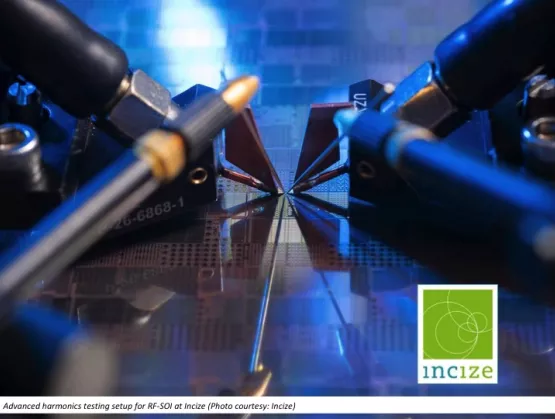
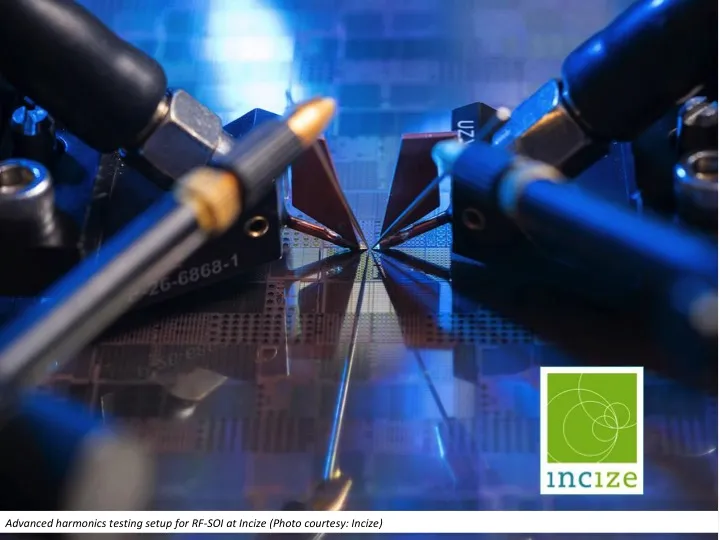
With the CAGR for switches in cell-phone RF front-end modules running at 9% for the next five years, new players want to get in on the action, and established players want to up the ante. The specialists at Incize help wafer suppliers, foundries and fabless companies maximize switch performance starting at the substrate level. CEO Mostafa Emam explains how.SOI News (SN): Can you tell us about the role Incize plays in the RF-SOI ecosystem? [caption id="attachment_32519" align="alignright" width="140"] Incize CEO Mostafa Emam. (Photo courtesy: Incize)[/caption] Mostafa Emam (ME): Our clients are wafer suppliers, foundries and fabless companies. The services we offer are testing and modeling of substrates, with the vision of what will happen in the value chain. Based on what the customer will do with the substrates, we do testing and modeling to improve the technology and tune their processes. Although the big players have teams devoted to this, we can add a layer of characterization that they have no expertise in. Some of our customers are foundries that have been using bulk silicon, but now see opportunities in RF-SOI. But they’re starting from scratch and we help them to adopt the technology. We help them understand the physics behind the technology so they can migrate from bulk to SOI. We help them develop test structures and evaluate their technology. Then we create models for both fully-depleted and partially-depleted SOI with PD-SOI 130 nm or 60 nm technology dominating the RF front-end module market. We believe RF is an art and you need to see the whole picture. SN: Can you tell us a bit about the history of Incize? ME: The RF-SOI story started in the 1990s. Then came trap-rich RF-SOI wafers from Jean-Pierre Raskin’s team at UC Louvain, industrialized by Soitec. Our lab at UC Louvain became known for our expertise in RF-SOI, and in 2011 we created Incize as a spin-off. [Editor's note: for more background, see this SOI Consortium article about the birth of trap-rich substrates and the company’s founding.] At first our characterization services were very diverse, but by 2014 we focused mostly on RF-SOI because of the big demand. In 2015 we started doing radiation hardness tests for space applications and a new business unit was created. In 2016 we started our modeling and PDK activity, followed the next year by work on GaN on Si. In 2018, we started offering full support to RF-SOI newcomers, who were starting from scratch, usually smaller players in the RF market. It takes about two years to fully train the engineers, support the technology enhancements, design test vehicles, measure them and finally do the modeling and PDK. So some of these players are now fully established in the RF-SOI market and have contracts in place with big customers. SN: In your presentations, you often say there is room for all. What do you mean by that? ME: There is a big market for RF-SOI in the coming years. It can offer the low-power, the low-cost and the high performance. RF-SOI is the only mature technology that combines all of this today. It successfully competes with traditional III-V technology. More foundries want to employ RF-SOI. We show to them that it’s not black magic – you just need to know how it works. [bctt tweet="There is a big market for RF-SOI in the coming years. More foundries want to employ #RFSOI. We show them that it’s not black magic – you just need to know how it works. - Incize CEO Mostafa Emam #5G #semiconductors" username="@soiconsortium"] On our side, we have the knowledge and the infrastructure. Our added value is that we can do advanced tests the customers can’t do. So the foundry says there’s opportunities in switches, we’ll do this and develop it all with optimization for specific Ron and Coff [the figure of merit for RF switches]. The foundry develops an RF switch and aiming at certain performance (RonCoff). We help our customers during this development phase. Once the performance target is reached we start developing a model and a PDK. There is enough demand for RF-SOI, as even entry-level cell phones have SOI chips. Some opt for a fast and low-cost solution. Many target “good enough”, although some target to compete against the big players – it’s a question of their business strategy. And this is where our added value comes in. SN: Can you provide some more insight into how you see the RF market? ME: The Front End Module (FEM) is a fast growing market, with increasing demand in terms of volume and performance. This includes antenna switches, LNAs, tuners, filters, etc. Historically, III-V materials have been used for their high performance and high power handling. However, RF-SOI has become the material of choice, and the biggest driver is integration of the RF switch and LNAs in one chip. It’s not easy to integrate the power amplifiers (PAs) on the same chip (still being on III-V substrates). But as it decreases footprint and cost, there are those who’ll do it. There is no viable competition for SOI – nothing will replace it in the short term. There are other technologies, but they are long term. It’s a stable market with high demand. SN: For those of us who are not RF experts, can you help us understand the technology? ME: The switch is sort of the traffic light of the FEM, receiving and transmitting. The simplest RF switch can be composed of only four transistors. Transistors leak power so you need to determine your Ron Coff performance. [Editor's note: Resistance on vs. Capacitance off, the RF switch figure of merit, is measured in femtoseconds and should be as low as possible. Psemi has a good video explaining it.] When the Coff capacitance is small, the switch is really off. When the On resistance Ron is small, it means low losses, and the switch is turned On. Ron and Coff is a compromise. And as there are many frequency bands and antennas, the FEM becomes very complex. Another issue is power handling, since the switch is the first stage behind the antenna. And finally, there is the question of switch linearity. Trap rich SOI wafers suppress harmonics so you have less distortion originating in the substrate. You have to model this – the designer needs to know. In addition to single tone harmonics you also get intermodulation, where, two or more high power signals at two different frequencies create distortion at other frequencies. The danger is that these parasitic signals can be so close that the filter can’t reject them and the useful signals get distorted. This was a killer for the switch created on the bulk substrate. Trap-rich RF-SOI fixed this. So now 100% of switches are on trap-rich SOI substrates. While it’s still a niche market, there is demand from customers for increasing the number of bands – that’s driving this market. SN: And what happens as we move to 5G? ME: There’s more and more pressure on the specs. It’s an art when anything changes. Moving from 3G to 4G required complete upgrade of the [foundry’s] models. With 4G, the specs are severe and the FEM must be built on trap-rich substrates. But 5G is not well defined, so the RF industry is taking their best shot. What is clear: the performance requirements get more challenging. Once the technology is understood, it can be implemented. But the foundries and the fabless need our help to do it fast and do it well. We create more value working together. SN: How do you see things evolving? ME: The number of foundries today doing switches on RF-SOI is increasing, and this will continue for the next few years. We saw this opportunity and invested in it. Our company is just ten people, and we are self-funded. We are swimming in business, but we have fun. And we’re getting recognition. Any company with CMOS in place could adopt RF-SOI. But it’s a different mindset. We help with the transition. ~ ~ ~Click here to read more feature articles in SOI News.
Read More
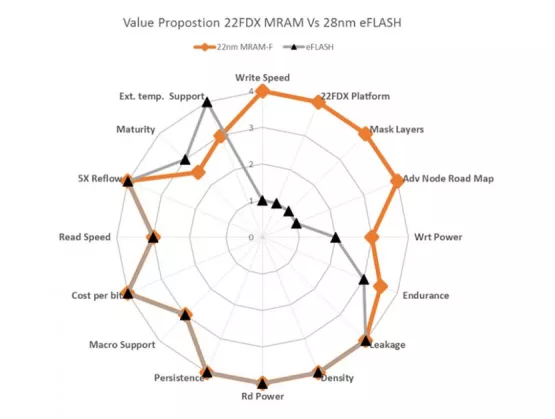
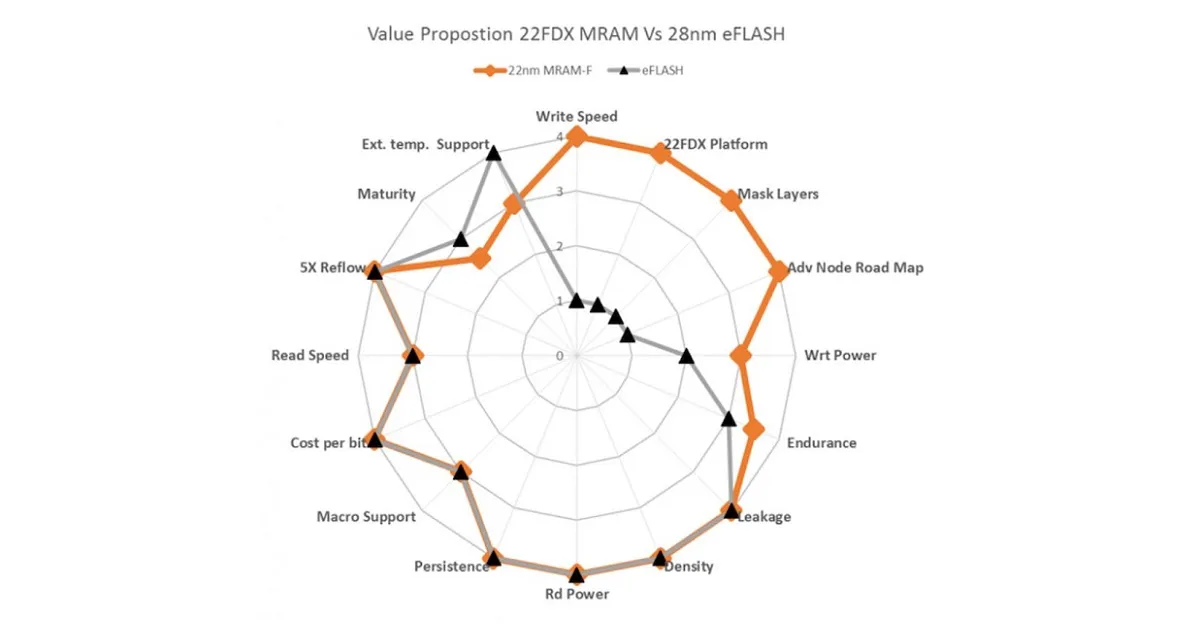
GlobalFoundries recently announced that its embedded magnetoresistive non-volatile memory (eMRAM) has entered production on the company’s 22nm FD-SOI (22FDX®) platform. (See the full press release here.) The company says this advanced embedded non-volatile memory on its FDX™ platform provides a cost-effective solution for low-power, non-volatile code and data storage applications. It is now working with several clients with multiple production tape-outs scheduled in 2020. GF heralds the announcement as a significant industry milestone, demonstrating the scalability of eMRAM as a cost-effective option at advanced process nodes for IoT, general-purpose microcontrollers, automotive, edge-AI, and other low-power applications. [caption id="attachment_31334" align="alignright" width="485"] (Courtesy: GlobalFoundries. Click to enlarge.)[/caption] “We continue our commitment to differentiate our FDX platform with robust, feature rich solutions that allow our clients to build innovative products for high performance and low power applications,” said Mike Hogan, senior vice president and general manager of Automotive and Industrial Multi-market at GlobalFoundries. “Our differentiated eMRAM, deployed on the industry’s most advanced FDX platform, delivers a unique combination of high performance RF, low power logic and integrated power management in an easy-to-integrate eMRAM solution that enables our clients to deliver a new generation of ultra-low power MCUs and connected IoT applications.”[bctt tweet="In production! @GlobalFoundries’ eMRAM on #22FDX FD-SOI replaces #eFlash for #IoT genpurpose #microcontrollers #automotive #edgeAI more. #lowpower #chipdesign #FDSOI" username="@soiconsortium"] [caption id="attachment_31330" align="alignleft" width="467"] (Courtesy: GlobalFoundries. Click to enlarge.)[/caption] Designed as a replacement for high-volume embedded NOR flash (eFlash), GF’s eMRAM allows designers to extend their existing IoT and microcontroller unit architectures to access the power and density benefits of technology nodes below 28nm. It is a highly versatile and robust embedded non-volatile memory (eNVM) that has passed five rigorous real-world solder reflow tests, and has demonstrated 100,000-cycle endurance and 10-year data retention across the -40°C to 125°C temperature range. The FDX eMRAM solution supports AEC-Q100 quality grade 2 designs, with development in process to support an AEC-Q100 quality grade 1 solution next year. [caption id="attachment_31331" align="alignright" width="280"] GF’s state-of-the-art 300mm production line at Fab 1 in Dresden, Germany, will support volume production of 22FDX with MRAM. (Courtesy: GlobalFoundries)[/caption] Custom design kits featuring drop-in, silicon validated MRAM macros ranging from 4 to 48 mega-bits, along with the option of MRAM built-in-self-test support is available today from GF and their design partners. eMRAM is a scalable feature that is expected to be available on both FinFET and future FDX platforms as a part of the company’s advanced eNVM roadmap. GF’s state-of-the-art 300mm production line at Fab 1 in Dresden, Germany, will support volume production of 22FDX with MRAM. Prior to this announcement, an excellent GF blog by David Lammers recapped GF's 2019 IEDM presentation of their eMRAM reliability data. You can read that here. It also provides a lot of interesting background information.
Read More
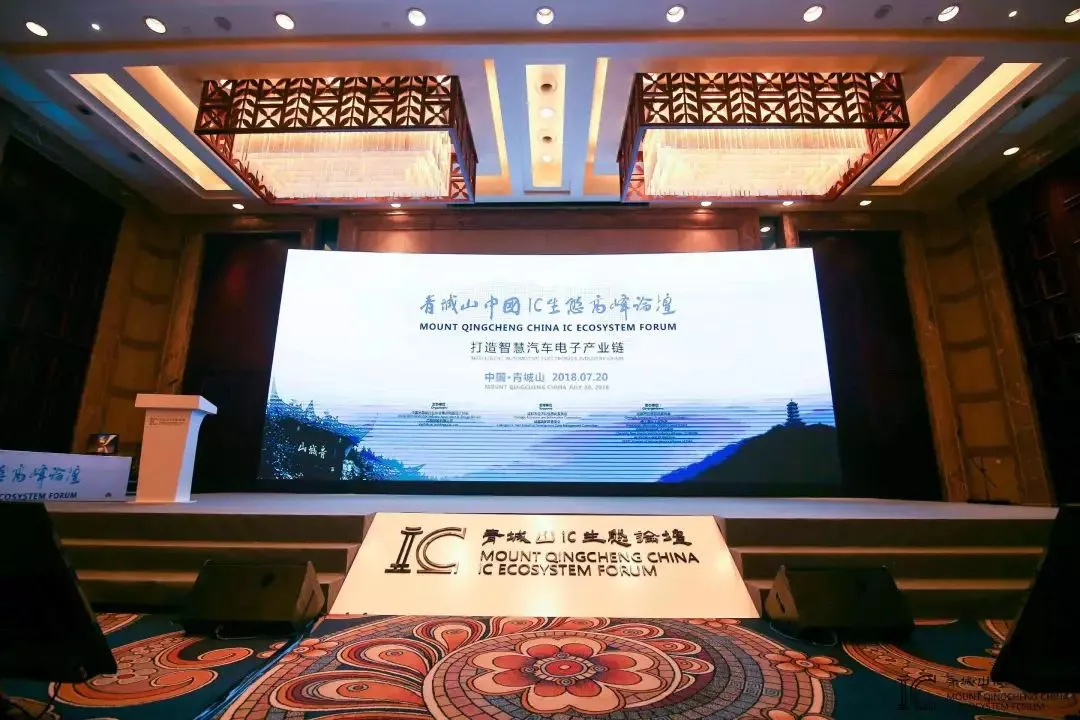
FD-SOI was a very important topic during the recent Mount Qingcheng China IC Ecosystem Forum. To situate things, Mount Qingcheng, with its lush hills and waterways, is located just outside of Chengdu. That of course is where GlobalFoundries is building its new fab, which will be the first in China to run FD-SOI. Chengdu is also a key city in China's automotive electronics landscape. [caption id="attachment_12236" align="alignright" width="300"] (Image Courtesy: VeriSilicon)[/caption] The theme of the forum was Building a Smart Automotive Electronics Industry Chain. Over 260 decision-makers from government, academia and industry attended – and the SOI Consortium had a significant presence. The event was chaired by Wayne Dai, CEO/Founder of consortium member VeriSilicon, and tireless champion of the the FD-SOI ecosystem in China and worldwide. Morning keynotes were given by: Carlos Mazure, Soitec CTO and SOI Consortium Executive Co-Director; Mark Granger, GF's VP of Automotive Product Line Management; and Tony King-Smith, Executive Advisor at AImotive, a GF 22FDX customer. BTW, transcripts of all the talks are available through Gasgoo, China's largest automotive B2B marketplace. You can click here to access them. (They're in Chinese – but you can open them in the language of your choice using the major translation websites.) Chengdu Officials Affirm Support for FD-SOI Fan Yi, Deputy Mayor of Chengdu, spoke extensively of FD-SOI in his keynote on the importance of rapidly developing smart cars. He heralded the “spectacular” new GlobalFoundries fab there. Following a meeting with the company's top brass the day before, he affirmed GF's confidence in their investment. There is a solid roadmap for FD-SOI, he noted, and efforts are underway to accelerate the move into production and expand education and training. He cited the benefits of FD-SOI for the entire supply chain, from design through package and test, raising the level of the entire IC industry to new heights. The government, he said, attaches great importance to this enterprise. Their thinking regarding intelligent transport in China is integrated with the overall approach to smart cities. SOI Consortium Leads Industry Keynotes [caption id="attachment_12232" align="alignleft" width="300"] Wayne Dai, VeriSilicon Founder and CEO (Photo courtesy VeriSilicon)[/caption] In his opening remarks, Wayne Dai emphasized the need for China to seize the advantage in the next round of development opportunities in the automotive electronics industry. This year's Qingcheng forum, he noted, brought together key representatives from across the supply chain, from of the highest to the deepest reaches of the smart car electronics industry, and across markets, technologies, solutions, industrial ecosystem, standards and regulations. In his talk on how FD-SOI is boosting the accelerated development of automotive electronics, Carlos Mazure presented the SOI Industry Consortium. He noted that the Consortium promotes mutual understanding and development across the ecosystem. SOI is already present throughout automotive applications, he noted. There are currently about 100mm2 of SOI per car, in such diverse areas power systems, transmissions, entertainment, in-vehicle networking and more. SOI will experience especially high growth in electrification, information/entertainment, networking, 5G, AI/edge computing and ADAS. He then went on to give some history and an extensive overview of the major trends and highlights we've seen over recent years. He finished by giving examples of convergence across the supply chain with IC manufacturers working with automakers to lower power, increase processor performance and advance 5G. [caption id="attachment_12233" align="alignright" width="665"] Carlos Mazure, Soitec CTO and SOI Consortium Executive Co-Director; Tony King-Smith, Executive Advisor at AImotive and Mark Granger, GF's VP of Automotive Product Line Management (Photo courtesy VeriSilicon)[/caption] GF's Mark Granger addressed the rapid development of automotive electronics. In certain areas, he said, he sees growth rates of over 20%. They are working on building the Chengdu ecosystem, especially for design, and in cooperation with the rest of the supply chain. Furthermore, he reminded the audience, when you talk about cars, travel implies that you also talk about IoT as well as things like infotainment and integrated radar ICs. In addition to cost and power efficiencies, the AEC-Q100 standard for IC reliability in automotive applications is also pushing designers to turn to FD-SOI. In the GF meeting with Chengdu government officials (referenced above in deputy mayor Fan Yi's talk), he too confirmed their support of FD-SOI as a key technology for China. GF is currently cooperating with about 75 automotive partners, he said, and the company is looking to increase cooperation with partners in the Chengdu region. Tony King-Smith talked about the 22FDX test chip AImotive is doing with Verisilicon and GF. In case you missed it, in June 2017 AImotive announced its AI-optimized hardware IP was available to global chip manufacturers for license. AiWare is built from the ground up for running neural networks, and the company says it is up to 20 times more power efficient than other leading AI acceleration hardware solutions on the market. In the same announcement, they revealed that VeriSilicon would be the first to integrate aiWare into a chip design,and that aiWare-based test chips would be fabricated on GF's 22FDX. The chip is expected to debut this year. While the afternoon agenda was not specific to FD-SOI, it did focus on the "smart cockpit" and "intelligent driving", with talks by nine leading players in China's automotive IC and investment communities. ~ ~ ~Note: Many thanks to the folks at VeriSilicon, who wrote up this event for their WeChat feed, and shared photos with us here at ASN.
Read More
Specialty foundry TowerJazz is ramping a 65nm version of its RF-SOI process on 300mm wafers at Fab 7 in Uozu, Japan. To support the ramp, the company has signed a contract with long-term partner, Soitec, guaranteeing a supply of tens of thousands of 300mm SOI silicon wafers, securing wafer prices for the next years and ensuring supply to its customers, despite a tight SOI wafer market. [caption id="attachment_12108" align="alignright" width="300"] The 300mm 65nm RF-SOI process will be offered at the Uozu, Japan fab, which is operated by the TowerJazz Panasonic Semiconductor Company (TPSCo). (Photo courtesy: TowerJazz)[/caption] Five of TJ's seven fabs do RF-SOI. LNA (low-noise amplifers) are a big market driver, and with RF-SOI they can integrate the LNA with the switch, CEO Russell Ellwanter said in his lead keynote at the SOI Consortium’s 5th International RF-SOI Workshop in Shanghai (spring, 2018). BTW, that was in fact a very inspirational talk about Value Creation, and the importance of treating your suppliers with respect. He credited his company’s close relationship with RF-SOI wafer-supplier Soitec for TJ’s claim to the world’s best linearity. “We are delighted to see the strong adoption of 300mm RF SOI through this large capacity and supply agreement with TowerJazz to augment our already significant 200mm RF-SOI partnership,” said Soitec CEO Paul Boudre. “TowerJazz was the first foundry to ramp our RFeSI products to high volume production in 200mm and continues as one of the industry leaders in innovation in this exciting RF market with advanced and differentiated offerings.” According to the TJ press release (you can read it here), with its best in class metrics the TowerJazz 65nm RF-SOI process enables the combination of low insertion loss and high power handling RF switches with options for high-performance low-noise amplifiers as well as digital integration. The process can reduce losses in an RF switch improving battery life and boosting data rates in handsets and IoT terminals. It's a high-growth market, to be sure. Market researchers Mobile Experts predict that the mobile RF front-end market will reach $22 billion in 2022 from an estimated $16 billion in 2018. TowerJazz says its breakthrough RF SOI technology continues to support this high-growth market and is well-poised to take advantage of next-generation 5G standards, which will boost data rates and provide further content growth opportunities in the coming years. Customers are already getting into position. For example, Maxscend (WuXi, China), a provider of RF components and IoT integrated circuits, is ramping in this new technology. “We chose TowerJazz for its advanced technology capabilities and its ability to deliver in high volume while continuously innovating with a strong roadmap. We specifically selected its 300mm 65nm RF SOI platform for our next-generation product line due to its superior performance, enabling low insertion loss and high power handling,” said Maxscend CEO Zhihan Xu. As longtime ASN readers will know, we've been covering the evolutions of TJ's RF-SOI platforms since the beginning of the decade. It's worth noting, too, that beyond RF, TowerJazz also offers foundry customers other SOI-based processes, such as the new 0.18μm BCD SOI, a 200V SOI technology platform (announced in 2017, press release here) for motor drivers, industrial tools, electric vehicles and more. The previous generation 0.18μm SOI for automotive power management also offers exceptional area savings and is well-suited for high temperature operation. Back in 2014, here at ASN we did a great interview with TJ SVP Dr. Marco Racanelli about when and why they use SOI – and while processes have advanced, the basic drivers are still there, so it's a still a good read. And finally, designers will want to know that the TJ Multi-Project Wafer (MPW) Shuttle Program offers the 65nm RF-SOI process, as well as other SOI-based processes. See the website for scheduling and details.
Read More
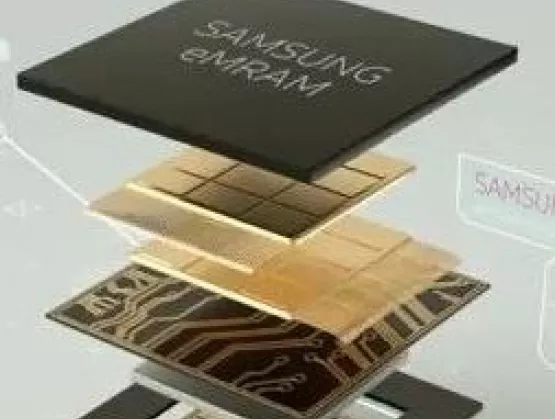
Per Arm, the industry's first eMRAM compiler IP is now on Samsung's 28nm FD-SOI technology. The announcement was made in a post by Kelvin Low, VP Marketing for ARM's Physical Design Group (read it here). He said that ARM has successfully completed their first eMRAM IP test chip tapeout. The Arm eMRAM compiler IP will be available from 4Q 2018 for lead partners. Samsung Foundry’s 28nm FD-SOI process technology is called 28FDS. eMRAM (which stands for embedded MagnetoResistive RAM) is a novel non-volatile memory (NVM) option positioned to replace incumbent NVM eFLASH, which has hit its limits in terms of speed, power, and scalability. Arm's new eMRAM compiler IP gives Samsung's 28FDS customers the flexibility to scale their memory needs based on the complexity of various use-cases, explains Low. “What drives the cost-effectiveness of this compiler IP is that eMRAM can be integrated with as few as three additional masks, while eFlash requires greater than 12 additional masks at 40nm and below,” he says. “Also, the eMRAM compiler can generate instances to replace Flash, Electrically Erasable Programmable Read-Only Memory (EEPROM) and slow SRAM/data buffer memories with a single non-volatile fast memory – particularly suited for cost- and power- sensitive IoT applications.” [caption id="attachment_11972" align="alignleft" width="300"] A key slide shown by Arm at the 2017 SOI Consortium's Silicon Valley Symposium (Courtesy: Arm and the SOI Consortium)[/caption] At the SOI Consortium's 2017 Silicon Valley Symposium, Arm said that they were stepping up their support of FD-SOI (read about that here) – and clearly they are! At that event, Arm VP Ron Moore gave a great presentation, which is freely available on our website: Low Power IP: Essential Ingredients for IoT Opportunities. Samsung, btw, has been offering 28FDS for about three years now. (ASN did a 3-part interview with Kelvin Low back in 2015 when he was a senior director of marketing for Samsung Foundry. It's still a useful read – you can get it here.) As of last fall, Samsung said it had taped out more than 40 products for various customers. And at the SOI Consortium's 2018 Silicon Valley Symposium, Hong Hoa, SVP said they'd already taped out another 20 this year (read about that here). https://youtu.be/EB14K8Gq5-w Samsung says the write speed of their eMRAM is 1000x faster than eFlash. They actually announced the industry's first eMRAM testchip tape-out milestone on 28FDS in September 2017 (you can read the press release here). They also did an eMRAM test chip with NXP. (BTW, Samsung has a really nice video explaining their eMRAM offering – you can see it above or on YouTube here.) As noted in ASN's Silicon Valley 2018 symposium coverage, the basic PDK for the Samsung 18nm FD-SOI process (18FDS) will be available in September 2018, with full production slated for fall of 2019. It will deliver a 24% increase in performance, a 38% decrease in power, and a 35% decrease in area for logic. RF for the 18FDS platform will be ready by the end of this year, and eMRAM beginning in 2019.
Read More
“GlobalFoundries, TowerJazz, TSMC and UMC are expanding or bringing up RF SOI processes in 300mm fabs in an apparent race to garner the first wave of RF business for 5G, the next-generation wireless standard,” writes Mark Lapedus of Semiconductor Engineering. His recent piece, RF-SOI Wars Begin, explains why demand across the supply chain is currently tight. Rest assured, the supply situation is being addressed fast. By next year, 300mm-based RF-SOI manufacturing (vs. 200mm) will increase from 5% to 20%. But with insatiable end-user demand for greater throughput, overall RF-SOI device demand is increasing in the double-digit range, so 200mm-based manufacturing is also expanding fast. [caption id="attachment_11905" align="alignleft" width="300"] The front-end modules in all smartphones are built on Soitec's RF-SOI wafer technology. The most advanced, for LTE/LTE-A, are built on Soitec's RFeSI-SOI wafers, which have four layers to meet the demands of devices with high linearity requirements. (Courtesy: Soitec)[/caption] SOI wafer manufacturer Soitec has 70% of the RF-SOI wafer market share. The other RF-SOI wafer manufacturers – Shin-Etsu, GlobalWafers and Simgui – all use Soitec's RF-SOI wafer manufacturing technology. This is an excellent, comprehensive piece, that clearly explains the complexities of the markets, the devices, the manufacturing and the supply chain. It's a highly recommended read. BTW, the SOI Consortium is organizing a 4G/5G SOI supply chain workshop during Semicon West (July '18). Sign up or get more information on that under the Events tab here on the consortium website. Of course, here at ASN, we've been covering RF-SOI for over a decade. You can use our RF-SOI tag to access most of the pieces we've done over the years.
Read More
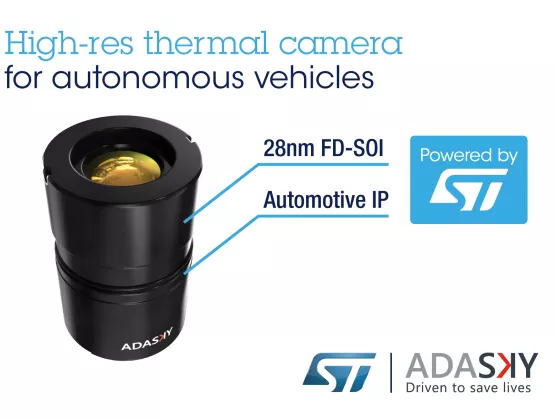
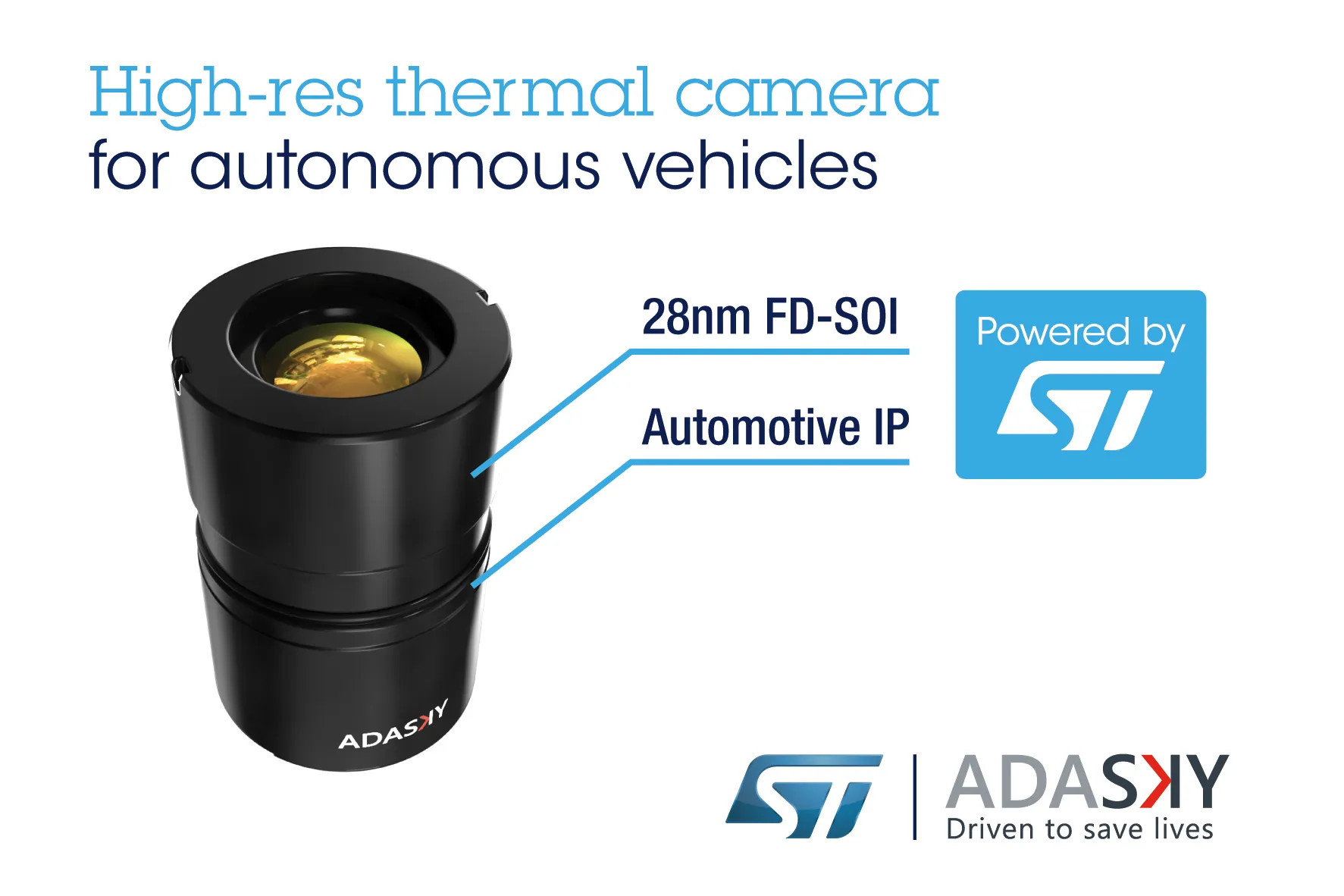
Automakers are currently evaluating prototypes of Viper from AdaSky, a Far Infrared (FIR) thermal camera that embeds custom silicon co-designed with and manufactured by ST in 28nm FD-SOI. The complete sensing solution aims to enable autonomous vehicles to see and understand the roads and their surroundings in any condition. “With the help of ST, we have created the first high-resolution thermal camera for autonomous vehicles with minimal size, weight, and power consumption--and no moving parts. ST’s access to, and expertise in, ultra-low-power design, IP that is fully qualified for automotive applications, and 28nm FD-SOI technology have been vital to meeting the severe power constraints that would challenge our sensors’ performance,” said Amotz Kats, Vice President Hardware, AdaSky. “We’re in a position to deliver a breakthrough solution to revolutionize and disrupt the autonomous vehicle market because of ST’s mastery of automotive qualification and its strong manufacturing supply chain, which grants reliability, long-term support, and business continuity to car makers throughout the whole life of their production.” Passive infrared vision, like that in AdaSky’s Viper, when used in a fusion solution, can help close the gaps to provide accurate sight and perception without fail in dynamic lighting conditions, in direct sunlight, in the face of oncoming headlights, and in harsh weather. The new camera uses an FIR micro-bolometer sensor to detect the temperature of an object. In an ADAS solution, Viper uses proprietary algorithms based on Convolutional Neural Networks to classify obstacles and show them in a cockpit display to give the driver an early warning. This warning comes several seconds earlier than it would when using a conventional sensor in the visible wavelength and is even faster than what is possible with the human eye. The two companies say that the Far-Infrared thermal camera extends ADAS sensor fusion capability with a new layer of information, helping pave the way to fully-autonomous driving in any condition. Prototypes are now under evaluation by carmakers with initial production targeted for 2020. (Read the full press release here.)
Read More