downloadGroupGroupnoun_press release_995423_000000 copyGroupnoun_Feed_96767_000000Group 19noun_pictures_1817522_000000Member company iconResource item iconStore item iconGroup 19Group 19noun_Photo_2085192_000000 Copynoun_presentation_2096081_000000Group 19Group Copy 7noun_webinar_692730_000000Path
Skip to main content
Default Banner Image

training

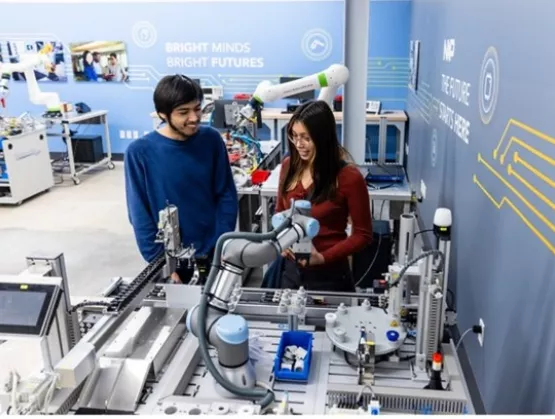
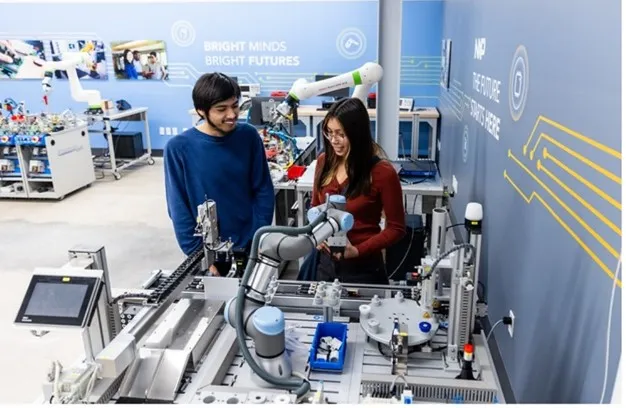
The semiconductor industry is a rapidly expanding sector in the United States with an anticipated 115,000 new jobs by 2030. A projected 67,000 of these in-demand roles will remain unfilled (SIA Workforce Blueprint, 2024), given the current training landscape. To address this workforce challenge, many strategies must be leveraged. One solution is to diversify the education and training needed to move workers into the semiconductor industry. Through semiconductor-specific programming at community colleges and universities, institutions can attract a wide array of learners, and by creating flexible credit, non-credit, degree, diploma, and certificate programs, education providers can meet hiring needs through many pathways. The SEMI Foundation, the workforce development arm of SEMI, is now offering Fundamental Semiconductor Knowledge Certification for high-quality programs that prepare entry-level workers for success in the growing semiconductor industry. SEMI’s Fundamental Semiconductor Knowledge Certification conveys that: Learners who are new to the semiconductor industry and successfully complete the program will be well-prepared for entry-level roles; Program completers have had exposure to fundamental semiconductor industry information and context, as well as introductory hands-on experience;Completers of these programs will have the specific knowledge and skills required for entry level positions; andProgrammatic design and content have been informed through input and feedback from local industry partners.Certified Programs: Spotlight on Austin Community CollegeAustin Community College District (ACC)—located in Austin, TX, was the inaugural recipient of the SEMI Foundation’s Fundamental Semiconductor Knowledge Certification for their Advanced Manufacturing Production (AMP) program. The strength of ACC’s programming is further illustrated by the College’s partnership with America’s Frontier Fund (AFF) Foundation, Merit America, and the Texas Institute for Electronics to expand the AMP program across the United States in 2025. This expansion will allow job seekers to access the SEMI Certified AMP program in a flexible, location-diverse capacity. ACC’s Dr. Laura Marmolejo, Dean of Advanced Manufacturing, and Laura Lucas, Director of Strategic Initiatives, spoke with SEMI Foundation to share the origin story of AMP and provide lessons learned and advice for others who are developing or expanding similar programs. Dr. Laura Marmolejo, Dean of Advanced Manufacturing, and Laura Lucas, Director of Strategic InitiativesKnowledge Sharing: Best Practices and StrategiesWhen asked what other schools can learn from ACC's experience, Dr. Marmolejo and Ms. Lucas focused on three key areas: direct engagement with industry, flexibility on programming and meeting local needs, and developing a pathway that can be clearly communicated to learners and industry alike. Dr. Marmolejo emphasized the importance of developing strong connections with industry. “Start by building these relationships with the company. They need to trust you,” said Dr. Marmolejo.” Ms. Lucas also spoke of how the program's origin and ultimate success emerged from direct engagement with companies. By understanding direct needs at each company, identifying consistent needs between the companies, and identifying ways that the College could support those needs, ACC was able to offer multiple solutions that appealed to both students and employers. Austin Community College offers several ways for learners or jobseekers to deepen their knowledge of the semiconductor industry and advanced manufacturing sector. Learners can begin their journey with the College’s 8-week Advanced Manufacturing Production (AMP) program, upskill with the Core Automation Semiconductor Training (CAST) program, or pursue a bachelor's or associate degree.Another benefit of the close collaboration between ACC and industry is that the College "is understanding where the regional hiring demand is at any given time,” said Ms. Lucas. This awareness, coupled with a mindset of flexibility and adaptability among the instructors and administrators, allows ACC to align programming with local needs, ensuring that jobseekers experience success once they complete their programs. For example, recently in Austin, employers have been focused on upskilling existing employees, so ACC has been able to open more sections of the Semiconductor Technician Advanced Rapid Start (STARS) program for incumbent workers within the local workforce ecosystem. When hiring gaps require more new additions to the industry, ACC will be able to pivot to increased AMP and CAST programming. This awareness of industry needs and the flexibility allows ACC to think about its offerings holistically.Advanced manufacturing students at ACCAnother consideration that schools and faculty can keep in mind when developing programs is how they scaffold programming and communicate the pathways and differences between offerings to external audiences. Internally, the distinctions between programs may feel obvious, but learning how to promote each pathway to learners, and how to differentiate them when seeking employer input is critical. Whether it's AMP, CAST, or STARS, "the topics are the same; what’s different is the level of depth,” explained Dr. Marmolejo. Ensuring learners enroll in the right program for their individual needs and career path will help the College build the right pathways for students from education to career. Clear communication about programming will also inform the industry about the best ways to get and stay involved in course development and iteration. Dr. Marmolejo with advanced manufacturing students at ACCACC’s success in building pathways for students into industry at the local level is evident in the more than 2,800 students enrolled across all advanced manufacturing programs, as well as its upcoming national program expansion for AMP. Other educational institutions and training providers can learn from the best practices and experiences of ACC, and can similarly have their work reviewed and certified by the SEMI Foundation.Press event at ACC in November 2024 to announce the expansion of AMP program nationwide and the awarding of the SEMI Certification.SEMI Certification: Next Steps for Training and Education PartnersSEMI Certification for training programs communicates to learners, jobseekers, and employers that the awarded programs have achieved the highest standards of program excellence in preparing entry-level workers to succeed in the growing semiconductor industry. Through 2025, the SEMI Foundation plans to expand program and course certification to include technician training programs. If you are a training or education partner looking to submit a program for consideration, please complete the SEMI Certificate Screening form. For more information about existing and future SEMI Certification efforts, please contact Anissa Hamdon-Morison at [email protected] or visit SEMI Certified Programs Courses | SCAN.Anissa Hamdon-Morison is the Curriculum and Training Manager at the SEMI Foundation.
Read More
We live in the New Industrial Age. Manufacturing is undergoing a profound transformation, driven not only by technological (e.g. Artificial Intelligence, robotics, IoT) but also societal, market and regulatory developments that have fundamental implications for the workforce competency requirements. How can education and training systems keep pace with this unprecedented change? How does a future-proof curriculum look like?This topic has been extensively addressed by the Curriculum Guidelines for Key Enabling Technologies (KETs) and Advanced Manufacturing Technologies (AMT) initiative (2017-2019) of the Executive Agency for SMEs (EASME) and DG GROW of the European Commission. Carried out by PwC, the initiative focuses on the promising ways of organising learning experiences of individuals and groups in the New Industrial Age. The initiative produced the Curriculum Guidelines 4.0 that aim to equip all key stakeholder groups with the knowledge base needed to transform the existing curricula.The guidelines were developed based on the extensive state-of-play analysis and active stakeholder contribution by means of expert workshops, pan-European online surveys, in-depth interviews and individual expert consultations. All key stakeholder groups were involved in the preparation of the guidelines, including the representatives of education and training providers, industry, policymakers and supporting structures (e.g. industry associations, cluster organisations and trade unions), as well as learners themselves. SEMI was among the key contributors. The guidelines were presented to the public at the EU Conference on Skills for Industry: Curriculum Guidelines 4.0 in Brussels on 26 November, 2019.The guidelines aim to be applicable for both designing fundamentally new educational offers and/or advancing the existing curricula, depending on the level of required change. They address non-tertiary vocational education and training, higher education and on-the-job training for the manufacturing-related domains.The guidelines follow a holistic approach covering a broad spectrum of dimensions relevant to curriculum design and implementation, namely: Strategy: defining core values, commitments, opportunities, resources and capabilities of an educational/training institution Collaboration: promoting practices that move beyond the typical institutional collaboration patterns and engaging individuals and communities Content: defining the nature of educational content, including specific principles related to the actual content of the curricula Learning environment: creating specific environment during the program, e.g. stimulating multidisciplinary orientation, design thinking, team spirit, collective problem-solving, risk-taking behaviour, experimental approaches Delivery mechanisms: establishing means by which learners experience and access education/training; paying special attention to technology-enabled learning Assessment: identifying most appropriate forms of assessment, including advantages and disadvantages Recognition: exploring appropriate formal and informal ways of recognition Quality: identifying the determinants of education training quality: what makes learners’ and employers’ perception different? Based on the results of the pan-European survey, the four key elements that require the most substantial change are Strategy, Collaboration, Learning Environment and Content.The guidelines will be tested in practice in the context of METIS (Microelectronics Training, Industry and Skills), a project recently launched by SEMI and 19 partners from 14 countries. Aligned with the Curriculum Guidelines 4.0, METIS will establish a Microelectronics Observatory and Skills Council consisting of representatives from industry, academia, NGOs, think tanks and government. The consortium will develop a New Skills Strategy for the microelectronics industry in Europe with a focus on raising occupational profiles and skills critical to the future of the sector.METIS will enable a new industry-driven curriculum with 43 modules integrating online education and work-based learning in microelectronics design and manufacturing. Training will focus on chip design, system design, basic of manufacturing and key competencies. METIS is a Sector Skills Alliance co-funded by the Erasmus+ Program, receiving 4 million EUR funding from the EU.Preparing students for lifelong learning, offering Big Picture education, creating effective learning ecosystems, applying problem-based and student-centric approaches, shifting from human-robot interactions towards human-machine collaboration – these are just some examples of the curriculum guidelines principles highlighted in the guidelines.The guidelines aim to offer key highlights, indicate a variety of possibilities and identify sources for more detailed information and inspiration. The guidelines by no means aim to serve as a standardised detailed recipe for organising education and training processes, as there is no one best way to approach it. The diversity of learners’ needs and contexts per definition implies a need for multitude of approaches, which could also be combined in their own unique/customised education and training solutions.The Curriculum Guidelines 4.0 will be publicly released in January 2020, and will be available on the EU Publications. More information about this and related initiatives can be found at https://skills4industry.eu/. Dr. Kristina Dervojeda leads the PwC Innovation Research Centre in the Netherlands.
Read More
On the day I joined SEMI in March of 2017, I was filled with excitement to be on-boarding at a time when great, leaping strides in innovation were driving the rapid expansion of our ecosystem. In my many conversations with members that followed, I was not surprised that a vast majority ranked among their top concerns the persistent challenge of attracting, training and retaining the talent needed to grow their businesses. Later that year, I raised the global talent shortage issue in my article Securing Talent to Connect, Collaborate and Innovate. As an industry veteran I knew that the decades-long workforce development challenge will only worsen with the proliferation and increasing complexity of technology.Innovation has never been more technology-intensive. Developing the technology and producing the components required for applications powering next-generation communications (5G), artificial intelligence (AI) and machine learning, autonomous vehicles, and the Internet of Things (IoT) require bright minds in diverse fields of science to fill critical positions in the global electronics manufacturing industry. Today, that talent struggle is acute, threatening to undermine our industry’s potential to grow to $1 trillion by 2030.The electronics industry needs a comprehensive, integrated program to build the talent pipeline. The program should inspire school-age children to adult learners to pursue careers in this great but underrecognized industry. It needs to shine a spotlight on career opportunities. It must prepare workers with standardized skills sets transferable across the industry. And it must connect trained workers with hiring companies.SEMI is uniquely positioned to deliver this solution. Launched almost two years to the day after I joined SEMI, SEMI Works is SEMI’s branded workforce development initiative. We realize that trade associations don’t create jobs. Their members do. Think of SEMI Works as SEMI’s commitment to build and maintain the needed infrastructure – the talent pipeline. SEMI Works is comprehensive. The program, supported by SEMI members, is a wide-ranging effort by our Global Advocacy team to ensure education is demand-driven, training programs better meet the needs of the industry, more people pursue careers in electronics and our members have access to the talent pool that we are cultivating. With SEMI Works, SEMI is developing scalable solutions to improve connections among training and education providers, prospective workers and the industry. Key features of SEMI Works will include SEMI-certified education courses and training programs linked to industry requirements and skills credentialing for workers.SEMI Works starts with raising awareness of SEMI-certified programs as a key bridge connecting prospective talent, the industry and applicable training and education programs. Growing awareness of the programs will enable SEMI to build an extensive database of employers and qualified talent and link both to the right training. SEMI will continue to drive and endorse programs that help meet member needs throughout the education continuum – from K-4 to higher education and adult training. But the infrastructure and ecosystem required to support and scale these programs is the key for all of us to win together. At a high level, SEMI Works consists of several important components: Linking the required industry competencies to education and training course curriculum – Similar to the establishment of SEMI standards, SEMI will certify education and training programs that dovetail with the industry competency model. Initial certification and annual re-certification ensure continued updates, relevance and sustainability of the programs. SEMI will raise awareness of SEMI Works certified programs as the standard for meeting the industry’s talent requirements. Developing and maintaining the electronics industry competency model – Through established working groups and ongoing dialogue with our members, we are developing a competency model – a tiered matrix of required competencies used to link course curriculum to the talent needs of employers. The competency model consists of interpersonal and individual skills, academic and general industry requirements, advanced manufacturing competencies, and competencies by job. SEMI will establish and maintain the model with regular updates. Improving access to talent – Through SEMI Works, SEMI will build an extensive database that brings together programs, talent and employers. People and organizations opting into a SEMI-certified program or acquiring a SEMI program certification will be part of the SEMI database. Job seekers will be able to set up a profile and resume and search for training and employment opportunities, and employers will search the talent pool – much as job-search sites work today – assured of a skills match based on the SEMI certification. I am passionate about education and proud of all of SEMI’s efforts. I am especially proud of the work we are doing to help provide a pathway to meaningful careers for children and adults all around the world. We no longer have the luxury of a piecemeal approach to training and education.It is my hope and belief that SEMI Works, together with our efforts to improve diversity and inclusion in the workforce, will be SEMI’s lasting mark on the global electronics industry.Ajit Manocha is president and CEO of SEMI.
Read More
SEMI has launched a mentoring program that pairs seasoned industry professionals with university students and professionals wanting to advance their careers. The program is designed to help tackle the semiconductor industry’s workforce shortfall and prepare the next generation of innovators. Under the program, SEMI members with years of professional experience share their knowledge with developing talent and help build their professional networks as they embark on their careers in the microelectronics industry.As the microelectronics manufacturing industry faces increasing challenges in recruiting, training and retaining a diverse pool of highly skilled talent to sustain the remarkable pace of innovation globally, SEMI has made workforce development a top strategic priority. Globally, the industry is confronted with more than 10,000 job vacancies.To help build the workforce of the future, SEMI has rolled out industry-wide programs to address a chief reason for the workforce shortage – increasing competition from other technology sectors. The initiatives include enhancing industry awareness of the industry’s critical need for talent, increasing the representation of women, and supporting young professionals and university students soon to be making important career decisions. The new SEMI Mentoring Program builds on those initiatives by guiding the next generation of innovators.With mentoring a proven method to develop talent, SEMI has contracted with Chronus – an experienced provider of a software mentoring platform tailored to support the SEMI Mentoring Program.SEMI Mentoring Program: Roles and Responsibilities This is a formal relationship in which mentors guide mentees in their professional development. The mentor will answer questions and take a personal interest in, guide, encourage, and support the mentee. The mentor will meeting monthly with the mentee and follow up as needed. The mentee will set up the first meeting to discuss professional goals, topics he or she would like to cover and timing for subsequent. Both mentor and mentee will commit to remain connected for at least six months. Frequently Asked Questions Q: How are meetings conducted?A: Mentors and mentees can meet face-to-face or virtually, but should meet for a minimum of one hour once a month for six months.Q: How are goals set?A: The mentor and the mentee agree on goals during their first meeting. The mentee is responsible for arranging meetings, preparing the agendas, and any other pre-meeting work. This will ensure that the discussions touch on the topics that matter most to the mentees.Q: What happens once the six months are up?A: You can continue an unofficial relationship if both parties agree, or you can search for a new mentor or mentee by reapplying through your mentor profile.Q: What is SEMI’s role?A: SEMI is here to help match you based off your preferences, facilitate the relationship, provide materials to guide your experience, and help resolve any program or platform related issues.Q: What are the program eligibility requirements for mentors?A: A mentor must be an employee of a SEMI member organization with a minimum of five years’ professional experience to mentor a university student, or seven years’ professional experience to mentor a developing professional.Q: What are program eligibility requirements for mentees?A: Developing Professional Program Developing professional, 0-7 years in their career Employed by a SEMI member organization University Program At minimum, a rising junior enrolled in a university program (students through PhD level accepted) Completing a STEM major Within 6 months of graduation if currently out of school and seeking employment Preferred: Interest in the microelectronics industry Q: Why be a mentee?A: Learn from an experienced industry professional and accelerate your professional development.Q: Why be a mentor?A: Being a mentor will allow you to grow as a leader while giving you the rewarding experience of guiding someone’s growth path firsthand. Join us in shaping the future of our industry by becoming a mentor or mentee. Sign up here! For more information about the program, please contact Cristina Sandoval, manager of Workforce Development, at [email protected].
Read More