downloadGroupGroupnoun_press release_995423_000000 copyGroupnoun_Feed_96767_000000Group 19noun_pictures_1817522_000000Member company iconResource item iconStore item iconGroup 19Group 19noun_Photo_2085192_000000 Copynoun_presentation_2096081_000000Group 19Group Copy 7noun_webinar_692730_000000Path
Skip to main content
Default Banner Image

High Tech U

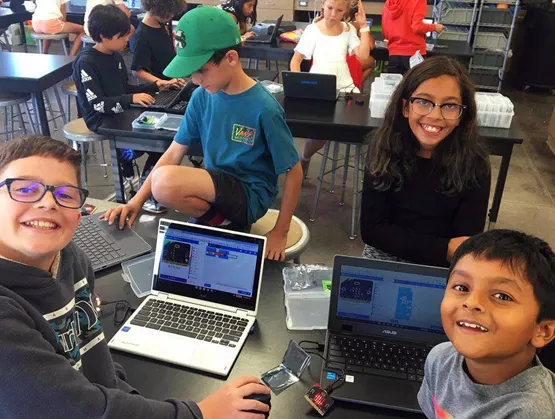
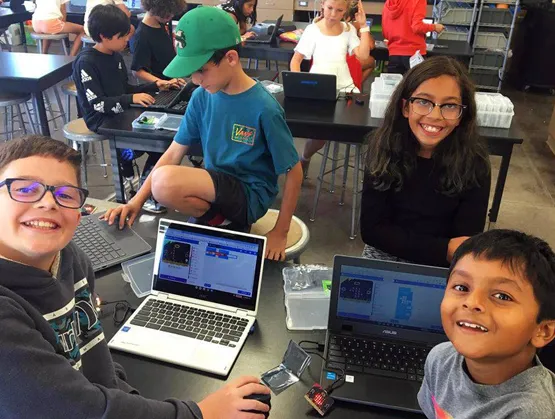
SEMI High Tech U is making waves around the world, introducing students and educators to the fascinating world of microelectronics through hands-on, experiential STEM learning kits. The SEMI Foundation started the program in the U.S., aiming to spark interest in semiconductors and technology, and High Tech U has expanded across borders to reach students in Europe and Southeast Asia. Recently, young learners in Germany and Malaysia participated in the SEMI program, diving into circuits, coding, and connecting their learning to the ever-evolving semiconductor industry.One of the core goals of High Tech U is to empower educators and students with tools that make microelectronics accessible and engaging. Since 2022, thanks to support from sponsors like KLA, Nordson, Western Digital, STMicroelectronics, Applied Materials, Broadcom, Infineon, and Qorvo, the program has reached over 5,500 students across multiple states and countries.MichiganStudents in Ypsilanti creating circuits with various materials.In the summer of 2024, SEMI Foundation partnered with Toyota and Washtenaw Community College to provide a free three-day summer program at Parkridge Community Center in Ypsilanti, Michigan. Dozens of Ypsilanti middle school and elementary school students engaged in active, hands-on learning about circuits using everyday materials such as playdough, copper tape, and batteries. The students built basic circuits on paper, created light-up greeting cards, and sculpted figures illuminated with tiny LED bulbs. This learning opportunity taught students and their counselors how circuits and semiconductors are an integral part of everyday life.MalaysiaStudents, staff, and teachers from ST Muar GEMS program.In 2023, STMicroelectronics Muar sponsored High Tech U kits for local schools as part of their Girls in Engineering, Mathematics Science (GEMS) STEM Lab program. SEMI Foundation staff collaborated with the GEMS program and provided a live international train-the-trainer session where teachers familiarized themselves with the High Tech U kits and accompanying curriculum. This session ensured that STMicroelectronics partners from the Muar Primary School were prepared to implement the program and make the connections between student learning and the work of the microelectronics industry.The STMicroelectronics Muar GEMS program has since educated many students in the local area on circuits, coding, and the basics of semiconductors. This partnership continues to blossom as STMicroelectronics aims to expand the implementation of the successful GEMS program. Moving forward in 2024 and beyond, GEMS students will apply their newfound skills in a friendly competition to solve real-world problems, showcasing how knowledge of circuits and coding can make a difference in creating a better world.GermanyStudents from SEMI Europe’s inaugural High Tech U program in Berlin.The SEMI Europe team has also recently launched their first High Tech U program in partnership with the Micro:bit Educational Foundation. Through a series of hands-on STEM activities, SEMI introduced a 4th-grade class in Germany to the fascinating world of microelectronics. Students were able to explore the fundamentals of coding and electronics through building a codable guitar using cardboard, aluminum foil, and electrical clips.The program continues to grow in Europe, providing students opportunities for interactive projects like crafting dice, programming melodies, and building smart sensors. The students’ enthusiasm and curiosity has shown the possibilities of engaging young minds in the world of microelectronics.Expanding Opportunities for Industry InvolvementSEMI invites you to take part in attracting, developing, and retaining the microelectronics talent of the future. Join us in this critical work while strengthening your company’s impact on your local communities. Learn more about High Tech U and opportunities for companies to get involved around the globe by contacting Bia Hamed at [email protected]. Berton Mahardja is the Director of Global Education Initiatives at SEMI Foundation. Prior to joining SEMI, Berton served in various roles across K-12 education. He is passionate about programs that support equitable industry access for students and adults.
Read More
As technology companies worldwide struggle to narrow the yawning gender parity gap, organizations in other industries ranging from insurance and food services to banking have emerged as guiding lights for how to boost the number of women in the workplace. MetLife, the 48,000-employee insurance giant, is among the standouts. In 2015, the New York-based company launched Developing Women’s Career Experience, a 14-month program designed to hone the business and strategic acumen of high-potential female workers. The goal was to increase the sense of urgency to promote women. The program bore fruit, expanding the representation of female managers and entry-level workers to 50 percent. Over the past five years, Sodexo, the French food services and facilities management company headquartered in Paris, has also upped female representation on its list of corporate priorities, expanding the ranks of women in entry and manager roles by 10 percent on average. More impressively, the number of women senior vice presidents has grown 20 percent and those in the C-suite have doubled.Sodexo drove the increases by developing a scorecard to hold managers accountable for diversity and inclusion and tying their performance to total compensation. Fully 10 percent of their bonuses were linked to strides in diversity and inclusion. Leaders at the 470,000-employee company scored points for hiring, promoting and retaining more women and underrepresented groups and could hike the total by taking other steps to improve the work culture by demonstrating inclusive leadership.“We do see companies taking bold actions and are seeing tremendous results,” said Audrey Bernardo, a partner at consultancy McKinsey Company, as she presented the case studies at Diversity – Women in Tech to kick off FLEX|MEMS Sensors Technical Congress (MSTC) 2020 last week in San Jose.And it turns out the payoffs matter not only for the bottom line but also a company’s ability to attract and retain the best talent. Citing research from the McKinsey Company and Lean In 2019 report Women in the Workplace as well as McKinsey’s 2018 Delivering through Diversity, Bernardo noted that gender-diverse companies are 24 percent more likely to financially outperform their less inclusive counterparts, while organizations with higher ethnic diversity are 33 percent more likely to outshine less diverse companies.Younger workers are particularly sensitive to diversity biases. The survey of more 250,000 employees at 600 companies found that employees under the age of 30 are almost two times more likely than older workers to raise the need for diversity and more likely to see bias in the workplace.“Diversity and inclusion has become a business imperative,” Bernardo said. Yet despite the urgency, gains among tech companies in cultivating a diverse workforce have been hard-won in part because of the challenge to better balance the proportions of male and female workers. And the headwinds start to gather when females are young. According to the report, 15-year-old females are vastly outnumbered by boys in their appetite to work in tech fields, with girls 65 percent to 84 percent less interested in pursuing tech careers than boys the same age.That dynamic extends to females in their college years. Despite earning more degrees than men overall, women account for the minority of tech degrees – ranging from as low as 13 percent representation in Chile and 15 percent in Brazil to as high as 45 percent and 36 percent, respectively, in India and Mexico. In the U.S., women account for just 23 percent of undergraduate degrees in tech.Bernardo praised the growing number of companies that are “reaching further down the age pipeline” to inspire young students to pursue STEM educations and careers in tech and cited the work of the SEMI Foundation – through High Tech U and other programs geared toward young students – to inspire the next generation of industry workers.The picture brightens once women have entered careers at technology hardware companies – they are promoted at only a slightly lower rate than men. Yet when it comes to outside hires, women are brought on board at a much lower rate than men. For example, women account for just 22 percent of the senior vice presidents hired at hardware companies, 17 percent of vice presidents, 22 percent of senior managers and directors, and 25 percent of managers.Part of the challenge for women in senior leadership positions is balancing careers with their home lives since they are two times more likely to be in dual-career households than their male counterparts.“We will never solve the women-in the-workplace problem until we solve the women-in-the-home problem,” Bernardo said.Indeed, giving women the leeway to work from home and take time off for family or personal reasons ranked among the power practices the study found most correlated to diversity and inclusion progress. Others include C-level executive participation in shaping a diversity and inclusion strategy, establishing numeric targets for tracking gender representation across the workforce as Sodexo has done, and unconscious bias training. “D I needs to be visible from the top,” Bernardo said.A shining example of executive support for diversity and inclusion initiatives is the work by Atlanta-based SunTrust Bank to encourage workers to embrace differences in people and build awareness of unconscious bias. In 2018, the 23,000-employee company held a daylong event that included workshops focused on candid conversations about gender, race, disability, LGPTQ identity, religion and military service.The Day of Understanding was sponsored by the SunTrust CEO. Within three years, the proportion of employees viewing the SunTrust workplace as inclusive grew to 80 percent, an 11 percent jump.Michael Hall is a marketing communications manager at SEMI.
Read More
High-tech industry clusters in the bustling northern Taiwan port city of Hsinchu look set for an upgrade. Long a world-class hub of the semiconductor and optoelectronic technology industries, Hsinchu City is laying out plans to work with SEMI to attract more international companies, generate more jobs, promote Hsinchu’s development and help grow Taiwan’s microelectronics industry. High-tech heavyweights such as TSMC, UMC, MediaTek, Realtek, and AUO are all headquartered in The Windy City. The Industrial Technology Research Institute (ITRI), a leading Taiwan research center and incubator, also calls Hsinchu home, and the city boasts one of the highest concentrations of educational institutions in the region, a roster that includes National Chiao Tung and National Tsing Hua universities. Hsinchu’s thriving relations with these industry, academic and research partners have made it a hotbed of innovation, with numerous large Taiwanese and foreign companies having opened local offices. No less than these partners, the city – like SEMI – is committed to innovation.In a recent visit to the SEMI Taiwan office in Taipei, a Hsinchu City government team led by mayor Lin Chih-Chien, met with Terry Tsao, global SEMI chief marketing officer and president of SEMI Taiwan, to explore collaboration opportunities in areas such as technology subsidies, policy, education, and infrastructure. The meeting built on a relationship between the city and SEMI Taiwan that sprouted after SEMI executives and Hsinchu officials joined ITRI to host the Autonomous Driving System Platform in Open Fields kick-off ceremony – an initiative to accelerate Taiwan’s adoption of smart transportation technologies – at SEMICON Taiwan 2019.At the meeting, Mayor Lin highlighted that Hsinchu has long attracted high-tech companies by cultivating a business-friendly climate through incentives such as subsidies for infrastructure buildouts. He hopes to work with SEMI to promote to members the benefits of setting up local offices in Hsinchu City.With both Hsinchu’s high-tech clusters and SEMI’s global members deeply reliant on skilled workers for sustaining innovation and growth, Tsao and Mayor Lin agreed that inspiring students to pursue an education and careers in science, technology, engineering and mathematics (STEM) is vital to building a high-tech talent pool. One collaboration opportunity SEMI Taiwan is eyeing is to launch Taiwan’s first SEMI High Tech U (HTU) program in Hsinchu to spark the interest of school-age children through STEM educational activities at school camps or art and cultural centers. SEMI’s STEM discovery program offers hands-on activities and experiential learning led by industry volunteers. Since 2002, HTU has reached some 8,000 high-school students in 12 U.S. states and nine countries.Emmy Yi is a marketing specialist at SEMI Taiwan.
Read More
With one of the oldest and largest public education systems in the developed world, how well does the US public education system serve the global electronics industry? Public education in the US has had time on its side. In 1635 the Boston Latin School became the first public school in the US. Boston Latin was originally a boys-only secondary school that taught Greek, Latin and the humanities. It wasn’t until 1918, however, that the US government required all children to obtain at least an elementary-school education – available to them through free public schools. As public education increasingly served the masses rather than just the elite, a balance of humanities, mathematics and science began to replace the classics.While free public education in the US got a comparatively early start, most American students score lower in science and math than students in many other developed nations. According to a 2017 Pew Research Study, 15-year-old American students ranked 24th in the world in international standardized age-group science testing and 38th in the world in standardized mathematics testing. While test scores are just one measure of proficiency, do they in some way reflect a lack of motivation to study science and math because of students’ unfamiliarity with STEM careers? Source: Pew Research. See article. Make STEM RelevantIf we want the US to remain a leader in the global electronics industry, we need to pay attention to the disconnects between academics and workforce development. We must help show students at an early age that STEM careers can be exciting, creative and fulfilling, and that math and science are essential to STEM.Ways to Get InvolvedWhether you work for a large publicly traded electronics manufacturer, an equipment or materials supplier, a foundry or a startup, you can take action to support student engagement in STEM. Here are a few ways to get involved:Participate in Community Programs One fun way to inspire budding technologists is to sponsor one of the FIRST programs for students. These age-segmented competitive programs range from FIRST LEGO League, Jr. Challenge for six-ten year-olds to FIRST Robotics Challenges for high school and college students, giving you the opportunity to sponsor a team or even to coach.Our company sponsors Team TNT, a Southern Oregon-based team that placed among the world’s top high school robotics teams at the spring 2018 world championships. We also brought two members of Team TNT to SEMICON West 2018, where they attended SEMI’s three-day High Tech U and presented their insights on building their FIRST Challenge robot at the Smart Workforce Pavilion. Margaux Quady (L) and Matthew Mills (R), Team TNT members, presented at SEMI’s Smart Workforce Pavilion at SEMICON West (Rogue Valley Microdevices) Concerned about the dearth of girls interested in STEM — and the small numbers of women in engineering careers? Look for your local equivalent of the Advocates for Women in Science, Engineering, and Math (AWSEM) Symposium, a day-long program for middle school girls. One of our engineers, Jennifer Devin, gave a hands-on workshop on deconstructing smartphones to showcase the silicon chips inside them. If you cannot find something like AWSEM, check out national programs such as the Society for Women Engineers (SWE)’s SWENext program for girls ages 13-18 as well as Girl Powered.Partner with Local SchoolsYou would be surprised at the opportunities to present what you do in the classrooms of school-age children. Take after Allyson Hartzell, managing engineer at Veryst Engineering in Needham, MA. Allyson speaks with students in her local elementary schools of Somerville and Cambridge, Massachusetts because she thinks that we must reach younger children to get them excited about STEM learning. “Waiting until middle school or high school to help students visualize the real-world appeal of STEM careers is just too late,” said Hartzell. “I’ve had amazing experiences working with local elementary-school students. Students become engaged when you show them real-world examples such as electron micrographs of MEMS.”Many middle schools and high schools also look to their communities to provide tutors in STEM subjects. Check with the community liaison at your local school to get started.Engage in Internship ProgramsInvolvement doesn’t stop in the K-12 grades. Seek out a local university’s internship program and hire some interns in that program to work at your company. The interns will gain valuable applied experience in your environment, and you might find young engineers who would love to join your company after they graduate. Oregon’s MECOP, an engineering-specific internship program founded on close industry-university collaboration, has been amazing for our recruitment. Some of our finest engineers were once in the MECOP program, including our engineering manager.Anything you do to get involved in inspiring coming generations of students to explore STEM — no matter how small your action — will make a positive difference in helping US students become better prepared to enter a technology-focused workforce. Through collaboration and creativity, we can help US companies keep the global electronics industry moving toward greater innovation. Jessica Gomez, CEO and co-founder of Rogue Valley Microdevices, entered the semiconductor manufacturing field in 1998 at Standard Microsystems Corporation of Hauppauge, New York where she acquired valuable knowledge in both semiconductor processing and production management. Jessica also held positions at Integrated Micromachines and Xponent Photonics prior to co-founding Rogue Valley Microdevices in 2003. As head of a technology company, Jessica recognizes the criticality of workforce development – and has become an advocate of STEM education. Rogue Valley Microdevices supports STEM initiatives for middle-school girls, a competitive robotics team for high school students, and a college internship program specifically for engineers.Expanding her energies beyond the company she co-founded, Jessica is also applying her passion for change to politics. She is currently campaigning for the Oregon State Senate.For more information, visit Rogue Valley Microdevices.
Read More
In my first six months at SEMI, I’ve visited with many member companies and industry leaders. One theme I hear repeatedly is a concern about our most fundamental source of innovation and productivity – people.Our industry has a significant need for additional workers and several trends are working against us.For one, only 11 percent of elementary students in the U.S. indicate an interest in science, technology, engineering, and mathematics (STEM) education according to the National Science Foundation. In other regions, recruiting and retaining high-skilled workers remains a constant challenge.Ironically, the incredible electronics manufacturing technology that we create has enabled many of the new-tech industries in software, social media, internet services and applications that now directly compete for the best and brightest technical talent. Young engineers have other choices and many are lured to newer growth industries with familiar internet brands.Today, due to continued industry advancement and robust growth, capital equipment companies, device makers and materials companies collectively have thousands to tens-of-thousands of open unfilled positions. Furthermore, the representation of women in the high-tech workplace remains disproportionately low.We have long been aware of the need to support a diverse pipeline for high-skilled workers. In 2001, the SEMI Foundation was established to encourage STEM education and stimulate interest in high-tech careers. SEMI and its Foundation launched the High-Tech U (HTU) program to engage and excite high school students. HTU enlists industry volunteers to work with local high school students in a three-day interactive hands-on curriculum. Young people get a fun and inspirational exposure to binary logic, circuit making, a fab or electronics manufacturing setting and other aspects of professional development.To date, we’ve delivered 216 HTU programs and reached nearly 7,000 students in 12 states and nine countries. The results are compelling. Our 2016 survey of HTU alumni shows that they enter college at five times the national rates and 70 percent that graduated college are employed in a STEM field. By any measure, the initiative is successful and worthwhile.However, the talent problem statement has grown. Industry needs are greater and the time has come to redouble our effort to attract and retain talent for our high-skilled manufacturing sector. Therefore, SEMI is elevating workforce development as a top strategic priority.The SEMI HTU team is already engaged with key member companies to develop our enhanced roadmap for workforce development including a comprehensive study with Deloitte Consulting to underpin the key problems and solutions in areas of focus for decisive and systematic SEMI action.Belle Wei, SEMI Foundation Board member and the Carolyn Guidry Chair in Engineering Education and Innovative Learning at San Jose State University said, "It is critical that we work to prepare the future workforce. This requires a high level of collaboration between industry and higher education. We appreciate SEMI's leadership role in this collaboration to further develop the workforce pipeline."We have launched a HTU Certified Partner Program (CPP) with the goal of reaching more students through industry partners who commit to long-term participation and independent delivery of High Tech U. In addition, we are expanding outreach to universities and community colleges and preparing to launch an industry image campaign to better tell the remarkable story of opportunity in our industry.The capacity to innovate and the skills to manage complex design, engineering and manufacturing processes are essential factors that sustains our high-tech industry – and they are dependent on people.Finally, as mentioned above, we have already started some new initiatives to enhance our HTU. A SEMI workforce development roadmap and execution plan will be detailed in a future SEMI Global Update article following the upcoming SEMI International Board Meeting. SEMI welcomes any inputs in addition to your continued support.This endeavor is increasingly urgent and recruiting the industry’s future innovators is well-aligned with SEMI’s mantra to connect, collaborate, innovate, grow and prosper.
Read More