downloadGroupGroupnoun_press release_995423_000000 copyGroupnoun_Feed_96767_000000Group 19noun_pictures_1817522_000000Member company iconResource item iconStore item iconGroup 19Group 19noun_Photo_2085192_000000 Copynoun_presentation_2096081_000000Group 19Group Copy 7noun_webinar_692730_000000Path
Skip to main content
Default Banner Image

SEMICON West

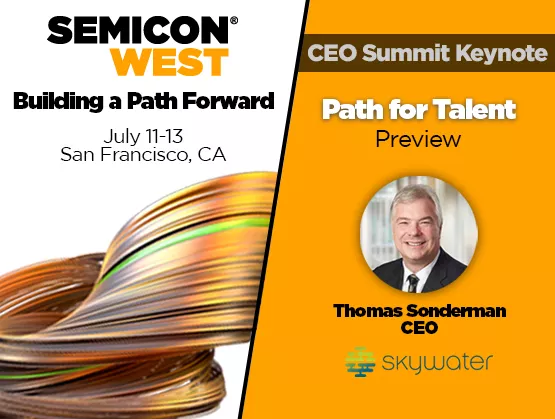
With technological advancements driving our digital era, the demand for semiconductors is skyrocketing. The chip industry is projected to reach unprecedented heights of around $1 trillion in annual revenue by 2030. However, amid this remarkable growth, a daunting challenge looms: the shortage of skilled workers for semiconductor design and manufacturing. As the industry strives to keep up with the escalating demand, the scarcity of qualified personnel has emerged as a critical obstacle. To help the industry overcome this and other key issues, SEMICON West 2023 will explore Building a Path Forward to its future in the event’s inaugural CEO Summit keynote program. A recent SEMI announcement provides an overview of the keynotes and programs at the July 11-13 exhibition and conference at the Moscone Center in San Francisco. The event on July 13 will kick off with Path for Talent session keynotes focused on cultivating a strong talent pipeline, creating a diverse and inclusive industry, and building a career in microelectronics. Tom Sonderman, President and CEO of SkyWater Technology, will present the Path for Talent keynote titled Building the Future: Workforce Development in the Semiconductor Manufacturing Industry. In a podcast with Francoise von Trapp of 3D InCites, Sonderman previews his presentation, highlighting the talent challenges facing the U.S. semiconductor industry and potential solutions. He also shares a glimpse of some of the SkyWater recruitment and training programs designed to fill critical roles from fab technicians to lead engineers. The interview with Sonderman is part of the SEMICON West Podcast Series in the runup to and at the event. It follows the opening SEMICON West preview episode with SEMI Americas President Joe Stockunas in which he highlights a slew of new features that span keynote and conference programming, networking opportunities and even dining options. The CEO Summit keynote program features two additional critical industry topics each of the first two days of the event: Path to $1T – Tuesday, July 11 Luminaries will share insights on the chip industry’s progress towards $1 trillion in annual revenue including the importance of CHIPS Act funding. New semiconductor technology advances and growth segments that promise to boost the global supply chain’s financial performance will also be hot focus topics. Path to Net Zero – Wednesday, July 12 CEOs will share sustainability strategies and insights on the U.S. microelectronics industry’s position on international sustainability and climate agreements and legislation. SEMI offers a comprehensive workforce development program to aid the chip industry in narrowing the talent gap and promoting diversity, equity and inclusion. The program will be on display at the SEMICON West Workforce Development Pavilion hosted by the SEMI Foundation. The pavilion will offer new strategies for recruiters, students and job seekers and spotlight why microelectronics is a smart career choice. Discussions on building a diverse and inclusive workforce, and an interactive day with high school students to help spark their interest in microelectronics careers will be key features of the program. Registration for SEMICON West 2023 is open. Samer Bahou is director of Marketing Communications at SEMI.
Read More
In many ways it feels like we’ve turned back the hands of time. We are staying at home, playing board games with the family. Outdoors, we can view mountains not seen in decades – air pollution has dropped nearly 20 percent. Neighbors we haven’t met are out walking, a lot. Traffic is relatively sparse.We’re staying up late, sometimes even getting up early, for calls with all regions. Some of us have temporarily suspended our use of cleanroom masks – but now wear them everywhere we go outside of the house. And through virtual meetings, I see I’m not the only one who let the beard grow. Who would’ve thought we’d be able to so quickly and completely change our habits?Clearly, the usual distractions that fill most of our lives have given way to a temporary pause. We have time to reflect, and perhaps gain even greater perspective. I hope that’s been a good thing for you.Through virtual meetings, we seem to be getting access to people not typically in our circle of influence – both up and down the organizational ladder. This pleasant surprise seems to be helping to create a valuable acceleration in how the industry community interacts and progresses.As a testament to the strategic importance of our industry, the fabs continue to produce. This is due in great part to the standards, technologies and their resulting applications that enable those operations. Many parts of our industry supply chain became officially designated as essential businesses. Whether or not we stayed home from the office, we’ve continued to work on our roadmaps for growth beyond the current lull.Empowered by 50 years of technology legacy, we are again demonstrating the capability to manage disruption through collaboration. This is the signature of our industry’s highly regarded business culture. Among what we have learned is that this pandemic has made all of us more vulnerable in a variety of ways, and in turn has accelerated our unity as an industry community like never before.This month, as I brainstormed with a set of industry execs during one of countless Zoom meetings, it was clear that when they gather, they want more than a repackaged version of everyone else’s usual messages about this unusual year.While this type of year certainly wasn’t what we had in mind when we began to construct ways to mark this 50th year of SEMICON West, we’ve taken the bull by the horns and begun to blaze a new trail. The consensus within the industry is that SEMI’s constant, measured communication is netting an increased, and growing, level of trust among our collective, global group that may serve as one of the silver linings of this irregular year.As a result, we’ll lay a new road with the first – and possibly not the last – Virtual SEMICON West. For this inaugural digital format, we’ve secured a set of visionaries offering both legendary and evolutionary talents alike to reveal what we can expect during the next few years. It’ll be unlike any other such gathering before, and there’ll be something for everyone.Despite the pause in time we’ve experienced during our isolation of these recent weeks, the timeless value of collaboration marches on. I look forward to joining you at Virtual SEMICON West, July 20-23.Dave Anderson is president of SEMI Americas.
Read More
No, that wasn’t a fancy chandelier on the periphery of ES Design West’s exhibit area, the co-located event at SEMICON West. It was IBM’s Q quantum computer, a striking bit of industrial design that looks like a chandelier from a stately ballroom.While it resembled an ornate lighting fixture, IBM Q does much more than illuminate a room. The Q contains 20-quantum bits (20 qubits), equivalent to 2**20 or two to the 20th power classic bits. Impressively, IBM is currently readying (or may already have) a 50-qubit computer.During ES Design West, IBM demonstrated the Q Experience quantum cloud services platform and Qiskit, an open source quantum software framework. IBM’s booth staff showed how Q can solve problems beyond the practical reach of even today’s conventional supercomputers. Examples include the Traveling Salesman Problem (TSP) of finding the shortest route to enable the salesman to visit every city once and return to the starting point. Other examples are chemistry, drug and medicine discovery, weather and climate modeling, and security and advanced cryptography.The demos did even more, highlighting just how far semiconductor design and manufacturing advances have come to make quantum computing architecture possible.We have Dr. Jeffrey Welser, vice president of IBM Research–Almaden, to thank for bringing Q to SEMICON West and ES Design. During his keynote, The Future of Computing: Bits + Neurons + Qbits, he noted that Quantum computing holds the potential to solve problems even the most powerful classical computers cannot and challenges our community to drive innovation from materials to devices to systems. Both he and the booth staffers made the point out that Q will not replace conventional computing but augment it to solve complex problems beyond computational limits and/or the storage capacity of conventional computers.Challenges of Quantum Computing are not insignificant, however, and start with coherence time or the time interval over which the qbit is in a quantum state. The 20-qbit Q shown at ES Design West has a coherence time of 90 microseconds. Noise and variance are other challenges. The IBM booth staff said that a typical program must be run at least 1,000 times. Results are filtered with the extremes removed to get the most consistent result.Fault tolerance is high on the list of challenges as well because a solution for fault tolerance in quantum computing has yet to be discovered. Users like us take fault tolerance for granted in modern classical computers, addressed in hardware and firmware. Programmers don’t need to be concerned about it because the computer takes care of it through error correction.Finally, Q and most other quantum computers require near 0 Kelvin temperatures to operate. The refrigeration systems are large, expensive and not easily portable. Research is ongoing to find materials, such as carbon nanospheres, that will allow quantum computing at room temperature.Most experts agree that we are years away from practical deployment of large quantum computer systems. IBM’s open system for users around the world to access a Q computer to run programs is helping drive the way forward.Robert (Bob) Smith is Executive Director of the ESD Alliance, a SEMI Strategic Association Partner. He is responsible for the management and operations of the ESD Alliance, an international association of companies providing goods and services throughout the semiconductor design ecosystem.
Read More
Did you miss the SEMI International Standards Reception at SEMICON West 2018? Not to worry, here are the highlights.SEMI honored two Standards industry leaders for their outstanding accomplishments in developing Standards for the electronics and related industries.Two awards were given recognizing the efforts of each member. The Technical Editor Award recognizes the efforts of a member to ensure the technical excellence of a committee’s Standards. This year’s recipient is Sean Larsen of Lam Research. Mr. Larsen has led the North America EHS Committee and multiple EHS task forces for over a decade. His knowledge of the Regulations, Procedure Manual, and Style Manual, combined with his vast experience in the industry, ensures that complex safety matters are explained in a clear, consistent manner, and ballot authors frequently rely on him for his technical skills in preparing ballots.In addition to co-chairing the North America EHS Committee, Mr. Larsen is currently the co-leader of the SEMI S22 (Electrical Design) Revision TF, the SEMI S2 Non-Ionizing Radiation TF, the SEMI S2 Korean High Pressure Gas Safety TF, and the Control of Hazardous Energy TF.The Corporate Device Member Award recognizes the participation of the user community and is presented to individuals from device manufacturers. This year’s recipient is Don Hadder of Intel. Mr. Hadder has been actively involved in the Standards Program for several years, and currently leads the Chemical Analytical Methods Task Force and chairs the North America Liquid Chemicals Committee. He has successfully re-energized the committee, which is now focused on enabling continued process control improvements for advanced nodes. He recently drove the development of a critical new standard: SEMI C96, Test Method for Determining Density of Chemical Mechanical Polish Slurries, the first document in a series of SEMI Standards that will be devoted specifically to CMP slurry users, IDMs, slurry suppliers, metrology manufacturers and OEM equipment suppliers.Mr. Hadder has worked at Intel for 23 years, where his experience and system ownership has been in Diffusion, Wet Etch, Planar-CMP, Ultra-Pure Water, Waste Treatment Systems, Abatement and Vacuum Systems, Bulk and Specialty Gas, Bulk Chemical Delivery and Planar Chemical Delivery.James Amano, Sr. Dr. International Standards, opened the reception with a few words. He noted that the total number of published SEMI Standards is nearing 1000, and that these documents serve as the backbone of modern day semiconductor manufacturing. SEMI president and CEO Ajit Manocha, speaking at the SEMI International Standards Reception at SEMICON West. Ajit Manocha, President and CEO of SEMI, reminisced how he was an active Standards Member, and how much he got out of SEMI Standards as a young engineer at Bell Labs. He passionately emphasized that SEMI Standards remain critical in this era of new materials and disruptive architectures and processes, calling them the "oxygen of the industry."Laura Nguyen is coordinator, International Standards, at SEMI.
Read More
The Advanced Lithography TechXPOT at this year’s SEMICON West will explore progress in extreme ultraviolet lithography (EUVL), its economic viability for high-volume manufacturing (HVM) and other lithography solutions that will address the march to 5nm and onward to 3nm.As a prelude to the event, SEMI asked Neeraj Khanna, Global Head of the Patterning Customer Engagement Team at KLA-Tencor, a speaker at the TechXPOT, for insights about the readiness of inspection and metrology tools for EUVL applications at 5nm and 3nm. For a full list of speakers and program agenda, visit http://www.semiconwest.org/programs-catalog/lithography-5nm-and-below.Neeraj Khanna, Global Head of the Patterning Customer Engagement Team at KLA-TencorSEMI: In general, how would you characterize the readiness of inspection and metrology tools intended for EUVL applications at 5nm and 3nm? In particular, what are some of the remaining research and development challenges that need to be addressed for each of these nodes?Neeraj Khanna: KLA-Tencor is working closely with its customers to qualify and ramp EUV. Our suite of inspection, metrology and data analytic solutions are being implemented to enable EUV infrastructure readiness including, for example, new reticle and resist qualification, scanner qualification, and EUV ramp preparation. These EUV integration activities require process control systems that support a wide range of applications, including hotspot discovery, lithography modeling, focus/dose process window qualification, reticle print check, mask blank inspection, and process and tool monitoring.As with any major technology inflection, it is critical to understand sources of process variation to enable ramp at optimal yield. For example, stochastics result in random pattern variations, which have a major impact on EUV yield. To manage stochastics, IC manufacturers are deploying process control solutions that support fast modeling of stochastic variations coupled with high-sensitivity, high-coverage wafer defect inspection. Another example is a methodology called hybrid scanner utilization whereby, when EUV scanners are implemented in production, they will only be used for a few layers, while all other layers will be patterned with 193i scanners. This technique requires tighter control and monitoring of overlay budgets.SEMI: How are you able to achieve this tighter control and monitoring?NK: To understand why hybrid scanner utilization requires tighter control and monitoring of overlay budgets, it’s important to outline how this differs from current scanner implementation. For critical layers in current process flows using 193i lithography, pattern layers for a given wafer are printed using the same stage/chuck on the same scanner. The overlay performance achieved using this lithography strategy is called dedicated chuck overlay (DCO). Use of a dedicated scanner and chuck for lithography reduces inter-scanner and inter-chuck distortion effects, resulting in DCO overlay error of less than 1nm. When EUVL is first implemented in production, it will be used for a few layers – likely, cut masks and contacts with eventual migration to metal 1 layers. All other layers will be patterned with 193i scanners. This hybrid scanner operation eliminates any possibility of using a dedicated scanner and dedicated chuck to support tight overlay performance specifications. Instead, fabs will be forced to optimize mix-and-match overlay (MMO), with the overlay performance obtained using different scanners for printing different layers on a given wafer.With overlay specifications for advanced DRAM and logic at ~2.5nm, fabs will need to implement strict 193i-to-EUV scanner matching strategies or risk consuming 60 to100 percent of the overlay budget on just MMO. To achieve tighter overlay control and monitoring required for MMO, fabs need to implement dense, in-field overlay error measurements that feed into scanner fleet management systems. KLA-Tencor’s ATL™ overlay metrology system supports a high measurement speed and the use of small in-die targets, enabling dense in-field overlay measurements with high accuracy. Our 5D Analyzer® data analytic and management system includes scanner fleet management capability that enables automatic product-based corrections to minimize MMO error, helping fabs reduce the risk to yield loss associated with a 193i-EUV mixed scanner implementation. SEMI: What other challenges do you see coming to the fore at 5nm and 3nm?NK: Overall, the 5nm and beyond design nodes will face challenges associated with new lithography technology, potential new device structures and smaller pattern pitches. IC manufacturers will require process control solutions that not only identify process windows, but also monitor patterning parameters and defectivity at multiple points to identify process shifts. To monitor dynamic processes at these advanced nodes, inspection and metrology tools will need to have both sensitivity to critical parameters/defects and robustness to process variation in order to provide IC engineers with smart feedback for efficient control of their processes.SEMI: Could you elaborate on what will be required to monitor patterning parameters and defectivity at multiple points? How different will the techniques be at 5nm/3nm vs. at say, 7nm or 10nm?NK: As an example of monitoring at multiple points, consider the transition to EUV lithography. With EUV, the cost per scan goes up dramatically. Thus, IC manufacturers will monitor parameters at multiple points to maximize yield and minimize risk: EUV reticle qualification requires inspection and metrology throughout the entire flow from mask blank manufacturing, to the mask shop, to the IC fab. For the advanced design nodes associated with EUV, wafer qualification requires monitoring and control of wafer defectivity, shape and geometry throughout the wafer manufacturing process. It also requires control of fab incoming wafer qualification while ensuring that fab-wide processes are meeting defect and shape standards necessary for printing smaller feature sizes. EUV resist characterization and qualification requires comprehensive lithography simulation, wafer defect inspection, and film thickness and uniformity measurements to help reduce development time and prepare the litho stacks for production ramp. As EUV scanners are ramping, fabs are faced with finding any unknown particle sources within the new scanner chambers. This situation is driving the need for tighter and more frequent PWP (particles per wafer pass) chamber monitors to ensure scanner cleanliness. In addition, EUV scanner qualification requires reticle front and backside particle checks, and hotspot discovery and process window qualification using optical wafer defect inspection and e-beam review. EUV process monitoring encompasses overlay error monitoring, focus/dose monitoring, critical dimension (CD) and 3D device shape monitoring, and continuous process window monitoring. EUV inline defect monitoring and tool monitoring is important for reducing baseline defectivity in the litho cell for faster ramp, and for early identification of litho excursions in production. A critical part of this monitoring strategy is inline after develop inspection (ADI) monitoring, which is defect inspection on patterned wafers after printing and development of the resist ADI. Inline ADI innovations that find yield-critical defects allow fabs to reduce process issues, prevent at-risk wafers early in the process, and enable rework when excursions are found in production. As with past technology transitions, the implementation of multiple monitoring steps as part of a comprehensive process control strategy will be critical for a fab’s successful ramp of EUV.Debra Vogler, SEMI
Read More
What’s next for smarter, more connected electronics manufacturing - Part 3 The fast-maturing infrastructure now enabling analysis of exponentially larger data volumes brings the microelectronics industry to an inflection point, where the winning companies will be the first to master the use of this data to solve the industry’s emerging challenges. SEMI expands its coverage of these vital issues with a Smart Manufacturing Pavilion and three days of talks SEMICON West, July 10-12 in San Francisco. While deep learning is starting to be applied to image recognition for wafer inspection, it is also being considered for sequential pattern recognition in order to evaluate equipment parameter traces. The next emerging applications will start to use those learned patterns to predict outcomes, and then use those predictions to automate process control. One early application of deep learning is IC process development. “People don’t think of research and development as the first place to automate, but it’s where applying our digitization and simulation has first had impact,” says David Fried, Coventor vice president of Computational Products. He noted that insertion is easier in the lab than in the fab. Technology at 10nm and beyond is now so complex that companies at the leading edge must use process modeling to understand the effect of process variation on their designs. Learning cycles can now be accelerated during development by simulating 10,000 digital wafers instead of running 25 actual wafers during screening, Fried says. Applying structured analysis and machine learning to the data simplifies optimization across the 500 or more interrelated process steps. Coventor has recently introduced a statistical analysis package that aids the design and analysis of process variation experiments by using large volumes of data from its models. Fried says these models are next being used to accelerate the yield ramp in manufacturing. Digital simulation also could speed development of high-mix, lower value products While digital twins are best known for their use in complex, high value products like jet engines, the simulation technology could also enable the electronic manufacturing services (EMS) sector to reduce the time, cost and risk of developing its high mix of products. “The EMS sector’s use of digital twins will be vital for it to smooth the move of CAD/CAM digital design data for so many different products into manufacturing, and to accelerate validation testing of designs and products by doing more of it in the virtual world,” says Dan Gamota, vice president of Engineering and Technical Services at Jabil. Gamota also highlights the push for traceability from the automotive and healthcare markets, where the digital models could be used to quickly assure that the design was built exactly as specified. “In the past year, traceability has evolved from just ‘nice to have’ to ‘how to achieve,’” he adds. “Companies are expecting it, but aren’t willing to accept the cost and risk of doing it alone. We need the community to discuss realistic implementations, identify the most critical elements and bring together the ecosystem partners to build baseline reference architectures for key digital building blocks. The community also needs to assure the reliable flow of data among the electronic manufacturing segments from semiconductor to OSAT to EMS.” Predictive maintenance and virtual metrology applications could mature in next few years While predictive maintenance initially seemed a likely early application of machine learning in factories, it remains a challenge for the electronics sector. “The difficulty is that it’s not clear where to get the most bang for the buck,” says Tom Ho, president of BISTel America, noting that it may make the most sense to track the failure performance of a single expensive part, like an electrostatic chuck, since predicting the failure performance of a whole complex system like an etcher is much harder. “Collecting enough data from all failure types, including especially the rare events, is difficult unless you have a long history of a lot of tools,” adds Doug Suerich, PEER Group product evangelist. “The gain from collecting performance information from many tools across the industry could be big, but many companies still need to overcome concerns around exposing their IP.” Another big opportunity for prediction is virtual metrology – predicting the wafer outcome from the process or sensor data with enough accuracy to replace the physical metrology. “Virtual metrology is improving, and since metrology can be slow and expensive, any reduction could mean a huge potential savings,” says Suerich. “But it is still seen as too scary for many companies. Two to three years from now, companies will expand the practice from lower risk areas into processes that require more confidence in the results.” Moving beyond prediction to automated control needs digital models Once the results are predicted, the model can be used to control or automatically optimize a process and enable the system to learn by itself, usually by reinforcement learning on a digital model. The model can then independently make adjustments to optimize the manufacturing process. “Automated process development is getting close now. Instead of smart guys turning the knobs, deep learning is automating the smart tuning,” says Suerich, suggesting the industry could see widespread adoption in as little as two to three years. This type of machine learning needs a good digital model, and masses of data for learning. One approach uses human experts to build a physics-based model of the clearly understood parts of the process, then turns to deep machine learning to optimize the lesser-understood variables. The alternative, the data-first approach, runs a computer algorithm to suggest the solution purely from data, without human input, and then relies on the human to evaluate the usefulness of the results. Modeling digital twins of wafers could enable automated process control, chamber matching, and fleet matching, says Fried. If every wafer had its own virtual twin with all the upstream metrology and structural information needed to make equipment control decisions, it could feed forward that information to enable the seamless transition from one step in the process to another based on understanding their complex interrelationships. This could potentially improve uniformity across wafers and equipment, and reduce the need for metrology, he argues. Moving metrology sensors into the chamber will also require model-based algorithms to enable dynamic process control in close to real time, says Fried. These algorithms will be needed to acquire, parse, and process the data at high speed, and then to choose how to adjust the controls. “There will be a model behind collecting and interpreting the metrology data,” he notes. “That’s a really rich vein for improvements in process control.” “The end goal is to collect equipment data in real time, analyze it with AI, and send back controls to optimize manufacturing processes,” Jabil’s Gamota says. “This requires a robust architecture for communication between equipment and consistent formats for data collection and analysis. But the cost and complexity of this heavy lifting is too great for any one company to do alone. We need a consensus-based architecture for ingesting, analyzing and acting on the data.” SEMI tests data transfer protocols, benchmarks best practices SEMI is launching a smart data project to identify the various data transfer protocols needed for inter-company communications. The project will feature a proof-of-concept model in a development fab to produce verifiable results so SEMI can better understand how different approaches meet member needs. SEMI’s smart manufacturing technology communities and the Fab Owners Alliance are also benchmarking current smart manufacturing practices in the microelectronics industry to help SEMI members better understand the path forward and potential return on investment. Speakers over all three days at SEMICON West addressing these issues include Active Layer Parametrics, Applied Materials, Applied Research Photonics, ASML, Bosch Rexroth, Cimetrix, Coventor, ECI Technologies, Edwards Vacuum, Final Phase Systems, GE Digital, Infineon, Jabil, Lam Research, Osaro, Otosense, PEER Group, Qualcomm, Rockwell Automation, Rudolph Technologies, Schneider Electric, Seagate, Siemens, Stanford University, TEL, TIBCO Software. See semiconwest.org. What’s next for smarter, more connected electronics manufacturing - Part 1 What’s next for smarter, more connected electronics manufacturing - Part 2 Paula Doe, SEMI
Read More