MILPITAS, Calif. — January 2, 2024 — Global semiconductor capacity is expected to increase 6.4% in 2024 to top the 30 million *wafers per month (wpm) mark for the first time after rising 5.5% to 29.6 wpm in 2023, SEMI announced today in its latest quarterly World Fab Forecast report.
 The 2024 growth will be driven by capacity increases in leading-edge logic and foundry, applications including generative AI and high-performance computing (HPC), and the recovery in end-demand for chips. The capacity expansion slowed in 2023 due to softening semiconductor market demand and the resulting inventory correction.
“Resurgent market demand and increased government incentives worldwide are powering an upsurge in fab investments in key chipmaking regions and the projected 6.4% rise in global capacity for 2024,” said Ajit Manocha, SEMI President and CEO. “The heightened global attention on the strategic importance of semiconductor manufacturing to national and economic security is a key catalyst of these trends.”
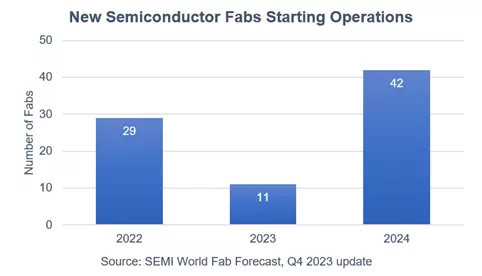
Covering 2022 to 2024, the World Fab Forecast report shows that the global semiconductor industry plans to begin operation of 82 new volume fabs, including 11 projects in 2023 and 42 projects in 2024 spanning wafer sizes ranging from 300mm to 100mm.
China Leads Semiconductor Industry Expansion
Boosted by government funding and other incentives, China is expected to increase its share of global semiconductor production. Chinese chip manufacturers are forecast to start operations of 18 projects in 2024, with 12% YoY capacity growth to 7.6 million wpm in 2023 and 13% YoY capacity growth to 8.6 million wpm in 2024.
Taiwan is projected to remain the second-largest region in semiconductor capacity, increasing capacity 5.6% to 5.4 million wpm in 2023 and posting 4.2% growth to 5.7 million wpm in 2024. The region is poised to begin operations of five fabs in 2024.
Korea ranks third in chip capacity at 4.9 million wpm in 2023 and 5.1 million wpm in 2024, a 5.4% increase as one fab comes online. Japan is expected to place fourth at 4.6 million wpm in 2023 and 4.7 million wpm in 2024, a capacity increase of 2% as it starts operations of four fabs in 2024.
The World Fab Forecast shows the Americas increasing chip capacity by 6% YoY to 3.1 million wpm with six new fabs in 2024. Europe & Mideast is projected to up capacity 3.6% to 2.7 million wpm in 2024 as it launches operations of four new fabs. Southeast Asia is poised to increase capacity 4% to 1.7 million wpm in 2024 with the start of four new fab projects.
Foundry Segment Continues Strong Capacity Growth
Foundry suppliers are forecast to rank as the top semiconductor equipment buyers, increasing capacity to 9.3 million wpm in 2023 and a record 10.2 million wpm in 2024.
The memory segment slowed expansion of capacity in 2023 due to weak demand in consumer electronics including PCs and smartphones. The DRAM segment is expected to increase capacity 2% to 3.8 million wpm in 2023 and 5% to 4 million wpm in 2024. Installed capacity for 3D NAND is projected to remain flat at 3.6 million in 2023 and rise 2% to 3.7 million wpm next year.
In the discrete and analog segments, vehicle electrification remains the key driver of capacity expansion. Discrete capacity is forecast to grow 10% to 4.1 million wpm in 2023 and 7% to 4.4 million wpm in 2024, while Analog capacity is projected to grow 11% to 2.1 million wpm in 2023 and 10% to 2.4 million wpm in 2024.
The latest update of the SEMI World Fab Forecast report, published in December, lists 1,500 facilities and lines globally, including 177 volume facilities and lines with various probabilities expected to start operation in 2023 or later.
Download a sample of the SEMI World Fab Forecast report.
For details about SEMI reports on other semiconductor sectors, visit SEMI Market Data or contact the SEMI Market Intelligence Team (MIT) at [email protected].
*200mm equivalent
About SEMI
SEMI® connects 3,000 member companies and 1.3 million professionals worldwide to advance the technology and business of electronics design and manufacturing. SEMI members are responsible for the innovations in materials, design, equipment, software, devices, and services that enable smarter, faster, more powerful, and more affordable electronic products. Electronic System Design Alliance (ESD Alliance), FlexTech, the Fab Owners Alliance (FOA), the MEMS & Sensors Industry Group (MSIG), Nano-Bio Materials Consortium (NBMC), and SOI Consortium are SEMI Strategic Technology Communities. Visit www.semi.org, contact one of our worldwide offices, and connect with SEMI on LinkedIn and X (formerly Twitter) to learn more.
Association Contacts
Michael Hall/SEMI US
Phone: 1.408.943.7988
Email: [email protected]
Christian G. Dieseldorff/SEMI US
Phone: 1.408.943.7940
Email: [email protected]
Chih-Wen Liu/SEMI Taiwan
Phone: 886.3.560.1777
Email: [email protected]
 “We congratulate the newly elected International Board members, Kai Beckmann and Benjamin Loh, and thank them for their commitment to guide SEMI in representing the global electronics manufacturing and design supply chain,” said SEMI President and CEO Ajit Manocha. “Kai and Benjamin add to the breadth and depth of knowledge on our Board of Directors and will help us to ensure that SEMI programs continue to advance semiconductor industry growth, address top concerns, and deliver exceptional member value.”
 The leaders were also recognized for their contributions to the Path to Net Zero session during the SEMICON West 2023 CEO Summit keynote program. The honorees will be commemorated on the SEMI Wall of Fame at the association’s headquarters in Milpitas.
 “We commend the thoughtful approach the U.S. Department of Commerce has taken in awarding incentives and are pleased to see the advancement of incentives to bolster the resiliency of the domestic semiconductor supply chain,” said Joe Stockunas, President of SEMI Americas. “In order for the global semiconductor industry to support the push for digitalization and a diverse range of smart applications over the coming years, we must go beyond elevating just one facet of the supply chain and pursue a fortified ecosystem encompassing equipment, materials and advanced packaging. SEMI has advocated with the U.S. Chips Program Office to distribute incentives with this goal in mind, and we are confident in their understanding of the industry’s needs."
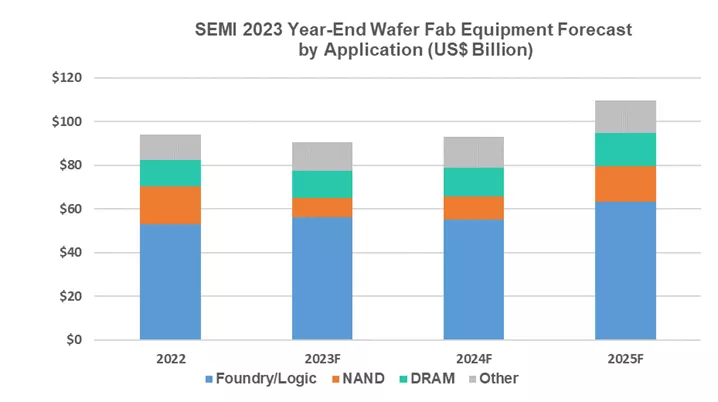
 “We anticipate a temporary contraction in 2023 due to the cyclical nature of the semiconductor market,” said Ajit Manocha, SEMI President and CEO. “2024 will be a transition year. We then expect a strong rebound in 2025, driven by capacity expansion, new fab projects, and high demand for advanced technologies and solutions across the front-end and back-end segments.”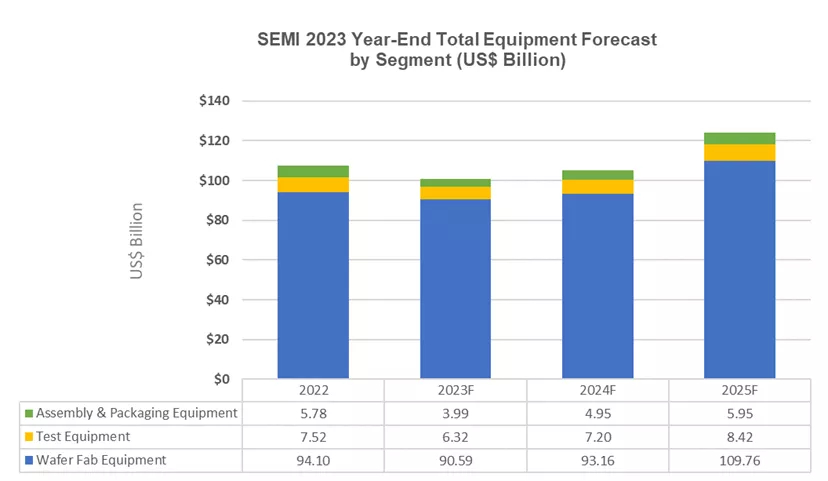
 Themed Forward as One, SEMICON Japan 2023 will highlight cutting-edge technology innovations in areas including artificial intelligence (AI), robotics, power electronics, Internet of Things (IoT), smart mobility, and quantum computing. The event will also feature presentations and executive panels on key industry topics with thought leaders from the electronics design and manufacturing ecosystem, academia, and government.
  With Europe projected to need 350,000 new workers in the semiconductor industry by 2030, Laith Altimime, President of SEMI Europe, emphasized the imperative for cultivating leaders capable of navigating the complexities of the semiconductor industry. “The semiconductor industry must further develop diverse leaders who can reshape businesses in a complex and fast-changing world of uncertainty. The growing number of job vacancies in Europe’s semiconductor sector risks undercutting its growth potential as companies expand manufacturing capacities. It is essential for leaders in the industry to unlearn outdated approaches and prepare for unforeseen challenges. The SEMI Leadership Accelerator will facilitate this transformative process.”
 Headlining SEMICON Korea 2024 will be keynotes by representatives from SK hynix, Merck KGaA, Darmstadt, Germany, and Eliyan, while more than 30 conferences will feature presentations by 200 thought leaders. The exhibition area, covering more than 37,000 square meters (over 9 acres), will feature nearly 500 companies from across the Korea semiconductor ecosystem showcasing cutting-edge semiconductor manufacturing technologies and services at 2,100 booths.
 “Sharing resources to start this foundational semiconductor industry sustainability work now is important to enable wider access to low-carbon energy in the next five to ten years,” stated Young Bae, SCC Governing Council member and sponsor for the SCC Scope 2 Working Group, and Global Business Director, Advanced Cleans Technologies at DuPont. “One of the key action areas the SCC has identified is the lack of low-carbon energy plans and actions in the Asia-Pacific region. The EC will help the SCC by accelerating investments to broaden access.”
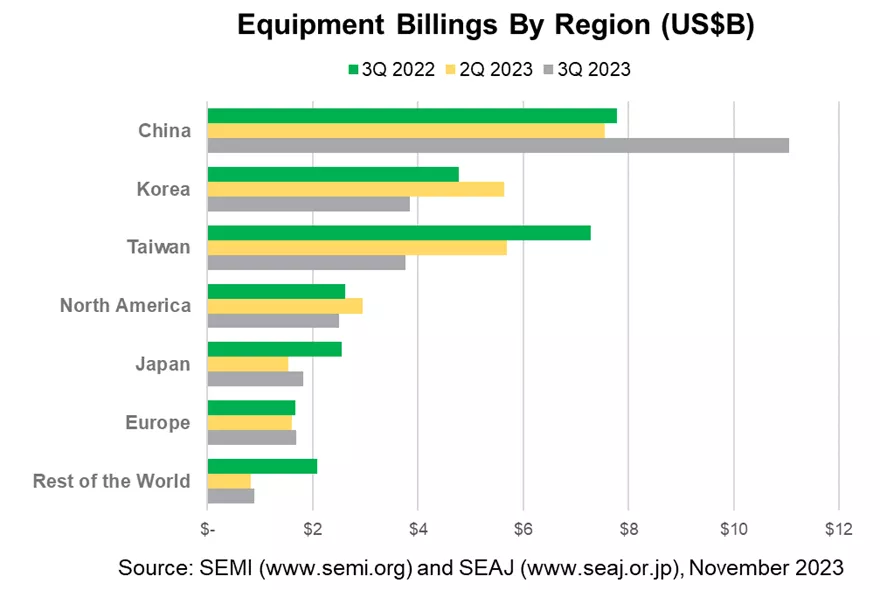
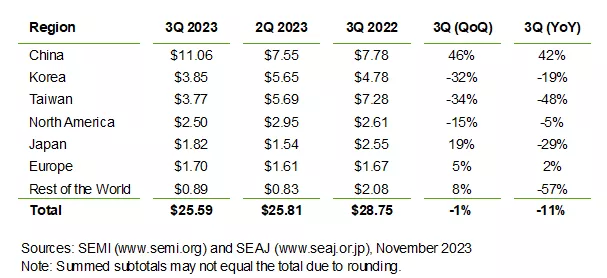
 “The Q3 2023 dip in equipment billings was due to softening chip demand,” said Ajit Manocha, SEMI President and CEO. “However, China has shown strong demand and spending power for mature-node technologies, a sign of the industry's resilience and growth potential in the long run.”