downloadGroupGroupnoun_press release_995423_000000 copyGroupnoun_Feed_96767_000000Group 19noun_pictures_1817522_000000Member company iconResource item iconStore item iconGroup 19Group 19noun_Photo_2085192_000000 Copynoun_presentation_2096081_000000Group 19Group Copy 7noun_webinar_692730_000000Path
Skip to main content
Default Banner Image

High Tech U

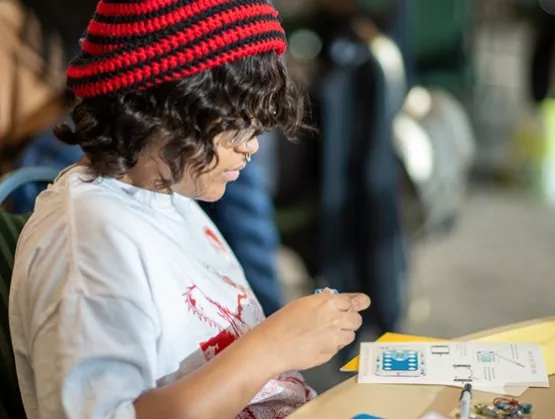
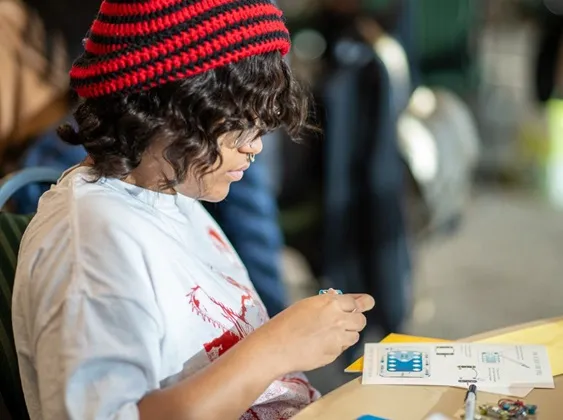
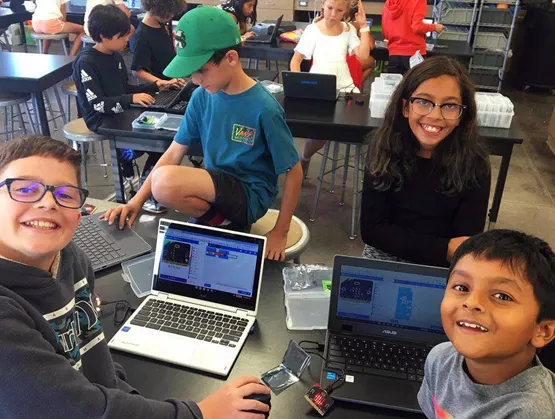
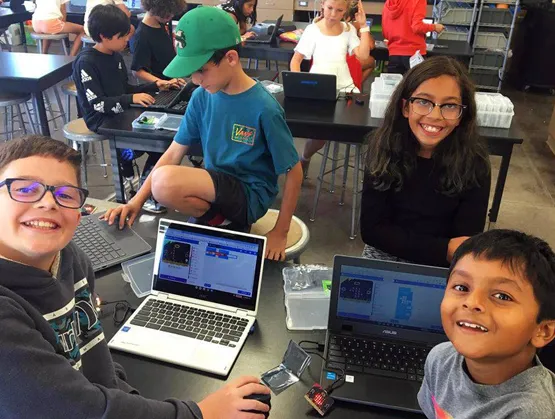
SEMI High Tech U is making waves around the world, introducing students and educators to the fascinating world of microelectronics through hands-on, experiential STEM learning kits. The SEMI Foundation started the program in the U.S., aiming to spark interest in semiconductors and technology, and High Tech U has expanded across borders to reach students in Europe and Southeast Asia. Recently, young learners in Germany and Malaysia participated in the SEMI program, diving into circuits, coding, and connecting their learning to the ever-evolving semiconductor industry.One of the core goals of High Tech U is to empower educators and students with tools that make microelectronics accessible and engaging. Since 2022, thanks to support from sponsors like KLA, Nordson, Western Digital, STMicroelectronics, Applied Materials, Broadcom, Infineon, and Qorvo, the program has reached over 5,500 students across multiple states and countries.MichiganStudents in Ypsilanti creating circuits with various materials.In the summer of 2024, SEMI Foundation partnered with Toyota and Washtenaw Community College to provide a free three-day summer program at Parkridge Community Center in Ypsilanti, Michigan. Dozens of Ypsilanti middle school and elementary school students engaged in active, hands-on learning about circuits using everyday materials such as playdough, copper tape, and batteries. The students built basic circuits on paper, created light-up greeting cards, and sculpted figures illuminated with tiny LED bulbs. This learning opportunity taught students and their counselors how circuits and semiconductors are an integral part of everyday life.MalaysiaStudents, staff, and teachers from ST Muar GEMS program.In 2023, STMicroelectronics Muar sponsored High Tech U kits for local schools as part of their Girls in Engineering, Mathematics Science (GEMS) STEM Lab program. SEMI Foundation staff collaborated with the GEMS program and provided a live international train-the-trainer session where teachers familiarized themselves with the High Tech U kits and accompanying curriculum. This session ensured that STMicroelectronics partners from the Muar Primary School were prepared to implement the program and make the connections between student learning and the work of the microelectronics industry.The STMicroelectronics Muar GEMS program has since educated many students in the local area on circuits, coding, and the basics of semiconductors. This partnership continues to blossom as STMicroelectronics aims to expand the implementation of the successful GEMS program. Moving forward in 2024 and beyond, GEMS students will apply their newfound skills in a friendly competition to solve real-world problems, showcasing how knowledge of circuits and coding can make a difference in creating a better world.GermanyStudents from SEMI Europe’s inaugural High Tech U program in Berlin.The SEMI Europe team has also recently launched their first High Tech U program in partnership with the Micro:bit Educational Foundation. Through a series of hands-on STEM activities, SEMI introduced a 4th-grade class in Germany to the fascinating world of microelectronics. Students were able to explore the fundamentals of coding and electronics through building a codable guitar using cardboard, aluminum foil, and electrical clips.The program continues to grow in Europe, providing students opportunities for interactive projects like crafting dice, programming melodies, and building smart sensors. The students’ enthusiasm and curiosity has shown the possibilities of engaging young minds in the world of microelectronics.Expanding Opportunities for Industry InvolvementSEMI invites you to take part in attracting, developing, and retaining the microelectronics talent of the future. Join us in this critical work while strengthening your company’s impact on your local communities. Learn more about High Tech U and opportunities for companies to get involved around the globe by contacting Bia Hamed at [email protected]. Berton Mahardja is the Director of Global Education Initiatives at SEMI Foundation. Prior to joining SEMI, Berton served in various roles across K-12 education. He is passionate about programs that support equitable industry access for students and adults.
Read More
High-tech industry clusters in the bustling northern Taiwan port city of Hsinchu look set for an upgrade. Long a world-class hub of the semiconductor and optoelectronic technology industries, Hsinchu City is laying out plans to work with SEMI to attract more international companies, generate more jobs, promote Hsinchu’s development and help grow Taiwan’s microelectronics industry. High-tech heavyweights such as TSMC, UMC, MediaTek, Realtek, and AUO are all headquartered in The Windy City. The Industrial Technology Research Institute (ITRI), a leading Taiwan research center and incubator, also calls Hsinchu home, and the city boasts one of the highest concentrations of educational institutions in the region, a roster that includes National Chiao Tung and National Tsing Hua universities. Hsinchu’s thriving relations with these industry, academic and research partners have made it a hotbed of innovation, with numerous large Taiwanese and foreign companies having opened local offices. No less than these partners, the city – like SEMI – is committed to innovation.In a recent visit to the SEMI Taiwan office in Taipei, a Hsinchu City government team led by mayor Lin Chih-Chien, met with Terry Tsao, global SEMI chief marketing officer and president of SEMI Taiwan, to explore collaboration opportunities in areas such as technology subsidies, policy, education, and infrastructure. The meeting built on a relationship between the city and SEMI Taiwan that sprouted after SEMI executives and Hsinchu officials joined ITRI to host the Autonomous Driving System Platform in Open Fields kick-off ceremony – an initiative to accelerate Taiwan’s adoption of smart transportation technologies – at SEMICON Taiwan 2019.At the meeting, Mayor Lin highlighted that Hsinchu has long attracted high-tech companies by cultivating a business-friendly climate through incentives such as subsidies for infrastructure buildouts. He hopes to work with SEMI to promote to members the benefits of setting up local offices in Hsinchu City.With both Hsinchu’s high-tech clusters and SEMI’s global members deeply reliant on skilled workers for sustaining innovation and growth, Tsao and Mayor Lin agreed that inspiring students to pursue an education and careers in science, technology, engineering and mathematics (STEM) is vital to building a high-tech talent pool. One collaboration opportunity SEMI Taiwan is eyeing is to launch Taiwan’s first SEMI High Tech U (HTU) program in Hsinchu to spark the interest of school-age children through STEM educational activities at school camps or art and cultural centers. SEMI’s STEM discovery program offers hands-on activities and experiential learning led by industry volunteers. Since 2002, HTU has reached some 8,000 high-school students in 12 U.S. states and nine countries.Emmy Yi is a marketing specialist at SEMI Taiwan.
Read More
In my first six months at SEMI, I’ve visited with many member companies and industry leaders. One theme I hear repeatedly is a concern about our most fundamental source of innovation and productivity – people.Our industry has a significant need for additional workers and several trends are working against us.For one, only 11 percent of elementary students in the U.S. indicate an interest in science, technology, engineering, and mathematics (STEM) education according to the National Science Foundation. In other regions, recruiting and retaining high-skilled workers remains a constant challenge.Ironically, the incredible electronics manufacturing technology that we create has enabled many of the new-tech industries in software, social media, internet services and applications that now directly compete for the best and brightest technical talent. Young engineers have other choices and many are lured to newer growth industries with familiar internet brands.Today, due to continued industry advancement and robust growth, capital equipment companies, device makers and materials companies collectively have thousands to tens-of-thousands of open unfilled positions. Furthermore, the representation of women in the high-tech workplace remains disproportionately low.We have long been aware of the need to support a diverse pipeline for high-skilled workers. In 2001, the SEMI Foundation was established to encourage STEM education and stimulate interest in high-tech careers. SEMI and its Foundation launched the High-Tech U (HTU) program to engage and excite high school students. HTU enlists industry volunteers to work with local high school students in a three-day interactive hands-on curriculum. Young people get a fun and inspirational exposure to binary logic, circuit making, a fab or electronics manufacturing setting and other aspects of professional development.To date, we’ve delivered 216 HTU programs and reached nearly 7,000 students in 12 states and nine countries. The results are compelling. Our 2016 survey of HTU alumni shows that they enter college at five times the national rates and 70 percent that graduated college are employed in a STEM field. By any measure, the initiative is successful and worthwhile.However, the talent problem statement has grown. Industry needs are greater and the time has come to redouble our effort to attract and retain talent for our high-skilled manufacturing sector. Therefore, SEMI is elevating workforce development as a top strategic priority.The SEMI HTU team is already engaged with key member companies to develop our enhanced roadmap for workforce development including a comprehensive study with Deloitte Consulting to underpin the key problems and solutions in areas of focus for decisive and systematic SEMI action.Belle Wei, SEMI Foundation Board member and the Carolyn Guidry Chair in Engineering Education and Innovative Learning at San Jose State University said, "It is critical that we work to prepare the future workforce. This requires a high level of collaboration between industry and higher education. We appreciate SEMI's leadership role in this collaboration to further develop the workforce pipeline."We have launched a HTU Certified Partner Program (CPP) with the goal of reaching more students through industry partners who commit to long-term participation and independent delivery of High Tech U. In addition, we are expanding outreach to universities and community colleges and preparing to launch an industry image campaign to better tell the remarkable story of opportunity in our industry.The capacity to innovate and the skills to manage complex design, engineering and manufacturing processes are essential factors that sustains our high-tech industry – and they are dependent on people.Finally, as mentioned above, we have already started some new initiatives to enhance our HTU. A SEMI workforce development roadmap and execution plan will be detailed in a future SEMI Global Update article following the upcoming SEMI International Board Meeting. SEMI welcomes any inputs in addition to your continued support.This endeavor is increasingly urgent and recruiting the industry’s future innovators is well-aligned with SEMI’s mantra to connect, collaborate, innovate, grow and prosper.
Read More