downloadGroupGroupnoun_press release_995423_000000 copyGroupnoun_Feed_96767_000000Group 19noun_pictures_1817522_000000Member company iconResource item iconStore item iconGroup 19Group 19noun_Photo_2085192_000000 Copynoun_presentation_2096081_000000Group 19Group Copy 7noun_webinar_692730_000000Path
Skip to main content
Default Banner Image

deep learning

At SEMICON West 2020, the Honorable Al Gore, former U.S. Vice President and recipient of the Nobel Peace Prize for environmental activism, commented on the world being in the midst of a “sustainability revolution.” Just what did he mean by that, and why bring that message to us? The answer is that he believes the digital transformation wields the magnitude of the agricultural and industrial revolutions, but with the exponential speed that the semiconductor industry created and enabled. Ok, that would put him in the right place… SEMICON West.Among a rich lineup of speakers to mark the 50th anniversary of the event – and 50 years of the semiconductor industry facilitating the innovation of the Information Age -- Gore joined other icons in their fields who graced the virtual stage for our featured keynotes. Each analyzed how microchip advances are critical to solving some of the world’s greatest challenges.As host of the conference, I had the privilege of introducing Gore; Gary Dickerson, President and CEO of Applied Materials; and, Dr. John Kelly III, Executive Vice President and Director of IBM Research, along with other renowned speakers. Their insights seemed especially timely for how our global supply chain can help to build a more sustainable future. Following are a few of the highlights from their discussions. Al Gore – The Planet Faces Existential CrisisIn his keynote conversation with Greenbiz editorial director Heather Clancy kicking off SEMICON West 2020, Gore emphasized that digital technology advances – and in particular microchip innovation – provide the greatest opportunities to overcome the world’s most epic challenges. Chip breakthroughs will be the cutting edge of what he called the rapidly growing sustainability revolution to improve energy efficiency, reduce our reliance on fossil fuels, and optimize the performance of renewable energy generated by solar, wind, and electric battery sources.“We face an inflection point as we rely more on data and communications technology, particularly in areas like cloud computing and artificial intelligence,” Gore said. “Industry is aware of this and working on it, but this meeting (SEMICON West 2020) with your present leadership marks a real turning point. It’s something to be proud of, something to be celebrated. It’s what gives me hope.”Citing Moore’s Law and enormous strides made in chip efficiency and effectiveness, Gore said that within two years smart chips will make everything from solar panels and batteries to renewable energy plants and electric vehicles to be both cost- and performance-competitive with traditional energy sources. Afterwards, renewable energy will be more attractive. Gore urged the energy-intensive semiconductor industry to shift to more renewable power sources for manufacturing. To meet this challenge, Gore encouraged the industry to embrace strategies for “step changes”: First, collaborate and share best practices more transparently across the entire microelectronics value chain. Examples already abound where “cutting-edge apps, AI, and deep learning reduced data server energy use significantly without hardware changes,” he said. Second, reduce electricity required to manufacture smarter and smaller semiconductors. Gore encouraged “all of the equipment manufacturers to work together to reduce the amount of carbon dioxide emissions in manufacturing these advanced semiconductors.” Third, follow the lead of a growing number of companies that “continue decarbonizing the power supply on which data centers operate,” he said. Fourth, work with government through the Science Based Target Initiative, which sets decarbonization limits that keep global temperatures no more than two degrees Celsius above preindustrial levels. Finally, rely on “diversity of thought” and “collective thinking” when innovating for the digital future. Research and experience prove that different points of view lead to better decisions. The technology industry has made progress in workforce diversity, but more can be done, Gore said. This last point plays to our collaborative strengths as SEMI members and an industry. “It is just unbearable to imagine a future generation living with the kinds of consequences scientists tell us would ensue if we don’t heed their warnings and solve this crisis,” Gore said, drawing parallels to the COVID-19 pandemic. “We have to accept the situation and make sure we do everything we can. I am inspired by this industry’s leadership, innovation, and spirit to rise to the challenge and make a difference.”Gary Dickerson – Making Possible A Better FutureTo ensure another 50 years of accelerating growth and innovation, today’s semiconductor leaders must share a deep commitment to a more sustainable and just supply chain industrywide.“The first thing we need to do is decouple our growth from environmental impacts,” Dickerson said in his keynote. “Our responsibility as leaders is to leave the world a better place.”Dickerson said that while he firmly believes the explosion of processing and storage data has “the potential to change the world,” the downside is that it also has the potential to rapidly expand our industry’s carbon footprint. Without dramatic change, electrical usage will continue to rise as machines generate and consume more data, compute performance progresses, and workloads from the edge to the cloud grow.“It will be impossible to create neural networks (using AI) with the rate of today’s power consumption,” Dickerson said, noting that more improvements must be made in the performance and efficiency of semiconductor devices, architectures, structures, materials, and advanced packaging.Dickerson urged the electronics ecosystem to “permanently think and act differently” by breaking down communication barriers among systems integrators, equipment suppliers, design and manufacturing service providers, and other industry players. Sharing learnings and best practices will be vital to this change, he said. Dickerson unveiled SuCCESS2030 (Supply Chain Certification for Environmental and Social Sustainability) – Applied Materials’ 10-year roadmap for creating a more sustainable supply chain – during his talk. Under the SuCCESS2030 initiative, Applied Materials will hold its suppliers to the company’s own high standards for committing to renewable energy and workforce diversity by setting targets such as: Reducing supply chain carbon emissions 15 percent in four years by relying more on intermodal shipping than air freight Transitioning the supply chain to recycled content packaging, with a target of 80 percent by the end of 2023 Eliminating phosphate-based, pre-treatment of metal surfaces by 2024 Working with trade associations like SEMI to develop diversity and inclusion strategies to increase underrepresented minorities in the workplace Dickerson said that deeper and more open partnerships between Applied Materials and its customers and suppliers have led to a number of promising outcomes. Examples include hardware and software upgrades, product and service optimizations, and improvements in chip architectures that increased throughput density for higher system performance while decreasing power and chemical consumption, costs, and space requirements. What’s more, Applied Materials recently introduced its Selective Tungsten Process Technology, which uses new materials, atomic-level designs, and ultra-clean rooms to improve the performance of interconnected transistors while lowering power consumption.Dickerson said the COVID-19 pandemic has awakened the world to the power of digital technologies that make it possible to communicate, collaborate, and share data across the globe while sheltering in place. “When I think of the world’s grand challenges, it’s clear the semiconductor industry has a critical role to play,” Dickerson said. “I strongly believe we’re in a position to shape the future and leave the world a better place.”John E. Kelly III – 50 Years That Changed The World … And We’re Just Getting Started During the past half century, semiconductors have given rise to essentially every major technology advance, Kelly said in his keynote. Microchip innovation has played a central role in rocketing humans to the moon, simulating nuclear weapons on a supercomputer, connecting people to nearly everything via mobile devices, and keeping people alive with pacemakers and other electronic medical devices.The strides in innovation have been staggering. In 1970, a semiconductor chip featured a few thousand components. Today, that number stands at 50 billion. Breakthroughs in everything from materials and chemicals to polishing, processes and interconnectivity have driven gains in power-efficiency and performance while reducing chip size.Moore’s Law is far from dead. Paraphrasing Winston Churchill, Kelly said, semiconductor innovation today is not at “the beginning of the end, but at the end of the beginning, and the best is yet to come – driven by extreme collaboration and extreme innovation to solve the world’s biggest challenges.”Kelly said he believes technology is the only answer to the onslaught of grand challenges confronting societies and people today, including air and water pollution, climate change, diminishing natural resources, storm-related disasters, food supply shortages, and the COVID-19 pandemic.Kelly lamented that the world’s response to COVID-19 illustrates that “not much has changed” since the Spanish Flu crisis a century ago. The same technology – masks – remains the primary defense. “I think if we had used digital technologies and computer modeling earlier on, we could have detected the spread of this flu” to minimize its impact, Kelly said.Today’s computer modeling and analytics capabilities aren’t quite ready yet to tackle such complex problems as pandemics, global warming, or water contamination. However, Kelly said, several game-changing technologies – all powered by semiconductors – are emerging as promising answers to our most daunting challenges.“It’s all about the data, and artificial intelligence is the way forward – it’s analytics on steroids, and many new devices will be required to drive AI at the scale of these problems,” Kelly said. “The second technology revolves around not just cloud computing but edge computing and cloud at the edge. Data will be generated in enormous amounts at the edge, which is where we will need to store and compute the data. The next is Quantum Computing. Frankly, we do not have enough computing power yet to look at some of the biggest challenges we have.”All these advances will present new challenges for the semiconductor industry, such as developing new materials, new chip architectures and new mapping structures for AI-embedded devices to reach their full potential.With many of these disruptive innovations too large for any company to solve singlehandedly, Kelly advised industry players to form more “radical partnerships.”“Extreme collaboration and extreme innovation will drive solutions to all these world challenges,” Kelly said. “The best is yet to come.”Radical partnerships… Sustainable revolutions… Extreme innovation… It’s been 50 years of SEMICON West, but it sounds like we’re just getting the real magic started. Like John Kelly said and the other keynoters emphasized, the best is yet to come.Dave Anderson is president of SEMI Americas.
Read More
Artificial intelligence (AI) is on the verge of transforming entire industries as it gears up to power semiconductor industry innovation and growth, thrusting the technology to front and center at SEMICON Japan 2019, December 12-14 at the Tokyo Big Sight (Tokyo International Exhibition Center).The SMART Technology Forum at SEMICON Japan will highlight the latest AI developments and trends. Supported by U.S. Commercial Service in Japan, the forum will feature Yutaka Matsuo of the University of Tokyo. An authority on AI, Matuso will give an overview of both AI business and technology. His presentation will be followed by an AI outlook from Microsoft Japan, Amazon Web Services and DefinedCrowd.A number of Japanese startups are on leading edge of AI innovation in machine and deep learning. One is Preferred Networks Inc., a company that applies cutting-edge deep learning technology to Internet of Things (IoT) applications across transportation, manufacturing and healthcare.In his opening day keynote at SEMICON Japan, Toru Nishikawa, president and CEO of Preferred Networks, Inc., will highlight the latest developments and promise of using deep learning for industrial applications. Nishikawa will unpack how AI companies jockeying for competitive advantage will win by harnessing technologies to process massive amounts of data efficiently and quickly.Following is look at Preferred Networks, Inc. and five other Japanese startups that are driving AI innovation. Within Japan's world of AI, machine learning, and deep dearning, Preferred Networks is likely the most well-known Japanese company. The parent company, Preferred Infrastructure, was founded in March 2006 by Toru Nishikawa and Daisuke Okanohara, who focused on search engine development before turning to machine learning and establishing Preferred Networks to commercialize the technology.Preferred Networks established itself as one of the world’s top providers of machine learning technology with the development of Chainer – an open source deep learning framework that has been offered free of charge since June 2015 and was released before TensorFlow, Google’s renowned Deep Learning framework. Established in 2012, ABEJA is thought to be Japan’s first venture company to specialize in deep learning. ABEJA's core technology is its AI platform ABEJA Platform. Based on this platform, the company offers various solutions to more than 100 client companies. ABEJA also offers ABEJA Insight, a specialized package service for the retail and distribution, manufacturing, and infrastructure industries. Data analytics provider BrainPad Inc. was the first Japanese AI venture listed on the Tokyo Stock Exchange. Established in 2004, before the advent of big data, BrainPad Inc. cultivated a vision of analyzing vast amounts of data in increase the competitiveness of Japanese companies. LeapMind Inc. aims to offer deep learning technology that uses fewer computing resources and draws less power. Both are important capabilities since deep learning requires considerable computing resources to perform image and speech recognition. The company’s answer to this deep learning challenge is a small form factor FPGA with low power consumption.In April 2018, LeapMind started offering the tool DeLTA-Lite to support model construction for Deep Learning. The tool simplifies the development of deep learning design models, eliminating the need for model design, hardware, and software expertise. Hacarus Inc.’s HACARUS-X AI technology, which combines sparse modeling and machine learning technology, features low power consumption and small devices such as FPGAs. In collaboration with semiconductor trading company PALTEK, Hacarus is integrating HACARUS-X algorithms with Xilinx's FPGA Zynq UltraScale + MPSoC. Both companies area also implementing HACARUS-X algorithms in a box computer.Sparse modeling is gaining attention as a modeling method by which humans can understand the judgment process of AI by extracting features from a small amount of learning data. With expertise in life science fields such as medical and biology and image processing technology, LPixel, Inc. develops image analysis systems with original algorithms and machine learning techniques. It has developed a cloud-based AI image analysis platform and an AI medical image diagnosis support technology that streamlines the review of large amounts of research data and detects image fraud in research papers and other documents for the medical and biology fields, freeing researchers to devote more time to their core work. Yoichiro Ando is a marketing director at SEMI Japan.
Read More
As artificial intelligence’s (AI) sprawling influence reshapes industries from logistics and healthcare to automotive and manufacturing, Taiwan is poised to leverage its cutting-edge capabilities and rich history in semiconductor manufacturing to stake out a leadership position in AI. Taiwan’s semiconductor manufacturing industry accounts for a major share of the region’s GDP and, with its manufacturing prowess, the region is fertile ground for using AI to optimize and even revolutionize chip manufacturing. In an AI and Semiconductor Smart Manufacturing Forum recently hosted by SEMI Taiwan, experts from Micronix, Advantech, Nvidia and the Ministry of Science and Technology of Taiwan (MOST) shared their insights on how deep learning, data analytics and edge computing will shape the future of semiconductor manufacturing. Here are four key takeaways.1. Monitor, Forecast, and PreventToday, tier 1 foundries use AI tools to combine equipment know-how and manufacturing statistics in managing massive Fault Detection (FD) data, much in the way that a car’s tire-pressure monitoring system helps maintain safe inflation levels and prevent accidents. For example, AI enables the real-time collection and monitoring of massive amounts of processing data, then alerts system administrators of any hardware failures or other manufacturing abnormalities.AI also makes it possible to adopt Run-to-Run (R2R) control to automate manufacturing process adjustments and corrections by providing feedback that can drive higher processing efficiency. In addition, virtual metrology replaces manual sampling inspection for comprehensive quality control, enabling foundries to improve yields, reduce costs, and strengthen their competitive advantage.2. Beyond Automation: Edge Computing The evolution of IoT is giving rise to a paradigm shift in the industry as the recognition grows that smart factories must go beyond automation to focus also on intelligence. All information – from equipment status and manufacturing process statistics to on-site environmental data – needs to be collected through sensors. In highly time-critical scenarios, returning all sensor data to the cloud for processing is time-consuming and impracticable. This is where edge computing’s real-time features and lower cost than cloud computing come into play.How does edge computing work in a smart factory? First, a rich trove of data from various devices is collected and integrated via Manufacturing Execution Systems (MES). Software analysis then produces a real-time factory production status before production data is visualized through a combination of system platforms and human-machine interfaces. In the end, the data is analyzed realtime in the cloud so failures can be predicted and prevented to help increase capacity and reduce costs. The approach is even capable of Bill of Materials (BOM) predictions, allowing better collaboration between upstream and downstream suppliers.3. Deep Learning Accelerates AI Deep learning enables autonomous driving, intelligent voice assistance and many other AI breakthroughs. The heart of deep learning is its ability to automatically process and learn data in various formats such as images, video and text with no human domain knowledge. This increases predictive accuracy and efficiency in processing massive amounts of data. Deep learning also enhances the efficiency of human-machine collaboration.4. Taiwan’s Competitive Niche: Industry 3.5Industry 4.0 is not just about improving production management. It also focuses on integrating supply chains, even among competitive companies. For Industry 4.0 to thrive, rival companies must grow together. The first and third industrial revolutions centered on disruptive technologies like steam engines, transistors and digital, while the second and fourth revolutions homed in on competition among various business models, platforms and industry ecosystems.While Taiwan’s strengths include innovation, short time-to-market, low manufacturing costs, and high supply chain management efficiency, the region still lags advanced countries in basic industry and research capabilities. Squeezed by Chinese supply chains and high-end manufacturers in advanced countries, Taiwan should start by carving out an Industry 3.5 niche for the island’s manufacturers. SEMI will continue to facilitate cross-industry connection, collaboration and innovation to help manufacturers seeking higher production efficiency and lower costs incorporate AI as a core competitive advantage. At SEMICON Taiwan 2018, SEMI will unveil its Smart Manufacturing Journey, an exhibition that gathers leading AI companies such as ABB, Advantech, Nvidia, Sony and UPS to demonstrate a comprehensive roadmap for smart manufacturing technologies and applications. For more information, please visit the SEMICON Taiwan website.Emmy Yi is a marketing specialist at SEMI Taiwan.
Read More
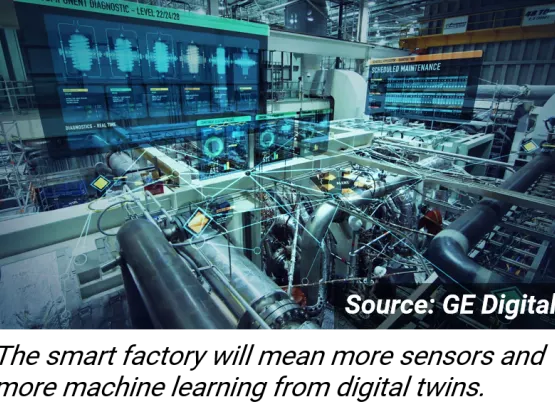
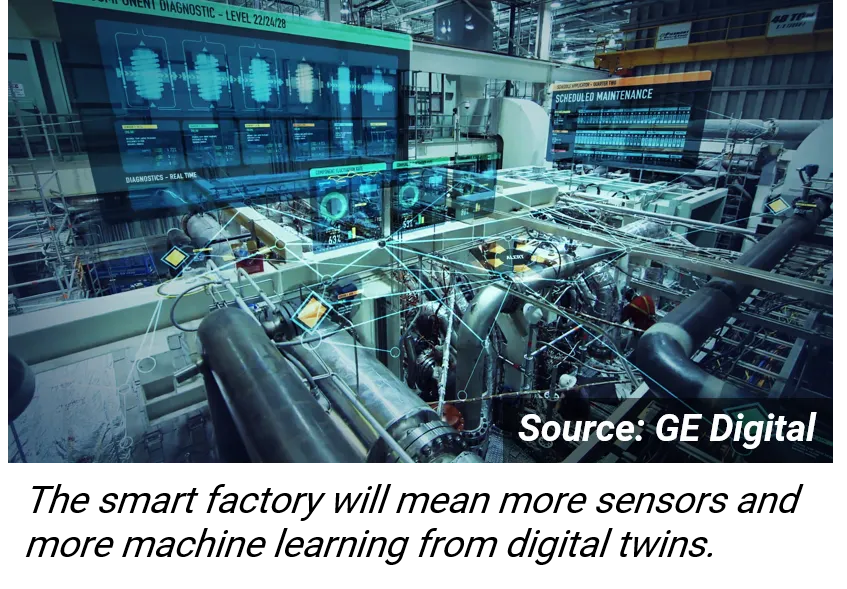
The fast-maturing hardware and software that are enabling practical applications of equipment intelligence and machine learning mean disruptive change for microelectronics manufacturing. But first comes the basic work of building the basic infrastructure, figuring out IP separation, and learning to solve physical problems in the digital world. Just how much can the semiconductor industry leverage industrial IoT practices from other industries? Common wisdom may be that industrial software solutions aren’t well suited to the IC sector’s complex needs. But GE Digital enterprise account executive Luke Smaul, currently working with Intel, argues that semiconductor fabs and toolmakers are dealing with similar issues as GE did when it first started working with Delta Airlines to monitor the GE engines on Delta planes. Smaul will speak at SEMICON West about GE’s work with Intel over the past few years and, in particular, how its solution for cloud security and IP separation can work for ICs. “GE learned to provide IP security and separation in the aviation space with its suppliers, which moved us all up the value chain, providing a big engine for growth,” says Smaul, who started his career as an IC engineer. “GE Aviation saw a 25 percent increase in issue detection rates by leveraging the same common platform. We’ve shown that we can protect Intel intellectual property in its own cloud space and control who can access what.” A toolmaker can access only particular fab data as needed for analysis, and then can reveal only the output from the analysis and a subset of supporting data. “IP separation has to happen, and it will unlock huge added value,” Smaul says. GE’s Predix solution aims to supply an easy-to-use, plug-and-play system for analytics to enable a yield engineer without a deep data background to select a supported sensor, a gateway to connect automatically to the cloud, and an analytics application to test a hypothesis of how the collected data relates to yield. “This empowers the yield engineer to use and unlock information for a quick improvement, even for simple things such as looking at the impact of degradation of fan performance over time on yield,” says Smaul. “Though the scope may be small, the impact on yield in aggregate, and when scaled, is large.” “There needs to be much more collaboration across the industry to make this work, and to share best practices,” says Smaul. “Just as GE moved from selling gas turbines to selling power-as-a-service, vendors of other big, expensive assets like IC equipment will likely change their business model from selling tools towards selling yield-as-a-service. This will simplify life for the fab while bringing the toolmaker more opportunity to sell improved capabilities on existing tools.” More human intelligence makes AI smarter Applying AI neural network approaches such as deep learning to predict outcomes from digital models is enabling disruptive advances in speech and image recognition, but applying it to complex IC manufacturing problems such as predictive maintenance has been a challenge. These neural networks require massive amounts of data to train, and the IC sector doesn’t really have big data, just a lot of little data clusters due to the dynamics and context richness of processes. This data is difficult to combine for analysis. In addition, the neural network provides only an answer but can’t explain why, notes Michael Armacost, managing director of advanced service engineering at Applied Materials. “We’ve learned that it works better if we do not ignore what we know already, but rather incorporate expert knowledge in a structured way to help us focus on the key features and the key data,” says Armacost, who will also speak in the program. This includes choosing the most important steps to include in the model, identifying the limited data to collect and how to filter the data for outliers, and then selecting the final parameters and features, adjusting the limits, and making adjustments as results drift change over time. The less data needed, the better for the complicated issue of IP protection as well. The big gains from these new analysis approaches will likely require data from more than one company and supporting security for remote connectivity. “Some end users are attempting to do the AI all themselves, but in the long term there will need to be collaboration across companies,” says James Moyne, University of Michigan professor and consultant to Applied Materials, another speaker. Collaboration will need to balance the value of the solution against the risk of compromising IP. “The low-hanging fruit are applications such as predictive maintenance in areas that do not involve high-priority IP. Another approach will be to limit the amount of shared data needed – to first build the model on a wide range of data, but then to use only a very small amount of data to operate the models.” Ready-made models could speed the process Coventor’s semiconductor process models are finding initial applications in R D whereby companies use the simulation to understand the effect of process variation on their complex designs. Instead of running dozens of actual wafers to optimize semiconductor processes, users can instead quickly simulate the results of complex process interactions on their design. Going forward, the process models could find a wide range of applications, from accelerating stabilization of new processes in the fab to enabling real-time co-optimized control across previously independent unit steps to improve wafer uniformity. “This improved uniformity across wafers and equipment could potentially reduce the need for costly physical silicon validation,” suggests Joseph Ervin, Coventor director, semiconductor process and integration, another SEMICON speaker. “Making use of in-situ metrology for real-time control also demands a digital model to process and analyze the collected data for quick response. This area has tremendous potential for improving semiconductor process control.” SEMICON West features a Smart Manufacturing Pavilion with displays and three full days of speakers on building the infrastructure needed to enable disruptive artificial intelligence in the microelectronics sector. www.semiconwest.org The SEMICON West Smart Manufacturing Pavilion features interactive Touch Liquid Crystal Displays (TLCD) and working production equipment on the floor from Bosch Rexroth, Cimetrix, Rudolph Technologies, Inficon/Final Phase Systems, OMRON, DISCO and Edwards Vacuum. For information on the SEMI Smart Manufacturing Initiative and how to get involved, please click here. Paula Doe, SEMI
Read More