

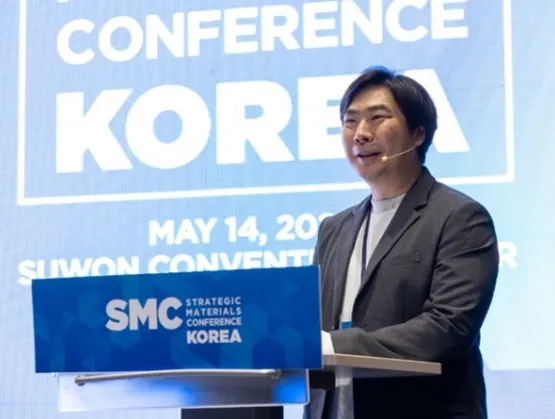
Driven by the recovery of the overall semiconductor market and rising demand for advanced materials for high-performance computing (HPC) and high-bandwidth memory (HBM) manufacturing, global semiconductor materials revenue rose 3.8% year-over-year in 2024. At the heart of this momentum, Strategic Materials Conference (SMC) Korea 2025 brought together approximately 300 industry leaders on May 14 to discuss bold innovation roadmaps and the evolving challenges of the new AI-driven era.
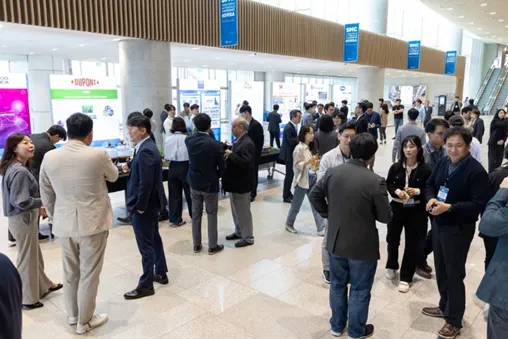
Celebrating its 10th edition, SMC Korea served as a convergence point for leaders across the semiconductor ecosystem—including materials suppliers, equipment manufacturers, chipmakers, and academia.
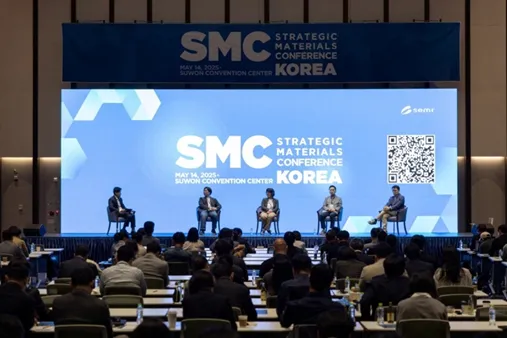
“This year’s SMC Korea has recorded the highest level of Q&A engagement. A full hour was dedicated solely to an audience-driven panel discussion, where questions ranged from materials technology and business to semiconductor process roadmaps and market outlook. The depth and interactivity of the dialogue reflected the standards of leading technical conferences. Some attendees even noted that it surpassed any academic or industry symposium currently held in Korea,” said Oh Kim, Co-chair of the EMG Korea Chapter and representative of Air Liquide Solutions Korea.
Exploring Next-Gen Technologies: 3D DRAM and CFET
The first session focused on next-generation semiconductor technologies, highlighting the future of materials and processes for 3D DRAM and Complementary FET (CFET) devices.
Dr. SukKoo Hong, Head of the Material Development team at Samsung Electronics, kicked off the session by outlining a roadmap for materials innovation in 3D DRAM and CFET. Dr. Hong emphasized key technical challenges in the development of 3D DRAM and CFET, highlighting the need for continued innovation in process integration and material engineering. Building on this, Dr. Hong stressed the increasing complexity of material processes and the critical need for tight cross-industry collaboration.
Dr. Inhee Lee, Director of imec’s Active Memory Program, highlighted the diminishing improvements in DRAM scaling and emphasized the urgent need for new high-k materials to enable higher density in next-generation 3D DRAM and 4F² DRAM architectures. Dr. Lee emphasized the need for further validation on performance shifts and data retention time resulting from changes in channel materials and architectures.
Professor Changhwan Choi of Hanyang University presented key material and process trends for CFET devices, focusing on monolithic and sequential integration as well as Backside Power Delivery Network BSPDN) technologies.
The session also featured a presentation by Linghzhi Zhang, Director of Product Management at Air Liquide Advanced Materials focused on “Si, Ge, B Hydrides for Next Generation Semiconductor Devices – Challenges and Perspectives.”
 |  |
The Future of Semiconductor Materials: Market Trends and Innovation Strategies
The second session highlighted semiconductor materials from multiple perspectives, including market outlooks, advanced technology solutions, and strategic responses to industry challenges.
Dr. Prayudi Lianto, Technology Manager at Applied Materials, discussed the technical barriers currently facing HBM, particularly the stacking height limitations. Dr. Lianto highlighted the importance of advanced packaging technologies such as through-silicon via (TSV) and hybrid bonding, and emphasized the critical role of material innovations. Key challenges include void formation during TSV gapfill and developing robust bonding strength and interfacial metals for low-temperature hybrid bonding.
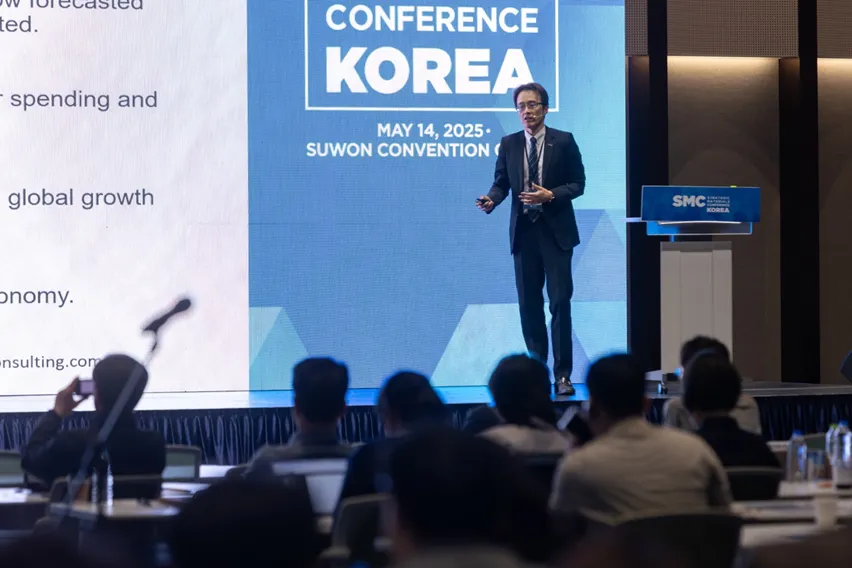
Andy Tuan of Linx Consulting provided a market outlook centered on macroeconomic shifts and evolving supply chain structures. Tuan noted that while the semiconductor industry is undergoing a short-term correction, the materials market continues to grow steadily—driven by 300mm logic, DRAM, and 3D NAND. Tuan projected that demand for process materials such as lithography, deposition, and CMP will see a notable recovery post-2025.
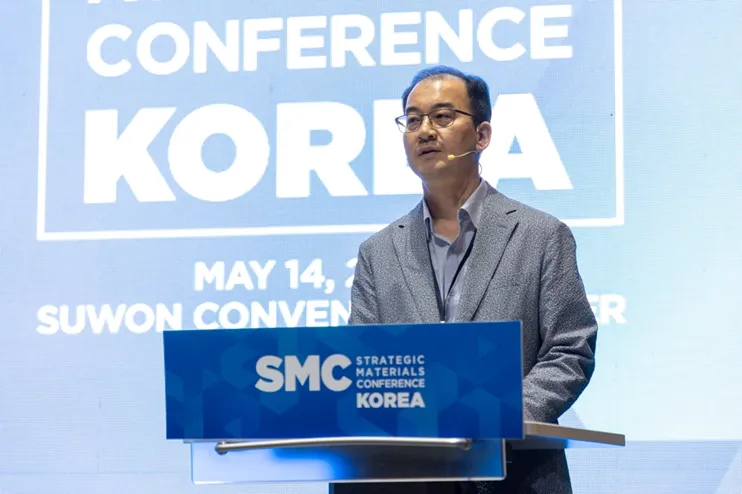
Dr. Deoksin Kil, Senior Fellow at SK hynix, underscored the growing significance of advanced process materials—including high-performance photoresists, functional chemicals, and CMP slurries—as enablers of semiconductor scaling and 3D evolution. Dr. Kil also stressed the need to maintain consistent quality and supply chain resilience, while pursuing sustainability through low-GWP gases and PFAS-free materials.
The session also featured the following presentations:
- Yohan Ahn, Senior Director, Entegris: “Technological Trends and Necessity of Material Contamination and Filtration for Wafer Defectivity Control in HBM Manufacturing”
- Dr. Mikko Utriainen, Chipmetrics: “Advancing ALD Tool Qualification Using Ultra-High-Aspect-Ratio Test Structures”
SEMI Korea extends its gratitude to all SMC Korea 2025 sponsors for making this insightful conference possible.
|
|
|
Jaegwan Shim is Senior Specialist, Marketing at SEMI.


