
Daniele Pagano is a Project Manager at STMicroelectronics and standardization leader for the Heterogeneous Integration for Connectivity and Sustainability (HiCONNECTS) consortium, a coalition of 65 partners from 15 countries developing solutions for electronic components and systems. Through his work, Pagano is directly shaping the next generation of semiconductor manufacturing.
SEMI spoke with Pagano about how integrating standards earlier in the development lifecycle can help bridge the gap between lab innovation and commercial deployment.
SEMI: Could you tell us about your role at STMicroelectronics (ST) and what first drew you to semiconductor manufacturing?
Pagano: At ST, I focus on advanced semiconductor manufacturing and innovation projects. I coordinate multidisciplinary teams, drive manufacturing development initiatives, and ensure that research outcomes translate directly into industrial applications.
In parallel, I lead standardization activities focused on maintenance and cybersecurity for HiCONNECTS. These areas are central to our mission, which is to develop core technology solutions for heterogeneous integration. Through HiCONNECTS, we emphasize development in areas like RF infrastructure and IT data applications, which are quickly becoming the backbone of modern digital society.
Semiconductor manufacturing attracted me because it combines science, engineering, and real-world impact. Semiconductors also underpin every technology we use today. They power everything from smartphones and electric vehicles to medical devices and industrial automation. I was also fascinated by the challenge of transforming cutting-edge research into innovations that are both highly scalable and reliable.
SEMI: In HiCONNECTS, you're involved in both advanced manufacturing development and standardization. How do these two areas complement each other?
Pagano: Both disciplines are closely interconnected. Advanced manufacturing focuses on creating technologies and processes that improve performance and reliability. Meanwhile, standardization helps ensure those innovations can be scaled. Without standardization, many promising technologies would struggle to move beyond the lab.
Working across both areas within HiCONNECTS gives me a valuable perspective. As new technologies emerge, we can identify potential standardization needs early to ensure that available data is usable, complies with privacy and cybersecurity requirements, and can be broadly implemented across different applications.
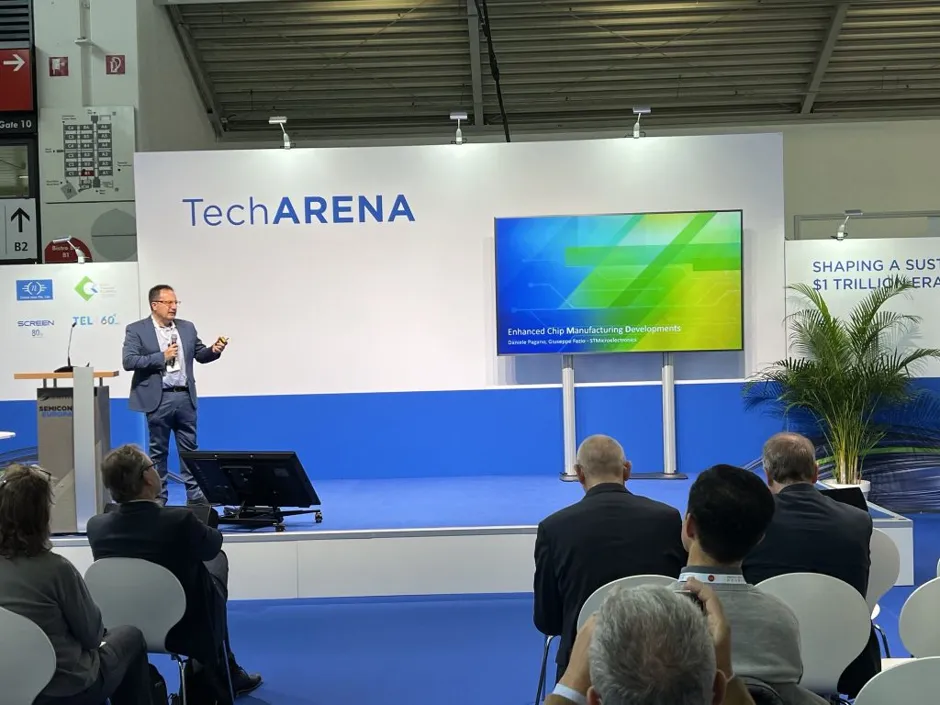
Daniele Pagano presenting at SEMICON Europa 2023
SEMI: Your work explores areas like AI, digital twins, and data analytics. How do you foresee these technologies changing the way chips are produced over the coming years?
Pagano: All of these technologies are becoming more crucial for the industry as semiconductor manufacturing processes get more complex. For instance, modern production environments generate large amounts of data, and AI can extract meaningful insights from that information to improve processes down the line.
Digital twins are particularly valuable because they can generate virtual representations of entire production lines. They create a realistic environment for engineers to predict outcomes and improve operations without halting the entire production line. Within the HiCONNECTS project, new digital twins are being developed to optimize dispatching, scheduling, and shop floor productivity.
Semiconductor factories will also become even more data-driven in the coming years, with higher levels of automation and real-time decision-making. Ultimately, digitization gives manufacturers greater freedom to produce the devices the world depends on.
SEMI: Sometimes, standards are only considered after innovation. Why do you think it’s important to think about standardization throughout a research project like HiCONNECTS?
Pagano: In reality, standardization should occur alongside innovation. When standards are considered at an earlier stage, researchers can better identify interoperability requirements, common terminologies, measurement methods, and best practices. However, due to the complexity of heterogeneous integration, addressing use-case requirements and standardization in tandem is key if we want to bring new technologies into production. To do this, we need cross-disciplinary collaboration.
Ultimately, the goal can be broken into three steps. First, create innovative technologies in the lab. Second, ensure they can be successfully transitioned into high-volume manufacturing environments. And finally, leverage AI and digital twins to improve innovations over time. Standards play a crucial role in making all of that happen, and accomplishing each of these things is only possible when we work together.
SEMI: HiCONNECTS brings together partners from industry, academia, and research organizations. What have you found most valuable about working in such a collaborative European project?
Pagano: One of the greatest strengths of HiCONNECTS is our diversity of expertise. Industry partners contribute practical knowledge of manufacturing challenges and market needs, while academic and research organizations often bring fresh perspectives, novel methodologies, and deep scientific insights.
Merging different disciplines also creates an environment where innovation can flourish. Challenges can be approached from multiple angles, and solutions benefit from more resources than any single organization can provide.
From a personal perspective, I find the exchange of knowledge to be particularly valuable. Collaborative European projects like HiCONNECTS encourage openness, learning, and the creation of long-term professional networks. These relationships often continue beyond the life cycle of the project, and they help strengthen Europe’s semiconductor ecosystem.

SEMI: Finally, what advice would you give to students and early career engineers who are considering a career in the semiconductor industry?
Pagano: The first piece of advice is to embrace continuous learning. The semiconductor industry evolves rapidly, and new technologies emerge all the time. A strong foundation in engineering, physics, materials science, data science, or computer science can open several career opportunities in this field.
Second, focus on developing strong technical abilities alongside effective collaboration skills. Modern semiconductor innovation relies on multidisciplinary teams, so the ability to communicate effectively and work across different domains is just as important as technical expertise.
Lastly, do not underestimate the importance of resilience and problem solving. Semiconductor manufacturing is one of the most challenging engineering environments in the world, but it’s also one of the most stimulating. The technologies we develop directly impact society, so for anyone passionate about technology and innovation, it’s an exciting industry to build a career in.
About HiCONNECTS
HiCONNECTS (Heterogeneous Integration for Connectivity and Sustainability) is a three-year project bringing together 65 partners to develop sustainable, energy-efficient cloud and edge computing platforms. The project focuses on high-performance computing, storage infrastructure, network interfaces, and real-time analysis of IoT sensors and big data.
SEMI Europe actively contributes to EU-funded initiatives, including Horizon Europe and Erasmus+ programs, capitalizing on its global member base and its role as the voice of the microelectronics industry. These activities enable SEMI to connect industry, research, and policy stakeholders while advancing European competitiveness and technological leadership. Learn more.
Kartikey Srivastava is Lead of EU Projects at SEMI Europe.
Daniele Pagano is Project Manager at STMicroelectronics Italy.


