downloadGroupGroupnoun_press release_995423_000000 copyGroupnoun_Feed_96767_000000Group 19noun_pictures_1817522_000000Member company iconResource item iconStore item iconGroup 19Group 19noun_Photo_2085192_000000 Copynoun_presentation_2096081_000000Group 19Group Copy 7noun_webinar_692730_000000Path
Skip to main content
Default Banner Image

Kartikey Srivastava

In an era where performance and efficiency are essential, heterogeneous integration is rapidly becoming a foundational technology. The webinar “Heterogeneous Integration in Action: Powering the Next Era of Connectivity” featuring speakers from the HiCONNECTS project dives deep into the advances, challenges, and ecosystem-building necessary to bring next-generation integrated systems to life across Europe and beyond.HiCONNECTS (Heterogeneous Integration for Connectivity and Sustainability) brings together more than 60 partners across Europe under the Chips JU to explore how packaging, materials, architectures and software can be co-designed for industrial uptake.A Bold Ambition: Why This MattersConnectivity is the lifeblood of our digital age. From smart mobility and data centers to consumer electronics and factory automation, demands on performance, energy efficiency, miniaturization and flexibility keep growing.Heterogeneous integration offers a path to meet those demands by enabling dissimilar technologies, for example chips, sensors, RF, photonics, advanced packaging and AI accelerators to work together more seamlessly than ever before.Set against the backdrop of Europe’s broader ambitions under the EU Chips Act to strengthen its semiconductor ecosystem and technological leadership, projects like HiCONNECTS demonstrate how coordinated R D can translate into industrially relevant demonstrators and use cases.Key Themes from the WebinarBelow are some of the most compelling takeaways from the session:From Components to SystemsAcross all talks, one message was clear: heterogeneous integration is no longer just about better individual devices, it’s about system-level co-design.Speakers showed this in very concrete ways:In power device manufacturing, improving yield, process control and data correlation across the wafer line directly improves the reliability of integrated systems.In smart logistics and manufacturing, autonomous mobile robots combine LiDAR, cameras, 5G, on-board compute and collaborative AI to operate safely on factory floors.In life-science imaging, cryo-electron microscopes, AI-assisted screening and high-performance computing are tied together into a single workflow.In connected and autonomous mobility, radar, V2X modems, explainable AI software and human–machine interfaces form one integrated chain.You can no longer treat sensing, connectivity, compute and packaging in isolation – the value lies in how they are composed into complete systems.Ecosystem Consortium DynamicsTo realize heterogeneous integration, no single entity can go it alone. The webinar highlighted how large consortia such as HiCONNECTS bringing in universities, research institutes, packaging houses, system vendors, and tool suppliers are key. A strong theme: modularity and interfaces must be agreed upon early to allow parallel work across partners.Why Europe’s Timing is CriticalHiCONNECTS sits within a broader European push to strengthen the continent’s semiconductor capabilities and reduce systemic vulnerabilities in critical value chains. Europe already hosts strong players in photonics, packaging, system integration, robotics, automotive and research.What the webinar underscored is that coordination and shared infrastructure are now decisive:aligning manufacturing know-how with AI and data analytics,connecting application-driven demonstrators with underlying technology platforms, andensuring results can be replicated and scaled beyond a single lab or pilot line.Final ThoughtsThe “Heterogeneous Integration in Action” webinar was a timely, forward-looking snapshot of how Europe’s microelectronics ecosystem is moving from component-level innovation to system-level co-design, grounded in real industrial use cases.The journey is far from complete, but the payoff is clear: higher-performance systems, new classes of products in mobility, health and manufacturing, and a stronger, more resilient European position in semiconductors.Kartikey Srivastava, Manager, EU ProjectsSEMI Europe Phone: +49 151 1436 6324Email: [email protected]
Read More
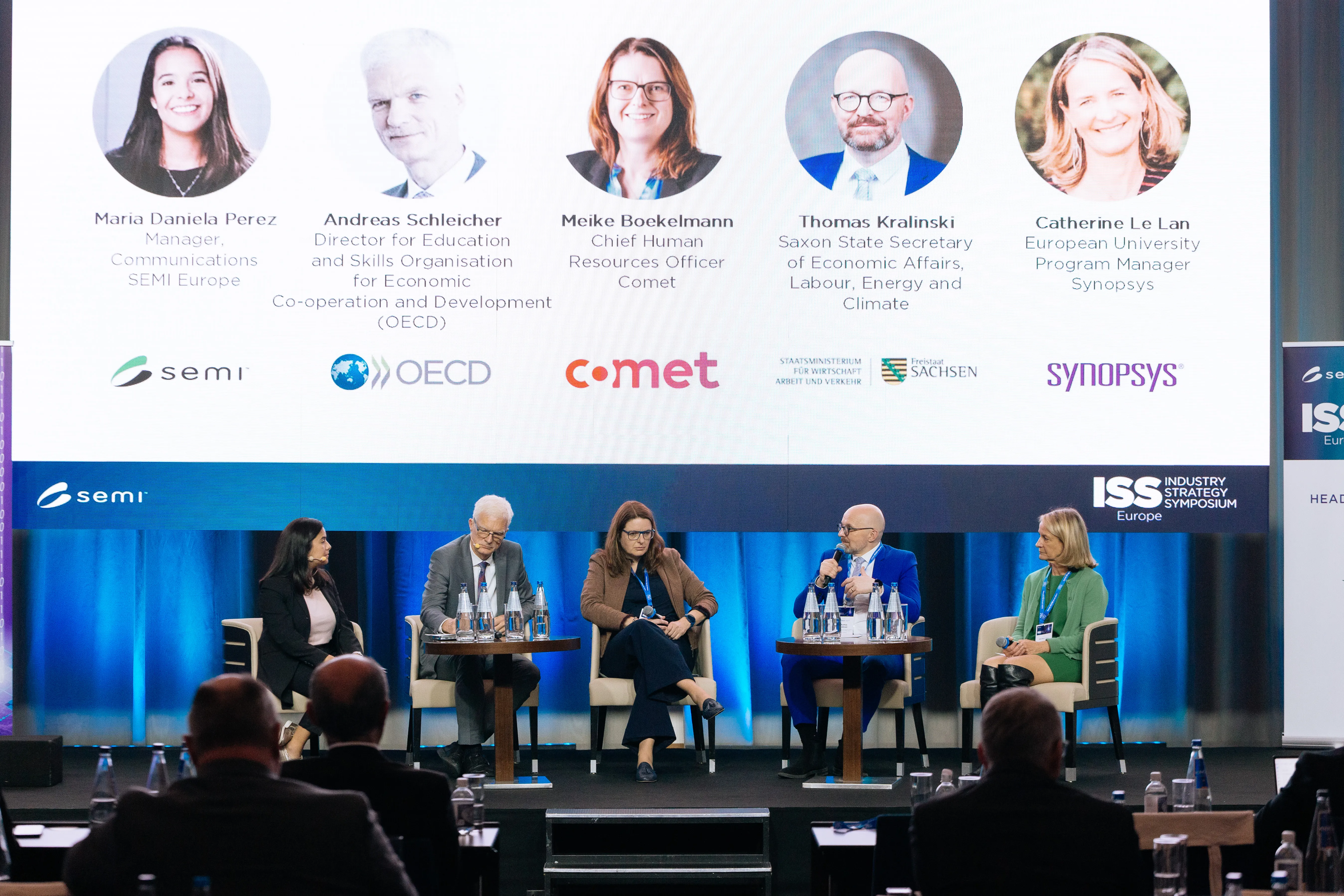
The semiconductor industry lies at the heart of Europe’s technological ambitions, powering breakthroughs in artificial intelligence, quantum computing, and advanced manufacturing. However, as the industry expands rapidly to meet surging global demand, the need for highly skilled workers is outpacing supply. According to the recently published ECSA Skills Strategy, Europe must train and hire tens of thousands of skilled professionals by 2030 to remain globally competitive. Without a robust and inclusive talent pipeline, the region’s independence in critical technologies might be at risk.At this year’s Industry Strategy Symposium Europe (ISS Europe) held in March, a panel discussion moderated by Maria Daniela Perez from SEMI Europe, brought together industry leaders and experts to explore solutions to this challenge. The discussion centered on how emerging technologies are reshaping the workforce, the role of education in preparing future professionals, and strategies for attracting and retaining diverse talent – all critical to ensuring sustainable workforce development in the semiconductor industry.Tackling Talent Acquisition and RetentionCatherine Le Lan, European University Program Manager from Synopsys, drew a direct connection between technological disruption and workforce challenges. “AI is driving unprecedented changes, and hardware is at the heart of the AI revolution,” said Le Lan. As the industry invests in new methodologies, leading-edge technologies, and innovative products, the demand for updated skillsets continues to outpace supply. This places a dual burden on companies – who must hire for both today’s and tomorrow’s skills – and on the education sector, which is expected to rapidly adapt.Meike Boekelmann, Chief of Human Resources at Comet, highlighted that the challenge is not just about attracting talent from within the semiconductor field – it is also about standing out in a crowded talent market. “We are not only competing within our industry for talent. We’re also competing against other industries: automotive, consumer electronics, and AI,” said Boekelmann. To succeed, companies must go beyond traditional incentives and offer meaningful, forward-looking career experiences. “Primarily what I see is that they’re really asking for creating an impact and also a sense of belonging… so they want to see what’s the outcome,” she explained. “There are more people leaving the labor market than entering the labor market,” added Thomas Kralinski from the Saxon State Secretary of Economic Affairs, Labour, Energy and Climate. “We need to think about immigration, family-work integration, and training.” His comments underscore the need for a holistic workforce strategy – one that not only fills immediate vacancies, but also strengthens the broader ecosystem through inclusive policies, targeted reskilling, and long-term demographic planning.Fostering Industry-Academia SynergyAs the industry evolves, so must its workforce. Andreas Schleicher, Director for Education and Skills at the OECD, made a stark observation. “There’s one thing worse than losing people – and that is to keep them and not upskill them.” He warned that the current pace of technological change demands far more than one-time training; it requires a culture of continuous learning. “Neither the industry nor the education sector has the capacity for upskilling and reskilling,” he noted, pointing out that while Europe performs well in early education, adult learning remains insufficient. “The incidence and intensity of upskilling and reskilling is so far out of what we will need.” Without scalable, lifelong learning systems, even experienced professionals risk being left behind.Building on this idea of future-readiness, Thomas Kralinski noted: “Do you know what kind of fab is going to be open in 10 years’ time or what startup is going to be founded in 10 years’ time? You probably don’t. But everybody who’s working there or will work there is born already – and is probably in school or at the university.” He underscored the need for steady investment in teachers, training systems, and educational infrastructure – not just to meet today’s demand but to ensure Europe’s long-term competitiveness.To truly inspire the next generation, Schleicher pointed to visibility as a vital factor. “You cannot be what you cannot see.” Without relatable role models or a clear understanding of how their interests connect to meaningful careers, young people – especially underrepresented students – often overlook STEM pathways. Schleicher described how even small actions, like industry professionals visiting schools to explain their work, can have a lasting impact. “You can bring someone from the semiconductors industry to speak to students and help them understand, for example, what’s in a mobile phone and that they can actually create tomorrow’s mobile phone.” That kind of engagement, he argued, helps “build dreams” and makes technology tangible, exciting, and inclusive.AI: An Enabler, Not a ThreatPanel moderator Maria Daniela Perez raised a critical question about the evolving role of AI in the workforce. Acknowledging the widespread concern that AI could lead to job displacement, she challenged the panel to consider a different perspective. How can AI be leveraged to broaden and accelerate the talent pipeline rather than replace it? In response, the panelists emphasized that AI is not a disruptor but an accelerator. Rather than eliminating jobs, AI-driven tools enhance productivity by automating repetitive tasks, freeing professionals to focus on innovation, problem-solving, and high-value work. Catherine Le Lan provided a compelling example, explaining how AI-powered electronic design automation (EDA) tools are enabling engineers to push the boundaries of technological advancement. She referred to a university study that compared two groups of students – one with access to AI tools and one without. “They found out that those AI tools helped to improve productivity and also helped to improve skills of the students,” she said. “The student who had used AI tools had better skills than the one who hadn’t used AI tools… because they had been able to focus on the high-level skills, and they got rid of the low-level skills.” Her remarks underscored how AI, when integrated into education, can accelerate both efficiency and learning outcomes.Collaboration: The Key to Sustainable Workforce DevelopmentAddressing the workforce challenge requires cross-sector collaboration among industry, academia, and policymakers. There is a shared responsibility to invest in long-term education strategies, develop structured training initiatives, and create an ecosystem where talent can thrive. This is precisely the mission of two SEMI Europe-led initiatives.The European Chips Skills Academy (ECSA) and the European Chips Diversity Alliance (ECDA) are playing a critical role in shaping Europe’s semiconductor workforce. ECSA is driving efforts to align education and training with industry needs, ensuring that both students and professionals are equipped with the technical expertise and practical experience required for the sector’s future. Meanwhile, ECDA focuses on building a more inclusive semiconductor workforce across the industry. By creating opportunities for underrepresented groups, ECDA is ensuring that the industry benefits from a broad talent pool.Securing Europe’s Semiconductor FutureIn her closing remarks, Maria Daniela Perez brought the discussion full circle, emphasizing that addressing the semiconductor talent gap requires collective ownership: “In the end, it ends up being all about collaboration,” said Perez. From engaging technology users to amplifying the industry’s visibility, to aligning with academia and policymakers, the path forward depends on shared action. By fostering this ecosystem-wide commitment – and investing in the people behind the progress – Europe can bridge the talent gap and shape a resilient, inclusive, and globally competitive semiconductor workforce.SEMI ContactKartikey Srivastava, Senior Specialist, CommunicationsEmail: [email protected]
Read More
The European semiconductor ecosystem continues to evolve, driven by the ambitions outlined in the EU Chips Act. With goals to strengthen Europe’s technological leadership and double its semiconductor manufacturing market share to 20% by 2030, collaboration across the value chain is imperative. Heterogeneous Integration for Connectivity and Sustainability (HiCONNECTS), a Horizon Europe-funded project, exemplifies this collaborative spirit. The initiative aims to develop next-generation electronic components and systems using advanced heterogeneous integration core technology solutions.The HiCONNECTS consortium, comprising 65 partners with diverse expertise, is addressing key societal and industrial challenges. These efforts focus on advancing core technology solutions for energy-efficient, high-performance wireless and wired cloud and edge computing, as well as automotive radar systems.“Collaborating with 65 partners is no small feat—it’s akin to orchestrating a complex IT network,” says Ilan Englard, Coordinator of the HiCONNECTS project. “We streamline progress by creating local networks of partners, all interconnected through a central management framework of tasks, work packages, and coordination. Such large consortia form intricate systems where complexity fosters innovation, often leading to surprising and transformative outcomes.” As the three-year project progresses, HiCONNECTS is working to establish pilot lines focused on key areas:RF Electronic Heterogeneous IntegrationPhotonic Components for Heterogeneous IntegrationAdvanced Packaging for Heterogeneous IntegrationThese pilot lines, led by organizations such as the Ferdinand Braun Institute and imec, will develop systems and modules through advanced equipment development, manufacturing optimization, and integration of electronic and photonic components. Validation of equipment in integrated process flows will further enhance the heterogeneous integration landscape.Now in its third year, HiCONNECTS continues to welcome new members. This inclusiveness underscores the project’s flexibility and its commitment to incorporating fresh perspectives as new trends and challenges emerge. At the 12-month consortium meeting in Catania last February, Arbonaut was unanimously inducted to contribute to the forest fire use case, further expanding the project’s scope.“The upcoming months are critical, as we move closer to delivering modules, systems, and demonstrators,” says Englard. “Our goal is to heterogeneously integrate the next generation of RF, electronic, and photonic components into networking, telecom, and radar systems, with support from module and equipment makers.”HiCONNECTS members at the 12-month consortium meeting in Catania, February 2024As this ambitious work progresses, sharing project results and achievements remains a top priority for the consortium to ensure meaningful social, political, and economic impact. By drawing attention to the results of the project, the consortium enhances the visibility, comprehension, and implementation of these advancements. Recently, four partners—Excillum, TNO, SANLAB, and Centria University of Applied Sciences—participated in a webinar titled “Heterogeneous Integration for Future High Speed Communication,” organized by SEMI Europe. The webinar is now available on demand for viewers worldwide.The significance of HiCONNECTS was further highlighted at SEMICON Europa 2024, where seven consortium members presented progress on topics ranging from advanced packaging to photonic integration. At the TechARENA, representatives from SEMI Europe, Excillum, Centria, Arbonaut, AT S, imec, and Applied Materials showcased the project’s contributions to the semiconductor ecosystem. “I was thrilled to present at the TECHArena and engage with the HiConnects partners,” said Julius Hållstedt, Head of segment - Semi Electronics, Excillum. “I especially appreciated the high attendance at my talk, which validated the strong interest in X-ray solutions for semiconductor applications. The insightful discussions at the SEMICON Europa exhibition and advanced packaging conference was a rewarding bonus.”HiCONNECTS Speakers at SEMICON Europa 2024By disseminating research and breakthroughs across various channels, such as publications, webinars, and conferences, HiCONNECTS is promoting knowledge sharing and fostering collaboration across the semiconductor ecosystem. This openness accelerates the adoption of new technologies, ensuring that European industry players remain at the forefront of critical advancements. Furthermore, sharing these results strengthens Europe’s position as a hub for cutting-edge research and development, driving both economic growth and technological leadership on the global stage.SEMI Europe is proud to be a consortium member of HiCONNECTS under the Chips Joint Undertaking (Chips JU), which is funded by the EU Horizon Europe program and supported by numerous countries, including Austria, Italy, Germany, and Sweden.About HiCONNECTS:HiCONNECTS (Heterogeneous Integration for Connectivity and Sustainability) is a three-year project bringing together 65 partners to develop sustainable, energy-efficient cloud and edge computing platforms. The project focuses on high-performance computing, storage infrastructure, network interfaces, and real-time analysis of IoT sensors and big data.Kartikey Srivastava is Senior Specialist – Communications at SEMI Europe.
Read More