


Between January and July 2026, Stanton Chase developed three regional Semiconductor Spotlight reports focused on market dynamics and executive leadership imperatives. The research found that North America, EMEA, and Southeast Asia are all facing engineering and leadership talent shortages.
The Semiconductor Bottleneck is Moving from Lithography to Advanced Packaging
The semiconductor industry is growing rapidly. Currently, IDC is forecasting that global semiconductor revenue will reach $1.29 trillion by the end of 2026, representing more than 50% growth over 2025. A separate McKinsey report takes a wider measure of the industry than sales alone, accounting for in-house design teams in its projections. On this wider measure, the semiconductor industry is projected to reach $1.6 trillion by 2030 under McKinsey’s base-case scenario.
These revenue gains are being spent on innovations in memory and advanced packaging to help address the memory wall. IDC identifies high bandwidth memory (HBM) as the primary constraint in the AI accelerator supply chain. However, most HBM capacity is pre-committed through 2026, with forward allocations reaching into 2027. With strained capacity around the world, IDC does not expect any meaningful new supply before late 2026 at the earliest. Companies wanting to circumvent capacity limits must build their own facilities, but this requires experienced operations leaders.
Why Semiconductor Subsidies Cannot Buy Packaging and Yield Expertise
Governments around the world have tried to solve the capacity shortage with public money. McKinsey’s analysis of the New Industrial Policy Observatory tracker noted a roughly 390% growth in industrial-policy actions between 2017 and 2024, listing defense, semiconductors, and high-end equipment as the focus.
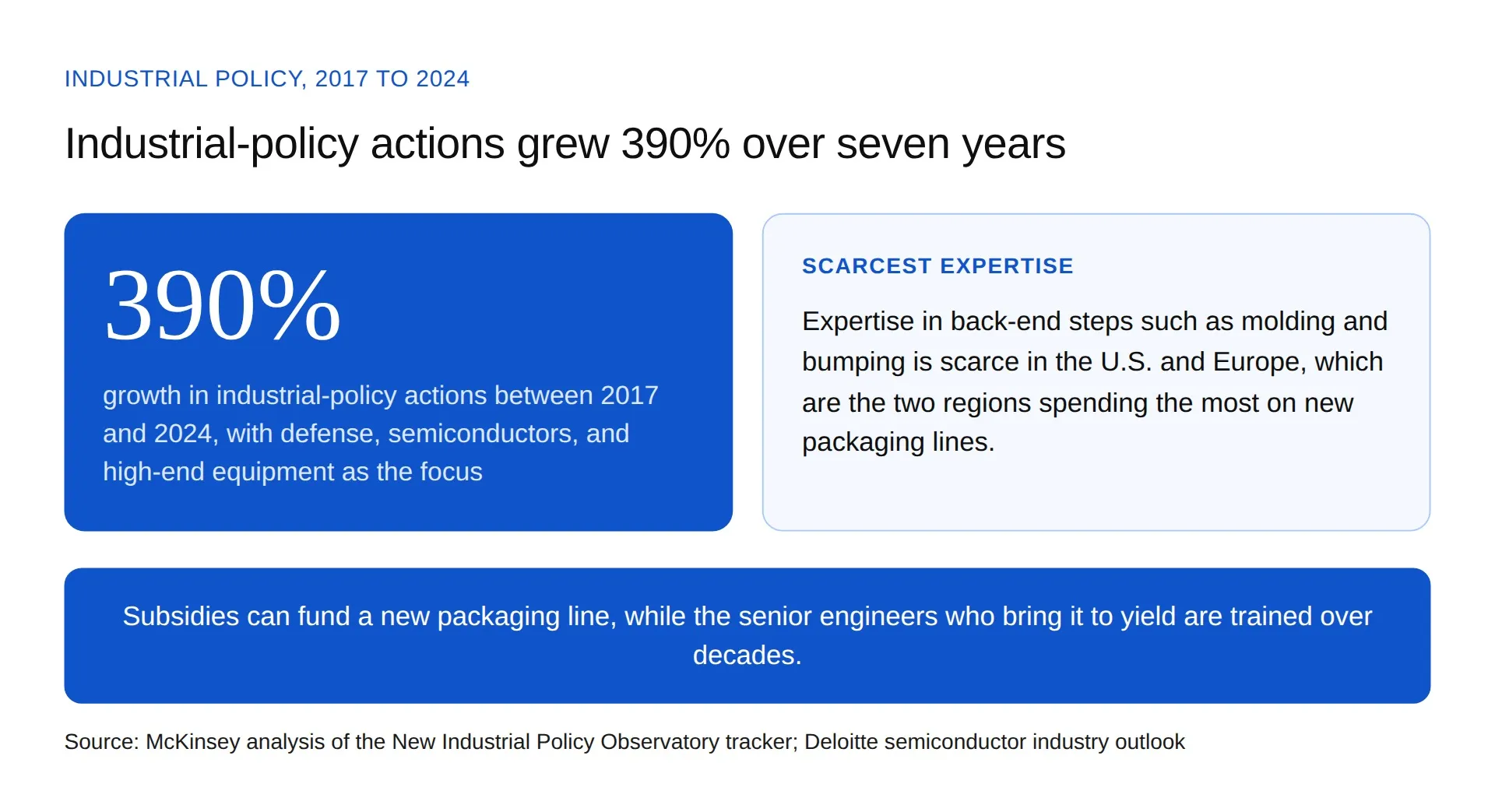
Government investments also go where skills are thinnest. For example, Deloitte found that expertise in back-end steps like molding and bumping is scarce in the United States and Europe. These are the two regions spending the most on bolstering their industries, and subsidies are quickly funding new packaging lines. Although facilities investments are being made, engineers who can ensure the success of these lines have typically been trained over decades. As it stands today, there are not enough skilled senior engineers to staff new buildouts.
How Semiconductor Talent Shortages Differ Across North America, EMEA, and Southeast Asia
The U.S. is rebuilding the manufacturing infrastructure that was moved offshore after the year 2000. Section 48D, a manufacturing investment tax credit to incentivize domestic semiconductor production, now offers a 35% investment credit for advanced manufacturing facilities, up from the 25% rate set in 2022. The higher rate applies to qualifying property placed in service after 2025, and the credit does not apply to projects whose construction begins after December 31, 2026.
Although this incentive is large, the country’s workforce is not in place to staff new manufacturing sites. McKinsey’s 2024 labor analysis stated that the U.S. semiconductor manufacturing workforce was down 43% from its peak in 2000. While around 1,500 engineers join the semiconductor workforce each year, forecasts show demand for 88,000 new engineers by 2029.
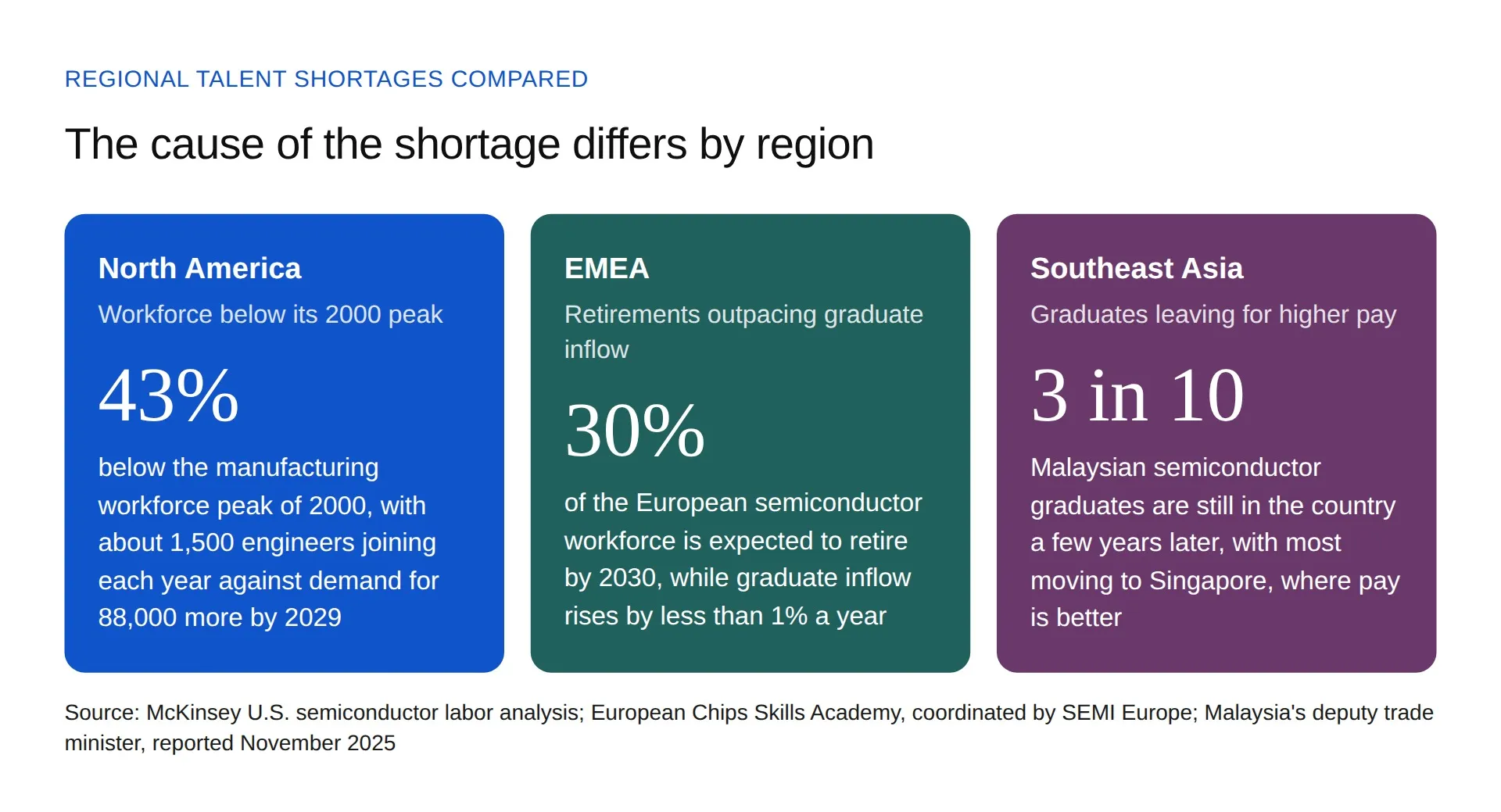
Europe’s shortage runs the other way. While the U.S. lacks engineers it never trained, Europe is losing its engineers to retirement. The European Court of Auditors highlighted that the EU’s 20% output target is very likely to go unmet and cited skilled worker shortages among the factors affecting implementation. The European Chips Skills Academy, coordinated by SEMI Europe, reported that nearly 30% of the European semiconductor workforce is expected to retire by 2030. At the same time, graduate inflow is rising by less than 1% each year.
Furthermore, Southeast Asia trains a high volume of engineers, but some Southeast Asian countries struggle to keep them. Malaysia’s deputy trade minister noted that of every ten graduates trained, only three remain in the country after a few years. Those engineers typically move within Southeast Asia rather than out of it, but they move to Singapore, where pay is better. While Singapore represents 10% of the global chip market, it also struggles with an aging workforce. To keep pace with its demand, Singapore recruits from neighboring countries.
Every Regional Semiconductor Facility Competes for the Same Talent Pool
Even though each region is specializing in something specific, all of them are recruiting the same engineering experts. For example, Deloitte expects Southeast Asia and India to grow as hubs for high-volume, back-end manufacturing. Meanwhile, Taiwan, the U.S., Japan, and parts of Europe are furthering heterogeneous integration and advanced packaging innovation. Deloitte concludes that talent constraints in advanced packaging may hold back regional autonomy goals around the world, even as back-end capacity keeps expanding in Asia.
Every program described exists to move advanced production out of Asia; however, the only people who have run advanced production at scale are in Asia. Public money can pay for a fab, but it cannot produce an experienced operator. This forces each region to compete for the same small group. For instance, hiring an engineer in the U.S. removes them from Taiwan.
What Semiconductor Leadership Planning Should Look Like Before 2030
To adequately staff new facilities and meet rising demand, hiring decisions must be made before 2030. Chipmakers that fill senior plant and engineering roles on time do so by planning for new hires years in advance rather than waiting until someone resigns. Companies that hire successfully also benchmark pay against Taiwan and South Korea and allocate enough budget for relocation.
This article summarizes the key findings of the three Semiconductor Spotlight reports and their shared talent development roadblocks. Each white paper covers its own region in depth, outlining where investments have been committed and the roles that need to be filled.
Read each report to learn more.
Semiconductor Spotlight: North America
Semiconductor Spotlight: Southeast Asia
About the Author
Jan-Bart Smits is managing partner at Stanton Chase Amsterdam, global sector leader for technology, and global subsector leader for semiconductors. In his more than 30-year career, his work has taken him across semiconductors, technology, and professional services, and his earlier global roles at Stanton Chase included global practice leader for professional services and global chair. He contributed to each of the three regional Semiconductor Spotlight reports and holds a master’s degree in astrophysics from Leiden University.


