downloadGroupGroupnoun_press release_995423_000000 copyGroupnoun_Feed_96767_000000Group 19noun_pictures_1817522_000000Member company iconResource item iconStore item iconGroup 19Group 19noun_Photo_2085192_000000 Copynoun_presentation_2096081_000000Group 19Group Copy 7noun_webinar_692730_000000Path
Skip to main content
Default Banner Image

Cadence

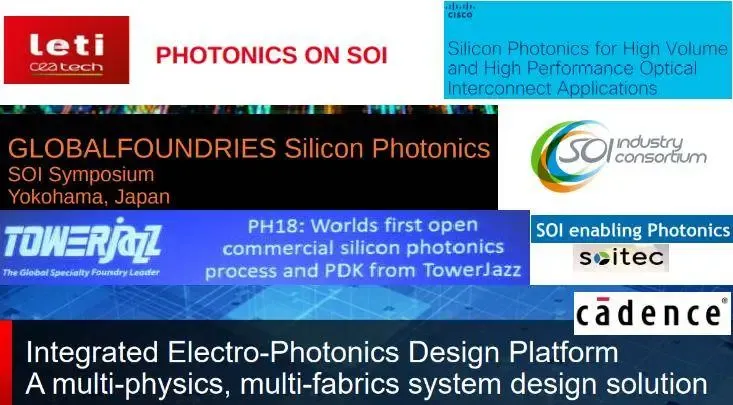
It should really be called SOI photonics – not just silicon photonics, quipped Soitec CTO Christophe Maleville at the SOI Consortium Japan event last fall. You’ve got to have SOI for the waveguides. There are megatrends driving significant growth in photonics – and they were all covered at the event. This is the final post in our coverage of the SOI Consortium’s Japan event (thank you for your patience!). It covers the photonics-related presentations by Soitec, Leti, Cisco/Luxtera, GlobalFoundries, Cadence and TowerJazz. Most of these presentations are now posted on the SOI Consortium website – you can access them if your organization is a member of the consortium. By way of reminder, the Japan SOI Symposium was a great success, with both days well attended. In case you missed our previous posts about the event, you’ll want to go back and read them, too. The first post covered the 5G/RF-SOI presentations by ST, Toshiba, Incize, GF, Silvaco and Sitri – you can read it here. The second post on the event covered eight very informative presentations on SOI in IoT and automotive by NXP, Dolphin Design, Leti, Silvaco, Arm, I-fuse and Secure-IC – you can read that here. Note that you can click on any of the illustrations to see enlarged versions. And now without further ado, here are the summaries of the photonics presentations. SOI Enabling Photonics – Ecosystem and Market Outlook – by Aziz Alami-Idrissi, GM Specialty SOI, Soitec. [caption id="attachment_28773" align="alignleft" width="233"] (Courtesy: Soitec SOI Consortium)[/caption] The megatrends in SOI photonics are: 5G (for more bandwidth, HPC, edge quantum computing), data centers (for high data rate transceivers and high-switch bandwidth), sensors (lidar, gas/chemical and gyroscopes) and biosensors (especially for medical). These are driving big changes: the 44% CAGR means the market is growing from a current TAM of about 500M$ to over 4B$ in 2025. One thing that’s really interesting is the expansion of the photonics market into these new fields in the next few years. While in 2019 90% of the photonics market served data center applications (the other 10% is for long haul), in 2025 optical I/O’s will account for over a third of the photonics market TAM. The other applications making an impact include AI, quantum, lidar (which will move into high-volume manufacturing in 2024) and medical sensors (hitting high-volume in 2023). For its part, Soitec is strengthening its portfolio with 8” and 12” large product coverage, new product sampling engaged, and extended features including newer engineered layers and RF immunity. Advanced Silicon Photonic Solutions Leverage SOI Technology – Eleonore Hardy, Business Development Manager, Silicon Photonics, CEA-Leti [caption id="attachment_28769" align="alignright" width="358"] (Courtesy: Leti SOI Consortium)[/caption] Leti helps companies make photonics products they can bring to volume foundries, explained Hardy. (btw, they’re presenting 21 (!) papers – including 5 invited – at PhotonicsWest 2020. Read about that here). You want to do integrated photonics to bring down costs, reduce power consumption, and scale (for higher volumes and reduced footprint). There are essentially three substrate choices: InP, SiN or SOI. SOI uses CMOS processes, so it’s low-cost and can be used in high-density photonic integrated circuits. What about the laser? Leti has developed III-V on silicon bonding, so you can have the laser on 4” III-V with a 300mm CMOS process (this is what Intel’s doing). They’re moving to 300mm wafers, 3D and advanced packaging. While communications is the big application realm, Leti is also applying photonics in automotive, medical, environment and computing. In the computing realm she gave the example of the European QuantERA SQUARE (Silicon Photonics for Quantum Fibre Networks) project for which Leti is doing the quantum emitter for absolute security and computing, wherein the transceiver/receiver for quantum cryptography integrates a hybrid III-V on silicon pump laser. Other examples of their work include miniature, low-cost and agile lidar for automotive and industrial applications (they’re working on a beam-steering emitter for an optical phased array). GlobalFoundries Silicon Photonics Solutions for Wired Infrastructure – Anthony Yu, VP, GF [caption id="attachment_28770" align="alignleft" width="684"] (Courtesy: GlobalFoundries SOI Consortium)[/caption] GF is giving their photonics business a big push. Optical interconnects are the future, said Yu, so they’re putting a lot of money into it. With data streaming multiplying by 3x/year and a current foundry TAM of $63 billion, the opportunity is huge. Fab 10 in Fishkill runs their 90WG process on 300mm wafers. A new process, 45CLO (also on 300mm) for O and C bands is going into the Malta fab. A big focus here are optical transceivers that convert RF signals to light. They see RF on SOI in a monolithic solution is needed to serve 100Gbs applications. They’re also moving to co-packaging optics: the packing technology will surround it with photonic chiplets. Customers have indicated that pulling the signals off the chips is limited by power, so they’ve worked hard on the fiber attach with MEMS and packaging technology for co-packaging. GF relies on substrate providers for high-quality SOI, and they have a world-class development team, he concluded. Integrated Electro-Photonics Design Platform – A multi-physics, multi-fabrics system design solution – Scott Li, Sr. AE Manager of Custom IC Platform, Cadence [caption id="attachment_28771" align="alignright" width="374"] (Courtesy: Cadence SOI Consortium)[/caption] This talk focused on photonics design challenges and solutions – including the CurvyCore™-based PDK for waveguide creation modal properties calculation that Cadence will soon be announcing. It’s a math-based engine that generates complex curvy shapes to support photonics. The first design challenges, said Li, are at the circuit level: how to do the schematics. The detailing tools, timesteps management and circuit simulation need to give the user the best performance. Cadence is working in close collaboration with a company called Lumericable on this. The next set of design challenges come at layout – especially generating curvilinear layout for any shape so that there are no gaps in connections. This is where CurvyCore comes in, fully automating layout and making it easy to modify. This includes place route, DRC and LVS for curvy shapes. The final challenge is at the system level. There is work to do here, but Cadence is collaborating closely on solutions with key partners. The ultimate goal is for photonics layout and editing to be available with all the features designers get in electronics editing. Silicon Photonics for High Volume and High Performance Optical Interconnects Applications – Thierry Pinguet, Technical Leader Engineering, Cisco /Luxtera [caption id="attachment_28772" align="alignleft" width="396"] (Courtesy: Cisco/Luxtera SOI Consortium)[/caption] Over the last decade there’s been steady growth in optical high speed interconnect solutions, mainly driven by HPC, enterprise, and especially the hyperscale datacenter. The largest volumes are for intra datacenter interconnect (between servers). Now mobile applications for backhaul are also driving volume for high speed optical interconnect for 5G network implementation. ASICs and photonics are getting closer as the industry moves to put them in the same package. But everybody does silicon photonics differently (even within Cisco). Luxtera tries to use the same infrastructure as electronics, but patterning is still a challenge: it’s not 90o “Manhattan” style. The wafers are no problem – they work with leading wafer suppliers like Soitec and SEH. They have explored a “double SOI” substrate (like a mirror), which showed large insertion loss improvements in grating couplers . For the electronics and the laser (MEMS), they do a micropackage, although at one point they also did monolithic integration. For better performance, they’re moving to TSVs. A hot topic is ASIC and photonics co-packaging. You can use optical tiles, but then the light is remote, like a power supply. No matter how you do it, though, the bottom line is that silicon photonics is the only way forward for the data center. PH18: World’s First Open Commercial Silicon Photonics Process and PDK from TowerJazz – Masanobu Kumazaki, Engineer, TowerJazz. This presentation was given in Japanese without translation into English, and is not available on the consortium website. But the slides showed at the event indicated that their PH18 is the world’s first open commercial silicon photonics offering. For optical transceiver components, silicon photonics provides another opportunity for a specialty foundry. It is a high-growth market. The TowerJazz offering is 220nm SOI, and uses standard EDA tools from Synopsys, Cadence and Mentor for design flow.
Read More
The SOI Consortium’s China 2019 event ran for two days, and it’s taken four (!) posts to cover all the presentations. In this final post we cover the afternoon RF-SOI sessions, which were dedicated to the China RF-SOI ecosystem and the RF value chain. In case you missed them, our previous posts recapped: 1. major keynotes from both the FD-SOI and RF-SOI days; 2. the FD-SOI presentations; 3. the morning sessions of the RF-SOI day; and 4. (this post) the RF-SOI day afternoon sessions. As we noted in Part 1 of our RF-SOI coverage, there were over 500 attendees for the RF-SOI day. And impressively, the room was still packed right through to the very end of the afternoon. Read on! SESSION 2: CHINA RF-SOI ECOSYSTEMSuzhou HunterSun Electronics: Super Opportunity for Integrated RFFE (“Jacky” Yujun Ding, COO)This talk had two parts. First, how is 5G changing the world, and second, what are the RFFE opportunities? He cited IHS data indicating that 5G will create tens of millions of jobs. New products include NB IoT, cellular V2X, as well as traditional PC/tablets and smart phones. But you still need to cover 2/3/4G with 5G. Major growth will happen in 2025-27. In terms of opportunities for RFFE, you've currently got 550mm2 going for $8; in 5G, you'll need 600mm2, but it will cost $16. You need RFSOI for filters and antenna switches, which are in high demand. Parts of the supply chain have no China players. Revenue for BAW is higher than SAW, but there's more SAW. He sees the industry moving heavily into integrated FEM (versus chip-on-board). He finished by itemizing different parts of the RFFE, indicating where the opportunities are (citing some data from Yole), with a special emphasis on integrated products for Chinese companies, with continued investor confidence. SmarterMicro: RF-SOI: Key Technology of Smart Connection (Yangyang Pen, Director) RF-SOI is an enabler of smart connections. However he sees GaAs as better for power, so SmarterMicro has a solution combining RF-SOI and GaAs. They've developed the world's first mMTC RFFE for high-performance upgrades on a single die and software reconfigurable. He notes that for IoT, lifetimes will be longer than 10 years, and that terminals are becoming more powerful. CanaanTek: Critical SOI CMOS Blocks in the 5G NR Sub-6GHz RF Front-End Architectures (Wayne Ni, CTO Board Chairman) CanaanTek is a fabless company working in consumer markets, with switches, tuners and LNAs in SOI-CMOS. He wants to capture 10% of the market with a focus on sub-6. The antenna/tuner is a must, and they've developed solutions for switches here. The figure of merit is RonCoff. He showed a product roadmap on SOI-CMOS. Xpeedic: Innovative EDA Solutions to Enable Differentiated RF-SOI Designs (Feng Ling, CEO)RF-SOI is growing, but there are still design challenges in process, models, filters and packaging. To design a good front end, you need better models and filters. People think passives are easy, but you need accurate models here. Xpeedic has developed design flows that include the effects of packaging early in design. Their products include IRIS, iModeler and Metis (for packaging). They've also introduced substrate modeling in partnership with CWS in France. The product is called SiPEX: it can address linearity in switch or PA designs. You need accurate substrate models to do this. Customers indicate they're seeing big improvements as well as reductions of 25% in chip area. IDP filters is another place they're working, to provide RF filters to fabless IC or module companies. No single filter technology can fit all the needs – IDP is one of them, so they have a broad portfolio of IDP filter technologies. He closed by saying that especially in China, the SOI ecosystem is really growing. SESSION 3: RF VALUE CHAINTowerJazz: Specialized RFSOI Foundry Technology to Support Rapid New Product Development (Paul Hurwitz, Director of RF Technology Development)This presentation gave a full overview of what TowerJazz offers in terms of RF-SOI foundry services with its fabs in Isreal, the US and Japan. What's new in 2019 is a diversifying of 200mm and 300mm. 200mm is best for power handling (for infrastructure/basestation antenna tuners and switch power handling, for example). 300mm is best for SW and LNA integration and higher digital densities. They've got new SOI models for the latest technology generations, and physics-based modeling of RF breakdown for accuracy. With more die being flipped, they needed new substrate modeling. For LNA and switch integration in 300mm, they invested in RF modeling. They also have an in-house MPW (multi-project wafer) program. He noted that customers in China are moving quickly in response to their customer requirements. Okmetic: Tailored Silicon Substrates for RF Applications (Atte Haapalinna, CTO)Okmetic Oy is a niche player in the substrate materials market, with specialties in sensors and MEMS, where they are the market leader. Now part of China’s NSIG group, they are expanding their manufacturing facility in Finland. In this presentation, their CTO talked about their current offerings as well as what they have under development. They do 150-200mm wafers, with a special emphasis on thick SOI. In terms of silicon substrates for RF, ultra-high resistivity is key. Their wafers are also used in IDP – integrated passive devices – for RF and acoustic filters. They are continually improving their high resistivity Magnetic Czochralski (MCz) silicon wafers, and are developing substrates for RF passives for automotive V2X. For RF beyond 6 GHz, they are looking at customized high resistivity silicon wafers for mmWave with researchers and customers. For sensors, they do SOI wafers with built-in cavities. Incize: RF SOI Ecosystem – History Challenges (Mostafa Emam, CEO)The world is exceeding expectations in terms of data usage. While the CAGR for devices is 27%, for data it’s 46%. Therefore each device needs to be faster and more power efficient. Incize recognizes RF as an art, with each piece hand crafted. But artists need to see the whole picture: at Incize, they help 17 companies – including wafer suppliers, foundries and fabless – see that big picture, especially in measurement, characterization and modeling for RF. For wafer suppliers, they do very high-power and very precise on-wafer testing to determine things like intermodulation distortion and substrate interference. For foundries, their specialty is in RF switches, for whom they do harmonics testing and thermal noise management. With those insights, Incize foundry customers have drastically increased the performance of the RF chips they’re manufacturing on trap-rich, high-resistivity SOI wafers. Meanwhile, Incize is also preparing PDKs for future potential substrate generations including GaN-on-Silicon, silicon-on-porous, and new contactless testing techniques for piezoelectric-on-insulator (POI – used in filters in 4/5G). “There’s a really big business opportunity for RF-SOI,” concluded Emam, “and room for everyone.” Cadence: SOI Technology in Intelligent and IoT/Vision/AI Systems (Jonathan Smith, Senior Director)Cadence does SOI enablement at advanced nodes. Smith shared three recent success stories. First, there’s the Musca-S1 test chip they did with Arm, Samsung and Sondrel this past spring. Second, there’s the Tensilica DSP for automotive vision on GlobalFoundries’ 22FDX, which uses 1/10th of the power of existing solutions and was demonstrated at CES. And finally there’s the i.MX line from NXP. In recent news, there’s a new version (18.1) of Virtuoso RF. Though it’s been on the market for 30 years, they’ve added advanced methodologies so that system design and analysis are on the same platform. They’ve also announced National Instruments’ analysis solver, the Clarity 3D solver for next-gen 3D solutions, the integration of multiple electromagnetic (EM) solvers, and advance SiP options. Silvaco: Xena-IP Management Infrastructure for the SOI Ecosystem (Babak Taheri, CEO)Every multi-core SoC today has as many as 200 IPs, if not more. How do you manage that? Tracking and traceability of IP is complicated but important. For IP providers, how do they track where its being used? And for IP consumers, they need to know what they’ve used and where. What’s required is an IP management system to keep track of the different functions and different concerns. Today’s tracking systems don’t talk to each other. Silvaco’s Xena IP management solution organizes all IP data, accounts, products, contracts, devices, support, compliance and reporting. For compliance in particular, they do IP “fingerprinting” and “DNA analysis”, which they’ve patented. The fingerprint is a digital representation of the IP: it’s not just software. It is secure, and can’t be reverse engineered. It’s not a tag: a tag is inserted into the IP, whereas fingerprints are extracted. DNA analysis flags discrepancies and quickly identifies where they are and which files to look in. Xena works in the cloud, enterprise systems or hybrids. The SOI ecosystem will be hearing a lot more about this. ~~ Please note that the China event presentations are all available on our website to anyone whose company or organization is a member of the SOI Consortium.
Read More
Since the beginning of the year, there’s been a steady stream of excellent news around Samsung Foundry’s 28FDS, their highly successful 28nm FD-SOI offering. Let’s take a look at what’s been happening, as things do seem to be accelerating. By way of reminder, they announced the industry’s first eMRAM (embedded MagnetoResistive RAM) testchip tape-out milestone on 28FDS in September 2017 (you can read the press release here) - which was just a year after they had announced mass production of 28FDS process technology.At the end of 2018, Arm announced the industry’s first Embedded MRAM (eMRAM) compiler IP built on Samsung Foundry’s 28FDS process technology. Follow that with this announcement at the beginning of 2019: Soitec Expands Collaboration with Samsung Foundry on FD-SOI Wafer Supply. The two companies announced that Samsung had secured a high-volume supply of FD-SOI technology to meet industry's current and future demands especially in consumer, IoT and automotive applications. In March came two more big announcements. First: Samsung Electronics Starts Commercial Shipment of eMRAM Product Based on 28nm FD-SOI Process. As they noted in the PR, “Samsung’s 28FDS-based eMRAM solution offers unprecedented power and speed advantages with lower cost. Since eMRAM does not require an erase cycle before writing data, its writing speed is approximately a thousand times faster than eFlash. Also, eMRAM uses lower voltages than eFlash, and does not consume electric power when in power-off mode, resulting in great power efficiency.”Hard on the heals of that came the news that Arm and Samsung Announce IP Platform including eMRAM for 18nm FD-SOI. At the SOI Consortium’s Silicon Valley Symposium in April, Tim Dry (he’s Samsung’s Director of Foundry Marketing for Edge and End Point), gave a terrific presentation. Entitled Samsung’s FDS with MRAM: Enabling Today’s Innovative Low Power Endpoint Products, it details the company’s FDSOI roadmap for the IoT Endpoint Platform (and yes, you can download in its entirety). Then in May at the big Samsung Foundry Forum in Silicon Valley, Arm, in collaboration with Samsung Foundry, Cadence, and Sondrel, demonstrated the first 28nm FD-SOI eMRAM IoT test chip and development board. The Musca-S1 test chip demonstrates a new choice in SoC design for IoT solutions, said Arm. (Sondrel, btw, is Europe's largest independent IC design consultancy.)In parallel, Cadence announced: Cadence Custom/AMS Flow Certified for Samsung 28nm FD-SOI Process Technology. Especially aimed at digitally-assisted analog designs, what’s new here is that the Cadence custom and analog/mixed-signal IC design flow is now Samsung Foundry certified for 28FDS. Samsung’s 28FDS PDK techfile is Mixed-Signal OpenAccess ready, enabling customers to deploy OpenAccess-integrated, fully interoperable Virtuoso-Innovus implementation flows. For its part, at its Foundry Forum, Samsung unveiled extensions of the company’s FD-SOI (FDS) process and eMRAM together with an expanded set of state-of-the-art package solutions. They indicated that the development of the successor to the 28FDS process, 18FDS, and eMRAM with 1Gb capacity will be finished this year.And finally, companies like NXP are shipping exciting new products fabbed on Samsung’s 28FDS. Ron Martino, VP GM of NXP’s i.MX Application Processor Product Line covered key products in his presentation at the SOI Consortium’s Silicon Valley Symposium (see our coverage here). Among them: the i.MX7ULP for long battery life with 2D 3D graphics for wearables and portables in consumer and industrial applications; the i.MX 8 and 8X subsystems for automotive and industrial applications; and the i.MX RT series of “cross-over” processors. The i.MX RT ULP (real-time, ultra-low-power) series, which Martino says is the “new normal”, deals with a high number of sensor inputs. The i.MX RT 1100 MCUs, which have been qualified for automotive and industrial applications, are breaking the gigahertz performance barrier.In July, linuxgizmos.com reported that, “In June, NXP began volume shipments of its super power-efficient i.MX7 ULP, which it announced in 2017. The SoC is billed as the most power-efficient processor on the market that also includes a 3D GPU. […] the ULP version includes a 3D graphics capable Vivante GC7000.” (Vivante, btw, is a VeriSilicon company, which is an SOI Consortium member and a leading proponent of FD-SOI design and IP in China and worldwide.) This is leading to some really nice wins for NXP. For example, they’ve got Amazon's Alexa Voice Service (AVS) leveraging the i.MX RT crossover processor, enabling developers to quickly and easily add Alexa voice assistant capabilities to their products. The RT series has rapidly been expanded, with versions for voice-controlled devices and offline face and expression recognition capabilities for smart home, commercial and industrial devices.Also announced this summer: NXP and Microsoft Bring Microsoft Azure Sphere Security to the Intelligent Edge with a New Energy-Efficient Processor. That collaboration includes development of a new crossover applications processor in NXP’s i.MX 8 series integrating Microsoft’s Azure Sphere security architecture and Pluton Security Subsystem. Their customers “will be able to harness the high-performance and energy efficiency of NXP’s i.MX 8 applications processors combined with Microsoft’s unequaled security and assurance provided by Azure Sphere certified chips”. As Martino concluded in his presentation, “The future of embedded processing [is] enabled by FD-SOI.” And Samsung Foundry’s FD-SOI offerings are clearly a massive enabler of that future.
Read More
2019 will be a busy fall for the SOI Consortium and our members.First off are the SOI Consortium events in Shanghai and Tokyo, which are very popular indeed. We now have the dates locations locked in, so you’ll want to mark your calendars:Shanghai: 16 17 September 2019, FD-SOI Forum / RF-SOI Workshop. Both days will be held at the Pudong Shangri-La Hotel in Shanghai. The first day will focus on FD-SOI. The second day is all about 5G and RF-SOI. These are huge events – to get an idea of the magnitude, you can read our coverage of the 2018 event. Tokyo: 30 31 October 2019, Japan SOI Design Workshops. This year both days of workshops will take place in the Yokohama Landmark tower. The first day will be devoted to FD-SOI; the second day turns to More-Than-Moore – especially photonics and MEMS. Last year’s workshops were packed with excellent presentations and panel discussions, which we covered here. The SOI Consortium and members will also be giving talks at Semicon Europa, which is being held 13 – 15 November 2019 in Munich, Germany. The programs are currently being finalized. As soon as they’re ready, we’ll be sure to let you know so you can register and/or share the news with your colleagues and clients. But in the meantime, make sure you save the dates.Would you like to check out the presentations given at Consortium events in previous years? If you hover your cursor over the Events tab at the top of our home page, you’ll get a drop-down menu of events for the last five years (we’re working on adding more – we’ve been doing these events for over a decade!). Click through to any past event and you’ll land on a page where you can download most of the presentations that were given there. Of if you’re looking for past presentations given by any particular company, use the search engine at the bottom of any page on our website. S3SYou’ll also find many of our members at the IEEE/EDS S3S Conference in San Jose, CA, October 14 – 19th. S3S (formerly known as The SOI Conference) has been running in various forms for over 30 years. They always have an excellent line-up of speakers, plus it’s a great opportunity for networking with researchers from across the worldwide SOI ecosystem. BTW, while the deadline for general paper selection has already closed, papers of exceptional merit are currently being accepted for their Late News Sessions. See the 2019 Call for Papers for more information – those Late News papers need to be received by 23 August 2019 for consideration. Also, IEEE S3S Conference will once again host a full-day short course and a half day tutorial. These are very popular. The short course this year will be on SOI Design and Technology for Analog and Mixed Signal. As of this writing, the program is still being finalized, but more will be announced in the next few weeks, so check back on their website soon for updated information.Member EventsAnd finally, don’t forget to learn more about the offerings from and in support of the SOI ecosystem at our members’ events around the globe, including: GlobalFoundries – GTC | Samsung Foundry – SFF | ST – Technology Tour | Synopsys – SNUG | Cadence – CDNLive | Silvaco – SURGE | Arm – TechCon | NXP – Tech Days | Leti – Events | imec -Events |
Read More
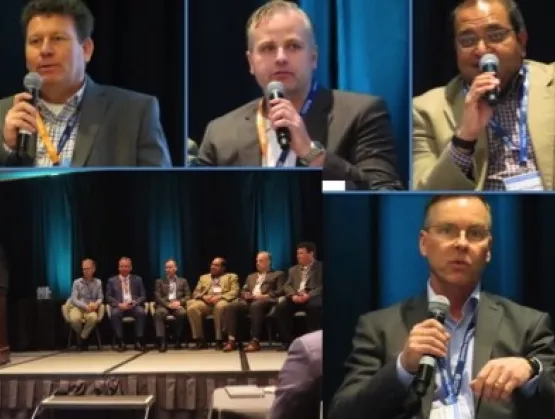
The SOI Consortium and member companies had a significant presence at two important events in China recently: the World Semiconductor Congress (WCS) in Nanjing and the SOI Academy, including an FD-SOI Training Day in Shanghai. Nanjing is especially known as a leading RF chip design hub in China, but WCS went well beyond RF. The three-day 2019 event was held at the Nanjing International Expo Center. It attracted over 30,000 visitors, 5000 of whom attended the various summit forums. Presenting at WCS '19 in Nanjing (clockwise from top left): Wayne Dai, CEO/Founder, VeriSilicon; Carlos Mazure, Executive Director, SOI Consortium; Giorgio Cesana, Director, STMicroelectronics; Christophe Tretz, Design Expert, SOI Consortium. (Photos courtesy: WCS)The SOI Consortium organized the SOI Forum, which was part of an afternoon Innovation Summit. Presentations were given by members of the SOI Consortium team, and by leaders from our membership, including Simgui, NXP, Incize, ST, IBM, Cadence and Xpeedic. Some of those presentations are now available from our website -- click here to get them.Earlier in the day, SOI Consortium member VeriSilicon participated in a morning session on AI and IoT Wireless Communications. They presented their low-power Bluetooth design platform for GlobalFoundries 22FDX, and CEO Wayne Dai moderated a lively round-table discussion.Following hard on the heels of the Nanjing event, the SOI Consortium team and members headed to Shanghai for the SOI Academy 2019, hosted for the second year in a row by member SIMIT (Shanghai Institute of Microsystem and IT under the Chinese Academy of Sciences). The two-day event attracted more than 250 professionals from more than 100 domestic and foreign IC companies and research institutes. Keynotes by SOI Consortium Executive Director Carlos Mazure, SITRI CEO Mark Ding and Jean-Eric Michallet, Head of the Microelectronics Components Department at Leti and bizdev director for the SOI Consortium focused on the SOI ecosystem. The SITRI and Leti talks also gave updates on their research and industrialization alliance. Further talks were given by leaders from Soitec, GlobalFoundries, VeriSilicon, IBM and Xpeedic. These addressed the growing FD-SOI ecosystem, applications in automotive electronics, 22 nm and 10 nm FD-SOI devices, advanced SOI substrate technology, China’s FD-SOI development, the FD-SOI manufacturing process, product design, EDA tools and all aspects of industry’s software and modeling value chain.Several speakers noted that more and more local Chinese customers are actively adopting FD-SOI for low-power, high-performance chips. SOI Academy, Shanghai, 2019, FD-SOI Training Day attendees.(Photo credit: SIMIT)The second day was devoted to hands-on professional training, given by experts from Leti using an actual PDK and punctuated by in-depth discussions. This helped the IC designers to fully understand the advantages and flexibility of FD-SOI in low-power logic, analog/mixed-signal and RF. All in all, “It was a great success,” concluded Jean-Eric MICHALLET, Head of the Microelectronics Components Department at Leti and bizdev director for the SOI Consortium. Plans for the next SOI Academy are already underway, with plans to extend the topics to include more on photonics, RF, power and MEMS.
Read More
Why FD-SOI? What can you do with it that you couldn’t do before? That was the big question from IHS Markit’s Matthew Short that kicked off the first panel discussion at the SOI Consortium’s Silicon Valley Symposium. And there were some great answers.VeriSilicon, Analog Bits and Silicon Catalyst were among the consortium members with stands at the SOI Symposium, Silicon Valley 2019.Here in this final part of our coverage of the event, we’ll detail who said what in the two panel discussions, as well as the presentations by Leti, Intento Design the SOI Consortium’s IP/EDA roundup.If you missed the previous two installments of our coverage, you can catch up on the rest of the presentations in part 1 (NXP, Samsung more) here and part 2 here (Synaptics, GlobalFoundries more). Almost all of the presentations are now freely available under "events" on the consortium website - or just click here to get them.How FD-SOI Changes What You Can DoThe presentation by Matthew Short, Sr. Director of IoT Technology at IHS Markit, was not specific to SOI, but it sure did lay out out the market opportunities. Entitled IoT, 5G, ADAS and AI Market, it’s available on our website. Matt spent most of his career in chip design at NXP/Freescale, so he really has an engineer’s perspective on where this all is going. At IHS Markit, they define IoT as anything with an IP address. Over the past year more than 10 billion devices were shipped, and there were more “things” than cellular handsets, so the world has really changed. He outlined the growth drivers, suggested that 5G won’t be a “wow” thing for consumers, and noted there is a lot of debate raging regarding how smart sensors should be (the Tier 1’s want smart).He was then joined on the stage by the participants in the first panel discussion, which looked at product and application drivers. That included: NXP Fellow Rob Cosaro; Tim Dry, Director of Edge Endpoints Marketing at Samsung Foundry; ST biz dev director Roger Forchhammer; CoreAVI biz dev VP Lee Melatti; Nokia VP Michael Reiha; and Analog Bits EVP Mahesh Tirupattur.First Short asked why customers wanted more integrated solutions. For CoreAvi, it’s about safety, for ST in automotive it’s about security, for Analog Bits, it’s about integrating more analog, for Nokia it’s just a necessity.Then he asked Why FD-SOI? What can you do that you couldn’t do before? For ST, which is doing MCUs for automotive, it’s about energy efficiency, speed, the density of non-volatile memory and the robustness of the technology. For NXP, it’s back biasing, low voltage and power numbers never seen before. “FD-SOI really makes a difference in the products we can bring to market,” said Cosaro. For CoreAVI, it’s the long-term power impact. And for Analog Bits, “Customers see huge benefits,” said Tirupattur, for cost sensitive applications. He has customers selling their technology in high volumes in FD-SOI. What about edge vs. cloud? For Nokia, it’s monolithic integration for best-in-class RF, advanced memory, biasing and voltage regulation adding a layer of intelligence. Samsung sees edge as distributed cloud, and CoreAVI sees safety in the edge, because you can’t completely rely on the cloud.Where are the weak points in the FD-SOI ecosystem? For Samsung, more people need to use back biasing. “People need to use the knobs,” said Dry. For Analog Bits, the next step is innovation around back biasing, as many in logic don’t understand the benefits, so the ecosystem needs to promote the value proposition. ST suggests that with more products out there, customers will see the benefits. NXP did “a lot of the heavy lifting” at 28nm – now you need more people using these nodes, not just the cellphone nodes.How will the architecture change? For NXP, it’s all about memory bandwidth. For Samsung, it’s the promise of analog and interconnect. Nokia sees the back-end and heterogeneous integration with FD-SOI and RF enablement. Analog Bits’ Tirupattur said he’s pushing his engineers for even lower power in a still smaller form factor, noting that most analog engineers had been more focused on performance than power, but now that’s changed. For ST, it’s AI/ML throughout automotive, and FD-SOI is beneficial there.Leti the Connected Car Leti's slide 27, SOI Symposium, Silicon Valley 2019Research giant Leti’s presentation was entitled Applications Around the Connected Car. 85% of Leti’s €315M budget comes from R D contracts with its 350 industrial partners. Truly a driving force in FD-SOI, Leti is involved in a dizzying array of projects. For the connected car, they cover (much of it on SOI): high precision smart sensing, embedded processing fusion, new computing paradigms and deep learning, ultra-low power computing nodes framework, ultra-low power connectivity for IoT, energy management and scavenging, and security. They do vision at the edge, 3D technology for smart imagers, and ways to dramatically reduce power. They’ve got a Qbits platform on FD-SOI for AI at the edge, a super low power neural network accelerator, and ULP connectivity. Check out the presentation for lots of details.EDA/IP OverviewSlide 9 from SOI EDA/IP Overview.SOI Consortium Executive Co-Director Jon Cheek gave a quick round-up presentation aggregating various IP and EDA offerings entitled , SOI EDA/IP Overview. It is taken from recent member presentations including Cadence, Silvaco, VeriSilicon, Synopsys and GlobalFoundries, giving you an idea of how dynamic the ecosystem has become.Automating Analog While the logic side of the design equation has long had robust automation tools, some consider the analog side as sort of black magic. New consortium member Intento Design aims to fix that. Here at ASN we covered their work with ST briefly a few months ago here. At the SOI Symposium, the company’s CEO Dr. Ramy ISKANDER presented their solution in ID-XploreTM: A Disruptive EDA for Emerging FDSOI Applications. Intento, a partner in GlobalFoundries FDXcelerator program, has cognitive software for first-time right analog design. It determines the appropriate static and dynamic body biasing ranges to meet PVTB (Process/Voltage/Temperature/Body Bias), and is fully integrated into the Cadence Environment. They produced multiple correct-by-construction FD-SOI designs, and the total time spent to generate eight candidates FD-SOI designs took less than a day. The Tools Are in the BoxThe last panel discussion, entitled Are the Tools in the Box? was moderated by the Consortium’s Jon Cheek. Participants included: VeriSilicon SVP David Jarmon; Arm PDG Marketing VP Kelvin Low; NXP’s Stefano Pietri, Technical Director of the company’s Microcontrollers Analog Design Team; Jamie Schaeffer, who’s GF’s Sr. Product Offering Manager for 22FDX and 12FDX; and Cadence Strategic Alliances Director Jonathan Smith. 2nd panel discussion, SOI Symposium, Silicon Valley 2019Yes, the tools are in the box. Smith of Cadence said they’re providing them, and NXP’s Pietro said that they’re very well positioned in his specialty, analog. VeriSilicon has IP, and anything they don’t have in house they’ll license. So why be afraid of body biasing? NXP has proof by example – they see such huge cost advantages that they try to leverage it as much as possible. GF’s doing training, since each area (automotive, IoT, etc.) has different needs. Some VeriSilicon customers already see such substantial benefits from FD-SOI that they’re not bothering to do biasing. Cadence points out that the Arm POP announcement is huge, and Arm’s Low wondered if the SOI Consortium could do an IP portal? “Our sales departments need to explain the advantages to our customers!” said NXP’s Pietro.From the audience, NXP VP longtime FD-SOI proponent Ron Martino (who, btw, wrote some great articles for ASN when they first got into FD-SOI – read them here), asked why designers think FD-SOI means a lot of corners? How do we convince the industry that FD-SOI simplifies design? Cadence is working with GF, responded Smith, and will have some big new at Arm’s TechCon this fall. “We need more training and marketing to show it’s not scary," he added. For GF, the corners don’t get more complicated, and they’re working with Dolphin Integration on getting them covered early in the planning. Ease of access to IP will help, per Arm. And in a great concluding remark, VeriSilicon’s Jarmon said, “The craft is being automated. The more we work together, the greater success of FD-SOI.”
Read More
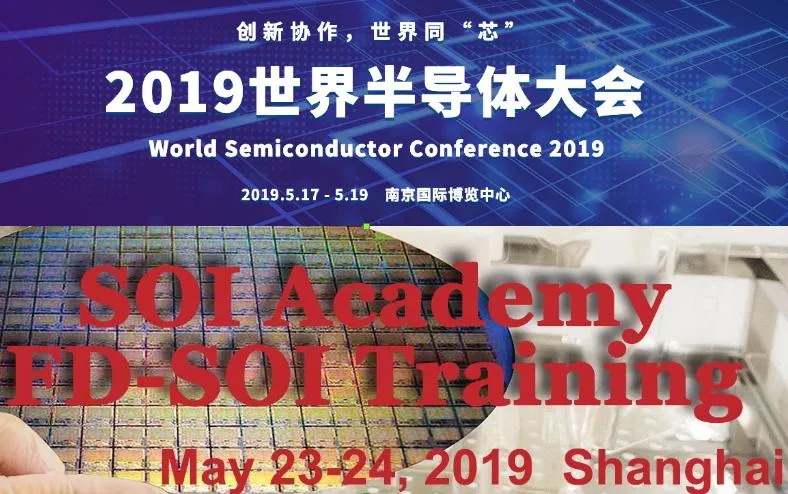
Join us! In partnership with our members, the SOI Consortium is co-organizing and participating in two key SOI events coming up in China over the next few weeks. On May 18th, we’ve put together an SOI Forum at the World Semiconductor Congress (WCS) in Nanjing. And on May 23rd 24th, we’ve teamed up with our members SIMIT, Sitri and Leti for another in our series of SOI Academies, including an FD-SOI Training Day. (The last one this past winter was a terrific success – read about that here if you missed our coverage at the time.) QR code for WCS, Nanjing '19At WCS, the SOI Forum (sub-forum #8) is part of the afternoon Innovation Summit. We’ll cover the broader SOI ecosystem, including both RF-SOI and FD-SOI – from wafers to design through manufacturing. Presentations will be given by members of the SOI Consortium team, and by leaders from our membership, including Simgui, NXP, Incize, ST, IBM, Cadence and Xpeedic. Click here or scan the QR code for the full program and registration information. Also at WCS, SOI Consortium member VeriSilicon will be participating in a morning session on AI and IoT Wireless Communications (sub-forum #4). They’ll be giving a presentation on their low-power Bluetooth design platform for GlobalFoundries 22FDX, and their CEO Wayne Dai will be moderating a round-table discussion. You can get more information on that (in Chinese only, tho) here, or follow VeriSilicon on WeChat. QR code for SOI Academy and FD-SOI Training, Shanghaid 2019The SOI Academy in Shanghai is an opportunity for experienced designers to gain solid expertise in FD-SOI. The event begins in the afternoon of May 23rd with a series of informative plenary talks by members of the SOI Consortium team, and by experts from our members Leti, Soitec, VeriSilicon, GlobalFoundries and NXP. The FD-SOI Training starts the next morning, on May 24th.. This is a hands-on event lead by top experts from Leti. The morning is devoted to digital design in FD-SOI, and the afternoon to RF design (including for 5G) in FD-SOI. Attendees will get a comprehensive understanding of design techniques for low-power chips leveraging the multiple benefits and flexibility of FD-SOI technology. Get more information here, or from the WeChat QR code.We've got a busy schedule! To keep up to date with where we and our members will be promoting the SOI ecosystem, be sure to check our Events page regularly.
Read More
Takeaway #1: As NXP VP Ron Martino noted in his opening keynote at the recent SOI Symposium in San Jose, FD-SOI is the technology platform for enabling edge computing, and ultra-low power is the sweet spot. Organized by the SOI Consortium with support from our members, the recent SOI Symposium in Silicon Valley was an enormous success. Close to 300 decision makers signed up – more than double what we saw just a couple years ago. Attendees spanned the ecosystem: from end-users to design to foundries and right up to the investment community. The presentations and panel discussions were absolutely terrific, and almost all are now freely available - click here to get them.The focus was heavily on FD-SOI this time, but some very interesting RF-SOI talks were given as well. This was a day packed with presentations by players from across the SOI ecosystem. In this post, we’ll only cover a few. But the others will follow quickly, so watch this page. And now without further ado, let’s dive in.NXP: In the Sweet SpotNXP VP Ron Martino presenting at the 2019 SOI Symposium in San Jose.NXP is designing FD-SOI into many new products, said Martino, GM of the i.MX Processor Application Product Line. There’s a new wave of products – generically you could call them IoT but in fact they’re found throughout the industry. It’s about interacting with the cloud, so edge processing is critical. His presentation, Embedded Processors for Future Applications, is now freely available for downloading from our website.The new i.MX7ULP is a great example of ULP in the sweet spot. From a design standpoint, it leverages IP, power optimization, and what he described as “starter biasing”. That gets them the long battery life with 2D 3D graphics they need for wearables and portables in consumer and industrial applications.NXP slide 10, SOI Symposium, San Jose '19 (Courtesy: NXP)Having deepened their expertise in biasing, NXP has now moved on to “advanced biasing” for the next generation of products. For example, the i.MX RT ULP (real-time, ultra-low-power) series are “cross-over” processors, which Martino says are the “new normal”. They deal with a high number of sensor inputs. The i.MX RT 1100 MCUs, which have been qualified for automotive and industrial applications, are breaking the gigahertz performance barrier with a low-power, 28nm FD-SOI process.Another new product leveraging advanced biasing is the i.MX RT 600. They’ve done hardware acceleration on specific functions and optimized around visionand voice integration at low cost and power.As shown at Embedded World '19, automotive app for NXP'x i.MX 8, which is on 28nm FD-SOI. (Courtesy: NXP)Likewise for the i.MX 8 and 8X subsystems for automotive and industrial applications. At Embedded World, they showed it driving advanced OLED screens, cameras (for parking, for example), V2X, audio, user monitoring (like driver pupil tracking), and integration into the windshield in a heads-up system. This is the high end of the capability of 28nm FD-SOI, he said. It’s a 6 CPU core system with multiple operating systems, about which he said: “It’s the dashboard...it’s amazing.”BTW, in another presentation, CoreAVI, which builds avionics, automotive and industrial products on NXP’s i.MX 8, addressed safety. You can get that here.FD-SOI enables a scalable solution for real-time and general compute with the lowest leakage memory, the best dynamic and static power, Martino concluded. NXP’s leadership in body biasing is enabling edge compute, and we can expect to see more content coming soon.In another NXP presentation later in the day, Stefano Pietri, Technical Director of the company’s Microcontrollers Analog Design Team caught a lot of people’s attention. A wave of cameras went up to capture each of his slides in Analog Techniques for Low Power, High Performance MPU in FD-SOI – but you can get the whole thing now from our website. It’s a very technical presentation, in which he details the many ways FD-SOI makes the analog team’s job easier, enabling them to get performance not available from bulk technologies. They developed a lot of in-house expertise and IP (see slide 16 for a catalog of the IP).Samsung: Enabling LP Endpoint ProductsTim Dry, Samsung Foundry Director of Edge Endpoint, SOI Symposium, San Jose '19Tim Dry, Director of Foundry Marketing: Edge and End Point presented Samsung’s FDS with MRAM: Enabling Today’s Innovative Low Power Endpoint Products. In a telling first, Samsung has made this presentation available on our website.FD-SOI covers the wide range of requirements for intelligent IoT, he explained: from high to low processing loads; and active to dormant processing duty cycles. That includes chips that will last for ten years, and need to be able to wake up fast and kick right into high performance. These products are 50% analog, and packaging is part of the solution (especially for the RF component).Samsung has been shipping 28nm FD-SOI (which they call 28FDS) since 2015, first in IoT/wearables, then in automotive/industrial and consumer. Yields are fully mature. In March 2019, they announced mass production of eMRAM on 28FDS. It’s a BEOL process, adding only 3 masks. It cuts chip-level power by 65% and RF power by 76% over 40nm bulk with external memory. Beyond the fact that it's 1000x faster than eFlash, eMRAM also has other advantages that make it especially good for over-the-air updates, for example.Samsung Foundry FD-SOI IP slide, SOI Symposium, San Jose '19 (Source: Samsung Foundry Keynote at SOI Symposium 2019, USA)Samsung also has RF and 5G mmWave products shipping in 28FDS. The company has a fantastic ecosystem of partners helping here, said Dry. In AI at the endpoint, they’re shipping IoT products for video surveillance cameras: some are high speed, but some are also low speed – it depends on the detection use case. And most importantly for the design ecosystem, the IP is all ready.Next up for Samsung is 18FDS, which will ship this year with RF, then in 2020 with eMRAM. 18FDS, Dry said, is optimized for power reduction. Compared to 28FDS, it’s got 55% lower power consumption, 25% less area and 17% better performance at the same power. You’ll hear more about it as well as their design services if you’re at the Samsung Foundry Forum in May (registration info here).ARM’s Biased ViewsKelvin Low, VP of Marketing for Arm’s Physical Design Group (PDG) gave a presentation entitled Biased Views on the Industry’s Broadest FDSOI Physical IP Solution. By way of background, Arm and Samsung Foundry recently announced a comprehensive, foundry-sponsored physical IP platform, including an eMRAM compiler for 18FDS. In case you missed it, at the time Arm Senior Product Marketing Manager Umang Doshi described the offering in an Arm Community / Developer physical IP blog, which Arm graciously agreed to share with ASN readers. Slide 9 from Arm's presentation, Silicon Valley SOI Symposium 2019.At the SOI Symposium, Low emphasized to the audience that Arm now has the broadest range of FD-SOI + IP solutions. It addresses mobile, consumer, IoT, automotive and AI/ML. There are 18FDS POP (processor optimized pipe) packages for Arm Cortex-A55, Cortex-R52 and Cortex-M33 processors. IP integrates biasing and a number of standard PVTs (corners). And since the Samsung platform is foundry-sponsored, it’s free.Slides 6 and 11 from Arm's presentation, Silicon Valley SOI Symposium 2019. The goal of POP IP is to enable partners to implement and tapeout Arm cores with the fastest turn-around time and best-in-class PPA while maximizing the benefits of process technology.Arm did a test chip with eMRAM, which they’ve just gotten back. It’s functional (some details are available in slide 14 of their presentation), and the company is now preparing a demo board that they’ll be showing shortly. Watch this page!That's all for this post. The next post -- part 2, covering presentations by Synaptics, GlobalFoundries, STMicroelectronics, Dolphin Integration and Anokiwave -- is now available. Click here to read on.
Read More